Last night I finished putting together this awesome Lego mosaic of our family. (I bought the kit and uploaded a photo to create a Lego picture, one tiny tile at a time).
As you can see from this video, up close it looks like a bunch of Lego bricks. But when you step back, it’s pretty extraordinary how the pixels transform into ZEMR (Zach, Eli, Maya, Ron.)
It gives me pause. How often do we make conclusions without stepping back to understand an entire situation? How often do we make judgements without looking from other angles?
In Pirkei Avot, Rabbi Hillel taught, “Do not judge another until you have been in that person’s place.”
And so – before we make a judgement, we should get a little perspective.
It takes a moment in time to look once. It takes another moment in time to look again. Let’s not forget that second moment in time.
Every synagogue you’ve ever visited has one. They come in different shapes and sizes but the origin of each comes from the opening of last week’s Torah portion: “You shall further instruct the Israelites to bring you clear oil of beaten olives for lighting, in order to cause the light to go up continually” (Ex. 27:20).
In its most literal sense, the verse commands us regarding the special menorah that was situated inside the tabernacle and then later in the Temple in Jerusalem. This menorah is to be a ner tamid, an eternal light—it should never go out.
And so it is, to this very day, that every synagogue includes one, reminding us of our past, reminding us of our destiny.
The commentators of the midrash, however, understood this verse metaphorically. The ner tamid is not a physical lamp; rather, it is merely a reflection of the ultimate light that is according to the rabbis, Torah itself: our wisdom, our learning, everything that gives meaning to our lives.
So if Torah is the eternal light, what is this first verse of Parashat Titzaveh really telling us? What does the olive oil represent? And why should it be pressed? Why this particular detail?
The 20th-century commentator, Ed Ya’aleh (my cousin, Rabbi Eliezer Davidovits, 1878-1941) interprets as follows:
“It is possible to study [Torah] when times are good but this [type of Torah study] usually does not last—it cannot be sustained. If one wants words of Torah to exist eternally, one must study in poverty and with a broken body and soul … This is the understanding of the verse (‘and they shall bring to you pure olive oil, pressed for lighting…’): that is, one should [be willing to] shatter oneself and be pressed, crushed for the sake of the ‘light (meor)’ that is the Torah. Then and only then can [your Torah study] make of you ‘a ner tamid.’”
It’s a powerful and also disturbing teaching. We think of Torah study as something sweet, something that brings light and joy to our lives. Here, though, we have an image of the student of Torah who is willing, eager even, to suffer for the sake of her learning.
Sadly, Rabbi Davidovits understood this teaching in a deeply personal way. He lived through the rise of Nazism and ultimately succumbed to its horrors. He was murdered along with almost his entire community in 1942. Here’s how his son, Yisrael Ya’acov, described his father: “For over twenty years,” he writes, “[my father] went out to study—rain or shine, summer or winter—at five in the morning. I have been told that even when the time of sorrow for all of Israel had arrived, he went out at risk of his own life early in the morning to learn. [Once] the evil, cursed Hlinka Guards [members of the antisemitic Slovak People’s Party] came and almost killed him. Wefound him outside, unconscious. That generation! Do you realize the feats of our ancestors, how they risked their lives to study Torah?”
My cousin knew what it was to be pressed, to be crushed. He was persecuted, in large part, because of his love of Torah and his allegiance to its values.
He was willing to pursue Torah, to live a loud and proud Jewish life, whatever the cost.
Though unsettling, it is an apt and urgent understanding of the eternal light for this moment of darkness with Israel under attack and antisemitism rampant on college campuses and beyond.
I’m inspired by this teaching, notwithstanding its challenges. At just such a time of being “pressed” in so many different ways, we need more than ever to commit ourselves to the work of causing the light to go up, the sacred task of igniting the ner tamid and, in so doing, becoming a ner tamid: an eternal light of goodness and hope.
May the light go up and up, forever.
Rabbi Yoshi Zweiback is the Senior Rabbi of Stephen Wise Temple in Los Angeles, California.
Comedian Richard Lewis, who parlayed his neurotic Jewish personality and self-deprecating humor into a 50-year career as a standup and actor, died Wednesday. He was 76.
Lewis had been in ill health for a number of years and last April announced that he had been diagnosed with Parkinson’s disease two years earlier. Although he considered himself retired as a standup, he appeared again as a regular in the current season of “Curb Your Enthusiasm,” playing a version of himself in the HBO show created by and starring his childhood friend Larry David.
“Richard and I were born three days apart in the same hospital and for most of my life he’s been like a brother to me,” David said in a statement released by HBO. “He had that rare combination of being the funniest person and also the sweetest. But today he made me sob and for that I’ll never forgive him.”
Lewis’ sensibility, in clubs and on screen, could be as dark as the funereal suits he often wore. In a signature joke, he spoke about an uncle who was so depressing that he would sit at home listening to the soundtrack of “The Pawnbroker,” the grim 1964 film about a Holocaust survivor.
He also is credited with the tagline “from Hell,” as in “the ex-wife from Hell.” When the “Yale Book of Quotations” gave him credit for the catchphrase in 2022, he tweeted, “Where is my Nobel Prize?”
Lewis also appeared in a number of films, including “Robin Hood: Men in Tights,” Mel Brooks’ 1993 parody, in which he played an extremely Jewish-seeming Prince John.
Lewis was born in Brooklyn and raised in Englewood, New Jersey, the son of a caterer and an actress in community theater. “My father was so well known as a caterer and so booked up that he was actually booked on the weekend of my bar mitzvah so I had to have my party on the Tuesday,” he once told an interviewer.
After earning a degree in marketing at Ohio State University, he began writing and regularly performing stand-up comedy in 1972. The Jewish comedians Woody Allen and Lenny Bruce were obvious role models, although Lewis proved influential in his own right: Comedy Central ranked him #45 on its list of “100 Greatest Standups of All Time” in 2004.
In the 1989 sitcom “Anything But Love,” which ran for four seasons, Lewis establishes his character as Jewish in the first minutes of the pilot. Lewis told a British weekly, the Jewish Telegraph, in 2011 that he was not a synagogue-goer but that he consciously infused his Jewish identity into his comedy — and that he viewed comedy as a deeply Jewish act.
“I have a tremendous love affair for being a Jew,” he said at the time. “I’m so proud to be part of this people. I want to be part of anything else.” He added, “Because of what the Jews have gone through since literally Day One, one of the survival mechanisms was to talk about all the hell that we’ve been through. It’s so much funnier being a Jew than anything else. If we don’t find humor then we’re in deep trouble.”
Lewis struggled with addiction issues for years, proudly explaining in 2016 that he was “22 years sober” and that he mentored those in the recovery community.
That same year, Lewis acknowledged that his health had taken a toll on his performing, but that he would continue to write, act and do the occasional stand-up gig.
“I’ve learned to accept the fact that I’m not like I used to be,” he said. “I try to stay healthy and sober and to give back. I’ve received a lot of help. I’ve lived through a lot of tsuris. The art of aging is being grateful for being alive and having some laughs and helping other people.”
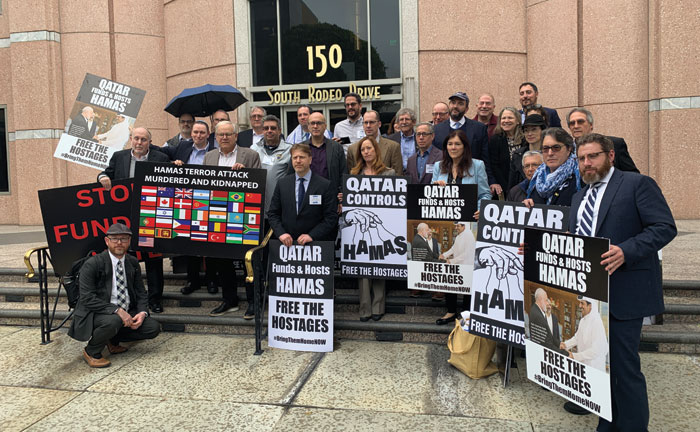
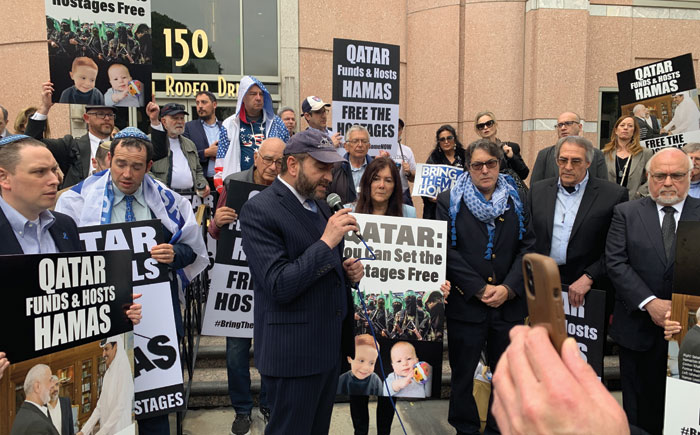
On Feb. 26, chants of “bring them home!” filled the air at 150 S. Rodeo Drive in Beverly Hills, outside the Consulate General of the State of Qatar in Los Angeles, as Jewish and local leaders, rabbis and community members concerned about the fate of the hostages in Gaza protested the role of Qatar in supporting Hamas.
They waved Israeli flags as well as signs that read, “Qatar Funds and Hosts Hamas: Free the Hostages.”
Rabbi Pini Dunner speaks at the protest. Photo by Ryan Torok
“I’m a local activist, I’m a community rabbi, concerned for the fate of the hostages,” Rabbi Pini Dunner, one of the organizers of the Feb. 26 demonstration, said in an interview. “And this is what we need to do to bring to the attention of the world that Qatar is not neutral.”
“If we’re going to make sure that we make a dent in the situation, we have to make sure that Qatar feels pain,” Dunner said, explaining the reason for the day’s protest. “Without pain, the hostages will never come back. They’ve got no vested interest to support the hostages, their sympathies lie with Hamas. Their sympathies don’t lie with the cause of the hostages. They must know that we’ve recognized that they are not neutral. They are pernicious actors. And they have to be held to task for that.”
The midday rally drew approximately 70 people and was held as the war between Israel and Hamas in Gaza continues. It was organized, specifically, to spotlight the role Qatar, a tiny Arab Gulf country, plays in funding Hamas as well as in hosting senior Hamas leadership.
Since Hamas took more than 240 hostages from Israel on Oct. 7, Qatar has played the part of mediator during hostage negotiations, though many have cast doubt that Qatar is genuinely a neutral actor.
There was no immediate response from the Qatari consulate to the day’s protest, according to Dunner.
Rabbi Daniel Mehlman, who leads Temple Ner Tamid of Downey, attended the afternoon gathering. In the late-1970s, Mehlman spent years living in Israel, during which time he officiated High Holy Days services at a secular kibbutz in the Gaza Envelope. So, when Hamas terrorists massacred southern Israeli villages this past October, he felt the tragedy personally.
“I’m here because Qataris have a big influence, money-wise, and in other ways with everything that’s happening in Gaza,” Mehlman told the Journal. “We want the hostages to come home. What’s happening to them is devastating.”
Beverly Hills City Councilman John Mirisch, who has been outspoken about Qatar’s connections to Hamas, also turned out. Since Oct. 7, Mirisch has led demonstrations outside Beverly Hills’ Maybourne hotel, calling attention to, and denouncing, its Qatari ownership.
“There are some things more important than hotel taxes,” Mirisch said. “Jew-haters should not be welcomed in our community.”
Additional speakers included StandWithUS CEO Roz Rothstein, one of the co-organizers of the conference. Also in attendance were Rabbi Matthew Abelson, executive director of StandWithUs Rabbis United division, and dozens of rabbis from across the country who were in Los Angeles for a StandWithUs Rabbis United gathering.
Referring to Qatar’s attempt to present itself as a neutral actor in negotiations over the hostages and referencing comments Mirisch had made earlier, Cooper put it plainly, saying, “The jig is up.”
Simon Wiesenthal Center Associate Dean and Rabbi Abraham Cooper also came out. Referring to Qatar’s attempt to present itself as a neutral actor in negotiations over the hostages and referencing comments Mirisch had made earlier, Cooper put it plainly, saying, “The jig is up.”
I was standing in my kitchen, out of breath, my heart beating a million miles a minute. I had just punched the wall. My husband Daniel, who was next to me, was stunned.
“You need to get help for your anger,” he told me.
I thought, “Why?”
I had so much I deserved to be angry about.
I had a rough childhood. I was broke. And New York City, where I lived at the time, was just so stressful.
But after seeing Daniel’s reaction – and taking a moment to calm down – I realized that I needed to change. I thought these outbursts were healthy, that they released something and were good for me. But really, they were just temporary relief, and I wasn’t addressing the root of the problem: my anger itself.
I started learning about the Torah’s stance on anger. It is one of the traits the Torah fervently condemns, stating, “Someone who gets angry is like one who worships idols.”
Anger comes from an overinflated ego, from constantly victimizing oneself instead of figuring out a positive way to react to all of life’s challenges. Yes, it’s easier and more comfortable to be the perpetual victim, but as Jews, we need to strive for a more elevated way of living. Our anger gets in the way of our ability to be b’simcha, to live with joy, and cuts off our connection to Hashem.
There is so much to be angry about right now. In our darkest moment, Oct. 7, the world seemingly turned on us and blamed us for the attack.
It’s OK that Israelis were raped, kidnapped and murdered, because they deserved it, is the narrative among antisemites. Our hostages are still not home, the U.S. is proposing a two-state solution – which would effectively reward Hamas for murdering Jews – and terrorist attacks are still happening in Israel. Jews are being silenced on social media, the pro-Hamas crowd has been taking over college campuses and city streets and so many politicians won’t lift a finger to do anything about it.
Doesn’t it just make you want to scream? Over the past few months, there have been many times I’ve certainly felt like punching a wall.
But it won’t help.
I spend a lot of time on social media talking about Judaism and Israel, and I see a lot of angry posts and comments.
I turn on the TV to watch the news, and the anchors are red in the face, yelling at those they oppose.
I see road rage on the highway and videos of people punching each other and flipping out in the grocery store line.
It’s all so exhausting, and not conducive to any sort of progress.
If you feel the anger coming on, don’t give into it. Instead, be proactive about fighting it.
The number one way I became less angry was by strengthening my connection to Hashem by learning Torah and relying on prayer in my times of need.
I now view myself as a victor instead of a victim, and I make sure to take frequent breaks from social media and other things that could stir up my anger. Instead, I partake in activities that replenish my soul. This means spending time with my family and friends, going to shul, taking a walk, watching a feel-good movie and petting my dogs.
I urge you to go above the anger and tap into positivity instead.
If you’re having trouble making big changes, start with small ones. Wake up every morning and say the prayer Modeh Ani, starting your day with gratitude and a good attitude. Once you begin doing this, you’ll realize there is so much more in life to be happy than angry about.
Life is a tremendous gift; we must not waste our time being angry. By overcoming your anger, you can feel better, be much more productive and, of course, strengthen your relationship with Hashem, the Ultimate Source of comfort and joy.
Amy Kritzer Becker believes cooking should be fun!
“People take it so seriously,” Becker, founder of What Jew Wanna Eat and Modern Tribe and author of “Sweet Noshings: New Twists on Traditional Jewish Desserts,” told the Journal. “It’s just food.”
Especially when hosting holidays, people tend to put a lot of pressure on themselves, they get nervous about how the meal will turn out
“[Guests] are there for you and for the whole experience,” she said, “Not just for your matzo ball soup.”
If you are hosting and people offer to bring dishes, Becker says to let them! Make a few things and let your guests fill in the rest. Or choose recipes that you can make with your family or friends.
“[Do] not worry about making [recipes] with 20 parts,” she said. Start with something simple, like latkes.
“Those are one of my favorites,” Becker said. “I’m always torn between wanting to eat them all year and wanting to save them for Hanukkah to make them special.”
Becker grew up baking with her mom and bubbe. They would make Jewish favorites, like rugelach and mandel bread, along with cookies and brownies.
When she launched her What Jew Wanna Eat blog in 2010, Becker asked her bubbe for some of her recipes to get started.
“She’s the kind of person, no matter what my interests are, she goes into it 100%,” Becker said.
“She had my mom scan all of her index cards [and] email them to me.”
“I took a look at those [little lined note cards], and I was like, ‘What is this?’ Measurements weren’t exact … [directions were like] bake it till it’s done. I quickly got on the phone with her and talked through some recipes.”
Becker started blogging one new recipe a week and soon got emails from readers, who were making her recipes and sending pictures.
“People [were] saying how they really felt connected to their Judaism through food,” Becker said. “And I was like, I think I’m onto something. I think this is even bigger than just food. It’s really part of our identity.”
All of Becker’s recipes are twists on traditional Jewish recipes. She likes to put her own spin on things, while offering extra guidance.
For instance, Becker’s drunken honey pomegranate cake is a twist on traditional Rosh Hashanah honey cake that is perfect year round.. Recipe is below.
“It’s a one-bowl kind of cake, so if you’re just starting to learn how to cook, this is a good one for you to try,” she said.
Whereas honey cake has a “reputation” for being dry, this one – a twist on Becker’s bubbe’s recipe – is the opposite.
“It uses pomegranate juice, honey, and there’s some whiskey in it, which you can leave out,” she said.
Just substitute with more pomegranate juice.
“This is a great cake, too, because, if you make it today, it’s even better tomorrow, and it’s even a little better the next day,” she said. “It’s more moist.”
Becker loves to add color to her food, too.
“A lot of Jewish food, especially Ashkenazi food, is brown, and I think some of the best food is brown: brisket, chopped liver,” she said. “This cake is brown, but it has a pomegranate frosting on it, so it’s bright pink [with] pomegranate arrows on top.”
When adding color, why stop at cake?
“Brown food is some of my favorite food, but I think you eat with your eyes,” she said.
Becker likes to garnish with fresh herbs. For instance, she puts chives on her chopped liver and serves it with a ton of different colorful vegetables for a vibrant presentation.
“My ancestors are from Poland and Austria, so I [feel] like, if they had access to avocados, of course they would have used avocados to maybe garnish a latka,” Becker said. “Why not just incorporate fresh [ingredients] and colorful food into your Jewish recipes too.”
Sort of like the Jewish fruitcake, dry, sweet honey cake is usually not welcome at Rosh Hashanah, but it’s always there. This version, however, is super-moist with coffee, pomegranate juice, and whiskey, and it’s one you’ll want seconds of.
Photo by Amy Kritzer Becker
Ingredients:
For Cake:
Butter, oil, or cooking spray for greasing pan
3 cups (426 g) all-purpose flour, plus more for flouring the pan
1 cup (200 g) granulated sugar
½ cup (115 g) light or dark brown sugar
2 teaspoons baking powder
1 teaspoon baking soda
½ teaspoon kosher salt
1 teaspoon ground ginger
1 tablespoon ground cardamom
1 teaspoon ground cinnamon
½ teaspoon ground nutmeg
1 cup (235 ml) canola oil (or vegetable or grape seed oil)
1 cup (235 ml) honey (trick: measure oil before honey and it will slide right out of the measuring cup)
3 eggs
1½ teaspoons vanilla extract
½ cup (120 ml) strong brewed coffee, at room temperature (can be decaf)
½ cup (120 ml) pomegranate juice
¼ cup (60 ml) whiskey (or more pomegranate juice; I’ve also used amaretto)
Zest from 1 lemon
For Glaze:
1 cup (113 g) powdered sugar
½ –1 tablespoon pomegranate juice
Pomegranate arils (seeds) for garnish
Directions:
Preheat the oven to 350ºF/180ºF. Grease 12-cup (2.8L) Bundt pan and flour lightly.
In a large bowl, whisk together flour, sugars, baking powder, baking soda, salt, ginger, cardamom, cinnamon and nutmeg until combined. Set aside.
In a separate large mixing bowl add oil, honey, eggs, vanilla, coffee, pomegranate juice, whiskey and lemon zest and beat with a hand or stand mixer with a whisk attachment until incorporated. Add dry mixture to wet mixture and beat just until combined. You do not want to over-mix and make the cake tough. The batter should be thick but runny enough to stick to the whisk attachment.
Pour the batter into the prepared pan (it should fill two-thirds of the pan) and bake for 50–60 minutes until the cake is golden brown and a toothpick inserted into the cake comes out mostly clean.
Cool for 15 minutes in the pan and then turn the cake out onto a cooling rack to finish cooling.
To make glaze, whisk together powdered sugar and enough pomegranate juice to make a glaze thick enough to cover the back of a spoon. Drizzle over cake. Garnish with pomegranate arils and serve.
Debra Eckerling is a writer for the Jewish Journal and the host of “Taste Buds with Deb.” Subscribe on YouTube or your favorite podcast platform.Email Debra: tastebuds@jewishjournal.com.
So much to say this week, but I promised myself (and my wife Adi) that I wouldn’t pull any more all-nighters on these. Especially as I finish these on Saturday nights after Shabbat ends, and I wake up at 5am for my hospital shift on Sunday mornings. So, let’s see my time management!
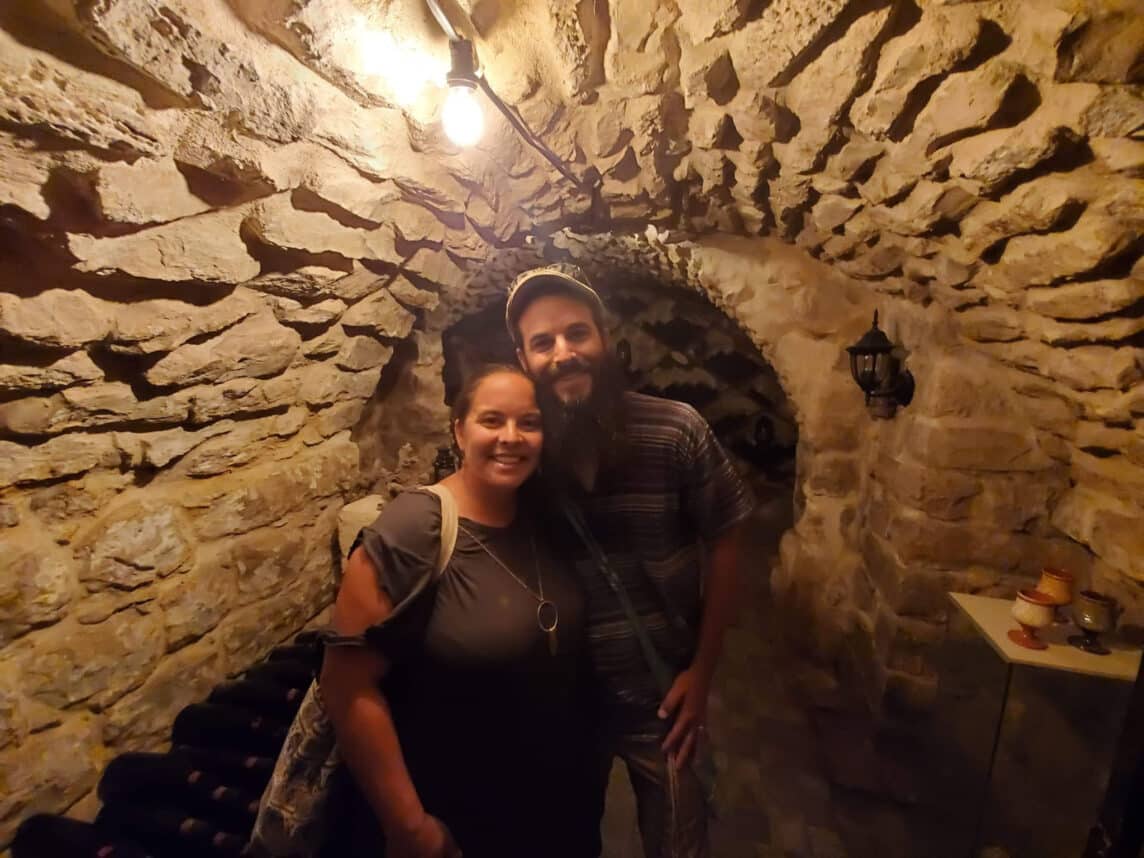
The photograph I share, is of Adi with her wonderful brother Adam, in the Abuhav Winery, within the historic, gorgeous, and artistic city of Tzfat.
This week, Adam has been given official leave from the IDF, to fly in and visit us with his son Malachi, and we’re SO excited to see them! Adam Bodenstein is a licensed tour guide in Israel, but like most of the country 40 and younger, his job is on hold while he’s called into Reserve Duty. A visit from him, is therefore more special than ever.
Today I had setup a new friend, Ahmad4ISRL, to speak at the large Orthodox synagogue where I grew up, Beth Jacob. I met Ahmad thanks to my educational efforts here, connected by an old friend Ariel Jalali. Ahmad had lunch with my family a month ago, and it was the most amazing 3-4 hours of hearing his astounding life story. We were mesmerized. I told him that if he was ever comfortable talking to a crowd, I would definitely set it up. The thing is, he’s stuck wanting to have privacy and safety for his family, so his anonymity is crucial. This week he came to town, and realized that an orthodox shul on Shabbat is an ideal place to speak, if you want to guarantee that nobody will take a photo of you. Phones are already not allowed! So his privacy was built in whether he wanted it or not! Perfect, ha!
He was nervous, but it did not show from the fantastic speech he gave. 250 people hung on to his every word, yelled words of encouragement when he got choked up, and he got more rounds of applause than I’ve seen for years in a shul. When it ended, the Rabbi figured some people would want to say hello, but about 40 people stayed, and continued wanting to talk, until we had to leave just to let the Rabbi and security guards finally go home!
It was a memorable experience, and I appreciate Ahmad giving us his time, and speaking his truth. It is NOT an easy thing to do, and he puts up with a tremendous amount of abuse for it, so I want him to know that we did not take it for granted.
I could easily write more, and certainly might another time.
Unfortunately, this was at the tail end of a week where I was recovering from pneumonia, Liam has an ear infection, Natalia was vomiting from a stomach bug, and Adi started to have a fever today. So to say that it’s been an easy week, would be a lie. But I’m incredibly glad today’s event happened. And now I present this week’s Chosen Links by…me.
ARTICLES/THREADS
1a. From The Persian Jewess. A horrible but inspiring story about her grandfather in Iran, who had to literally avoid the rain touching his Jewish skin. “As a child, he was prohibited from being outside when it rained. By law, if rainwater hit his “Yahud” skin the entire water supply was deemed “impure.” Punishment for violating this law was death. When he walked in the street, if his family was recognized as being Jewish, Muslims were free to beat him and spit in his face.”
1b. She now tells the awful story of children in Iran, during regime change. “Each day in class, my cousins – some as young as 5 – and all their Jewish classmates had to stand up and recite “Death to America!” “Death to Israel!” as part of their morning ritual.” And then relates it to Hamas. Thank you for the compelling essay:
2a. Brianna Wu writes an excellent post, bringing up the year before Israel was given independence, the Brits were also involved in the India partition. “My question is, are we trying to rewind all of the injustices of 1947/1948? Or just the parts of history that affect the Jews?” She’s such an important, impartial voice coming from the left, where so much of the misinformation about Israel is coming from these days:
2b. This thread is ONE OF MY FAVORITES I’VE EVER SHARED. Here you have Brianna Wu again, who isn’t Jewish, and is very left wing. She uses her important voice, to take you through a tour of the history of antisemitism. It’s so damn good, I couldn’t have done it better myself.
After going through an abridged history of antisemitism and displacement, she finishes off with this statement. “NONE OF THIS IS PROGRESSIVE. At best it’s ignorant, and at worst you’re just the latest in a very, very long line of people to buy into antisemitic propaganda and decide Jews should find somewhere else to live.” Now go back to the beginning and read all of this. And realize that if every “progressive” was even half the person that Brianna is, critical of the Israeli government (just as most of Israel is), critiques about what should happen next, BUT a staunch defender of Jews and ZIONISTS, this would be a much safer world for us. Thank you Brianna, my new friend:
3. Ali Adi, a Muslim Israeli, makes the argument that even if you want to play the devil’s advocate about all other hostages, why the babies??? He wants an end to Hamas, without releasing any more of their violent prisoners:
4. Hen Mazzig reports on further heartbreaking details of sexual assault to the hostages. “In released hostage Aviva Siegel’s first full interview on Israeli TV since her release, she recounted more details of sexual assault of young female hostages, who were forced to dress in tiny clothes, watched as they showered, and beaten with sticks by armed Hamas militants.” Read on if you can stomach it:
5. Dr. Einat Wilf writing an open letter to President Biden, to think about certain things, before pushing peace on both parties. She understands that, “you cannot force Palestinians to want something – a Palestinian state in part of the land with the other part of the land belonging to the Jewish state – that they have never wanted for themselves.”
6. This is a pretty incredible post, written by Cheryl, about her family history as an “Arab Jew”, and shared by Imtiaz Mahmoud. “Finally, in 1948, we declared independence, and Muslims declared genocidal war on us, after just one damned day.”
7. David Collier does his fantastic investigative journalism, and finds that the Washington Post was either the perpetrator of the unluckiest, most negligent bit of journalism, or was just flat out lying. “The Washington Post picked seven journalists to profile, and successfully avoided picking any of those who work directly for agencies of Hamas or Islamic Jihad. My research showed that 50% of those listed were directly employed by these proscribed terrorist groups…The odds of the Washington Post doing this by chance are worse than 1/128.”
8. Excellent point by Aviva Klompas, about protestors choosing targets that are Jewish, but not even Israeli. “Protesting outside these institutions sends a message that you hate Jews. It does not tell us that you seek a future of peace between Israelis and Palestinians.”
9. A birth certificate where the father’s name is Israel, returned with vandalism. “We felt as if we had been taken back to 1930’s Germany where the Nazis would put notes on Jewish people’s documentation. ‘It is completely warped and it hurts my heart that my daughter is not even six-months-old and she has already been discriminated on in the worst way.'” Eirian Prosser reports on this disgusting story:
10. Simon Deng just honored me by calling, and telling me how much Israel means to him. He actually trekked from Tel Aviv to Jerusalem in the past few months, showing his support for the country every step of the way.
His story is so dramatic that I would rather not spoil it for you. I’ll just give you the first few sentences and if you aren’t interested from there, I don’t know what to say. “My name is Simon Aban Deng. I am from South Sudan. I am a Shilluk. I am a Christian. I am a former slave.” His story is….huge:
11. Douglas Murray is always entertaining to watch speak, and just as captivating to read. On the ground in Israel almost non-stop since October 7th, he screams from the rooftops about how bad an idea a two state solution RIGHT NOW would be. “In this song — sung by Republicans and Democrats alike — if the Palestinian people had another state then all the other problems of the Middle East would be solved.”
12. Fern Reiss explaining how bad things are around the world for Jews right now, comparing it 1934 Berlin. “Who would have thought in our lifetime we would see a repeat of the precursors to the Holocaust? Who among us (we, who grew up in this entitled, comfortable era), would have expected to again be contemplating removing our Kipot, leaving our Magen David in the drawer, stripping our identifying Jewish details?”
13. Color me surprised. Bill Maher, the king of embracing controversial interviews, thinks his two hours with Ye/Kanye is too dangerous to put into the world. So it’s remaining shelved. He calls him a “charming antisemite”:
14. This story is huge. An investigative journalist name Jordan Green, has been pulling the thread to see where it takes him, on a right wing extremist group in America. Known as 2119, or the Blood and Soil Crew, this hate-filled band of unmerry men have been targeting Jews, Blacks, and LGBTQ groups. He’s being threatened by the group, but refuses to be intimidated. The story is behind a paywall, but his thread is highly descriptive:
15. Who didn’t see this coming? A divided House over Israel. This is why to date, Ritchie Torres is the only politician I’ve chosen as my Spotlight. He’s been amazingly steadfast in his support of Israel, to the point where he left the Progressive Caucus. Glad to have you on our side, Mr. Torres:
16. I loved the essay written by Amanda Howe (shared last time) so much, that I decided to go back and see if she had written anything else on the topic. Sure enough, she didn’t disappoint. “Another way you could really help would be to cease victim-blaming. According to you, Israel wore a short skirt: therefore asked for her and all her daughters to be raped…You judged Israel as hysterical, overly cautious, cruel and inhumane as it built walls and borders to protect and put soldiers in place to defend. You judged Israel to be colonial brutalists as they installed check points and rationed what went in and out of Gaza. And whenever Israel attempted to play the pipes of peace, Hamas turned water pipes in to missiles.”
17. The principles and tenets of the Zioness Movement. Looking out for everyone in the world, including the Palestinians, but certainly remembering to be inclusive of Zionists. Thank you:
18a. An excellent article by Dara Horn. It has a paywall, but if you have access, it’s really worth reading. And if you don’t, Debra Messing explains it here with screenshots:
18b. “But there are nuances to sadistic barbarity against Jews, we are told, and sometimes gang-raping Jewish women is actually a movement for human rights. It hardly seems fair to call people anti-Semitic if they want only half of the world’s Jews to die. The phrase “Globalize the Intifada,” currently chanted at universities across America, perhaps widens the net a tiny bit—but really, who can say? Even the phrase “Gas the Jews,” chanted at a rally organized by NYU students and faculty, is so very ambiguous. How dare those whiny Jews presume to know what’s in other people’s hearts?” Yeah this article is really damn strong. I’m linking it here with gift access that’s good for just a few days:
19. Marisa Douenias, aka The Snarky Semite, gives a great tutorial on what makes something antisemitic. It’s what she calls her 3-D test. Demonization, Delegitimization, and Double Standards:
20. The “Son of Hamas” Mosab Hassan Yousef, writes this tweet. “If you care for the Palestinians, pressure Hamas to drop their weapons and free the hostages otherwise, the enemies of famine and disease will dominate the strip. Where are the Pro Palestine hypocrites? Why don’t they go down to Gaza and help the Palestinians?” He has no patience for people screaming at Israel in their fight against Hamas:
21. I have no way to know this person’s real name, but assuming he speaks the truth, it’s an incredible story. He is a “Palestinian Muslim Arab”, and just a few short months ago, he was not only anti-Israel, but he was glad for October 7. Him reading, researching, and watching images from that day, completely turned him around.
“And the only way to accomplish this, in my view, is for the Arabs to leave the Palestinians alone. Stop pushing them to “resist” because that will only end in more displacement and more wars and death.”
22a. Ahmed Fouad Alkhatib fights the good fight, and keeps getting attacked in the process for it. Pro Palestinans scream at him for wanting an end to the “resistance”. “They entirely overlook the fact that maybe because half of my family in Gaza is dead, the other half are hungry, homeless, or displaced, I’m not a fan of Hamas’s choices & decisions, which are part of decades-long failures by Palestinian leaders. Maybe I don’t want my people to live in perpetual “resistance” wars and Intifadas? Maybe, just maybe, we need to try something fundamentally different that’s based on reality and pragmatism, not empty slogans and feel-good activism that gets us nowhere?”
22b. On the other side, he will get attacked by pro Israel people, who are angry when he speaks against the war or IDF. “You can’t love me when I criticize Hamas and Palestinian/Arab leadership and failures but lose your mind when I point out the genuine & serious problems with Israeli policies, politicians, and positions.” Voices like his are so important to hear. The amount of abuse he withstands from both sides, I would not be able to handle:
23. I reported on this story a few months ago, when MIT professor Mauricio Karchmer resigned from the school, due to the antisemitic atmosphere there, with little support for the Jews like himself. So his resignation letter went viral. I’m glad to report he was hired at Yeshiva University, where he can feel comfortable with his public Jewish identity:
24. Interesting new strategic update. They are creating a road in Gaza that acts as a new crossroad. They are trying to make it harder for Hamas to smuggle weapons from one part to another. Or Fialkov gives his expertise, “”In my opinion, Israel should also establish a similar barrier south of Khan Yunis,” he said, “so that if Hamas smuggles weapons through Rafah again, they will not spill over into the entire Gaza Strip but will only remain in the Rafah area. That way, Hamas in the Gaza Strip will not be able to arm itself as it has armed itself in recent decades.” I’m not sure the ins and outs of this, and would want to read an analysis, but it’s an interesting update. Matan Wasserman reports:
25. Gershon Baskin makes a good point about getting Qatar to apply some do or die pressure on Hamas. The only flaw I can see in the logic, is his assumption that Hamas taking the time to, “figure out how to end the war it started without the continued death and destruction that they brought on to the Palestinian people” would be viewed as a bad thing from their POV.
26. It’s entirely possible that I shared this old thread months ago, but even if so, it’s worth sharing again. Hillel Fuld goes through the so-called human rights groups, and how insane it is for them to be on the side of Hamas in this fight:
27. Are you ready to hear an incredible Holocaust story? Leibel Mangel, who is in the IDF, describes his grandfather encountering the infamous Mengele. Twice. Just wow:
28. Matisyahu pours his heart out in this thread. He is experiencing protests and vandalism to his concerts, a true sign of antisemitism. Why is he being protested? Because he’s Jewish. And he cares about Israel. That’s all it takes these days. You’re ok if you’re a Jew who hates Israel, there aren’t many of those, but if that’s you, you’re embraced by the protesters. For now. While it’s convenient for them to utilize you as an ally. It’s gross:
29. An extremely well argued, if depressing look at the push for a Palestinian state. “Diplomats can’t afford to allow the impression that there is a military solution to terrorism. Or too much of anything else. And so they’re rushing to impose their diplomatic solution that would empower terrorists because that is all that diplomacy with terrorists ever accomplishes. Since Oslo, diplomacy has consistently proved the flip side of the Roman “si vis pacem, para bellum” or “if you would have peace, prepare for war.”
Israelis have learned the hard way that if they prepare for peace, they will have war.” Daniel Greenfield writes:
30. This is an interesting and creative angle. We know thanks to Honest Reporting, that many journalists reporting on October 7th, were actually assisting Hamas. Not much different from how we know UNRWA had many members assisting. So there is now a lawsuit against the Associated Press, for knowingly rewarding terrorist activity, by paying for the photos. Susan Edelman and Allie Griffin report:
31. Salo Aizenberg giving us the latest baseless accusations from the UN, this time claiming that Israeli soldiers have been raping Palestinians. Zero evidence provided, but the accusation is all it takes to make millions believe it. “Do not expect “experts” will ever follow up because that’s not the aim of this release. The true goal, which was successful, was to get media & NGOs to report UN says IDF soldiers are raping Palestinians, so you see it’s not just Hamas (allegedly) the Jews are doing it too.”
32. Iran’s Crown Prince Reza Pahlavi is the cover story this week, with an incredible backstory and interview done by Tabby Refael. Not to be missed, he also gave a speech at the Museum of Tolerance, and that transcript is included at the end. He, like so many who escaped from Iran, truly love the country. He feels the people are not in any way represented by the horrible ones in charge since he was exiled. To most of the Western world, Iran is one of the biggest evils around. To many FROM Iran, their country has been taken hostage for many decades, and they are waiting to get it back:
33. Karen Lehrman Bloch, who has no love lost for the antisemitism of the Progressive Left, takes a huge swing at the antisemitism of Candace Owens on the “America First” Right. “Sure, there are Marxist Jews. And they’ve caused us a lot of problems. But they don’t like Israel any more than you seem to. They are not the ones defending Israel against the incessant attacks from Democrats that you have proclaimed to hate. In fact, some have helped to create terrorism-friendly campuses and are taking part in the daily, violent pro-Hamas protests.”
34a. Shai Da has been a one-man crusader at Columbia University, showing us their endless supply of ill intent against anything Zionist. Here he creates a thread, showing not only have they not corrected anything, but they haven’t even acknowledged the scandals. “You’d think that a leader would at least send some message to their Jewish community, stating their commitment to fighting antisemitism…Two lawsuits and a Congressional hearing within six months. This must be one of the most rapid value destructions in academia.” Keep fighting the good fight, Shai:
35a. Seth Mandel is an excellent writer, who I need to follow more closely. Here he discusses Harvard and Columbia in particular, with regards to how bad antisemitism on campus has been. In reference to the House Committee letter that Shai Davidai referred to, demanding Columbia report all documentation about Jews and antisemitism from the past 3 years. “I look forward to seeing what they find, but I know what they won’t find: the slightest bit of effort to make Jews feel anything but unwelcome on campus. You would think, in the wake of October 7 and the spectacularly embarrassing congressional testimony of some elite school presidents, these institutions would at least go through the motions to appear to act consistent with their professed rules, norms, and values.”
35b. Here Seth tells us about how many places left, right, up and down are cancelling, withdrawing or just not having speakers because they have…. At some point in their lives shown an affinity for Israel. We’re grasping at straws here, people:
36. Bianna Golodryga writes a necessary thread, about the horrendous sexual violence against women and men on and since October 7th. “Analysis of the data reveals that sexual and gender-based violence systematically occurred in all arenas where the Oct 7th massacre occurred, as well as in captivity”:
37. Dr. Michael Oren, Israel’s former ambassador to America, writes a great article about what to expect from Hamas after this. As a structured, formal military operation, it will be destroyed. And that’s crucial. But as an idea, it cannot be eradicated. “The government can reduce the threat of a resurgent Hamas, but only by taking bold diplomatic decisions that include the demilitarization of the Gaza strip and efforts to deradicalize its population.” Excellent analysis:
38. I’ve shared many videos of Biggah in the past, and he’s been an incredible supporter of Israel, and against the hatred. This one is different; it’s not a video. He shares some of the hateful messages he’s gotten, and shows how angry people talk to him, with ears, eyes and minds already closed:
39. South African Chief Rabbi Warren Goldstein recently went to Israel, to help solidify the bond between the two countries, that was damaged when they took Israel to international court. “I reassured them that despite the ANC government’s morally repugnant support for Hamas and Iran, most South Africans have distanced themselves from the ANC’s position. Millions of South African Christians pray for and support Israel. Israel has many allies and friends here in South Africa who are ashamed of their government’s support for terrorist regimes and despots. Moreover, the ANC’s support has sunk to 40% and is still falling.” Obviously we know that the Jewish community over there has our support, but it’s nice to hear that most of the country also disagrees with the disgusting ANC:
40. Rafael Medoff gives the history of politicians trying to “look at the bright side” of things such as…the murder of Jews. Because it leads to good things, like finally having a Palestinian state, right? Comparable examples of this happening are given, including about Mussolini and even Hitler. The latest politician to suggest such a thing is Martin Indyk. “Martin Indyk is saying, in effect, that while October 7 was a nasty piece of business, that’s just what Palestinian Arabs do, so we should look on the bright side—it might convince Israelis to give in to U.S. pressure for a Palestinian state. That’s an ugly sentiment, and unfortunately, it’s nothing new; Indyk is just finally saying the quiet part out loud.”
41. People turned away from the Toronto Raptors game, unless they would remove their “Free The Hostages” sweaters. Because that’s really too political. But yet when the stadium was asked if someone is asked not to wear a BLM sweater, they didn’t answer, and I can’t imagine the answer would be yes. Ari Blaff reports:
42a. Brian Fishbach writes about this great new account that’s tongue-in-cheek, but based on a very serious point. How much of the world’s hatred, is based on the factually incorrect assumption, that Israel is just a bunch of white Jews. “The caption of each quick video features the identity of the ancestors of the speaker. There’s Sherry (Yemenite and Libyan), Leah (Ethiopian), Yuval (Iraqi and Moroccan), Shahar (Tunisian and Iranian), and Liav (Moroccan and Turkish).” They each speak to the camera and say, “I am a white colonizer”. So simple, and so great. It’s all thanks to filmmaker Ben Younger, who was kind enough to talk to me on the phone when I was straight out of college, and surely wouldn’t remember that generosity:
43. Brian Fishbach writes another piece, this time covering a wonderful event that I’m sad to have missed, because I feel quite personally connected to it. A fundraiser for Sheba Medical Center, one of the main hospitals helping victims of terror, and soldiers, and so much more in Israel. Adi used to be the Friends of Sheba Director of Development. And here comes the shameless name dropping, because you’ll see why I should have been there. Avi Liberman helped host, Rob Kutner and David Waghalter helped produce it, and Daria Lesnik Hoffman even did the graphic design. Throw in Tiffany Haddish, Kevin Nealon, Rachel Bloom, and Dan Ahdoot, and I would have had a blast:
44. Sam Abrams writes a rather worrisome piece, breaking down things even further than we had been looking. We know college students are more liberal than conservative, but we are seeing it more with women than men. We know younger people are more in favor of cancel culture than older ones, but we are seeing it far more from women than men. And all of this even more so, with Jewish women in particular. “That there is little viewpoint diversity among Jewish women on campus today is concerning. The data show that Jewish women are far more open to shutting down views that they find objectionable and what is distressing is that as these women, notably those who are in the elite schools, become leading voices of the Jewish community in years to come…we need leaders of diverse backgrounds who know how to embrace and work with difference. Silencing dissent not only slows down progress and creates anger and animosity, but also it is antithetical to Jewish ideals, which encourage debate and dialogue and celebrate difference.” One of the key tenets of Judaism has always been about debate, and the importance of reasoning out multiple sides. If our next generation is doing that less than ever, it is troubling. If it’s even more true for one gender over another, that’s depressing:
45. Jacob Shofet is a law student at UC Berkeley, and gives an interesting take on the “Accuracy in Media” truck campaign. You know, those trucks that are there to help us fight antisemitism, by parking by the campus, and publicly shaming those who have spoken against us. He encounters a Muslim student privately, and would normally use that chance to open a dialogue. Instead that student is afraid of being doxxed. “It could be a time to build trust, a time to correct lies and errors that give otherwise decent people repugnant views on Jews and Israel. But he demurs, afraid that his words will land his face on a truck and name on an online list. He’s afraid of telling me his sincere beliefs and I lose my chance to privately challenge his views in a lasting way…I cannot change his mind, or anyone else’s, if they cannot trust me with their real thoughts. Only after their guard is down can I change the narrative on Israel’s war against Hamas. Other Jewish students have voiced similar missed chances, with the Accuracy in Media truck frustrating our efforts.” Sometimes things that are well intentioned, can come at a cost:
46. Aidan Djavadi has lived his life hoping to go to West Point, and now that he’s there, he’s experiencing the wonderful Jewish community they have built. “Being Jewish at West Point is wonderful. We’re a small community, 136 of 4,400, but we’re responsible for representing our people. Many cadets never met a Jew before West Point; our job is to introduce ourselves, ensuring all cadets know that as future Army officers, we will have a Jewish soldier who, like all soldiers, is entitled to excellent leadership. Simultaneously we have an unspoken duty to dispel notions within the Jewish community that Jews don’t serve. We do and we have since the beginning.” He then gives examples of Jews at West Point over the years. It’s quite patriotic and inspiring. Thank you Aidan:
47. Keren Setton writes about Netanyahu, and how realistic new elections actually are. “The only plausible scenario for early elections is one in which there is widespread public rage and substantial American pressure on the government…This will also not happen so easily; it is very difficult to bring about elections.” Are we stuck with a prime minister, who was already being protested by half the country prior to October 7th, or will the other shoe finally drop for him?
1a. How often do you see me share a commercial? Well, this one is beautiful. El Al is the only airline that didn’t cancel all of its flights to Israel after October 7th, so here you have a saga of Israelis hearing about the massacre, flying to join the IDF, and being shown appreciation after. Whoa. Thank you to the Persian Jewess and Sarah Nadav for sharing:
1b. This isn’t a video, but it’s a beautiful thing El Al is doing, so I’m gonna place it right here. Free trips to Europe for soldiers. “The tickets will include a pre-selected seat and luggage, and they will be able to be used on a flight departing Israel any time between May 5, 2024 and February 17, 2025.” Love it:
3. Hillary Clinton giving a speech about how they had a forum at Columbia about Ukraine, and it went off without a hitch. And then they had a forum about sexual violence as a weapon against women around the world, discussing multiple countries including Israel, and there were angry protests. She also brings up the frequency of Holocaust denial among young people:
4. South Africa Chief Rabbi Warren Goldstein, who wrote an article shared this week, went to Israel recently, and recorded this video documenting his visit. Visiting scenes of the massacre was still worse than he could have imagined. One particular victim, had been working on peace, and helping people in Gaza. But she too was not only murdered, but it took months to identify her remains. The tragedies were endless, and Rabbi Goldstein was there to show the support of the South African community, not fairly represented by their horrible government:
David Draiman was one of these cool names that I grew up knowing was “one of us”. How many times in college did I hear someone say, “The guys from the Beastie Boys are Jewish! So is the guy from Disturbed!”
Well, Draiman from Disturbed IS not only Jewish, but very proud to show that on full display. And I thank him and salute him as such.
A few examples of him being an out and proud Zionist:
This week my “Charity” here is going to instead be a recommendation. Something that most of us rarely if ever do, takes a little bit of effort, and can really help. I’m referring to leaving a POSITIVE review for someone’s business.
It’s a fact that most people are motivated to leave reviews when they are emotional. A business screws up and irritates you, so writing a review is one of the only cathartic things you can do. But what about all of those people who run businesses that just…do it well? Are you usually left with the same motivation to write up a really BEAUTIFUL review? Sometimes, but less often. And that’s a shame, because it’s a really wonderful feeling receiving that glowing feedback. My recommendation is that this week, you think of 1-2 places that you enjoy going to repeatedly over the years, it could be a restaurant, your hair salon, your mechanic, just….choose. And if you haven’t done it, leave them a great review, post it on Yelp, copy to Google Reviews, and submit. It’s so damn easy, and costs you nothing. Think of it as a free way to give charity.
ON A LIGHTER NOTE:
1a. OMG this might be my favorite one The Daily Brine has done yet. Really clever take on today’s college kids:
3. This is more TikTok-like than most of my shares, but I watched it 3 times in a row and laughed more each time. Also the comment under the video “it’s not my fault I keep noticing patterns” is gold:
1a. Creative Community For Peace have helped move forward some great petitions in support of Israel. They are doing it again now with Eurovision coming up. “We, the undersigned members of the entertainment industry, are writing to express our support for Israel’s continued inclusion in the 2024 Eurovision Song Contest. We have been shocked and disappointed to see some members of the entertainment community calling for Israel to be banished from the Contest for responding to the greatest massacre of Jews since the Holocaust.”
It goes on from there, and has signatures from people as varied as Helen Mirren and Gene Simmons. Thank you.
3. Elizabeth Savetsky has been a wonderful voice for Israel, and against antisemitism. Here she brings up my alma mater, UCLA, and the latest attempt to bring the BDS movement to the school. What especially disgusts me, is when I look at the resolution, there are SO many student groups signing off on this. It’s nauseating:
Also, the 2-part season finale of Quantum Leap, was a joy to watch.
Adi with her wonderful brother Adam, in the Abuhav Winery, within the historic, gorgeous, and artistic city of Tzfat.
Boaz Hepner works as a Registered Nurse in Saint John’s Health Center. He moonlights as a columnist, where his focuses are on health, and Israel, including his Chosen Links section of the Journal. He is a Pico/Robertson native, and lives here with his wife Adi, and children Natalia and Liam. He can be found with his family enjoying his passions: his multitude of friends, movies, poker and traveling.
“Don’t say or do anything that you don’t believe in,” my grandfather, Cecil Eprile, said the last time I ever spoke with him.
I was in 10th grade and leaving the following morning for a Model United Nations conference in Chicago. He had traveled the world as a Jewish South African journalist in the 1960s, meeting Martin Luther King and traveling with Robert Kennedy. I figured he’d have a few words to share about diplomacy.
On the second day of the conference (in the days before cell phones), I was called to the front of the room and taken to a cubicle with a small rotary phone. My mom was on the other end of the line. Grandpa had died of a heart attack. I wasn’t coming back to Cleveland with my classmates. I’d be flying out to San Diego the next day for the funeral.
“Eat, drink and be merry,” one girl said before boarding the bus back home, leaving me alone in a hotel lobby. How can people be so insensitive? I wondered. Why couldn’t they be more like Grandpa?
My grandfather was steadfast in both his moral clarity and kindness. The founding editor of Golden City Post, the first widely circulated newspaper for people of color in South Africa, he was active in the anti-apartheid movement and a confidante of Nelson Mandela. He received regular briefings from the ANC (African National Congress) and published hard-hitting editorials critical of the hypocrisies of the apartheid government. While on the run from authorities, Mandela came to my grandparents’ house dressed as a chauffeur and, before being captured, had my grandfather escorted to his hiding place.
In 1967, while imprisoned on Robben Island, Mandela penned a letter to my grandfather asking for money for his studies and for help with issues with his son Makgatho’s education. Makgatho had been expelled from school following a student strike and Mandela asked my grandfather for assistance getting him readmitted or enrolled in another boarding school, saying, “I leave the matter in your hands.” At the time, Mandela was only allowed to send two letters a year. My grandparents, whose home had been raided by the South African police, had already left the country. They never received the letter.
Almost 25 years later, in January 1990, within days of being released from prison, Mandela embraced Yasser Arafat calling him “a comrade-in-arms.” While he may have felt the sting of betrayal, my grandfather did not expect loyalty from Mandela based on their friendship or his activism. In an open letter published in the Jerusalem Post, he appealed to Mandela’s sense of justice, saying:
“It comes naturally to you to champion the underdog, and your sympathy for the suffering of the Palestinian refugees comes as no surprise. But before putting all the blame for that suffering on Israel, won’t you, in fairness, at least examine what part the cynical policies of Arab states over the years has played in the equation?”
Today, more than 30 years later, I wonder what my grandfather would have said about South Africa charging Israel with genocide at the International Court of Justice. An ardent anti-Communist, he understood the influence that Russian and Chinese interests had on the ANC and would have seen through the veneer of moral high ground.
Why, he might have asked, did South Africa take a neutral position on Russia’s invasion of Ukraine yet such a strong stance on a war that more readily could be justified as self-defense? Could it be explained by a Russian oligarch’s major donation to the ANC? And was it just a coincidence that the news outlet that appeared sympathetic to South Africa’s position, chalking it up to a fine balancing act of diplomacy, was none other than Al Jazeera?
Where was South Africa’s moral fortitude denying — on multiple occasions — a visa to the Dalai Lama, who, along with tens of thousands of his people was forced into exile by China in an act of ethnic cleansing? And in the ultimate display of hypocrisy, when Omar al-Bashir, then-president of Sudan and the mastermind behind the genocide of over 300,000 people in Darfur, visited South Africa in 2015, why did they refuse to turn him over to the International Criminal Court?
What would he have thought of Mandela’s grandson, Mandla (son of Makgatho), welcoming Hamas leaders to lay wreaths on a statue of Mandela in Pretoria on Dec. 5, less than two months after slaughtering 1,200 Israelis? Might South Africa, plagued by the world’s highest unemployment rate and an ongoing energy crisis (with the average person experiencing nine blackouts a day), be motivated by Iranian money? What other reasons could there be for Iranian president Ebrahim Raisi’s scheduled visit to South Africa on Feb. 27?
And, as a journalist, he likely would have questioned the almost five billion dollars funneled to American universities by Qatar since 9/11 and the memorandum of understanding signed between Northwestern University’s journalism department and Qatar. At the same time, he likely would have been concerned with Netanyahu’s motivations and political maneuvering, and asked, At whose expense?
But beyond these political questions, what might he have said I should do as an individual? Practical, but also guided by empathy, I think he would have cautioned me against tribalism, and encouraged me to be open to understanding the stories and pain of both Israelis and Palestinians. At the same time, I think he would have told me to never hide — to not cower in the face of antisemitism, to be proud of who I am as a Jew and raise my voice, especially in the name of the hostages who remain captive in Gaza.
As a child, I didn’t understand why my grandfather called out his friend Mandela in a public forum. How might this choice hurt a friendship that once seemed so important? I now see his letter as a prescient message to a wider audience — those of us who hold fast to liberal ideas, who consider ourselves “allies” but refuse to bend to the rising tide of progressive virtue-signaling and tacit acceptance of, or worse yet support for, terror as a form of “resistance.”
In a letter asking for news of my grandfather, Mandela wrote, “In his office and home he kept a dialogue with those who repeatedly found themselves in disagreement on vital questions and he used his resources to narrow gaps and to caution against separatism.”
Perhaps the clearest idea comes not in my grandfather’s words, but from those written about him. In a letter to journalist and mutual friend Joyce Sikhakhane, asking if she had news from my grandfather, Mandela wrote, “In his office and home he kept a dialogue with those who repeatedly found themselves in disagreement on vital questions and he used his resources to narrow gaps and to caution against separatism.”
My grandfather believed in dialogue across boundaries, in bringing people together across the divide. “Character is how you treat those who can do nothing for you,” Mandela once said. This conviction, that you do what is right, not out of political expediency and not for transactional reasons, but because it is righteous, brought my grandfather and Nelson Mandela together. While my grandfather was not particularly observant, he held strongly to Jewish ideals. He was drawn to Pirkei Avot and lived his life by these words: “If I am not for myself, who will be for me? If not now, when?”
Vanya Green Assuied is a licensed psychotherapist, musician and educator living in Los Angeles. For a video inspired by this story, please visit www.vanyavoice.com
Hamas’ terrorist attack on Oct. 7 has led to a surge in antisemitism. But antisemitism has been around for almost as long as there have been Jews. Professor Michael Berenbaum, a specialist in Holocaust studies, initiated a series of free classes on Feb. 8 titled “From the Holocaust to Hamas: Faces of Antisemitism.” He delves deeply into the multifaceted nature of antisemitism across historical and contemporary contexts.
Berenbaum emphasizes the necessity of understanding the background of antisemitism to comprehend its contemporary relevance. Through his lecture series, he offers a comprehensive examination of antisemitism throughout history. Sessions cover topics such as Christian and Muslim anti-Judaism, “The Protocols of the Elders of Zion,” Nazi antisemitism and contemporary manifestations.
“Only with a background of the subject of antisemitism can we begin to understand what is happening today.”
Berenbaum highlights the variability of antisemitism in terms of its sources, goals, priorities and societal perceptions of danger. “Only with a background of the subject of antisemitism can we begin to understand what is happening today,” Berenbaum said. “Once we have a background, we can well understand what these themes are with regard to antisemitism as it occurs today.”
As director of American Jewish University’s Sigi Ziering Institute and a Professor of Jewish Studies, Berenbaum brings extensive expertise to the subject. His distinguished career includes pivotal roles in the establishment of the U.S. Holocaust Memorial Museum and the Survivors of the Shoah Visual History Foundation.
Berenbaum previously worked as Project Director overseeing the creation of the U.S. Holocaust Memorial Museum and the first director of its Research Institute. Dr. Berenbaum served as the President and CEO of the Survivors of the Shoah Visual History Foundation, which took the testimony of 52,000 Holocaust survivors. His work has won an Emmy, and he has authored or edited 20 books. “Antisemitism varies in regard to its source,” he said. “It varies with regard to its goal. It varies with regard to its priority. And it varies with regard to how endangered the society feels.”
The last class in the series, “Contemporary Antisemitism: Sources, Goals, Priorities, Crises,” is available Feb. 29.
Last week, I was thrilled when the Journal ran my interview with Iran’s Crown Prince Reza Pahlavi as its cover story. During that interview, Pahlavi offered something that had eluded me for so long: optimism that Iran may change for the better, and that, in his words, it was time to “stop hoping and start believing” in a free Iran.
I thought about Pahlavi’s words for weeks after our interview in late January. I don’t know if counting sheep is an outdated practice, but several nights ago, after consuming a copious amount of cake at 11 p.m. and struggling to sleep, I played a game of imagination.
I imagined all of the ways that Iran would be different if, next year, the regime ended, a referendum was passed and the country tasted freedom again for the first time in nearly 50 years. Perhaps the new government would be an American-style republic. Or a British-inspired constitutional monarchy with Pahlavi at the helm. Whatever it would be, it would no longer be a fanatic Shiite theocracy. My heart pounded at such an exciting thought.
In an attempt to lull myself to sleep again, I began to count sheep. Only, these sheep were lazily chewing shrubs on a pastoral Iranian mountaintop. Many miles behind them, beyond the horizon, lay the silhouette of my hometown, Tehran, the capital of a new Iran in which the regime no longer existed.
Here is everything else I imagined:
It is spring of 2026. The Cyrus Accords between Iran and Israel had been signed that previous summer. Traffic is jam-packed at LAX as the first international flight between Los Angeles and Tehran is set to depart.
It is spring of 2026. The Cyrus Accords between Iran and Israel had been signed that previous summer. Traffic is jam-packed at LAX as the first international flight between Los Angeles and Tehran (with a stopover in Tel Aviv) is set to depart at 11 a.m. local time. Inside the Tom Bradley terminal, hundreds of Iranian-American Jews who will visit Iran for a few weeks draw a collective deep breath as they stare at the massive flight information display system. There it is, in all its glory; a sight which, until now, has never been seen at LAX: “DEPARTURES: 11 A.M. FLIGHT 1839. DESTINATION: TEHRAN.”
Yes, in my dream, America and Iran have restored relations, which also meant that flights, most of them direct, have resumed between the two countries for the first time since 1979.
When the plane lands in Tel Aviv for a brief stopover, everyone cheers. When it finally lands in Tehran, everyone aboard cries. Several Jewish passengers need some gentle coercion to leave the plane; they had never abandoned the trauma of having to flee Iran after the 1979 revolution, and though this is one of the happiest moments of their lives, they still struggle to believe that they will set foot in a new, free land, where persecution is no longer.
But as soon as they leave the plane and smell Tehran’s famously congested air (the new government is working on environmental measures nationwide), they can sense that something feels different.
Months earlier, Hamas had been all but eradicated and Hezbollah, which still remains in Lebanon, has been squeezed so hard of funding that the replacement for the late Hassan Nasrallah has been forced to moonlight as a busboy in Beirut.
In Tehran, things are nowhere near perfect. Running water in the hotels is too cold. There are centipedes the size of small cars under the sink of many new Airbnbs, especially in the south. There is still some confusion in more remote areas regarding new banknotes that have been printed (the old ones featured the face of Ayatollah Ruhollah Khomeini on one side and Jerusalem’s Dome of the Rock on the other). At small, outdoor markets in the most remote areas, people are still getting used to the new banknotes: an image of Cyrus the Great, founder of the Persian Empire, on one side, and a drawing of Persepolis on the other.
There is even more confusion in big cities, as street signs named after “martys” and terrorists have been removed and changed. Pre-1979 “Pahlavi Avenue” in Tehran, which then became “Valiasr Street” post-1979, is now “Ayandeh (“Future”) Avenue.” Taxi and Uber drivers are doing their best to keep up with new street names. Traffic is a glorious mess, and there is an “Ayandeh” avenue or street in nearly every city.
At the base of Tehran’s famous Azadi Tower, a special “Re-unity Concert” will begin shortly. For the first time in nearly five decades, the country’s most legendary performers, all of whom were previously in exile, will again sing in their home country. Scalpers have been warned to stay clear of the premises. Tens of thousands wait in long lines; fortunately, street vendors are ready for them, and it is precisely that time of the year, in the spring, when “Gojeh Sabz” (small, green sour plums) and “Chaghaleh Badom” (fresh almonds, still in their fuzzy hulls) are poured into wax paper bags and sold to happy customers.
During sound checks for the concert, the haunting voices of Iranian legends Googoosh, Ebi, Moein and Dariush may be heard by those lucky enough to live and work in the vicinity of Azadi Tower. Younger Iranian performers will join them on stage. Non-religious pop music and female performers are no longer illegal in Iran.
Nine hundred kilometers away, in the south, the monument of Persepolis will also host a historic concert to celebrate the legacy of ancient Persia and the future of a new Iran. A small group of Shiite clerics has arrived to protest the concert, but the bearded men are quickly chased away by dozens of women, most of them mothers, hurling rocks, overripe melons and house slippers.
Seventy miles south, at the tomb of the ancient Persian poet Hafez in the city of Shiraz, couples hold hands in the gardens. Some of them kiss, while others embrace and doze off on picnic blankets, encircled in a warm, spring breeze. No one is arrested.
At the Tehran Grand Bazaar, the second-best-selling pomegranates are the ripe Israeli variety. Naturally, the top best-sellers still hail from Iran. For some reason, the pomegranates in Iran taste sweeter this year.
In the streets, most women wear their hair uncovered. Some women still cover their hair. The choice is theirs to make. Stalls at Tehran’s bazaar still offer a beautiful array of headscarves, alongside new racks of women’s swimsuits and miniskirts.
The previous week, synagogues all over Iran held Purim celebrations, attended by local officials. In a few weeks, the Israeli foreign minister will travel to Tehran to speak at a Yom Ha’Shoah commemoration ceremony that will also recognize Iran’s role in saving over 1,000 Jewish children during the Holocaust by allowing them to temporarily resettle in Tehran. A delegation of over 100 Israeli hydrologists and water engineers will return to Iran for the fourth time this year to help ensure the country has an effective integrated water management system.
Next month, Jewish community centers and Jewish schools around the country will host Yom Ha’atzmaut parties to celebrate Israel Independence Day. The celebrations won’t be as large as past Nowruz (Persian New Year) parties, but attendees will feel proud that they are Iranians, and proud to be Jews.
No one will be arrested.
Photos of Ayatollah Khomeini and Ayatollah Ali Khamenei are being removed from all classrooms and government buildings, especially from classrooms at predominantly Jewish schools. Jewish heritage tours for students and young professionals from around the world will be available in Iran for the first time, beginning this summer.
In a few days, the new mayor of Tehran will hold a press conference and announce her city’s plans to submit a bid for the 2042 Winter Olympic games.
No, nothing will be perfect. It will take years to overcome drought and challenges ranging from poverty to internal political strife and border skirmishes with Iraq, Afghanistan and Pakistan. But it will be a new era.
If, during the reign of Reza Shah Pahlavi from 1925-1941, Iran was modernized in ways no one thought possible, and if, in the late 1970s, it reverted back to the misogyny and brutality of a medieval period that no one thought was possible, then we must believe that today, anything can happen.
I imagined the sights, sounds and smells of a free Iran as a means to help me fall asleep. But the heart-pounding thrill of everything I imagined rendered me an insomniac for the rest of the night. And I had never felt so happy to be awake.
Tabby Refael is an award-winning writer, speaker and weekly columnist for The Jewish Journal of Greater Los Angeles. Follow her on X/Twitter and Instagram @TabbyRefael





 Especially when hosting holidays, people tend to put a lot of pressure on themselves, they get nervous about how the meal will turn out