

fbpx

February 16, 2024

StandWithUs Calls on Seattle Elementary School to Investigate Lesson Glorifying Anti-Israel Protests

StandWithUs announced on Wednesday that they have sent a letter to a school district north of Seattle to investigate a lesson for second graders that glorified anti-Israel protests.

The letter, dated Jan. 17, expressed “deep concern” over a lesson at Syre Elementary School in Shoreline, Wash. The lesson, the letter claimed, “included misinformation, glorification of anti-Israel rhetoric, and antisemitic bias under the guise of a social studies class about protest.” The lesson, presented on Dec. 5, featured a video that showed, among other things, “other indigenous people” involved in Palestinian protests; StandWithUs argued that this seemed to imply that Jews aren’t indigenous to Israel. The video also showed “a segment cheering the eviction of an Israeli diplomat from New Zealand based solely on his Israeli identity” and lauded pro-Palestinian protesters “who illegally disrupted and blocked a Thanksgiving Day parade.”

But what StandWithUs found “most appalling” was that the video showed children doing the “from the river to the sea” chant. This video was described as young people protesting for “what is right.” After the video was shown, students were directed to make “a poster in support of Palestine.”

In StandWithUs’s view, the lesson promoted “bias and bigotry” by delegitimizing Israel’s right to exist — and Israel’s existence is important to the Jewish identity — and “prominently featuring” the “from the river to the sea” chant.” The chant is “a call for the ethnic cleansing of Jews” in Israel, meaning that the lesson taught students a “genocidal narrative.”

The letter contended that the lesson violated the Shoreline Unified Schools District’s policies barring bias and bigotry in the classroom, and urged both the school and district investigate the matter and then take “appropriate action.” Additionally, StandWithUs called on the district to provide “school-wide education” on “Jewish identity and antisemitism.”

“The exponential increase in anti-Israel and antisemitic rhetoric since Hamas’ Oct. 7 massacre and kidnapping in Israel is clearly evident on college campuses and in the community,” StandWithUs Center for Combating Antisemitism Director Carly Gammill said. “Situations like this demonstrate that we are dealing with a far more insidious problem that has crept into the educational system at much lower levels, with teachers indoctrinating young minds with anti-Israel propaganda and misinformation that incites violence and undermines and denies 3,000 years of Jewish history in the land of Israel.”

“Situations like this demonstrate that we are dealing with a far more insidious problem that has crept into the educational system at much lower levels.” – Carly Gammill, SWU

The district said in a statement to the Journal, “While the District has a general policy of not commenting on particular personnel matters, we take allegations of discrimination seriously, including thoroughly investigating and taking appropriate steps to ensure that the District is safe and welcoming for students, staff, and community members. The lesson materials that appear to have been used are not part of the district-approved ‘Social Studies Alive!’ or ‘Storypath’ curricula. From our initial review, curriculum materials and grade-level standards do not suggest that this would be a lesson typically taught in a second grade social studies lesson.”

Gammill said in a statement to the Journal, “The District claims to take allegations of discrimination seriously and asserts this lesson was not within the district-approved curriculum. There appears to be ample reason, then, for the district to thoroughly investigate this matter, to provide the parents of any students subjected to discriminatory, false, and inappropriate indoctrination with information about the remedial measures it intends to take. The District must also ensure that the staff and students within its schools receive proper education about Jewish identity and antisemitic attacks against that identity.”

StandWithUs Calls on Seattle Elementary School to Investigate Lesson Glorifying Anti-Israel Protests Read More »

New Moshe Kasher Memoir Is An Adventure on Finding Your People and Kicking Your Demons

To get a general idea on who Moshe Kasher is before you read his new book, just read the title of his 2012 memoir: “Kasher in the Rye: The True Tale of a White Boy from Oakland Who Became a Drug Addict, Criminal, Mental Patient, and Then Turned 16.”

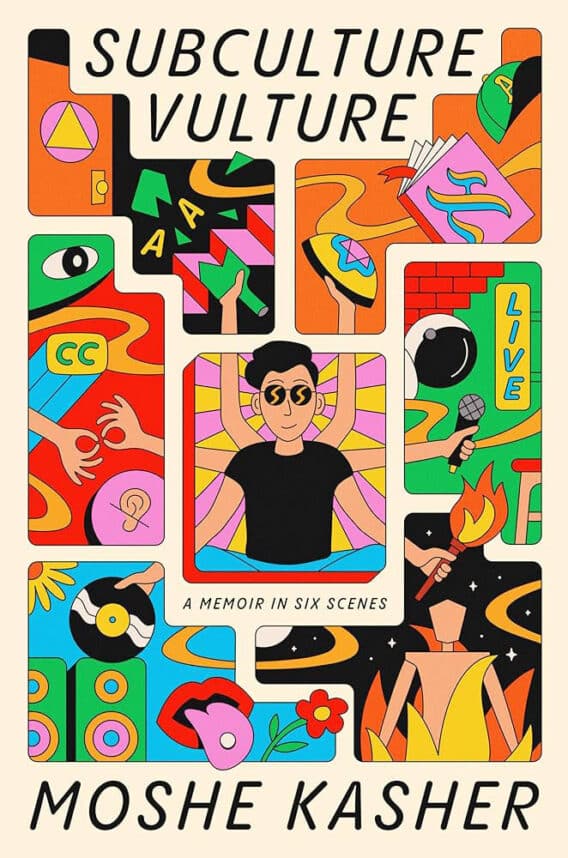
His new book, “Subculture Vulture: A Memoir in Six Scenes” is a detailed and well-researched sorting out of the subcultures that made him. It’s a story of finding your people, kicking your demons and making sure everyone else’s demons don’t become friends with yours.

“I don’t know if this is true for everybody, but it is true for me that I couldn’t kick my demons without my people,” Kasher told the Journal. “I really think that was, for me, the way to excise those demons. It was about finding other people that were like me so that I no longer thought the things that I thought made me painfully unique. And so I kicked the demons with the help of the people that I found.”

Those people, as the title suggests, fit into six “subcultures.” They are also the six “scenes” that make up the book: (1) “AA, or 10,000 Days at a Time,” (2) “Raves, or Notes from the Underground,” (3) “Deafness, or For Who The Bell Tolls Unheard,” (4) “Burning Man, or Staring at the Bright Lights,” (5) “The Jews, or a Drop in the River” and (6) “Comedy, or Funny over Everything.”

Kasher considers himself to be a “middle ground guy.” He was born into a world where his mother and father were deaf and he had a semi-Hasidic upbringing. He thinks that being born into these “weird little sub-communities of isolated people within the greater society” made him love little groups of people, bringing them together, but also making fun of them. “Subculture Vulture” is not just a retelling of life events. Kasher goes into detail about the history and/or science about the topic of each scene.

“I didn’t want to make any glaring errors,” Kasher said. “With Burning Man, I worried about alienating the people that I used to work with and making the organization think that I was an enemy of the state, but they don’t.” In the Judaism scene, he wrote a breakdown of antisemitism, Jewish identity and what it feels like to be a Jewish man in the entertainment industry.

“That’s a landmine that you worry about pushing any people on in either direction,” Kasher said of talking about his Judaism. “I wanted it to be true and not alienating and not feel polemic or ideological, but also to feel like a real defense of myself and my relationship with Judaism … I want them to know that I’m making fun of them in a way that is filled with a lot of love and reverence and also a lot of skepticism and stand up.” Kasher did the same thing in the final scene of the book, detailing warring camps within the world of standup comedy, pitting the “free-speech absolutists and those who want speech to change and change now.”

Kasher’s irreverent observations are a source of laughs in a book filled with some serious issues. He wrote, “I grew up in the ‘90s and didn’t have a serious political thought until I was 30. These days you have 12-year-olds with RBG neck tattoos arguing about the Senate parliamentarian’s role in enforcing stare decisis.”

He experienced some major milestones during the 12 years since he published his first memoir: He recorded his first Netflix standup special and hosted the Comedy Central talk show, “Problematic.” Last year, Kasher won an Emmy for Outstanding Daytime Special for co-hosting “Recipe for Change: Standing up to Antisemitism.” He married fellow comedian Natasha Leggero in 2015. They had a daughter together in 2018, and the same year, the couple did a tandem standup special on Netflix. With the exception of the Oakland raver scene, Kasher wrote most of the book as a new father. His daughter is five now.

“What is the purpose of a life? What is the purpose of my time on this earth? And that’s what I was searching for in these different universes and having a child.” – Moshe Kasher

“I didn’t realize until I pretty much started to get towards the end of a lot of these chapters that this wasn’t just a retelling of my own life,” Kasher said. “It was also like a scrapbook for my daughter to someday be able to read about this strange life that I had.”

Kasher shared a bit more about “Subculture Vulture” with the Journal. The conversation has been edited for length and clarity.

JEWISH JOURNAL: Was there a sense of duty you felt as you wrote the AA chapter?  

MOSHE KASHER: I was really worried. That was the chapter that caused me the most anxiety because I was really worried about writing an honest telling of my journey into and out of membership in the Twelve-step organizations. I am still sober, which I say in the book, but I wouldn’t call myself a member of any twelve-step group anymore. I think it’s a taboo because it’s scary. It’s a scary reality to leave that stuff behind and go, ‘I hope that I’m okay without this support network and this infrastructure of people that can help me.’ I was also worried about people thinking I was bashing AA by being honest about my experience in it.  I still love it and it’s still precious to me, and it’s still holy medicine in a way.

JJ: In what ways is your daughter your teacher?

MK: A lot of this book — my mind as a young kid going as a teenager into these worlds, or when I got older with my Jewish stuff, when my father passed away, I was 20—a lot of these identitarian parts of my life, or when I was really young and I was always looking for a guiding light of what my purpose is. AA is so powerful about that. AA says this, ‘here is your purpose, it is to help other people to get sober.’ It’s so clear. But a lot of these things I was like, what is the purpose of a life? What is the purpose of my time on this earth? And that’s what I was searching for in these different universes and having a child. For me, I know this isn’t necessarily true for people that choose not to have kids, but for me, it’s like the ultimate answer to that question, what is my purpose? Either spiritually or if you’re not a person of spiritually, biologically, it is just so obvious. It’s like this is the purpose. And so in that way, it was the ultimate answer to the question I’d been asking my entire life, what am I exactly supposed to be doing here? What is the reason for my being? And SHE is the reason for my being.

JJ: Tell us more about how music impacted your writing process.

MK: I would go into these worlds sonically while I was writing about them. There wasn’t a lot that I specifically listened to in the deafness chapter. But other than that, each one, I would pick a theme and I would start writing  to the music of that. Nas’ ‘Illmatic,’ Outkast’s ‘Aquemini.’ There’s a number of unbelievable mix tapes from early-1990s DJs that I wrote this thing to. There was a DJ Garth mixtape that I listened to. DJ Jenö from the Full Moon parties, some of Sunshine Jones’s early stuff, ‘Houses of the Holy’ by Led Zeppelin, ‘Sgt. Pepper’s.’ It’s just impossible. The Low End Theory, ‘XO’ by Elliot Smith, ‘Great Plan’ by Paul Simon, ‘Astral Weeks’ by Van Morrison. Why are you doing this to me?  Moshav’s “Shabbat, Volume One,” I wrote a lot of the Jewish chapter listening to that.

New Moshe Kasher Memoir Is An Adventure on Finding Your People and Kicking Your Demons Read More »