fbpx

December 6, 2023

Pogroms: A History Not Covered by Activists

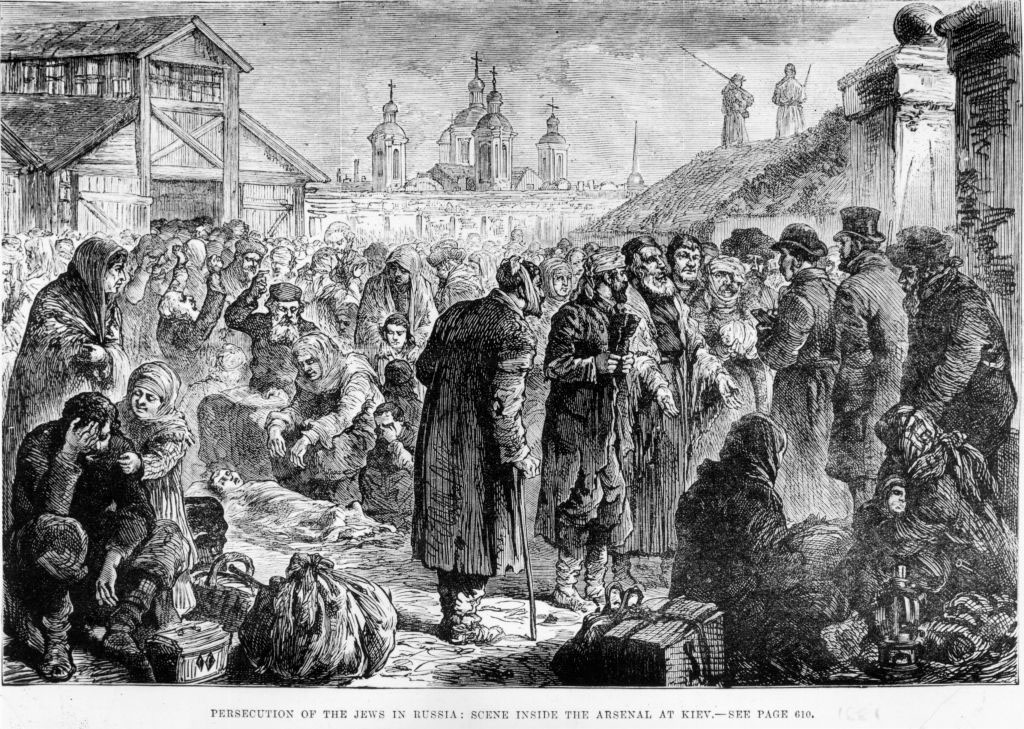
My great-grandmother lived through a pogrom in the Ekaterinoslav (Russia/Ukraine) region in the early 1900s. She suffered from horrible nightmares ever after, emitting blood-curdling screams in her sleep that woke and frightened her nine children.

While many Americans have some knowledge of the Holocaust, the history of pogroms feels largely nonexistent outside the Jewish community.

My great-grandmother was going to visit friends when heading toward the main street where she lived, she saw a troop of Cossacks on horseback. Two riders at the front of the group held a banner depicting Czar Nicholas and another depicting Rasputin. Their banners were those of approval of a current governing body, much like the Hamas flags recently carried by the terrorists who infiltrated Southern Israel. Behind these banners, my great-grandmother saw more men on horseback, many of them with Jewish babies impaled on the ends of their swords.

The stories that we continue to hear out of Israel bring back the memories and experiences of many Jewish families who survived pogroms before fleeing the land of their birth for safety elsewhere. Why do so many Jews live in the United States and in Israel? Because they were persecuted, and executed, and evicted everywhere else.

This is why the stories of incinerated homes, murdered families, beheaded babies and raped elderly are so particularly horrifying, and personal, to Jews the world over. This is also why the silence of friends, neighbors and humanitarian organizations continues to be so painful. Either you’re against the massacre and kidnapping of civilians or you’re not. These actions should be horrifying all by themselves, without historical context or political hedging, but they are made even more so because of where so many of our families come from, because of what so many of our families already survived.

Our families have not only survived this violence and violation before, but we have also sat through the silence and complicity of those we once called friends. The messages I have seen in the media and online grew numerous and loud as soon as Israel retaliated for the pogrom that was perpetrated against its citizens. But before that, all seemed quiet.

The silence that surrounded the murder, rape and torture of Jewish civilians in the days before Israel retaliated was far more deafening than any words. The many videos of activists ripping down pictures of kidnapped victims prove that bandwagon and propaganda messaging has been far more accepted than any real empathy or understanding.

When I stood at the Rally for Israel in D.C. with over a quarter of a million others calling for the return of the hostages and voicing our compassion for what was suffered by all those in Israel, I did not think that my photos on Instagram would finally lead a friend to reach out for the first time since this horror began. I was told that my standing with Israel ignored the bodies of Palestinian children. “Goodbye,” they wrote.

The comments section online is not the place where any peace or understanding will be found, and yet it feels like it is where a large battle is being fought.

The comments section online is not the place where any peace or understanding will be found, and yet it feels like it is where a large battle is being fought. This friend did not know the story of my great-grandmother. Like many, they probably do not know that Jews standing at a rally for Israel or rejoicing at the return of hostages are not doing so as a general political reaction to the news cycle, but rather as a response triggered in part by personal experience and trauma, both past and present.

Along the street behind the Cossacks, my great-grandmother watched the Jewish-owned stores being sacked. She watched as the Christian citizens, including many she recognized, and many who had professed themselves her friends, ran in and out removing the merchandise. Wanting only to save herself and the two children with her, my great-grandmother sat down with them on the curb of the main street, beside the gutter, already red with blood, and prayed she would go unnoticed in the chaos. It is a testament to her stillness and her bravery that my family and I exist today.

My family has seen the actions of the terrorists who crossed into southern Israel before and worry that we will see them again. My family has heard the silence of their friends and community before. We are still hearing it.

Pogroms: A History Not Covered by Activists Read More »

Lehavdil or How I Was Censored for Being a “Zionist” Professor

In response to my question about how he’s been holding up, my friend in Israel of many years—like me, a former Soviet Jew—replied that he’s been driving around the country, bringing food and clothes to army bases. “This is my miluim [reserve duty],” he said. “I wish I was there with you,” I wrote back, to which he answered, “This war has many fronts and one of them is on the U.S. campuses. That’s your miluim.” Indeed, I thought and then added, “lehavdil.”

I’ve returned often to this term since October 7th. Lehavdil—in Hebrew, “to separate, to distinguish, to differentiate”—is a central concept in Judaism. God creates the world through various separations; the separation between the sacred and the profane is at the core of Judaism. In the Talmudic lingo, lehavdil is used specifically to compare two things that are essentially analogous and still acknowledge that one of them is greater than the other, and hence the comparison is imperfect. In this case, there’s a brutal defensive war waged against an existential enemy by Israel and then there are the disturbing happenings on the green lawns and in the dorms and classrooms of U.S. campuses. Lehavdil indeed, and yet there’s much that unites them. This essay is a glimpse into one such campus and the meanings and forms of this wave of anti-Israel and anti-Jewish hate.

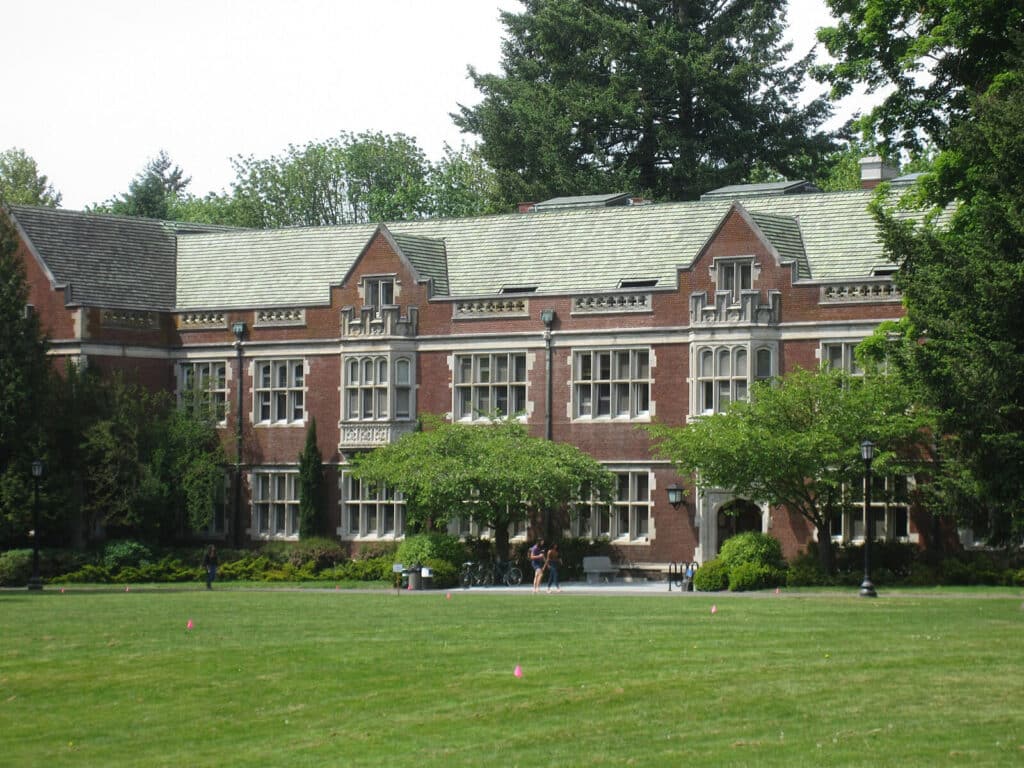
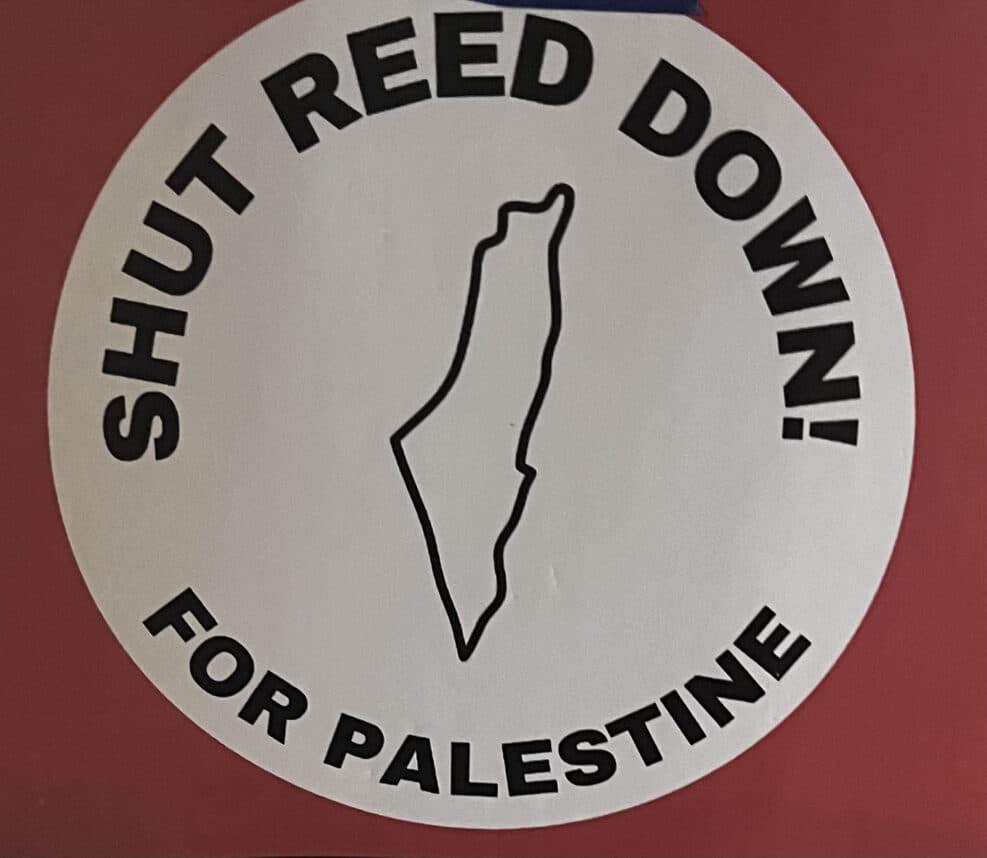
For the past month and a half, a small, elite liberal arts college in the Pacific Northwest, known for its brainiac, quirky students, many of whom go on to graduate study, has become a ground zero for hatred of Israel and the celebration of Hamas “liberators.” Unlike so many other campuses that have witnessed something similar, but also featured pro-Israel Jewish events, Reed College, which does not have a Jewish studies program or a student Jewish center, had not a single pro-Israel demonstration and not a single poster or a banner publicly advocating for Israel, the horrific loss of Jewish lives, or the return of hostages. The many Jewish students have been continuously silenced and harassed for not supporting or refusing to participate in the “walk out,” “shut down,” and “vigil” for the “victims of Israel’s genocide.” “Your silence has been noted,” they’ve been warned by their peers. Like the Soviet Jews who wanted to escape participating in professional and Party meetings about the brotherhood with the Palestinian nation and the blood spilled by the evil Israeli occupiers, these students have been looking for safety and a way out.
And again, I want to say lehavdil, since perhaps one should not compare living and surviving in a brutal authoritarian antisemitic regime and a U.S. campus where the students decided to take on one more unfortunate cause. Yet the parallels between the two situations are deep and go beyond peer pressure and the fear of being ostracized for diverting from the general line.

At Reed, as at so many other colleges and universities, the pro-Hamas rallies are neither spontaneous nor confined only to students, sympathetic or openly supportive members of the faculty, or the indifference or indecisiveness of the administration. They are well-organized, reinforced and funded from the outside. The primary culprit is the national organization “Students for Justice in Palestine” (SJP), whose insignia bears a masked warrior, waving a Palestinian flag. Similarly to Hamas, the organization’s program does not call for a two-state solution or pacificism, but the elimination of Israel in clear and blatant terms. As pointed out recently by Noa Tishby in the Jewish Journal, “SJP is a hate group and it is grooming American college students—grooming your children—to hate Israel, hate Jews and hate America. For years, universities have stood by and watched this brainwashing and incitement take place while doing absolutely nothing.” And, I would add, their rhetoric and ideology are a carbon copy of anti-Zionism, invented in the halls of the KGB after the Six-Day War to in fact institutionalize antisemitism in the Soviet Union. Cleverly, the Soviet anti-Zionist “science” rested on the principle that anti-Zionism was not antisemitism. According to it, there were tolerable Jews (Jewish workers participating in the building of Socialism in the Soviet Union; and, today, Jewish Voice for Peace [JVP)] activists in the U.S. are the equivalent) and the evil Israelis, who are the new Nazis.

In Portland, Oregon this situation is exacerbated by the fact that various violent groups, from anarchists to radical Socialists, have embraced the Reed student SJP warriors. This is exactly what happened on November 9th when the SJP and JVP students joined in with these outside groups and orchestrated a campus shut down for Gaza. While the actual number of student protesters did not exceed 150 or so, their rhetoric engulfed the entire college, charging the air with the banners and cries for “Global Intifada,” “Intifada everywhere,” and the banner “Hitler would be proud” next to the Palestinian flag, which most likely meant that Hitler would be proud of Israel for committing genocide, a staple of Soviet anti-Zionism. The event was covered by the only student newspaper on campus, The Reed College Quest, available online to everyone outside the college.

Its editors approached me with the request to explain the meaning of “Intifada everywhere,” since I happened to be one of a handful of Jewish studies scholars on campus. I agreed and provided the following comments:

“Intifada stands for violence against Israel and Jews; there were two intifadas – waves of violent uprisings and terror against Israelis in the 1980s and early 2000s which are responsible for the deaths of 1000 innocent civilians. Suicide bombings which devastated the Israeli society were part of this. The whole point of the peace process between Israel and Palestinians, which started in the 1990s and led to the establishment of Palestinian authority in the West Bank, is that Palestinians would renounce violence and stop terror. So by saying ‘there is only one solution, intifada revolution’ and ‘mobilize the intifada,’ these protesters condone and legitimize the unspeakable terror Hamas inflicted on the Israeli civilians and call for perpetual violence against them. And it is antisemitic—it threatens and is directed against Jewish lives. These slogans have been seen at other campuses … the slogan says ‘Intifada everywhere’ which means violence against Jews (and deadly violence at that) everywhere, beyond Israel. This is unadulterated antisemitism. Bias reports must be filed.”

When the article came out electronically on November 11th, I was glad to see that all of my points were included in it unchanged. I was proud of the coverage the student journalists delivered. In providing these comments my goal was both educational and moral: to impart the historical knowledge that most of the students lacked, explain how this rhetoric goes against the very idea of the peace process and thus cannot be seen as advocating for Palestinians or reconciliation between the two peoples, and clarify how it is unequivocally antisemitic. Earlier, I also pointed out to the authors that the shutdown took place on the anniversary of Kristallnacht, which they highlighted in the piece as well. Unsurprisingly, as soon as the article was up, there followed a barrage of hateful comments in the newspaper and the various chat groups, whose main thrust was that the authors had no right to ask about the meaning of Intifada “the most Zionist” professor on campus who does not speak Arabic (!). As one student put it, “I think the choice to ask the most Zionist professor on campus his opinions on the term intifada is irresponsible at best and targeted and dangerous at worst” while another one sardonically wondered, “Why ask a Soviet Jewish Zionist professor?” Lehavdil, I say again, but reading through these comments, I did feel like a Soviet Jew targeted by the antisemitic machinery, wrapped up in the ideological gibberish.

One comment, a “masterpiece” of intellectual antisemitism that erased the millennia of Jewish history, described my worldview as prioritizing “the comfort of a genocidal bureaucratic enthnostate that is younger than some of the people it aims to destroy and whose land it occupies.” The others were incensed by my description of Intifada as violence against Jews. “Common, it just means an uprising, there were intifadas long before Israel,” they fumed, sounding like the antisemites who claim that since Arabs are also Semites, they have nothing against the Jews, or that swastika is just a religious Sanskrit symbol.

Again, unsurprisingly to me, some of the attacks came from the students who proclaimed that as Jews they were disgusted by me and the article’s authors for quoting me. One student wrote, “I will never be able to have sympathy for the people who do that [aka Israel] even if they wave a symbol that has come to represent my people, and invoke their name and their trauma. My family did not die so that someone can use their names to justify genocide. From the river to the sea Palestine deserves to be free.” The KGB ideologues would have been proud, for here was an American Jew who willingly, not under the fear of arrest, employed the ideological language, morally corrupt to the core and fundamentally distortive of Jewish history. And herein lies the main danger. These students were taught this language by the larger ideological machineries and organizations that they reproduce ad perfectum. And while such voices remain the fringe of the fringe in the wider community, they occupy the center stage on the campuses and would continue to spread if not combatted. The lessons of how Soviet Jews, so many of whom are now in the U.S. and Israel, confronted this hate and saw through it in the old country should come in very handy.  

And while such voices remain the fringe of the fringe in the wider community, they occupy the center stage on the campuses and would continue to spread if not combatted.

When I opened the newspaper webpage a few hours later that Saturday, I was startled to discover that all of my comments had been removed and the following explanation provided: “At the time of the article’s publication, the Quest was unaware that Professor Grinberg had previously expressed support for certain views on Twitter which the editors found deeply troubling. Had the Quest been aware of these views, the papers would not have quoted Professor Grinberg. When the paper became aware of these views, the editors made the decision to immediately remove the quotes, after being informed by the Student Press Freedom Initiative that it was legal to do so. We have replaced Professor Grinberg’s comments with a direct quote from the Encyclopedia Britannica. We thank those who brought this to our attention.”

The words of this “Jewish Zionist professor” had to be expunged to the fullest. An hour later, the editors added, “The Quest was alerted the last sentence of paragraph 21 still made a reference to Professor Grinberg’s quote, which was no longer in the article. That sentence has now also been removed.” The student journalists, who only hours ago tried to put out honest reporting, swiftly turned into (or were cowered into becoming) industrious censors. The meticulousness and legality with which they cleansed the article of my words bring to mind the totalitarian practices of the 20th century, so alive in today’s Russia, China and Iran. Should I say lehavdil again?
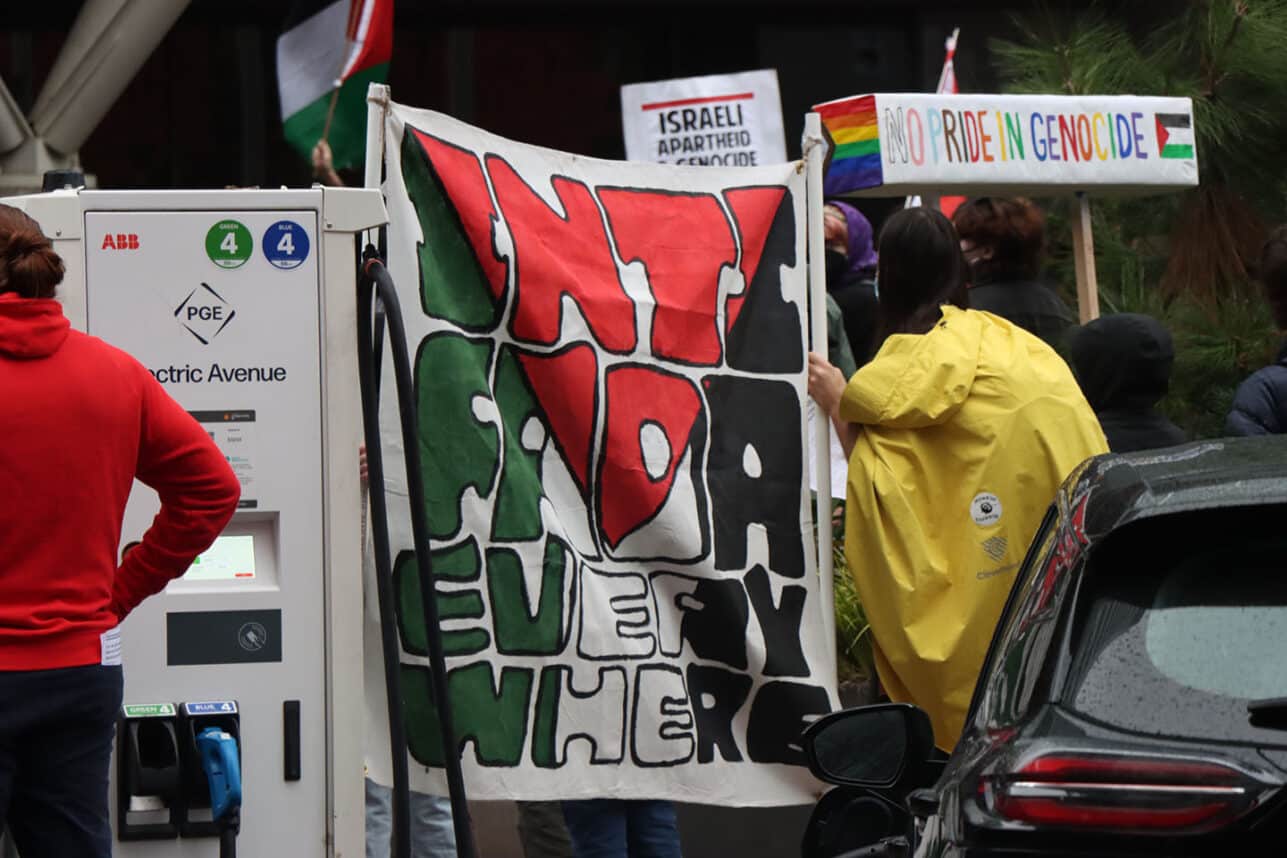
And what of the “deeply troubling” views I support on Twitter? When the paper version of the newspaper came out on November 15th, the article featured all sorts of voices: from SJP to JVP to the administration to the protesters to Merriam Webster Dictionary (apparently a great depository of Islamic knowledge)—all, except mine, which pointed plainly to the antisemitism at the core of these events, the voice that had to be muzzled because it belonged to a Jew and a Zionist. Adjacent to the article, plastered with the photos of the banners and “From river to the sea” ditties, there were two letters to the editor: one by an alum who proclaimed that I represent “violent eliminationism on campus,” citing the “vile” Tweet I retweeted by a well-known Iraqi intellectual, Hussain-Abdul-Hussain, who called on the Palestinians to abandon their terrorist ways, and the other Tweet I liked, which, in the best tradition of subversion, reversed “From River to the Sea Palestine Will be Free” to “From River to the Sea Israel is What You’ll See.” In addition to its rhetorical message, it also happened to be a statement of fact: Israel is what you will see when looking at today’s map. The other letter to the editor by a current student asked, “Why in the world would you interview known Zionist and professor of Jewish and Soviet studies for opinion … Regardless, this conflict is not a Jewish issue … it is an Israel and Palestinian issue.”

I think back to the Soviet Jewish past lived by my parents and grandparents, which I investigated and memorialized in my books, and I no longer need to add lehavdil.


Marat Grinberg is Professor of Russian and Humanities at Reed College and the author of The Soviet Jewish Bookshelf: Jewish Culture and Identity between the Lines.

Lehavdil or How I Was Censored for Being a “Zionist” Professor Read More »

Cease-And-Desist Letter Sent to Oakland Schools Over Anti-Israel “Teach-In”

A cease-and-desist letter was sent to Oakland Unified School District (OUSD) on Tuesday, demanding the school cancel Wednesday’s anti-Israel “Teach-In” scheduled to take place across the school district.

The letter, which was obtained by the Journal, was authored by The Deborah Project, a law firm providing pro bono legal services to Jewish and Israeli students who believe they have been discriminated against on campus. The Deborah Project is representing Oakland Families United Against Antisemitism, a group that includes parents of OUSD students.

The letter informs the district they expect the OUSD to “safeguard the students of this district from the biased and discriminatory material that certain members of the Oakland Educators Association have made known they will be inflicting on those students in their planned December 6 Teach-In.” The letter notes the Teach-In’s takeover, of OUSD classrooms, despite the Oakland School Board and the OUSD Superintendent’s public declaration  that the material violates School Board policy.

The letter refers to a statement OUSD Superintendent Dr. Kyla Johnson-Trammel made to OUSD families on Monday. Johnson-Trammel’s statement read in part: “I know that many of you are aware of the unsanctioned Teach-In planned by outside organizing in our schools this Wednesday, December 6. I want to make clear that the District does not authorize this action. Furthermore, I want to make clear that the instructional materials developed and shared by the Teach-In organizers are not aligned with the materials and guidance previously provided by our Chief Academic Officer, Dr. Sondra Aguilera. Our schools are sanctuaries for learning, and I am deeply disappointed by the harmful and divisive materials being circulated and promoted as factual.” (emphasis original)

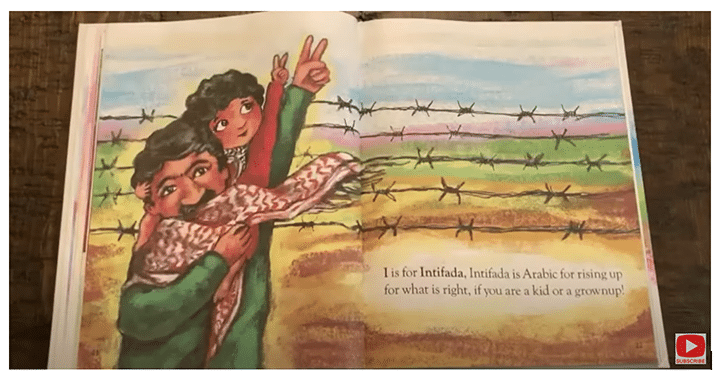
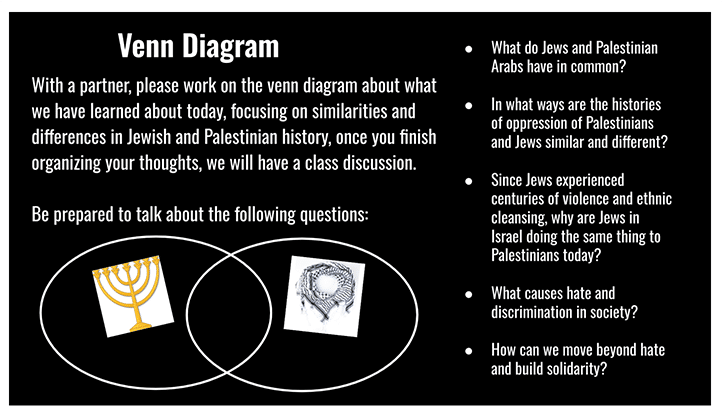
Among the material in the Teach-In includes a YouTube video titled, “Why is Israel called an ‘apartheid’ state?” and a read-along of the book “P is for Palestine,” which includes a page states: “I is for Intifada, Intifada is Arabic for rising up for what is right, whether you are a kid or a grownup!” Additionally, a “History of Palestine and Zionism” slideshow features a slide with the question, “Since Jews experienced centuries of violence and ethnic cleansing, why are Jews in Israel doing the same thing to Palestinians today?”

Lori Lowenthal Marcus, legal director of The Deborah Project, told the Journal that the Teach-In of such material will be happening “in their classrooms, on the campuses of the schools. We don’t know how many of the teachers will do this, but a vote by the OEA [Oakland Educators Association] last night ratified the decision to go through with this.”
The Oakland Educators Association is “categorically wrong when it claims teachers have free speech rights in their classrooms. They do not,” the cease-and-desist letter continued. “The ninth circuit held in Johnson v. Poway Unified School District … that teachers do not have free speech rights in the classrooms or whenever they are acting in their official capacity. Full Stop. This case is directly binding on all public-school teachers in California and it applies the holding in Garcetti v. Ceballos … that public employees do not have free speech rights while performing their official tasks.”

The letter also argued that the planned Teach-In will also foster a hostile climate against Jewish students on campus, thus violating Title VI of the Civil Rights Act. The Deborah Project contended that the district has an “obligation to keep out of our public schools material that discriminates against Jewish children and Israeli children.” “We know — indeed, the Superintendent Johnson-Trammell has declared — that the planned Teach-In will place into the California public schools for which you are responsible curricular material that violates these laws and so discriminates against Jewish children and Israeli children, including the children of the members of Oakland Families United Against Antisemitism.” The letter continued, “If you fail to fulfill your duty to prevent this, we will hold each of you who allowed this to happen morally, politically, and legally responsible for the harm that ensues.”

Marcus told the Journal “what parents, teachers and school administrators need to understand is that public school teachers do not have the right of free speech in the classroom, or at any time while they are acting in their official capacity.”

The OUSD and OEA have not responded to the Journal’s requests for comment.

Cease-And-Desist Letter Sent to Oakland Schools Over Anti-Israel “Teach-In” Read More »

Between the Fight and the Light: The Jews in 2023

It can get weird to keep up with the news while being ensconced in a holy city like Tsfat. In Los Angeles, where I live, there’s a natural flow between the news and my conversations. I don’t feel that here. Sure, people need to keep up with war news, given the need to rush to bomb shelters when you hear a siren. But the news is not an obsession. The rhythms of Torah and the struggles of daily life are what dominate.

So, it’s unusual that meeting a religious French artist in this isolated enclave gave me some perspective on what is happening now in America.

What is happening, to put it bluntly, is that Jew hatred has reached an alarming level even for those of us who don’t easily get alarmed. It’s hard to keep up with all the incidents, especially on college campuses. Many Jews are afraid. It’s as if Europe has come to America. Yes, we’re still in a free country and we’re free to fight back, but this has become an ugly fight none of us wanted. We’d much rather dance at weddings.

What is happening, to put it bluntly, is that Jew hatred has reached an alarming level even for those of us who don’t easily get alarmed.

Of all the recent incidents, I’d have to say this one memorable question best summarizes the sorry state of affairs for American Jews:

“Is it considered harassment to call for the genocide of Jews?”

The question came from New York Republican Rep. Elise Stefanik to the presidents of three top universities in a congressional hearing on Dec. 5. None of the leaders — from Harvard University, the Massachusetts Institute of Technology and the University of Pennsylvania—could answer with an unqualified “yes.” They all gave their own versions of “it depends.”

This troubling spectacle has now blown up on the internet. Remember, these are leaders of our most elite institutions who go overboard to protect minority groups against microaggressions but can’t bring themselves to protect Jews against the nastiest macroaggression. Indeed, calling for such things as “globalize the intifada” is calling for the genocide of Jews. This is dangerous speech that incites violence and creates a hostile environment for Jewish students.

Sadly, but not surprisingly, this bullying of Jews has spread across the country, adding a fresh level of venom to the world’s oldest hatred.

The result is that American Jewry is completely focused at the moment on the fight at hand, and for good reason. Countless Jewish activist groups have mobilized, using every weapon at their disposal, from the legal system to physical security measures to social media influencing. We’re now in hand-to-hand combat, which makes it understandably hard to see beyond the combat.

And yet, there is value in seeing beyond the combat.

Which brings me to that mystical French artist from Tsfat.

His name is Yoel Tordjman. I met him at a synagogue in the Old City. What struck me about him was not what he said to me (he’s not the schmoozer type) but what I found out later from a video on his website.

“What does it mean to be Jewish?” a filmmaker asked him (in French).

“It’s the searching to be,” he replied.

Tordjman reflected on the circular rhythms of life, on the fact that everything is always in motion. Humans look for solutions, stability, certainty, a beginning and an end– but a circle has neither.

The universe is always in motion, he explained. This motion is what creates life, what creates the seasons. Humans look for the stability of four distinct seasons, but even those seasons are an illusion. The universe has seasons within the seasons. The movement never stops; it’s permanent.

Given that everything is in motion, it would make sense, as Tordjman suggests, that being a Jew is the continuing search for what it means to be Jewish.

That search has grown exponentially in the wake of the October 7 pogrom and the ensuing rise in antisemitism. More and more Jews have been confronting what it means to be Jewish. With so many feeling under siege, a common response has been: It means fighting for our people.

But that fight, like everything else, is not static. It has no beginning or end. It has no fixed solutions, no finite point. Our fights, our lives, our Jewishness, are all in constant motion, in resonance with the centuries of motion of our ancestors.

Hanukkah, then, could not come at a better time. The holiday is about motion and transformation. We don’t settle for one static candle on one finite night. Each night, we go further. We keep adding light. We keep moving.

If being a Jew means searching for what it means to be Jewish, we ought to bring some of that search, some of that motion, some of that Hanukkah energy, into our present fights against antisemitism. We may be in maximum fighting mode at the moment, but being a Jew means more than the fight; it also means spreading light.

Is it possible to spread light while we’re engrossed in such a difficult fight? That’s for each one of us to answer. Maybe the Festival of Light can help show us the way. As we light a new candle every night, as we keep searching for the meaning of being Jewish, we may conclude that there’s no need to choose between the fight and the light, because the Jews and the world need both.

When we realize that nothing has a finish line, not the light nor the fight nor our Judaism, it’s a lot easier to follow the universe and embrace all three– whether we live in Tsfat or L.A., whether we read the news or not.

Happy Hanukkah.

Between the Fight and the Light: The Jews in 2023 Read More »

“Indiscriminate Killings” in Gaza? The Facts Suggest Otherwise.

The current war between Israel and Gaza has tragically suffered many non-combatant deaths. A common allegation in many media reports is that Israel engages in “indiscriminate” killings of civilians. While the loss of innocent lives is tragic and deplorable, such claims are common yet unsupported by data. Indeed, during exacerbations of this ongoing conflict, even scientific journals have published articles with political allegations, devoid of data or scientific analysis.[1,2]

The claim of indiscriminate killing of civilians can be simply verified using published data. Such indiscriminate killing would be expected to be random and result in an age and sex distribution of deaths which follows the distribution of the civilian population. For example, we would expect a comparable number of deaths in men and women. Similarly, targeted combat operations in Gaza would be expected to show a “bulge” of excess deaths in men, particularly in the younger ones of “combatant” age. We looked at the data from the first three weeks of two Israel-Gaza wars, namely the “Protective Edge” operation of 2014 and the current “Swords of Iron” war of 2023.

The data show the opposite of what much of the media usually claim. Let’s go through it in detail.

During the 2014 “Protective Edge” operation, the names and ages of casualties between 1-24 July 2014 were extracted from a website set up by the “Gaza-Deaths” non-governmental organization (NGO).[3] For the current 2023 “Swords of Iron” war, the data were extracted from the Gazan Ministry of Health’s published information on all casualties inside Gaza between 7-26 October 2023.[4] The 2023 data do not include the Hamas deaths inside Israel around the 7 October 2023 attack.  The Gaza overall population distribution was extracted from a “Middle East Monitor” NGO publication.[5] For both wars, we classified age as 0-19 years (children), 20-39 (“combatant” age) and 40 or over (older age) and calculated rates of death per 100,000 population for each age and sex stratum.

The data highlight a clear and significant excess of deaths amongst males, and particularly those aged 20-39 who would be the most likely in the combatant population.

The 2016 population of Gaza included 925,164 women and 955,971 men.[6] In the first three weeks of the conflicts, there were 513 reported deaths in 2014 and 6,746 in 2023. “Indiscriminate killings” would result in a rate of death during these three weeks of 27 per 100,000 in 2014 and 358 per 100,000 in 2023, similarly for both sexes and all ages.  The figures show that this is clearly not the case. Mortality was higher among males by 31 and 88 deaths per 100,000 compared with females in both 2014 and 2023, respectively.  The higher mortality among males is evident across all three age groups. The figures also show that the higher mortality for men is particularly in the 20-39 “combatant” age group, with 76 and 171 more deaths than women per 100,000 population, in 2014 and 2023 respectively.

Our analysis of reported deaths in Gaza in the 2014 and 2023 conflicts rules out any allegations of “indiscriminate killing” of civilians; it suggests rather that the opposite is true. The data highlight a clear and significant excess of deaths amongst males, and particularly those aged 20-39 who would be the most likely in the combatant population. This finding was consistent in both the 2014 and 2023 conflicts, which refutes any such allegation in both wars.

It is unfortunate that scientific journals such as The Lancet declined to publish this analysis but this same Journal published papers containing allegations that are unsupported by data and with no scientific foundation.[1,2] We believe that scientific publications should inform and influence political debate and never the opposite.

Figures: Mortality in Gaza per 100,000 population among females and males, stratified by age, during the first three weeks of the 2014 and 2023 Gaza wars. The red line represents the expected mortality for both sexes and all ages if deaths occurred indiscriminately.


Benjamin Fox is professor in Department of Internal Medicine, Faculty of Medicine, Tel Aviv University, Tel Aviv, Israel.

David Langleben is professor in Department of Medicine, Faculty of Medicine and Health Sciences, McGill University, Montreal, Quebec, Canada.

Samy Suissa is professor inDepartment of Epidemiology and Biostatistics, Faculty of Medicine and Health Sciences, McGill University, Montreal, Quebec, Canada.

Acknowledgments

In writing this letter we are reminded of our colleague Dr Avi Shimony who contributed to the acquisition and analysis of the 2014 data and died tragically in 2018. This letter is dedicated to the victims of terrorism and war. May their memory and sacrifice never be sullied by unscientific allegations.

References

[1]          Smith J, Kwong EJL, Hanbali L, et al Violence in Palestine demands immediate resolution of its settler colonial root causes. BMJ Global Health 2023;8:e014269.

[2]          Paola Manduca, Iain Chalmers, Derek Summerfield, Mads Gilbert, Swee Ang. An open letter for the people in Gaza. The Lancet  23 July 2014  DOI: 10.1016/S0140-6736(14)61044-8

[3]          http://gazadeaths.com/. Accessed 27 July 2014

[4]          Palestinian Ministry of Health (Gaza)  – Detailed report Gaza strip on Israeli aggression to victims (2023 October 26 – 7) .  https://www.moh.gov.ps/portal/wp-content/uploads/2023/10/تقرير-نهائي-باسماء-الشهداء-1.pdf   Accessed 27 October 2023

[5]         Middle East Monitor Website 16 August 2016: Israeli blockade on Gaza tightened in July, new figures show.https://i0.wp.com/www.middleeastmonitor.com/wp-content/uploads/2016/08/20160816_GazaStats-AgeDistribution.jpg   Accessed 27 October 2023

“Indiscriminate Killings” in Gaza? The Facts Suggest Otherwise. Read More »

Churches of Hope, Churches of Treachery

Immediately after the Black Sabbath of Oct. 7, when as Orthodox Jews we could first connect with the world, we learned two things. We got an inkling – it turned out to be just an inkling – of the worst slaughter of Jews since the Holocaust. And we learned who our friends were. Nine out of ten messages in our inboxes came from concerned Christians. But to our dismay, in the days that followed, many prominent figures from the world community who initially expressed their outrage at the Hamas pogrom, shifted to “yes, but” expressing “understanding” about what made Hamas do it; shifting their horror to Israel’s response.

But not the Christians who had initially reached out to us. They remained steadfast and continue to support Israel’s right to rid itself of an enemy pledged to destroy it. These leaders also insisted that Israel has been more mindful of preventing civilian casualties than any Western government ever was, and that the inevitable civilian deaths were entirely the moral responsibility of Hamas.

These Christians understood that Hamas had not looked for any political, or military gains, but set out to mass murder, maim, rape, and mutilate Jews. Furthermore, they believed what a Hamas official who had declared that Christians would be next target. Indeed, the fate of Copts in Egypt, and the slow-motion genocide of Christians in Nigeria carried out by Hamas’ ideological cousins were proof enough.

As pressure on Israel oh-so quickly morphed into widespread toxic anti-Semitism around the world, our Christian friends loudly condemned it. They explicitly owned up to two thousand years of church-inspired anti-Semitism and hoped to remove that stain on church history by fighting Jew-hatred in the present. “Not again. Not on our watch.”

Christian media, like the Christian Post and the entire Christian Broadcasting Network, have relentlessly showed understanding for Israel’s plight and unprecedented challenges. Powerhouse leaders like Revs. Gordon Robertson, Franklin Graham, John Hagee, Glenn Plummer (Bishop of Israel for the largest conservative denomination of US Black churches) and Pastor Johnnie Moore have stood with our community in time of need.

As good as these Christians are, others were appallingly awful.

One group of thirty Christian organizations issued a press release, sharing their letter to President Biden. After a half-line condemnation of the Oct. 7 pogrom, the letter wastes no time on transitions. “The horrific violence of Hamas does not justify further violence against Palestinian civilians.” Is that so? No right for Israel to defend itself against those who raped women, beheaded babies, and burned people alive? No right to extract its hostages? No right to extirpate a barbaric enemy that has pledged to repeat its horrors again and again, and to extend them to Jews around the world?

But they said it, for all to see. No such right.

The attacks against Israel’s actions mangled the truth with terms like: “collective punishment,” “indiscriminate and tragically disproportionate impact on civilians,” “seeking an end to the decades-long occupation and blockade.” Then they had the chutzpah to call for “immediate protections in Gaza for Sanctuaries of Refuge such as hospitals, schools, and houses of worship” – the very places Hamas has used as terror command centers and weapons depots. And they finally urged President Biden to end further military aid to Israel, while imposing consequences upon the Jewish state for its “gross violations of human rights, as required in US laws.”

The who’s who of this cabal isn’t surprising. The largest among them are the once-important mainline Protestant denominations – Presbyterian Church (U.S.A.), The United Methodist Church, Evangelical Lutheran Church, The Episcopal Church – whose relationship to Biblical truth and membership have shriveled since their decades-long denunciations of Israel and their calls for divestment. In another group are so-called “peace churches” (the most famous being the Quakers, who have long ceased being Friends of Jews). There are a few Catholic orders (not the Catholic Church), and of course, the National Conference of Churches, the US version of the World Council of Churches, an international network of liberal churches that has been anti-Israel since the founding of the Jewish State. And the inevitable NGO – in this case, Christians for Middle East Peace– who have always said they are “pro-Palestine, pro-Israel, pro-peace,” while downplaying Israel’s security.

These religious groups have aided and abetted the Palestinian side, bestowing on them an immoral blank check for virtually any attack on Israel.

Are these churches worse than other groups who have marched to Hamas’ tune? Yes. The others belong, chiefly, to two groups. One is anti-Semites. These people don’t pretend to have any moral standing. They just hate Jews and often other minorities.

Two are the unthinking social media masses whose knowledge of history has never advanced beyond images on the mainstream media, Tik-Tok and the febrile imaginations of the woke professors they kowtowed to in college. They are not people of any moral discernment. They just want to be in the virtual “in crowd.”

These church groups, however, and far more blameworthy.

Religious institutions are charged by society to think through issues – to research, agonize over the truth, and apply sharp moral reasoning to difficult issues. By insisting on a ceasefire and end of hostilities, these churches have supposedly weighed the arguments, and concluded that if Jews must continue to die at the hands of the barbarians next door, then so be it. If Gazans continue to perish, they will hold Israel responsible, rather than Hamas for using them as human shields. They also ignore Walter Russell Meade’s reminder that “War is not a war crime,” while forgetting that embedding combatants in schools, mosques and hospitals most assuredly is.

These churches have thought through the moral calculus and arrived at a position of contempt for the Jewish people. Effectively, they are telling The House of Israel: “You people need to die.”

Not on our watch. Never Again.  We haven’t forgotten the lessons from the Holocaust era.

We remember those in the US State Department who worked to block the rescue of European Jews from Hitler, even after it was clear that the Nazi death machinery was murdering thousands every day.

We remember with equal clarity those Christians who hid Jews in the Holocaust at the risk of their own lives. We remember the heroism of Karol Józef Wojtyła, who as a young priest saved a 13-year-old Jewish girl from certain death at the hands of the Nazis, who later became Pope Saint John Paul II. We are deeply impressed by the friendship of other churches – for whom the Bible remains their daily source of inspiration and guidance.

The darkness of the current Hamas nightmare is pierced by the support of our friends. As for the Gang of Thirty, their eyes remain shut to the evil that must be confronted, but our eyes are wide open to the fight against this evil– grateful that the Lord has provided allies we can rely on.


Rabbi Abraham Cooper is associate dean and director of Global Social Action for the Simon Wiesenthal Center (SWC). Cooper also serves as the Chair of the United States Commission on International Freedom.

Rabbi Yitzchok Adlerstein is the SWC Director of Interfaith Affairs.

Churches of Hope, Churches of Treachery Read More »

Why Henry Kissinger Never Got the “Jewish Nobel Prize“

In the days since the passing of Dr. Henry Kissinger, numerous articles have been written about his legacy, his brilliance, and his impact on US foreign policy and the Cold War.  He advised twelve US Presidents, and, according to the New York Times obituary, was “considered the most powerful secretary of state in the post-World War II era.”  “[His] enduring capacity to bring strategic acumen and intellect on the emerging challenges […] led President, Secretaries of State, National Security Advisors … to seek his council, including me,” said Secretary of State Tony Blinken, adding that “few people did more to shape history than Henry Kissinger.”

Amid such praise, my colleagues and I have received multiple inquiries asking why he was never awarded the Genesis Prize and whether our foundation would consider honoring him posthumously.

Indeed, Dr. Kissinger can be rightfully viewed as one of the most consequential statesmen on the world stage in the post-World War II era, and certainly the most influential Jewish American in foreign affairs in our country’s history. And since the Genesis Prize celebrates Jewish achievement, how could someone with Kissinger’s accomplishments have been overlooked?

It is a reasonable question, especially considering all of the other awards bestowed on Dr. Kissinger, including the 1973 Nobel Peace Prize, the US Presidential Medal of Freedom – the highest civilian honor of the United States – awarded by President Ford in 1977, the Medal of Liberty from President Reagan in 1986, the Order of Merit of the Federal Republic of Germany, and a slew of other honors and awards from governments and private foundations.

So why didn’t Dr. Kissinger receive the Genesis Prize, which TIME Magazine called “The Jewish Nobel Prize” and Haaretz described as “the most prestigious award in the Jewish world?”  What makes Mayor Michael Bloomberg, Justice Ruth Bader Ginsburg, Natan Sharansky and ten other laureates who received the Genesis Prize since it was established in 2013 more deserving?

The answer lies in the fact that the Genesis Prize is about more than Jewish achievement.  It is also about pride in Jewish identity and appreciation of the Jewish value of tikkun olam – making the world a better place, and unwavering support for the Jewish State. And this is where Dr. Kissinger fell short.

Henry Kissinger was not a proud Jew. “If it were not for the accident of my birth, I would be antisemitic,” Kissinger said in 1973, according to the authoritative 1992 biography by Walter Isaacson, citing Oval Office recordings. “Any people […] persecuted for two thousand years must be doing something wrong.”

In 1975, after he visited his childhood home in Germany and failed to utter a word about the Holocaust, Rabbi Norman Lamm, then Chancellor of Yeshiva University, encouraged Jews to disassociate from Kissinger: Dr. Kissinger is an illustration of how high an assimilated Jew can rise in the United States, and how low he can fall in the esteem of his fellow Jews.”

Another argument against awarding the Genesis Prize to Dr. Kissinger was his ambivalent policies towards Israel and his lack of clear moral stance when the wellbeing and security of the Israeli people were in jeopardy.  Many historians and former Israeli officials, for example, have accused Kissinger of delaying military aid to Israel during the Yom Kippur War in 1973, which they argue needlessly prolonged the war and led to loss of countless Jewish lives. Memoranda of Kissinger’s telephone conversations from October 1973, uncovered by the National Security Archive, provide blunt and fascinating vignettes from a significant moment during the Nixon presidency.  In one recording about the Yom Kippur War, the Secretary of State candidly tells Soviet envoy Anatoly Dobrynin that it would be a “nightmare” if either side won.

While Kissinger angered many Israelis in 1970, he was disdained by Soviet Jewish refuseniks, who felt betrayed by the Jewish Secretary of State. Kissinger did not believe that the struggle for freedom of Soviet Jews was a foreign policy priority for the United States, and called US Jewish activists who championed the cause “self-serving bastards.”

Kissinger strongly opposed the Jackson-Vanik Amendment, which made American trade with the USSR conditional on free Jewish emigration. “The emigration of Jews from the Soviet Union is not an objective of American foreign policy,” Kissinger told President Nixon in remarks made public when one of the batches of the White House tapes were released in 2010. “And if they put Jews into gas chambers in the Soviet Union, it is not an American concern. Maybe a humanitarian concern.”  The late Eli Wiesel, founding member of the Genesis Prize Committee, refused to speak to Kissinger after learning of this comment.

As a practitioner of realpolitik – a school of thought that focuses on balance of power and disregards moral considerations – Kissinger did not follow the Jewish ideal of tikkun olam and appeared blind to human rights and social justice. This framework enabled policy decisions which led to tens of thousands of civilian deaths in Asia and Latin America – from strategic bombing campaigns in Vietnam, Laos, and Cambodia, to his support for Pinochet’s brutal dictatorship in Chile.

Of course, we cannot be oblivious to the historical context. Kissinger was the only Jew in the top echelons of US power, working for a president who was known for his antisemitic views. Certainly, Kissinger’s statements – as well as some of his policies and diplomatic maneuverings – reflect not only Kissinger’s deep personal insecurity about his Jewish roots, but also his desire to fit in and have the kind of influence he was able to wield all over the world, including the Middle East.

After he left government, Kissinger sought to clarify his position on Israel and his Jewish identity. In 1977 he said that, “The security of Israel is a moral imperative for all free peoples.”  And in an interview only three months ago given to Avinoam Ben-Yosef, President Emeritus of Jewish People Policy Institute, published in Maariv, Kissinger said: “I am Jewish, so … I take the survival of the Jewish people and of the Israeli state as a personal objective.”

And it seems that towards the end of Dr. Kissinger’s long life the Jewish world started coming to terms – at least partially – with the controversial diplomat. Shimon Peres presented Kissinger with Israel’s Presidential Medal of Honor in 2012 for his “significant contribution to the State of Israel”.  Two years later, the World Jewish Congress awarded Kissinger the Theodor Herzl Award for bringing “an unusual combination of knowledge, brilliance and skill to the office of Secretary of State.” Reacting to his passing, President of Israel Isaac Herzog issued a statement, noting Kissinger’s “love and compassion for Israel.”

And while the Jewish community welcomed Kissinger’s personal “détente” with his own Jewish identity, our foundation felt Kissinger could have done much more for the Jewish people and for the State of Israel when he was at the height of his power – as Secretary Blinken is doing today.  He didn’t, which is why this great statesman and one of the most brilliant Jewish minds of the post-WWII era never received the Genesis Prize.


Stan Polovets is the Co-Founder of the Genesis Prize.

Why Henry Kissinger Never Got the “Jewish Nobel Prize“ Read More »