fbpx

November 23, 2023

It’s Time for Professors Who Support Israel to Proclaim their Zionism – the Toronto Way

Since October 7, our most sophisticated universities have confirmed the most basic lesson every kindergarten kid learns – when good people cower, the bullies win.  We all know that most professors don’t hate Jews. Nevertheless, the Silence of the Tenured Lambs has let a rabid minority of Jew-hating anti-Zionists run rampant on college campuses with minimal pushback. Treating lush quads like prison yards, thugs throughout North America have harassed Israelis, attacked Jews, and repeatedly called for Israel’s destruction – “from the river to the sea” – and mass Jew-killing by “globalizing the intifada.”

The result, on too many campuses, is a poisoned-ivy league, a new network of universities where half the Jews on these campuses report feeling scared, more than a third report witnessing acts of violence against Jews in their universities, and more than a third have felt compelled at one point in the last few weeks to hide their Jewish identity from their peers. So much for safe space!

These 555 physicians had the Zionist impulse to defend themselves, their people, their state, their highest ideals, and Western civilization.

But look closely at these haters shouting, “Gas the Jews!” and “When People are Occupied, Resistance is Justified.” You see that, like all bullies, they are cowards at heart. They are human rights “activists” who rationalize mass murder; feminists who are silent about mass rape; physicians insensitive to human suffering when it is Israelis who bleed; and totalitarian liberals who support dictatorships and terrorists.

When I challenge professors to take a stand, too many of them shrug. They don’t want to disrupt their careers. They worry about a few fanatic colleagues or students shouting them down or trashing them on social media. They act as if it’s not their responsibility to make sure that everyone on campus feels comfortable, respected, free to think independently — even if the students dare to be pro-Israel. And many of these paralyzed professors simply wonder, what are they supposed to do?

Appalled by the way these Hamas apologists have obsessively and selectively singled Israel out, and struck by the silence of medical professionals, Dr. Berger did what comes naturally to him – he took a stand.

Fortunately, 555 Jewish Physicians in the University of Toronto’s TFOM – Temerty Faculty of Medicine – have shown us how easy it can be to do the right thing. Like all those heroic Israelis who fought back ferociously to save Israel from Hamas that day, these 555 physicians had the Zionist impulse to defend themselves, their people, their state, their highest ideals, and Western civilization.

Here is their full statement, released earlier this week:


OPEN STATEMENT TO THE UNIVERSITY OF TORONTO TEMERTY FACULTY OF MEDICINE FROM JEWISH PHYSICIAN FACULTY

The Israel Gaza War is causing agony for many TFOM faculty and polarization in the TFOM. We feel immense anguish over the suffering and deaths of innocent Israelis and Palestinians. We believe in the right of both Israelis and Palestinians to self-determination and statehood.

Yet, on the streets of Toronto and in the TFOM itself, the hostile and belligerent position towards Jews who identify with the state of Israel, or who identify as Zionists, is discriminatory. The distinction between anti-Zionism and antisemitism is tissue thin. Only for Jews is self-determination and autonomy – Zionism – denounced as a racist endeavour.  Only for Jews is living in their indigenous homeland considered “colonialism.”

We, therefore, hold the following as central to our identity as Jews in the TFOM:

  • We affirm the right of TFOM faculty to be openly Zionist and to support the right of Israel to exist and defend itself as a Jewish state and for those faculty to be free of public ostracism, recrimination, exclusion, and discrimination in the TFOM.
  • To us, being a Zionist in 2023 means that we accept the right and the necessity of the survival of the Jewish people, and the existence of a Jewish state that ensures their survival. Anything that undermines or threatens Israel’s survival, undermines, or threatens the existence of the Jewish people and is, ipso facto, antisemitic.
  • We know that accusations against Israel as “apartheid”, “colonialist”, or “white supremacist” or committing genocide are mendacious and aim to promote the argument that Israel should be dismantled as a Jewish state, making such accusations themselves antisemitic.
  • We reject as antisemitic any blame on Israel for Hamas’ slaughter of Jews and non-Jews, and any justification for the slaughter because of historical context, opposition to settlements and occupation, or legitimate resistance.
  • We reject as antisemitic any claims of equivalency between the Israeli people’s right to self-defence against terrorist groups who seek to annihilate Israel and the Jewish people, and the Hamas terror attacks against Israeli civilians.
  • We reject as antisemitic any claims of equivalency between the duty of Israel to rescue its citizens who are being held hostage by Hamas and the Hamas terror attacks against Israeli civilians.
  • We reject as antisemitic the imposition of a collective political responsibility on Jews to denounce Israel simply because they are Jews. We affirm the right of Jews alone to define antisemitism for themselves absent any interference from those outside of the Jewish community.
  • We implore the TFOM in any investigation of antisemitism to apply the International Holocaust Remembrance Alliance (IHRA) definition of antisemitism.
  • We reject the expectation that Jews must reach total consensus on the definition of antisemitism; we know that the vast majority of Jewish TFOM faculty endorse the IHRA definition; and we disavow the weight given to a tiny minority of Jewish faculty who object to the IHRA definition.
  • We abjure the cover of “academic freedom” within the TFOM to permit unrestrained antagonism by some TFOM faculty to Zionist Jews and their publicization of grotesque and antisemitic characterizations of Israel, the only Jewish state.
  • We believe that academic freedom is not absolute. In particular, leaders in academic medicine with power over learners and faculty, who in some cases are the sole leader responsible for thousands of learners and faculty, should not be issuing statements which collide with equity, diversity and inclusion for Jews or which make Jews feel unsafe and unwelcome in the TFOM and which are unrelated or unessential to their core academic role, research, and publishing of results.
  • We ask and expect that Jews receive the same consideration and protection that the TFOM provides to other minority groups.

How did this statement come about?

Dr. Philip Berger, an Officer of the Order of Canada and an inductee in the Canadian Medical Hall of Fame, is among those who initiated the effort. He has spent his 45-year-career practicing at the intersection of medicine and social justice. The Canadian Medical Hall of Fame describes him as “an advocate for refugees, members of the LGBT community, people with HIV/AIDS, those suffering from addiction, homelessness, and living in poverty.”  Dr. Berger “has also worked to promote methadone treatment, needle exchanges, documentation and recognition of the aftereffects of torture, academic infirmaries for the homeless, and clinical treatment of AIDS in Africa.” This “tireless champion of social justice and accessible health care in Canada and the world,” has “been a crusader never afraid of the controversial,” while serving “the needs of the sick and those who have suffered abuses of power.”

Alas, he has one strike against him. He is also, he reports, “a defiant left-wing Jew and Zionist.”

Since October 7, Berger — like so many other academics and social justice warriors – has been seeing colleagues, including many who consider him a mentor, attacking Israel viciously. He and others in the Toronto medical community have seen videotapes of once-cherished colleagues screaming at the front of a rally, demanding another intifada, which they clearly recognize, as Berger notes, as “a call for the murder of Jews.” Another associate “posted that he would rather stand with the devil than with Israel.”

Dr. Berger and his colleagues only circulated this letter to Jews because as a Zionist he understands the need right now to empower Jews.

Appalled by the way these Hamas apologists have obsessively and selectively singled Israel out, hearing how the language is anti-Semitic not “just” anti-Zionist, struck by the silence of medical professionals in the face of the Hamas bloodbath, Dr. Berger did what comes naturally to him – he took a stand.

“I have been on the Left my entire adult life and am intimately familiar with its analyses regarding Zionism, antisemitism and Israel,” he explained.  “I am also intimately familiar with the emotions of my Jewish Zionist colleagues.  I simply wedded the two to exploit the vulnerabilities of the left and the inadequately expressed angst of the Zionist colleagues.”

True, Jew-hatred is the problem of the Jew-hater not the Jew. But Dr. Berger and his colleagues only circulated this letter to Jews because as a Zionist he understands the need right now to empower Jews. This “is a fight to the death for Jews and a fight that Jews alone have to wage,” he declares. His vision – and strategy – “struck a deep chord.” Within a week 555 Jewish physicians on faculty has signed.

As we cheer this initiative, pray for each of its signers, and – in this case – hope for massive copycatting worldwide, one may be tempted to think this is what courage looks like. But it shouldn’t take courage to stand for truth, fairness, and justice for Hamas’s victims. This is what self-respect looks like. This is what standing for liberal principles and truth looks like. And this is what big tent, righteous, Zionism looks like.

Jewish professors across America who support Israel would be wise to emulate this Zionist courage.

It’s Time for Professors Who Support Israel to Proclaim their Zionism – the Toronto Way Read More »
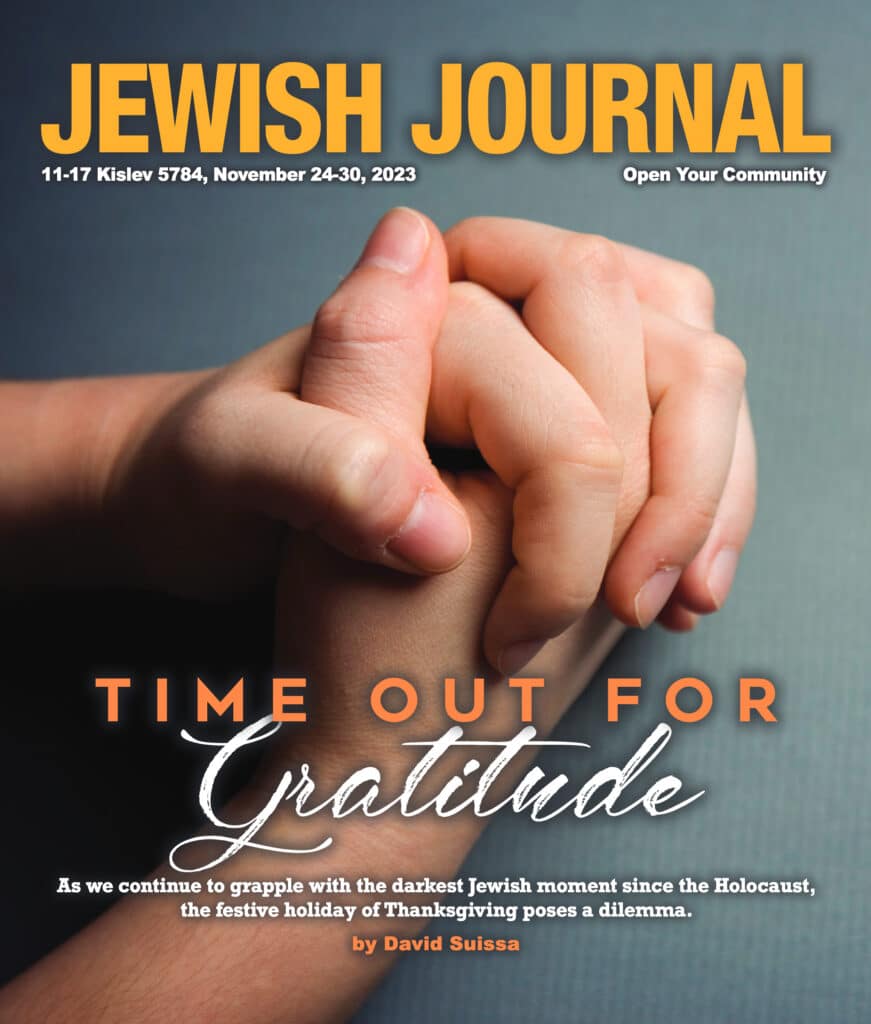

Print Issue: Time out for Gratitude | Nov 24, 2023

CLICK HERE FOR FULLSCREEN VERSION

Print Issue: Time out for Gratitude | Nov 24, 2023 Read More »

Campus Watch November 23, 2023

Dept. of Ed. To Investigate Seven Schools Over Alleged Antisemitism

The Department of Education announced investigations on November 16 into seven schools over alleged instances of antisemitism and Islamophobia.

Spectrum News NY1 reported that the investigations are under Title VI of the Civil Rights Act. The schools under investigation are Cooper Union, Cornell University, Columbia University, University of Pennsylvania, Lafayette College, Wellesley College and the Maize Unified School District in Maize, KS. Wellesley told NY1 the investigation stems from a complaint by the Brandeis Center over residential advisors in a dormitory saying there should be “no support for Zionism” in the college community and a “teach-in”; the college said that they quickly rectified the former and that the complaint didn’t accurately summarize the latter.

Maize Unified School District told NY1 that they will cooperate with the investigation but haven’t been told the reason for the investigation. Lafayette College President Nicole Hurd said in a statement “incidents like those that have occurred at other campuses” haven’t occurred at Lafayette, though she did acknowledge that there was a “problematic poster” that the college swiftly handled.

Columbia said that, while they’re not going to comment on the investigation itself, they have established a task force to address antisemitism on campus and have denounced the “harassment of Jewish, Palestinian, Muslim and Arab students.” Cornell declined to comment to NY1.

ASU Cancels Rashida Tlaib Event

Arizona State University (ASU) canceled an on-campus event featuring Representative Rashida Tlaib (D-Mich.), citing procedural issues. 

A university spokesperson told The State Press, a student newspaper: “The event featuring Congresswoman Tlaib was planned and produced by groups not affiliated with ASU and was organized outside of ASU policies and procedures. Accordingly, that event will not take place today on the ASU Tempe campus.”

The event, called “Palestine Is an American Issue,” was organized by the Arizona Palestine Network and co-sponsored by ASU’s Students for Justice in Palestine (SJP) chapter, per The State Press. The SJP chapter called the university’s decision to cancel the event “unacceptable … Rashida Tlaib must be heard on campus as the only Palestinian member of Congress who plans to speak on an American issue at an event.”

GWU Suspends SJP Over Projecting Anti-Israel Slogans onto Library

George Washington University (GWU) suspended its Students for Justice in Palestine (SJP) chapter for at least 90 days over the chapter projecting anti-Israel slogans onto the university’s Gelman Library in October.

As previously reported by the Journal, the slogans projected onto the library included “glory to our martyrs,” “divestment from Zionist genocide now,” and “from the river to the sea Palestine will be free.” The GW Hatchet reported on November 14 that they received a statement from the university stating, “Effective immediately, the university has prohibited SJP from participating in activities on campus.” On February 12, 2024, SJP’s activities will be restricted on campus.

A representative from the SJP chapter told the Hatchet that the university’s decision to suspend them is “a political response to a growing wave of backlash and repression towards Palestinian organizing.” Around 100 students attended an on-campus rally on November 15 protesting against SJP’s suspension, the Hatchet reported.

Jewish Students File Lawsuit Against NYU Over Its Handling of Antisemitism

Three Jewish students filed a lawsuit against New York University (NYU) on November 15 alleging that the university has improperly handled incidents of antisemitism since October 7.

ABC News reported that the three students claim in the lawsuit that they have been subjected to “repeated verbal and physical threats, and made to feel unsafe on campus, as they are forced to confront angry mobs of students and faculty members extolling the Hamas massacre, and calling for the deaths of Jews and the annihilation of Israel.” The lawsuit alleged that “the university has done nothing to enforce these policies to remedy or prevent that behavior, and certainly nothing approaching the manner in which NYU has enforced them with respect to misconduct not involving antisemitism.”

University spokesman John Beckman disputed the allegations, telling ABC: “NYU looks forward to setting the record straight, to challenging this lawsuit’s one-sided narrative, to making clear the many efforts NYU has made to combat antisemitism.”

Jewish Students Assaulted at Ohio State

Two Jewish students have been assaulted and small Israeli flags were stolen from the Hillel at Ohio State University (OSU), Jewish Telegraphic Agency (JTA) reported.

The assault, which occurred on November 10, reportedly involved two Middle Eastern men punching the two students in the face after a verbal altercation outside a bar. The two suspects allegedly said “k— Zionist.” Both OSU Vice President Peter Mohler and Ohio Governor Mike DeWine (R) condemned the incidents; DeWine announced that he had ordered increased patrols on campus in response to the incidents.

Campus Watch November 23, 2023 Read More »

Understanding October 7 in Light of the Holocaust

So many events of October 7 were like scenes from the Holocaust. Jewish communities devastated as hundreds of Jews are murdered by killing squads in a single day. Parents killed in front of their children and children murdered in front of their parents, old people and children burnt alive. This massacre was so devastating that, understandably, the Holocaust is being invoked to assess it.

The most important insight generated by the association of October 7 and the Holocaust was the end of an illusion. 

The most important insight generated by the association of October 7 and the Holocaust was the end of an illusion. For decades, Israel dealt with Hamas as a troubling movement which could be contained — albeit that it disrupted life in the South and in Israel at large from time to time. On October 7, the people of Israel awoke to realize that — like the Nazis — Hamas was seriously committed to its principles of destroying the Jewish state and killing Jews everywhere. Out of this moment of moral clarity, an Israeli national consensus emerged to destroy Hamas’s fighting machine and end its governing of Gaza — whatever the cost.

 However, we must control our shock and our intense Holocaust memories to avoid overreaction or despair. For example, in Israel, some have said that the Jewish state turned “never again” into an empty slogan — since more Jews were killed on this day than on any single day since the Holocaust. Others wrote that the state of Israel is a failure. After all, Israel’s main function is to prevent the recurrence of mass murder of Jews — and it failed to do so. 

The despairing outcries that the Shoah is back are wrong. The terrible failure of October 7 must not be allowed to override the extraordinary achievements of 75 years. 

The Holocaust occurred because the enemies killed thousands of Jews day after day — particularly over five war years. Unchecked, the Nazi assault eventually claimed six million powerless victims. The state of Israel was created to give Jews the power to prevent genocide. After the October 7 massacre, within a couple of days, the IDF eliminated more than 1,500 of the killers who rampaged through southern Israel. 

In the years of its existence, Israel rescued millions of Jews from persecution or death. Israel made Jewish life more valuable by reversing past history. In the Holocaust years, Jews were less likely to get permission to relocate or attain a haven to save their lives. Thanks to Israel and other governments it recruited, in the ‘80s and ‘90s in the Soviet Union and Ethiopia and in the 2020s in Ukraine, Jews (or their families) were more likely to get aid and a chance to emigrate and remove themselves from harm’s way. 

The Jewish state offered a haven for Jews worldwide through the Law of Return. Endangered partial descendants of Jews were offered unconditional rescue. Recently, the two religious parties in the extremist ruling coalition sought to cut this lifeline. Hopefully, after this war, the full importance of offering safety to people threatened because of their connection to Jewry will be reasserted and the Law of Return fully upheld.

The main expression of Jewry’s commitment to “never again” allow a Holocaust to happen was Israel’s taking political and military power into Jewish hands. But exercising power does not assure that Jews will never again be persecuted and killed. Having power means that Jews can defend themselves and that the value of Jewish lives can be restored. 

Taking power is widely misunderstood. Strength is not a guarantee of safety. As long as there are genocidal enemies out there, Jews are vulnerable. In a way, we have been lulled into complacency by Israel’s incredible success in reducing Jewish losses for 75 years.  We have grown used to wars in which Jewish casualties were a fraction of our enemies’.  Think of the invention of the Iron Dome which neutralized the threat of rockets amassed by Hamas and Hezbollah. These rockets could have killed thousands — no, tens of thousands. (In retrospect, shame on us for treating it as normal that residents of southern Israel lived under continuous rocket fire all these years.)

As long as enemies relentlessly pursue the destruction of the Jews, there was bound to be some time or place when our side lowered its guard or malfunctioned— and the enemy took advantage to torture and massacre. This is in no way intended to minimize the government and military failures which made October 7 possible. After the war, an investigation will be held and those responsible will be held accountable. The IDF has always learned lessons from its failures and improved future performance. But as long as antisemitism rages — as it does especially in Muslim cultures now — there will be future assaults on Jews. The price of power is eternal vigilance and, tragically, some home front casualties, as well as death and damage to our defenders. 

Part of the tragedy in the Holocaust was that the Nazis paid little or no price as they annihilated the Jews. The deaths of the powerless victims only increased the vulnerability and suffering of the rest of the Jews. Israel reversed that. The deaths of the defenders and the IDF soldiers who are fighting back are unbearable and heartbreaking but their sacrifices bring more security and dignity to the rest of the Jews. 

We learned in the Holocaust that we live in a world where there is unlimited power available to the murderers. As we believe that life must go on — our religion teaches us to work so that life will win out over death in this world — we had no choice but to take up the burden and costs of taking power to neutralize the evildoers. Fighting radical evil and paying the price of standing up in defense of life is our destiny going forward. This is why remembering the Holocaust is a central guide to policy and morality— for the rest of the world (and all potential victims) as for us. This is why it was so important to push for a United States Holocaust Memorial Museum on the National Mall. 

Our choice to rebuild and live did not change the reality that in this harsh world, there are powerful forces willing or wanting to destroy the Jews. I confess that I, among many others, believed that the vicious and inhumane behavior of the Nazis was so odious that antisemitism would be suppressed for a long time. Antisemites would be leery of being labeled as followers and allies of Nazi teachings. This umbrella of moral outrage and shame actually lasted for less than one generation in the West. Antisemitism has come into the open both verbally and in violence. In the Muslim world, the barriers against antisemitism and genocide were swept aside by the spread of radical Islam and jihadism. The poisonous fruit of that development is Hamas: An organization dedicated from its founding to wipe out the state of Israel and kill Jews all over the world. 

To live with dignity, we have to fight antisemitism in all countries and in all forms. In this fight, the state of Israel will be our concern and our major weapon. Our concern, because the antisemites seek to delegitimate Israel by demonizing and isolating it. Israel is already the “Jew among nations.”’ The Muslim nations and their allies (especially in the U.N.) have drawn upon conspiratorial, antisemitic tropes in an attempt to place it beyond the pale. At the same time, Israel will be a major weapon against antisemitism because its world leadership in medicine, technology, irrigation, and cybersecurity dramatizes that Jewry is (as promised to Abraham) a “blessing for all the families of the earth.” (Genesis 12:3.) 

Israel will continue to be a model in the exercise of power with ethical restraint because we remember what it was like to be persecuted by unlimited power. Even as the IDF invades Gaza, it strives to minimize civilian casualties, in tactics as well as in munitions. Hamas’s sheer barbarism and cruelty for cruelty’s sake has convinced the whole country that it must be wiped out. Everyone understands that if Hamas won a war against Israel, such tortured deaths would be the fate of every Jew in Israel. Still, the IDF’s actions are driven not by revenge but by the need to restore life and security in Israel and stop future massacres. 

After the Holocaust, the greatest assault of death forces on Jewish life ever, Jewry was driven to build Israel and unleash the greatest outburst of life and creativity in our history. After October 7 and this war, Israel and world Jewry will respond by raising Jewish life and the Jewish state to the highest levels of dignity, equality and humanity ever.


Rabbi Yitz Greenberg serves as the President of the J.J. Greenberg Institute for the Advancement of Jewish Life (JJGI) and as Senior Scholar in Residence at Hadar.

Understanding October 7 in Light of the Holocaust Read More »

Table for Five: Vayetzei

One verse, five voices. Edited by Salvador Litvak, the Accidental Talmudist

Leah’s eyes were tender, but Rachel had beautiful features and a beautiful complexion. 

– Gen. 29:17


Judy Gruen
Author, “The Skeptic and the Rabbi: Falling in Love with Faith”

Rachel is not the first matriarch noted for her beauty. Both Sarah and Rebecca were also beautiful, but as Rabbi Jonathan Sacks (z”tl) points out, their beauty was mentioned only when they and their husbands dwelled temporarily in the land of the Philistines because of the famine in Canaan. Abraham and Isaac realized that their wives’ beauty would far overshadow the average looks of the local women, making them vulnerable to kidnapping. That is why both Abraham and Isaac claimed that their wives were their sisters. 

In contrast, the minute that Jacob lays eyes on Rachel at the well, he kisses her and weeps. It seems to be love at first sight, with the Torah suggesting that Rachel’s beauty dazzled Jacob, sweeping him off his feet. Jacob’s love for Rachel is profound and is mentioned repeatedly, including the explicit statement that he “loved Rachel more than Leah.” No wonder Leah’s eyes were “tender,” a reference to the river of tears she had cried throughout her life from believing she was destined to marry Esau, Jacob’s wild and undisciplined brother. Unable to compete with her better-loved and more attractive sister and rival wife undoubtedly kept the tears flowing. 

We learn an important lesson here: The Torah refers to Leah’s “tender eyes,” not saying overtly that Rachel was more beautiful than she was. We need to build people up — especially children — by noting the qualities they do have and not mentioning what they lack.  


Rabbi Chaim Miller
Author “Practical Tanya, Gutnick Chumash”

The Torah portrays Leah as having a certain depth, which is not immediately apparent in Rachel. Concerned about her future arranged marriage to Esau, Leah cries incessantly (Rashi). We are told nothing about Rachel’s inner world, only about her external beauty. 

Perhaps it is this contrast that led the Zohar to identify Leah with the deep, subconscious of soul-power called binah and Rachel with malchut, the most superficial layer of consciousness concerned with physical reality. When we adopt the mindset of malchut, we think, “If I fight with reality, I will lose.” While retaining agency and free choice, we are careful to act within the constraints of societal convention and the pursuit of reasonable goals. 

Binah is the part of our psyche that makes it possible for us to re-invent ourselves. Binah’s powers are deep and vast, accessible only through focused inner work and a defiant will. 

Leah’s efforts produced results: Her tears realigned her destiny. Not only did she become Jacob’s wife, she merited to rest alongside him for eternity in the Cave of Machpelah. 

So as we reread this verse in the Torah this year, we may ask ourselves: Am I going to accept the societal status quo, or find the courage to defy it? Am I going to own all the parts of myself, or just the bits that other people find “beautiful”? Can I be strong, like Leah, and display my wounds and vulnerabilities to the world?


Abe Mezrich
Author, “Words for a Dazzling Firmament”

Rachel is not the first Biblical character to have such beauty. As others have pointed out: Rebecca too, is described in a similar way. Indeed, Rebecca is said to have been “very beautiful” just as she rushes to help Abraham’s servant — someone come from a long way in need of water. Which might mean Rebecca’s beauty, and perhaps Rachel’s beauty too, is a kind of good strength. It reaches out and enacts change; it makes people better off for having encountered it. 

Leah has something different from beauty. She has “tender eyes” – or, in another translation (JPS), “weak eyes.” The Midrash says Leah’s eyes are weak from crying because she fears she will be shuttled into a tragic marriage with Esau. In the literal text she is shuttled into a loveless marriage with Jacob. Either way she does not seem strong at all. Life happens to her, and all she can do is see her eyes go tender as she looks on. But God also looks on. 

God “saw that Leah was hated;” so He gives Leah a son. And Leah sees God seeing her. Reu-ven, Leah names this boy: “See a son…because HaShem has seen my affliction.” 

Maybe all of Judaism is encapsulated in these women. When life is thrust upon us before our eyes, God sees us and gives us what we need. And when He gives us strength, we have a responsibility to bear: we must turn around and give beauty to the world.


Yehudit Wolffe
Founder Bais Chana of California and KosherSofer.com

As a people, Jews reached rock bottom, cried, and grieved over the pain of October 7.

Our mother Leah cried for a good reason, her tears were effective, but her beauty was diminished.  Our mother Rachel did not cry and was beautiful.

Crying is inevitable. However, will we act like victims? or will we wipe away our tears and act courageously?

When I was a teenager, a day before Israel bombed Iraq’s nuclear reactor, I remember the Lubavitcher Rebbe called for swift action: To drop everything and sell letters in a unity Torah. Since it “gives each soldier the power of 304,805 soldiers … the enemy will be frightened and will not come to the front lines.”

So, therefore, I decided now to bring this spiritual protection for soldiers. How? Avrohom Dovid, my husband, a scribe, is writing a Torah scroll dedicated to IDF soldiers, while we gather the names of soldiers to dedicate a letter, (304,805) for each soldier.

All Jews are emissaries to reveal G-d in this world (Lubavitcher Rebbe Shabbat Chaye Sarah, 1992). We are battling truth and good against evil. All Jews are needed to energetically act to complete our mission, wiping our tears to make real change.

We are promised “G-d will wipe away tears from all faces.” Our good deeds will accomplish this and comfort us. Engaging in courageous kind good ventures is needed now to make good prevail over evil. And “Rachel’s children will return to their borders.” This expresses how: AM YISRAEL CHAI! 


Rabbi Scott N. Bolton
Congregation Or Zarua, New York, NY

Today, both Leah and Rachel, among the Mothers of Israel, are praying for their children. While these two sisters are different women in the Book of Genesis they come to represent the motherly qualities of our ancestors and the strong women of the Jewish People in our time. Both Leah’s eyes and Rachel’s focus us on their trevails. God promised that their tears will turn from those of sorrow to those of jubilation. In the Book of Jeremiah (31:14-16) we learn Rachel’s eyes wept, “… weeping for her children, she refused to be comforted …” However the Children of Israel as one beautiful body, a united entity, would inherit their portion. “Thus says the Lord: ‘Refrain your voice from weeping, your eyes from tears, for your work shall be rewarded; And they shall come again from the land of your enemy … your children shall come again and return to their own borders.'” 

In recent days, we have witnessed how beautiful thousands of Jews coming together look! Unity in Israel, masses in Los Angeles to NYC we have gathered waving Israeli flags and singing out for family, to comfort mourners, to pray for the safe return of hostages and to unite in support of the defense of our homeland. With tender eyes we remember the fallen beautiful sons and daughters and babies and grandparents of Israel. Leah and Rachel know what God promised: “For all the land which you see, to you and your offspring I give it forever.” (Gen. 13:15) I feel their hope.

Table for Five: Vayetzei Read More »

Rosner’s Domain | The Challenge of Being Real

It might be true, the late PM Yitzhak Rabin said — and the full quote is required, because it was often taken out of context — “that the best solution for Gaza would be for it to drown in the sea, but since that is not possible, a solution must be found.”

You see, the second part of the quote is essential as one ponders a growing trend on Israel’s right: To propose that Gazans ought to just leave the area. “Countries around the world should offer asylum to Gazans seeking relocation,” two Israeli members of Knesset, one from the centrist Yesh Atid, wrote in The Wall Street Journal. “The international community can … provide one-time financial support packages to Gazans wishing to move …”

It is an important idea because of what it says about the current state of affairs. I’ll try to explain with five quick comments:

First: The idea of convincing Palestinians to move elsewhere is an old idea that is now gaining momentum in right-wing circles. One right-wing columnist wrote: “Israel has only two choices: either to control the Gaza Strip with military rule, or to move its population to another place … There is no third solution that would allow Israelis a decent life on this land.” An editor of a right-wing intellectual magazine wrote: “This population’s removal from Gaza is… not the exile, but the completion of the move that began in the War of Independence.” You can agree or disagree with these writers, but you must notice them. Such ideas mean something.

Second: The fact that these ideas are circulating indicates a breaking of a psychological barrier. Thirty years ago, when minister Rehavam Ze’evi spoke about the relocation of Palestinians, many Israelis considered him a pariah. They thought such an idea was immoral. Recent events forced us to rethink these once-preposterous ideas. And it’s not that Israelis lost their desire to behave morally. They were forced to adjust their standards to a reality in which the standards of Hamas also exist. So, while the Prime Minister of Canada can speak after October 7 as if the same rules apply to Israel’s and Canada’s challenges (“even wars have rules. All innocent life is equal in worth”), we know this is not exactly true. An extreme situation opens the door to ideas that were once considered extreme into the mainstream.

The current reality is truly unbearable, and it is not easy to find a practical way out of it. And no, rehashing the old Two State Solution cliché is not a more practical solution. It’s just a different kind of fantasy.

Third: If we stay with psychology, the relocation theme also indicates how difficult it is to come up with a realistic solution to the current reality. Rabin understood this when he said that the idea of Gaza drowning is tempting but impractical. In today’s Israel there are those who have reverted to fantasy and condemning them is easy but superfluous. The current reality is truly unbearable, and it is not easy to find a practical way out of it. And no, rehashing the old two-state solution cliché is not a more practical solution. It’s just a different kind of fantasy. 

Fourth: Part of the discourse on Gazan relocation is an understandable and justifiable provocation against the rest of the world. If it is so important for the Prime Minister of Canada to protect women and children in Gaza, he is welcome to hand them Canadian visas. They could move to the sparsely populated provinces of Saskatchewan and Manitoba. Of course, Canada will not do such thing. When Justin Trudeau rebukes Israel, it is not because he cares about Gazans, it is because he cares about appearing righteous, and leaving Israel with the daunting challenge of living in reality. 

Fifth: Is the idea truly unrealistic? To answer this question, we must define the “idea.” Is it realistic to assume that Canada will take in masses of Gazans? The answer is no. Is it realistic to assume that Gazans will leave willingly? Here we must ask what willingly means. The two Israeli MK’s mentioned in their WSJ article that Austria and Sweden took in masses of refugees from Bosnia during the Yugoslav wars. Were these refugees leaving willingly? Yes, they agreed to move because the other option was a massacre. The same is true for the quarter of a million Syrians who willingly moved to Germany. They agreed to move to a progressive Western country in order to escape the killing fields. This does not happen in Gaza because Israel is neither Syria nor Serbia. Israel does not kill innocent Gazans indiscriminately. 

Is the idea of Gazans leaving a good idea? It is a convenient idea for Israel, to which the Gazans would respond by proposing that it is Israelis who ought to relocate (in fact, that is the ideology of those thinking Zionism is a colonialist project). So, in the world of fantasy, one can imagine many things. But in a realistic world, Gazans are still here, we are also here, and neither are going anywhere.

Something I wrote in Hebrew

Where was God on October 7 is a question that some Israelis ask. I tried to respond by referring to other disasters:

The Holocaust was mentioned by relatively many Israelis as an event that weakens faith in God … Only among the ultra-Orthodox was there a majority, not a large one (56%), who said that the Holocaust was a faith-strengthening event. Perhaps because it is very difficult for them to say about anything that it weakens the faith. But among the religious, who all believe, about a third said that the Holocaust is an event that weakens faith (31%). And among the traditionalists, about 40% said so. And among the secular, a significant part of whom obviously do not believe, two-thirds said so. Which may also indicate the reaction of the Jews in Israel to October 7. Where was God? Some will be tormented, some will say that his ways are mysterious, some will say that he is simply doesn’t exist.

A week’s numbers

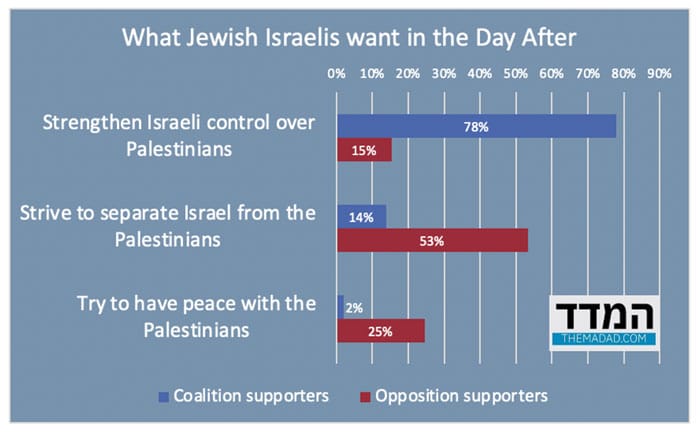
Security and/or separation is what Israelis believe in. Peace – not so much. Not with the Palestinians, and not as long as they want us all dead.

A reader’s response:

David Lilienfeld wrote: “It seems likely that American opinion supporting a ceasefire is likely to hit levels Biden can’t ignore in about a week. After that, I don’t know that Biden will have any way of resisting calling for a ceasefire.” My response: 1. It is now a week after, and (as I write) Israel still fights. 2. Biden’s view is crucially important, but it’s not the only important factor as Israel’s ponders its options.  


Shmuel Rosner is senior political editor. For more analysis of Israeli and international politics, visit Rosner’s Domain at jewishjournal.com/rosnersdomain.

Rosner’s Domain | The Challenge of Being Real Read More »

Preparing for a Post October 7 World

In the aftermath of the Hamas pogrom of October 7, we sense a different moment in time as a religious community and as citizens of this country. This is a new war against the Jews, as Hamas’ assault on Israelis is now being carried forward by their allies on America’s soil and beyond. In connection with the Gaza crisis, we are experiencing a series of challenging moments, setting off complex emotions, triggering new questions and generating an array of both personal and collective concerns.

 Correspondingly, in this postmodern age, as much of the world sheds aspects of its religious identity and participation, the Middle East has become the centerpiece of religious extremism and activism. This is a war being fought on multiple fronts. While Israel engages in a military campaign, world Jewry faces a major public relations battle, pushing back against antisemitic and anti-Zionist attacks as it seeks to build a pro-Israel case with key audiences and governments. As we know, a conflict with a non-state enemy (e.g., Hamas) is very different from engaging with a nation-state. Yet, increasingly, the West has experienced such wars against ISIS and other terror organizations. 

We struggle to explain why so many opponents of Israel and those who have never engaged with this issue are now attacking Israel, arguing that October 7 was justified or the natural outcome of “occupation.”

For nearly a month we have been trying to analyze this angry assault on Israel and Jews.  Our opponents claim the deaths of Jews are due to the policies of Israel.  Their arguments are tied to the progressive left’s ideological reliance on critical race theory, which defines Israel and Israelis as “occupiers.”

We need to point out that behind such responses lies raw, real and present anti-Semitism. Whether our “friends” are even conscious of their hatred, at bottom their messaging reflects anti-Jewish beliefs. Sadly, their angry words and threats are not offered in a vacuum, leaving space for others to potentially act out this hatred on Jews here and elsewhere. Indeed, words have consequences.

Israel is identified as “the” global problem. Jews are charged with being white colonialists; Israel is labeled an apartheid state; Zionism is claimed to be racism. 

I can readily believe that weeks from now there will be circulating on social media the notion that the events of October 7 never happened; after all, Jews will do anything to advance their influence and power!

In this moment, as we know, our home-based enemies dismiss the events of October 7 as well as the Zionist historical narrative; there is only one storyline here, and it has no room for the State of Israel. “From the river to the sea” implies the ultimate elimination of Israel. The eradication of the Jewish State serves as an extension of the Nazi agenda to eliminate Jews. 

No battleground is more pronounced than our college campuses, where Jewish students are being challenged, threatened and intimidated and the case for Israel has been dismissed. The academy is enabling its faculty, students and administrators to deliver hateful political messages designed to discredit Israel and its American supporters. 

Critical debate has given way to celebratory demonstrations marginalizing Jews and Israel. Possibly most troubling is our discovery of the profound lack of knowledge about the Middle East and, more directly, the Israel-Arab conflict on the part of key influential leaders in academia. Particularly challenging are the number of Jews opting to support Hamas, as they are prepared as well to identify Israel as “the problem.” These times have motivated some Jews to separate from their own, as they attempt to escape being labeled a “Zionist” or worse.

What will this mean for the love affair that American Jewry has had with this nation’s institutions of higher education, and more directly with some of this country’s premier universities? Will Jewish kids rethink where they will attend college? Will there be a fundamental reshaping of the relationship our community has had with the prestigious academic centers in this country?

Possibly for the first time, we wonder about our status, even our safety.  Some of us are withdrawing from public Jewish places, uncomfortable to be in those spaces where Jews gather. Others are removing the physical symbols of Jewishness, both personal and communal.  

At the same time, for instance on the grade-school level, we are seeing a transformational moment.  Now we have reports of parents moving kids from public educational settings into Jewish parochial schools. 

It is the psychological effect that seems most challenging. The “what ifs” are more frequently introduced, especially since we have just observed the fifth anniversary of the Tree of Life Synagogue shooting. These feelings are real. In conversations, both private and public, Jews are asking one another, What does this mean? 

Even as this moment has generated a surge in Jewish activism and philanthropic support, there is a corresponding feeling of increased isolation. In the aftermath of these events, are we likely to see our community turn inward, no longer feeling fully embraced by the American promise? Could it be that this resurgence of a new type of tribal loyalty is replacing cultural assimilationism?

With the unfolding of these events also comes the question of what types of Jewish leaders do we need both here in the Diaspora and in the State of Israel. As our communal order shifted over time away from an Israel-centric agenda during the 1970s and 80s, framing a personalized, spiritualized and siloed American Jewish focus, do we have the rabbinic and communal leaders necessary to guide, direct and serve us as we confront a public advocacy-driven moment? In what ways do we reenter the public spaces we once occupied? Who will be our future partners and allies, as we revisit the question of where we will find trustworthy communal actors?

The unpacking of this unsettling moment will go on for a while, as it must. In the end we will need to reassess how as a community we will operate in this new reality. 

By necessity, the unpacking of this unsettling moment will go on for a while, as it must. In the end we will need to reassess how as a community we will operate in this new reality.  How will we rebuild our trust in the institutions that have failed us and our children during these past days and weeks? Above all, we will find both the language and resources to rechart and rebuild the Diaspora-Israel partnership, affirming its historic centrality and abiding value.


Dr. Steven Windmueller is an Emeritus Professor of Jewish Communal Studies at the Jack H. Skirball Campus of HUC-JIR, Los Angeles. His writings can be found on his website, www.thewindreport.com.

Preparing for a Post October 7 World Read More »

Finding Hope Amid the Empty Strollers: Reflections on UCLA’s “Bring Them Home” Rally

Walking into the Hillel building at UCLA on November 7, I saw something that both moved and distressed me, which could only be understood in the context of our post-October 7 world. 

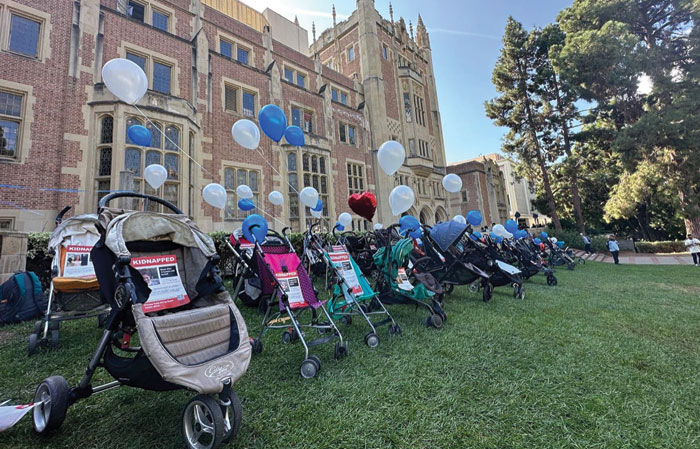
It was the sight of dozens of strollers being stored in the building’s lobby. 

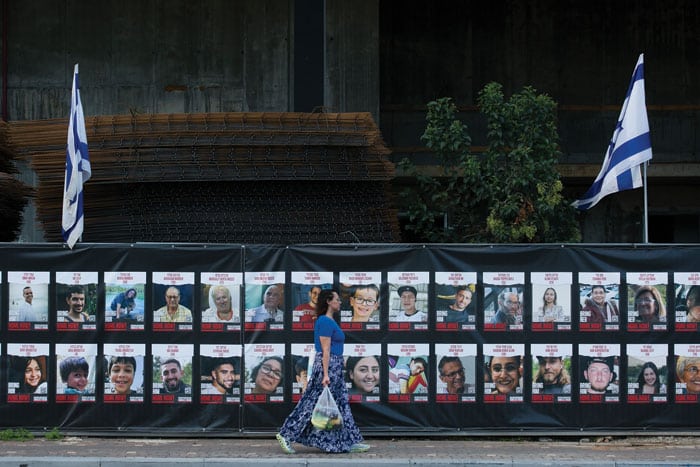
The strollers weren’t there because children were learning or playing at Hillel that day. On the contrary, they were there because of almost 40 missing children, who were captured by Hamas terrorists on October 7 and have been held hostage in Gaza ever since. These empty strollers would be displayed at our on-campus “Bring Them Home” rally later that day, marking the one-month anniversary of the atrocious attacks against the Jewish people and the State of Israel.

At that November 7 rally, I was deeply affected by the presence of those empty strollers as well as our immaculately decorated yet desolate Shabbat table – with empty chairs for the hostages of Hamas. To me, those objects served as the concrete manifestations of our heavy hearts, of our acute feelings of loss, and of our shattered, incomplete worlds. 

Their symbolism brought to my mind the famous verses in Chapter 31 of Jeremiah, which describe our matriarch, Mother Rachel (Rachel I’manu), weeping for the Jewish people. “A cry is heard in Ramah — wailing, bitter weeping — Rachel weeping for her children. She refuses to be comforted for her children, because they are gone.” 

Since October 7, we’ve found ourselves stuck in a harrowing new reality — Israel is fighting for its survival while the world grapples, once again, with the Jewish Question. After restless nights, we’ve been waking up to news reports of terror attacks, rocket sirens and infiltration alerts. We’ve formed an anxious routine of constantly checking in with our loved ones in Israel to see if they are safe. 

The media updates are a daily reminder that Israel is now in Week 6 — and counting — of this war. Still, hundreds of innocent hostages remain held in captivity in Gaza. The IDF’s forces, meanwhile, are actively operating in harm’s way in the terror-ridden enclave. The casualties keep mounting; there remains no clear end in sight to the conflict.

During the rally that afternoon, while I fixated on the empty strollers and the deserted Shabbat table, and contemplated the unimaginable plight of the hostages and their families, I could also imagine Rachel I’manu weeping for her children, who are gone.

I could hear Rachel I’manu weeping for the men, the women and the children taken hostage on Simchat Torah, as well as for their families and loved ones. Rachel I’manu weeps for the victims of the massacres, for the fallen soldiers, and for the brave warriors protecting the State of Israel. She weeps for the plight of the Jewish people, both in Israel and in the diaspora. 

Even though November 7, 2023 marked the formal completion of the shloshim stage of the mourning, our intense suffering and national grief persists. Now more than 40 days later, Rachel I’manu continues to weep bitterly. Her children are in danger and distress; there remains no consolation.

Will there ever be consolation? 

At the “Bring Them Home” rally that afternoon, after reflecting on those conspicuous and poignant symbols of loss, I took a fuller look at my surroundings. Beyond the empty strollers were hundreds of students, faculty, alumni and community members, all rallying together in the heart of UCLA’s campus in support of Israel. 

I saw magnificent Israeli flags waving softly in the breeze under the powder-blue Southern Californian sky. I thought of the Israeli national anthem — “Hatikva,” “The Hope.” Then I felt something that has eluded me for most of the war: I started to feel, perhaps, an inexplicable sensation of hopefulness. 

I felt the mood described in the very next verse of Jeremiah’s Chapter 31. “Thus said GOD: Restrain your voice from weeping, Your eyes from shedding tears; For there is a reward for your labor — declares GOD: They shall return from the enemy’s land.”

During the rally, I could feel, in a most tangible way, the unity and the resilience of the Jewish people. Observing the passionate yet peaceful crowd, I could sense our nation’s indomitable spirit. We are indeed the “nation that has survived the sword.”

I could also relate to the prophetic words in Jeremiah: “I will build you firmly again, O Maiden Israel.” I became convinced: after October 7, the Jewish people will indeed rebuild. In both Israel and the Diaspora, we will build houses, we will establish synagogues, and we will found schools. We will raise families and we will develop our communities. 

And yes, the citizens of Israel will return to those very towns and communities along the Gaza fence that were pillaged and marauded on Simchat Torah, and they will rebuild them, too. 

But then I wondered: how could I be so sanguine? Admittedly, the feelings of hopefulness couldn’t be based on any empirical evidence I had. 

Why was I optimistic?

After all, the rally was held at my school, UCLA, which, in recent weeks, like many other college campuses, has become an epicenter of a torrid wave of spiraling anti-Semitism in America. At universities nationwide, pro-Palestinian groups and their demonstrators — students and faculty members alike — regularly delegitimize the State of Israel and call for armed resistance against it. 

In their bravado, pro-Palestinian activists claim that their rhetoric is not even anti-Semitic. 

For Jewish students, it is now clear as day that our campuses are not, in fact, “safe spaces” for us. Each day, we can feel our Jewish identities and attachments to Israel under attack. 

And on the more macroscopic level, the Jewish people are in a most precarious state. Across the world, our enemies are emboldened to an extent not seen in decades. The mainstream media, too, hardly attempts to disguise their bias. Human rights groups have now largely forgotten the atrocities of October 7. Israel, the “nation that dwells alone,” is blamed squarely for the suffering of the Palestinians in Gaza. 

So, given these local and global developments, how could I have felt hopeful on a college campus during our November 7 rally? Did this even make sense?

Upon further reflection, I have come to accept that my emerging feelings of hope weren’t based on any logic, reason or any specific evidence I had.

Upon further reflection, I have come to accept that my emerging feelings of hope weren’t based on any logic, reason or any specific evidence I had. 

Instead, my hopefulness emanated from my intuition, and from an innate conviction that, despite the current situation that has set us reeling, the nation of Israel will live on. It was a hopefulness rooted in faith, in emuna, and trust in the power of the timeless Jewish spirit. 

Even while we mourn this ongoing tragedy, I have unbridled hope in the Jewish people and their resolve to rebuild. I can reconcile the majestic Israeli flags in that lively crowd, with those nearby empty strollers and the deserted Shabbat table. There is no paradox here. 

I now reflect on the timeless verse in Exodus, which describes how the Israelites responded, thousands of years ago, to the Egyptians’ stubborn attempts to oppress them through forced labor.

“But as much as the Egyptians would afflict them, so did the Israelites increase and so did they gain strength.”

After October 7, 2023, why would this time be any different?


Alex Rubel is a third-year student at UCLA.

Finding Hope Amid the Empty Strollers: Reflections on UCLA’s “Bring Them Home” Rally Read More »

As Peers and Professors Support Terror, Jewish College Students Find Refuge in Community

“My students often tell me that they feel scared on campus,” Ohr Ranim, an Israel fellow at San Diego State University (SDSU) said at a webinar held by the Jewish Agency for Israel on November 8.

“Some students are afraid to go to class,” said Ranim, who spoke on the Zoom call, titled, “Antisemitism on College Campuses Since Oct. 7th.” “Others feel uncomfortable sleeping near roommates who posted on social media something about Hamas or anti-Israel.

“Jewish students are taking down their mezuzahs in their dorm rooms. They are afraid to speak up because of the responses that they know they will get: Whether from their friends, from their coworkers and even from professors.”

Students who attend Harvard Business School have been taking off their kippot because they do not feel comfortable wearing them on campus, Sapir Reznik, the Jewish Agency’s Israel fellow at the Harvard Hillel, said.

Even Natan Sharansky, who spent nine years in prison in Soviet Russia, just for wanting to make Aliyah, said on the call that he, “was absolutely shocked that the first reaction on many American college campuses the awful pogrom of Oct. 7 was a statement of 34 organizations at Harvard and then [similarly hateful] statements from professors at Columbia University, Cornell University and many others who publicly expressed enthusiastic support for Hamas.”

Sadly, this is “the result of all of academia’s social liberation movements is to blame Israel for all of Hamas’s atrocities” said Sharansky, a former chairman of the executive of the Jewish Agency for Israel.

“It is awful, and at the same time eye-opening [for many Jews] that antisemitism and anti-Zionism go together as part of the leading progressive ideologies at the universities.”
– Natan Sharansky

“It is awful, and at the same time eye-opening [for many Jews] that antisemitism and anti-Zionism go together as part of the leading progressive ideologies at the universities,” said Sharansky, who identified the three D’s of anti-Zionist propaganda: the Demonization of Israel, the Delegitimization of Israel’s right to exist, and Double Standards applied to Israel that would not be applied to any other country under attack. 

“Those who claim to be for progress can, in fact, turn very quickly, into the very primitive, neo-Marxist, antisemitic approach,” he said.

Hamas’s recent attacks on Israeli civilians were so brutal, that through those barbaric attacks, “Hamas removed themselves from the family of human beings,” Gonen Ben Yitzhak, a longtime intelligence officer of Israel’s Shin Bet and political leftist, told Ami Magazine.

Nevertheless, in Los Angeles, just nine days after Hamas terrorists mutilated 1,200 innocent Israeli civilians and kidnapped 239 more Israelis who were celebrating Simchat Torah, the loudest, angriest students at UCLA were the pro-Palestinian activists. 

“Israel, Israel: You can’t hide,” many pro-Palestinian supporters on campus shamelessly chanted as they marched to an ominous drumbeat. They yelled, “We charge you with genocide,” which is now the pro-Palestinians’ widespread tragic mischaracterization of Israel’s counter-attack to protect its citizens: something any other country would do.

After hundreds of UCLA faculty witnessed pro-Palestinian students “celebrating” the gruesome massacres and kidnappings Hamas committed in kibbutzim and other Israeli communities that border Gaza City, 300 UCLA professors signed a letter that expressed their horror while witnessing pro-Palestinian students engaging in “explicit calls for violence.”

At UCLA, where pro-Palestinian students advertised events that featured images of weapons and violence,” and were chanting “Intifada,” the UCLA faculty called on UCLA Chancellor and CEO Gene Block, “to condemn the protests that cross the line from protected speech to unlawful incitement.” 

Thus far, Block has issued only bland statements that warn against acts of “antisemitism, Islamophobia, and anti-Arab hate” as if they are occurring at equal rates at UCLA.

Recently, Brandeis University was the first college in the country to ban a campus chapter of Students for Justice in Palestine (SJP), known for their violent hate speech that claims to be free speech.

Columbia University announced the school has suspended the campus chapters of SJP and Jewish Voice for Peace, but just “for the remainder of the fall term.” 

Many experts allege that the same sources of billions of dollars that originate in Qatar to fund Hamas’s terror activities also successfully influences many American liberal academics by funding prestigious chaired positions and making other large donations to America’s elite colleges.

While professors and college administrators have said nothing in response to their students’ vocal support for Hamas, some elite professors are not only attending the rallies, but encouraging their students to join them, Reznik reported.

Five Jewish students at Harvard, for instance, were left alone in a class, after one professor asked his students to join him at a pro-Palestinian rally, Reznik recalled.

“Everyone else had left, and so the five Jewish students left because they thought that class had been canceled,” she said. “But then, the professor and all the other students returned to continue class, without the Jewish students.”

Ori, a SDSU student who was born in Israel, said that lately, as he walks into the Alpha Epsilon Pi fraternity house, which proudly flies an Israeli flag, he finds himself, “looking over his shoulder.”

When Ori wears a t-shirt that bears a graphic of the Israeli flag, he finds many classmates “look at him like they want to punch him in the face,” said Ori, who is the president of his fraternity.

Just last week, along with a few of his friends, Ori was putting up posters to raise awareness of the 239 kidnapped Israelis, when “a few girls came just to tear the posters down, smile, laugh at us and harass us,” he said.

What helps Ori and many other Jewish students the most are the places and people who provide and strengthen Jewish community, connection and support at refuges like Hillel houses, Chabad houses and the Israel fellows of the Jewish Agency.

“On Oct. 7, Ranim dropped everything to speak with all of the students he could to process what was going on, what was the situation, and how can we help,” Ori said with gratitude. “And every day since, Ohr has helped us.”

Ranim, a young lawyer and entrepreneur, who serves in the Israeli reserves, wanted to serve as an Israeli fellow “to motivate students to combat misinformation about Israel and most importantly: to always be proud to be Jewish,” he said.

“I didn’t expect to see students fighting every day to be Jewish.”

As most college students consider themselves “progressive,” Jewish college students are trying to understand how they fit into the idea of what they thought was a liberal democracy, Reznik explained.

“Students’ modern values to which they feel obligated — their Jewish identities and their relationships to Israel — are now clashing at Harvard and other colleges,” she said.

To help foster unity, Reznik has helped students to create vigils, and she has organized speakers, and rallies, but the most important part of her job right now, she said, is to reach out to the Jewish students.

“We are talking to students one-on-one,” Reznik said. “We are trying to show students that their college Hillel, which is the Jewish home away from home, can reach out to them and be a safe environment.”

She continued, “The students feel trapped and are trying understand what to do. I am here.”

As Peers and Professors Support Terror, Jewish College Students Find Refuge in Community Read More »

Rabbis of LA | Rabbi Bernat-Kunin on Teaching During the Hamas War

Since October 7th, the students and faculty at Milken Community School have seen the world change. But Rabbi Gordon Bernat-Kunin, the rabbinic director and director of the Advanced Jewish Studies Center/Beit Midrash at the school said it’s “too soon to judge whether the changes are transformative (for the 800 students),” but added “they are definitely substantive.”

Bernat-Kunin probably is the best judge of student reaction since he has spent his entire 31-year career at the 32-year-old school.

When the students and teachers were brought together before classes on the Monday morning after Oct. 7, the rabbi asked himself “how do you create understanding from something so overwhelming to so many people within the school community?” 

When the students and teachers were brought together before classes on the Monday morning after Oct. 7, the rabbi asked himself “how do you create understanding from something so overwhelming to so many people within the school community?” At that moment, he said, “I felt tremendous gratitude for the Jewish tradition of prayers that made up most of ceremony, read by rabbis of our school.” As the rabbinic Head of School, Bernat-Kunin said “I attempt to integrate Jewish values, ideas, Jewish texts and practices into the fabric of the school.”

Since the Gaza War began, there have been changes on campus:

• Students in grade 12 attended a StandWithUs rally on Oct. 10, displaying their solidarity and support for Israel.

• In Milken’s Upper School Fashion & Design class, students are utilizing IDF fashion as inspiration for their upcoming designs.

• Rabbis at the Upper School are hosting a (new) daily morning minyan before school at 7:30 a.m. in the Beit Midrash.

• Upper School students met with Middle School students to discuss Israel and its history, helping to give younger students more context in a group lunch-and-learn setting.

• A blessing/prayer wall where students, faculty and staff can write messages of hope and memory for those affected.

These are examples of what Rabbi Bernat-Kunin meant when he said “I am inspired by the opportunity to work in an environment that is pretty rare. The mere act of the community coming together on Monday morning at 8 o’clock doesn’t happen often.” The rabbi noted the shofar was blown at the meeting “out of a sense of unity. How do we support one another? When you have a variety of students from grades six to 12, how do you teach the same thing to very different groups of people?”

The Tarzana native believes Milken is meeting the challenge. “We have been giving students immediate context by working with departments that have the ability to fashion a lesson that can go from grades six to 12,” Bernat-Kunin said. “We also are looking at social media and the question of how do you speak to students of different ages and background since Milken is a pluralistic day school.”

Bernat-Kunin’s path to the rabbinate began in 1984, after his junior year at Harvard. “A big influence on my interest in the rabbinate was participating, perhaps by accident, in the Brandeis-Bardin Institute’s BCI (collegiate) program in 1984. He was supposed to spend the summer working for a politician in Washington, but the politician changed plans. A good friend whose mother was on the board at Brandeis-Bardin was planning to spend time at BCI,” the rabbi said. “He invited me to join him.”

Career clinched.

“I found it absolutely inspiring, enthralling,” Bernat-Kunin said. “It was pluralistic community building, incredible learning, incredible arts. You felt as if there were different people on each of your shoulders pulling you in different directions.” He sounded as if, 39 years later, he still could not believe the irresistibility of this fresh look at Judaism. Bernat-Kunin said that “you could be with the influence of the great Dani Dassa, and he would be speaking to you of his love of the land of the Tanakh – and Jewish culture. Then you could have a Hassidic doctor who wanted to show you about Jewish meditation. He wanted you to wake up early in the morning to watch the sunrise.”

The school offered “amazing teachers on different sides of an issue. One was Dennis Prager. The other was Donniel Hartman, who had just finished his service with the Israeli army. He had grown up with one of the great scholars of the Jewish people, David Hartman.”

After graduating from Harvard, Bernat-Kunin enrolled at the Pardes Institute of Jewish Studies in Jerusalem. “A Pardes teacher told me something I have not forgotten: ‘The drama of the lesson is learning within the spaces between the words of the text.’”

Bernat-Kunin spent five summers working at BCI with the celebrated educator Dr. Bruce Powell.  One day Powell said to the newly ordained rabbi, “I am working at a new school, Stephen Wise Community School (Milken’s original name). How would you like to join me?”  

The rabbi’s four children – three boys and a girl — graduated from Milken, and all four spent the second semester of 10th grade in Israel, part of the Milken program. “When they were young,” the rabbi said, “we decided we wanted them to become as comfortable as possible in Israel. When I had a sabbatical, they ended up spending a full year in Israel. It was unbelievably rewarding.” Self-effacingly, their father said he “never will be like a native – but perhaps my children can.”

The rabbi’s three sons are currently in Israel. Two have made Aliyah and the third is spending his gap year at the Hartman Institute. Rabbi Bernat-Kunin’s pride was palpable. “When I watch the level of decisions they have to make in their lives, it is so beautiful, inspiring and daunting,” he said.

The rabbi has asked himself: What does it mean to build a bridge or have your child surpass you? His answer: “When I look at my children and see the choices they have made, it is amazing. All three sons are in Israel, and my daughter is about to be installed as a  rabbi at Sinai Temple.”

Fast Takes with Gordon Bernat-Kunin

Jewish Journal: Best non-Jewish book you ever have read?

Gordon Bernat-Kunin: Camus’ “The Plague.”

J.J. What do you do on your day off?

B-K: Go on long hikes with close friends. Sometimes I also go kayaking. 

J.J.: Your favorite Jewish food?

B-K:  The flourless chocolate cake.

Rabbis of LA | Rabbi Bernat-Kunin on Teaching During the Hamas War Read More »