This week, we met with a new member of Congress. She is graciously reaching out to clergy members to check in on the Jewish community. We shared our fears as to how Hamas is striking terror across the world. Vowing to wipe Israel and the Jewish people off the global map. She listened to our horror and witnessed our grief.
One of her questions was surprising. She looked at us and asked, “How do you predict this war will end?” We are rabbis. Not political analysts.
However, our experience as Jews has taught us much. After hearing testimony from Holocaust survivors, listening to first-hand accounts of Persian Jews fleeing Iran during the Iranian revolution and understanding the history of Israel and the Jewish people, a few predictions were easy to offer.
The Jewish people will prevail.
Israel will endure.
Will it be a long road of recovery? No doubt.
Will it take years to physically rebuild ravaged kibbutzim, destroyed homes and burned infrastructure? Certainly.
Will Israel be forever changed and is this a demarcation in Jewish history? Tragically, yes.
But the spark of hope within the Israeli and Jewish spirit is not so easily dimmed. When Haman sought to massacre the Jewish people, there was Esther, igniting courage and inspiring strength. Through the destruction of both Temples in Jerusalem and the expulsions from England and Spain, while our enemies wished for our disappearance, we remained rooted in tradition and peoplehood. And even after experiencing the murder of 6 million Jewish souls in the Holocaust, we continue to stand as a vibrant, diverse, Jewish community.
My prediction: Someone else’s calling and planning for Jewish demise does not determine our fate. It never has. It never will.
Am Yisrael Chai. That says it all.
We will endure. A bright spark of light that forever shines through the darkness of time.
Shabbat Shalom
Rabbi Nicole Guzik is senior rabbi at Sinai Temple. She can be reached at her Facebook page at Rabbi Nicole Guzik or on Instagram @rabbiguzik. For more writings, visit Rabbi Guzik’s blog section from Sinai Temple’s website.
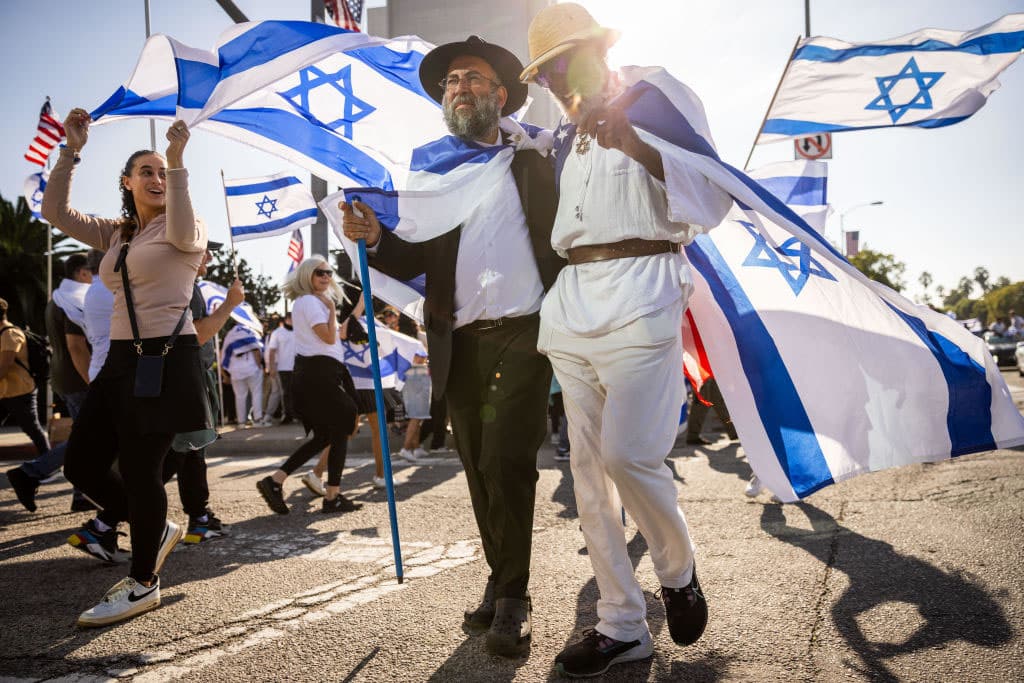
Nearly 400 members of the Iranian Jewish community gathered on Oct. 25 at the Eretz Cultural Center (ECC) in Tarzana for an event to show solidarity with Israel and raise money for three prominent Israeli non-profit groups helping Israelis after the Oct. 7 attack by Hamas terrorists.
“Eretz Cultural Center’s ‘Stand with Israel’ event was not just about raising funds, but to bring awareness to antisemitism, hate threats on college campuses, educate on the organizations and what they are currently doing for Israel and its people,” ECC Executive Director Rebecca Aghalarpour said. “More importantly this event was about unity.”
The gathering also featured prominent Jewish and non-Jewish community leaders such as Israeli deputy consul general Amit Mekel, Rabbi Abraham Cooper, associate dean for the L.A.-based Simon Wiesenthal Center and Los Angeles Police deputy chief Allen Hamilton.
A musical performance for Israel featured Iranian Jewish community members. Photo by Karmel Melamed
“Unfortunately, on that Shabbat, Oct. 7, we all experienced the worst slaughter of Jews since the defeat of Adolf Hitler in 1945,” Cooper said. “Yet from the moment they (Hamas) did that nightmare, we as Jews were awakened with a renewed unity and that kind of unity will help us prevail in the end.”
Aghalarpour said the ECC event raised roughly $300,000, all of which will be donated to the non-profit groups Beit Halochem for IDF Wounded Soldiers, Magbit Foundation and Jewish National Fund-USA.
ECC President Nader Gaim said the event was also an important gathering to help bring a sense of healing to many local Iranian Jews who have long been very supportive of Israel and were deeply pained by the events that transpired on Oct. 7 in Israel.
“I absolutely think that this event brought us together in Jewish unity, hope and that there is a light at the end of this tunnel,” Gaim said.
Amidst the greatest crisis Israel and the Jewish people have known in more than two generations, Jeffrey Herbst’s piece, URJ’s Call for a “Humanitarian Pause”, is more interested in sowing division than offering an “argument for the sake of heaven”. As the leader of the Reform movement in North America, recognizing our community is deep pain, I know that his efforts will accomplish nothing more than to further exacerbate divisions and tensions within the Los Angeles and broader Jewish communities.
At this terrible moment, the American Jewish community is overwhelmingly coming together to support Israel and one another in the face of war abroad and record levels of antisemitism at home. Los Angeles has seen too many of those horrific antisemitic attacks in recent weeks. Our responsibility is to stop this dangerous trend, even as we refute those within and beyond our communities who falsely accuse Israel of committing genocide (and are astonishingly silent about Hamas’ decades-old public call for genocide), rebut those who erroneously consider Israel a settler colonialist enterprise, and reject those who think murdered Israeli babies deserved their fate. As we do this, we must firmly denounce American Jews who, though united in supporting Israel’s just war, choose to launch spineless attacks on one another.
The author’s attempts to twist meaning and paint a false picture of the Reform movement’s unyielding commitment to Israel and the security of all her people is reprehensible. He also grossly mischaracterizes the profound difference between a humanitarian pause and a ceasefire. The pause called for by our organization will allow food, water, medicine, and other humanitarian aid to flow into Gaza – and as our statement noted, should only occur if Hamas does not divert these vital humanitarian resources. This is precisely what President Biden and Secretary of State Blinken, firm in their support of Israel, have advocated. Likewise, the Reform movement joins them in a belief that a ceasefire at this moment would be a tragic mistake and a strategic advantage to Hamas in its quest to eliminate the Jewish state.
I would also question those who, like the author, maintain there is no difference between a humanitarian pause and a ceasefire. Can they explain why Israel’s adversaries in this war opposed the U.S.-drafted UN resolution calling for a humanitarian pause? And why those same countries drafted a UN resolution calling for a ceasefire that both the U.S. and the U.K. vetoed? Apparently, these folks know something that every major government in the world is unaware of. It is unfortunate that Prof. Herbst has fueled his position by misrepresenting the Reform movement on this critical issue.
While we maintain the view that a humanitarian pause by Israel is morally and tactically warranted, we respect that others may hold their own views. But can we at least agree that all Jews who stand with Israel in its right to safety, security, and self-determination, alongside a Palestinian people who must be afforded those same rights via a negotiated solution, should refrain from publicly attacking each other and weakening the Jewish community when its heart is already breaking? Public smears do not serve our shared goal of helping Israel secure itself and return the hostages to their loved ones.
It is also wrong that Prof. Herbst chooses to proffer his argument by ludicrously suggesting that the URJ’s commitment to securing release of the 240 hostages is somehow evidence of lack of care for the plight of every Israeli who has been touched and terrorized by Hamas. Will the Israeli people ever be whole while these beloved members of our global Jewish family are held in the tunnels deep below Gaza? No one should attempt to downplay the suffering of the hostages or their families.
We face daily assaults across North America on college campuses, in the corridors of power and in the media, against which we must stay united and focused. As this war continues, the climate of opinion will shift further and further from Israel. Our shared challenge is to lovingly engage one another as we continue to make the case for Israel’s existential war not against the Palestinian people, but Hamas.
Rabbi Rick Jacobs is the President of the Union for Reform Judaism
The pro-Palestinian chants at UCLA could be heard well before one approached the courtyard, where hundreds of students had gathered for yet another rally. Rebecca, a second-year English major, hurried past the demonstrators, apprehensive about being identified as a Jew. ‘I make a considerable effort to navigate in and out of my classes without wearing my Star of David necklace anymore,’ the 20-year-old student revealed, who wished to be identified by her first name only. ‘There’s an underlying atmosphere of fear on campus. If you’re Jewish, fear is almost inevitable. Many of my Jewish friends actively avoid any potential conflicts. They attend classes, visit the library, and head straight back home or to their dorms.’
Similar apprehensions are voiced by Jewish students across campuses in the U.S. ‘We live in fear,’ and ‘The school administration fails to ensure our safety,’ are common sentiments expressed.
Dana, a 25-year-old law student at UCLA, spoke to the Jewish Journal under the condition of anonymity. ‘I’m wary of potential retaliation,’ she admitted. ‘Since this situation began, I try to avoid unnecessary strolls around campus. Many of my classmates display the black and white scarf associated with Palestinians and the Palestinian flag. I witness their gatherings and demonstrations, and honestly, it’s intimidating. I’m now cautious about what I wear, whether it’s a shirt with “I love Israel” or a Star of David necklace. I don’t want to face any form of retaliation. It’s bewildering that we, as Jewish students, feel fearful to show our support for Israel, while pro-Palestinian supporters express themselves openly. They know we are not violent people and that we will never attack them for the horrible things they are saying. But we’re aware of the risks to our safety and that’s why many of us choose not to get involved.”
On October 25th, a video surfaced depicting pro-Palestinian students chanting ‘Israel, Israel, you can’t hide, we want a Jewish Genocide,’ sparking widespread debates over the actual words used. Some claim the chant was ‘We charge you with genocide.’
Irrespective of the exact wording, Jewish students at UCLA express their unease attending classes amidst such rallies. ‘The concerning issue is that even some professors endorse these rallies and hold pro-Palestinian views,’ explained 19-year-old student Alex Katz. ‘When you know your professors support these views, there’s a fear of speaking up as it might impact your grades. Some of us have lost family and friends in terror attacks in Israel, yet we haven’t heard a word of compassion from our professors or the administration.’
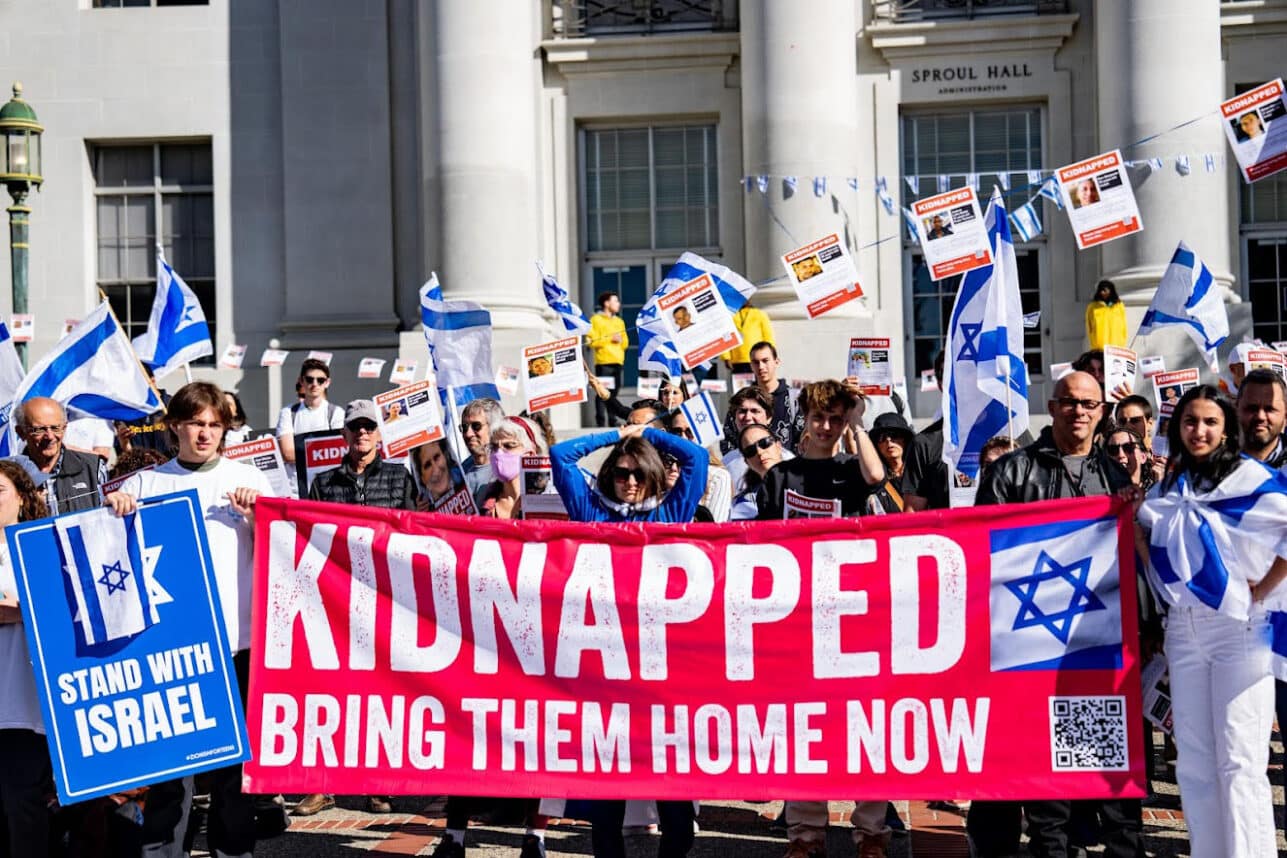
At UC Berkeley, Jewish students also feel alienated by their professors. According to students we spoke to, some professors have advocated for a day off from classes for pro-Palestinian rallies and offered a five-point credit if students attended. During one such rally, a professor even expressed the opinion that Israel has no right to exist.
Daniel Conway, the co-president of “Bears for Israel,” has always been outspoken and proud to be Jewish. Living in Los Angeles, he had never experienced antisemitism. The first time he encountered it was when he got to Berkeley.
“These past weeks have left me feeling unsafe on campus,” he said. ‘The Graduate Student Instructor (GSI) permitted class cancellations for students to attend pro-Palestinian rallies. Influential figures are advocating for Bears for Palestine, which typically promotes a highly anti-Israel rhetoric, even celebrating acts of terrorism against Israel. It’s deeply unsettling.”
Conway and his mother attempted to address their concerns with the school administration but received a standard response: “We do everything to protect your children.” However, it appears that Jewish students feel the administration isn’t doing enough to ensure their safety. “They assure us of security during rallies, yet at every pro-Palestine rally, a Jewish student has been attacked. Just last week, a Jewish student was struck by a metal bottle, yet none of these assaults are labeled as “hate crimes.”
Ariel Mizrahi, Associated Students of the University of California (ASUC) senator and chair of the Jewish Student Union at UC Berkeley said that the display of support for pro-Palestinian students, without equivalent support for Jewish students, leaves Jewish students feeling alienated by the professors and the administration alike.
“We have a sense that the administration is brushing us off when we bring our concerns to them. Jewish students aren’t safe on campus and they still say there is nothing to worry about. There is a sense of uncaring. They say they are protecting us but they don’t communicate how they do so.”
Mizrahi said that in each pro-Palestinian rally there were Jewish students who got hurt. All of the incidents were reported to the campus police and yet, nothing has been done about it.
While UC Berkeley claims professors are not allowed to cancel class in order to allow students to go on rallies, this is exactly what had happened. “They are not enforcing their own conduct rules” said Mizrahi. “There are many Jewish students who are not comfortable saying they are Jewish or reporting their professors who are clearly pro-Palestinian to the administration because they are afraid they will give them grade deductions. I had multiple students come to me and say they want to leave the school and go to a less prestigious school, just so they can feel safe.”
Mizrahi said that she had met with school administration and raised her concerns multiple times but sensed that her words fell on deaf ears.
“I asked them how many Jewish students need to be attacked or killed in order for them to take action? How many Jewish lives need to be at risk for them to care? It feels like Jewish lives at UCB are worth less.”
Photo by Ben Weiss-Ishai
When asked whether she regrets choosing UC Berkeley, despite being accepted to several other prestigious universities, Mizrahi surprisingly replied, “No. I was forewarned about Berkeley before arriving here, and I made the conscious choice to attend for that very reason. I believed there were aspects I could influence and was prepared to take on that challenge, but I didn’t know how difficult it’s going to be. I find myself disappointed in my school; it’s not the prestigious university it claims to be.”
Amid all they hatred they feel on Campus, there is one beacon of light. Many Jewish students found a safe haven in Chabad Berkeley run by Rabbi Gil Leeds and his wife Bracha.
Rabbi Leeds said that he sees an increase of students attending their Shabbat dinners. “Last Friday night 125 students came for dinner. I see also a lot of interest of students to put Tefillin. They stop by our table in campus and ask to put Tefillin and say a prayer. Those are students I never met before. It’s almost a sense of resistant with all the hate that is directed at us. Yes, we are Jewish and we are proud to be.”
Still, Rabbi Leeds acknowledges the fact that many Jewish students choose to hide their Jewish identity and are afraid to participate in pro-Israel rallies. “There are many students who don’t want to get involved because they are afraid. People have been openly hostile to Jews on campus and I understand they are scared. If you hide your Jewish identity you might not be a victim, but it’s not a solution. We need to stand all together and show how strong and united we are.”
In response to questions from the Journal, Dan Mogulof, ass’t vice chancellor, Office of Communication and Public Affairs, emailed “While we understand how upsetting and frightening some of these demonstrations have been for Jewish students, they are protected by the First Amendment of the Constitution. We might not like it, but even hate speech is protected and, as public university, we cannot shut down or prevent anyone or any organization from expressing their point of view outside of the classroom. To do so would be breaking federal law. We would [be] sued. We would lose.”
And regarding the professor who was quoted that Israel has no right to exist:
“When acting in their private capacities, University employees have the same rights and responsibilities as any other member of the public, including freedom of speech, as guaranteed by the Constitution. At the same time, individual employees, including faculty, do not speak for or represent the values, perspectives or positions of the University. It is a different story if classrooms are being used for political advocacy.”
Tomer Peretz, 41, traveled to Israel with his two young sons to attend a wedding on October 2. Five days later he awoke to the sound of sirens and a new and terrifying reality. The memory of October 7th, 2023 will forever be remembered as the worst terrorist attack in the history of the State of Israel.
Two days after the attack, Peretz volunteered with ZAKA, a volunteer-based organization known for its work in disaster and terrorist attack response. He arrived with them at Kibbutz Be’eri, tasked with the grim mission of collecting the scattered bodies and body parts in the area. The haunting scenes from that day are etched in his mind along with the pungent smells. What he witnessed during that week he recounted in this chilling interview.
Peretz, a professional artist with ties to the fashion industry, told the Jewish Journal how he found himself volunteering with ZAKA; “On Friday, before everything began, I sat with friends from my unit, we shared a meal and exchanged stories. The very next day, my unit was called to action. Despite being diagnosed with PTSD after my military service which exempted me from reserve duty, I couldn’t bear to sit at home and do nothing. So, I called a friend of mine who had been volunteering with ZAKA for 25 years and asked to volunteer. On Monday, I was already in Nahal Oz in Be’eri, working alongside them to collect the bodies.”
ZAKA doesn’t typically recruit volunteers on such a short notice and for such a gruesome task, but Peretz was determined. His commitment made him one of them in no time. “I’ve never done anything like this before, but my friend who volunteers with ZAKA for 25 years, is familiar with my military service and he thought I’d help from outside and not actually go into the field and collect bodies, but that’s what happened. The truth is that I didn’t leave him much choice either.”
By the time Peretz and ZAKA arrived in Be’eri, the bodies had started to rot. It was two days after the massacre and a war field like nothing they had ever experienced before awaited them.
“The first body was that of a woman who was shot in the face until there was nothing left, they just kept shooting even after she was killed. It was Monday morning and by then the bodies were swollen and had worms. They were scattered everywhere, in and outside the homes, some of them had limbs, fingers, feet, hands amputated, or an eye taken out. It was clear that they had been severely tortured before being shot or burned alive. I saw a mother hugging her little boy in an attempt to protect him and they were both burned, there was a couple who were burned together but the man’s body was not completely burned and you could still see the severe whipping on his back. I saw a baby with an axe in his head. In general, there were a lot of babies with decapitated heads. ZAKA volunteers who are used to collecting bodies after terror attacks and disasters went aside to vomit, some fainted. The friend, the team leader of the international delegation, brought me there. He has been to disaster scenes like Turkey and Haiti said he had never seen anything like this before. Hamas’ cruelty shocked us all. In one of the mamads (Israeli secured shelters) we found a 50-year-old man. He killed 15 terrorists and after he was eventually caught, they amputated all his fingers, he somehow managed to escape to the safe room, where he died of smoke inhalation after they burned the place. We found the bodies of the terrorists he killed in the area.”
ZAKA meticulously places each body within a bag, carefully noting the corresponding house number and the specific injuries observed, such as a missing hand, right leg, or an eye. Subsequently, the team searches the immediate area for any severed organs, which are then appropriately bagged. “One of the most distressing moments I witnessed involved burned bodies,” said Peretz. “At one point, I was handed a small bag containing the remains of a young child. I didn’t inquire about its contents; I was simply stunned. As I carried the bag toward the truck, someone told me that it held the charred remains of a little boy. It was an incredibly difficult moment, and we both struggled to hold back our emotions. Every passing second, you find yourself stepping aside, overwhelmed with grief, and tears flow freely. We recited a prayer, the Kaddish with a rabbi while encircling the bodies wrapped in plastic bags.”
Each day, Tomer and the crew of volunteers returned home for a few hours’ sleep before they were scheduled to come back and continue their work. The first night, they just sat and talked until 3am. During that first week, none of them were able to sleep well, the devastating images of entire families tortured and burnt alive too hard to comprehend. In one home the volunteers found a family of four tied up, all dead. The father was missing an eye, the little boy’s fingers were all cut, the little girls’ feet amputated, her mother was missing one breast. While the family was lying there bleeding and in sheer agony, the terrorists were sitting at the dining table eating. The thoughts of what the victims experienced during their last hours on earth don’t let go of anyone who had witnessed the horrors firsthand.
“Actually, my nights have become harder now,” admitted Peretz, “When you’re in the midst of a war, your mind is constantly occupied with the tasks at hand. However, now that I’m back here in Los Angeles, my mind has more room to reflect, and it’s difficult to grapple with the situation from a distance. There’s a strong urge to be there and continue helping but I have a wife and three children who need me.”
Perez has lived in Los Angeles for 18 years and is the father of three children, aged 5, 9 and 11. His decision to volunteer was a source of concern for his family, particularly his parents, who were understandably worried. Initially his wife had difficulty accepting his choice, but she soon began to offer her support.
From the moment Peretz arrived in Be’eri and later at the Nova festival area, he never ceased his efforts to document the atrocities. His goal was to ensure that the world had an opportunity to witness and comprehend the gravity of the situation. Most Zaka volunteers primarily consist of ultra-Orthodox men, using “kosher” phones that lack cameras, they found it perplexing that the new volunteer was consistently recording.
“One of them said to me, ‘You’re recording too much,’” Perez said. “I responded, ‘The world needs to witness this.’ Their mindset leaned more toward safeguarding families. These are deeply spiritual individuals who view their work as a sacred duty, a great Mitzvah. They don’t prioritize social networks. Coming from a different background I understood the vital importance of these images and videos for the world to gain insight into what occurred here.”
Peretz is acutely aware that, despite the extensive documentation, there are still individuals who deny the events in Israel, much like Holocaust deniers. He clarified that he doesn’t attempt to persuade these deniers but rather focuses on engaging with those who are genuinely interested in understanding and learning.
“I often encounter those deniers on social media. However, I don’t invest my time and energy in debating them,” Peretz explained. “My preference is to educate those who are unaware of the truth and are genuinely seeking to learn. Engaging with deniers is often futile because they will invariably find something to dispute. Whether I present evidence like the bag containing the charred remains of a child or even the child’s body itself, they will assert its doctored or manipulated. Regardless of the proof offered, deniers tend to adhere to their biases, disliking Jews and disregarding the facts. This pattern of denial and hatred is nothing new for us Israelis.”
During these operations, rocket attacks continued in the area, forcing the volunteers to find shelter behind some vehicles. In order to deal with everything he had witnessed, Peretz said he receives a partial treatment. “Every other day I speak with someone. ZAKA has now included me in a support group that has a psychiatrist and a therapist. I recognize the importance of self-care. Additionally, keeping busy has been a saving grace for me. I’m deeply involved in advocacy work, frequently moving from one interview to another. Currently, I’m also working on an art installation scheduled for November 5th. We’ve created a space, complete with a stage and setting, reminiscent of the Nova Festival. The event will host 1700 people, with 1400 simulating the deceased and experiencing horrors, 200 simulating abductees, and 100 simulating the missing.”
A few months ago, Peretz, a gifted painter, was working on a fashion line he named “War Is Over.” He reflected, “I declared then that the war was over, and then all of this happened.”
Tomer Peretz and his fashion line: The War is Over (Photo by Sarah Orbanic)
Peretz characterizes ZAKA’s work as “the dirtiest job in the world.” Yet, it is also a noble mission performed by a group of truly righteous people who are dedicated to ensuring that the deceased receive a proper Jewish burial. This is done not only for their sake but also to provide closure for their grieving families.
I did it – 36 miles to raise funds to help send kids to Jewish Summer Camps in Southern California. Thank you all who sponsored my ride! Now, more than ever, our kids need to have access to meaningful Jewish experiences that uphold our support for Israel in these very difficult times.
I want to say that the ride was glorious.
It was not. Why? One word with two pronunciations. You choose whichever you want.
“Windy.”
There were moments of the ride that were super windy. At times it was both windy and windy.
And it exhausted me.
As always, I find metaphors.
Our Jewish journey is rarely an easy one. The Israelites winded their way through the desert for 40 years. Jonah faced a fierce wind on his voyage from Jaffa.
And today – we continue to battle twisted narratives of history, blowhards who learn about the Middle East from Tik Tok videos, and academics who create false truths when teaching the next generation.
And with all this – we continue to travel the windy road. And while it can be exhausting, we will never, for even a moment in time, think of quitting.
If you’re wondering why so many Jews, from left to right, have such a short fuse lately, look no further than Ghazi Hamad, a Hamas leader with an affinity for clarity.
“Israel is a country that has no place on our land,” Hamad said in an interview with Lebanese TV that has blown up on social media. “We must remove it because it constitutes a security, military and political catastrophe to the Arab and Islamic nation. We are not ashamed to say this.”
The massacres of Oct. 7, Hamad added, are “just the first time, and there will be a second, a third, a fourth.”
For those of us who have been paying attention, these vows of Jewish annihilation are nothing new. It’s written in black and white in the Hamas charter.
So why are so many people now so stunned?
Because October 7 changed everything.
A terror attack that kills three Israelis is not the same as a terror invasion that massacres 1400 Israelis– including babies, infants, women, families and the elderly.
The sheer magnitude of these atrocities, in other words, has forced everyone to pay attention.
And here’s the thing about murdering, raping and mutilating 1400 human bodies—it leaves no room for nuance. The cruelty overflows with clarity.
No wonder so many people jumped on the activist group IfNotNow, who forever discredited themselves when they saw the massacres and immediately blamed Israel:
“Israel makes every day under apartheid a living hell for Palestinians. Human beings can’t live like this…. Blood is on the hands of Israel’s fascist government, army, and everyone who has aided their crimes against Palestinians.”
IfNotNow saw the worst Jewish calamity since the Holocaust and chose to stick to their usual pro-Palestinian talking points.
In that sense, the unprecedented magnitude of Oct. 7 has been a clarifying moment. It has shown us people’s true colors.
It has also brought clarity to how most Jews have reacted to everything that has followed that darkest of days.
When we think of babies slaughtered and women raped and families burned alive, our revulsion at the assault on Jewish college students across U.S. campuses has zero nuance.
Our revulsion at those blaming Israel or the “occupation” for the massacres of Oct. 7 has zero nuance.
Our revulsion at college leaders, politicians, Hollywood personalities and others who have been wishy-washy in their condemnation of the barbaric slaughter of 1400 Jews has zero nuance.
Our revulsion at those college leaders who have failed to protect Jewish students during this epidemic of anti-Jewish hostility has zero nuance.
Our revulsion at the haters who are tearing down posters of Israeli hostages has zero nuance.
For many of us, October 7 is a day that shattered nuance. It is one of those transcendent moments that might permanently reset the Jewish table, a day when so many Jews lost their innocence.
The trauma of losing 1400 Jewish souls and then seeing much of the world rise up against Jews will not easily go away. It is now hardwired in our collective memory.
We’re not fooled by the current focus on Israel’s efforts to eradicate Hamas. We know that many of those who are now bashing Israel and calling for a “ceasefire” were also bashing Israel right after Hamas murdered 1400 Jews.
We’re not fooled by the leftist intellectuals who use Israel as a battering ram for everything they hate about the West, from colonialism to capitalism to white privilege to nationalism.
The trauma of losing 1400 Jewish souls and seeing much of the world rise up against Jews is not going away. It is now hardwired in our collective memory.
We’re not fooled by a biased media that now gleefully highlights Palestinian deaths in Gaza, because we know that the cowardly murderers of Hamas, who hide behind their own women and children, are ultimately responsible for every single Palestinian casualty.
And of course, we’re not fooled by those reflexive calls to make “peace” with those who are sworn to our destruction.
We don’t know where this war is going, but we know where the Jews are going.
After the bewildering and surreal darkness of Oct. 7, followed by the biggest burst of Jew hatred in recent memory, the great majority of Jews have picked a side.
Amy Schumer quoted a comment made Martin Luther King’s comment about the silence of friends regarding violence in Forward on 11/1/23:
Schumer previously posted an image of MLK to Instagram with his quote, “in the end, we will remember not the words of our enemies, but the silence of our friends.” She turned the comments off.
It is as if MLK was prophesying about the contemporary situation in which people who claim to be philosemitic friends of Israel react with silence to the antisemitic October 7 Hamas pogrom.
Gershon Hepner is a poet who has written over 25,000 poems on subjects ranging from music to literature, politics to Torah. He grew up in England and moved to Los Angeles in 1976. Using his varied interests and experiences, he has authored dozens of papers in medical and academic journals, and authored “Legal Friction: Law, Narrative, and Identity Politics in Biblical Israel.” He can be reached at gershonhepner@gmail.com.
George Washington University (GWU) President Ellen Granberg condemned the projections of “Glory to our martyrs” and other anti-Israel slogans onto George Washington University’s (GWU) library on October 24.
According to photos posted to X, formerly known as Twitter, by Stop Antisemitism, other slogans included, “Divestment from Zionist genocide now” and “From the river to the sea Palestine will be free” on the Gelman Library; the library is named after Melvin and Estelle Gelman, both of whom were Jewish philanthropists. Estelle Gelman served on the board of the United States Holocaust Museum, among other Jewish nonprofits.
“Students are projecting horrifying messages onto a school library building glorifying Hamas terrorists that beheaded babies, raped teenage girls, and murdered 1400+ people,” Stop Antisemitism wrote on X. “We call on President [Ellen Granberg] to immediately expel those involved.”
George Washington University – students are projecting horrifying messages onto a school library building glorifying Hamas terrorists that beheaded babies, raped teenage girls, and murdered 1400+ people.
In a subsequent post, Stop Antisemitism showed footage purportedly showing four students behind the projection arguing with police and refusing to move.
The four students responsible for the pro terrorist light show are now being confronted by police.
They refuse to move and continue to argue with police.
The GW Hatchet, the university’s student newspaper, reported that the four students were from the university’s Students for Justice in Palestine (SJP) chapter and they put 10 statements on the library in the span of around two-and-a-half hours. Among the statements were “GW the blood of Palestine is on your hands” and “2,000 Palestinian children were murdered by ‘Israel’ in the last two weeks,” per the Hatchet. The student paper also reported that the four SJP members were ordered by police to shut down their projection, and they eventually did so following “a tense conversation” with police and university officials that lasted about 15 minutes.
“Last night, multiple images were projected onto GW’s Estelle and Melvin Gelman Library by a group of individuals, including GW students, acting in violation of our university policy,” Granberg said in an October 25 statement. “They do not speak on behalf of the George Washington University. These images included antisemitic phrases that have caused fear and anxiety for many members of our Jewish and broader GW community, and we wholly denounce this type of conduct. Further, these statements do not contribute to the environment of rigorous debate and discussion that is expected at GW.”
She added that the “images were removed as quickly as possible, but I know this does not heal the deep and painful wounds it has opened across our campuses. As our university stated this morning, GW is reviewing this incident and will take appropriate steps in accordance with university policies.”
Earlier that day, the university had released a statement saying that the projections were “unauthorized” and acknowledged the “ the distress, hurt, and pain this has caused for many members of our community.” This initial statement received backlash on social media for failing to mention antisemitism.
Why didn't you use the words "Jewish" … "Jews" …. "antisemitic" … "antisemitism" even one time?
Lame! Why can’t you also put in there that the statements projected on our walls were repulsive. That glorying the martyrs who are murderers, rapists, torturers, and kidnappers, is shameful.
The projections received national attention, including from members of Congress. According to the Hatchet, Senate Minority Leader Mitch McConnell (R) said on the Senate floor on Wednesday, “At George Washington University here in the nation’s capital, student activists projected antisemitic messages on the side of a campus building named for a pair of Jewish benefactors. They issued a call to free Palestine from the river to the sea. For anyone unfamiliar with Israel’s geography, that is a call for the destruction of the Jewish state.”
Representative Josh Gottheimer (D-NJ) posted on X, “Hamas brutally murdered, raped, & kidnapped more than 1,400 innocent people, including Americans. Now, there are messages being displayed at George Washington University glorifying terrorism. [Granberg] must explicitly condemn Hamas & act against terrorist sympathizers.”
Hamas brutally murdered, raped, & kidnapped more than 1,400 innocent people, including Americans.
Now, there are messages being displayed at George Washington University glorifying terrorism.@PresidentofGW must explicitly condemn Hamas & act against terrorist sympathizers. https://t.co/4SOSS6Uks8
Jewish Insider obtained a letter from a bipartisan group of members from the House of Representatives on October 25––all of whom are GWU alumni––who said they were disgusted at the projections on the library. “The glorification of Hamas terrorists and calls for the destruction of Israel is vile and antisemitic,” the letter, addressed to Granberg, stated. “GW must condemn these actions in the strongest possible terms and take immediate steps to protect its Jewish students.” The letter also noted that almost 25% of the students at GWU are Jewish and they “fear for their lives and do not feel safe. GW must make clear to its student body that this despicable behavior won’t be tolerated, and an investigation must be launched without delay.”
Anti-Defamation League CEO Jonathan Greenblatt posted on X, “It happened last week at @nyuniversity too. This effort to intimidate Jewish students is absolutely appalling — but it’s the indifference of [GWU] and the lack of leadership at so many other universities that’s even more painful.” Greenblatt’s post was on Tuesday evening, before Granberg’s statement was published.
It happened last week at @nyuniversity too. This effort to intimidate Jewish students is absolutely appalling — but it’s the indifference of @GWtweets and the lack of leadership at so many other universities that’s even more painful. https://t.co/YgAr53bCIf
“Time to shut checkbooks when a university lacks the moral decency to stop the promotion of genocide of the Jewish people,” the Simon Wiesenthal Center declared on X.
Estelle + Melvin Gelman paid for the @gelmanlibrary at @GWtweets. Time to shut checkbooks when a university lacks the moral decency to stop the promotion of genocide of the Jewish people. https://t.co/hxmcM9l6tu
Sabrina Soffer, a student at GWU, posted on X that after the projections were shut down, “students hung around speaking with the police and amongst themselves. Some were verbally harassed and threatened. I saw a few crying. Students don’t feel safe and feel like ‘they have to leave DC.’” “This is a severe and pervasive situation,” she added. “It interferes with our education. Jewish students fear going to class. They can hardly focus. Now they have to worry about physical safety. Why are my family members trembling in bomb shelters in Israel asking me if I’m safe? Absurd.”
Soffer continued on X: “The tragedy of it all is that those glorifying Hamas hurt the Palestinian people most. The Palestinian people deserve better advocates – those who aren’t Israel hating ideologues but who care for true Palestinian freedom & peace. Antisemitism NEVER pays. #FreePalestineFromHamas”
Eventually the scene was cleared while students hung around speaking with the police and amongst themselves. Some were verbally harassed and threatened. I saw a few crying.
Students don’t feel safe and feel like “they have to leave DC.”
This is a severe and pervasive situation. It interferes with our education. Jewish students fear going to class. They can hardly focus. Now they have to worry about physical safety.
Why are my family members trembling in bomb shelters in Israel asking me if I’m safe? Absurd.
The tragedy of it all is that those glorifying Hamas hurt the Palestinian people most. The Palestinian people deserve better advocates – those who aren’t Israel hating ideologues but who care for true Palestinian freedom & peace. Antisemitism NEVER pays. #FreePalestineFromHamas