fbpx

October 7, 2023

Iran’s Fingerprints Seen Behind Hamas’s Murderous Rampage

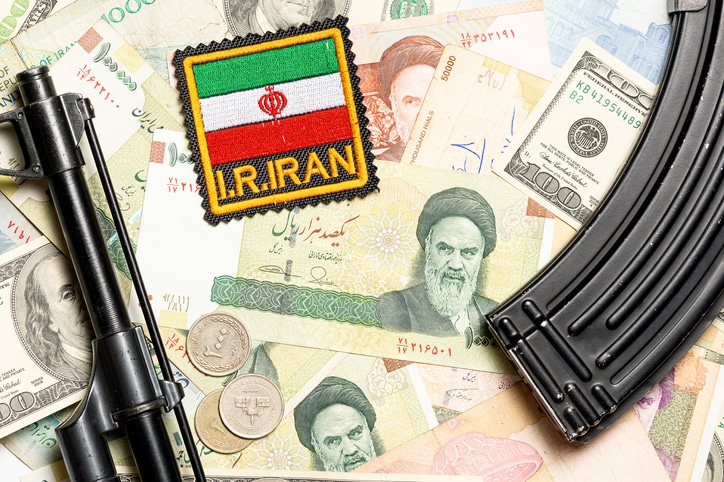
(October 7, 2023 / JNS) Current and former Israeli defense officials suspect Iranian influence played an important role in Hamas’s decision to stage a series of mass murder and kidnap raids on the South on Saturday.

During a Zoom call with journalists organized by Media Central, Eyal Hulata, who was Israel’s national security adviser from August 2021 to January 2023, discussed “the Iranian fingerprints on both potential [Hamas] planning and motivation, in light of attempts to normalize [relations] with Saudi Arabia.”

Both Tehran and Hamas stand out for their desire to act as “spoilers” to the Saudi-Israeli normalization process, which would likely benefit the Palestinian Authority at Hamas’s expense, Hulata assessed.

“Hamas clearly wouldn’t have wanted this to go. If Iran needs a player to act, it’ll be more in Gaza than in Lebanon,” he added. “There are reasons for the spoilers of the region to put their heads up. Our enemies around us think Israel is weaker now. That is a concern of mine.

“All of this is now in the background. We need to fight back and do whatever we can to bring our people back,” Hulata said.

“This morning, Hamas embarked on the deadliest terror attack in Israel’s history. They’ve been planning this for a long time, obviously. This is a very coordinated attack, and unfortunately they were able to surprise us tactically and cause devastating damage in casualties, people murdered in their beds and homes, and an unknown number of people taken back to Gaza. Civilians and soldiers have been abducted,” he continued.

“This is unprecedented. Hamas has never done something like this. We never encountered that. The fact that they felt they could or should do it is very alarming.”

The fact “that this happened 50 years after Yom Kippur War is on everyone’s mind,” Hulata said. “They were hoping to mimic this event. Clearly, everyone is thinking that and is worried about this failure, which is grave and devastating. The IDF spokesperson said it will be investigated. But at this point, the crucial issue is first how we end the fighting in Israel and then conduct fighting in Gaza.

“This will end with devastating results in Gaza and if Hezbollah gets involved it will end with devastation in Lebanon,” the former national security adviser said.

The large number of Israeli hostages taken to Gaza “complicates everything,” he added.

The Israeli Cabinet is likely weighing a range of options, Hulata said, including the option of conquering all of Gaza. “If I was national security adviser, I would want to hear that option and weigh it compared to other options,” he stated.

“Iran’s tentacles everywhere”


Lt. Col Richard Hecht, the IDF’s international spokesperson, said during his own comments to international media that “Iran has tentacles everywhere,” when asked about its likely role in the Hamas onslaught.

All military options “are on the table,” he added.

“Hamas has declared war, a combined offensive on Israel,” said Hecht, describing its attacks on Saturday as involving some 3,500 rockets fired including very heavy salvos on Tel Aviv, and a major ground invasion of Israel.

There were still 22 locations late in the day where we were engaging with terrorists who entered “Israel from the sea, the land and the air. Some of the locations we cleared, some of the locations, fighting still happen [there],” he said.

“We have a severe hostage situation in Be’eri and Ofakim, still ongoing. We’ve mobilized mainly special forces to deal with these events. There’s a very strong professionalism on how to deal with this kind of event in these elements of the military. I can confirm we have hostages and casualties. I don’t want to go into numbers but they are substantial,” he said.

“Right now we’re fighting; there will be lots of discussions about intelligence [failures] down the road,” said Hecht.

“Right now we are focused on two courses of action: returning security around Gaza and the planning by the prime minister and IDF General Staff on future steps in Gaza. There will be a severe response to this inhumane attack,” said Hecht.

Earlier on Saturday, Israel Air Force jets struck military infrastructure in two multi-story buildings in the Gaza Strip that senior Hamas operatives use for carrying out terrorist activity.

In one of the buildings, the IDF struck the military offices of a number of units and arrays of the Hamas terrorist organization, including the Hamas intelligence headquarters, its weapons production offices and other offices belonging to senior Hamas organization leaders.

The other building contained military offices used by Hamas’s General Security Service, the IDF said.

According to Hecht, “Hamas has a massive amount of projectiles. They’re going to fire as much as they can. It’s still early days. PIJ [Palestinian Islamic Jihad] is also probably involved.

“We’re moving and mobilizing forces right now. Mainly mobilizing reservists to the South and special operations intervention units for communities under attack,” he said.

The next 50 years in Gaza

Defense Minister Yoav Gallant said on Saturday, “Today we saw the face of evil. Hamas has launched a brutal attack against the citizens of the State of Israel, attacking men, women, children and the elderly, indiscriminately. Hamas will understand very quickly that it has made a mistake—a grave mistake—and will pay a [heavy] price.

“Fifteen years ago, as head of the [IDF] Southern Command, I came close to ‘breaking the neck’ of Hamas. I was stopped by the political echelon. This phenomenon will not continue. We will change reality on the ground in Gaza for the next 50 years. What was before will be no more. We will operate at full force. I ask Israel’s citizens to remain determined and to support our security forces,” Gallant said.

Earlier, IDF Spokesperson Rear Adm. Daniel Hagari said, “There are strikes by the air force in several locations. UAVs, scanners [sensors] and fighter jets are striking in the area of the [Gaza border] fence. Hundreds of such strikes were carried out—hundreds of deaths, including many terrorists.”

He continued, “In the [IDF] Northern Command we are on high alert, there are currently no events there but we are ready for any event and whoever attacks us in the entire northern arena will pay a very heavy price. Our focus is on Gaza but we are on high alert in case we encounter any incident, we currently do not have such information [about such enemy activity].”

Iran’s Fingerprints Seen Behind Hamas’s Murderous Rampage Read More »
An End to Politics and Diplomacy as Usual

The attacks on Israel on Shabbat and a holiday morning by Hamas terrorists are more than just shocking examples of barbarism. The toll of Israeli dead and wounded—not to mention those kidnapped and taken into the Gaza Strip by these murderers—is sickening. And it should alarm and enrage civilized people everywhere.

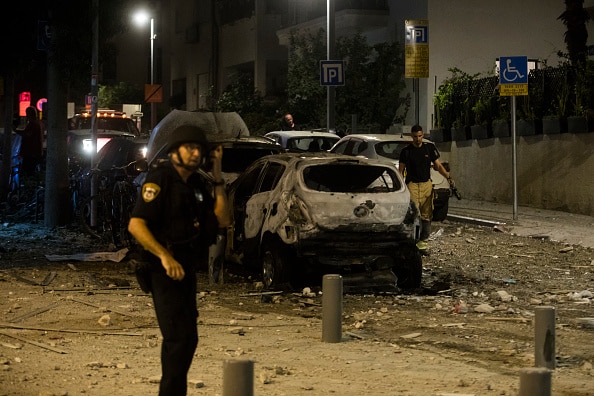
The full extent of the horror on the southern border, coupled with a barrage of thousands of rockets and missiles fired at Israeli villages, towns and cities, is yet to be determined. Nor can we be sure what will follow after the first day of what Israeli Prime Minister Benjamin Netanyahu has rightly characterized as a “war,” and whether it will spread to include Iran and its Hezbollah terrorist auxiliaries in Lebanon.

But we do know this. It is an event that changes the Middle East. All the rules that have governed the way Jerusalem deals with its terrorist foes and their Gaza stronghold since it fell under Hamas control in 2006—in which the Israeli government and military have always sought to limit the conflict—must now be thrown out.

Above all, it must be an end to politics and diplomacy as usual in Israel, the Diaspora and the West.

Whatever strategies and tactics that the Jewish state adopts as it seeks to reassert control over its border, rescue those held hostage and punish those responsible for these crimes, some basic principles must govern the response to these events.

The first is that the Jewish people and those who care about Israel must unite. After a year of political division and a culture war that threaten to tear Israeli society asunder and undermine its economy and security, those arguments must cease there and elsewhere. The magnitude of this crisis is comparable to that of past wars in 1948, 1967 and 1973. And so must be the response of those who claim to be Israel’s friends and supporters.

It may be difficult to imagine the current politically fractured, more heavily assimilated Jewish community of the United States that is far more alienated from Israel than it once was coming together as it did during those days. But nevertheless, that is the model that the Jewish world and sympathetic non-Jews must follow. It must be clear to the world that when Israel is under attack and Jews are being murdered, the solidarity of the Jewish people and decent people everywhere with Israel must be unquestioned.

Second, there must be no tolerance or acceptance of the usual narratives and biased media coverage of the conflict that focus more on Israel’s responses than on Palestinian terrorism itself, and which often seek to demonize the Jewish state’s justified measures of self-defense.

Those who seek to wipe Israel off the map—whether by terrorism or political means—are engaging in a global attack on the Jewish people. The rising tide of antisemitism that is sweeping across the world in recent years is driven in large part by anti-Zionist propaganda. Anything that seeks to legitimize the goals of the terrorists to destroy Israel must be rightly labeled not just as hateful but as a form of antisemitism that must not be normalized or allowed to be represented as part of mainstream opinion in the West.

If Hamas cared about the safety of the population of Palestinian Arabs living in Gaza who languish under their tyrannical Islamist rule, they would not have started this war. They will, no doubt, continue to use the people under their control as human shields. That is a tragedy. But worries about the suffering of Palestinians caused by Hamas’s actions cannot be allowed to color the responses to efforts to save Israeli hostages, and take out the terrorists and their military infrastructure.

The civilized world must fully support Israel’s counterattack. Any talk of proportionality or the need for restraint on the part of Israel as it copes with this assault on its citizens should be rejected.

Such bloody terrorism is not a natural response to Palestinian frustration or an effort—as Hamas falsely asserts—to prevent harm from being done to the mosques on Jerusalem’s Temple Mount.

When Hamas talks about ending the “occupation,” it is not speaking about pushing Israel back to the 1967 armistice lines or complaints about Jews living in the heart of their homeland in Judea and Samaria or Jerusalem. As far as Hamas and other Palestinian groups are concerned, “occupation” refers to the existence of Israel within any boundaries. Their goal is not freedom for their people since if that was what they wanted, the Islamists as well as their supposedly more “moderate” opponents would have accepted any one of the compromise peace offers extended to them in the past. What they want to do is to kill Jews and eliminate the Jewish state.

Sadly, those sentiments are not merely present among extremists but also part of the mainstream of Palestinian political thought and culture. The shameful scenes in which Palestinians have been shown celebrating terrorism and exulting over the dead bodies of murdered Jews or hostages must not only not be forgotten; conclusions should be drawn about what this means in terms of the future of the conflict and what the goals of diplomacy should be.

Any reportage about this war that doesn’t make that clear isn’t merely biased against Israel. It constitutes an adoption of terrorist talking points that legitimize their wrongful insistence on continuing their century-old war on Zionism that has become inextricably tied up with Palestinian national identity.

Third, Hamas and its allies must gain no political or diplomatic benefit from their crimes.

The current imperative for American foreign policy and that of other nations must be to ensure that this unprovoked and appalling tragedy must not be exploited by the forces that have launched this war.

Any discussion in the current context of redoubled efforts to resurrect a two-state solution to the conflict that Palestinians have repeatedly rejected over the past decades must end. On the contrary, rather than a way to stop the violence, the existence of the terrorist-run independent Palestinian state in all but name in Gaza is proof that such a plan is a guarantee of more suffering and bloodshed.

Hamas—no doubt acting with the knowledge and support of Iran—seeks to derail the widening circle of peace in which Arab states have embraced normalized relations with Israel. This war is clearly, at least in part, a response to efforts to involve the Palestinians in negotiations between Saudi Arabia and Israel. The Jewish state’s burgeoning alliance with the desert kingdom is the result of rational assessments of the national interests of both Middle Eastern countries and their mutual fears about Tehran’s quest for regional hegemony and a nuclear weapon. This war is a reminder that the Palestinians must no longer be allowed to hold Arab nations hostage to their intransigent refusal to accept the legitimacy of a Jewish state, no matter where its borders are drawn.

There will be time enough in the days and weeks ahead to fully assess how much responsibility those who have sought to appease both the Palestinian terror organizations and Iran must bear for this tragedy. The same is true with respect to assigning blame for what can only be termed a catastrophic failure on the part of Israel’s security establishment.

But for now, the priority must be to ensure that Israel’s borders are protected, its people’s safety ensured, and that those responsible for these criminal acts must be severely punished and no longer allowed to launch attacks on the Jewish state with impunity. Any other response from individuals, organizations and their leaders, politicians or governments is unacceptable.

May God watch over the people of Israel and those tasked with their defense. May their efforts be victorious. And may the hateful enemies of the Jewish state be made to understand that their crimes and evil intentions will no longer be tolerated by the civilized world.


An End to Politics and Diplomacy as Usual Read More »

Israelis Traumatized Over Hundreds Dead as Hamas War Continues

On Saturday morning, Israel woke up to the harshest terror incursion in the country’s history. Hundreds of Hamas gunmen from the Gaza Strip overwhelmed the border by land, sea, and air, attacking Israel’s civilian communities, where they indiscriminately killed or wounded soldiers and civilians alike.

The Israeli government has reported over 700 dead and more than 2000 injured, including women, children, and the elderly. Scores of Israelis were kidnapped and moved inside the Gaza Strip, though no official number has been reported yet.

The Israeli army arrived at the sites of incursion a few hours later and fought the terrorists for several hours, eventually announcing that it killed over 200 gunmen and regained most of the captured territory. Those civilians who managed to reach bomb shelters and saferooms, where they locked themselves inside, were stuck there for several hours with no way to communicate with the outside, no electricity, and in many cases, no food and water.

Dozens of terrorists also reached a major rave party taking place at Kibbutz Reim next to the border with Gaza, where they shot and killed many of the partygoers, injuring and kidnapping others. Participants who managed to run away from the danger stayed hidden and unable to communicate with their families, creating uncertainty and chaos within many Israeli homes.

Simultaneously, some 3,000 rockets were fired from Gaza into the neighboring Israeli communities and cities in central Israel, including Tel Aviv and Jerusalem.

Prime Minister Benjamin Netanyahu has since declared war and vowed to retaliate with all the nation’s might. Until now, Israeli airstrikes have leveled areas of Gaza, hitting hundreds of targets. Tens of thousands of Israeli army reservists have been called up, reinforcing the belief that a ground invasion will likely follow.

On Saturday evening, while Israelis from the South were still dealing with terrorist infiltrations in their communities, residents and tourists in central Israel were rushing to bomb shelters, seeking protection from repeated rocket barrages raining down on the country.

Kovie Adar, a tourist from New York who is in Israel visiting his family for the holidays, told The Media Line about his experience during the last 24 hours. Adar was in a neighborhood in Givatayim, in central Israel, where one of the Hamas missiles hit.

“We were in the bomb shelter. It’s an older building and does not have a saferoom, so we went to the bomb shelter, and it was really loud, like a sonic boom, really scary, oh my God,” he said.

Robert Owen, a tourist from London, was also close to a rocket that landed in the heart of Tel Aviv. “Last night was the worst time; we went down into the shelter from the hotel, and as we were coming down, I heard a pretty loud bang, which I realize now was a hit on the building around the corner, which was quite scary,” he told The Media Line.

After a day of missile attacks and much uncertainty, people in Israel are trying to cope with the unprecedented situation.

Meira Erez, a Tel Aviv resident and shop owner, told The Media Line that the events of the last day reminded her of the Yom Kippur War, which was also a surprise war that started exactly 50 years ago.

“It’s difficult, it’s a very difficult feeling. We never had such a situation like this. Fifty years after the Yom Kippur, and now it’s Simchat Torah. It’s awful,” she said.

Adar compared what he is living with the events of 9/11. “I was in New York on 9/11; I lived in Manhattan at the time, far from the towers, but that was the closest thing I have ever experienced to this,” said Adar.

Tom Bitton is a resident of Tel Aviv and, together with his wife, owns one of the shops in central Tel Aviv that was hit by a rocket.

“I’m the owner of this business, JusterArium,” Bitton told The Media Line. “Yesterday, some of the neighbors told us that the store was hit, and we saw that everything was broken here. We saw that the building was hit by a rocket, and we came back this morning to try to take what we could and what we hoped would be good.”

Rachel Adar, an Israeli expat living in New York, says that this situation has no precedent. “I don’t remember anything like this, never ever. I’ve been through the Six-Day War … but it was nothing like this. It was quite scary,” she told The Media Line.

People in Israel are in acute shock over what they just lived through during the last day and a half.

“Such a massive attack from the air, from the sea, from everywhere; in parachutes, they came. I don’t think anybody could have imagined it,” said Erez.

Poaz Wang, a tourist from Taiwan, told The Media Line that he was visiting Israel for pleasure and also for business and that he had never been in such a situation. He was scared because his hotel was very close to where the rocket hit in Tel Aviv on Saturday night. “I cannot imagine something like this happening in my country,” he added.

The streets of Tel Aviv are normally packed with residents and tourists but now cafés are serving few patrons as a palpable fear lingers.

However, despite the fear, The Media Line found in the heart of Tel Aviv a large pop-up network of volunteers who were collecting and packing donations for soldiers and civilians.

Shahar Agami, one of the volunteers and a resident of Tel Aviv, said that the rockets were the least of their worries. Their first priority is helping the soldiers who are defending the country and the residents of southern Israel who were affected by the terrorist incursion.

“What is more important for us is our soldiers; they are fighting, and we are very worried,” she told The Media Line.

Agami described how the massive donation initiative in central Tel Aviv started spontaneously through social media groups.

“We had this WhatsApp group, and many people who were part of other WhatsApp and Facebook groups noticed that there was a collection point to buy, organize, and bring food to soldiers as well as to the civilians in the South who need new things after their houses were ruined, broken, and burned. Everything is spontaneous here,” she said.

To read more stories from The Media Line, click here.

Israelis Traumatized Over Hundreds Dead as Hamas War Continues Read More »

Prime Minister Benjamin Netanyahu and Defense Minister Yoav Gallant at the site of a terrorist attack in the South Hebron Hills in Judea, Aug. 21, 2023. Credit: PMO.

Netanyahu: We are at war

“We are at war, not in an operation or in rounds [of violence], but at war. This morning, Hamas launched a murderous surprise attack against the State of Israel and its citizens. We have been in this since the early morning hours,” Netanyahu said in a video address from the Kirya military headquarters in Tel Aviv.

“I convened the heads of the security establishment and ordered—first of all—to clear out the communities that have been infiltrated by terrorists. This currently is being carried out.

“At the same time, I have ordered an extensive mobilization of reserves and that we return fire of a magnitude that the enemy has not known. The enemy will pay an unprecedented price,” the prime minister continued.

“In the meantime, I call on the citizens of Israel to strictly adhere to the directives of the IDF and Home Front Command. We are at war and we will win it.”

Hamas killed more than a hundred Israelis on Saturday as the terrorist organization fired 2,500 rockets at the country’s South and Center and sent dozens of terrorists into communities located along the Gaza border.

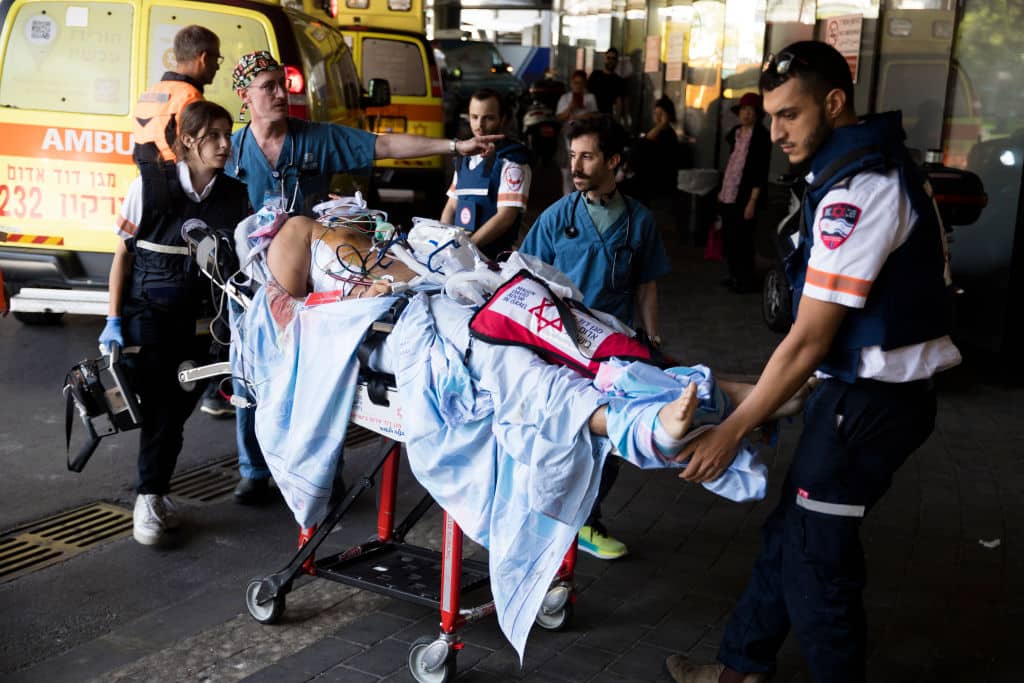
More than 900 Israelis were evacuated to hospitals across the country, almost half of them to Soroka Medical Center in Beersheva and many to Barzilai Medical Center in Ashkelon.

Hamas said it had abducted soldiers and civilians and taken them back into the Gaza Strip.

Netanyahu convened a security meeting at the military headquarters attended by Defense Minister Yoav Gallant and other high-ranking officials.

The Israel Defense Forces was ordered to a “state of war readiness” and Gallant authorized a “special security situation” within 80 kilometers of the Gaza Strip, enabling the IDF to close relevant sites and impose safety restrictions on the population.

The IDF later announced the launch of an operation named “Iron Swords.”

Netanyahu: We are at war Read More »