Why is it that Sukkot always has a way of sneaking up on us?
No matter what day the holiday falls on, Neil and I always find ourselves in the sukkah at midnight, still putting on the final touches.
In each of our homes, our sukkah was the first thing we built. We build a permanent structure that stands in our back garden all year long and every Sukkot, we cover the top with palm leaves and add trellis on the sides.
Decorating the Sukkah is a major creative outlet for me. I hang Moroccan table clothes and curtains on the sides. I hang twinkle lights and Moroccan lanterns. It’s just like a casbah.
Little tea lights and beautiful flowers adorn my tables.
Of course when my kids were young, we had plenty of their art projects and they proudly displayed it.
Neil and I grew up in apartments, so we don’t take our Sukkah for granted. Its with great joy and gratitude that we sit in our sukkah with family and friends with lots of festive and traditional foods.
Its a lot of work but these moments are what bring us together and create lasting memories.
—Rachel
The first Sukkah in my memory bank is forever engraved in my mind. I must have been four years old when my brother Rafi and I came home from school and my father proudly showed us the Sukkah he had built in our backyard.
I was amazed by the little hut he had built! The roof and walls were made completely of s’chach — spiky green palm fronds artfully arranged. My father decorated the sukkah with fruit — stems of fresh yellow dates, oranges, pomegranates and green and red apples—all hanging from the ceiling of the sukkah with butcher’s twine.
I remember my father’s pride and happiness that my brother and I were so excited about that first Sukkah.
Every year, my father joyfully took on the mitzvah of building the Sukkah. He would always be in search of palm fronds because it wasn’t a real Sukkah without the palm fronds.
Every year, my father joyfully took on the mitzvah of building the Sukkah. He would always be in search of palm fronds because it wasn’t a real Sukkah without the palm fronds.
Over the years he planted date palms in all our homes, so that he would be guaranteed palm fronds for Sukkot. He loved palm trees and dates were his favorite food, a legacy of his childhood in Baghdad.
This Sukkot, my brother Danny will take on the mitzvah of building a Sukkah for my mother. He will use palm fronds for s’chach and he’ll arrange the entrance of the Sukkah with the same arch made of the long palm fronds that was my father’s signature.
My extended family will gather in my parents home and we will remember how much my father loved this holiday.
My father’s other favorite foods were rice and sautéed onions. And even better when they were served together. He would tell my mother “Please fry more onions! I’ll peel and chop them for you.”
So this Sukkot in my father’s memory, my mother will cook one of his favorite dishes — Fish Pilau Im’tabak — a classic dish from the Iraqi/Babylonian Jewish kitchen.
This layered dish is an exquisite marriage of sautéed onions, tomatoes, rice and fish with a dash of curry lending an earthy, spicy sweetness.
This layered dish is an exquisite marriage of sautéed onions, tomatoes, rice and fish with a dash of curry lending an earthy, spicy sweetness.
When we’re done eating, one of us will repeat what my father used to say when he was finished eating “I’ve lost my appetite!” And we’ll be grateful for the old memories and the new ones.
—Sharon
Nana Sue’s Fish Pilau Im’tabak
2 lbs firm whitefish fillets
1 lemon
1 tsp kosher salt
1/2 tsp white pepper
1 tsp turmeric
Oil for frying
Squeeze juice of lemon over the fish. Sprinkle the salt, pepper and turmeric on the fish.
Warm oil in a large skillet over medium heat, then add the fish and fry until golden brown. Place fish on a dish and set aside.
3 cups basmati rice
4 1/2 cups cold water
2 tsp salt
1/4 cup extra virgin olive oil
In a heavy pot, soak the rice for 10 minutes, then rinse well.
Add the water, salt and olive oil, then bring to a boil over high heat, stirring occasionally.
When all the water has boiled away, remove from heat and place lid on the pot.
1/3 cup extra virgin olive oil
5 medium onions, cut into 1/4 inch round slices
1 tsp sugar
1/2 tsp salt
1 tsp curry
6 large tomatoes, cut into 1/4 inch round slices
Warm oil in the large skillet over medium heat. Add the onions, sugar and salt, then sauté about 5 minutes until the onion has caramelized.
Layer the tomatoes over the onions, then add half the cooked rice over the tomatoes.
Layer the fish and onions over the rice and top with the remaining rice.
Cover the skillet, lower the heat and allow to steam for half an hour.
Place a large serving platter over the pot and carefully flip the pot over.
The Im’tabak should look like an upside down layer cake.
Rachel Sheff and Sharon Gomperts have been friends since high school. They love cooking and sharing recipes. They have collaborated on Sephardic Educational Center projects and community cooking classes. Follow them on Instagram @sephardicspicegirls and on Facebook at Sephardic Spice SEC Food.
“(In)sights: Peacemaking in the Oslo Process” by Gidi Grinstein with Ari Afilalo begins with a quote from the Tanakh, ‘Seek peace and pursue it’ (Tehillim 34:15).It is a powerful verse — made all the more impactful by its simplicity, but just as the Talmud takes a single line of scripture and expands upon its every hidden implication, “(In)sights” reveals the countless complexities, considerations, breakthroughs, liaisons, setbacks, and headaches that come into play when one actually attempts to “seek peace and pursue it” in the real world.
Many of these messy details will be confounding to anyone who isn’t a career diplomat. Rather than a straightforward set of deliberations on key issues, peacemaking apparently involves public negotiations alongside multiple secret backchannels, negotiators who have been instructed explicitly to stall, and demands engineered to sink the whole process. Instead of dispassionate professionals talking brass tacks at a table, there are often screaming fights and tears.
But through it all, we are told, Grinstein never stopped wearing a certain novelty tie, “classic dark blue with a gentle design of doves,” to important meetings — a striking visual symbol of the Oslo process itself, in which the highest ideals of peace collided with the frustrating realities of politics, power, and compromise.
Thirty years ago, Gidi Grinstein was “the youngest and most junior member” of the Israeli delegation at Camp David — the place where the Oslo peace process came to a dramatic climax and promptly fell apart.
Thirty years ago, Gidi Grinstein was “the youngest and most junior member” of the Israeli delegation at Camp David — the place where the Oslo peace process came to a dramatic climax and promptly fell apart when, seven years after the signing of the first Oslo agreement, PLO leader Yasser Arafat rejected Israeli Prime Minister Ehud Barak’s best offer.
Gidi Grinstein (Gahlrinat/Public Domain)
In the years that followed, other members of the delegation would pen their memoirs of the historic peace process, each intent on answering the question on everyone’s mind: “What went wrong?”
That it has taken 30 years for Grinstein to write his own account can be attributed to two reasons. The first is stated explicitly in his book. He was young and “just” the secretary of the delegation, “neither a principal nor a major decision-maker.” As such, coming out with his own analysis could have been interpreted as overstepping boundaries.
“Frankly,” he writes, “I thought it would be bad for my career. Principals do not generally appreciate seconds who document and analyze their actions.”
There is, however, a second unstated reason, which is that he seems fundamentally ambivalent about the purpose of such a book.
Is it a memoir — a personal account of his time in the rooms where world history was being made? Is it a eulogy for a failed vision of peace? Is it an autopsy? Or is it a guidebook for future peacemakers, who will need such a resource when the conditions for negotiations again “ripen”?
The book itself is undecided on this matter. This is by design. “Beyond the historical value of documenting Gidi’s stories,” writes co-author Professor Ari Afilalo, “our book is also designed to support future negotiations.”
By design or not, however, one senses a hesitance in the writing. The book holds back from fully entering into the “narrative” aspects of Grinstein’s story, though it is neither a straightforward book on policy and principles geared towards wonks and visionaries.
In this, I’m reminded of a passage from the Talmud. In a deliberation about the ancient Yom Kippur ritual, the text pauses to ask what purpose there is in pouring over minutia from the past.
One potential solution is offered: We aren’t asking about the past but the future, when the Messiah comes and the Temple Service is restored.
The Talmud rejects this answer. Our learning isn’t for the sake of the past or the future. Rather, it is for the present — so that we, right here and now, can have better understanding and wisdom.
As I read “(In)sights,” I kept this in mind. The book was not quite a tale of the past, nor was it quite a guide for the future. It did, however, help me understand what exactly we are talking about when we talk about the pursuit of peace between Israel and the Palestinians.
The Oslo process unfolded like a quest in a fantasy novel — a desperate search for a magical talisman which, when found, would change the world forever.
The Oslo process unfolded like a quest in a fantasy novel — a desperate search for a magical talisman which, when found, would change the world forever. The name of this much-sought entity was “FAPS,” an inelegant-sounding acronym for “Framework Agreement on Permanent Status.”
In the 90s, the Oslo Accords led to the creation of certain interim arrangements between Israel and the Palestinians. Chief among these was the creation of the Palestinian Authority as the representative political body for the Palestinian population, as well as the division of the West Bank into areas of Palestinian or Israeli control.
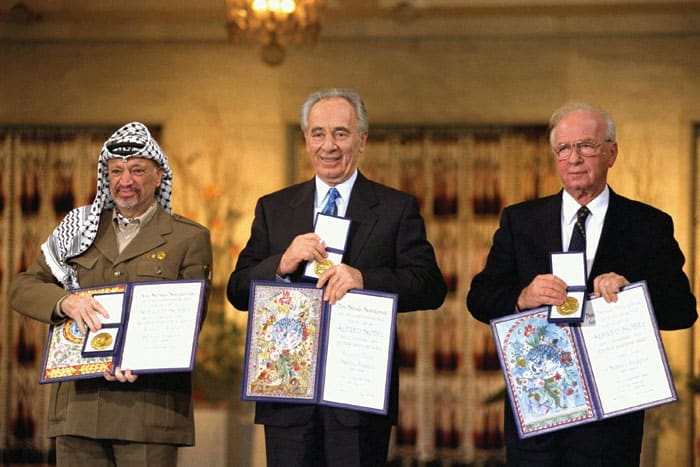
From Left: Palestinian leader Yasser Arafat, Israeli Foreign Minister Shimon Peres and Israeli Premier Yitzhak Rabin display their Nobel Peace Prizes December 10, 1994 in Oslo, Norway. (Photo by Yaakov Saar/GPO via Getty Images)
These interim arrangements sidestepped crucial outstanding issues, including Palestinian refugees, the status of Jerusalem, security, water, and access to holy sites — leaving all of that for the elusive FAPS, which, when settled upon, would answer all questions and end all disputes.
For anyone who suffers under the misconception that the peace process ought to be simple, the story of the search for a FAPS is a helpful antidote. Securing a peace deal with a stateless population is far more complex than forging peace between two states — as Israel did with Egypt, for instance. After this is settled, there remains a complex web of issues pertaining to security, resources, and recognition.
Grinstein’s book details how the Israeli delegation navigated these matters to arrive at Ehud Barak’s historic offer — a Palestinian state on nearly all of the territory of the West Bank and Gaza with its capital in Jerusalem—an offer that, perhaps shockingly or perhaps predictably, led not to peace, but to the outbreak of terrible violence and the collapse of the peace process itself.
Observers worldwide were (and are) shocked by Arafat’s rejection of this exceedingly “generous” offer. The reason that this is shocking, however, is because we believe that the two-state solution serves the Palestinians’ interests more than Israel’s and that it is therefore something which Israel would grant only begrudgingly.
“It is a paradox that the ultimate achievement for Zionism in securing a territory for the Jewish People hinges on having a bilaterally agreed and internationally recognized border with the Palestinians, with no further claims.”
Grinstein, however, argues that this is not actually the case. Barak’s FAPS would more vitally serve a Jewish/Israeli interest. In creating permanent and final borders for the state of Israel, a FAPS would essentially finish the work of Zionism, making Israel a clearly defined entity whose existence is recognized even by its most avowed enemies. “It is a paradox that the ultimate achievement for Zionism in securing a territory for the Jewish People hinges on having a bilaterally agreed and internationally recognized border with the Palestinians, with no further claims.”
Such a closing of accounts, however, would essentially put an end to the Palestinian national movement’s dream of a Palestinian state in all of Mandatory Palestine.
From this perspective, neither Arafat’s rejection nor Barak’s offer is so shocking. The Palestinians, far from being desperate for an offer, knew that “accepting” statehood meant giving up key leverage.
Grinstein’s account is a tribute to the hardworking individuals who pushed for peace under the leadership of Ehud Barak. It is not, however, without critique of some of the assumptions underlying this process.
One of these is the very idea of making a FAPS the final goal of the peace process. It would have been better, according to Grinstein, to work towards a semi-autonomous Palestinian pseudo-state within provisional borders and then worry about settling the fine details later.
Similar approaches have been popularized in recent years by thinkers like Micah Goodman — the Israeli author who advocates “shrinking the conflict” rather than solving it. By working to reach agreements on small, solvable problems, the occupation can be lessened without having to devise an overarching FAPS that somehow satisfies everyone involved.
Another key assumption of the Oslo process that Grinstein calls into question is the idea that unilateral action should be avoided. Had Arafat followed through on his threat of unilaterally declaring Palestinian independence, Grinstein muses, perhaps that would have been a blessing for the process in the end. Had Israel decided unilaterally on final borders without Palestinian consent, maybe this would have moved things along.
But in 2023, the idea of either unilateral or bilateral peace is likely to raise eyebrows amongst many Israelis. In 2005, Israel unilaterally withdrew from Gaza. Instead of peace, it led to the takeover of the Gaza strip by Hamas and a nonstop cycle of war that lasts to this day. Bilateral agreements, on the other hand, hardly have a better track record. The collapse of Oslo led to the second intifada.
And so the Israeli public has, in many ways, stopped believing that peace is possible. Whether or not this was true at Camp David, the situation is demonstrably worse today.
Today, the Palestinians have no single representative governing body which could negotiate with Israel on their behalf. There is the Palestinian Authority in the West Bank, run by President Mahmoud Abbas of the Fatah party, but there is also the Gaza Strip, dominated by Hamas. Even if Israel did strike up a deal with the PA, the matter of Gaza would remain unsettled.
For its part, Israel is no longer run by the likes of Ehud Barak. Instead, Israel is currently governed by the most right-wing government in its history, replete with ministers who are avowedly pro-annexation and against the formation of a Palestinian state.
The amount of settlers in the West Bank has doubled since the days of the Camp David summit, threatening any future Palestinian state’s contiguity and viability. Also, the trauma of the evacuation of settlers from Gaza in 2005 has transformed the idea of such withdrawals into a political nonstarter. In other words, the Palestinians shouldn’t expect any more offers like they received from Barak in the near future.
This hasn’t fundamentally changed the Palestinian leadership’s expectations, however. Offers of a state on less than 100% of the West Bank and Gaza, like the Trump plan, are not so much as countenanced.
Both sides, according to Grinstein, believe that time is on their side. Sober analysis reveals how deeply untrue this is. Israel is rushing towards a one-state reality that threatens the Zionist dream of a Jewish and democratic state. Palestinians, meanwhile, are holding out for a better offer when no such offer is on the way.
Still, Grinstein is not a pessimist. “Millions of Palestinians and Israelis do not want to share a society and be part of the same nation, effectively rejecting the notion of the current situation in the West Bank as permanent. Their collective energy will, at some point, be transformative.”
When will this happen? Well, Grinstein says we must wait for “ripeness.” When the time is “ripe,” he writes, “hitherto-decades-old insurmountable problems can be creatively resolved in days or hours.” In other words, we must wait — wait for a shift in zeitgeist, a “synchronization of clocks,” a wind of change.
This prognosis reminded me of a Haaretz column from last year by Rogel Alpher titled, “Only a Black Swan Event Will End the Occupation.” The Black Swan theory, created by Nassim Nicholas Taleb, describes rare, unpredictable, and highly impactful events that defy conventional expectations. These events challenge the reliability of historical data and models, emphasizing the need to be prepared for the unexpected.
The column depressed me. It was, if nothing else, a sign that prospects of a peace deal have become so grim that all we can hope for is a vague, nameless, future something. We might as well wish upon a star.
Such events have shifted the course of Israeli history before. Think of the current protest movement or the Abraham Accords. Even the foundation of the state of Israel itself can be considered a Black Swan event.
That said, such events have shifted the course of Israeli history before. Think of the current protest movement or the Abraham Accords. Even the foundation of the state of Israel itself can be considered a Black Swan event.
At some undisclosed point in the future, perhaps another such event will trigger “ripeness.” Something will happen that will make Palestinians decide that the time has come to end their struggle against Israel and build a state. Something will change that will make Israelis realize that a lasting peace is worth more than expanded borders.
Towards the end of his book, Grinstein writes: “Zionism — the outlook that calls for the Jewish People to have a state in the Land of Israel, where it realizes its right of self-determination — has been a Jewish prayer for nearly 1,900 years.”
In truth, the dream goes back even further than that.
We are at a point in our Jewish calendar when we conclude the yearly cycle of Torah readings. The book of Deuteronomy ends with the Israelites poised to enter the promised land — but the narrative drops off before they actually cross that boundary. A week later and we begin again with the creation of the universe.
Readers eager to see the happy ending play out, and to watch the Israelites actually ride off into that sunset, can turn to the book of Joshua. But the book of Joshua is about conquering and dividing the land. In other words, we don’t actually get to see the Israelites settle down into their new homeland. All we see is more seeking, more war, more pain.
Surely, after that, things get easier. But alas, in the book of Judges, we see that the Israelites have not reached stasis. They are continually at war with their neighbors.
By the time we get to the book of Kings, we have tales of foreign empires invading the land, laying siege to the cities, and exiling the Israelites.
There is something terribly upsetting about these narratives. The Israelites have come to the Promised Land to build a society and serve God, but they never quite find material security. Their placement remains precarious. Their situation remains vulnerable. No FAPS — no permanent status — is ever achieved.
Modern history mirrors this story, for both Jews and Palestinians. Both peoples want a final settling of accounts and a laying down of arms, but neither can accede to the full extent of the other’s demands. And so the quest for a FAPS remains forever on the far side of a litany of outstanding issues with no clear solutions.
What I took away from this book is the same lesson I take away from the troubled history of the Israelites portrayed in the Tanakh — namely, that there is an absurdity to the quest for finality, for permanence, for happily ever after. In a world of flux, of clash, of conflict, we are setting ourselves up for failure when we make this our goal.
We dream of permanence, we speak of “never again,” we declare our “eternal capital.” But the truth is that no status is really permanent in this world.
I can’t speak for Palestinians, but I know that this idea is very frightening to Jews. We dream of permanence, we speak of “never again,” we declare our “eternal capital.” But the truth is that no status is really permanent in this world.
Better that we admit it now and take Grinstein’s advice — waiting for the moment to be ripe and then moving forward in a pursuit for provisional peace instead of a FAPS. It’s less idealistic than a novelty tie with doves, but it will have to do.
Matthew Schultz is a Jewish Journal columnist and rabbinical student at Hebrew College. He is the author of the essay collection “What Came Before” (Tupelo, 2020) and lives in Boston and Jerusalem.
One month ago today, Marc Becker, a longtime entertainment industry executive, passed away from cancer at age 37.
Becker was a radiant pillar of the Los Angeles community — a community that is reeling with shock and heartbreak over his passing. He led his life with love and gratitude, and a contagious enthusiasm to connect people together. If you know someone who was a teenager in Los Angeles’ Jewish community during the mid-late 1990s and early 2000s, there’s a good chance they knew Becker.
At his funeral on August 30th at the Mount Sinai Simi Valley Cemetery, over 800 people came to pay their respects. Becker’s family said that it was the largest memorial service in the history of the cemetery since its founding in 1997. Friends and family flew in from around the country to be there for the person who was always there for them. As members of Los Angeles’ Jewish community learned of Becker’s passing, they also learned of the mutual friends who, too, are shocked to learn that such a wonderful human is now gone. It’s a testament to how many lives Becker touched in a life cut too short.
Becker served in numerous positions in the entertainment industry, most recently as the Chief Executive Officer of The Tangent Agency, where he worked since 2015. Prior to Tangent, Becker worked for seven years as an Executive on the Global Brand Marketing team at Universal Pictures. But of all of Becker’s many accomplishments, his older brother Jeremy Weiner said that Becker’s greatest legacy is his wife Lindsay and their seven-month-old son Jett.
Becker was born on May 5, 1986 in Los Angeles to Rosanne and Norman Becker. His older brothers, then 12-year-old Brian Weiner and then 11-year-old Jeremy Weiner, loved him so much that they fought over who would change newborn Marky’s diapers — their mother had to draw up a schedule. They entertained his curious questions and tried to teach him everything. Jeremy described his little brother as his “forever plus one”; If he was invited to a playdate, little Marky came too.
In fact, on his third date with future wife Michelle, Jeremy insisted that she meet his little brother. Looking back, Michelle said that Becker was the little brother she never realized she always wanted. He grew up in a home of love and support. And Becker put it all back into everyone he met.
“We all poured so much love into Marc so that he would develop into a confident, kind and uninhibited man,” Brian said. “And we watched with joy and pride as we saw Marc enter any room and lift the room. It reminded me of our Papa Goldsmith, my mother’s father. He too had a similar way in magnetism of showing others that he is genuine and cares.”
As a youth, Becker attended Sinai Akiba Academy. Jeremy recalled his little brother’s smile as he looked back while marching into his first day of kindergarten while singing Sir Mix-a-Lot. He would become a Bar Mitzvah at Sinai on April 17, 1999, and graduate the following year.
“He somehow made you feel like you were part of a special and exclusive club, and yet magically, paradoxically, he also made each and every person feel absolutely included,” Jonah Platt, Becker’s friend and fellow graduate of Sinai Akiba in 2000, said. “Marc had room for everyone in his heart. His hand was forever outstretched. All you had to do was take it and you’d find yourself in his warm embrace. And with Marc, there was never any expectation or conditions. He gave his heart away freely asking nothing in return except whatever you were willing to give. His default setting was to give you the maximum of himself that you were open enough to receive. Most of us have some kind of wall up or require a certain demonstration of character or loyalty before we let people in. Not Marc. To know Marc was to love him because to know him at all was to know him completely.”
“Marc had room for everyone in his heart. His hand was forever outstretched. All you had to do was take it and you’d find yourself in his warm embrace.” -Jonah Platt
As a teenager, Becker also participated in United Synagogue Youth, and kept close contact with many of the friends he made there. During his freshman year at Milken Community School, he played varsity baseball for the Wildcats. Danny Rubin, one of Becker’s best friends, recalled that before they even had driver’s licenses, Becker started a business to sell ice cream at the beach in Santa Monica. It was one of the many entrepreneurial goals Becker envisioned and sought through to success. This one, albeit, without a permit. Still, Rubin recalled how they would pick up ice cream and dry ice at Costco with Becker’s father Norman, then take the bus to Santa Monica, and sell it to beachgoers. And it wasn’t just a teenager running a lemonade stand. Becker kept detailed records on what products sold, which products didn’t and adjusted accordingly. Rubin said that it was Becker’s ability to truly connect with people which made that enterprise successful.
“Marc was drawn to the person having a bad day, the shy person, the person who for whatever reason languished in the corner of a room, or the person who couldn’t even show up at all,” Rubin said. “He’d find wherever they were and pour out a bit of empathy from his overflowing cup.”
After graduating from Milken in 2004, Becker attended the University of Wisconsin-Madison. On his first day at The Statesider dormitory, he met yet another Jeremy who would love him like a brother — Jeremy Winter.
“I always say that I won the lottery getting Marc as my random freshman roommate 19 years ago,” Winter said. Even though they’d never live in the same city again, Winter and Becker remained as close. Winter, now residing in Chicago, was one of the many people who flew to Los Angeles on August 30th for just a few hours to help lay their dear friend to rest. “He was the kindest, most thoughtful, vivacious person,” Winter continued. “There will be a hole in my heart that will never again be filled.”
Becker returned to Los Angeles after college and began work at Universal Pictures. At Universal, where he’d help work on film marketing campaigns across the company’s media platforms and theme parks, his talents were noticed. He worked on the “Fast & Furious” franchise and was integral in the successful launch of the “Despicable Me” franchise in 2010. From 2011-2014, Becker earned his MBA at the USC Marshall School of Business—all while still working at Universal.
As Becker’s professional resume grew, so did his family titles. Literally from day one, he thrived at being the best uncle he could be. When Becker’s niece Abigail was born, she was rushed to the NICU. After friends and family who offered support at the hospital headed home for the night, he held his sister-in-law Michelle’s hospital bag and said he would be staying the night to be there for them. He was always a source of support and positivity when times were tough. Friends say that he was the first to show up for birthdays (often calling at the stroke of midnight) and would be the first shoulder you can cry on during a shiva.
When his nieces and nephews Abigail, Sophie, Jacob and Ethan were born, Becker surprised each of them (and their parents) with a seven-foot-tall teddy bear that took up half a room. He never missed an opportunity to create special moments with them. He’d dress up and trick-or-treat with Abigail and Jacob, only to do it again a short time later that day with Sophie in another part of town. He took Abigail and her mother Michelle to the “Despicable Me 2” premiere at Universal in 2013, and brought Sophie and her mother Jodi along too when “Minions” premiered in 2015.
That same year, Becker became CEO of The Tangent Agency. Under Becker’s leadership, Tangent became “an industry-leading creative powerhouse working with major studios, including Warner Bros, Mattel, Disney and Netflix.” No matter how busy he was, Becker continued to value the importance of mentorship. In a 2019 interview with Idea Mensch, Becker said that he was a “big proponent of mentorship and sharing my experiences whenever possible, so I NEVER turn down an informational interview.” He would also take the time to participate in Milken School’s career day.
When Tangent announced Becker’s passing, they wrote, “If you have worked with us over the years, you have no doubt gotten to experience the larger-than-life presence that was Marc. He was the life of the party, with a million-watt smile that could light up any room. So full of energy, passion, and life — he had a genuine joy not only for the work he did, but more-so for the people he connected with. Ever since joining the Tangent team and taking on the role of CEO, he poured his time, enthusiasm, and heart into his work and his work-family. He changed our lives forever, and we will never forget him.”
Rabbi David Wolpe traveled from Boston to Los Angeles just to officiate in person at Becker’s funeral. In his time as Senior Rabbi at Sinai, Wolpe presided over Becker’s bar mitzvah and his marriage to Lindsay. Wolpe was also at the bris of their son Jett in February of this year.
In his eulogy, Wolpe said, “What everybody remembers about [Becker] is what Lindsay called yesterday, ‘the magic of Marc.’” Rubin’s eulogy echoed Wolpe’s sentiment.
“Marc had this innate ability to make everyone else feel like the only person in the room, but Lindsay, his wife, made Marc feel like the only person in the room. It’s rare that someone could find such a perfect compliment.”
When Becker first met Lindsay Firestone at a Burn60 Class, he walked right up to her and asked her out. He proposed marriage to Lindsay in April 2019 in Palm Springs.
They got married in a pandemic-reduced ceremony on the beach in Malibu on May 9, 2020, with only an officiant and a witness. The world continued to grapple with the COVID-19 Pandemic over the subsequent year. During this time, Becker and Lindsay’s world came to a halt when he was diagnosed with a brain tumor. Over the following two years, Wolpe said that Lindsay cared for Marc “in every possible way — in ways you should not have to care for a partner in your 30s nor in your 80s, but she did and she didn’t mind because it was Marc.” Wolpe added that almost every time they spoke Becker told him how blessed he was for he and Lindsay to have found each other.
Becker’s brother Brian said that when Becker was diagnosed with cancer, “it hit [everyone] like a freight train — everyone except Marc. Never once did he complain or allow the terrible and frightening diagnosis to change his mindset. To the contrary, Marc was often the support system for everyone else. So many friends have walked through the doors of Marc and Lindsay’s home with tears in their eyes saying how much of an impact Marc had on their lives. Through it all, Marc showed only his love and gratitude for their support.”
When Becker’s family called Wolpe with grim updates about his condition, he then would get in touch with Becker “while bracing to hear how hurt and scared he was.” Becker would tell Wolpe, “We had a setback today, but everything’s going to be great any time now. We have a new treatment.” There was always a new treatment and when that treatment failed, Becker would say, “They’ll try something else.”
At the first night of Becker’s Shiva, his friend Joe Yomtoubian told mourners that you beat cancer by how you live, why you live, and in the manner in which you live.
Becker fought the illness with everything he had, as he had done with any challenge he ever faced. The young couple still wouldn’t let it stop them from having the wedding they dreamed of with friends and family. When the big day finally came unobstructed, October 15, 2021, the traces of Becker’s cancer battle were not readily apparent — his hair was shorter than usual. But his smile and spirit were as big as ever and radiated through everyone present.
In the rooftop ceremony, Lindsay spoke her vows to her husband: “Despite the world’s challenges that affected our wedding plans and the incredible personal challenges that changed our lives, we persevered with extraordinary strength and extraordinary love. Marc, you always find the silver lining. Your positivity is infectious. You bring this special kind of energy and excitement into every room that you walk into. Your sincerity, compassionate nature and commitment to doing what is right, always, are only a few characteristics that make you truly exceptional. And among the many people that you have an impact on, there’s me.”
Becker said his vows to Lindsay, “Well, here we are, the main event finally surrounded by our family, our friends, our loved ones, our nearest and dearest. Very few, and hopefully little to no couples — oh, here it comes,” he said, fighting back tears “have had their bond tested the way we have. … I have to keep putting in jokes so I stop crying.”
A year later, in October 2022, Becker and Lindsay announced that “Baby Boy Becker” would be coming into the world in February 2023. On Valentine’s Day 2023, Jett Isaac Becker was born.
Becker was a proud father and an excited parent. Danny Rubin said that “While in the hospital, [Marc] said he couldn’t wait to hear Jett say, ‘I love you.’ And though Marc never got to hear those words, [Rubin knew] he felt it in his soul and left the legacy of love.”
Rubin said that during Becker’s last days when he could barely move his lips, he wrote the words ‘thank you,’ because that was who he was, and he knew that’s what his dear friend Danny needed to hear.
Wolpe encouraged those who knew Becker best to write down their favorite memories of Becker and send them to the family for Jett to have a thick book of stories about his father when he’s older, “even if it was the slightest encounter.”
As those “Magic of Marc” stories pile up, his peers in Los Angeles and beyond will have to carry on living with their always positive, super kind and generous social engineer living in their hearts and memories. His friend Jonah Platt offered an apropos coping mechanism for all those connected to Becker to endure this new reality without Becker in it by embodying Becker’s virtues every day:
“Marc, I promise to honor you and our friendship and your gifts the best way I know how: By paying it forward and continuing to love and support this enormous family you have built by making sure your beautiful son Jett knows the mensch his father was.”
The Speaker of Canada’s House of Commons, Anthony Rota, announced on Tuesday that he would be resigning after he honored a man who fought for the Nazis during a Friday session of parliament.
The Associated Press (AP) and Politico reported that after Ukrainian President Volodymyr Zelenskyy’s speech to the Canadian parliament that day, Rota shouted out Yaroslav Hunka, 98, as a “hero” who fought for the First Ukrainian Division, prompting a standing ovation from lawmakers. However, various media outlets have since reported that the First Ukrainian Division was also known as the 14th Waffen SS-Grenadier Division, a Nazi volunteer unit during World War II.
Rota issued a statement on Sunday apologizing for honoring Hunka, saying that he had since came across “more information which causes me to regret my decision” and that no one in the parliament that day knew about his plans to honor Hunka. On Tuesday, Rota said, according to the AP: “I must step down as your speaker. I reiterate my profound regret for my error in recognizing an individual in the House during the joint address to Parliament of President Zelenskyy. That public recognition has caused pain to individuals and communities, including to the Jewish community in Canada and around the world in addition to Nazi survivors in Poland among other nations. I accept full responsibility for my actions.” Rota will officially step down on Wednesday, although he will remain as a lawmaker.
Canadian Prime Minister Justin Trudeau, who is in the same political party as Rota (Liberal Party), told reporters on Monday that Rota’s decision to honor Hunka was “extremely upsetting” and “deeply embarrassing.” However, the BBC noted that Trudeau did not call on Rota to resign, though Reuters reported that Trudeau urged Rota “to ponder his future.” Trudeau does not appear to have publicly commented on Rota’s resignation as of publication time.
Friends of the Simon Wiesenthal Center (FSWC) President Michael Levitt said in a statement that Rota made “the correct decision” to resign because “of the hurt this incident has caused to Canada’s Jewish community, Holocaust survivors, veterans and other victims of the Nazi regime. It’s also paramount that Parliament investigates this incident and shares the results with all Canadians.” “If there’s to be any silver lining, it must be the reaffirmation of the critical importance of Holocaust education and remembrance, particularly as the number of Holocaust survivors dwindles and antisemitism escalates in Canada and around the world,” Levitt added. “We hope all Canadians see this as an example of how important it is to learn from history, including the darkest chapters.”
Prior to Rota’s resignation, myriad Jewish groups had argued that Rota’s apology was not enough. “While we appreciate the apologies of the Canadian government, this should have never happened in the first place,” Anti-Defamation League CEO Jonathan Greenblatt posted on X, formerly known as Twitter. “It’s an affront to Canadians & the wider Jewish community. We echo our friends in Canada – there must be a thorough explanation of how this appalling incident was allowed to happen, and ensure that steps are taken so that it never happens again.”
Following Yom Kippur, we can comment on the standing ovation received by a veteran of the Nazi's 14th Waffen SS Division in the Canadian parliament. While we appreciate the apologies of the Canadian government, this should have never happened in the first place. It's an affront… https://t.co/U5wJVq9kxr
The American Jewish Committee also posted on X, “While we appreciate @HoCSpeaker Rota’s apology for recognizing a Ukrainian Nazi Waffen-SS veteran on the floor of Canada’s House of Commons, we are left dumbfounded as to how such a massive oversight occurred. This incident is embarrassing for Canada and deeply offensive to Jews around the world. Honoring such a Nazi collaborator only serves Russian propaganda in the midst of its aggressive war on Ukraine.”
While we appreciate @HoCSpeaker Rota's apology for recognizing a Ukrainian Nazi Waffen-SS veteran on the floor of Canada's House of Commons, we are left dumbfounded as to how such a massive oversight occurred.
Stop Antisemitism noted on X that the SS division that Hunka served in “burned 1,000 Polish villagers ALIVE.” “This man is a MONSTER!” Stop Antisemitism added.
INSANITY- Yaroslav Hunka, now 98, was a member of the 14th Waffen Grenadier Division of the SS in Ukraine, the military wing of the Nazi Party (SS Galichina).
Galichina members burned 1,000 Polish villagers ALIVE.
Yad Vashem said in a statement on Tuesday that the decision to honor Hunka was “deplorable” and was the “result of ignorance and lack of information about the facts of the Holocaust and an absence of sensitivity to the many Holocaust survivors who sought refuge in Canada post Holocaust, not to mention the many members of the Canadian armed forces who lost their lives fighting the Nazis. While Yaroslav Hunka fought during WWII, he did so as a member of the Waffen SS as part of the German war effort. Regardless of the political goals invoked by the Ukrainian ultra-nationalists to justify their approach, these people actively collaborated with the Nazis. Yad Vashem, the World Holocaust Remembrance Center in Jerusalem, advocates the adoption of a zero-tolerance policy to war criminals associated with the massacre of civilians, Jews and non-Jews.” The Holocaust museum urged “the Canadian government to partner with Yad Vashem’s global educational efforts in bringing Holocaust remembrance and education to all relevant audiences worldwide, including in Canada.”
Human rights attorney Irwin Cotler, who founded and chairs the Raoul Wallenberg Centre for Human Rights, asked in a thread on X, “How did Yaroslav Hunka enter Canada to begin with? How is it that he was never held accountable? Indeed, if there had been accountability in real time, this shameful act would not have occurred. It must serve as a reminder not only of the imperatives of Holocaust remembrance and education, not only of the obligation to counter increasing Holocaust denial and distortion, but of the imperative to bring war criminals to justice … including those in the present Russian leadership responsible for the planning and execution of the Russian crime of aggression in Ukraine.”
While the apologies are necessary and welcome, it raises a larger question. How did Yaroslav Hunka enter Canada to begin with? How is it that he was never held accountable?
Indeed, if there had been accountability in real time, this shameful act would not have occurred.
It must serve as a reminder not only of the imperatives of Holocaust remembrance and education, not only of the obligation to counter increasing Holocaust denial and distortion, but of the imperative to bring war criminals to justice…
B’nai Brith Canada urged the Canadian government to “finally open all Holocaust-related records to the public. Although Canada’s World War II policy towards Jewish immigration was, ‘none is too many,’ our Government welcomed thousands of Nazis after the war.” “Canadians deserve to know the full extent to which Nazi war criminals were permitted to settle in this country after the war,” the Jewish group said in a Tuesday statement. “The Deschênes Commission Final Report – the only official investigation into this subject – remains largely redacted, impairing transparency and accountability.”
The Centre for Israel and Jewish Affairs (CIJA) thanked the parliament in a post on X for unanimously passing a motion “condemning the invitation and withdrawing the tribute given to” Hunka on Friday.
Thank you @yfblanchet and Members of Parliament for passing this unanimous motion, condemning the invitation and withdrawing the tribute given to a Nazi SS veteran in the House of Commons on Friday. https://t.co/TtBn8lkMUB
One of the most electrifying moments in the Torah occurs when Joseph reveals himself. “He said to his brothers, ‘I am Joseph. Is my father still alive?’ But his brothers could not answer him because they were so frightened in his presence.” The Talmud tells us that Rabbi Elazar wept when he read this verse, saying “If the brothers were terrified when a man of flesh and blood revealed himself, how much more so when the Holy One, Blessed is He, reveals Himself.”
During the Days of Awe, the Holy One, Blessed is He, reveals Himself, and we are revealed to ourselves. The King is in the field. The poverty of our excuses and self-deceptions becomes obvious, undeniable. God draws very near. Whether we articulate it openly or not, we are frightened and ashamed in His presence. The seeming remoteness of His involvement in our day-to-day lives — the false comfort we take during the year that God is not seeing and hearing us — gives way during the Yamim Noraim to an overt awareness that our inscrutable King is here and is judging us.
During these fateful days, we acknowledge that truth with an honesty we either can’t muster or actively avoid during the rest of the year. For a short few inspired weeks, we understand, intellectually and emotionally, that we are passing before the Shepherd who counts us, assesses us, and calls to us by name. We know we can’t hide so we say, inwardly and silently to ourselves “Hineni, yes, I am here,” but we have no confidence in what we would say back to God. What confidence can we have in another reckoning as to who we really are? How should we react — flawed human beings so disappointed and frustrated with ourselves — when we contemplate that God is within us, beside us, evaluating us?
By any logic, as Rabbi Elazar says, we should be appalled, like our brethren in the palace of Pharoah, when our callousness, neglect, and false sense of virtue are suddenly exposed. We should be demoralized by the meager — if any — progress, we make in improving and refining ourselves. We should be discomfited by the litany of unfulfilled promises and commitments we accumulate year after year.If we were honest, we would weep — like Rabbi Elazar — when we reflect on how we waste what God has given us in this life, starting with time, the most precious gift of all.
When Joseph revealed himself to his brothers, they were too paralyzed to act, too ashamed to speak. So Joseph acted and spoke for them. He came close to them and wept with them in a mystical reunion borne of the intense familial love that unites every Jew across all generations. Joseph spoke words of comfort and encouragement, he reassured his brothers that they could trust one other, and he predicted a future of unity and blessing. And Joseph made plans for their father Jacob – our father Jacob – to join them in exile, to guide them, and to bless them.
And so it is for us. The Holy One, Blessed is He, has revealed Himself to us, and we are revealed to ourselves, and we don’t know what to do or say. But we know, in our most essential being, that our Parent made us, loves us, and understands us. And so, through our tears, we ask Him to act for us and speak for us. And He does. Day by day, our feelings of inadequacy and shame begin to transform over the Yamim Noraim, as God embraces us, comforts us and reminds us that nothing can sever the love that binds us together. Over these inspired days, we feel the divinity within us, the transcendent spark unbound by place or time. We sense God’s wordless encouragement, His reassurance that we can be trusted, that the coming year will be one of great promise, that we have what is required to do better. And that He will be with us to guide and bless each of us — a soul stuck awkwardly in a vulnerable body — as we navigate an exile we don’t understand.
When we are revealed to ourselves, our initial, legitimate reactions — fear, paralysis, fatalism — give way to a profound, powerful consciousness of reconciliation, love, forgiveness and optimism.
During the ten days of self-examination from Rosh Hashanah to Yom Kippur — the aseret yamei teshuvah — we experience that catharsis and reorientation. We learn that when the Holy One, Blessed is He, reveals Himself, and when we are revealed to ourselves, our initial, legitimate reactions — fear, paralysis, fatalism — give way to a profound, powerful consciousness of reconciliation, love, forgiveness and optimism. We come out of Yom Kippur exhausted, exhilarated and yearning to move from the ethereal to the practical. We will take what we have learned and build a house for our God so we can be with Him a little while longer, before this holy time slips away from us yet again.
And when we sit in the sukkah, our King, our Parent, our Teacher, our Friend, is there as well, within us, beside us. As we move around the sukkah, having conversations with family and friends, eating our meals, our soul wordlessly, continuously conveys the intensity of our gratitude for this temporary, fragile place in time, for this short, tenuous life in a broken and beloved world. Our soul silently exudes ecstatic thanks for those whom we love and have loved without any measure. Our soul cries out that our humble sukkot are nothing less than our forefathers’ sukkot in the wilderness where, come what may, the Ancient of Days took care of us, protected us and guided us.
And when Sukkot — the season of our greatest joy — inevitably ends, our soul reminds the King, crying as we part, that despite our idolatry, ingratitude and failures, His cloud of glory returned to us in that exile of old when we so desperately feared that it might not. That He has promised to return to us forever though we fear He will not. That whenever He reveals Himself to us, and we are revealed to ourselves, it is so that we can be forgiven, and that we can begin again.
Pierre Gentin lives in Westchester County, New York.
Jewish teachings give us plenty of guidance on how to treat animals. If you own animals, you are supposed to feed them before you feed yourself. It’s forbidden to eat the limb of a live animal. And because the dogs didn’t bark when we left Egypt, we have a special connection to canines.
These are just some of the countless lessons about animals. Now, author and Rabbi Levi Welton has written a book to teach young children about the Jewish view on animals as well. His book, “My Animal Teacher,” goes through the different types of animals and what we can learn from them. There’s the dog, who teaches us loyalty, the tortoise, who slows down to enjoy nature and the caterpillar, who goes on an inspiring life journey.
“The caterpillar, for many, she’s just a pest who is slow, but she knows that a good struggle can make your wings grow,” Welton writes, showing photos of a caterpillar transforming into a butterfly.
“This book is a labor of love, a tribute to the teachings of the Baal Shem Tov, and a testament to the boundless lessons that nature, particularly the animal kingdom, has to offer,” Welton told the Journal. “As we journey through the pages of ‘My Animal Teacher,’ we find ourselves in the captivating realm of the animal kingdom, where each creature, great and small, serves as a living testament to the wisdom and teachings of the Baal Shem Tov. In every rustle of leaves and chirp of a bird’s song, there lies a hidden message, a profound life lesson waiting to be discovered.”
While the author points out that the great rabbis of Jewish history didn’t have pets, they did have animals they worked alongside that were also given a weekly day of rest, as it states in Exodus, “Six days you may do your work, but on the seventh day you shall rest, in order that your ox and your donkey shall rest.”
“The Torah teaches us that animals are not just our food or pets but can [also] be our co-workers and teachers.”
“The prominent Rabbi Shmuel Eidels, The MaHarSha, once said that the reason the Hebrew name for a dog is ‘kelev’ is that it shares an etymological root with the words ‘kulo lev’ or ‘all heart,’” Welton said. “Obviously, [this is] a Divine tribute to dogs being role models for love and loyalty … the Torah teaches us that animals are not just our food or pets but can [also] be our co-workers and teachers.”
“My Animal Teacher” features beautiful, full-page photos of the animals, with rhymes and prompts for readers — on the lion page it asks, “Can you roar too?” and on the oxen page, it states, “How are the oxen helping the human?” On the spider and bug pages, Welton writes, “The human King David took notes from a spider, even the littlest bug can be a spiritual provider.”
“Young readers will embark on a thrilling adventure, exploring the lives of various animals, from the mighty lion to the humble ant,” Welton said. “Through vivid illustrations and heartwarming narratives, they will discover the profound lessons that these creatures impart, and in doing so, they will cultivate a deep sense of kindness, modesty, honesty, love and so much more.”
Essentially, every creature we encounter can teach us something. We just have to stop and pay attention. “From the most majestic of mythical beasts to the humblest of garden insects, each being carries within it a unique story, a message that transcends the boundaries of species and resonates with the very core of our existence,” Welton said. “When we gaze into the soulful eyes of a trusted canine companion, we witness the profound depths of love and the art of unwavering loyalty. In the graceful glide of a bird in flight, we find inspiration in the freedom to explore and embrace life’s limitless possibilities. To acknowledge every creature’s potential as our teachers is to embark on a journey of boundless enlightenment.”
We love being in control. We’re taught that controlling our thoughts, our emotions and our actions is the key to a balanced and healthy life.
And yet, even the most disciplined among us can easily lose control. There are moments, for example, when tears can squeeze out of our eyes, and no matter how hard we try to stop them, they just keep coming out. There are other moments when our anger can hijack us and we can’t do anything to stop it.
What should we call that—a surrender to the unstoppable?
Given that I experienced some uncontrollable tears recently, I decided this year to make “surrender” the theme of my Kol Nidre talk at the Chabad at Beverly Hills Hotel. A few people asked me to write about it, so here’s a distillation of my talk.
One of the most essential questions in life is how to make the correct decisions. But what gets in the way of making these good decisions?
I spoke about the mind, the heart and the soul. In our everyday lives, the mind and the heart make most of the noise. They’re consumed with our daily struggles, current events, our wins and losses and our minute-to-minute checking of texts, emails and social media feeds. In this whirlwind of activity, they take turns being the boss. Sometimes our minds rule us; sometimes our hearts do.
The price we pay for this noisy dance between mind and heart is that they shut down our souls, where our inner godliness resides. The idea of the soul can be esoteric and difficult to grasp. The clearest way I’ve heard it explained is that our soul represents our inner wisdom. When we quiet the noise driven by our minds and hearts, we can more readily access the serenity of that inner, intuitive wisdom.
In other words, there is a deep, godly part of us that knows naturally and instinctively what is right and what is wrong. It doesn’t need arguments or even explanations. It can guide us with a decision as mundane as going to the gym, or as consequential as resisting anger.
Yom Kippur is an ideal time to connect to that inner wisdom. We are stripped of all daily concerns and interruptions—no food, no water, no current events, no social media, no texts or emails. It’s just us and God; us and our souls.
Our toughest job is to convince ourselves that we do, in fact, have that inner wisdom. It’s easy to forget that. Our minds are filled with memories of wrong decisions, moments when we may have hurt others and even ourselves. Given that painful noise of memory, it’s natural that any “inner wisdom” will be hard to see or feel.
But that’s precisely why we take advantage of the stillness of Yom Kippur to connect with that deeper side. The melodies, the prayers, the solemn mood of the day, are all there to help us along.
Yom Kippur, then, becomes a kind of spiritual springboard that sets us on the right path for the rest of the year. What matters most, after all, is not what we do during the 10 days between Rosh Hashanah and Yom Kippur, but what we do during the 355 days between Yom Kippur and Rosh Hashanah. Those are the true days of awe.
What matters most, after all, is not what we do during the 10 days between Rosh Hashanah and Yom Kippur, but what we do during the 355 days between Yom Kippur and Rosh Hashanah. Those are the true days of awe.
We know we’re on the right track when we surrender to the wisdom of our souls; when our inner godliness, our inner goodness, comes to us automatically; when we don’t need to overthink, because we allow our inner wisdom to drive our decisions.
When my tears came out the other day, it was my soul speaking. I had no choice but to surrender and let them flow. Tears can flow from overwhelming sadness or sublime beauty. We surrender to both.
Should anger, however, come out of me this year, I know it won’t be my soul speaking. I know I will have surrendered to a heated mind or an anxious heart.
Can we ever get to a point where we can surrender to our inner goodness?
I hope so, because I love the idea. I love that doing the right thing is not just a choice from my mind but a reflex from my soul. I love the thought of being able to let go, knowing I have this divine mechanism inside of me that intuitively knows what’s right.
Maybe I’m also tired of always being in control. It can get exhausting. My mind and heart both need a break. I’m enticed by the prospect of surrendering to something I know will always be good, something I can count on to always bring out my better angels.
Those who believe that Yom Kippur is a somber, arduous day are those who have never experienced the magic of Yom Kippur in Tel Aviv.
Yes, it is the holiest day of the Jewish year—a day of repentance and self-examination, but it is also a day of freedom from commerce, capitalism and traffic—a day when the air clears and we are allowed to experience the urban fabric not as consumers or worker bees, but as human beings.
In the decade since I moved to Tel Aviv from the US, I have experienced Yom Kippur in many different ways. There have been years when I fasted and years when I did not. There were years I spent in synagogue and years I spent at home, years spent beating my chest and years spent riding my bike.
In the United States, observing Yom Kippur means making a choice—or a set of choices. In Tel Aviv, the holiday descends upon the city like weather. The world stops. The cars disappear. The grates of the storefronts slam shut. The voices of children are heard as they pedal their bikes furiously around corners.
Israel is a divided country—there’s no debating this. We are often guilty of hating one another. Even more so, we can fear one another. But there are a few moments each year when one sees what works about this place. In Tel Aviv, Yom Kippur is one of those moments, because it is sacred for everyone—but to each in their own way.
Perhaps it seemed too good to be true, but I always suspected that someday—when I was much older—Tel Aviv’s Yom Kippur would be just a memory. The closure of the city, the absence of cars, the urban serenity—it all requires a kind of stable social contract that just seems hard to preserve. Somehow, especially in this year of protests, it seemed to already belong to the past—like stories of the good old days when no one locked their doors and everyone knew their neighbors.
It seems that someday has arrived. Sunday, on the evening of Yom Kippur, an Orthodox Kol Nidre service was disrupted and literally shut down by protesters. Why? Ostensibly because the service had a mechitza—a separation—between the men’s and women’s section in accordance with Orthodox tradition.
There are several ways one can frame this incident. Some saw it as a simple matter of law and order. The Municipality had not—as it had in the past—granted permission for this “sex segregated” prayer service. The worshippers were therefore breaking the rules, and the protesters were just enforcing them.
Alas, this was not their role. But if one were inclined to defend the protesters, one could say that their vigilantism was motivated by a somewhat noble ideal: they believed that they were safeguarding Tel Aviv’s culture.
One could also say—as some commentators have argued—that the Kol Nidre service was not merely an innocent prayer gathering, but a deliberate provocation by a group with a religious agenda.
This may well be the case, but the response was hardly proportional and cannot be explained away so easily. This is bigger than one gathering and has to do with the growing consensus in the anti-government protest movement that Tel Aviv must remain a stronghold against religion. Also, because the extremist coalition behind the judicial overhaul is dominated by the fervently religious, this has made the protest movement especially sensitive and easily triggered by anything “religious.”
But Tel Aviv’s culture isn’t threatened by religious people. Judicial overhaul or not, religious people are part of Tel Aviv. Secular and religious Tel Avivians do not have to be enemies. We could, in fact, lead the way in showing the rest of the country that coexistence is possible. We could also work as partners in fighting the real threats to Tel Aviv’s culture, namely skyrocketing cost of living, stagnant leadership, traffic, infestations and menacing Wolt drivers.
Secular or religious, Yom Kippur in Tel Aviv is an utterly singular day, a day which exists nowhere else in the world but here. I want to call it sacred, but we needn’t make recourse to religious concepts. Sacred or profane, it doesn’t matter. Yom Kippur in Tel Aviv is a rare, precious, and unlikely phenomenon.
To destroy its special atmosphere with animosity and aggression therefore takes a kind of recklessness—a failure to see the good because one is utterly consumed with a perpetual, zero-sum fight against the other.
Yes, I always knew it would happen someday. I just thought we had more time.
Matthew Schultz is a writer and rabbinical student at Hebrew College. He is the author of the essay collection “What Came Before” (Tupelo, 2020) and lives between Boston and Jerusalem.
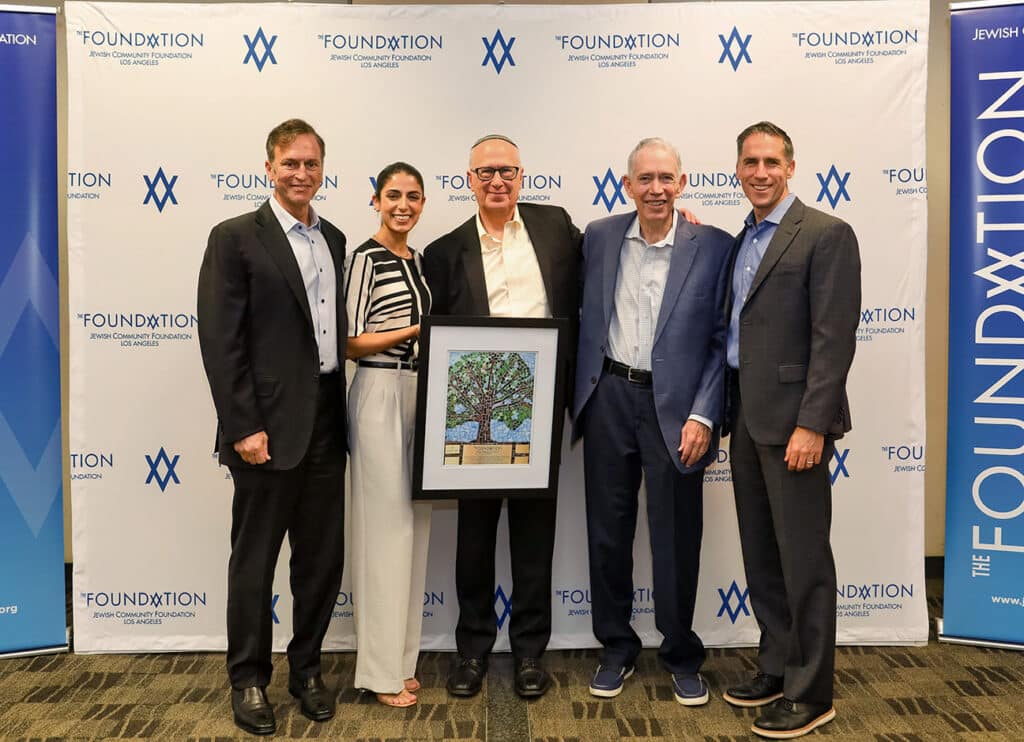
Earlier this month, the Jewish Community Foundation of Los Angeles (The Foundation) presented the inaugural Marvin Schotland Leadership Award to Dr. Bruce Powell. Over a career spanning a half-century, Dr. Powell, dean of the School for Jewish Education and Leadership at American Jewish University, previously helped found and lead three Los Angeles Jewish high schools – Yeshiva University of Los Angeles (YULA) High School; Milken Community High School; and deToledo High School – among innumerable other achievements.
The Foundation established the award – which includes with a $50,000 donor-advised fund – in tribute to the accomplished career of its former president and chief executive officer. It honors Schotland’s vast contributions and visionary leadership. In selecting Dr. Powell, The Foundation chose an individual whose own career embodies these same principles of Jewish leadership and community. The following are the remarks Dr. Powell shared at the awards presentation. They have been edited for clarity and concision.
What adults believe can usually be determined by what we spend our time on, and how we allocate our excess financial resources beyond food, clothing, shelter, and so forth.
My wife Debby and I, for example, spent all of our excess resources on Jewish education, tzedakah, and weddings.
In doing so, this concept of “what we believe is what we spend our time and money on” became a pathway for our philanthropic lives.
Marvin Schotland and I met in 1990 when he wandered into my office at Yeshiva University of Los Angeles High School, where I was serving as head of school. He was inquiring about enrolling his son, Daniel, in 9th grade.
Marvin and his family were relocating from New Jersey, and I asked why he was moving to Los Angeles from the East Coast. He explained that he was going to head up our Jewish Community Foundation. We spoke briefly about what that meant to him.
It was at that moment that I understood that Marvin’s vision for philanthropy in our community was, in fact, a vision for justice.
Indeed, it occurred to me that a community foundation is an endowment for justice in our Los Angeles Jewish community, and for the community at large. A means for leveling an unlevel playing field.
I learned from Marvin that philanthropy was, indeed, the actualization of Jewish justice in our world. Debby’s and my charitable philosophy evolved from that and unbeknownst to him, Marvin became my philanthropic rebbe.
I watched with awe and wonder as he built our Foundation from a $90 million fund into a $1.3 billion philanthropic powerhouse.
I also wondered how Debby and I could become a part of his vision of increasing justice in our community.
Years later, during a Shabbat dinner at our home, Debby and I had a conversation about tzedakah with Naomi Strongin, The Foundation’s vice president of the Center for Designed Philanthropy. While already heavily engaged in various organizations, we always felt that we needed to bring more focus for our giving.
Naomi suggested that we could both simplify and improve our donation strategy by creating a Donor Advised Fund, (DAF), at the Jewish Community Foundation. Moreover, she explained that by creating a DAF we would also indirectly be providing financial support for dozens of other causes in our community. It works this way: A portion of the modest DAF administrative fee is returned to the community through The Foundation’s institutional grantmaking —in effect, sustainable philanthropy. After that conversation, we took her advice and our DAF journey began.
Recently, Debby and I traveled to Chicago to greet a new granddaughter, and offer extra hands to care for our kids’ two-year old. Our daughter and son-in-law decided, after two weeks of diaper changing and kitchen cleaning, to give us a day off.
We visited the Art Institute of Chicago.
Debby and I marveled at the amazing exhibits of Impressionist painters. I was especially taken by the brush strokes of Van Gogh, Monet, Renoir, and Seurat.
It occurred to me that our DAF at the Jewish Community Foundation is akin to a philanthropic paint brush; indeed, a paint brush that brings into focus our vision for justice through thoughtful and strategic giving.
About two months ago, Foundation Trustee Andrea Sonnenberg, a parent and a former board member at de Toledo High School, called me at home to deliver the amazing news that I had been awarded the first Marvin Schotland Leadership Award.
To the wonder of Debby and our four adult children, I was, perhaps for the first time in my life since I learned to talk, speechless.
Of course, in good fashion, Andrea buried the lede. By the way, she said, the honor comes with $50,000 deposited into our DAF to give away to meaningful causes as we choose.
Suddenly, Debby and I were given not only a philanthropic paint brush, but an entire palette of paint as well.
And most importantly, in some small way, we could live up to the standards of justice set by my philanthropic rebbe, Marvin Schotland.
The Torah teaches us, “tzedek tzedek tirdof,” (“Justice, justice you shall pursue.”)
The Preamble to our American Constitution implores us to “establish justice, insure domestic tranquility, and promote the general welfare.”
Debby and I cannot imagine a better way to fulfill both of these Torah and American ideals than through our DAF at The Foundation that has now been strengthened by this incredible gift. Doing this in the name of Marvin Schotland is an added bonus and personal sense of joy.
And so, I extend my profound gratitude to the Jewish Community Foundation, its Board of Trustees, Chair Evan Schlessinger, President and CEO Rabbi Aaron Lerner, and its dedicated management team and staff.
Most of all, we owe our appreciation to Marvin Schotland for both the values he inspired and leadership building a significant financial endowment for our community that pursues justice, promotes the general welfare, and fulfills the highest philanthropic values set forth in our Jewish tradition — to pursue justice.
Indeed, what adults believe is how we spend our excess wealth; so too, what a community believes is how we endow the future for our children.
In 2017, Gal Rosenberg, a combat soldier in the Israeli Defense Forces (IDF), was injured during a raid to capture two ISIS terrorists in Jenin, a Palestinian city in the West Bank.
“We were ambushed during the operation. There were moments when I thought I would never make it back home. It was very scary. I was thinking to myself, how on earth did I end up here?“ – Gal Rosenberg
Talking about that harrowing experience, he said, “We were ambushed during the operation. There were moments when I thought I would never make it back home. It was very scary. I was thinking to myself, how on earth did I end up here? I was only 21 years old, practically a child.”
In a recent phone interview with the Jewish Journal from his home in Israel, Rosenberg disclosed that despite suffering from severe post-traumatic stress disorder (PTSD) and four herniated discs in his lower back, he has no regrets about serving in the Golani Brigade, one of Israel’s elite combat units. “I would do it all over again today. It’s a mission. I served my country, and I did what I had to do.”
Rosenberg could have requested release from the army due to his injuries, but he chose to continue his service. “I felt a sense of duty to complete my service like everyone else,” he said. “At that time, I didn’t fully grasp the severity of my injury or my PTSD. Those realizations came later.”
Like many soldiers grappling with the invisible wounds of war, it took considerable time for Rosenberg to be officially recognized by the IDF as a wounded soldier. When injuries aren’t readily apparent and you appear outwardly healthy, convincing others of your struggles can be challenging.“It was a four-and-a-half-year process before I was acknowledged as a wounded soldier,” he said. “However, the recognition itself was challenging as well because there was no escape from it. This is who I am. It was a moment that shattered me.”
During his darkest moments, Rosenberg found comfort and solace in Belev Echad, which translates to “One Heart.” Belev Echad is a global movement dedicated to assisting wounded IDF soldiers in accessing the support they require. Rosenberg speaks fondly of Belev Echad, stating, “They became my home, my family. No one understands what I’m going through better than them. When you return home, it’s hard for people to comprehend your experiences. Only those who have been there can truly understand. Within the first 10 minutes of meeting them, we felt like we’d known each other our entire lives.”
Belev Echad was established in 2009 by Rabbi Uriel Vigler and his wife Shevy. It began as an annual tour of New York City for wounded IDF soldiers, serving as a gesture of solidarity and support.
The organization operates a center in Kiryat Ono, near Tel Aviv, where wounded soldiers can come together for meals, participate in MMA and Krav Maga classes, engage in dog training and embark on trips. Rosenberg, who is currently studying architecture at Bezalel Academy of Arts and Design in Jerusalem, recently relocated closer to the center to access its services more frequently. “This is my second home, and the people there are my second family,” he said. “They provide us with so much. Every week, I take surfing lessons with a group from Belev Echad, and it’s immensely beneficial.”
Each year, Belev Echad sends a group of recovering soldiers on a 10-day, five-star tour abroad, providing them with an unforgettable experience. On October 10th, they are set to bring eight wounded IDF soldiers to Los Angeles — four men and four women. Rosenberg, who will be joining the group, participated in a similar trip to New York a few years ago. “It was truly amazing,” he said. “We received an overwhelming amount of love and support, more than I had ever experienced in my life. I felt deeply appreciated. We traveled, met with members of the community, shared our stories and discussed how we were coping. Dealing with what we’ve been through is still incredibly challenging. I’m seeing a psychologist, and I also got a golden retriever to help me with my PTSD.”
Rosenberg has two younger brothers, one of whom has just completed his service in a combat unit, while the other is preparing to enlist soon.“I told him that he should join a combat unit like me because we need to protect our home. However, he is understandably apprehensive due to what happened to me, and I completely understand that. I was so traumatized by my experiences that, after leaving the IDF, I deleted all my service photos. I have just one left. I didn’t want to remember anything from that time. Until I started attending Belev Echad, it was incredibly difficult for me to discuss the army or have any connection to it. The organization gave me hope that I could recover and have a happy and healthy life.”
Matan Segelman
Matan Segelman, a 30-year-old participant in the upcoming trip to Los Angeles, also experienced PTSD during 2012’s Operation Pillar of Defense in the Gaza Strip. “My unit was severely understaffed,” he said, “and as a result, I had to shoulder the responsibilities of both a commander and the soldiers themselves, as many of them were cadets. I didn’t sleep for six consecutive days. When one of my superiors noticed that I wasn’t feeling well, he urged me to rest while he took charge of the soldiers. However, sleep eluded me. The following morning, when my commander inquired about my well-being, I assured him that all was fine. I didn’t want him to suspect that something was amiss, so I returned to the operation.”
However, nothing was fine with Segelman, and he began to exhibit unusual behavior. At that juncture, his commanders decided it was necessary to have him evaluated by a psychologist, who subsequently referred him to a psychiatrist. The diagnosis was manic depression, and which was treated with medication.
Segelman opened up about the enduring impact of his condition, saying, “It still affects me. I’ve grappled with depression, experienced manic episodes, and found myself perilously close to contemplating suicide. There are moments when you lose touch with reality, feeling invincible and on top of the world, followed by times of profound despair.”
Following his discharge from the army in 2014, Segelman’s battle with depression deepened. He said, “I had to fight to be recognized by the defense office as a wounded soldier suffering from PTSD. Sitting in front of a committee, trying to convey the extent of your suffering, and feeling like they don’t believe you can be a traumatic experience. During that time, I distanced myself from friends and family, and it was an extremely trying period.” With the support of a psychologist and a psychiatrist, Segelman eventually found joy in life again. He attributes a significant part of his recovery to Belev Echad. “They envelop you with love,” he said. “Everything we do there, from the trips to our weekly surfing sessions, nourishes our souls.”
Segelman fondly reminisced about his 2019 trip to New York, describing it as the most enriching experience. “That trip breathed life into our souls. Being among people who have shared similar experiences is profoundly comforting. The Jewish community we encountered was incredible, treating us like members of their own family. Feeling that love and appreciation for our service warmed our hearts. It truly was an extraordinary journey.”
The organization is seeking Jewish families to host these wounded warriors for dinners, breakfasts, or overnight stay. If you are interested in hosting, please reach out to Belev Echad at: (212) 831-2770.



 “(In)sights: Peacemaking in the Oslo Process” by Gidi Grinstein with Ari Afilalo begins with a quote from the Tanakh, ‘Seek peace and pursue it’ (Tehillim 34:15).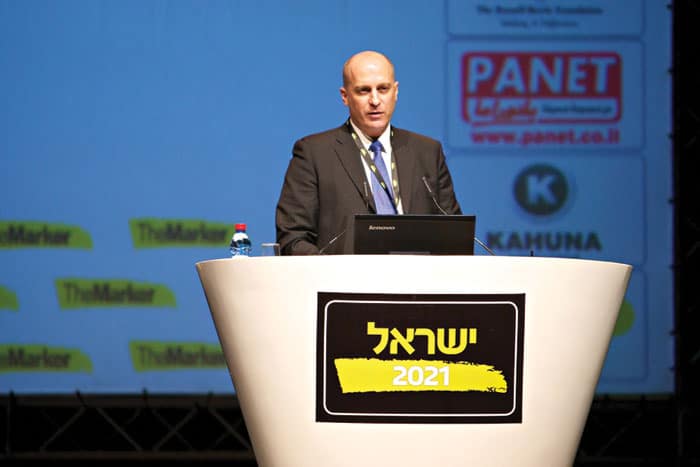


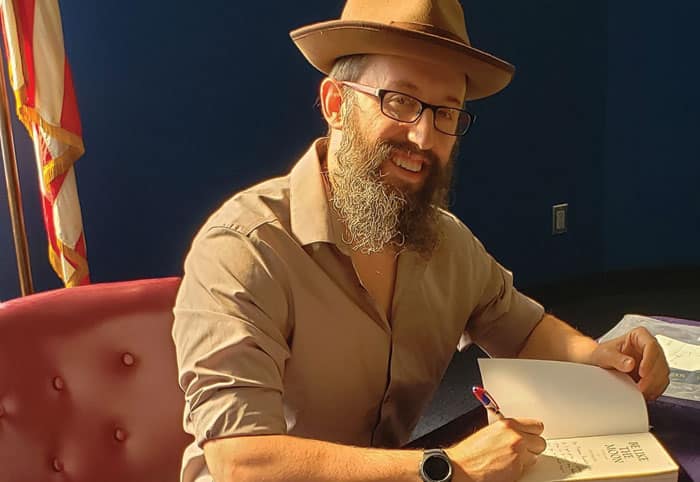
 These are just some of the countless lessons about animals. Now, author and Rabbi Levi Welton has written a book to teach young children about the Jewish view on animals as well. His book, “My Animal Teacher,” goes through the different types of animals and what we can learn from them. There’s the dog, who teaches us loyalty, the tortoise, who slows down to enjoy nature and the caterpillar, who goes on an inspiring life journey.
 “The prominent Rabbi Shmuel Eidels, The MaHarSha, once said that the reason the Hebrew name for a dog is ‘kelev’ is that it shares an etymological root with the words ‘kulo lev’ or ‘all heart,’” Welton said. “Obviously, [this is] a Divine tribute to dogs being role models for love and loyalty … the Torah teaches us that animals are not just our food or pets but can [also] be our co-workers and teachers.”
 Essentially, every creature we encounter can teach us something. We just have to stop and pay attention. “From the most majestic of mythical beasts to the humblest of garden insects, each being carries within it a unique story, a message that transcends the boundaries of species and resonates with the very core of our existence,” Welton said. “When we gaze into the soulful eyes of a trusted canine companion, we witness the profound depths of love and the art of unwavering loyalty. In the graceful glide of a bird in flight, we find inspiration in the freedom to explore and embrace life’s limitless possibilities. To acknowledge every creature’s potential as our teachers is to embark on a journey of boundless enlightenment.”