fbpx

September 22, 2023

Why Did Taxpayers Fund Antisemitic Hatefest at Penn?

Despite a sea of protests, the “Palestine Writes” festival at the University of Pennsylvania, which features a parade of convicted Palestinian terrorists, terrorism apologists and antisemites such as Roger Waters, whose concerts feature inflatable pigs marked with a Star of David and Waters dressed as a Nazi, will proceed as planned.

That has been widely covered. What has received little attention, however, is that the anti-Jewish hatefest is funded in part by Pennsylvania taxpayers through a grant issued by the Pennsylvania Council on the Arts. In other words, Pennsylvania taxpayers are helping fund this river of hate.

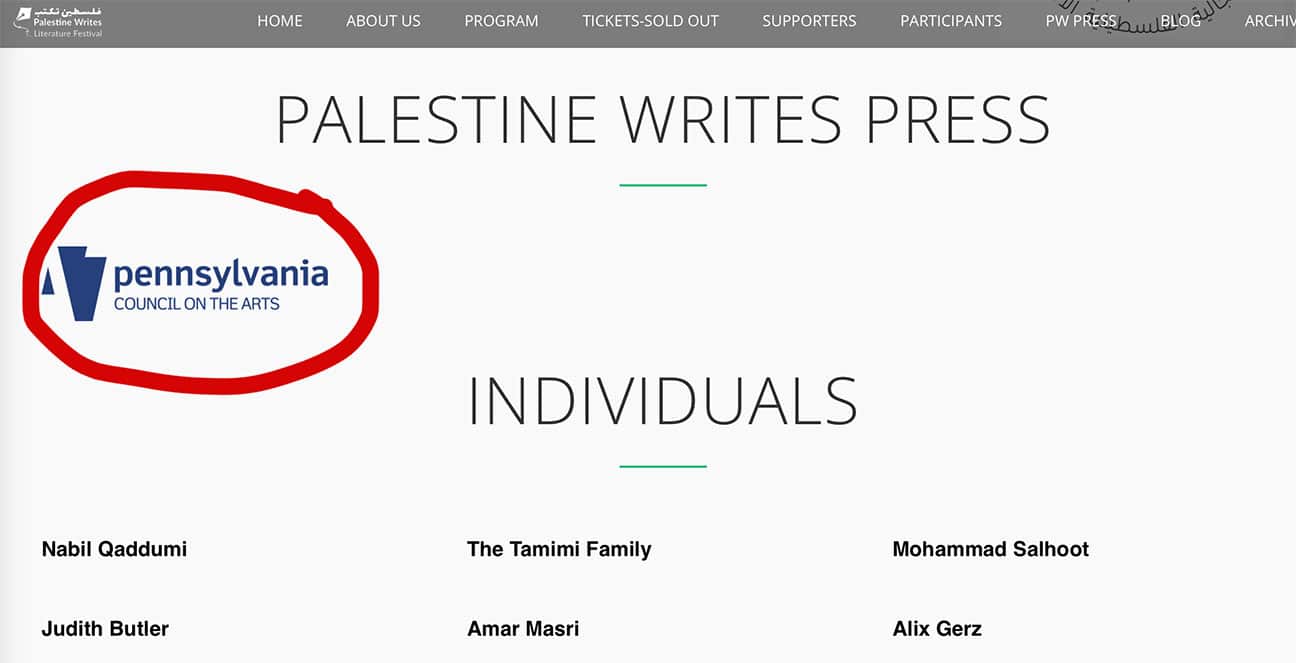
After public opposition rose about the event, the Council claimed its support was merely for an “anthology” of Palestinian writers. Now, backed by Pennsylvania Governor Josh Shapiro, the Council has demanded that its insignia be removed from the festival’s website and promotional materials.

Removing a state logo, however, is hardly enough while the money remains in the pockets of the celebrators of Jew hatred and government defrauders. Where is the demand that the taxpayer funds be returned and an investigation launched into how a Pennsylvania agency was deceived?

Just to recap the reason for all this, here’s a list of some of the speakers at this hatefest disguised as literary festival:

  • Mays a/k/a Mayss Abu Ghosh, a convicted terrorist, works with the terrorist groups Hezbollah and the Popular Front for the Liberation of Palestine, and explicitly supports violence as the “only road to Palestine.”
  • Antisemitic musician Roger Waters, a prominent BDS activist whose concerts feature the crudest antisemitism and imagery.
  • Huwaida Arraf, co-founder of the International Solidarity Movement which cooperates with the terrorist organizations Hamas, Palestinian Islamic Jihad and the PFLP.
  • Susan Abalhawa, Executive Director of Palestine Writes, who calls for terror wars against Israel, glorifies terrorists and likens Israelis to Nazis.
  • Noura Erakat, who teaches others to use the (since revoked )1975 UN Zionism is Racism resolution.
  • Disgraced former CNN correspondent and newly hired CUNY professor Marc Lamont Hill, who supports the effective elimination of Jewish Israel “From the river to the sea.”
  • Anti-Israel professor-activist David Palumbo Liu, who has tweeted, “If Israel is not the most hated nation in the world, there is something deeply wrong with the world.”
  • Anti-Israel agitator Reem Assil, who gained infamy for emblazoning one wall of her bakery with a mural idolizing PFLP mass murderer Rasmea Odeh.
  • Aya Ghanameh, past president of Students for Justice in Palestine at Rhode Island School of Design, who says, “Yeah I support violent resistance and what about it?”
  • Refaat Alareer, a professor at Islamic University of Gaza, who is on record as saying, “Are most Jews evil? Of course they are.”

When Penn’s President Magill was called to account for the use of her campus to host this hatefest, she retreated to “academic freedom,” issuing a statement on behalf of the university leadership that they “fiercely support the free exchange of ideas as central to our educational mission.”

But the Jew hatred from the speakers at this event gives the lie to that claim.  This isn’t about academics but about the crudest enmity against the Jewish people and Jewish national liberation.  And it’s clearer here than in most places that the overt hate speech directed at Jews would never be tolerated were it directed at another minority group.

Thankfully, important influencers at Penn have made it clear they won’t remain silent about a celebration of Jew hatred at the university to which they give their time and money. On Friday, current members of Penn’s Board of Trustees signed an open letter to President Magill calling on her to take additional steps to distance the university from the hatefest. The letter was signed by more than 2,000 Penn alumni and University affiliates.

Like many of us, these courageous voices understand that “academic freedom” is not an excuse to allow a festival of hate, not to mention be deserving of a penny from taxpayers.


Lori Lowenthal Marcus is the legal director of The Deborah Project

Why Did Taxpayers Fund Antisemitic Hatefest at Penn? Read More »
PA Council on the Arts Demands Palestine Writes Festival Remove Their Logo from Festival’s Website

The Pennsylvania Council on the Arts (PCA) issued a cease-and-desist letter to the Palestine Writes Literature Festival on Thursday demanding that the PCA’s logo be removed from the festival’s writes, claiming that the festival is falsely listing them as a “supporter” of the event.

The letter, authored by PCA Counsel Amber J. Sizemore, alleges that “the PCA has repeatedly attempted to address this matter amicably and cooperatively, but the Palestine Writes Literature Festival organization has failed to take necessary action to resolve this matter … In fact, Palestine Writes abruptly reversed course and failed to follow through on its own offer to remove the logo entirely from the website,” Sizemore wrote. “Instead, the sponsor web page was merely manipulated to list the PCA as a sponsor for ‘Palestine Writes Press,’ which the PCA expressly stated by email was not sufficient to resolve its concerns.”

Sizemore emphasized that the Thursday letter was “the third and final warning” to stop displaying the PCA logo on the festival’s website, “including the festival ‘Sponsor’ and ‘Supporter’ page.” PCA is “not a sponsor or supporter of the festival,” Sizemore wrote. “As you are aware, PCA awarded limited grant funding to Playgrounds for Palestine. That grant award was limited to a literary anthology project and a series of workshops, seminars, readings, and other events to launch the anthology and provide publishing education to authors. While PCA understands that Palestine Writes is a parent initiative to Playgrounds for Palestine, PCA has provided no funding, or other sponsorship or support, to the parent initiative or to the festival. PCA has also not otherwise authorized any use of its logo, or any other references to the PCA as a sponsor or supporter, related to the festival. Therefore, such logo use and references to the PCA create a misleading impression regarding the PCA’s role with that event.” This would be a violation, the letter continued, of “Pennsylvania consumer protection laws,” and that the festival’s use of the logo violates state and federal laws regarding trademark infringement.

Sizemore also argued that the PCA grant money to Playgrounds for Palestine expired at the end of August and that the festival is outside of the scope of the grant.

She concluded the letter by demanding that the festival reply to her by Friday morning confirming that the logo has been scrubbed from the festival’s website and any festival-related material. Otherwise, the PCA could take “immediate legal action” and refer the matter to the state Attorney General, Sizemore warned.

As of 2:30 p.m. Friday, the PCA logo still seems to appear under the “Palestine Writes Press” section on the “Supporters” page of the festival website.

The festival and the PCA did not respond to the Journal’s requests for comment by publication time.

Anti-Defamation League (ADL) CEO Jonathan Greenblatt posted a link to the cease-and-desist letter on X, formerly known as Twitter, writing: “Thanks to [Pennsylvania Governor Josh Shapiro] for your swift action and courageous leadership in standing up against hate.”

Stop Antisemitism Executive Director Liora Rez said in a statement to the Journal, “We greatly appreciate Governor Shapiro’s office in their unwavering commitment to ensuring that the State of Pennsylvania plays absolutely no role in this reprehensible hate fest. We hold serious reservations that by permitting the perpetuation of this troubling event, President [Elizabeth] Magill is effectively fostering an environment in which antisemitism at Penn will not merely endure but flourish.”

The festival is taking place at the University of Pennsylvania’s campus this weekend, September 22 to 24. The festival has been controversial; many of the speakers criticized as being antisemitic, including former Pink Floyd bassist Roger Waters and academic Marc Lamont-Hill. The university issued a statement on September 12 acknowledging the “deep concerns about several speakers who have a documented and troubling history of engaging in antisemitism by speaking and acting in ways that denigrate Jewish people” and that the university denounces “antisemitism as antithetical to our institutional values.” But the university also supports “the free exchange of ideas as central to our educational mission. This includes the expression of views that are controversial and even those that are incompatible with our institutional values.” Susan Abulhawa, the executive director of the festival, told the Journal on September 15 that none of the festival’s speakers are antisemitic and that “the weaponization of antisemitism to silence or marginalize us has been an effective tool by those who have taken everything from us, shattered our families and country, killed and maimed and traumatized and terrorized us, and carved out our hearts. It is galling that they harass us even here as we try to have a moment of togetherness and agency, putting forth a mind blowing narrative that we are victimizing our colonizers.”

PA Council on the Arts Demands Palestine Writes Festival Remove Their Logo from Festival’s Website Read More »

Penn Hillel Vandalized

The University of Pennsylvania’s (UPenn) Hillel was vandalized on Thursday morning by a perpetrator who allegedly shouted antisemitic remarks while doing so.

The Hillel posted a statement to Instagram saying that just before the Hillel opened at 7 a.m., a member of the Penn Hillel community opened the door to enter morning services. At this point, an unknown individual ran inside the building and “knocked over several pieces of furniture while shouting antisemitic obscenities about Jewish people.” According to The Daily Pennsylvanian (DP), the perpetrator allegedly shouted, “Jesus is king,” “F— the Jews” and “they killed JC.” The DP also reported that, according to a Jewish student, the vandalism resulted in “a flipped table, scattered papers, and a damaged podium” as well as “flipped-over trash cans.”

The Hillel statement added that their staff chased the perpetrator out of the building and that the perpetrator was subsequently arrested by campus police. Per the statement, the campus police noted that the perpetrator “had been knocking over trash cans” on a nearby street and was “acting erratically” beforehand. “No students were present nor witnessed any of the episode, and no one was hurt during the incident,” the statement said. Penn Hillel also argued that the perpetrator “did not accidentally choose to enter our building. He did not accidentally choose to shout antisemitic slogans. He chose our building. He chose to do so just three days before Yom Kippur. He chose to do so one day before a number of speakers are coming to campus who have histories of making antisemitic and hate-filled statements against Jews. This was not a coincidence.” This an apparent reference to the upcoming Palestine Writes Literature Festival being held on UPenn’s campus this weekend, though the DP noted in an update to their story that there isn’t any evidence connecting the vandalism to the festival; the festival has condemned the Hillel vandalism.

The Penn Hillel statement concluded by saying: “We are saddened by these events, but are utterly undeterred in our mission –– to support every single student on campus during their Penn journey, Jewishly, and in so many other ways –– today, tomorrow, and for years to come.” They referred all further inquiries to the campus Division of Public Safety.


View this post on Instagram


A post shared by Penn Hillel (@pennhillel)

The Penn Division of Public Safety said in a statement to the Journal on Thursday, “Early this morning, Penn Public Safety was notified of an individual overturning trash cans and acting erratically on Walnut Street. Penn Police intercepted the individual at Steinhardt Hall (Hillel), where the individual was making offensive statements and overturning furniture. Penn Police determined the individual was experiencing a crisis and safely removed the individual and transported the individual for further evaluation. Penn Public Safety also initiated and is following all protocols for potential bias incidents on campus, and is continuing to provide additional support to the Hillel community following this incident.”

Penn student Maya Harpaz, who serves as an executive board member and vice president of Israel engagement for Penn Hillel, told the DP that the vandalism was “extremely heartbreaking and painful given everything that’s happening right now on campus.”

Jewish groups denounced the vandalism.

“We are still collecting information, but ADL is deeply disturbed by the antisemitic incident at @PennHillel this morning,” the Anti-Defamation League (ADL) posted on X, formerly known as Twitter. “Thankfully no one was hurt, but perpetrators need to be held accountable. Security measures need to be reviewed and adjusted.” They urged the university leadership “to issue an unequivocal condemnation of the antisemitism associated with the festival this weekend and to completely dissociate the university from it.”

The American Jewish Committee (AJC) similarly posted on X, “AJC is deeply concerned about an antisemitic attack at Penn Hillel this morning ahead of a campus event featuring antisemitic speakers. We stand in solidarity with Jewish students and continue to work with them to fight hate and ensure thriving and secure Jewish life on campus.” According to Jewish Insider, AJC CEO Ted Deutch will be attending Penn Hillel’s “Shabbat Together” event on Friday that’s being held in response to the festival.

Stop Antisemitism posted on X that the vandalism is “even MORE reason to move this weekend’s hate fest OFF of your campus before someone gets hurt @Penn!”

International Legal Forum CEO Arsen Ostrovsky posted on X, “This is what happens when antisemitic hate on campus, like this obscene ‘Palestine Writes’ festival of hate, goes unchecked by @Penn leadership!”

The Palestine Writes Literature Festival is being held from September 22-24 on UPenn’s campus; the university has previously issued a statement acknowledging the “deep concerns about several speakers who have a documented and troubling history of engaging in antisemitism by speaking and acting in ways that denigrate Jewish people” and stating that the university condemns “antisemitism as antithetical to our institutional values. As a university, we also fiercely support the free exchange of ideas as central to our educational mission. This includes the expression of views that are controversial and even those that are incompatible with our institutional values.” Susan Abulhawa, the executive director of the festival, told the Journal on September 15 that none of the festival’s speakers are antisemitic and that “the weaponization of antisemitism to silence or marginalize us has been an effective tool by those who have taken everything from us, shattered our families and country, killed and maimed and traumatized and terrorized us, and carved out our hearts. It is galling that they harass us even here as we try to have a moment of togetherness and agency, putting forth a mind blowing narrative that we are victimizing our colonizers.”

The Palestine Writes festival posted a statement to social media on Thursday condemning the Hillel vandalism as “a cowardly and heinous act” and called for “a thorough investigation” into the matter. They proceeded to criticize the DP’s coverage for connecting “this attack to an intersectional and inclusive literary festival” and demanded that the student paper “clarify their misleading story and its racist defamatory claims” and “to honor the ethics of journalism, rather than irresponsibly and falsely linking the attack to a festival organized by fellow Penn students.” Representatives from the DP did not respond to the Journal’s request for comment.

UPDATE: University President Elizabeth Magill and other university leaders addressed the Hillel vandalism in a statement on Friday.

“Penn Police responded yesterday to reports of an individual shouting antisemitic obscenities and overturning furniture at Penn Hillel,” the statement read. “The individual was determined to be in crisis and was quickly and safely removed and referred for medical evaluation. This troubling incident came in the wake of another upsetting occurrence at the Weitzman School of Design, where a group of students found a swastika painted on the wall of a spray booth, a small room that is used for painting projects, on the fourth floor of Meyerson Hall.” The statement continued: “We unequivocally condemn such hateful acts. They are an assault on our values and mission as an institution and have no place at Penn. Sadly, incidents of hatred, including antisemitic rhetoric and acts that denigrate Jewish people, have become all too common. That these incidents happened on our campus, in our spaces, is deeply unsettling.”

“We also acknowledge the timing of these incidents is particularly difficult given the controversial speakers who will be participating in the event on our campus over the coming days,” Magill and the other university leaders added. “It is our collective responsibility as a community to stand clearly and strongly against antisemitism.”

Penn Hillel Vandalized Read More »

My Yom Kippur Apologies

On this Yom Kippur, I need to do more than read words in a holy book. I need to change specific behaviors of mine. Politically speaking, I have crossed the line. For specific actions I took in the name of politics, I apologize.

I apologize for screaming at people who were unmasked during COVID. I was scared, but that does not justify going up to complete strangers and tearing their heads off. Maybe they had a good reason for being unmasked.

I apologize for screaming at people about COVID vaccines and boosters. Again, I have to understand and respect that different people have different views for what could be perfectly valid reasons.

I apologize for yelling at people to trust the science when the whole point of science is questioning everything. Judaism teaches people to question things, not accept them on blind faith just because experts say so.

I apologize for flying into rages at people over climate change. Just because I passionately care about something does not mean everyone else must care about that same thing.

I apologize for screaming at people about gender pronouns. In the big scheme of things, my screaming at them does nothing to change their mind.

I apologize for claiming that someone who disagreed with me is or was a racist, sexist, bigoted homophobe. People can disagree with me and still be good. No policy difference justifies verbal violence.

I apologize for demanding that everything I agree with be mandatory, everything I disagree with be banned, and anyone I disagree with be censored.

I apologize for constantly trivializing the Holocaust. Climate change is not the Holocaust. Gay and transgender people are not facing genocide in America. Companies that serve meat are not murderers or Holocaust practitioners. People who disagree with me on abortion or gun control are not murderers.

I apologize for labeling politicians and others as Hitler, Nazis, fascists, or any other words connected to the evils of the Holocaust. Donald Trump is not Adolf Hitler. He is just a guy who has a different policy approach than I do. Benjamin Netanyahu is not Adolf Hitler. He is my fellow Jew.

I apologize for speaking out of arrogance, smugness, and overall pompousness. A person who disagrees with me is not an imbecile simply because they do not share my point of view. Constantly telling them that they don’t understand makes me insufferable. Maybe they understand perfectly and just disagree with me for legitimate reasons.

I apologize for bullying people because they expressed different opinions from me. I was not checking their privilege. I was stripping away their humanity.

Most importantly, I apologize for constantly making arguments based on the premise that the ends justify the means. The ends do not justify the means. People who advocate for an action opposite mine or even complete inaction are probably acting due to deep personal convictions. I am not allowed to break the law for the greater good.

I apologize for substituting my insights for God’s infallible wisdom. I will vow going forward to always remember that the people who disagree with me politically are often good people and potential lifelong friends. I will question their views without questioning their motives or their hearts. My political opponents are human beings created in Hashem’s image. I owe them kindness, not vitriol. They deserve the benefit of the doubt.

I will be a Jew first, an American second, and a politically charged individual way down the list. I will immediately be better.

Finally, I hope to forgive the two female strangers who screamed at me one day for being unmasked. I am not there yet. Maybe by Yom Kippur, I will be.

Have an easy fast.


Eric Golub is a retired stockbrokerage and oil professional living in Los Angeles.

My Yom Kippur Apologies Read More »

Coping with Holiday Eating

For the first time in years, I made homemade challah for Rosh Hashanah. Unfortunately, it was delicious: soft, airy, with just the right amount of honeyed sweetness. At the table I could not resist reaching for a second piece, but at least I was disciplined enough to take only half a second piece.

The High Holy Days are designed as a time for self-reflection and festive meals, including sweet foods. These holiday meals, so thoughtfully and even beautifully prepared, can nourish us physically, spiritually, and psychologically, too.  But with the Holy Day season now in full swing, many of us are now simply full, making self-reflection something we must push off till after a nap. When Yom Tov meals stretch out nearly three weeks, from Rosh Hashana through Sukkot, they can add up to become a caloric nightmare. We may be filled not only with challah dipped in honey but also with regrets when our clothes begin to strain against our expanding bellies. Been there, done that.

Food temptation is as old as time. In the Garden of Eden, God issued a single commandment related to eating: “From every tree of the garden you shall surely eat; and from the tree of knowledge of good and evil you should not eat from it.” (Genesis 2:16-17). Despite a nearly limitless buffet, Eve and Adam couldn’t resist the forbidden fruit. The cost was high: An eviction notice from Paradise.

In the new book “Body & Soul: The Torah Path to Health, Fitness and a Holy Life,” authors Rabbi Alexander Seinfeld and Dr. Daniel Grove highlight the significance of this commandment appearing so early. “Introducing the concept of mitzvah with a story about eating and self-control is a subtle and fascinating choice,” they write. Logically, one might have guessed that interpersonal mitzvot such as loving one’s neighbor and treating others with kindness, or the mitzvah to worship God and not any other deity, might have preceded it. They add, however, “The epitome of a mitzvah is self-control in the face of food taavah (temptation).” With food temptation ever-present and sometimes overwhelming, self-control with food becomes a paradigm for actualizing our full Godly potential.

This discipline may be tougher than ever. Modern food production is designed to get us addicted to salt, sugar, and fat. Unhealthy products jammed with these ingredients are the ones manufacturers market most aggressively. The lure of unhealthy foods is “one of the greatest and most universal tests of our times,” the authors write.

It’s been a lifelong mission for me to slowly, steadily become more disciplined with eating. I’ve made a lot of progress and am no longer tempted to overeat, but I’ve also had to make peace with a body that stubbornly clings to several more pounds than I feel is fair. I bet my metabolism joined a union with a workweek of only 20 hours.

My cooking has also evolved. Even when preparing Shabbat and holiday meals, I don’t pour sweet or fattening sauces over my meat or chicken. I serve crustless vegetable quiches, fresh roasted vegetables sprinkled with herbs and olive oil, and healthy salads. Still, I’m no extremist. I whip up the same cinnamon chocolate chip coffee cake most every week. It’s a delicious crowd-pleaser, lighter than any bakery cake. Besides, everybody knows the antioxidants in chocolate are healthy, and release feel-good endorphins, too.

Our guests seem relieved not to have to face down heavy potato or noodle kugels at our table. Other than kids, many people today are mindful of their weight and health, and try to avoid eating more than is good for them. This is doubly true when they are just hours away from another Shabbat or holiday meal. In my experience, light makes right in the cooking and eating department.

“Eating is a central pillar of what it means to be human,” observes Rabbi Akiva Tatz, quoted in the book. “It is the energy that keeps body and soul together . . . by absorbing the energy of the world and incorporating it into what you are.”

And so the struggle to find that balance between body and soul continues, one half-piece of challah at a time.


Judy Gruen is the author of several books, including “The Skeptic and the Rabbi: Falling in Love With Faith.” Her next book, “Bylines and Blessings,” will be published in February 2024.

Coping with Holiday Eating Read More »

Making Excuses for Antisemitism, from Kanye to FDR

How many ways are there to excuse antisemitism? Quite a few, it seems.

The CEO of Adidas, the German-based apparel company, says that rapper Kanye West “didn’t mean it” when he went on those antisemitic rants last fall. Among other things, West threatened to “go death con 3 [sic] on Jewish people,” ranted about “Jewish Zionists” controlling the media, and declared there were “good things about Hitler.”

“I don’t think he’s a bad person, it just came across that way,” Adidas head Bjorn Gulden claims. But at least Gulden is candid about his motive for excusing West’s bigotry: “That meant we lost that business, one of the most successful collabs in the history…very sad.”

A few days later, on the other side of the ocean, police said that the thug who smashed up the Hillel at the University of Pennsylvania was “experiencing a crisis.” In other words, according to the police, it wasn’t antisemitism, even though the attacker was ranting and raving about Jews as he rampaged through the Hillel center. 

Whether or not the assault in Pennsylvania was connected to the upcoming anti-Israel conference on campus, or the proximity of the Jewish holidays, will eventually be determined. But this much is already clear: the attacker knowingly singled out a Jewish target, and was screaming anti-Jewish slurs as he damaged a Jewish organization’s property. That sounds like something more than a random moment of personal “crisis.”

Since celebrity antisemites have more fans than lesser-known bigots, they tend to enjoy more protection from excuse-makers.

After Mel Gibson’s first public antisemitic tirade, in 2006, actress Jodie Foster told USA Today: “Is he an anti-Semite? Absolutely not.” Then why did Gibson make antisemitic comments? “It’s no secret that he has always fought a terrible battle with alcoholism,” she declared.

Foster did not comment when, a few years later, an apparently sober Gibson referred to Jews as “oven-dodgers.”

Congresswoman Ilhan Omar tried to excuse her own 2019 comment about Jews and money (“all about the Benjamins”) by claiming, “I wasn’t aware of the fact that there are tropes about Jews and money.”

Omar’s political allies used several different excuses in response to her statement that Americans Jews use their “political influence…to push for allegiance to a foreign country.” Congresswoman Alexandria Ocasio-Cortez said Omar was merely being “insensitive” (as opposed to bigoted). Senator Bernie Sanders insisted that Omar’s remarks constituted “legitimate criticism of the right-wing, Netanyahu government in Israel,” although Omar had been referring to American Jews, not the Israeli government or its policies.

From time to time, a historian can be found among the excuse-makers. President Franklin D. Roosevelt repeatedly made antisemitic comments not because he was antisemitic, but just as a way of “breaking the ice” with foreign dignitaries, according to Richard Breitman, in his 2013 book FDR and the Jews (coauthored with Allan Lichtman).

During a meeting with the Soviet foreign minister in 1942, President Roosevelt agreed with a complaint by a White House aide about the large number of “distinctly unsympathetic Jews” and “kikes” in the American Communist party. And in a conversation with Josef Stalin during the 1945 Yalta conference, Roosevelt joked about “giving” America’s six million Jews to the king of Saudi Arabia. FDR merely “was using anti-Semitism as an ice-breaker” on these occasions, Breitman wrote. 

The problem, however, is that an “ice-breaker” is, by definition, something that is done at the beginning of a conversation, in order to facilitate a more open discussion. But the transcripts of Roosevelt’s conversations reveal that the remarks about “kikes” took place at the very end of an hours-long dinner meeting; and the “joke” to Stalin was made on the next-to-last day of the week-long Yalta conference—in other words, long after the “ice” was broken.

Why do some people make excuses for antisemites? Reasons vary. Sometimes business interests are at stake. Sometimes the goal is to advance a political agenda or protect the reputation of a public figure whom one admires. But whatever the motive, making excuses for antisemitism is wrong—because it undermines the fight against bigotry and encourages antisemites to believe they can get away with it. 


Dr. Medoff is founding director of The David S. Wyman Institute for Holocaust Studies and author of more than 20 books about Jewish history and the Holocaust. His latest is America and the Holocaust: A Documentary History, published by the Jewish Publication Society & University of Nebraska Press.

Making Excuses for Antisemitism, from Kanye to FDR Read More »