fbpx

July 25, 2023

The One Question the Coalition Won’t Ask: What’s Best for Israel?

In all the statements and arguments I’ve read from Israel’s coalition in support of its controversial judicial overhaul, I still haven’t seen one that answers this simple question: What’s best for Israel?

I’ve heard plenty of arguments that have danced around the question — the Supreme Court has grabbed too much power and reforms are long overdue; important segments of Israeli society have felt disenfranchised; the coalition was democratically elected and has the right to pass these laws, and so forth.

None of these arguments, however, have hit the bullseye: These reforms are good for the country!

Of course, this shouldn’t shock us. Put yourself in the shoes of a coalition member like Shas MK Aryeh Deri, the convicted felon who needs these reforms to regain his seat in the Cabinet; or Bezalel Smotrich, the far-right maximalist who needs these reforms to advance his dream of annexing the West Bank; or the Haredi parties who need these reforms to codify into law that Haredim will forever be absolved from military service; or Prime Minister Benjamin Netanyahu, who could certainly use these reforms to help him with his criminal trial.

Clearly, these goals are rooted not in the national interest but in narrow and personal agendas. There’s a good reason why this government has been called the most extremist in Israel’s history— it’s very much about narrow and personal agendas.  

Seen in that context, the judicial reforms are just a means to push through these agendas without any High Court getting in the way. The extremists know that while they’re ramming through a fundamental judicial overhaul that impacts all Israelis, the benefits will accrue mostly to them. A long and proper process of reaching a national consensus is hardly in their interest.

Haredi parties, for example, may love the idea of the state pouring more secular tax money into their communities and yeshivot, but they’re not naïve enough to think that secular Israelis will believe it’s good for the country.

Similarly, Smotrich and his ilk may believe intensely that every inch of Judea and Samaria must remain in Jewish hands for eternity, but they’re no fools. They know that a significant segment of Israelis believe it will endanger the future of Israel as a Jewish democracy.

Let’s face it, the term “judicial overhaul” was always misleading. What this extremist coalition is after is an Israel overhaul. Neutering the Supreme Court is simply the instrument to get there, which is why the very idea of a “broad consensus” threatens them.

No wonder the coalition has been avoiding the only question that really matters: What’s best for Israel? They know they can’t make that case, so they must divert our attention.

They’re not blind. They’ve seen hundreds of thousands of fellow Israelis from all walks of life demonstrating for 30 straight weeks. What can they tell them — you’re all wrong? Trust us, our reforms are really good for the country? And please don’t pay attention to the damaging repercussions to our economy and national security that our moves have triggered?

Who are we kidding?

It’s not an opinion but a plain fact that Bibi and his Likud party have neglected the national interest by pushing through a divisive overhaul they know goes too far. We hear now that some of those Likud MK’s may have woken up. According to JPost, seven of them “expressed their views or were quoted in private conversations as advocating for further judicial reforms only if there is broad consensus.”

Gee, thanks. A little late, I would say. You watched your country tear itself apart for seven long months, potentially leaving lasting scars, and now you finally speak up? After you pass the first bill that led to the turmoil in the first place? Saying now what you should have said seven months ago— “only if there is broad consensus”— is not courageous. It’s lame.

It doesn’t have any easy answers, but in these times of unprecedented turmoil in the Jewish state, “deep and thought-provoking” may be the one thing we know for sure is best for Israel. 

For those of us who love Israel, this has been a painful and disillusioning time. But regardless of how strongly we feel one way or another, we still need help making sense of it all. I’m glad to say that our cover story this week, from our writer in Jerusalem Matthew Schultz, is as deep and thought-provoking as any commentary I’ve read on the subject.

It doesn’t have any easy answers, but in these times of unprecedented turmoil in the Jewish state, “deep and thought-provoking” may be the one thing we know for sure is best for Israel.

The One Question the Coalition Won’t Ask: What’s Best for Israel? Read More »
Rally Held for Jewish Families Suing State Gov’t for Special Needs Funding Before First Hearing

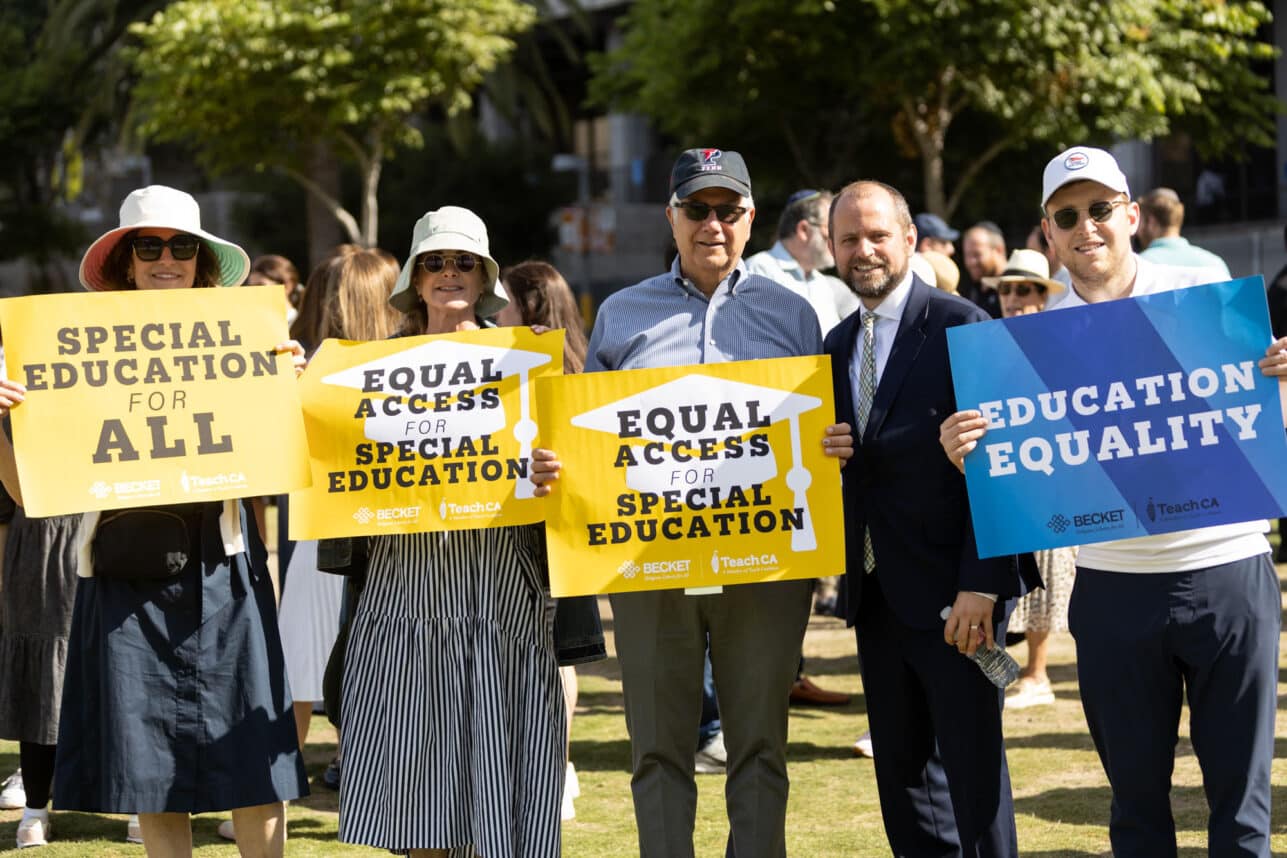
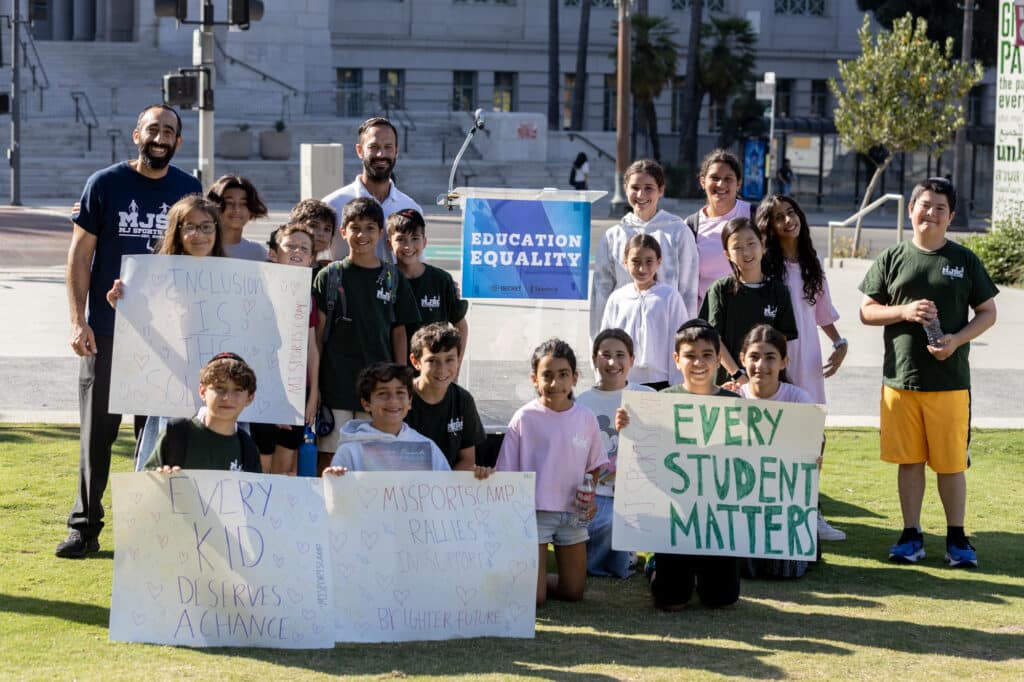
A rally was held on the morning of July 21 before the first hearing on the Orthodox Jewish families and Jewish day schools’ lawsuit against the California state government, alleging that the state government is unconstitutionally barring federal funding for special needs services from Jewish day schools.

Under the federal Individuals with Disabilities Education Act (IDEA), public schools are required to provide funding for special needs students. But some public schools don’t have the infrastructure for that, in which case they make a referral to private schools that do. The families of special needs students then receive federal funding to attend those private schools. But the California state government has barred such funding from going to religious private schools, the issue at the heart of the current lawsuit, Loffman v. California Department of Education. The plaintiffs are Chaya and Yoni Loffman, Fedora Nick and Morris Taxon, and Sarah and Ariel Perets––all of whom are parents of special needs children––and Los Angeles Jewish day schools Shalhevet and Yavneh Hebrew Academy.

Around 200 people attended the rally, which was held at the Gloria Molina Grand Park lawn across from City Hall and featured various speakers decrying the actions of the California state government. Teach Coalition Founder Maury Litwack kicked off the rally by highlighting the “unimaginable situation” of the parents who are filing the lawsuit. “Their desire is a simple one: to send their children with special needs to a school, yeshiva, that will give them the tools necessary to flourish, but also with an education set in a Jewish environment,” Litwack said. “But despite that simple need … the state of California has refused them help because the state of California and their elected officials have decided that these children, and thousands like them, are not eligible for special education funding simply because their parents value a religious education.”

Litwack lambasted the California policy as being “outrageous” and “unfair.” “The courts and places like the Supreme Court have already declared that religious schools and their parents cannot be discriminated in this manner,” Litwack said. “It’s unconstitutional … what California’s doing stands against this. All children with disabilities regardless of their religious beliefs should have the same opportunity to receive a quality education that meets their unique needs. And a parent should never, never have to compromise on how or where their child’s educated. So today, here, all together, we’re gonna change that.”

The first parent in the lawsuit to speak was Chaya Loffman, a mother of two. “Like every parent, I want to raise my children with all the care and support that they need to thrive,” Loffman said. “Unfortunately, California is making it harder for me to provide that to my child with disabilities simply because of our faith. Politicians in this state are using religion as an excuse to deny my son and countless other children a safe and supported learning environment that meets all their needs. No parent should have to choose between raising their child in faith and providing their child with the tools that they need to reach their full potential.” She prayed for the court “to allow my son to receive the supportive, religious, and education environment that he needs to flourish.”

The other parent in the lawsuit to speak was Fedora Nick. Her two oldest sons were able to receive a Jewish education, but her youngest was not due to being diagnosed with autism. “In California, our elected representatives refuse to help children with disabilities attend schools that reflect their religious backgrounds,” she said. “Because the state bars religious schools from its program providing support services to children with disabilities, my husband and I have been unable to send our son to a school where he can reach his full potential, educational and spiritual.”

One of Nick’s sons, Asher Taxon, proceeded to tell attendees he is “saddened” that his younger brother, who has autism, has been denied the same education that Taxon received at Jewish schools. “Kids like him have to overcome obstacles and challenges to have their unique needs met in the classroom and our state politicians are making that even harder,” Taxon said. “Instead of putting more barriers in front of these kids with disabilities, California should be doing everything it can to ensure that safe, supportive and compassionate learning environments are available to all.”

Courtesy of The Becket Fund for Religious Liberty

Miriam Marks, who is a parent of a special needs child but is not one of the plaintiffs, told rally attendees: “When you are the parent of a special needs child, every day is a battle. A fight for something your child needs. Every day brings something new, something you could not have anticipated or planned for.” She explained that her son, Yonatan, has received new opportunities thanks to various therapies and treatments. “Today, I stand in front of you with a deep understanding of the importance of what the right special needs support can do for a child,” Marks said. “And even more so, what having that support and access––wherever a parent feels is best for their child, especially in their school of choice––could mean. An opportunity we wish we could have had with Yonatan.”

Other speakers were from Jewish day schools. Rabbi Yoel Burstyn, principal of Bais Yaakov Los Angeles, recounted how Martin Luther King Jr. decided “to try the impossible and accomplished the incredible.” “He fought discrimination. He fought segregation. People didn’t believe he would be able to accomplish what he accomplished,” Burstyn said. “But he wouldn’t relent and he succeeded. We here today are doing the exact same thing: we are fighting discrimination. We taxpayers––who pay our taxes––all we’re asking for is give us back our money. We pay our taxes, and we deserve to get the services that we paid for.” Burstyn proceeded to give a message to state politicians. “We don’t want to take you to court. We don’t want to fight you to court. We should be on the same side,” he said. “We’re all fighting for these children who can’t stand up for themselves. Open your hearts and open your mind and understand, we need you and you can do it.” Burstyn later added: “You believe in people’s right to choose. Where is our right to choose if we can’t get what’s rightfully ours?”

Yavneh Academy Dean Rabbi Shlomo Einhorn also spoke at the rally, expressing Yavenh’s desire “to provide every child that comes to our school an Orthodox education that allows and enables them to flourish. According to California, however, we should not be able to help students with disabilities.” He lamented that “shining a lot” on the issue wasn’t enough for the state government to change course. “For the congresspeople in Sacramento, it’s politics before children,” Einhorn said. “I hope and I pray that the court will right this injustice and allow all students to flourish at Yavneh and other private religious institutions across the state.”

Video courtesy of The Becket Fund for Religious Liberty


After the rally concluded, some headed over to the courthouse for the case’s oral arguments, with the state arguing to dismiss the case and the plaintiffs arguing for a preliminary injunction. Nick Reaves, one of the attorneys from The Becket Fund for Religious Liberty that is representing the plaintiffs, told the Journal that he thought “the hearing went well.” “The court was asking both sides some challenging questions, but I think we explained to her that this was a really important issue. I think one way we did that was by having the whole community show up.” Reaves pointed to the rally as well as the fact that 40 or 50 families showed up in the courtroom for support for the plaintiffs. He expects that it could take “several weeks if not several months” for the court render a decision.

“We’re looking forward to the next steps in this case,” Reaves said. “This is not gonna be a single hearing, there’s gonna be multiple opportunities to explain to the court why these Orthodox Jewish families and schools have the same rights as other families who choose to send their kids to a secular school.”

The Loffman parents said in a statement to the Journal following the hearing: “We want to educate our son in a safe, supportive learning environment that meets his unique needs and upholds our shared religious beliefs. Unfortunately, California is forcing our family to choose between raising our son in our faith tradition and providing him the help he needs to reach his full potential.”

Teach Coalition Founder Maury Litwack also said in a statement to the Journal regarding the hearing, “All children with disabilities, regardless of their religious beliefs, should have the same opportunity to receive a quality education that meets their unique needs—and a parent should never have to compromise on how or where their child is educated.”

“We’re looking forward to continuing engagement with community,” Reaves said. “The community’s support is really what allows us to do this litigation.”

This article has been updated.

Rally Held for Jewish Families Suing State Gov’t for Special Needs Funding Before First Hearing Read More »

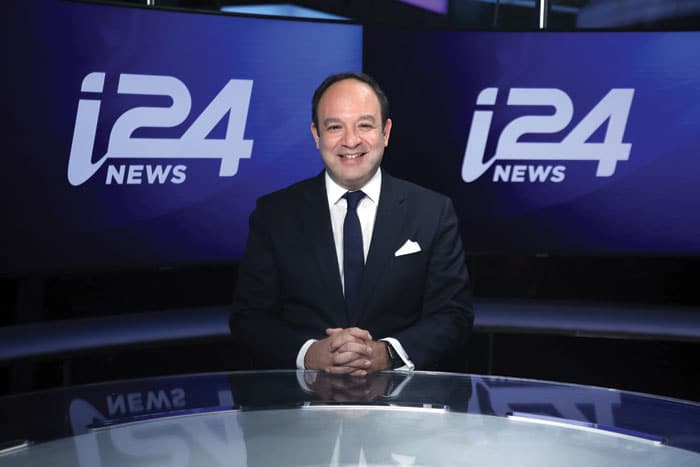
Frank Melloul: Running a News Channel that Speaks to Arabs and Jews

Eleven years ago, Frank Melloul, a former diplomat, was working at France 24, a state-owned international news network based in Paris. He received a call from Patrick Drahi, the founder of Altice, the second largest telecommunications company in France, who told Melloul he was fed up with the biased way the media covered Israel. He saw what France 24 was doing, and he wanted to create something similar in Israel. He asked Melloul: Are you on board? 

Melloul, who had faced antisemitism living in France, was intrigued by the idea. Just two months after talking with Drahi, he made Aliyah with his family, and worked with Drahi to start what is now i24NEWS, a 24/7 news channel that broadcasts in Israel and the Middle East. 

“When I arrived in Israel and said I want to launch an international news channel to change the perception of Israel, everyone was laughing in my face,” Melloul said. “They told me that in one year, it’d be dead. Now, it’s 10 years later.”

Over the past decade, Melloul, now CEO, and his team have gained international recognition for their channel, which is the only place Israelis can go for news 24 hours a day, seven days a week. The channel broadcasts in Hebrew, English, Arabic, French and Spanish, and is shown not only in Israel, but also throughout the Middle East and Arab countries. It has bureaus in Tel Aviv-Jaffa, the United Arab Emirates and Rabat and Casablanca in Morocco. 

Unlike others news stations – especially those in Arab countries – i24NEWS is totally independent from the government. It also doesn’t take any political positions, instead inviting commentators of all different backgrounds to state their views. The channel is known for hosting debates between Israelis and Palestinians. 

“Other networks don’t have these debates,” Melloul, a Swiss native whose father was from Morocco, said. “When you have a Palestinian and an Israeli, you can see the reality of what’s happening on the ground. That’s why Arabic countries have started to watch us, because on those channels you don’t see these debates either.” 

The CEO knows he is doing something right, because people accuse him of belonging to various political parties all the time.

“For the rightists, I’m a leftist, and for the leftists, I’m a rightist. I don’t care if you’re a liberal or a conservative, because we have both.“

“For the rightists, I’m a leftist, and for the leftists, I’m a rightist,” he said. “I don’t care if you’re a liberal or a conservative, because we have both. Doing Shabbat is a disaster for some families in Israel who are for or against Bibi. I presume it’s the exact same situation in the U.S. If I have to explain i24NEWS, it’s the channel you can watch with your family and see the points of view of your brother, your sister and yourself. There is no journalist telling you what to think.”

“When you’re looking at any news, you’ll see headlines that Israel is bombing Gaza,” he said. “When you watch us, you’ll see that Israel is bombing Gaza, but we don’t start the story with the bombing of Gaza. We start it in the morning, when Hamas is launching rockets against Israel. The headline is that Israel is under attack and retaliating in Gaza.”

i24NEWS airs in the Palestinian territories, and Melloul describes his network as the alternative to Al Jazeera.

“We have screen-shots of Al Jazeera broadcasting i24NEWS many times. They are stealing my feed, even though they are our enemies, because we are a credible network.”

“We have screenshots of Al Jazeera broadcasting i24NEWS many times,” he said. “They are stealing my feed, even though they are our enemies, because we are a credible network. After 10 years, we’re an alternative to Al Jazeera for the Arabic countries themselves.”

The channel has also reached non-Jews who know nothing about the conflict in Israel. 

“Colleagues who aren’t Jewish are telling me they’re watching it,” Melloul said. “They tell me they didn’t know Israel was like this. They didn’t know about our tech or how we coordinate projects between the Israelis and the Palestinians.”

Along with approving story ideas at the channel, Melloul travels to Europe, the Gulf States, the U.S. and Africa for his work; he recently gave a speech to a pro-Israel group in Los Angeles.

“I’m managing i24NEWS as a diplomat,” he said. “When you’re a journalist, you’re always looking for a scoop, and when you’re a diplomat, you’re always looking for an impact.” 

When he’s at home in Israel, he goes over story ideas with his team and often is at the office very late into the night because he’s collaborating with people in the U.S.  

“Hopefully, we won’t open an office in China as well,” he said. “Because then, I would not sleep.”

Being able to show a more complete truth about Israel to countries that normally only receive negative propaganda has been at the heart of Melloul’s work. But he also believes that bringing together Jews and Muslims in the newsroom has been an important part of i24NEWS’ mission. 

“In the media, coexistence and peace are possible,” he said. “When Jews and Muslims are covering the same news, that’s the beginning of peace. It shows we are able to build something together. Religious Jews in the settlements are working together with Palestinians in East Jerusalem. They are meeting for the first time and working together.” 

Frank Melloul: Running a News Channel that Speaks to Arabs and Jews Read More »

Jewish Groups React to Passage of “Reasonableness” Judicial Reform Bill

Multiple American Jewish groups criticized the Israeli government’s passage of a judicial reform that limits the Supreme Court’s ability to strike down government decisions based on the “reasonableness” standard.

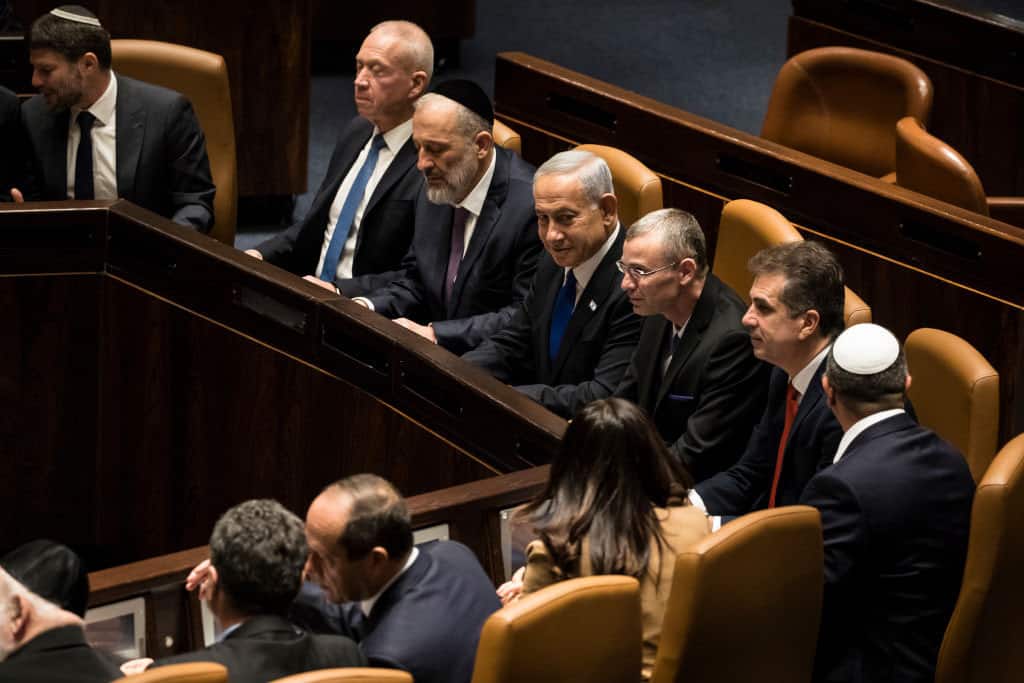
The bill passed in the Knesset 64-0, with the opposition boycotting the vote altogether. Protests have been raging across Israel over the bill and the ruling coalition’s broader push for judicial reform; some military reservists even said after the July 24 bill passed that they would no longer voluntarily serve in the military to protest the bill.

Various Jewish groups expressed concern that the bill passed without a “broad consensus” in the country.

“We are deeply disappointed that the Israeli government passed the controversial Reasonableness Bill, failing to heed the call of President Herzog and others to reach a compromise rooted in a broad societal consensus,” the Anti-Defamation League (ADL) said in a statement. “As we have previously said, this initiative and other judicial overhaul proposals could weaken Israeli democracy and harm Israel’s founding principles as laid out in the Declaration of Independence. The failure to reach a compromise has led to unprecedented divisions within Israeli society, threatening both the country’s social cohesion, economic well-being and, according to experts, its security preparedness.” They later added: “We continue to believe that in this historic moment, all Israeli political leaders should demonstrate courage and willingness to compromise and make concessions. There is no legislation that is more important than the well-being of the Israeli society. We strongly urge the Israeli government to refrain from moving additional judicial overhaul bills forward and focus instead on working together with Israeli civil leadership to build consensus and cohesion aimed at healing the wounds within Israeli society.”

The American Jewish Committee (AJC) expressed their “profound disappointment” in a similar statement. “The new law was pushed through unilaterally by the governing coalition amid deepening divisions in Israeli society as evidenced by the hundreds of thousands of Israelis who have taken to the streets,” the AJC said. “Of particular concern to AJC, the continued effort to press forward on judicial reform rather than seeking compromise has sown discord within the Israeli Defense Forces at a time of elevated threats to the Jewish homeland and has strained the vital relationship between Israel and Diaspora Jewry. While many Israelis agree that some reform of Israel’s judicial system is warranted, AJC has consistently maintained that reform to the institutions core to Israeli democracy should only be adopted on the basis of the broadest possible consensus. That is why we have been strongly supportive of President Herzog’s efforts to find compromise. President Herzog’s successful visit to the United States last week reminded us that a thoughtful and pragmatic approach can gain support across political lines.”

Conference of Presidents of Major Jewish American Organizations Chair Harriet P. Schleifer and CEO William Daroff said in a statement, “We must remember the dangers that discord and division can pose to the Jewish people. We call on Israel’s leaders to seek compromise and unity. Responsible political actors must ease tensions that have run dangerously high. The Conference of Presidents will always advocate in support of the bilateral relationship between the United States and Israel, which is crucial to the security and well-being of both nations. Israel is a Jewish and democratic state. Both countries benefit immeasurably from this strategic partnership and abiding friendship, and will continue to do so because of our fundamental bonds and common interests.”

The European Leadership Network (ELNET) tweeted, “ELNET, being apolitical and non-partisan, is deeply concerned about the ramifications of this vote and has called upon the government to reach a broad national consensus on constitutional changes. ELNET believes both mutual interests and common democratic values are the basis for relations between Israel and Europe. ELNET will carefully monitor developments moving forward.”

Other Jewish groups went a step further, suggesting that the bill’s passage threatens to destroy Israel’s democracy altogether. “With the “reasonableness standard” repealed with respect to a critical range of government decisions, the Supreme Court has lost a major piece of its ability to act as a balance on the actions of the executive,” J Street said in a statement. “This extreme-right government will have an increasingly unrestricted hand to carry out major appointments, dismissals and policies without fear that they could be halted and overturned by the court. Their agenda will almost certainly include deeply harmful new acts of annexation and expropriation in the West Bank, where they continue to pursue a one-state nightmare of permanent occupation and exclusive sovereignty between the Jordan River and the Mediterranean Sea. It will continue to chip away at the rights of women, LGBTQ+ people, Palestinians (both Israeli citizens and those in the occupied territory), non-Orthodox Jews and many others.”

The Jewish Democratic Council of America (JDCA) denounced the bill’s passage as being “anti-democratic.” “We are deeply concerned by the ongoing attempts to erode Israel’s democracy with measures like this one, which unequivocally weakens Israel’s judiciary, democracy, and systems of checks and balances,” JDCA CEO Halie Soifer said. “As President Herzog has urged and President Biden advised, the focus of the Israeli government should be on uniting around a consensus for judicial reform, not divisive and undemocratic measures like this one. We stand with the hundreds of thousands of Israelis who have demonstrated in support of Israel’s democracy and in opposition to harmful judicial overhaul proposals, including this legislation.”

The Rabbinical Assembly and United Synagogue of Conservative Judaism similarly said in a statement, “The governing coalition’s choice to unilaterally pass this legislation represents a clear and present danger to the country’s independent judiciary, which may still come under further assault. Democracy requires independent legislative, judicial, and executive branches. With no written constitution nor upper house in the legislature, the independence of Israel’s judiciary is indispensable. Prime Minister [Benjamin] Netanyahu’s coalition has created serious fractures in Israel and the wider Jewish world. In the face of their legislative aggression, we are heartened by the broad citizen coalition of Israelis who are resolved to protect the Jewish and democratic nature of the state. We urge the government to refrain from introducing further judicial legislation and to participate in negotiations under the auspices of President Isaac Herzog.”

By contrast, Zionist Organization of America (ZOA) National President Morton A. Klein expressed staunch support for the bill. “There were hundreds of thousands of Israelis in Tel Aviv rallying in support of this judicial reform … yet the media in Israel and America neglected to report this,” Klein said in a statement. “The reform is a victory for democracy, the rule of law, a democratic balance of powers, and is curbing judicial tyranny in Israel. The ‘reasonableness standard’ was abusive, violated democratically-passed laws; was used to oust a democratically-elected minister; and subjective: What’s unreasonable to one person is reasonable to another. There was no criteria for judging ‘reasonableness’: It was simply the judge’s political or personal opinion and worldview! And when you have an Israeli Supreme Court with an overwhelming left wing majority with no diversity, you get rulings not reflecting the law or the people. I’m sure if the Court had an overwhelming right wing majority, the people in the streets opposing judicial reform would be supporting it.” He added that it “would be an anti-democratic travesty to allow Israel’s democratic process to be thwarted by the left wing mobs who obstructed vital roads and Israel’s airports, sometimes acted violently, and even tried to block Knesset members from entering the Knesset to vote today.”

Democratic Majority for Israel CEO Mark Mellman and Board Co-Chairs Ann Lewis and Todd Richman said in a statement, “While we believe it was a serious mistake for this government to ignore the pleading of the majority of its citizens, as well as its President, and pass this bill without significant compromise, it was done democratically. As in any democracy, including the United States, governments are empowered to make decisions however disappointing or unwise we may believe them to be. It should also be noted, despite some misleading headlines in the media, the law approved today in the Knesset does not prevent the Israeli Supreme Court from overturning government decisions, though it does remove one important criterion for doing so.” They added that “it is not too late for compromise on it and other elements of the proposed judicial overhaul. We urge all parties to return immediately to negotiations under the auspices of President Herzog to agree on a widely supported set of laws that guarantee the democratic character of the Jewish state. We remain inspired by the hundreds of thousands of patriotic Israeli protesters continuing to fight to protect their democracy, and we know that through these difficult times, the U.S.-Israel relationship remains steadfast.”

Jewish Groups React to Passage of “Reasonableness” Judicial Reform Bill Read More »