fbpx

June 9, 2023

CUNY Denies Jewish Group’s Claim That Board of Trustees Chair Told Chancellor Not to Attend Antisemitism Hearing

The City University of New York (CUNY) is denying a claim from the Jewish group Students and Faculty for Equality (SAFE) CUNY that the chairman of the CUNY Board of Trustees told Chancellor Felix Matos Rodriguez not to attend the New York City Council’s hearings on antisemitism.

SAFE CUNY posted a lengthy statement to social media on June 6, claiming they have “an immaculate source” saying “that CUNY Board of Trustees Chair Bill Thompson TOLD the chancellor NOT TO ATTEND the antisemitism hearings. If this is true, [New York Governor Kathy Hochul (D)] must get involved in this horrifying antisemitic mess IMMEDIATELY. Also incredibly disturbing is that City Council leaders running these hearings had no idea just how duped they were– Rodriguez was never going to come to those meetings.” They concluded their post with a call for CUNY to receive “a complete overhaul, top to bottom.”

A spokesperson for CUNY told the Journal that SAFE CUNY’s claim “is patently false.” “The Chairperson of CUNY’s Board of Trustees never instructed the Chancellor not to attend the public hearing,” the spokesperson said. “CUNY was well represented at the hearing by a senior member of CUNY leadership. It’s unfortunate that this misguided group continues to spread lies and inflammatory accusations designed to malign our system and ignores CUNY’s proud 175-year history of educating and employing Jewish New Yorkers. CUNY has repeatedly and consistently denounced antisemitism and has taken a number of recent steps to combat it on our campuses. These steps include partnering with Hillel to build community and understanding across campuses, distributing hundreds of thousands of dollars systemwide for programming specifically targeting antisemitism and all kinds of bigotry, launching an online portal for the community to report hate crimes, partnering with the Foundation to Combat Antisemitism to raise awareness about antisemitism and forming a new Advisory Council on Jewish Life.”

Thompson himself denied SAFE CUNY’s claim, telling The New York Post: “I never instructed the chancellor not to attend the Council hearing. The statement in the article is absolutely false and the chancellor is issuing a statement to that effect.”

CUNY Professor Jeffrey Lax, who founded SAFE CUNY, is standing by the claim “with 100% confidence.” “Our source is immaculate, and we know what is happening at our once-proud university,” Lax said in a statement to the Journal. “CUNY has repeatedly gaslighted and lied to its Jewish communities and it predictably does so, yet again, here. It is clear that the Jewish people of New York City no longer believe CUNY’s lies about its purported efforts to fight antisemitism and that they will also not believe CUNY’s latest lie, which does not even make any logical sense. There is no precedent for the top executive at an agency or department of the city or state to evade multiple requests to appear by a legislative body.  Rodriguez was under a politically directed instruction not to appear by Trustee Chair Thompson.”

Lax accused CUNY of lying “in a public statement about the very tenets of the First Amendment” when the university said in a statement that “hate speech, however, should not be confused with free speech.” “It would have been laughable, were it not so sad, that CUNY asserted that ‘hate speech’ was not protected ‘free speech,’” Lax said. “Why would CUNY and its top lawyers go to such lengths as to lie about the protections of our constitution? It did so in order to avoid admitting that its law school’s commencement speaker may have engaged, not merely in hate speech (which is protected), but in incitement to violence –which is not protected under the first amendment. Lies. Lies. And more lies.” CUNY’s statement about hate speech was released on May 31, addressing the commencement speech given by Students for Justice in Palestine activist Fatima Mohammed.

Matos Rodriguez had come under fire last year after he didn’t appear at a June 2022 antisemitism hearing; the hearing had been postponed from earlier the month because the chancellor claimed to have a scheduling conflict. The Journal reported at the time that it is our understanding that CUNY chancellors typically only testify on budget hearings, while all other hearings feature university subject experts and officials close to the situation.
CUNY Denies Jewish Group’s Claim That Board of Trustees Chair Told Chancellor Not to Attend Antisemitism Hearing Read More »

AJU Take 3: Can We Reimagine the Space to Better Serve the Community?

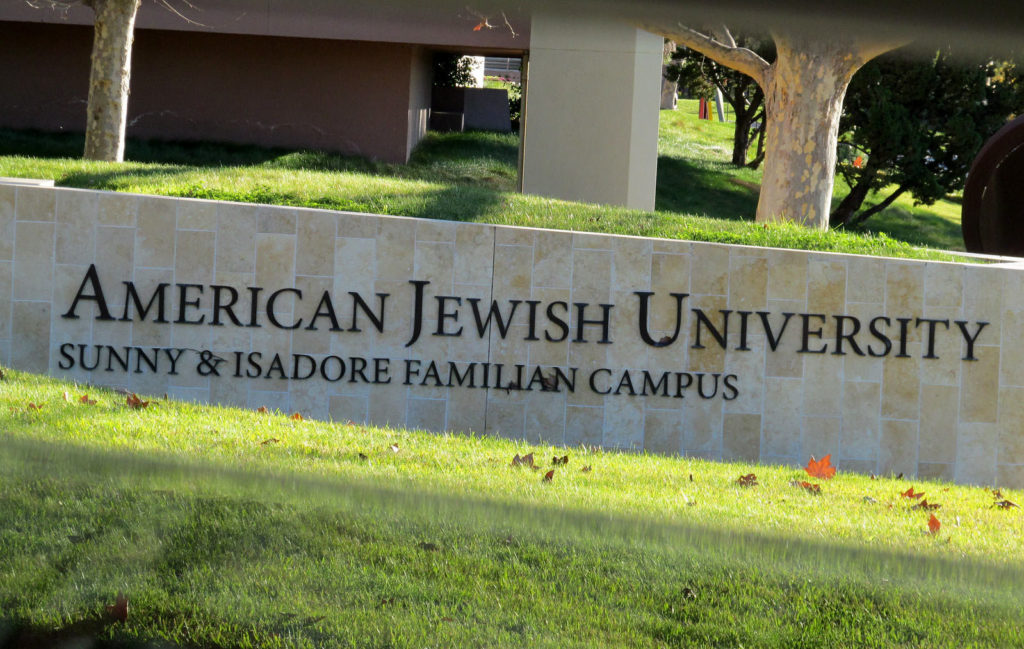
The biggest story in Jewish LA is the news that the sale of the American Jewish University (AJU) campus to an international school will not go through.

Before discussing future visions for the space, it’s helpful to get a sense of why the deal failed to get neighborhood support.

The prospective buyer was a privately owned company called Education First (EF), a for-profit, language study abroad program that planned to change the use of the University to a year-long boarding school for international students who are enrolling to come to California to learn English.

In an April email prior to a neighborhood meeting, Ameet Keny, President of the Casiano Estates Home Owners Association (HOA), summarized the reasons for the group’s opposition:

“The fact that the company is for-profit changes the use of the campus as their goal will be to enroll and house as many students as possible.  Currently, the Conditional Use Permit (which was issued in 1966, prior to the construction of any of our homes and prior to the opening of nearly every school along the Mulholland Corridor) for the AJU allows for up to 200 students to be living on campus.

“EF plans to increase that to 700 students living on campus year-round. They also plan on having another 200 students living with host families be shuttled to the campus daily between the months of Sept-June and 500 students be shuttled to the campus daily during the summer months.  Incidentally, all 1200 students partaking in EF’s summer camp (700 living on campus + 500 being shuttled in daily) will be between the ages of 13-18.  This is a major change and intensification of use of the campus.

“For these reasons and many more (fire safety/evacuation, traffic/congestion, wildlife concerns, impact on power, sanitation, parking etc.), the homeowners are opposed to the proposal set forth.”

It’s clear that in terms of getting neighborhood support, this was always going to be a tough sell, so no one should be shocked that it didn’t go through.

But beyond the specific facts of the breakdown, two key points have emerged: One, any future buyer will need to work very closely with the HOA to get their support, and two, as I wrote earlier, LA Jewry now has a second chance to keep the campus in the community.

The big question: Will Milken Community Schools renew their interest and make another offer? I’ve heard that their interest has cooled. I’ve also heard that the real estate market has softened in the months since AJU made its conditional deal with EF.

In other words, it’s possible that AJU won’t find a buyer that meets its price, and will face the prospect of going back to square one with the daunting question: What can AJU do with the campus?

Instead of seeing that option as a defeat, the AJU can see it as an opportunity.

The AJU now has a chance to reimagine the campus for the new century and for the needs of a changing Jewish world. We’re still recovering from the biggest global disaster of our time—a pandemic that took more than 5 million lives and shut down much of the world for two years. The Jewish community is hardly immune from the aftershocks. We’ve never been more physically isolated. Lured by the online conveniences of Zoom, Amazon, Postmates and Netflix, we’ve never been more homebound.

What we need now are physical spaces where we can gather in person. AJU can look at its Mulholland campus not as a giant burden but as a communal garden. What kind of creative, engaging spaces and events can it create that will get the Jews of LA to come together and reconnect?

What we need now are physical spaces where we can gather in person. AJU can look at its Mulholland campus not as a giant burden but as a communal garden.

A reimagining of AJU is hardly the only option. A whole other direction, which several of our readers have brought up, is senior housing. Since I asked readers for ideas, I received this interesting thought today from Rabbi Laura Geller:

“If the campus can be rebuilt as housing it should be inter-generational. Some version of a Continuing Care Community with pods for millennials with lower rents and smaller units for families with younger kids in exchange for interaction with the older adults.

“Or intentional co-housing, with common areas for laundry, library, craft studio, space for prayer etc. Examples of this kind of mixed housing are all over the country, often connected to universities. We are the most age segregated society in the world now and so much data suggest that all of us, younger and older, benefit through inter-generational connections.

“And the Mikvah should remain. It matters so much, especially to the non-Orthodox community which depends on it for all kinds of new ritual.”

A whole other direction, which several of our readers have brought up, is senior housing.

We will share more ideas as they come.

LA Jewry is now in the process of a communal conversation over the future of a magnificent space in which every member of our community has a stake. In addition to board members, we also need the voice of community members.

Whether the future will be shaped by Milken Community Schools, AJU, Rabbi Geller’s idea or as-yet unformed groups or ideas, the venerable Jewish campus on Mulholland Drive will be a defining space for LA Jewry for the next century.

Shabbat shalom.

AJU Take 3: Can We Reimagine the Space to Better Serve the Community? Read More »

Now is the Time to Call Out Anti-Zionist Activism

The rise of anti-Zionist groups on college campuses is a disturbing trend that has gained momentum in recent years. Groups like Jewish Voice for Peace and Students for Justice in Palestine often claim they are not antisemitic; they say that they are only “anti-Zionist” and that their cause is political. However, in practice they routinely fail to raise such distinctions. While the principles of freedom of speech and expression are critical values that must be upheld at the university level, these anti-Zionist groups often cross the line, directing their “activism” toward Jewish students, faculty and Jewish organizations on campus.

While not all critics of Israel are antisemitic, many anti-Zionists use language and tropes that demonize Israel and the Jewish people. This is particularly concerning, given the rise in antisemitic incidents on college campuses. Moreover, it is important to recognize that many of these campus groups do not seek to promote peace or dialogue between Israelis and Palestinians. Rather, they delegitimize Israel and provide moral cover to those who call for Israel’s destruction, often giving them a big platform to do so.

Just last week, CUNY Law School’s commencement speaker, Fatima Mousa Mohammed, used her platform not to speak about the accomplishments of her law school class, but rather to bash Israel and promote dangerous antisemitic rhetoric. Mohammed has an extensive history of delegitimizing Israel’s right to exist and has tweeted her wish that “every Zionist burn in the hottest pit of hell.” She continued in the speech to accuse Israelis of being colonial settlers and engaging in indiscriminate violence, among many other things. Mohammed’s anti-Zionist tirade was pure hate speech, but it took the chancellor and board of trustees two weeks to issue a statement denouncing it. In the meantime, Mohammed received a standing ovation and the support of law school professors.

This type of behavior is not unique. Last year, CUNY Law invited Nerdeen Kiswani, founder of the pro-Palestinian organization Within Our Lifetime, to give the commencement speech. Not only has Within Our Lifetime called to “globalize the intifada,” which is a direct incitement of violence against Israel and the Jewish people, but also Kiswani herself has a deep history of statements calling for the destruction of Israel. In her commencement speech, she said she faces “a campaign of Zionist harassment” because of her Palestinian identity but conveniently leaves out the antisemitic bigotry espoused by the CUNY School of Law Students for Justice in Palestine chapter she led for nearly three years.

Despite this blatant antisemitism, thousands of students, professors and community members have praised Kiswani, Mohammed, and other anti-Zionist “activists,” including a CUNY professor who is part of the pro-Palestinian group Jewish Voice for Peace and described Kiswani as “intelligent, honorable, and courageous,” and CUNY Law’s Dean who applauded Mohammed and the hateful values for which she stands. Many faculty also do not believe that Jewish students feel unsafe on campus or that there is a “climate of antisemitism” in the presence of such figures.

Furthermore, Kiswani, Mohammed and campus anti-Zionist group members are not supporting Palestinian rights. Instead, their close-minded bashing of Israel makes it more difficult to have productive conversations and targets Jews, an ethnic minority on campus.

And for those that cast doubt on the extremism of these groups, their blatant antisemitism could not become more evident than when compared to the Iranian regime’s rhetoric. The regime has a long history of promoting hatred against Israel and the Jewish people, often directing its hatred toward Israel, Zionists and Jews all the same.

While the word “Jews” may not be used explicitly, it is obvious that these regime leaders are simply using “Israel” and “Zionism” as synonyms for “Jewish.” Iranian leaders have consistently denied the Holocaust, even endorsing a Holocaust caricature contest and exhibition to discredit this horrific genocide against the Jews. In 2011, former President of Iran Mahmoud Ahmadinejad declared that “an important act for the Iranian people is to shatter the modern idol which is the Zionist regime.” The destruction of Israel and dismantling of Zionism has only been further normalized politically over the years—Iran’s current supreme leader, Khamenei, consistently emphasizes that “the solution to Palestine is in destroying the Israeli regime.”

Just a few weeks ago, over 130 members of Congress signed a bipartisan resolution demanding that the EU designate Iran’s Islamic Revolutionary Guard Corps (IRGC) as an official terrorist group. The IRGC has freely engaged in violence, terror activities and human rights abuses for years and openly threatens democracy, Israel and the Jewish people. The urgency to pass this resolution and others pertaining to Iran is only a demonstration of the increasing threat Iran poses to the Jewish state as it moves dangerously close to obtaining a nuclear weapon.

As an Iranian Jew whose parents and grandparents were forced to flee Iran due to religious persecution, it breaks my heart to see the regime’s complete normalization of its “Death to America, death to Israel” mantra. Not only does the regime pose a physical threat to the United States and Israel, but also the rhetoric and values of its leadership, which have clear parallels to anti-Zionist campus organizations, endanger Jews around the world.

At the heart of both Iran’s and campus groups’ anti-Zionism are lies that are used to demonize Israel and delegitimize its right to exist. One such claim is that Israel is a white colonial power—an attempt to paint Israel as an oppressive force that seeks to dominate the Palestinian population. Figures such as Ahmadinejad have described Israel as a “Zionist regime that was created by imperialism.” In 2019, commander Salami of the IRGC declared that Israel’s “sinister regime must be eliminated from the geographies of the world.”

Similarly, a mock apartheid wall constructed by UC San Diego’s SJP and Muslim Student Association conveyed the idea that “the three basic characteristics of Zionism are: racism, expansionism, [and] settler colonialism.” In reality, Israel is a diverse and multicultural society that is home to many Arabs and other minority communities who have freedom and basic rights. Plus, more than half of the Israeli population is composed of Mizrahim, or Jews from the Middle East and North Africa, who are not white.

In reality, Israel is a diverse and multicultural society that is home to many Arabs and other minority communities who have freedom and basic rights.

Additionally, many anti-Zionist activists will claim that Zionism is racism. For instance, an SJP-sponsored speaker at Eastern Michigan University stated that “Zionism is a hateful, racist ideology.” This is a baseless accusation that is used simply to delegitimize the existence of a Jewish state. Zionism is not a racist ideology, but rather a foundational belief that has been at the heart of Judaism for thousands of years. Anti-Zionism rejects the idea of the Jewish state and its sovereignty.

Finally, we must address the claim of many campus groups that Israel engages in apartheid. This wrongful comparison of the Israeli government to the South African apartheid regime is the basis of events such as Israel-Apartheid Week and undermines Israeli democracy and humanitarianism. Israel is a democratic nation that grants rights to all its citizens, regardless of race or religion, and reducing Israeli-Palestinian relations to a narrative of apartheid is both inaccurate and dangerous.

Don’t get me wrong, legitimate criticism of Israel’s government or certain policies is not only acceptable but necessary. As a U.S. citizen, I cannot imagine not criticizing our government. Likewise, in Israel, hundreds of thousands of demonstrators have been protesting against proposed judicial reforms. That criticism differs completely from the total delegitimization of Israel and its right to exist.

I support free speech and civil discourse on campus; these values form the bedrock of the university. However, we must recognize and call out anti-Zionist activism that promotes harmful and antisemitic messages. As students, this is our time to stand louder and prouder than ever.


Alexandra Ahdoot is a rising junior at Duke University. Originally from Great Neck, New York, she grew up as part of the Iranian-Jewish community and quickly developed a strong Jewish identity and Zionist values. At Duke, Alex co-founded Students Supporting Israel and is heavily involved in Chabad and Jewish life. She is also a 2022-2023 CAMERA on Campus Fellow. 


Now is the Time to Call Out Anti-Zionist Activism Read More »

At the Heart of a Complicated Legacy

Oskar Schindler is an inconvenient hero. Without question, what he did during the Holocaust was exceptional: He risked his own life time and time again to save over 1,300 Jews. But Schindler was no saint. He spied for Abwehr, the counterintelligence arm of the German military, in Czechoslovakia, and played a critical role in helping the Nazis take over that country. He was a hard-drinking man who died of liver disease, a womanizer who neglected his wife, and after the war, he would constantly make financial demands of those he saved. Schindler remains an enigma, an exceptional hero at one period of his life who lived very differently for the rest of it.

Complicated legacies are difficult to disentangle. A figure like Paul Gauguin, who abandoned his family to pursue his artistic aspirations, still challenges those who evaluate his biography: Do his cultural contributions mitigate his moral failures? While art historians and even philosophers might be willing to overlook his flaws, his family would undoubtedly have a very different perspective.

The Talmud grapples with this question when discussing the life of Elisha ben Avuyah, who, embittered by Roman persecution, abandoned Judaism. He is called “Acher,” the “other one,” because the rabbis don’t want to pronounce his name; he is seen as a traitor who abandoned the Jews in their time of need. The Talmud declares that Acher can never repent and is banished from the world to come.

Yet Elisha ben Avuyah’s devoted disciple, Rabbi Meir, prays for him to be brought to heaven; Rabbi Meir cannot bear to imagine a beloved teacher languishing in hell. Acher is at once a despised heretic and a beloved teacher, and his legacy remains a matter of controversy.

And this goes to the crux of the matter: How complicated legacies are disentangled depends on who is looking at them. Children have a unique relationship with their parents, and both villains and heroes are seen in a very different light by their own families. (Jay Nordlinger wrote a book about the children of brutal dictators, “Children of Monsters,” where he explores the very different ways they see their own fathers’ legacies.)

On the other hand, how we see historical figures is in many ways a look in the mirror. Evaluations of them often vary, depending on one’s political viewpoint, and frequently change with the times. There are ample examples of revisionism, where historical assessments are modified to better fit with contemporary attitudes.

The case of the “generation of the desert” offers a lesson on how difficult it is to judge a complicated legacy. The Mishna in Pirkei Avot says that the Jews “tested” God ten times during the 40 years in the desert; it is a time of complaints, cowardice and betrayal. They build an idol when Moses is slow to return from Mount Sinai, they rebel against Moses’ leadership during the episode of the spies, and do so again at the direction of Korach.

Throughout the Book of Numbers, the Jews complain and complain again. Some of the complaints are readily understandable, in instances when they don’t have water or food, or when they face a large army. Some of the complaints, like one in this week’s Torah reading, are unreasonable; instead of being appreciative of their freedom, they begin to hound Moshe for meat.

The Hebrew word used to describe their complaining, “kimitonanim” (Numbers 11:1), elicits multiple negative interpretations among the commentaries. To Ramban, this word reflects bitterness, the broken soul of worried ex-slaves. However, Seforno sees the complainers as insincere. It is “as if” they were complaining, but not out of worry or fear; they just wanted to grumble. Ibn Ezra sees their complaint as reflecting an evil motivation; and Rashi concurs, saying the complainers were looking for a way to distance themselves from God.

In short, their incessant whining is indicative that they are lacking both character and faith. The quick and easy verdict on the generation of the desert is that they were moral failures.

However, it’s not that simple. The full story of the generation of the desert is hidden from the text. The Torah is silent about most of their lives; there are no events recorded for 38 of the 40 years in the desert. This lack of information conspires against the generation of the desert and encourages us to condemn them; we only hear about their failures, not their day-to-day lives. Certainly, they must have done some good during those 38 years. But how good were they?

This issue is debated in the Talmud (Sanhedrin 110b). It explains: “The generation of the desert have no share in the World-to-Come … this is the view of Rabbi Akiva … Rabbi Eliezer says that (they were so pious that) about them the Book of Psalms (50:5) declares: “Gather My pious together to Me, those that have entered into My covenant.”

Rabbi Eliezer offers a revisionist view of the generation of the desert. He puts aside their complaints against Moshe and their lack of faith in God, and instead, focuses on the rest of the years they were in the desert. The Talmud explains Rabbi Eliezer was inspired by the verse in Jeremiah (2:2), which says: “Thus says the Lord: ‘I remember you, the kindness of your youth, the love of your betrothal, when you followed Me into the desert, in a land that is barren.’” Following God into the barren desert is a profound act of faith.

Following God into the barren desert is a profound act of faith.

What about the complaining, the times that they tested God? Clearly, Rabbi Eliezer recognizes the generation of the desert was quite imperfect. But for all of their failings, this generation did continue forward; and one must recognize that survival alone is heroic for a group of runaway slaves. One needs to see the positive in a complicated legacy.

Rabbi Eliezer does offer a rather generous reading of this generation’s legacy. It is fascinating that Rabbi Akiva, the eternal optimist, the one who always sees the best in human nature, takes a hard line on the generation of the desert; as the Talmud puts it “Rabbi Akiva left behind his kindness in this case.”

Why does Rabbi Akiva do this? I would speculate that it had a lot to do with his historical perspective. Rabbi Akiva dreamt of the Jews overtaking the Romans, and was the foremost rabbinic supporter of the Bar Kochva rebellion. This would require stoic courage, a willingness to battle and accept losses; survival alone would not suffice.

That is why Rabbi Akiva needed to condemn the generation of the desert. Their spinelessness and dissension are the opposite of what is needed in a rebellion. Rabbi Akiva needed his own generation to despise cowardice.

In this particular case, current events suggest a particular interpretation of a complicated legacy.

As I mentioned before, family members wrestle with this subject as well. In my role as a rabbi, I’ve watched families contend with complicated legacies at funerals as they prepare for their eulogies. There are many such scenarios; some include great leaders who were abusive parents, and predatory felons who were loving husbands.

More difficult to unwind are the legacies of people whose relationships change: parents who are estranged from their children, only to reenter their lives years later, or those who go in the opposite direction, and disengage from their children later in life. Such eulogies will often latch on to the few good years at the end. (A similar perspective is offered by Teshuvah, repentance, which sees the person’s character at the end of their life to be determinative.) But not every complicated relationship follows a timeline; some have good and bad interspersed.

Rabbi Eliezer offers a different way to interpret complicated legacies. He is willing to listen to the silences in the record and hear echoes of goodness. He appreciates how difficult the position of the generation in the desert was, and yet even so, they did end up being the parents of a generation of pioneers, whom they carried to the doorstep of the promised land. There is another story hidden in between the lines of the text. And in their own struggle with complicated legacies, many family members use Rabbi Eliezer’s approach.

Years ago, I performed a very small unveiling, which was attended by the late woman’s child and another friend. The woman had suffered from serious mental illness all of her adult years, and she had pushed her son away from a very young age; he never had an opportunity to form a loving relationship with his mother. I asked him at the unveiling if he had any memories of her that he thought he should share. The son thought for a moment, and said he remembered one time when he was sick, his mother, concerned about his welfare, made him a cup of tea and brought it to his bed. He explained that it was the one moment that he could see through the veil of mental illness and experience his mother’s love.

In his heart, the son could hear a voice of love breaking through all of the confusion of a complicated legacy.


Rabbi Chaim Steinmetz is the Senior Rabbi of Congregation Kehilath Jeshurun in New York.

At the Heart of a Complicated Legacy Read More »

Confronting Chaos – Thoughts on Torah Portion B’ha’alotekha


Confronting Chaos  Thoughts on Torah portion  B’ha’alotekha 2023


The brilliance of the Torah as “Literary Philosophic-Psychology” is evident in this week’s Torah portion, “Be’ha’alotekha.”  We see here an interplay of chaos in the inner life, anxiety and fear, that turns into a fixation on food. From that fixation, the people then wanted to rebel against Moses and return to Egypt. A psychologist might say that the people fell into into a general dysthymia – a profound lack of well-being. Here’s the story.


After about 13 months at Mt. Sinai, on the 20th day of the second month (Iyyar), the Israelites broke camp and began their trek to the ancient homeland in Canaan. Within just a few days of leaving Mt. Sinai, the people become “k-mit’onenim” – “like moaners” (Numbers 11:1).  I see this as a dejected state, sunk in despair, irritable, and usually looking for someone to blame. Why the moaning? What just happened?


Reality happened, the reality that they couldn’t just stay at Mt. Sinai. Mt Sinai was their first home since fleeing from Egyptian slavery. The Israelites had been through extraordinary times, rapturous heights and shameful lows. Six days after arriving at Mt. Sinai on the first day of the third month (Sivan), they had witnessed the awesome revelation of the Decalogue, and had seen Moses disappear into the cloud-covered mountain top. Forty days later, Moses came down from the mountain, bearing the stone tablets. As a way of rejecting their new life governed by a moral law, the people regressed and cavorted with the Molten Calf. Moses effected a reconciliation between God and the people, went back up Mt. Sinai, and came back down with a second set of stone tablets. Once the second tablets were given, God had the people busy themselves with building the Mishkan, the elaborate tent that would house God’s presence.


I think the people were finally happy. Building the Mishkan required a vast array of talents. Everyone had something productive to do out of inner passion, not because of the Egyptian taskmasters’s whips. Then the Mishkan was finished, on the first day of the first month, just two weeks shy of one year since the liberation from Egypt. Now they had to march through the rocky desert and fight their way back to the homeland of their ancestors.


Perhaps the Israelites had been under the illusion, a futile hope, that they could just stay at Mt. Sinai.  In our Torah portion, the Israelites were reminded that they had to move on to the next part of their lives. I think they went through a minor version of the Molten Calf incident. The Israelites were resisting the purpose for which the nation was brought into being.


They moped, moaned, complained. That inner distress manifested into a craving for meat, a “ta’avah” (just how Eve saw the Tree in the Garden of Eden). The Israelites suffered a moral collapse, filled with anxiety and fear about the future that they dreaded.  They suddenly remembered the all-you-can-eat fish they ate for free in Egypt. And the free salad bar. “Cucumbers, melons, leeks, onions and garlic,” the Torah lists for us.


The inconvenient fact that the food was not free – they had been brutalized slaves – was obscured from memory. This is, indeed, part of the human condition. In the unconscious ego self, we sometimes remember the past in a particular way in order to justify our current state of thinking and feeling.  Instead of working things through in the painful process of confronting reality with wisdom, we come up with slogans – “free fish and salad bar.”  Moses, Aaron (and God) became the enemy with this newly discovered (false) history.


The Torah at this point digresses and reminds us that the people who were filled with craving actually had the manna from Heaven to eat – coriander seed that looks like bdellium (which grew on the river of Havilah, that flowed out of the Garden of Eden). Once prepared, we are told, it tasted like dough kneaded with oil. Small sweet cakes.


Effectively, God is leading them away from Sinai toward Canaan through a terrain sparkling with nourishment reminiscent of the waters of Eden. Like Eve and Adam, who had the entire garden for their enjoyment, the people had a craving for something else. They went from being ravenous for meat to wanting to return to Egypt where they “ate for free.”  We all know that nothing in the external world can satisfy those cravings, rooted in the chaos of our inner lives.


There was a two-fold response to this crisis of people’s grumbling and rebellion – I’ll just discuss one here. As a responshae to the people’s breakdown, God instructs Moses to gather 70 elders into the Tent of Meeting. There, God’s presence would descend upon Moses and emanate among the 70 elders, who then prophesied.


Not prophecy as in telling the future, but prophecy in its original sense – being filled with and communicating the spirit of God. In our language: to counter chaos with divine order, with meaning and purpose, with duty and dignity, with virtue, wisdom and connection to the soul.


The depth of this idea, that meaning can overcome chaos, cannot be overstated. We all at times feel an inner chaos that is displaced into addictions, substance or emotional. That inner chaos often has us scan our environment and blame others for our emotions, just as the people turned on Moses and Aaron.  We project our inner state onto the world and create a subjective reality based on how badly we feel.


Things happen in life that trigger habits of thought, feelings and emotions. The triggers are within us. We often can’t control what happens in life, but we can manage how we think and feel about it. The manna from heaven can be found in our souls. We can crave or act out, or we can go deep within and find spiritual nourishment. What we do with our disruptive thoughts and feelings defines our character.


We are all walking this rocky path together toward our inevitable deaths, without enough wisdom or time. Let’s at least not make it harder on each other.

Confronting Chaos – Thoughts on Torah Portion B’ha’alotekha Read More »

Identity and History: A Conversation with the Chair of the World’s Largest Jewish Museum

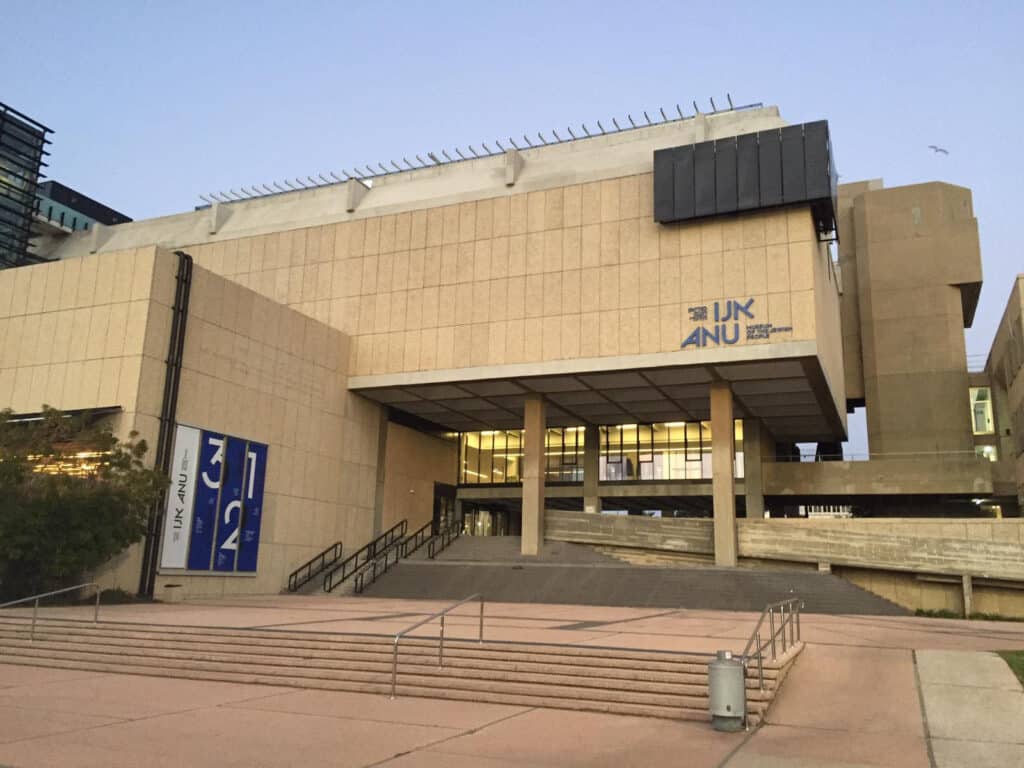
The ANU Museum of the Jewish People in Tel Aviv is the world’s largest Jewish museum, welcoming more than 600,000 visitors in the last year. In the last 15 years, the museum has completed a $100 million expansion project. Initially founded in 1978 by former World Jewish Congress President Nahum Goldmann, the museum was envisioned as a central location for the global Jewish community that could bring to life the Jewish people’s faith and spirituality, culture and contributions to humanity. Goldman originally named the museum the Nahum Goldmann Museum of the Jewish Diaspora. However, the now rebranded exhibition spans 72,000 square feet to present stories of Jewish life.

In April, the ANU Museum hosted the Koret Center for Jewish Civilization’s Jewish Peoplehood International Conference, a gathering of Jewish leaders and educators from around the world, designed to explore critical and timely conversations for the Jewish world.

Irina Nevzlin is the chair of ANU Museum’s Board of Directors and guided the museum through its expansion. The Jewish Journal recently shared a few questions with Nevzlin to discuss ANU’s efforts to bolster the relationship between the American and Israeli Jewish communities.

Jewish Journal: What was the driving force behind the recent renovations to the museum? What has changed since the renovation?

Nevzlin: Over the last 15 years, we transformed the name and the concept of the museum to talk about everything Jewish people. We are talking about Jewish life, success and continuity. Most importantly, we do it in a way that engages our younger generations.

Jewish Journal: How would you describe the central problem the museum faces?

Nevzlin: The Jewish people of Israel are in an identity crisis. We’re a very young country; therefore, we’re currently building the Israeli identity, or the identity of a Jewish majority. The center’s job is to develop a curriculum for this identity situation, answer identity questions, and build a new leadership to speak a language more applicable to the current crisis. Every day I am blessed to meet people who are so passionate about figuring out how to make things work. The Jewish people’s common denominator is curiosity and ambition, which is why the crisis is so intense. I am optimistic because I think, on a very deep level, we all care.

Jewish Journal: Where do you see the commonality between the American and Israeli Jewish communities? How do you go beyond the day-to-day politics to illustrate what Israel can do for Jewish people?

Nevzlin: We live in a world where all information is available. We’re constantly bombarded with information that makes you question how you define yourself. Helping people deal with questions of identity early on helps them figure out who they are. Being part of the Jewish people is the most stable thing you can connect to because that never changes. You’re born Jewish; you die Jewish. The perspective on Israel changes the moment you set foot in the country. There is something about Israel. We should make the effort for people to come and experience Israel and then help them process what they feel before, during and after.

Jewish Journal: What role does Israel play in bringing Jewish people back to the community?

Nevzlin: Israel must be a leading resource of hope. The “how” will take years to solve, but there must be a new way of talking about Jewish people. We require a new language, honestly. The answer lies in how we respond to changes while still staying true to our roots. Being Jewish keeps us strong, keeps us going and keeps our lives interesting.

This interview has been condensed for clarity.

Identity and History: A Conversation with the Chair of the World’s Largest Jewish Museum Read More »

Dept. of Education to Investigate SUNY New Paltz Over Antisemitism Allegations

The Department of Education’s Office of Civil Rights (OCR) has decided to launch an official investigation into the State University at New York (SUNY) New Paltz over allegations that two Jewish students were excluded from a sexual assault survivors’ student group. It is the first antisemitism investigation launched by OCR into a university since last week’s launch of the Biden administration’s national strategy against antisemitism.

The Louis D. Brandeis Center for Human Rights Under Law and Jewish on Campus (JOC), jointly filed the complaint with OCR on behalf of the students,  and announced the launching of the investigation on June 8th. As the Journal previously reported, the August 2022 complaint stated that the New Paltz Accountability (NPA) group “excluded” and “publicly vilified” the two students, Cassandra Blotner and Ofek Preis. Blotner and Preis were subjected to “further sustained harassment, including threats and intimidation of social media.” Although the University “knew about and publicly acknowledged the exclusion and harassment, it failed to intervene, either to discipline NPA or the organization’s leaders or to ensure opportunities for all victims of sexual assault on campus. It also failed to address the Complainants’ safety concerns arising from the harassment; as a result, both students were unable to attend classes and Ms. Blotner was afraid to spend time on campus.”

University President Donald Christian had said that the university can’t take action against the NPA because they’re not a recognized student group but the complaint argued that the university “has treated NPA as a de facto recognized student group on campus, providing survivors of sexual assault and their allies with educational programs and activities on campus through NPA” and thus the university is required to take action against them. The Brandeis Center-JOC June 8 statement did acknowledge that the university met with various Jewish students and members of the community and issue a series of recommendations to improve the campus climate for Jews, including the adoption of the International Holocaust Remembrance Alliance definition of antisemitism. But Denise Katz-Prober, director of legal initiatives for the Brandeis Center, argued in a statement that this was insufficient, as “it’s not enough to merely to consider adopting IHRA … The university must modify its policies, procedures and trainings, as UVM [University of Vermont] is now doing under the direction and supervision of the Department of Education’s Office for Civil Rights …  “The current recommendations fail to recognize that Jewish identity is not confined to religious practice, but also involves shared ancestry, shared history and shared culture.  Just as with UVM, the Department of Education’s investigation, involvement and guidance is critical.”

Katz-Prober hailed the launching of the investigation as “a monumental day for Jewish students across the U.S.” “[It] sends a clear and unequivocal signal to SUNY New Paltz as well as universities across the country that they take anti-Zionist discrimination and harassment seriously and they expect universities to take it just as seriously, and address it with the same intensity and vigor, as they do all other forms of harassment and discrimination … In this case, students were excluded and harassed based on their Jewish identity connected to Israel … the Department of Education’s commitment to investigate what transpired at SUNY New Paltz signifies it recognizes this form of harassment and discrimination as national origin discrimination based on shared ancestry.”

JOC Co-Founder and CEO Julia Jassey said in a statement, “When Jewish students are excluded because of their identities, as Jews or Israelis alike, that is antisemitism plain and simple. For too long, our voices have been neglected and the lived experiences of Jewish students facing antisemitism have been ignored or outright dismissed. Today represents a new chapter … When Cassandra and Ofek approached Jewish on Campus to describe the hate they encountered, we were both inspired by their courage to speak up and outraged that such intolerance exists at SUNY New Paltz … No student should ever be excluded from campus because of facets of their Jewish identity, let alone survivors of sexual assault. By launching an investigation into SUNY New Paltz’s actions, or lack thereof, in the face of this blatant antisemitism, the U.S. Department of Education’s Office for Civil Rights is taking a necessary step toward accountability. But as Jewish students on campuses across the country are forced to confront similar discrimination in their classrooms and student organizations, today’s announcement is a beginning, not an end.”

In a statement to the Journal, the university said, “We unequivocally condemn any attacks on SUNY students who are Jewish, and we will not tolerate anti-Semitic harassment and intimidation on campus. We do not comment on pending investigations.”

Dept. of Education to Investigate SUNY New Paltz Over Antisemitism Allegations Read More »

Samantha Ferraro: The Beauty of One Pot Mediterranean

Samantha Ferraro is sharing her love of all Mediterranean flavors in a new cookbook: “One Pot Mediterranean.” The author loves citrus, spices and showcasing recipes that cooks of all skill levels can prepare. 

“A lot of Mediterranean recipes are and can be made in one pot,” Ferraro, the author of “Weeknight Mediterranean Kitchen,”  told the Journal. “I am so excited about [sharing] all the hearty soups, braises and stews that I love to make.” As her mother is Sephardic, Ferraro grew up eating a lot of Sephardic and Jewish foods.  “I grew up with food around me, but I wasn’t mature enough to really appreciate it until I was older,” Ferraro said. “When I was in my mid-20s, which was a number of years ago, I was missing those flavors that I grew up on.” Ferraro started asking her mother, her aunt, everyone, “How did you make this?”

At the same time, she started her website, Little Ferraro Kitchen, where she was exploring food and sharing these older, traditional Mediterranean recipes. While her friends were not familiar with them, she would get emails from strangers who connected with her recipes.

“They were like, ‘My Sephardic grandmother made that too,’” Ferraro said. “And that would start a conversation. I would learn even more about a recipe … and I was just hooked.”

Ferraro not only loved that connection, she enjoyed reexperiencing those flavors as an adult, which is what inspired a lot of her recipes. “The Turkish stuffed peppers are a riff off of my mom’s stuffed peppers recipe,” she said. “The Turkish green beans over Yogurt were inspired by a childhood favorite, fasulye (green bean stew).”

“One Pot Mediterranean” includes more than 70 recipes, with each chapter broken up into different main proteins, along with a final chapter on salads to bring the whole meal together. “All of the one-pot recipes are seasoned with vibrant spices, fresh herbs and some with the additions of dried fruit and nuts for different textures and flavors,” she said. 

Whereas “Weeknight Mediterranean Kitchen” is a great introductory cookbook for people who want to dive into those flavors, “One Pot Mediterranean” focuses on the main course. 

“We’re creating something savory and delicious in one pot,” she said. “I love one-pot cooking because you can have proteins, grains and vegetables in one pot and then transfer the entire dish right to the table.” 

Ferraro suggests readers start by making her Garlic-Lemon Chicken with Saffron Pearl Couscous and Zucchini.

”Whether you grew up eating Mediterranean flavors or not, my wish is that these recipes make it into your kitchen and inspire a legacy of cooking with bold, fresh and vibrant Mediterranean ingredients.”

“The chicken starts with an aromatic marinade that includes thyme, lemon zest and garlic and then braises in a saffron infused stock with Pearl couscous and Zucchini,” she said. “All of the flavors work so well together and the chicken becomes incredibly tender with the chewy couscous. It’s truly delicious! … Whether you grew up eating Mediterranean flavors or not, my wish is that these recipes make it into your kitchen and inspire a legacy of cooking with bold, fresh and vibrant Mediterranean ingredients,” she said.

Garlic-Lemon Chicken with Saffron Pearl Couscous and Zucchini
Photo courtesy of Little Ferraro Kitchen

Samantha Ferraro’s Garlic-Lemon Chicken with Saffron Pearl Couscous and Zucchini
from “One Pot Mediterranean Cookbook”

Chicken Marinade
2 lb (907 g) bone-in, skin-on chicken
thighs
4 garlic cloves, finely chopped or grated
1 tsp dried thyme
1⁄2 tsp cumin
1 tsp kosher salt
1⁄2 tsp ground black pepper
1⁄2 lemon, zested and juiced
1⁄4 cup plus 2 Tbsp (90 ml) olive oil,
divided

Pearl Couscous
Pinch of saffron
1 tbsp (15 ml) warm water
1 shallot, diced
1 medium fennel bulb, diced
2 Tbsp (32 g) tomato paste
1⁄2 cup (120 ml) dry white wine, such as
Pinot Grigio
2 medium zucchini, diced
1 cup (150 g) dried pearl couscous
21⁄2 cups (600 ml) low-sodium chicken
stock
Chopped fresh parsley leaves, for garnish

Pat the chicken thighs dry with paper towels, and season with the chopped garlic, thyme, cumin, salt, pepper, lemon zest, lemon juice and 1⁄4 cup (60 ml) of olive oil. Use your hands to evenly coat the chicken all over, and set aside. If you have the time, marinate for at least 20 minutes and up to 8 hours.
While the chicken marinates, preheat the oven to 375°F, and add a pinch of saffron to the warm water to steep while you prepare the rest of the recipe.
Heat a wide Dutch oven over medium-to-high heat, and drizzle with the remaining 2 tablespoons (30 ml) of olive oil. Place the chicken thighs in the Dutch oven, skin side down, and sear the chicken until the skin is a deep golden color, then flip over and cook the other side for 3 to 4 minutes. Once the chicken is seared on both sides, transfer it to a plate.
To make the couscous, to the same Dutch oven, add the shallot and fennel, and sauté for 2 to 3 minutes to soften. Stir in the tomato paste and saffron water, and use a spatula to break up the paste so it melts into the oil. Next, pour in the white wine, and use a spatula to scrape any meaty bits from the bottom. Add the zucchini and couscous, and pour in the chicken stock. Give everything a gentle mix to evenly distribute all of the ingredients.
Return the chicken, skin side up, and any accumulated juices into the Dutch oven.
Cover and position the Dutch oven on the middle rack in the oven, and cook for 25 to 28 minutes, until at least half of the liquid has absorbed. Remove the lid, and continue cooking for 8 to 10 minutes, until the chicken is cooked through and golden brown and the pearl couscous is tender.
Garnish the chicken with parsley, and serve the chicken with the couscous and vegetables.

For more on Samantha Ferraro, check out the interview on Taste Buds with Deb on JewishJournal.com.

Samantha Ferraro: The Beauty of One Pot Mediterranean Read More »

Magen David Adom Training, Holocaust Museum LA ‘Golf Classic,’ JNF-USA Luncheon

Israel is exporting its knowledge in emergency medical response. On May 19, two senior paramedics from Magen David Adom (MDA), Israel’s national EMS organization, trained members of the Jewish community in how to respond after an attack or disaster in the first seven minutes it typically takes before first responders arrive to the scene.

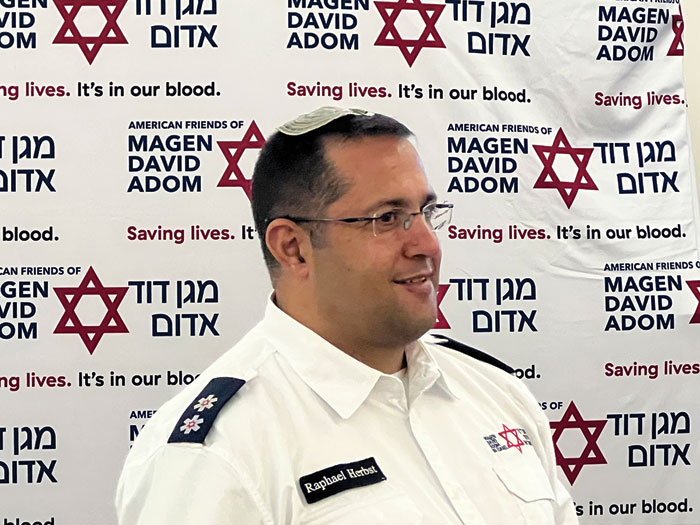
The program began with MDA Senior Paramedic Raphael Herbst highlighting the seven steps for responding to a crisis such as a mass shooting in a public setting.

“We know that saving time is saving lives,” Herbst told the small group assembled in a conference room at the Jewish Federation of Greater Los Angeles office building.

Magen David Adom Senior Paramedic Raphael Herbst. Courtesy of American Friends of Magen David Adom

Warm in demeanor, wearing a neatly ironed MDA uniform and a yarmulke, Herbst explained an effective response starts with ensuring your own safety. This is followed by calling for help and organizing the scene the best one can before emergency service providers arrive. The latter can mean separating victims into three groups: those who are walking, those on the ground and breathing and those on the ground and not breathing.

When calling for help, Herbst said, remember the dispatcher is “blind” to the unfolding crisis scene. He or she will only have the information provided to them by the person reporting the situation. Therefore, provide as much detail to the dispatcher as possible.

After Herbst’s presentation, a simulation activity focused on how to stop a victim’s bleeding. MDA medic Lena Beyer provided the small group with white, blood-stained T-shirts. Those given this apparel played out a scenario where they laid on the ground and called for help, while those uninjured were tasked with identifying the location of each of the wounded, even those obscured behind large objects such as conference room tables, approaching the victims and applying pressure on their fake wounds to prevent blood loss.

When dealing with external wounds, Herbst explained, practically anything can be used as a tourniquet — a t-shirt, belt or even your hands. 

The recent two-hour interactive training session at the Federation — titled “First 7 Minutes” — was one of several MDA held in Southern California during the month of May. In addition to L.A., six other trainings were organized between May 15 and May 23, including at the Chabad of Poway, which was targeted by a deadly shooting in 2019.

“This training isn’t just about learning how to stanch bleeding,” Herbst said. “It’s about seeking shelter while the danger is ongoing and taking immediate action in the aftermath of the incident to ensure first responders know where the injured are and can evacuate them for potentially lifesaving medical care as quickly as possible.”

Comprised of 2,800 staff members and 30,000 volunteers serving as paramedics, EMTs, first responders and first-aid providers, MDA has emerged as one of the world’s leading mass-casualty response organizations because of the frequent terror and rocket attacks Israel faces. 

The organization is Israel’s national emergency medical service and representative to the International Red Cross.


From left: Holocaust Museum LA board member Peter Best, Hall of Famer Amy Alcott and Holocaust Museum CEO Beth Kean. Photo by Paul Lester Photography

Holocaust Museum LA held its inaugural “Building Bridges Golf Classic,” a day-long event with a tournament, golf clinic with LPGA Hall of Famer Amy Alcott, cocktail reception and an online, silent and live auction. The May 22 program was held at El Caballero Country Club.


On May 31, Jewish National Fund-USA (JNF-USA) held its Women for Israel luncheon at the Luxe Sunset Boulevard Hotel. 

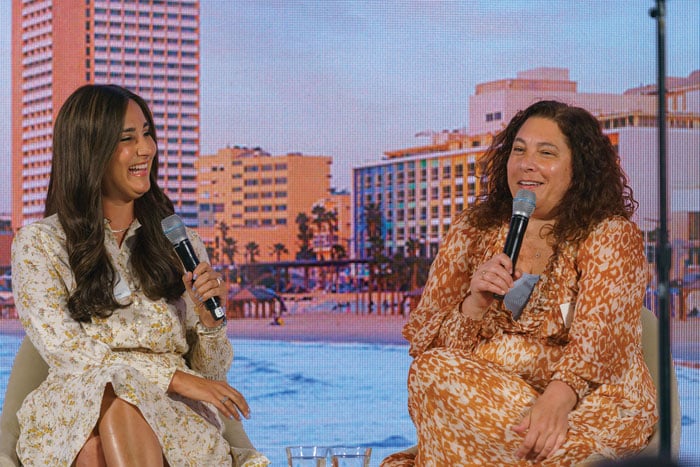
The event featured Allison Josephs, founder and executive director of the nonprofit, Jew in the City, and Variety’s Features Editor Malina Saval. They discussed their work for JITC’s Jewish Hollywood Bureau. The two women have partnered to urge the television and film industry to accurately depict Jews in their content as well as be more inclusive of the Jewish community. 

Event chairs included Marcia Selz, Laura Stein and Susie Toczek. Members of JNF-USA as well as Consul General of Israel in Los Angeles Hillel Newman addressed the crowd. 

-By Kylie Ora Lobell, Community Editor

Magen David Adom Training, Holocaust Museum LA ‘Golf Classic,’ JNF-USA Luncheon Read More »

Summer Soups to Try This Season

As the weather warms up, that means it’s time for cold soups.

“Cold soups are ideal for summer Shabbat dinners or lunches,” Faith Kramer, the author of “52 Shabbats: Friday Night Dinners Inspired by a Global Jewish Kitchen,” told the Journal. “They are made in advance, provide cooling sustenance in hot weather and have long been a part of the global Jewish kitchen.”

Kramer’s Buttermilk Soup with Cucumbers combines Eastern European and Near Eastern flavors. In her Jewish Greek egg and lemon recipe, cauliflower replaces rice for a hearty, parve, grain-free soup. Both tangy soups can be served as starters or main courses. 

“Cold dulls flavors, so be sure to taste and adjust seasonings again just before serving,” Kramer said.

Buttermilk Soup with Cucumbers
Photo by Faith Kramer

Buttermilk Soup with Cucumbers

5 Persian cucumbers (1 lb.), divided
2 cups whole or low-fat buttermilk
(preferably cultured)
1 cup vegetable broth, chilled
1/4 tsp minced garlic
1/2 tsp salt plus more if desired
1/8 tsp ground cumin
1/8 tsp ground cinnamon
1/8 tsp ground cardamom
1/4 tsp sugar, optional
1 Tbsp finely chopped dill
Garnishes, optional (see below)

Scrub cucumbers but do not peel. Chop 4 cucumbers into 1/4-inch pieces. In a large bowl, combine the chopped cucumber, buttermilk, broth, garlic, salt, cumin, cinnamon and cardamom. Cover and refrigerate for two hours or up to one day in advance so flavors have blended and the soup is very cold. Taste and add sugar and additional salt if necessary.
Finely chop the remaining cucumber for garnish. Serve chilled soup garnished with cucumber and dill. If desired, top with optional garnishes.
For garnishing, try sprinkling on one or more of these: chopped green onions, paprika or freshly ground black pepper.


Greek Cauliflower Lemon and Egg Soup 

Serves 8 as a starter, 4 as a main course

3 large lemons
4 cups vegetable broth
2 cups water
1 lb cauliflower florets, about 4 to 5 cups (Note: You’ll need one medium head of cauliflower (about 1 1/4 lbs with greens and stem)
2 Tbsp large, whole peeled garlic cloves
1/4 tsp ground black pepper plus more if
desired
1/8 tsp ground turmeric
1/4 tsp salt plus more if desired
3 large eggs, beaten
1/4 cup finely chopped fresh dill and/or
flat-leaf parsley
Garnishes, optional (see below)

Scrub 1 lemon. Cut off 2 thin pieces of peel (without white pith), each about 1-inch by 2-inches. Set peel aside. Juice lemon with others. Reserve 1/2 cup of juice.
Place broth and water in a large pot. Bring to a simmer. Add peel, cauliflower, garlic, black pepper and turmeric. Return to a simmer. Simmer, covered, until cauliflower can be mashed with a fork, about 40 minutes. Take the pot off heat. Cool until safe to handle. Remove and discard the peel. Blend soup until smooth with an immersion blender (or in batches in a regular blender). Return to a simmer.
Put eggs in a large bowl. Slowly pour in reserved juice whisking at the same time. Slowly drizzle in 1/2 cup soup, whisking constantly. Repeat 3 more times. Whisk until well combined. (This is to prevent eggs from curdling.)
Slowly pour eggs into the simmering (not boiling) soup, whisking continuously. Return soup to a simmer. Simmer uncovered for 7 to 10 minutes until it has thickened slightly (it will thicken more as it cools). Do not let soup boil (to prevent curdling). Taste. Add salt and additional black pepper as desired.
Place in an airtight container and refrigerate until cold (about 4 to 6 hours) or for up to 2 days. Stir just before serving. Taste. Add salt if needed. Serve in individual bowls topped with dill and desired garnishes.
For garnishes, try one or more of these: a drizzle of olive oil; a sprinkle of paprika, ground sumac or minced lemon zest; a dollop of harissa or hot sauce and a scattering of chopped tomatoes and/or greens.


While Judy Elbaum’s Summer Sweet Corn Soup is especially refreshing when served chilled on a sultry summer’s eve, it’s also delicious when served hot. It’s one of her favorite summer soups.

“I like to serve sweet corn soup with slices of crusty French or Italian bread,” Elbaum, founder of LeaveItToBubbe.com, told the Journal. “Or, in keeping with the corn theme, I like to accompany the soup with the corn sticks.”

Summer Sweet Corn Soup

2 Tbsp canola oil
1 onion, chopped
1 carrot, chopped
1 stalk celery, chopped
4 cloves garlic, minced
1 teaspoon garlic powder
½ tsp dried basil
¼ tsp dried thyme
6 cups vegetable or chicken stock
4 medium Yukon Gold potatoes, diced
corn kernels scraped from 4 ears of corn, scraped cobs reserved
6 sprigs parsley, tied with kitchen string
salt and pepper to taste
½ to 1 cup coconut milk (optional)

Heat the canola oil in a large soup pot. Saute the onion, carrot, celery and garlic in the oil on medium heat for 5 to 10 minutes, until the onions are translucent and the vegetables are softened. Stir the vegetables frequently to make sure they don’t brown.
Sprinkle the garlic powder, basil and thyme on the vegetables and cook for a minute or two to release their flavors.
Add the 6 cups of vegetable or chicken stock, potatoes, corn kernels, scraped cobs, parsley, salt and pepper to taste. Bring to a boil, reduce heat and simmer for 20 to 25 minutes, until the potatoes are soft.
Remove the parsley and the scraped cobs from the soup pot.
Pour the vegetables and stock into a large strainer placed over a large bowl.
Strain the vegetables, reserving the stock. Place the vegetables into a food processor. Puree the vegetables, adding several ladles of the stock to thin the puree into a soup consistency. You may have to do this in two or three batches.
Place the corn soup back into the soup pot. For a more creamy consistency, whisk in ½ to 1 cup of coconut milk.
If the soup consistency becomes too thick, you can always add some extra stock or coconut milk.
For more corn recipes, including the corn sticks, email puppy513@aol.com.


Watermelon Soup
Photo courtesy Michael Tanenbaum

Michael Tanenbaum’s family loves his Watermelon Soup.

“It’s perfect for the warm summer nights that have yet to materialize this season in LA,” Tanenbaum, founder of the website Consciously Kosher, told the Journal.

Watermelon Soup

4 cups seedless watermelon, sliced
approximately into 1-inch cubes
3 Tbsp fresh-squeezed lemon juice
1 Tbsp fresh-squeezed lime juice
1 Tbsp extra-virgin olive oil
1 Tbsp raw honey
1/4 tsp ginger powder (or more, to taste)
2 Tbsps cup shredded fresh basil,
for garnish
2 Tbsps shredded fresh mint, for
garnish

Combine watermelon, lemon juice, lime juice, olive oil, honey and ginger powder into a blender and blend for up to 30 seconds.
Chill in the refrigerator for at least 30 minutes.
Serve chilled and top with basil and mint.

Summer Soups to Try This Season Read More »