fbpx

May 19, 2023

On ‘Succession’ What’s The Deal With Roman’s Jewish Joke?

It’s a razor tight presidential race as Republican Jeryd Mencken (Justin Kirk) and Democrat Daniel Jimenez (Elliot Villar) square off. The third-to-last episode of HBO Max’s “Succession,” “America Decides,” aired May 14, and shows things get nutty as ATN, Waystar Royco’s powerful, conservative-leaning cable news network, covers election night. A fire breaks out at a vote collection center in Milwaukee, Wisconsin; crews are struggling to contain the blaze, and everyone in the building has been evacuated. But the uncounted absentee ballots inside the building are a complete loss.

As he watches the news footage, Kendall (Jeremy Strong) asks: “Who burnt this place down?”

Roman (Kiran Culkin), the youngest of the Roy children, is known for risqué humor, his answer to his brother’s question is more than strange.

He tells his brother “To me, it always comes down to a couple of old favorites: The Blacks and the Jews.”

He immediately says he is joking.

As more news comes in, the liberal Shiv, notes that with 100,000 absentee ballots unaccounted for and possibly destroyed by the fire, a call for Wisconsin can’t be made. Roman scoffs at the idea. “Your guys knew they were going to lose, so they did something crazy to throw it into question and get a revote.”

He repeatedly calls the fire a “false flag”  and demands that ATN calls Wisconsin for Mencken; Shiv argues they should wait until all the votes are counted. Their positions are based less on politics than a desire for power; Roman has a deal with Mencken, who has pledged to block the sale of Waystar/Roy, while Shiv wants the sale to go forward, because she has been promised a top position in the new company. If the fire was set by Mencken’s supporters, his candidacy would be in serious trouble.

“Succession” has elements of Shakespeare’s “King Lear” and while the show’s creators have insisted that the characters of Logan, Conor, Kendall, Shiv and Roman Roy and Waystar Royco, media conglomerate they own, are based on several entities and people, this season it most closely connects to News Corp and its founder Ruport Murdoch and Fox News is a mirror of ATN.

The penultimate episode will concern the funeral of Logan Roy, the recently deceased founder and chairman of Waystar Royco, the conglomerate that owns ATN.

With Wisconsin’s electoral votes up for grabs, will the losing candidate say it was stolen? Will there be riots? That remains to be seen. But it’s a pity that Roman’s joke about Blacks and Jews is reflective of reality.

The final two episodes of “Succession” air May 21 and May 28.

On ‘Succession’ What’s The Deal With Roman’s Jewish Joke? Read More »

Gemstones, Banners and Insignias — Comments on Torah Portion Ba-Midbar


Gemstones, Banners and Insignias

Comments on Torah Portion Ba-Midbar


Warning: There will be a homework assignment at the end of this teaching.


This Torah portion, Ba-Midbar (In the Desert) begins what in English is called “The Book of Numbers.” For many people, this Torah portion is officially one of the “boring Torah portions.” The Torah portion comprises, for example, lists of tribes and the number of males twenty years old and up in each tribe. These men over 20 are termed “kol yotzei tzava” “all who go out in the Legions” – Minute Men, the organized militia in case of a war (there were several).


We also have a list of those who didn’t serve in the militia – the Levites, who took care of the Mishkan – the Dwelling Place of God. We have descriptions of where all the tribes/militias stationed themselves around the Dwelling Place of God – 12 tribes around the compass, four stations, three tribes each.


The lists go on.


If you avoid reading the lists, you’ll miss a verse that is easy to overlook. In Numbers 1:2, we are told that “the Israelites shall encamp around the Tent of Meeting, each man by his banner and the insignia of their clans (ish al diglo b’otot l’beit avotam).” As far as I know, the “banners and insignias” is not expanded upon in the Bible.


In Rabbinic Literature, especially Ba-Midbar Rabbah 2:6-7, the imagination of the Rabbis fills in what the Bible leaves out. According to the Midrash, each of the 12 Tribes had a uniquely colored degel – banner. The colors of the banners were determined by the colors of the gems associated with each tribe on the Breastplate of the High Priest. Each tribe had an insignia on its flag, an animal or other image symbolic of the unique characteristic of each tribe. The three tribes together on each point of the compass, the regiment, as it were, had a tricolor – the three colors of each of that regiment’s three tribes.


In this short section of the Midrash, we have a riot of colors and images, formed into the battalions and regiments of the militia. Twelve banners, one for each of the 12 Tribes, each banner with a symbolic image. For example, the stone on the Breastplate for the tribe of Dan was a jacinth, the color of the tribal flag was sapphire and embroidered on the flag was a snake. Some tribe had to make sure we didn’t forget about the Snake.


The Midrash asks: Why did God assign to each tribe a banner, according to the colors of gemstones on the Breastplate of the High Priest, and insignias representing an array of allusions? The Midrash refers us to Deuteronomy 32:10. In that verse, the desert, the midbar, is described as a “tohu y’lel v’shimon,” “a howling, desolate wasteland.” Rashi adds a comment to that verse, where he clarifies that the desert was home to “crocodiles (taninim) and birds of prey.”


The Midrash and the verse in Deuteronomy, as many of you can see immediately, is resonating with the unformed void before creation (tohu) and the ancient mythological sea monsters of Babylonian mythology (the taninim), smelling of chaos. It would be hard to find a better image describing the crisis of meaning upon which Existentialism is founded. A howling, desolate wasteland, where birds of prey and sea monsters roam about. The Wasteland – a world evacuated of meaning, the stench of death and decay, a shattered world that invites nihilism and despair.


The Midrash speaks on the “banners, insignias and gemstones” using the distressing imagery of Deuteronomy 32:10, is teaching us how to navigate the Wasteland. I imagine the first thing the Israelites had to do was find gemstones in the terrain of desolation. Even in this howling Wasteland, there are precious stones to be found, sparkling with beauty. We give the gems names, and in those names, we find that the colors of the soul are being brought to the surface.


Don’t eat birds that feed on corpses. Straighten up. Find your tribe (you won’t be doing this alone). Fall into formations arrayed around the presence of God. You are a spiritual warrior. Chase off the sea monsters with light and order. Create symbols that remind you of your search for meaning and purpose.


We find our place among other gemologists and banner makers, embroiderers of symbols, organized around light and law, shapers of meaning in the Wasteland.


Your homework: Find gems, give them names. Each day find the gem that today is speaking to you in light and wholeness. Bring the colors of the soul to the surface. Create banners that guide your way. Fill your life with insignias and symbols. Find your tribe. Face front to the Dwelling Place of God.


Why is this book of the Bible called “In the Desert” (the howling, desolate wasteland)? To remind us where we are, what we must do, and what is at stake.


It’s not all homework. You can take one day off a week, to refresh your soul.

Gemstones, Banners and Insignias — Comments on Torah Portion Ba-Midbar Read More »

Singer Nicole Raviv Honors Israel and Aims To Unite People With Rendition of a Classic

Most singers would be on thin ice if, while performing “The Star Spangled Banner” in front of thousands of fans, their mic went out. But Jewish singer Nicole Raviv didn’t slip, continued singing the national anthem and was joined by fans prior to an NHL playoff game between the New York Islanders and Boston Bruins in Game 6 of the second round in June of 2021.

“As a performer, you have to keep singing, especially when you’re on television,” Raviv told the Journal. “I was happy for the support from the fans and I was happy the Islanders won.”

Nicole Raviv has performed the national anthem for numerous sports teams, including the New York Islanders. Photo Courtesy of New York Islanders Media.

Originally from Montreal and born to Israeli parents, Raviv said she’s been thrilled to perform at numerous stadiums to sing at sporting events. In honor of Israel’s 75th birthday, Raviv recently released a video with her take on the classic “Kol Ha’olam Kulo” with the band Narrow Bridge in which she sings in Hebrew English and Arabic and is joined by singer Yair Levi.  The video was made in collaboration with Jewish National Fund USA and the World Jewish Congress.

The band takes its name from the lyrics “gesher tsar me’od” which mean a very narrow bridge. The song’s chorus reminds listeners that the main thing while crossing is not to be afraid.

“I heard the song when I was little and what resonates is the idea to bridge people together to lessen any divide there is whether it is political or for any other reason,” Raviv said. “I got feedback from people that were not familiar with the song that they identified with the desire to not be afraid because we live in a world where there are things that make people fearful.”

To promote the song, Narrow Bridge held a song competition where people could submit their version of the song in their native language. The winner will win a free trip to Israel and perform with Raviv at the Tel Aviv Museum of Art. The winner will be announced on May 22.

“The goal is to promote Jewish diversity,” Raviv said.

Raviv’s Romanian mother and Moroccan father immigrated from Israel, and she said she began voice lessons when she was little.

She honed her skills at McGill University’s conservatory, the American Musical and Dramatic Academy and the New School in New York.

While she has performed at Nassau Coliseum, UBS Arena, the Barclays Center and other heralded venues for thousands, she said her most meaningful performance was for  the Israeli American Council in Miami, where she was accompanied by IDF Col. Golan Vach on guitar and harmonica. Listen here to her impressive vocals and Vach’s musicianship in their rendition of Leonard Cohen’s “Hallelujah.”

Vach is the leader of a unit of the Israeli Defense Forces that deals with rescue missions and his 15-member group has been to Albania, Haiti and went to Surfside, Florida after the tower collapse on June 24, 2001 in which 98 people were killed.

“It was an honor to sing ‘Hallelujah’ with him,” Raviv said. “The work he does with his group in communities around the world is amazing.” She added, “I get a thrill whenever I sing and I’m excited to be working on my own music as well.”

Singer Nicole Raviv Honors Israel and Aims To Unite People With Rendition of a Classic Read More »

The LUNAR Collective Celebrates Double Heritage Month

Asian American Jews celebrate their double heritage in May: It is both Jewish and Asian American and Pacific Islander Heritage Month.

The LUNAR Collective is a space for Asian Jews who are looking to connect with their tribe.

“We cultivate connection, belonging and visibility for Asian American Jews through intersectional community programs and authentic media storytelling,” Jenni Rudolph, co-founder and co-executive director, told the Journal.

Jenni Rudolph and Maryam Chishti (Photo by Holly Olmos)


The LUNAR Collective is a grassroots organization, led by Rudolph and co-executive director Maryam Chishti, who are both Gen Z Asian American Jewish women.

The name “LUNAR” initially referenced the lunisolar calendar, common in Jewish and many Asian cultures. It ultimately grew to symbolize something deeper: the fluidity and complexity of a multicultural identity.

“When we released the series in 2021, a hugely passionate community of Asian American Jews amassed in support of the project,” Rudolph said. “We realized our community was hungry for more opportunities to connect.”  

“We realized our community was hungry for more opportunities to connect.” – Jenni Rudolph

LUNAR began hosting Zoom gatherings, which ranged from joyful game nights to grief processing circles, before rolling out in-person gatherings in Los Angeles, the Bay Area and New York City.

“The success of these gatherings inspired us to re-brand in fall 2022 to the LUNAR Collective, the premiere organization by and for Asian American Jews,” Rudolph said.

In addition to hosting panels, screenings, workshops and other events, LUNAR sends speakers to synagogues, JCCs, schools and other communities to increase the visibility of Asian Jews and raise awareness of the true diversity of the Jewish community.

“We can proudly say that we’ve connected hundreds of Asian American Jews at in-person events, and connected thousands of Asian American Jews virtually,” Rudolph said. “It’s been incredibly fulfilling to grow what was intended to be a one-off film series into a thriving, tight-knit yet ever-growing community of Asian American Jews.”

LUNAR’s LA community leaders are Vanessa Bloom, David Chiu and Maetal Gerson.

David Chiu, Maetal Gerson and Vanessa Bloom (Photo by Delia Bush)

Bloom discovered LUNAR through an Instagram post. One of her friends, who is neither Asian nor Jewish, reposted LUNAR’s initial outreach call for Asian Jews. 

“I remember reading it and thinking, ‘Asian and Jewish? Good luck finding anyone,’” Bloom told the Journal. “Then I paused for a moment and went, ‘Wait.’ Needless to say, LUNAR was the first time I’d actually met other Asian Jews.”

Bloom said that LUNAR might not seem like a big deal to those outside of it, but for her and many others, it’s unique, special and hard to put into words.

“I don’t have to prove who I am, that I’m Asian enough or Jewish enough, I can just exist, me, as the whole person,” she said. “It’s coming home, to a place I never knew I needed but I can now never live without.”

Bloom believes that if everyone had a place like LUNAR where they felt like they truly belonged, the world would be a much kinder, loving place.

“Some people worry that Jewish world is becoming more divided, and creating a specific community for Asian Jews could contribute to that division,” David Chiu told the Journal. “It’s actually the opposite.”

Many Asian Jews at their events have told Chiu that they didn’t feel connected or welcome in the Jewish community until they came to a LUNAR gathering.

“By connecting with LUNAR, people often come away more connected to Jewish community and more excited to embrace their Jewish identity,” Chiu said.

Chiu, who’s on the board of his synagogue, feels like LUNAR has taken his Jewish practice to new heights.

Maetal Gerson said that their space, which is meant for those who identify as Asian and Jewish, is also incredibly diverse. That’s what makes it so strong.

“Our community is multi-ethnic, multi-generational and multicultural,” Gerson told the Journal. “We create spaces for everyone to come together, but also we recognize the need for people to share their stories and come together in affinity groups.”

When asked the best way to celebrate Asian American/Jewish American Heritage Month, Gerson said she thinks everybody has a different way of celebrating or recognizing these identities.

She said, “Doing something that makes you feel joyful or that is meaningful to you and that connects you to the Asian and/or Jewish community is a substantial way to celebrate this month.”

To learn more or to get involved, go to WeAreAsianJews.org.

The LUNAR Collective Celebrates Double Heritage Month Read More »

New Head of PAC Fighting Antisemitism: “It Is Time to Go on Offense”

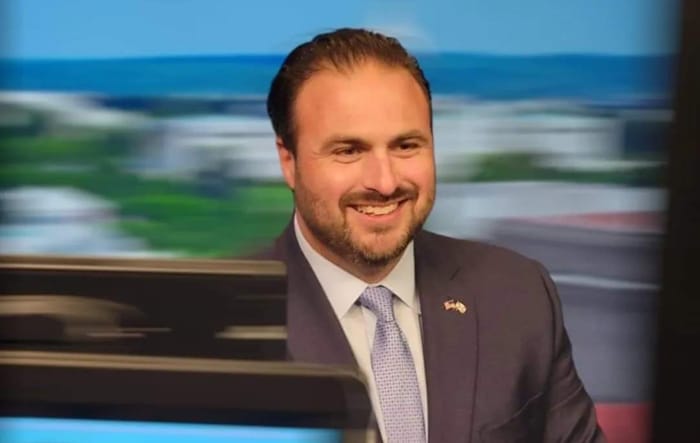
CASEPAC, the nation’s sole political action committee (PAC) dedicated to fighting antisemitism, announced on May 18 that their new executive director is Bryan Leib, who pledged “to go on offense.”

Leib has previously worked as the head of Iranian Americans for Liberty and is a television commentator and op-ed contributor on foreign policy issues. Leib told the Journal in a phone interview that CASEPAC is nonpartisan and will throw their weight behind any congressional candidate “who share in our unwavering commitment to combating all forms of the IHRA [International Holocaust Remembrance Alliance] definition of antisemitism.” CASEPAC was first established a couple years, but hasn’t been particularly active over the past year, Leib said, which is why he was brought in to “really take this thing to the next level.”

One of Leib’s goals for CASEPAC is to raise $1 million over the next year and “utilize the vast majority of that money to supporting members of Congress who have a track record of speaking out against all forms of antisemitism and we’re also looking to support first-time candidates from around the country that also sign onto our pledge to really combat antisemitism,” Leib said, adding that he decided to take on the role since he is the first grandson of a Holocaust survivor and “antisemitism is out of control in this country right now.” “Whether it’s from the lack of knowledge of the Holocaust in the under 40 years old demographic to the sharp rise of attacks of Jews all around the country, enough is enough,” Leib said. “I think way too many Jewish groups and political action committees as well have been playing prevent defense for too long. It is time to go on offense.”

Leib’s plan of offense includes naming and shaming members of Congress and congressional candidates who make antisemitic statements in various graphics and videos on social media as well as writing op-eds and letters to editors in local news outlets within the congressional member or candidate’s district. Additionally, Leib plans to name and shame individuals on TV, talk radio and podcasts. 

“We’re going to take the fight directly to people,” Leib said. “It’s really a combination of two things: one, we’re supporting existing members of Congress, congressional candidates who we feel, based on their record, really support fighting antisemitism. And then secondly, we’re going to take the fight directly to anyone who traffics directly in antisemitism. Obviously I’m talking about people like Ilhan Omar, who accused Jews of dual loyalty. I’m talking about Rashida Tlaib, who recently, once again, labeled Israel as an apartheid nation. We’re going to take the fight directly to these people because they think they can get away with these things and we’re going to make sure that they can’t.”

Leib contended that often members of Congress receive a “slap of the wrist” when trafficking in antisemitic tropes, citing the resolution that was passed in the House of Representatives in 2019 in response to Omar’s “it’s all about Benjamins” and dual loyalty comments. The resolution initially “named and shamed her for what she said, and unfortunately when push came to shove, the resolution was so watered down it was kind of an All Lives Matter, all everything instead of specifically addressing what happened,” Leib said, “and I think if CASEPAC had been on the scene back then, we would have been able to play a much bigger role in making sure that resolution was not watered down.”

CASEPAC will also focus other political figures at the federal level––including appointed officials––as well as legislation related to antisemitism. Leib pointed out that the Biden administration has recently said they might not codify the IHRA definition of antisemitism throughout the federal government, so CASEPAC plans to lobby Biden to “move forward with what he said he was going to do.” “When it comes to antisemitism, we’re gonna be very involved and there’s some ideas that we have for different legislation and other things that we can do to partner with members of Congress to really raise awareness about antisemitism,” Leib said, adding that it could be “as simple as having a conversation with a member of Congress” and encouraging them to use their platform and speak out against rising antisemitism.

“The more people speak out, the more it kind of shifts the conversation a little bit and shows the Jewish people that we do have nonpartisan support from Democrats and Republicans when it comes to fighting back against antisemitism,” Leib said.

New Head of PAC Fighting Antisemitism: “It Is Time to Go on Offense” Read More »

Jewish Humor and Antisemitism Twenty-Five Years After “Seinfeld”

Twenty-five years ago this month, in May 1998, NBC aired the final episode of “Seinfeld.” Critics and fans have universally celebrated the series’ transformative role for the sitcom genre, creating a cultural phenomenon through quirky characters, deceptively simple storylines, and an endless spate of “Seinfeldisms,” stock phrases that found their way into the daily discourse of millions of viewers.

Television critics and scholars, including me, have also documented how the show was a watershed in the depiction of Jewishness in situation comedies. Before the 1980s Jewish characters occasionally appeared on sitcoms, but with the exception of “Rhoda,” “Welcome Back, Kotter,” and the short-lived “Bridget Loves Bernie” they had not been centered as the chief protagonists since “The Goldbergs” had ended its run in 1956. Following the unprecedented success of “Seinfeld,” Jewish characters began to surface regularly on every network. Although Jewish executives, directors, producers, writers and actors had often been the driving force behind network television, the “Jewish sitcom” was a new phenomenon.

It is safe to conclude that “Seinfeld” still speaks to audiences today. It is broadcasted in syndication throughout the week, and for cord-cutters, Netflix began streaming it in November 2021. And in honor of the finale’s twenty-fifth anniversary, critics have been paying tribute: Maya Salam argues in The New York Times that “the sitcom has taken on new relevance,” while Nathan Abrams writes that “Seinfeld changed Jewish television forever.” The show remains universally available for consumption today, and it would be impossible to not notice how “Jewish television” has saturated the airwaves since the late 1990s.

If one aspect of “Seinfeld” disappointed critics and angered fans it was the series finale, the episode we are commemorating this month. The finale finds Jerry, George, Elaine and Kramer stranded in a small New England town, where they mocked, filmed, and failed to help the victim of a robbery in progress, thus landing them in jail for having violated a local “Good Samaritan Law.” The second half of the episode centers around their trial, which finds an array of witnesses—everyone they managed to ridicule, malign and offend over the course of nine seasons—testifying to their cruelty and borderline criminality. The judge sentences them to a year in prison to contemplate their wanton behavior. The plotline may have been clever, but it was poorly executed, thus ending a wild ride of groundbreaking entertainment on a rather low note.

Yet the finale offers important insight into the series, Jewish popular culture, and even American Jewish history if one views it through a Jewish lens.

Yet the finale offers important insight into the series, Jewish popular culture, and even American Jewish history if one views it through a Jewish lens. Television scholar Vincent Brook notes how the finale represents a clash between Jews and Christendom. Brook points out that they are tried in as puritanically goyish a milieu as possible in accordance with a law bearing the name of a parable straight out of the New Testament (Luke 10:30-37). Throughout the trial, Jerry, George, Elaine and Kramer are referred to as the New York Four, thereby underscoring their alienness to their WASPish surroundings. For as Lenny Bruce quipped, if you live in New York you’re Jewish, whether you are actually Jewish or not.

That there are no explicit references to anything Jewish in the finale is in keeping with the modus operandi of “Seinfeld.” What made the series groundbreaking TV is the way in which its writers cleverly inscribed Jewishness into the series: although a mere 11 (out of 180) episodes contain plots that reference Judaism or Judaic ritual, the writers nevertheless ascribed Jewish stereotypes to its characters (most notably the cheap, neurotic, effeminate George) without naming them as Jews, and crafted its stories and dialogue around arguments over the minutia of daily life that not only mimicked Jewish speech patterns but in many respects parodied the Talmud’s stereotyped penchant for endless debates about nothing. The show is recognizably Jewish to anyone who is Jewish or familiar with Jews, i.e. to a New Yorker, but not to someone from Butte, Montana, who, to quote Lenny Bruce again, is by definition a goy. “Seinfeld” was implicitly Jewish, and the finale was in keeping with this tradition.

If the New York Four ended up incarcerated for violating the puritanism of White Christendom, one could argue that the finale signifies the persistence of antisemitism in America. Christianity superseded Judaism, and once the proverbial Jew leaves the safety of multi-ethnic New York, he needs to adapt to Christian cultural codes of behavior; Jews are only tolerated as long as they fit in.

The United States, of course, is not Europe, and American Jewry has largely been protected from the blood libels, pogroms, expulsions and genocide that their ancestors endured for centuries. Jews tend to let their guard down when antisemitism seems to recede; instead of expressing fear, we make jokes, which is precisely what Jerry did on several occasions. In “The Shower Head,” Jerry’s cantankerous Uncle Leo accuses the kitchen staff at Monk’s café of antisemitism because they overcooked his hamburger; Jerry later appears on “The Tonight Show” and publicly ridicules his uncle’s persecution mentality: “I had lunch with him the other day, he’s one of these guys that anything goes wrong in life, he blames it on antisemitism. You know what I mean, the spaghetti’s not al dente? Cook’s an antisemite. Loses a bet on a horse. Secretariat? Antisemitic. Doesn’t get a good seat at the temple. Rabbi? Antisemite.” In another episode Jerry is caught making out with his girlfriend during a screening of “Schindler’s List,” which in American culture has been solemnly sacralized as if the film were the Holocaust itself. Jerry’s parents are livid, but he does not see the problem. Nazi and Hitler references are sprinkled throughout the series’ nine seasons, and the characters consider them little more than topics of conversation and vehicles for humor.

There is of course a long history of Jewish comedians making jokes about antisemitism and even the Holocaust. But “Seinfeld” grapples with the subject in a manner that speaks to the uniqueness of American Jewry. On the one hand, the lack of overt discrimination, especially after World War II, suggests that the generation of “Seinfeld” is rather indifferent to Jew-hatred; it was something that happened in the past and “over there.” On the other hand, the legacy of European antisemitism has marked the Jews as different and often less than welcome, albeit with greater subtlety.

Jewish entertainment, especially Jewish TV, is a prime example of the awkward place of the Jew in America. Although the principal TV networks (before the advent of cable channels such as HBO) were largely run by Jews, there was a pervasive belief in Hollywood that nobody wanted to watch Jews on TV. This is why there was an absence of Jewish characters on sitcoms for decades; this is why Brandon Tartikoff, the President of NBC, had nearly vetoed “Seinfeld” because he viewed the 1989 pilot episode as being “too New York, too Jewish,” notwithstanding the total absence of anything Jewish in it. Jewish entertainers—not only on TV, but also in film and even stand-up comedy—for much of the twentieth century muted their Jewishness on stage and on screen. Entertainers had little leeway in expressing Jewishness because this was a Christian land, where Jewish acceptance was imagined to be conditional.

This began to change in the late 1950s with Lenny Bruce, who was not afraid to get up on stage, act outrageously Jewish, and revel in acerbically deriding Christianity, its hypocrisy, and its legacy of antisemitism. He even mocked the Passion, taking personal credit, on behalf of the Jewish people, for the crucifixion of Jesus. Such antics landed Bruce in jail multiple times, charged with obscenity and later convicted, most notoriously in Chicago in the early 1960s.

In reality, the infraction Bruce had committed was blasphemy, but in the U.S. it is unconstitutional to charge someone with maligning religion. Nevertheless, the media, the police, and local church officials in Chicago made it clear that Bruce had mocked Christendom. One journalist described the trial as if it were something out of the middle ages: “Eventually, the trial took the form of a Catholic inquisition: with a Catholic judge, a Catholic prosecutor, and an all-Catholic jury, every single one of whom showed up on Ash Wednesday with a black smudge on his forehead.” Bruce had deployed Jewish humor to dismantle the religious edifice that had persecuted Jews for centuries, and Christianity struck back, declaring his comedy impermissible.

Bruce had deployed Jewish humor to dismantle the religious edifice that had persecuted Jews for centuries, and Christianity struck back, declaring his comedy impermissible.

Perhaps the Hollywood moguls who sought to keep explicit Jewish humor off of network TV for decades to come had Lenny Bruce in mind. Although we shall never know, the finale of “Seinfeld” suggests such a possibility. On trial for violating the Good Samaritan Law, the prosecutor’s opening statement underscored the New York Four’s long “record of mocking and maligning.” And they were convicted because their “callous indifference and utter disregard for everything that is good and decent has rocked the very foundation upon which our society is built.”

But Jerry is a comedian, a Jewish comedian, and in the closing scene of the finale, we find him practicing his oeuvre onstage in the jailhouse, ridiculing the prison system, telling a heckler convicted of murder to lighten up, and warning someone in the audience convicted of grand theft auto to not “steal any of my jokes.” Jerry’s Jewish comedy is what made him who he is, and it served as the building blocks of “Seinfeld” and all its subtle Jewish references. But it ultimately led to his incarceration for violating American puritanical Christendom. Jewish humor in public was deemed unkosher.

The elusive yet pervasive Jewishness of “Seinfeld” speaks to the story of American Jewry. We have been welcomed in this land of refuge and freedom on the condition that we do not violate Christian cultural codes. Antisemitism may have receded, but it has not been consigned to the trashcan of history nor has it been erased from Jewish collective memory. The uptick in bigotry and violence against Jews since 2017 demonstrates that becoming too comfortable, or rather too comfortably Jewish in public, may come at a price. Jewish comics have always known this and have found ways to be irreverently Jewish in a Christian land, always on the brink of crossing the line, but rarely doing so. “Seinfeld” is an integral part of this story. And twenty-five years later, we should be celebrating it.


Jarrod Tanny is an associate professor and Charles and Hannah Block Distinguished Scholar in Jewish History at the University of North Carolina, Wilmington. He is the author of “City of Rogues and Schnorrers: Russia’s Jews and the Myth of Old Odessa” (Indiana University Press) and the founder of the Jewish Studies Zionist Network. He is also the author of the forthcoming “Seinfeld Talmud” (Academica Press), in which the rabbinic sages of antiquity debate each and every Seinfeld episode.

Jewish Humor and Antisemitism Twenty-Five Years After “Seinfeld” Read More »

“A Middle Ground”

“If there were a middle ground between things and the soul”—John Berryman, “Dream Song 385”

Kohelet is a meditation on the magnetic allure, and ultimate limitedness, of things. Shlomo HaMelech identifies what we crave in this world: wealth, possessions, physical pleasure, knowledge, fame, intellectual prowess, ego gratification. His conclusion is that these things are haval havalim: vanity, vapor, nothingness, mist. Chasing after them is a striving after wind.

Yet as human beings, we have no choice but to operate in this material world. To process reality requires our physical senses. To act and achieve is dependent on our physical powers. Nevertheless, our tradition constantly admonishes that material things are illusory. Our faith is not in the material, which has no inherent power, nor in bodies that decay and die.

The primacy of the spirit over the physical would appear best captured in the counting of the Omer. Sefirat HaOmer is a journey from Mitzrayim, a place of physical enslavement, to Sinai, a place of spiritual opportunity. We count each day of our ascent from the land of constraint and paralysis, where physicality dominates, to an open plain where lowly human beings, in the shadow of a holy mountain, hear the voice of infinite God.

But what actually happens on that holy mountain? What happens when we come face to face with God’s immanence? When our cognitive faculties, our senses, overflow with ecstatic awareness of God’s existence? What happens when the ground around us shakes violently, shofar blasts deafen us, and lightning and smoke overwhelm us? The Torah tells us. We can’t handle it. We ask Moshe Rabbeinu to intervene, to intermediatebetween us and God.

It’s striking that the “Netivos Shalom” (written by Rabbi Shalom Berezovsky, zt’l) attributes the holiest of intentions to Nadav and Avihu, the sons of Aaron HaKohen, who died in the Mishkan, the Tabernacle. Their deaths were not due to any sort of wrongdoing, says the Netivos Shalom, but rather to their unbounded yearning for intimacy with Hashem at all costs, a desire so intense that it overrode their ability to function in this world. For Nadav and Avihu, intoxication with God meant their souls could not remain in their bodies when the Shechinah was so close by.

What are we to make of the reaction of the Jewish People, so constrained by physical limitation and fear that they could not bear to hear the voice of Almighty God at Mount Sinai? And how can we understand the experience of Nadav and Avihu, whose souls were so untethered to this world that they died as young men in the Mishkan?

As long as we are alive, our souls and bodies are bound together. If we do not attempt to transcend the physical, if we idolize the body and prioritize material things, our tradition tells us we are choosing the temporal over the timeless, the idiosyncratic over what is of infinite worth.  In so doing, we risk shutting out God as He speaks to us, as our ancestors felt compelled to do at Sinai. And over a long life, we also risk becoming idol worshipers ourselves. Whether the idol is money, fame, things or our own ego, it’s avoda zara, idolatry. But equally, we cannot live a life unmoored from the physical, material world in which we perform mitzvot, hone our unique capabilities, develop as unique personalities, and define ourselves by how we choose to live. To absent ourselves from this world is also a rejection of our tradition; it’s only in this world that the transformative power of mitzvot is at play.

To absent ourselves from this world is also a rejection of our tradition; it’s only in this world that the transformative power of mitzvot is at play.

But if there were a middle ground between things and the soul—if we didn’t have to oscillate between the grounded physicality of our lives in these bodies at this moment, and the otherworldliness of an astral spirituality disconnected from physical reality—what would that middle ground be? And how would we get there?

Our tradition provides the answer. The middle ground lies in observance of Shavuot each and every year after Matan Torah, the giving of the Torah. If all Jewish souls that will ever live stood at Har Sinai, then each of us carries within us the marker of our own personal encounter with God, even if we could not sustain that encounter for long. The middle ground lies in the retelling, in the ritual of reliving Matan Torah in settings where we can effectively engage as physical beings. On Shavuot our senses and our minds are put to use, and at the same time, our aspirational, grateful soul finds voice as it senses, once again, the arrival of the Shechina.

As long as we’re alive, we are both physical and spiritual and we must integrate and cultivate both of those dimensions of ourselves. There can be no other way. And if we each search for that middle ground, perhaps, with God’s help, we will no longer regret the friction we feel between body and soul as we make our way in this world. Perhaps, instead, as our bodies are nourished with Yom Tov food and drink, our senses enlivened with greenery and with song, our minds broadened with learning Torah, and our souls given space to rise as high as possible in these bodily frames—perhaps the Kedushat Yom Tov of Shavuot itself can enable us to sense more deeply a harmony that embraces both things and the soul, that middle ground between the immutable dual dimensions of every living human being.


Pierre Gentin lives in Westchester County, New York.

“A Middle Ground” Read More »

MSNBC Host Ari Melber Makes Seinfeld-Santos Connection

Ari Melber linked Jerry Seinfeld to a different George.

The host of MSNBC’s “The Beat” gave a nod to “The Yada Yada” which is the 19th episode of Season 9 of “Seinfeld.” In the episode dentist Tim Whatley (Bryan Cranston) tells Jerry he has converted to Judaism. Tim jokes that he went to the health club but he only used the sauna, which he called “more like a Jewish work-out.”

“The guy’s Jewish two days he’s already making Jewish jokes,” Jerry tells Elaine.

When Jerry goes to get his cavity filled, Tim jokes: “Did you hear the one about the rabbi and the farmer’s daughter? Those aren’t matzah balls.”

Jerry questions whether he should be making those jokes, but Tim tells him “Jerry, it’s our sense of humor that’s sustained us as a people for 3,000 years.”

Jerry corrects him to say it’s 5,000 years and is annoyed that Tim tells his assistant to get him a “shtickel,” or a bit,” of fluoride.

Jerry tells Elaine he believes the dentist converted to Judaism “just for the jokes” and also complains to a priest, saying he is offended, not as a Jew, but as a comedian.

Melber was interviewing documentarian Blake Zeff, who taped conversations with U.S. Representative George Santos, the New York Republican who has been indicted on 13 counts, including fraud and money laundering. Santos has pleaded not guilty.

On one of the recordings, Santos is heard making derogatory remarks about Jews.

Santos told Zeff “if you sit in a room with a lot of Jews, you’re f—-ed. It’s funny when the ‘isms’ start coming out. Oh, he’s such a mensch. He’s such a mensch  …”  Melber notes that in another conversation, Santos says he doesn’t rule out running for president, but there is some “mishigas” or craziness, regarding ethics concerns.

Listening to the recordings, Melber said he was reminded of the Seinfeld episode where Jerry wondered if his dentist “converted to Judaism for the jokes.”

This is not the first time Santos has made questionable comments about Judaism.  In addition to lying about his education and his career, Santos claimed to be Jewish. When it was pointed out that was not the case, Santos claimed he was misunderstood, he said he was “Jew-ish.” He said grandparents fled Jewish persecution in Ukraine and later during World War II; this was also disproven.

In a December 21, 2022 article in The Forward, Andrew Silverstein reported that Santos had previously said his mother was Jewish, but the Facebook page of his mother, Fatima Alzira Caruso Horta Devolder, revealed shared images of Jesus and no mention of being Jewish. The same article disputed Santos’ claims that his grandmother fled either Ukraine or Belgium.

The Republican Jewish Coalition in December said in a statement that Santos “deceived us and misrepresented his heritage.”

In another odd parallel between Santos and “Seinfeld, ” The New York Times reported that prior to politics, Santos’ had a dog charity that was not registered as a nonprofit or a rescue organization and there were questions regarding funds and the number of rescues.

In “The Strike,” an episode from season 10, George Costanza gave people holiday cards telling them he made a donation in their name to “The Human Fund.” When “The Human Fund” is exposed as a fake, George explains he gave out fake cards because he doesn’t celebrate Christmas, but instead celebrates Festivus. “They drove my family out of Bayside,” George says, referring to the Queens, NY neighborhood.

Santos’ district in New York includes areas of Queens as well as Long Island.

MSNBC Host Ari Melber Makes Seinfeld-Santos Connection Read More »

Kosher Guru Visits Los Angeles

Kosher Guru Gabriel Boxer is on a mission to spread the joy of kosher. 

“My motto [is] bringing kosher to the masses in a fun-filled way,” Boxer told the Journal. 

Boxer, a kosher industry food, travel and restaurant consultant, strives to educate the world on anything and everything kosher. This includes food, restaurants, supermarkets and chefs, as well as ingredients.

“Food really does bring people together,” he said.

From April 25 to May 4, the New York based Boxer traveled around Southern California, giving lectures on the origins of kosher foods. He spoke at the Chabads of Granada Hills, Playa Del Rey, North of Montana Avenue, Los Feliz, Pasadena, WeHo West, North Ranch, Ojai and the Beach Cities in Redondo Beach. “The feedback was amazing,” Boxer said. “Some people weren’t even Jewish, but wanted to learn about kosher food origins.”

One attendee, a woman who grew up in France during the Holocaust, saw people in her community being taken away. “She hid her Judaism to the extent she never even told her husband she was Jewish,” Boxer said. “She had to come and learn about her heritage, as she’s only now opening up to her Judaism.”

Last fall, Rabbi Zushi Rivkin from the Chabad of Pasadena reached out to Boxer, inviting him out to Los Angeles. “We agreed to an 11-course meal [made up of] dishes of different Ashkenazic and Sephardic foods,” Boxer said. They ranged from ghormeh sabzi and gefilte fish to kibbe and knishes. Other items included pita and hummus, matbucha and Moroccan carrot salad, soup and kneidlach, herring, borscht, plov and rugelach. They wanted to cover a variety of foods, since Jews come from different backgrounds, heritages and levels of observance.

“I love meeting so many different people,” he said. “They were people who were observant, not observant [or] not even Jewish. … It was really surprising to see the spectrum of people who showed up to the events, partook and enjoyed (themselves).”

One of the results of Boxer’s kosher food tour is that the Chabads want to book him for next year with different dishes. He also said synagogues, from Oregon to Memphis and Detroit to Florida, are reaching out to him.

An observant Jew who went to Jewish Day schools, Boxer keeps kosher and also believes kosher is about your Jewish lifestyle.

“God told us to be a light into the nations,” he said. “[I was brought up] to be a positive influence, and to always make what they call Kiddush Hashem, to be a good person.”

One of the benefits of living a good, positive life, Boxer said, is that others want to emulate you and bring good to the world.

One of the benefits of living a good, positive life, Boxer said, is that others want to emulate you and bring good to the world.

Kosher Guru has a huge Instagram following and YouTube channel, as well as an active Facebook group, called Kosher Guru’s Kosher Nation. “I have a lot of followers who aren’t even Jewish,” Boxer said. “They see me going to synagogue — every morning I show a picture — and some people reach out to me [and say], ‘Because of you. I’m going to start going to synagogue’ or ‘I’m going to start praying.’”

Those responses make Boxer happy. 

“I”m just trying to influence the world in a positive way,” he said. “Whatever you take out of that positivity, whatever you take out of that lifestyle, it should be pure and good.”

Ghormeh Sabzi

“I got this dish from my sister-in-law, who married a Persian man,” Boxer said. “This stew has become a regular at our dining room table. I hope you enjoy it as much as our family does.”

1 onion, chopped
4 Tbsp oil
1 leek, chopped
½ cup red kidney beans, soaked overnight and drained, or 1 can kidney beans, drained and rinsed (optional; if you don’t like beans, leave them out)
1 ½ lbs meat such as brisket or Chuck meat, cut in one-inch cubes
1 bunch parsley, finely chopped
1 bunch cilantro, finely chopped
4 dried lemons
Juice of 1 lemon
1 tsp salt
Pepper, to taste
1 tsp turmeric
1 tsp fenugreek
1 ½ cups water, or more as needed

In a large, heavy saucepan over medium-high flame, add oil, chopped onion and leeks and saute until soft and caramelized. Add turmeric, salt and fenugreek.
Add cubed meat and brown on all sides. Add chopped parsley and cilantro, juice from the lemon, dried lemons, kidney beans (if using fresh) and water. If it looks too dry, add a little more water.
Allow to simmer, covered, over a low flame for about 1 ½ to 2 hours, until meat is soft and tender.
Adjust seasoning, such as more salt, if needed.
Note: If using canned kidney beans, add them after the stew has cooked for about an hour. Discard the dry lemons before serving.
Serve over white rice. Enjoy!

Kosher Guru Visits Los Angeles Read More »

Dairy-Free Shavuot Recipes

The Jewish calendar is filled with holidays that have colorful and well-recognized traditions. Passover, Rosh Hashanah, Sukkot, Hanukkah and Purim all offer activities for the kids and elaborate traditions. Some even have “Hollywood-style antagonist vs. protagonist stories” to narrate.

Shavuot, however, is an exception. 

“There are two established customs on Shavuot: staying up all night to learn Torah and eating foods made with dairy,” Michael Tanenbaum, founder of the website Consciously Kosher, told the Journal. “The most common reason is that, since the Torah was given to us on Shabbat, we did not have the opportunity to slaughter animals. Therefore, we ate dairy.”

Foods enjoyed on Shavuot include cheese crepes, blintzes, quiches, casseroles, pizza and, of course, cheesecake.

Since eating dairy causes havoc for a growing number of people, Tanenbaum included, the Journal reached out for his recommendations on how people can enjoy the holiday without impacting their health. Consciously Kosher is dedicated to educating both the Jewish community and the general public on the overall health benefits of eating a kosher diet rich in nutritious, predominantly unprocessed whole foods.  

When Tanenbaum was a kid, his mother always made cheese crepes from scratch on Shavuot. The filling had farmer’s cheese, cinnamon and raisins. 

“This was always the culinary highlight of our Shavuot,” he said. “I can still remember the aroma of the fresh crepes wafting through the house before the sun set and the holiday began.”

Since Tanenbaum no longer consumes dairy products, he created a nondairy crepe alternative.

His recipe uses vegan ricotta cheese made from either cashews or almonds. Although similar in some ways to farmer’s cheese, ricotta is milder. (Tanenbaum likes to use Kite Hill’s ricotta cheese, which can be found at Whole Foods.)

Instead of making the crepes with modern wheat, Tanenbaum uses spelt. 

“Spelt is an ancient variant of wheat that has not been hybridized,” he said. “It has a lower gluten content and a deeper, nuttier flavor than modern wheat.” 

Einkorn flour is another flour alternative and, like spelt, it is much lower in gluten than modern wheat. There’s also almond flour, which is gluten-free. 

And remember, Tanenbaum said, “Even pizza crust can be made out of cauliflower.”

People with dietary issues can still enjoy Shavuot’s food traditions with delicious, non-problematic alternatives. 

People with dietary issues can still enjoy Shavuot’s food traditions with delicious, nonproblematic alternatives. There are nondairy variants of cheesecake, crepes and pizza, made with cashew cheese, almond cheese or blended nuts.

One more thing. Even if you can enjoy dairy, be careful not to overdo it on Shavuot. 

“I recommend preslicing the cheesecake or the pizza so that you only eat a pre-apportioned amount,” Tanenbaum said.

Only one slice of cheesecake or pizza? For a healthier holiday, it’s worth a try!

NonDairy Cheese Crepes 
Crepes
1¼ cup spelt flour
pinch of salt
3 eggs, beaten
1 ½ cups almond milk
2 Tbsp coconut oil (plus some more for
the outside of the finished crepes)

Filling
1 cup almond cheese
2 Tbsp raisins
¾ tsp Ceylon cinnamon
1 ½ Tbsp coconut sugar
1 tsp vanilla extract
½ tsp grated lemon zest
½ tsp Himalayan salt

Crepes
1. Set your crepe maker to high and preheat for 10 minutes. You can also use a frying pan. Put it over high heat on the stove.
2. Combine all ingredients in a blender or mixer.
3. Pour the crepe mixture onto the crepe maker until it spreads out about 6 inches, then flatten with the pastry spreader.
4. Flip the crepes after about 45 seconds (or when they are browned on the bottom).

Filling
1. Combine all ingredients into a small bowl.
2. Fill each crepe with about 1 Tbsp of filling.
3. Brush with melted coconut oil.
4. Serve warm and enjoy!

Photo by Michael Tanenbaum

Cashew Cheese Pizza with Almond Flour Crust 

Simple Mills Almond Flour Pizza Dough Baking Mix (Another vegan and gluten-free crust option is Bob’s Red Mill Gluten-Free Pizza Crust Mix)
2 Tbsp organic apple cider vinegar
2 Tbsp extra virgin olive oil
1/3 cup water

Toppings
1 Tbsp olive oil
1½ pounds roasted tomatoes
Freshly ground black pepper
8 ounces Miyoko’s Liquid Vegan Pizza Mozzarella cashew cheese (Sometimes labeled as Miyoko’s Pourable Mozzarella, it can be purchased at Whole Foods, Cooportunity, Target, Bristol Farms, Erewhon and Ralphs, among others.)
Chopped fresh basil
Roasted garlic, sliced

Crust
1. Heat oven to 350°F and line a baking sheet with parchment paper.
2. Whisk apple cider vinegar, olive oil and water together in a large bowl.
3. Pour the pizza crust mix into the bowl and stir well until a dough forms.
4. Add up to 2 Tbsp of additional water if the dough crumbles too easily.
5. Shape dough into a square or circle with raised edges.
6. Bake the crust for 15 minutes until slightly golden.

Toppings
1. Toss tomatoes with olive oil, a pinch of salt and the ground pepper.
2. When crust is done, remove from the oven. Increase temp to 450°F.
3. Roast tomatoes in the oven for 10-12 minutes. When done, remove and lower temp to 350°F.
4. Spread cashew cheese and sliced garlic on the crust.
5. Add roasted tomatoes to the crust and bake for an additional 10-12 minutes.
6. Remove from the oven, sprinkle with torn basil leaves and drizzle with olive oil.
7. Serve immediately.

Dairy-Free Shavuot Recipes Read More »