fbpx

May 16, 2023

Purported Land Sale in Armenian Quarter Will Damage Christian Presence in Jerusalem

To read more articles from The Media Line, click here.

A large portion of the Armenian Quarter in Jerusalem’s Old City has been sold to a Jewish developer in a move that could erase the centuries-old Armenian presence in the city and further squeeze the Christian minority in Israel.

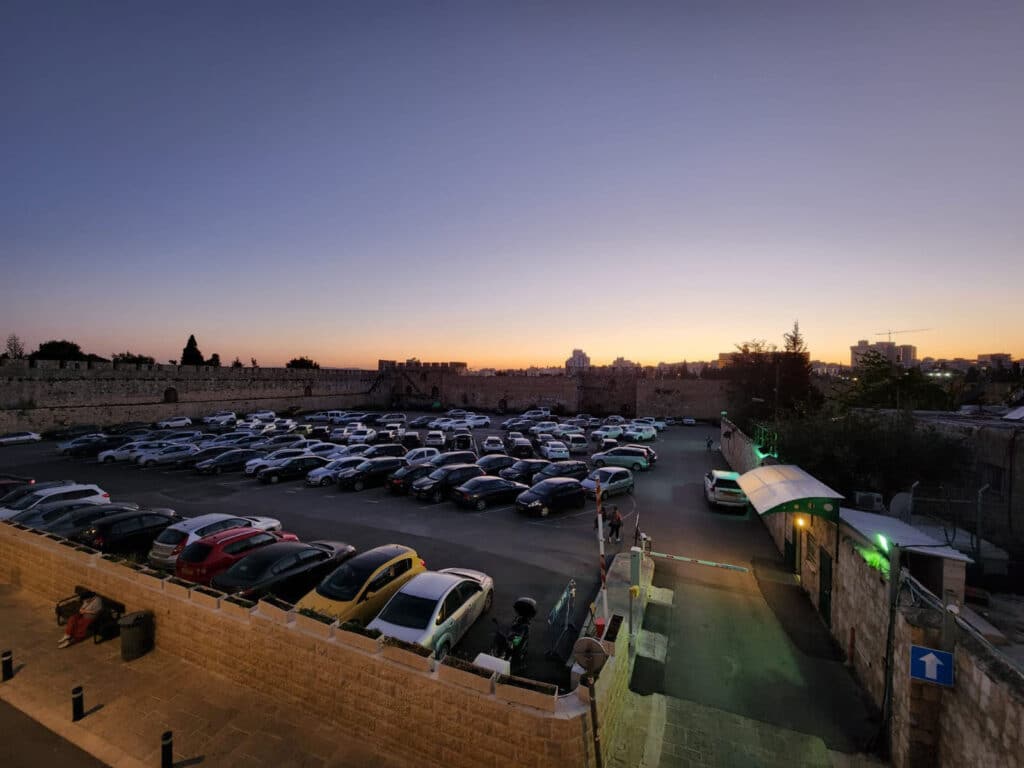
Though details of the deal remain unclear, the Armenian Quarter parking lot was taken over two weeks ago by a private company, Xana Capital.

The Armenian Patriarch Nourhan Manougian has yet to issue a statement or answer residents’ questions about how the sale will affect them. When contacted by The Media Line, a spokesman for the patriarchate said that until all the information was verified internally, he would not make a public statement.

The reports began trickling in from 2021 when former priest Khachik Yeretzian—then director of the patriarchate’s real estate department—told an Armenian news outlet that the patriarchate in Jerusalem had indeed leased the land to Danny Rubenstein, a Jewish businessman from Australia, for 98 years and that Rubenstein intended to build a luxury hotel on the property.

After that time, according to the 2021 article, Rubenstein would return the land along with the hotel to the Armenian Patriarchate.

The deal was signed in July of that year. In October, 12 Armenian priests in Jerusalem signed a statement condemning the sale and alleging that it was done illegally since it was not ratified by the Synod and the General Assembly.

“The agreement also disregarded the unified General Assembly’s ratification which thrice voted (2002, 2006, and 2015) that ‘agreements covering a period of one to 25 years should be ratified by the Holy Synod and agreements for 25 to 49 years be presented by the Holy Synod to the General Assembly for ratification,’” the priests said in 2021.

“The Holy See of Jerusalem is a pan-Armenian asset, and it has been under the attention and care of all Armenians for many centuries,” the priests continued. “This sacred heritage must be handled with the utmost care and responsibility, always upholding the charter of the Holy See so as not to undermine its centuries-old course and pass it on to future generations.”

Nevertheless, the deal moved quietly forward until the new owners claimed the parking lot in April.

On May 6, the Armenian Patriarchate of Jerusalem defrocked Yeretzian, the former real estate manager, in a unanimous decision of the Synod “for his disloyalty and especially the series of frauds and deceptions he committed regarding” the sale.

That was the extent of the statement.

In his own letter, Yeretzian said he was punished “for an act that the patriarch signed and now I am being accused.”

“One day the truth will be revealed,” he said in the letter.

Recent rumors, however, indicate that the deal includes far more land than originally thought including private homes, shops, and part of the seminary casting a pall of uncertainty over the residents and business owners in the area in question.

The land under dispute, once known as the “Goveroun Bardez” (an Arabized corruption of the Armenian for “Cow Garden”) and now the Armenian Quarter parking lot, is roughly 8 acres in size. This constitutes a quarter of the current Armenian Quarter, which itself is about 14% of the Old City.

Jerusalem Land Grab

On Wednesday, after it became known that Yeretzian was planning to leave the country, dozens of Armenian residents blocked him from exiting his house. Eventually, police were called in to escort the former priest outside the St. James Convent to an awaiting taxi followed by shouts of “traitor” from the protestors. He was spotted on a plane to Turkey on Thursday morning.

Land transfers in Jerusalem are delicate and can potentially upset the status quo. And they are frequently wrought with controversy. Greek Patriarchate property near Jaffa Gate was sold to an Israeli “land redemption” organization, Ateret Cohanim, in 2004. After an 18-year legal battle, the sale was recently upheld.

The issue is not simply religious between Christians who own the land and Jews who are trying to buy it. It is also political. Israel wanted the Armenian Quarter as part of a final status agreement in the Camp David negotiations.

Israel might have it anyway, demographically speaking. Should the Armenian Quarter become home to Jewish housing, the Jewish presence of the Old City will expand contiguously from its own quarter to and including Jaffa Gate.

n this undated photograph, Armenian pilgrims rest in the Goveroun Bardez (Cow Garden), now the Armenian parking lot, on Mount Zion in Jerusalem’s Old City. (Courtesy Hagop Djernazian)

On Thursday, the Palestinian Authority and the Kingdom of Jordan announced a decision to freeze their recognition of the Armenian patriarch. In a joint statement, the two said that Manougian “took real estate measures and deals that would affect the future of the Holy City, without consensus and consultation with the relevant parties, and without the involvement of the Synod and the general body of the St. James Brotherhood.”

“Patriarch Manougian’s dealings constituted a clear violation of relevant international covenants and decisions, which aim to preserve the status quo. In Jerusalem and protecting the authentic Jerusalemite Armenian heritage,” the statement read.

The Hashemite kingdom is the custodian of Christian and Muslim holy sites in Jerusalem.

Dimitri Diliani, a Palestinian Christian and activist in the Fatah party, told The Media Line that giving up the land destroys the mosaic character of the city and “undermines any possible solutions as it infringes on the status-quo arrangement that has kept the city for many years.”

Diliani said the patriarch should be deposed.

“The damage that this deal has done to the Armenian Quarter is grave and I believe that the patriarch has been disloyal to his people, to his church, to his mandate, and to the Christian character of Jerusalem,” he said. “These are grave violations to the trust that he should have upheld and the only thing I can think of that could be the beginning of finding a way to retrieve these properties is having him ousted as soon as possible.”

What Will Christian Residents Do?

Christians—who represent just 2% of the Israeli population—are feeling the squeeze. Since the time of Jesus, Christians have lived in the land and as Christianity developed into different institutions and denominations, patriarchs were tasked to preserve their presence and care for the needs of the community.

George Sandrouni, a veteran member of the Armenian community, said the bleeding of Armenian properties began 70 years ago with previous patriarchs, but it was not stopped then. He accused the leaders of failing to shepherd the flock assigned to them.

Without available church-subsidized housing, young people in the community will be forced to consider emigration.

“Eventually all the houses we live in will be leased out for 99 years and we will be in a situation that is not livable in Jerusalem,” he told The Media Line. “If we keep on losing future properties, our existence in this city is totally at stake,” he said.

But he also insisted that it wasn’t enough to remove Yeretzian.

“He’s the mouse, but the rat is still at home,” he said, referring to Manougian. “What is done cannot be reversed. The only thing we can do is clean out the house, keep it sterile and prevent further meltdown.”

Hagop Djernazian is only 23, but he is planning his future in the quarter and will fight for that.

“We have deep roots here in the Holy Land, especially Jerusalem. We are the only nation that has a quarter in Jerusalem so we must protect this place,” he told The Media Line. “This is home. We have many communities in the diaspora, but it’s not the same as here in Jerusalem.”

With rights in the Holy Sepulcher alongside the larger Catholic and Greek Orthodox denominations, the Armenians contribute to protecting the status quo, Djernazian noted.

“Without the Armenian presence, the Christian presence is way more endangered,” he said.

An Israeli scholar on Christianity said having no Christians “would be a disaster for Jerusalem.”

“When you say this is the city of the children of Abraham, it needs to have representatives of all religions,” Yisca Harani told The Media Line. “All of these instruments play together an incredible concert. We have to protect each and every instrument. Israel has to protect its indigenous inhabitants.”

History of Armenians in Jerusalem

The Armenian presence in Jerusalem stretches back to 90 BCE, but the establishment of the quarter occurred after the nation of Armenia declared Christianity its national religion in 301 CE. After that time, citizens began making pilgrimages to Jerusalem to see the holy sites.

These pilgrimages became the basis of the Armenian Quarter today. The ancient land is under the supervision of the Armenian patriarch, who is autonomous and not under the auspices of the Armenian Apostolic Church headquartered in Vagharshapat, Armenia.

Today, fewer than 1,000 Armenians reside in Jerusalem; up to 6,000 live in Israel and the Palestinian territories. While Armenians living in Israeli or Palestinian cities tend to identify politically with the societies in which they reside, many in Jerusalem consider themselves first and foremost Jerusalemites. Jerusalem-born Armenians are permanent residents of Israel but not all are citizens.

The quarter provided refuge for Armenians fleeing the genocide carried out by the Ottoman Empire which resulted in the slaughter of 1.5 million people.

St. James Convent is the heart of the quarter and home to private residences, a school, a library, two social clubs, and a museum that is open to the public. Across from the museum is the parking lot in question.

A Xana Capital sign at the entrance to the Armenian Quarter parking lot in Jerusalem’s Old City, with the Dormition Abbey’s bell tower on Mount Zion in the background. (Hagop Djernazian)

In an eerie parallel, the nation of Armenia is also watching its boundaries being chipped away by Azerbaijan on one side, Turkey on the other, and a monthslong blockade on 120,000 ethnic Armenians living in an enclave called Nagorno-Karabakh or Artsakh.

Purported Land Sale in Armenian Quarter Will Damage Christian Presence in Jerusalem Read More »
AJU Ziegler School of Rabbinic Studies to Relocate to Pico-Robertson Area

American Jewish University (AJU) announced it will relocate the Ziegler School of Rabbinic Studies to the Pico-Robertson neighborhood.

The new location, at 350 S. Beverly Dr. (by Olympic Boulevard), will occupy 7,700 square feet of space and is currently undergoing renovations. When completed, the school is expected to open early to mid 2024.

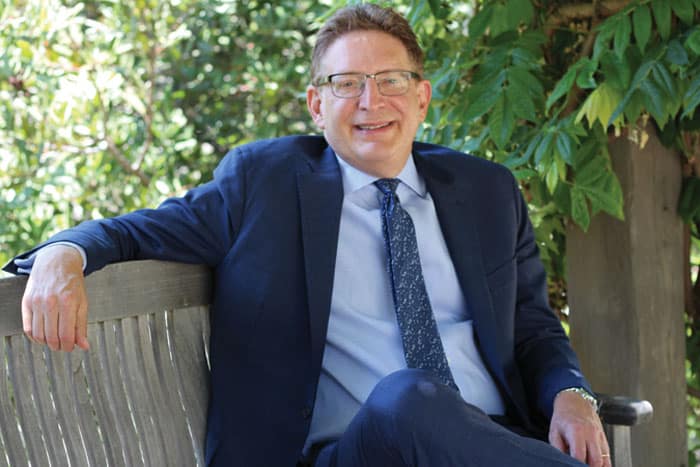
“With this move, American Jewish University begins a new chapter for the Ziegler School, providing our students with innovative opportunities to flourish in the heart of Jewish life in Los Angeles, AJU president Dr. Jeffrey Herbst said in a statement. “We are paying close attention to the shifting needs of the Jewish community, our offerings, and our students, and making important changes that will enable AJU’s programs to thrive for generations to come.”

Last year AJU announced plans to sell its Familian Campus in Bel Air and subsequently accepted an offer from EF Education First, an educational organization that offers language learning and international degree programs. The sale price was undisclosed.

AJU said the decision was based on both the recommendations of an external Blue-Ribbon Commission that was convened by AJU in January as well as research of Los Angeles Jewish life and input from Ziegler students and faculty. The move was approved by AJU’s board of directors and its regional accreditor, the WASC Senior College and University Commission.

The new space will feature a library, private offices for tenured faculty, shared workspaces, classrooms, a conference room, and Beit Midrash, and will include a design allowing for collaboration and communal gathering. 

The new space will feature a library, private offices for tenured faculty, shared workspaces, classrooms, a conference room, and Beit Midrash, and will include a design allowing for collaboration and communal gathering. According to the AJU statement, the new location “will immerse Ziegler students into the cadence of urban Jewish life and foster a rich Ziegler community.” 

Currently the Ziegler School has an enrollment of 30 students. Its first graduating class was in 1999. 

“The Ziegler School’s top priority is the success and well-being of our students. This strategic relocation will create huge benefits for both our students and faculty by increasing access to Jewish life,” Rabbi Bradley Shavit Artson, Dean of the Ziegler School, said. “Relocating the program to Pico-Robertson will facilitate a more rich and dynamic learning environment, which supports our mission to provide our students with strong academic and professional training, personal spiritual enrichment, and a sense of community.”

AJU Ziegler School of Rabbinic Studies to Relocate to Pico-Robertson Area Read More »

A Burglary That Came With Blessings

It was the afternoon of Thursday, May 4. My husband was calling me frantically. I was at my office and on a business call. 

“Come home now,” he texted me. “We’ve been robbed.”

Everything that happened next felt surreal. My husband Daniel explained that his mobile podcast recording studio, The Podcast Bus, which was parked in our backyard, was broken into. The burglar stole $25,000 worth of recording equipment, scratching up the floors of the bus and damaging the wiring that was inside the walls. 

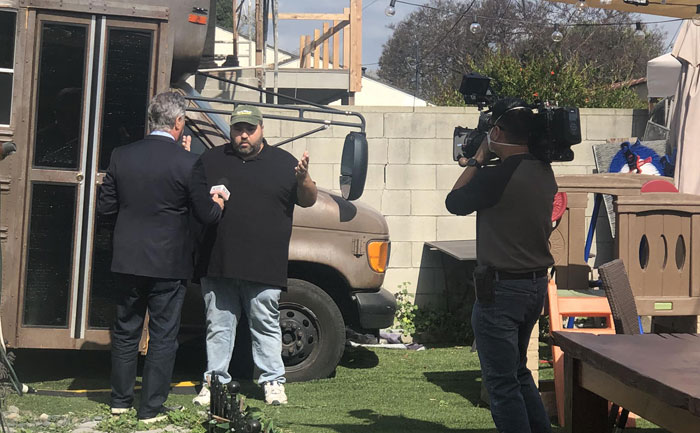
When I got home, we watched on the surveillance footage as the thief jumped over our neighbor’s wall, looked inside our daughters’ playhouse, went in our garage to grab a bag and then stole the equipment from the bus in just a few minutes’ time. 

It took a few minutes to snatch the equipment Daniel had worked for years to buy. 

I was so angry that I went out searching for the guy. Full of adrenaline, I was convinced that if I saw him, I’d punch him out. 

While I was out, and Daniel was home with our 1- and 3-year-old daughters, the man came back to wipe his fingerprints off the bus. Daniel was in the yard at the time. He realized he’d left the back door open, and this burglar could be armed. He acted on instinct and pushed our daughters’ playhouse towards the man, who then leapt back over our wall and ran into the alleyway. All of this was caught on camera. 

The police took two hours to come, and they didn’t go inside the bus or take fingerprints. 

I tossed and turned that night in bed, scared that the thief was going to come back. When I left the house the next day, I looked over my shoulder everywhere I went. Every sound made me jump. My husband was also traumatized and didn’t want me to go into the backyard at all. 

Even though Daniel and I weren’t talking about what happened in front of our 3-year-old, she must have sensed something was wrong. When she told me, “Mommy, I’m scared of the monster in the backyard,” my heart broke into a million pieces.

A few days after the incident, our friend Sam Yebri sent the footage of Daniel confronting the burglar to different media outlets, and one by one, they showed up at our doorstep. Daniel was on the local news: KTLA, KCAL, ABC 7, FOX 11 and NBC Los Angeles.  

And then, the national news, including Inside Edition, Fox News, TMZ and the New York Post, covered it. When being interviewed, Daniel focused on the good, praising Hashem on television and saying that everything He does is for the best, even if it doesn’t seem that way. 

We started a GoFundMe to try to get the bus back up and running – our insurance found a loophole and didn’t want to pay us what we were owed. We also needed to make up for Daniel’s lost income and raise funds for better security at our home. We received more than 300 donations from family, friends and strangers. One company, Rode, saw Daniel on the news and sent him some new equipment. Our wonderful rabbi, Rabbi Jason Weiner, gave a speech to our synagogue about us and made us feel supported and loved.

Multiple people gave us food for Shabbat and checked in on us. The Pico-Robertson community and broader Jewish community have been incredible. 

Daniel and I also received hundreds of kind messages. Multiple people gave us food for Shabbat and checked in on us. The Pico-Robertson community and broader Jewish community have been incredible. 

Two weeks after the burglary, I’m still feeling unsafe in my home and in L.A. It’s obvious that the crime is out of control here, and I don’t think it’ll get better anytime soon.

Being burglarized was an absolutely horrible experience. But at the same time, I can see how blessed we’ve been throughout this whole ordeal. 

I don’t know why the burglary happened, but I know that Hashem has a plan. Maybe one day I’ll figure out what the purpose of all this was. In the meantime, I’m acknowledging the good, and I’m eternally grateful for all the countless blessings in my life. 

To donate to the GoFundMe, please visit gofundme.com/f/rebuild-the-podcast-bus or email me at KylieOl@JewishJournal.com. Thank you.


Kylie Ora Lobell is the Community Editor of the Jewish Journal.

A Burglary That Came With Blessings Read More »

Jewish Family Starts Pediatric Fund in “Miracle Baby” Mother’s Memory

Newborn Carol Zaslow’s chances were slim-to-none. Born at Cedars-Sinai three months premature on Dec. 6, 1945, the infant weighed just 14 ounces. The odds of her survival were 1 in 50,000.

Carol’s doctors provided her with breastmilk via an eyedropper. After a few weeks, the eyedropper was replaced with a feeding tube.  The liquid nutrition, coupled with the Jewish hospital’s incubators for preterm infants as well as skilled obstetricians trained in the latest scientific advances, allowed the fragile baby to beat the odds.

Carol not only survived—she thrived. The “miracle baby” grew up in Westwood, graduated from USC with a triple major in English, social services and education and went on to start a family with her husband, David Zaslow. They had two daughters, Tracy and Carrie, both of whom became doctors, crediting their mom for inspiring their respective career paths. Tracy is a primary care sports medicine physician in Los Angeles, and Carrie is an ophthalmologist in New York.

Coinciding with Mother’s Day, Cedars-Sinai recently published an article about their former patient. The medical center said Carol’s long life was centered on family and service. She spent several years as a kindergarten and first grade teacher in the Inglewood Unified School District before becoming a stay-at-home mom. Believing helping others was fundamental to a fulfilling life, she started a D.A.R.E. program at her daughters’ elementary school, served as a Brownie troop leader and was elected to the board of a nonprofit literary arts organization.

In her third act, Carol, an empty nester, became a published children’s author, co-writing an award-winning series of books called “Little Kids do BIG Things.”

Last year, Carol was admitted to Cedars-Sinai for mitral valve regurgitation, a progressive heart-valve disease. She was readmitted several weeks later due to surgical complications. On June 10, 2022, she passed away.

Carol believed happy, healthy kids become compassionate and engaged adults—an outlook that informed her life’s choices. To honor that legacy, while showing appreciation to the hospital that always felt like family, the Zaslows, who are Jewish, recently launched the Carol Zaslow Memorial Fund, which supports pediatric research at Cedars-Sinai Guerin Children’s.

As of press time, the campaign had raised more than $170,000 of its $200,000 goal.

“Driven by the idea that investing in children’s health is so critical because they are tomorrow’s adults, and understanding pediatric research has always been underfunded, our family has decided that the Carol Zaslow Memorial Fund will be dedicated to furthering pediatric research to be able to maximally impact lives for generations to come,” the family wrote on Carol’s memorial page.

This past weekend marked Carol’s daughters’ first Mother’s Day without their dearest mom, the woman who at birth defied all medical expectations and went on to live a long and meaningful life. In interviews with Cedars-Sinai, the Zaslows discussed the various ways they remembered Carol, a wife, mother and grandmother.

“Maybe I’ll make her famous lemon Bundt cake, and I definitely will set aside some time to read a book,” Carrie said. “My mom loved to read.”

Tracy’s Mother’s Day plans included being “together with family and sharing our favorite memories of her.” One of those memories involved when Carol was in the hospital last year. “I’ll never forget her radiant smile when her two granddaughters made a surprise visit and showered their grammie with big hugs,” Tracy told Cedars-Sinai.

For Carol’s husband, David, Mother’s Day was an opportunity to reflect on how “blessed [he was] to find such a wonderful, caring, kind woman to be my wife,” he said. “Carol truly was a miracle baby, and that blessing led to our wonderful, very accomplished daughters who were blessed with their own children—our five happy, healthy, bright grandchildren who bring so much joy. The odds were stacked against Carol, but look at the legacy she left.”

Jewish Family Starts Pediatric Fund in “Miracle Baby” Mother’s Memory Read More »

you-dont-know-schiff

Hiram Kasten – Part 1

This week on the podcast, Mark and Lowell speak with the ultimate professional actor, performer and raconteur Hiram Kasten. 

Hiram started his stand-up career in 1978, when Jerry Seinfeld passed him on an audition at “The Comic Strip.” He went on to be a regular in the New York and New Jersey area, eventually emceeing at Dangerfields for five years, while continuing to work the circuit. Hiram moved west in the late eighties and has mined a healthy career playing parts in Sit-Coms and film roles. He still does well in Vegas, where, in addition to working the major casinos, he also headlined a two-year stint in the David Cassidy original production of “The Rat Pack is Back.” He also works frequently as a popular roast comedian. His theatrical training in off-Broadway has paid dividends, but he is most at home interpreting comedy, be it live or on film. Larry David has used him consistently over the years, including Seinfeld and Curb Your Enthusiasm.

Your hosts:
markschiff.com
Twitter: @markschiff
Instagram: markschiff1
 

Lowell Benjamin
Twitter: @lowellcbenjamin
Instagram: @lowellcbenjamin


Hiram Kasten – Part 1 Read More »