fbpx

May 14, 2023

Journal Columnist Tabby Refael Recognized by Hadassah

Tabby Refael, a weekly columnist at the Journal, was recognized by Hadassah as one of “18 American Zionist Women You Should Know.”

“I was thrilled to see Iranian American Jews on this special list, especially given that after the 1979 Iranian Revolution, our former home country made Zionism a capital offense,” Refael told the Journal. “Our community has been a deeply Zionist one for generations, and though many of us are now in the West, our hearts still remain threaded in the ancient Jewish tapestry of the East.”

Born in Tehran to Zionist parents, Refael and her family fled from Iran to the United States in 1988, eventually settling in Beverly Hills so that the two daughters could attend Beverly Hills public schools. While studying communications at University of California, San Diego, Refael witnessed virulent anti-Zionism and antisemitism on campus. In response, she became a pro-Israel activist.

Her love and support for Israel carried on into her post-undergraduate years, as she took a position at the Consulate General of Israel in Los Angeles before earning a graduate degree in public diplomacy from University of Southern California. She began pursuing journalism along with co-founding 30 Years After, a non-partisan organization that promotes civic and Jewish communal engagement among the Iranian-American-Jewish community.

At the Journal, where she has been a columnist for several years, she writes about family, the Los Angeles Persian-Jewish community, Iran and local issues.

In the inaugural edition of its list celebrating Zionist Jewish women, Hadassah also recognized actor, author and neuroscientist Mayim Bialik as well as ChayaLeah Sufrin, executive director of Long Beach Hillel in Long Beach.

“I thought of my grandmothers immediately,” Sufrin said, on being included. “I know how proud they would be of this honor as they were both such proud Zionists in their own ways. I understand the complicated relationship some parts of the Jewish community have with the word, ‘Zionism,’ but I want to reclaim the word and make it central to how all Jews identify.”

The list is part of Hadassah’s yearlong “Hadassah and Israel—Together at 75” celebration. Published May 9, the initiative aims to highlight the Zionist achievements of 18 women. The honorees are from the United States and Israel. According to Hadassah, they “represent the diversity of the Jewish community.”
Rhoda Smolow, national president of Hadassah, The Women’s Zionist Organization of America, said the list aligned with the organization’s longtime championing of proudly Zionist women.

“Just as they have since before Israel’s founding, women are helping to shape and guide Israel’s future, both behind the scenes and in the public square,” Smolow said. “As the leading women’s Zionist organization in the U.S., Hadassah is proud to shine a spotlight on these trailblazing women.”

Additional honorees include Leah Soibel, founder and CEO of the nonprofit media organization, Fuente Latina, which connects Spanish-speaking journalists to resources on Israel; Israeli human rights activist and journalist Emily Schrader and Melissa Weiss, executive editor of daily newsletter Jewish Insider.

Journal Columnist Tabby Refael Recognized by Hadassah Read More »

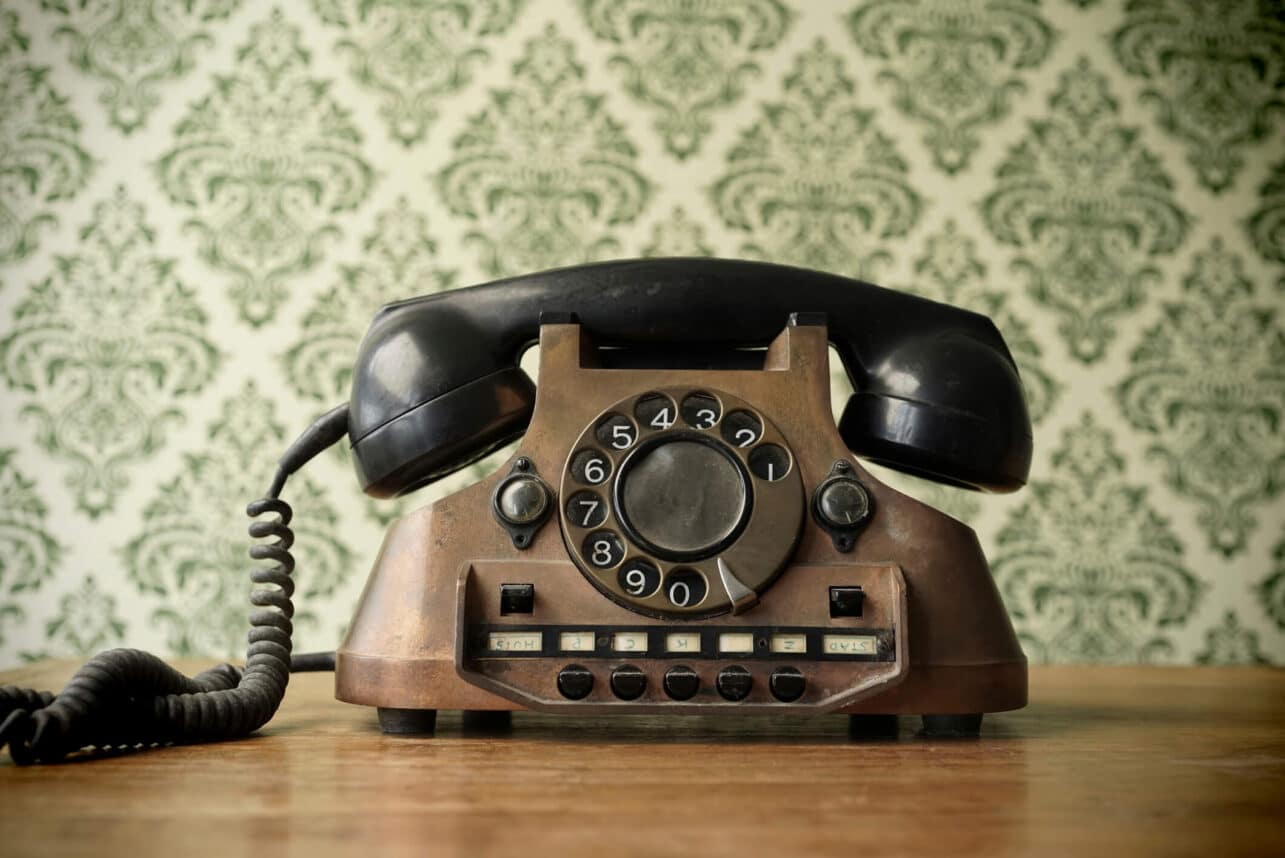
Old telephone made of copper - stock photo / GettyImages

An Amazing Mother’s Day Gift: The Phone Call

It’s been 59 years since my mother picked up an old-school habit that still has her hooked: She sits down at her kitchen table several times a day, picks up the phone, and talks. And talks. And talks.

Sometimes she’ll talk while peeling artichokes or sinking her weathered hands into fresh dough. More often, she’ll talk with a fresh mint tea by her side, right next to an old booklet with hundreds of hand-written names and phone numbers, many of them scratched out and updated to the point that they’re barely legible.

That old booklet is her social bible. Anyone who has ever meant anything to her is in there. Siblings in Israel. Old friends from Casablanca. Neighbors who go to her synagogue; neighbors who don’t. And of course, immediate and extended family.

Those hundreds of names come to life when she hears their voices. That’s why my mother is still blown away by the same technology she got hooked on 59 years ago: the telephone. It’s the human voices that move her, that bring back memories, that trigger laughter. Yes, she dabbles in Facetime and loves to see real faces, but those are exceptions. Day in and day out, what she loves more than anything is to hear familiar voices.

She’s not into the communication fashion of our era—texting—for the obvious reason that she can’t hear voices on a text. She proudly calls that “old school.”

She’s so old school, in fact, that she does something that’s become quite rare: She answers her phone when it rings (and when she’s not napping). This reliability encourages her friends and family to call her, because they know she will answer.

Although she has a smart phone, she rarely uses it. She prefers the landline on her kitchen table, next to the old booklet and the fresh mint tea. During the endless months of COVID isolation, that old landline with mangled chords became her lifeline.

I’m sure if I asked her for a great Mother’s Day gift, she’ll say “Call me every day,” which of course I do.

Happy Mother’s Day to all the mothers reading this.

An Amazing Mother’s Day Gift: The Phone Call Read More »

New York’s George Floyd Moment: It Was Only a Question of Time

New York City has always been a metropolis of menace. The Irish gangs of Five Points, the Italian and Odessa Mafioso, the Chinese Triads, the Son of Sam.

Those of a certain age can still recall that blighted urban era of 1960s and 1970s. Entering Central Park—at specific times, and at several entry points—was a high-risk venture. Neighborhoods and areas that would one day become fashionably hip—SoHo, Alphabet City, Tribeca, the East Village, the Lower East Side, Williamsburg, even Times Square—were unfailingly avoided at all cost.

All those gargoyles only added to its ominous nature. New York has been, for its entire history, a touchstone of cosmopolitan contradiction—museums competed with murder; the Great White Way was a diversion for the darker, seedier side of its bordering neighborhoods: the genuine “West Side Story,” the aptly named Hell’s Kitchen, the very crowded “Naked City.”

For many years there was little fondness for the Big Apple. Rotting from fiscal irresponsibility, police corruption, transit and sanitation strikes, electricity black outs, swelling homelessness, a rioting Harlem and a burning Bronx, and increasingly bold acts of criminality that permeated American culture and were immortalized in such films as, “The French Connection,” “Taxi Driver,” “The Warriors,” “Serpico,” “Escape from New York,” “Boardwalk,” “Fort Apache The Bronx,” “Mean Streets” and “Death Wish.”

These movies so convincingly torpedoed tourism that the city had to mount an ad campaign, “I Love New York,” in hopes of stemming the exodus of the middle-class.

And then, suddenly, the most improbable thing occurred: After 200 years of flashing the Bat-Signal in Gotham, the city that never sleeps because it was too dangerous to doze off, became enthrallingly livable. What followed was two nostalgic decades of relative calm—from the mid-1990s until shortly before the pandemic—when outlaws seemingly went elsewhere, and the city streets convinced everyone to finally let their guards down.

Infamously known as the “broken windows,” zero tolerance theory of policing, with its “stop-and-frisk” namesake and racial profiling afterthought, crime plummeted and the homeless disappeared. New York City was fast getting the reputation as a civilized and tranquil place to live. Times Square, bizarrely, turned into a flashy and tourist-friendly Disneyland.

Those days are now gone, and may never return. The progressive agenda of the Democratic Party, emboldened by the Black Lives Matter movement with its “defund the police” mantra, has as its focus not law enforcement but criminal justice reform. One such reform, unspoken but informally implemented, is that prosecutors will do their utmost to keep persons of color out of prison.

The unsurprising result of this naïve ideal was swift and bitter: Being soft on crime only leads to more and harder crimes.

New York is now coping with mass looting and petty larcenies that are becoming consequential, the deliberate terrorizing of Hasidic Jews and Asian-Americans, and the old dangers of mass transit resurfacing from subways.

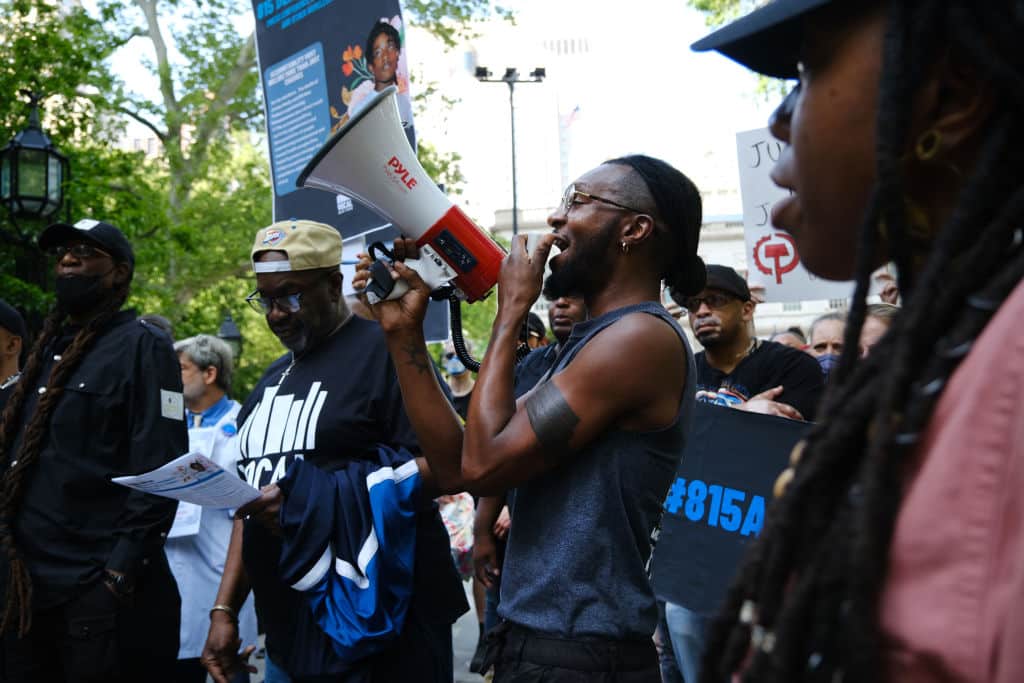
It took a while, but New York finally has its very own George Floyd moment. A mentally impaired Black homeless man, Jordan Neely, exhibited threatening behavior in a subway and possessed a rap sheet that revealed he was a repeat offender. A Marine veteran, Daniel Penny, who is white, placed Neely in a chokehold with fatal consequences. Penny is now being charged with second-degree manslaughter.

It doesn’t take much for a racially polarized nation to succumb to such a political powder keg. A person of color was killed by someone who is white. Had the Marine been African-American it would likely have been just another day in a combustible city. Tragic though it still may have been, it would not have qualified as a major news story or provided any reason to protest. With these racial dynamics in full view, the ghost of George Floyd will surely make a cameo appearance in this criminal trial.

It says much about race relations in America. Black-on-Black crime is a taboo subject even though it should be a public policy priority. This is where Black Lives Matter galvanizes adherents and exploits racial tensions. A homeless man’s life matters not because of who he was, or how he ended up in such desperation, but because his death was facilitated, literally, at the hands of a white person.

Yet, the circumstances of his homicide were clearly not premeditated. By all accounts, it was a case of self-defense—if not directly for Penny himself, then on behalf of his fellow commuters. Penny was not arrested at the scene. There were witnesses to interview and video footage to examine.

Charges of “systemic racism” were immediate. A decorated Marine who possessed no criminal record and is now a college student was recklessly labeled a “vigilante.”

Given this culture’s obsession with Marvel movies, doesn’t everyone already know that vigilantes leave their homes to avenge a wrong, and not to take notes in class?

Red state Republicans will be watching this case intensely as yet another blue state meltdown. If Penny is indicted (all but a certainty) and convicted of second-degree manslaughter, it will invigorate America’s culture wars even further: Children prodded to change genders; a southern border that is browning America a little more each day; the military’s recruitment of drag queens; transgender athletes trouncing women in collegiate sports; police departments demoralized and disarmed just when we need them the most.

Indeed, this latest development is the civilian equivalent of defunding the police. In a nation that already has no legal duty to rescue, why would any good Samaritan, who happens to be white, step in to abate a danger knowing that depending on the skin color of the assailant, he or she might wind up serving a 15-year prison sentence?

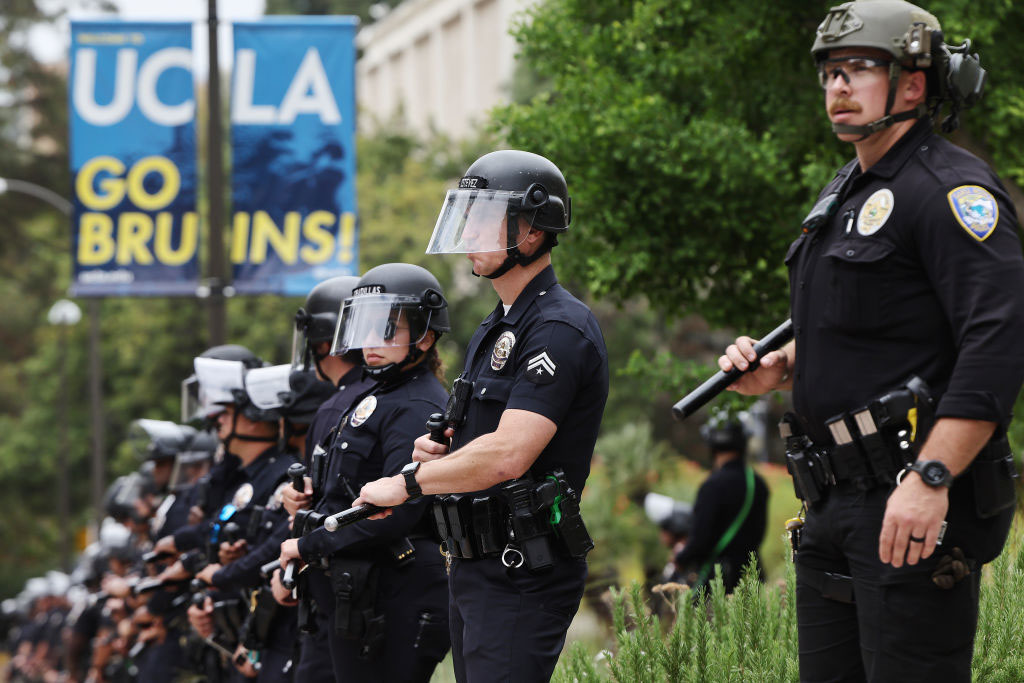
The police nowadays aren’t taking any chances when discharging their duties. Better to stand-down than commit a hate crime. The same will be said of those wisely risk-averse to refuse to come to the aid of anyone in trouble.

New York is unfortunately reclaiming old habits, but for different reasons. Back in the 1970s, the causes for surging crime were institutional. Nowadays, the reasons are entirely ideological.
Everyone is afraid of being called a racist. Complaining about crime is what a white privileged person is derisively expected to do. Forgoing the subway for Uber is one way to stay progressive while avoiding danger. Another is to stay home at night.

Nothing beats railing against police brutality and those murderous Marines. It’s the best way to become a liberal cliché, as a great city declines.


Thane Rosenbaum is a novelist, essayist, law professor and Distinguished University Professor at Touro University, where he directs the Forum on Life, Culture & Society. He is the legal analyst for CBS News Radio. His most recent book is titled “Saving Free Speech … From Itself.”

New York’s George Floyd Moment: It Was Only a Question of Time Read More »