fbpx

May 10, 2023

Producer Arthur Smith: “Hell’s Kitchen,” “Reach” and his Wife’s Brisket

“We have become a nation of foodies,” Arthur Smith, executive producer of hits such as “Hell’s Kitchen” and “Kitchen Nightmares,” said.

Food, food television and cooking is in a much different place than it was around 20 years ago, when “Hell’s Kitchen” came along. Debuting in 2005, “Hell’s Kitchen” was the first successful food show on network television; there had been successful shows, but they were on Food Network and other cable channels.

On “Hell’s Kitchen,” aspiring culinary professionals with varying levels of experience compete on different teams in a progressive elimination format. They face a variety of challenges, including serving guests in a professional environment.

Smith, whose background is in producing sports, admits he was not a foodie when he started producing the show.

“I was shown a tape of Gordon Ramsay doing a show in the UK, called “Hell’s Kitchen,” Smith said. “I loved Gordon right away. I could see that he was a special personality. And I loved the title of the show. I did not like the show.”

The UK version was Ramsay teaching celebrities and disciplining them in his “Gordon Ramsay” way. Smith wanted to make the US version more aspirational and broad.

Smith remembers his early meetings with Ramsay.

“He would say in his charming way, ‘You know absolutely nothing about food,’” Smith said. “There were a couple of swear words thrown in there.”

Smith would reply, “I do know something about making television.”

When Smith asked what great qualities every chef needs to have, Ramsay said palate, leadership, creativity, etc.

“At that point I said to him, ‘I promise you that everything that we do in the show will hearken back to one of those key qualities,’” Smith said. “We’re going to put some sportsmanship into it. We’re going to build a restaurant. We’re going to have two sides. We’re going to have two teams.’”

By the end of that conversation, Smith got a “High Five” out of Ramsay, and they were on their way.

While Smith was trying to figure out the puzzle that was the US version of “Hell’s Kitchen,” he had dinner with his wife at an Italian restaurant, and everything started falling into place.
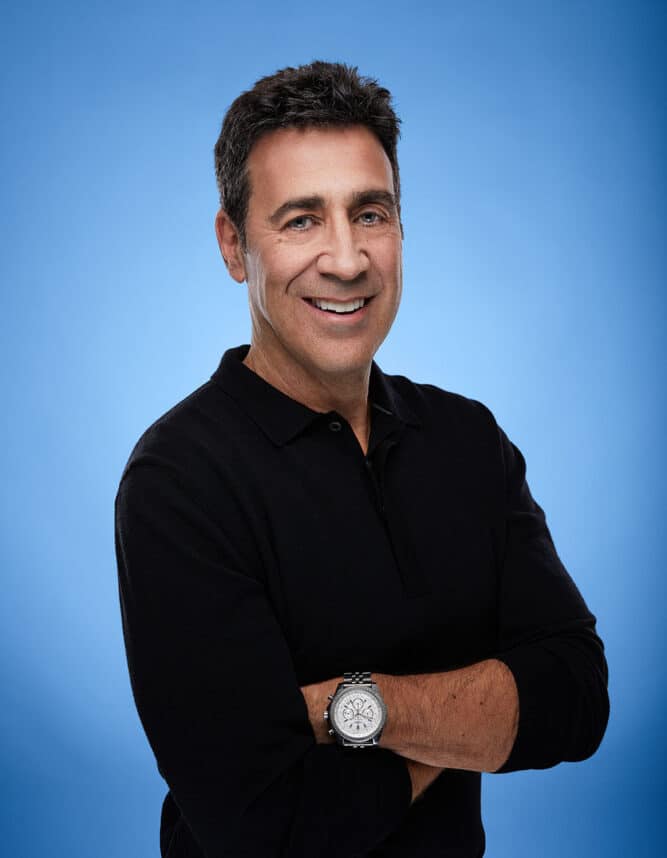
Photo Credit Zach Lyons Photography – Courtesy of Future PLC

It was an open kitchen and Smith was “obsessed” with everything that was going on. He saw the chefs, the timing, the orders going into — and food coming out of — the kitchen.

“‘Wait a second,’” Smith said. “‘This is kind of like sports. I know sports. I came from sports.’ ‘Hell’s Kitchen,” when you break it down, there’s a pre-game, where you’re watching them get ready; there’s the game, which is the dinner service; and then there’s the post game, which is the aftermath: breaking down what they did, sweating it out in the dorm and worrying about who’s going to go home.”

While Smith doesn’t classify himself as a foodie, he admits that his palate has matured. And he does enjoy good food. Arthur’s wife, Wendy’s, “sensational” brisket recipe is below.

“You can’t be around Gordon Ramsay without picking up something,” he said. For example, Smith now knows that Worsetershire sauce is the key ingredient to a great hamburger. And that when you make Beef Wellington, you should not slice it too early, because it will dry out.

A pioneer in nonfiction television, Smith’s experience goes beyond food. Other programs range from “American Ninja Warrior” and “Mental Samurai” to “I Survived a Japanese Game Show.” Smith is the author of the new inspirational memoir, “Reach: Hard Lessons and Learned Truths from a Lifetime in Television.”

“Over my career. I have learned and applied what I call the power of reach,” Smith said. “[It’s] the power of extending yourself. You only realize your full potential [when] you reach beyond what you think you can do.”
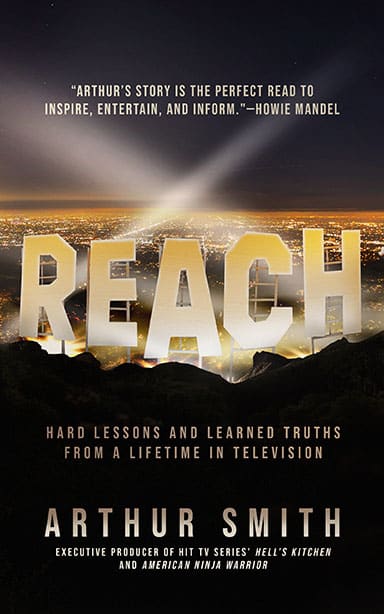
 

Reach is the difference between “a pipe dream and what you haven’t dared to try,” he said.

Whether you are thinking about auditioning for “Hell’s Kitchen,” changing your career path or for instance, writing your memoir, you don’t know what’s possible until you reach for it.

For my full conversation with Arthur Smith, listen to the podcast:

Watch the interview:

Learn more about Arthur Smith and his new book, “Reach: Hard Lessons and Learned Truths from a Lifetime in Television.”

* * *

Wendy’s Brisket

2 cups ketchup

1/2 prepared mustard

3/4 cups packed brown sugar

1 tsp cornstarch

1/2 cup water

1 (4-41/2 pound) brisket

Preheat the oven to 325°F.

Coat a large roasting pan with cooking spray.

In a medium bowl combine ketchup, mustard, brown sugar and cornstarch.

Remove 1 cup of sauce to a small bowl, add the water.

Mix well and pour into the pan.

Place the brisket in a pan and pour the remaining sauce over the meat.

Cover tightly with aluminum foil.

Roast 3 to 3 1/2 hours or until meat is fork-tender.

Remove meat from pan and let rest for 5 minutes before carving.

Serve topped with the pan drippings.


Debra Eckerling is a writer for the Jewish Journal and the host of “Taste Buds with Deb.” Subscribe on YouTube or your favorite podcast platform. Email Debra: tastebuds@jewishjournal.com.

Producer Arthur Smith: “Hell’s Kitchen,” “Reach” and his Wife’s Brisket Read More »

Samantha Ferraro: Little Ferraro Kitchen, Mediterranean Flavors, and One Pot Chicken

“You could read a lot about a person based on what’s on their table,” said Samantha Ferraro, author of “The Weeknight Mediterranean Kitchen” and “One-Pot Mediterranean” cookbooks.

You could also learn a lot about yourself, as you discover and explore new flavors.

Food is very sensory. “You’re smelling, you’re seeing, you’re touching, you’re enjoying,” she said.

And what’s on Ferraro’s table?

“If you came to my house and you looked in my kitchen, you would probably see lots of citrus,” Ferraro said. “I always have some lemons, oranges or limes, because I know I can make a multitude of things.”

You’ll also see bundles of fresh herbs, such as parsley, mint and basil.

With that assortment of spices, citrus and herbs, Ferraro knows she can make anything she wants.

“I grew up on a lot of those Mediterranean flavors,” she said.

Her mother’s side of the family is Sephardic Jewish, which, Ferraro explains, comes with a lot of Turkish and Spanish flavors; lots of fresh herbs and citrus.

“I’ve always just naturally gravitated towards those flavors,” Ferraro said.

Her two favorite spices are Za’atar, which is a spice blend that includes sumac, oregano, thyme and sesame, and smoked paprika.

Ferraro’s new cookbook, “One-Pot Mediterranean” follows the same flavors as her first one, but everything’s made in one pot. It’s meant to build flavors.

“So we might be searing chicken, and then adding vegetables,” she said, “Because everything is cooked at a different level. It’s all done in one pot.” Her recipe for One Pot Chicken and Rice with Lemon and Chickpeas is below.

Ferraro started cooking, and sharing recipes, through her blog, Little Ferraro Kitchen in 2011.

“Originally I was going to be a nurse,” she said. “I was in nursing school … and it didn’t work out, so I was definitely going through this discovery phase of like, ‘Who am I?’ ‘What am I meant to do in this world?’ And that’s when I started cooking.

Even though it started as an outlet to get her through a challenging time, cooking turned out to be Ferraro’s true passion.

So which does Ferraro love more? The cooking or the eating?

“I love to experience food: the flavors, the textures and the different nuances,” she said. “My favorite thing is getting someone excited about a recipe.”

When asked what is the one thing she knows now that she wishes she knew when she started cooking, Ferraro says to keep it simple.

“Let the good produce, or whatever you’re using, shine,” she said.

For instance, Ferraro loves citrus and will put it on everything. She adds lemon juice to salad dressings and lemon zest to baked goods (like cookies), and uses slices when cooking chicken or fish.

“If you have a good product, you don’t need to do much to it,” she said. “Just add some freshness to it, and it’s always going to be delicious.”

For my full conversation with Samantha Ferraro, listen to the podcast:

Watch the interview:

For more recipes and tips, follow @Ferrarokitchen on Instagram and LittleFerraroKitchen on Facebook.  Get Samantha Ferraro’s recipe for Roasted Salmon with Citrus and Herbs and Mediterranean Roasted Vegetables with Za’atar on LittleFerraroKitchen.com.

* * *

Photo courtesy Little Ferraro Kitchen

One Pot Chicken and Rice with Lemon and Chickpeas

A flavorful and easy one pot chicken and rice recipe that is seasoned with bold Mediterranean spices, chickpeas and fresh lemon.

2 lbs skin on and bone in chicken thighs

1 tsp paprika

1 tsp turmeric

1 tsp sumac

1 tsp Kosher salt

1/2 tsp Ground black pepper

1/2 tsp cumin

1/2 tsp allspice

1 lemon, zested and sliced thinly

Olive oil for drizzling

1 small shallot, diced

2 garlic cloves, finely chopped

1 cup uncooked basmati rice

15 ounce can chickpeas drained and rinsed

2 cups chicken broth

Fresh parsley, chopped, for garnish


  1. Preheat the oven to 400°F.
  2. In a small bowl, add all of the spices, lemon zest, salt and pepper and stir to combine.
  3. Dry the chicken thighs very well with paper towels and season the chicken with the spice and lemon zest mixture, making sure all the chicken is generously and evenly coated all over.
  4. Bring a wide dutch oven or pan to medium heat and drizzle with olive oil. Sear the chicken, skin side down until deeply golden brown, about 3-4 minutes, then flip over and sear the other side for another 2 minutes.
  5. Once done, remove chicken from the pan and reserve to a plate.
  6. In the same pan, add the chopped shallots and saute until caramelized and softened for about 2-3 minutes, then add the chopped garlic and saute for another 1-2 minutes until fragrant.
  7. Add the basmati rice and saute in the residual fat, so all of the grains are lightly coated with the flavored oil. Add the drained chickpeas and toss together for another minute.
  8. Nestle the chicken thighs into the rice and chickpea mixture, skin side up and pour the chicken stock around the chicken. Scatter the lemon slices on top of the chicken.
  9. Turn off heat and cover the pot. Then place it into the oven and cook for 20 minutes. Then remove the cover and continue cooking for an additional 10 minutes, until the liquid has absorbed and chicken is cooked through.
  10. Once done, remove the chicken from the oven and garnish everything with fresh chopped parsley.

Notes:

Take the time to sear the chicken skin and render the fat to use in sautéing the aromatics and rice.

Rinse the basmati rice a few times until the water runs clear. This produces a lighter and airier result once the rice is cooked.


Debra Eckerling is a writer for the Jewish Journal and the host of “Taste Buds with Deb.” Subscribe on YouTube or your favorite podcast platform. Email Debra: tastebuds@jewishjournal.com.

Samantha Ferraro: Little Ferraro Kitchen, Mediterranean Flavors, and One Pot Chicken Read More »

Over 300 Rockets Fired from the Gaza Strip into Israel

Over 300 rockets were fired from the Gaza Strip into Israel on Wednesday, after Israel killed three senior members of Palestinian Islamic Jihad in the early hours on Tuesday in the Gaza Strip. The attack killed a number of civilians as well. The ongoing operation in Gaza, which Israel specifies is against Palestinian Islamic Jihad affiliated individuals and infrastructure, has been dubbed “Shield and Arrow” by the Israeli military.

Red alerts to take shelter were sounded in Israel from the Gaza border area to the Gush Dan, Tel Aviv’s metropolitan area.

As of 6:00 p.m. Israel time, 62 rockets were reportedly intercepted by the Iron Dome and David’s Sling, Israel’s defensive military technology, and three were confirmed to have made impact inside of Israel. Sixty-five fell into Gaza, and three were fired at Tel Aviv.

On Wednesday evening, Egyptian press reported that a cease-fire had been brokered between Israel and Gaza militants, but a new wave of rocket alerts sounded in the Tel Aviv area at 7:30 p.m., shortly after the cease-fire announcement. In a televised address around 9 p.m., Prime Minister Netanyahu said that “The campaign is not over.” Speaking to the leaders of Palestinian Islamic Jihad: “We see you everywhere, you can’t hide.” Defense Minister Yoav Gallant later verified that the fighting was not over.

Leaders of the Israeli opposition, Yair Lapid of the Yesh Atid Party and Benny Gantz of the National Unity Party issued a statement stressing “the importance of backing IDF and security force operational activity.”

Over 300 Rockets Fired from the Gaza Strip into Israel Read More »

Save Israeli Democracy?

In cities around the world, including New York, Chicago, Miami, San Francisco, Los Angeles, Berlin, Munich, Oslo, Paris, Rome, and even Sydney, Australia, demonstrators opposing Prime Minister Benjamin Netanyahu’s proposals for judicial “reforms” have taken to the streets holding signs reading “Save Israeli Democracy.”  

Two of Netanyahu’s proposed reforms (which are arguably designed, at least in part, to keep him out of jail) are especially contentious and would have the most far-reaching effects. One affects how Supreme Court justices are appointed. The second permits the Knesset to override a Supreme Court ruling that strikes down legislation. While the demonstrators argue, and may be correct, that Netanyahu’s proposals are a threat to democracy because they give him too much power, they are wrong in how and where they are saying this. 

A bit of background. Israeli Supreme Court justices are appointed by a nine-member Judicial Selection Committee. At least five of its members (three Supreme Court justices and two Bar Association members) are themselves not popularly elected to any office. Since seven of the nine members of the Committee must vote in favor of a Supreme Court candidate, control over appointment rests in the hands of persons who are not popularly elected. Moreover, in its 1995 Bank Mizrahi decision the Supreme Court found the power to negate “unreasonable” Knesset legislation. The Knesset has no power to review that determination. Natanyahu argues that judges appointed in this fashion ought not to have such unfettered power. 

Netanyahu’s proposals would reduce to five the votes needed in the Judicial Selection Committee for a Supreme Court appointment and alter the Committee composition so that the elected ruling coalition has an automatic majority of Committee appointees. He would also enable the Knesset, by a simple majority vote, to override a Supreme Court finding of unconstitutionality. 

Although Netanyahu campaigned on these issues, critics argue that the proposed changes are undemocratic because they put all three branches of the government in the hands of the governing coalition. While this can be a risk, it is inherent in many parliamentary democracies (such as the United Kingdom) where there is no judicial power to oversee legislation, and the leader of the parliamentary coalition is typically the Prime Minister and head of the executive branch.

The divisions in Israel are so dramatic that checks and balances to legislative and executive excess are especially necessary. 

The more compelling critique of Netanyahu’s proposals is not that they are undemocratic, but too democratic, giving too much ultimately unreviewable power to the popularly elected Knesset and potentially permitting a tyranny of the majority (and the prime minister). The divisions in Israel are so dramatic — between Arabs and Jews, religious and secular, the political left and the political right, the pro-Netanyahu camp and the anti-Netanyahu camp – that checks and balances to legislative and executive excess are especially necessary.   

So although the demonstrators’ critique is wrong, they are right to be concerned. But in organizing worldwide demonstrations in opposition to Netanyahu’s proposals, the demonstrators are wrong in a fundamental way.  For example, the organization UnXeptable, which describes itself as a “grassroots movement launched by Israeli expats in support of a democratic Israel” and has chapters around the world, supports the worldwide demonstrations. Its Palo Alto founder, Offir Gutelzon, declares, “The foundations of Israeli democracy are being challenged” and “We call on Jewish Americans, and anyone who cares about Israeli democracy, to join us.” 

The call to “anyone who cares,” which is what the worldwide demonstrations are doing, undermines Israel and invites international intervention in its domestic affairs. Israel is a sovereign democratic state; how it chooses to organize its internal affairs is not a matter in which foreign governments should intervene. While Jews everywhere have a stake in Israel, to call for international pressure from non-Jews and from foreign governments is unseemly and dangerous, encouraging foreign governments to condition their relationships with Israel on how Israelis choose to govern themselves.   

So don’t demonstrate seeking to convince and involve foreign governments or non-Jews worldwide. Demonstrate in Israel or in front of Israeli consulates to influence the Israeli government. Argue in Israel and in Jewish publications the possible domestic repercussions when checks and balances are swept away.  But don’t damage Israel by bringing these arguments to people around the world.  Don’t invite non-Israelis and non-Jews, as the demonstrator’s signs declare, to “save Israeli democracy”.  Watch your words, and where you express them.


Mr. Smith is an appellate attorney in Los Angeles with the law firm of Lowenstein & Weatherwax and President of the Orthodox synagogue Westwood Kehilla.

Save Israeli Democracy? Read More »

Local Twin Brothers Win National Prize

Some kids participate in spelling bees while others are mathletes. Akiva and Raphael Shrier, 12, are winners when it comes to bible stories.

On Sunday, April 30, Akiva, who goes by Jack, took third place, and his twin Raphael (Rafi) placed fifth in the Chidon HaTanach finals.

“It’s an amazing experience to study Tanach every day for almost a full school year and then meet kids from all around the U.S. who have been doing the same thing,” – Raphael Shrier

“It’s an amazing experience to study Tanach every day for almost a full school year and then meet kids from all around the U.S. who have been doing the same thing,” Raphael told the Journal.

Jack said his favorite part was, “Chatting with the other kids before the tests.”

The boys, who attend Yavneh Hebrew Academy in Los Angeles, were the highest-scoring seventh graders in the country in the Middle School Division. The ones who placed first, second and fourth were all eighth graders.

The National Bible Contest, Chidon HaTanach, is sponsored by the Jewish Agency for American Jewish youth in grades six to 11. It tests students on the details of stories in several Biblical books. The Jewish Agency sends preliminary exams to schools during the school year (from December to March). They then invite the high scorers to the national finals in New York.

This is the second year the boys have competed and won. Last year, Raphael placed first and Jack placed second in the Sixth Grade Division.

The twins learned about the contest in 2021. One of their counselors at their Bnei Akiva summer camp, Camp Stone, inspired them. 

“He had participated in the Chidon for years, and he encouraged my boys to do the same,” the twins’ father Zach told the Journal. “When they returned from camp at the end of the summer, they were clamoring to get started.”

Jack and Raphael studied before and after school and on weekends, and often tested each other.

 “If you want to be uplifted, if you want to feel hopeful for the Jewish future, sign your kids up for the Chidon HaTanach,” Zach said. “There’s nothing else like it.”

Local Twin Brothers Win National Prize Read More »

Hat Tricks from a Jewish “Ambassador”

I try to be a good ambassador for Judaism out in the world, but wearing my religion on my sleeve (or my head, or on my plate) gets tricky. Years ago, I was invited to speak at the Erma Bombeck Writers Conference at the University of Dayton. Friday night before the program began, at a dinner for conference speakers and VIPs, I’d also been asked to say a few words about how Erma’s work had influenced me. I had short, amusing remarks locked and loaded, but there was a microphone at the podium–which I couldn’t use on Shabbat. What would I do when they called my name? Thankfully, as I was called divine inspiration tapped me on the shoulder. 

As the speakers before me had done, I first walked behind the podium and positioned myself at the microphone. I waited two seconds, looked at the audience and shrugged before walking around to stand in front of the podium. “I’ve got four teenagers at home,” I said with an exaggerated sigh and gesturing helplessly. “I don’t need a microphone.” The audience laughed and I was home free. Thank you, God! I said silently.      

The next night, I faced my most embarrassing situation as a kosher traveler among non-Jews. At a banquet for all three hundred and fifty attendees, I talked shop with congenial table mates who were all enjoying their treyf dinners of warm rolls, baked chicken, whipped potatoes, and green beans almondine. Meanwhile, I was summoning all my bicep and tricep strength to hack my way through the building-grade layers of aluminum foil and thick plastic wrap protecting the kosher meal ordered for me. (For some reason, my kosher meal on Friday night didn’t require Herculean strength to unwrap.) The caterer had provided feeble plastic cutlery when I needed a machete. Some guests stole furtive, sympathetic glances my way as the waiter hovered, trying to pour nonkosher wine into the wineglass I shielded with my hand. Clearly, I looked like I needed a drink. Probably two.   

This never would have happened in L.A. or any other more sophisticated Jewish community. I embrace my religious identity and hate for people to think that Jewish living — including keeping kosher — is such a burden, because it wasn’t. This was beyond cringeworthy — what had this caterer been smoking?    

When my tablemates were tucking into their dessert, God had mercy. I finally broke through the final layers of plastic. All eyes were now on my disposable plate to see what treasure had been revealed. My mortification deepened when I saw a bland-looking and shockingly small portion of salad, chicken, rice with peas, and roasted summer squash. I thought of the old joke about a Jew complaining bitterly about a bad meal he was served in a restaurant, and then adding, “And such small portions, too!” 

Fortunately, everyone was quickly distracted by the keynote speaker, Dave Barry, who had God-like status in this audience. I couldn’t help but notice, though, that only two people among the 350 of us wore any sort of hat. I was one of them, in a stylish Israeli-designed beret embroidered all around with tiny silver beads. The other woman covered her head with a duck hat nearly the size of a chimney. Logically, our hats did not belong to the same species of headwear. Irrationally, though, I feared that the ridiculousness of her hat might somehow taint my head covering worn as a sign of Jewish observance.  

As a volunteer ambassador for Judaism, I’m prepared not only to wear different hats but also to face down awkward situations along the way.

Barry couldn’t resist and asked the woman where she got her hat so that he could get one, too. I held my breath for a moment: would she feel insulted? But Barry was brilliant, his tone deftly blending kindness with a touch of disbelief. The duck hat wearer beamed with delight — with his clever attention, Barry had made her feel honored.  

In the end, I couldn’t help it if my tablemates thought keeping kosher was nuts, but at least my hats did me proud. A writer I admired complimented me on a mauve beret, which led to her endorsing my next book. As a volunteer ambassador for Judaism, I’m prepared not only to wear different hats but also to face down awkward situations along the way.


Judy Gruen’s most recent book is “The Skeptic and the Rabbi: Falling in Love With Faith.”  

Hat Tricks from a Jewish “Ambassador” Read More »

Shiva Minyan: The Embarrassment and the Necessity

One of the many challenges I recall from my decade as a congregational rabbi, was the powerful ways our synagogue would support its congregants during time of loss. The congregation took the mitzvah of menahem aveilim (comforting mourners) seriously, making sure that there were always enough people to make a minyan (10 adult Jews) to attend the Ma’ariv services offered in the homes of mourners. In that regard, we were no different than every other Jewish community.

What I often pondered was my own dilemma while forced to lead a prayer service praising God in a place where God’s love and power were hidden or missing. After all, each one of these homes sheltered families that had suffered the death of a beloved spouse, parent or sibling. How could I expect these people to be willing to praise God’s greatness, to extol God’s power, or to express gratitude for God’s goodness? Still aching from the pain of death and separation, these mourners could no longer view God as either benefactor or friend.

Perhaps it was just such a moment of rage and sorrow that originally generated the Yiddish expression, “If God lived on earth, all God’s windows would get broken.”

Yet it was precisely into those homes — homes filled with rage at God’s impotence, homes tormented by an overwhelming abandonment and isolation — that Judaism compelled me to stand and to sing of God’s enduring love and incomparable power.

In a home that reeled from the loss of a wife and mother, one of its pillars of purpose, meaning and identity — into that home I had to proclaim the continuing habitability of the universe, the beneficent purpose underlying God’s creation.

And, in homes ripped from communal moorings, uncertain of the continuing relevance of friends, community or Jewish fellowship, into precisely those homes poured friends and congregants, awkwardly reciting the phrases and melodies of our timeless tradition. Did this strange practice make any more sense to them than it did to me?

I, leading the prayers, represented the anomaly of God’s love in a place bereft of love, of God’s purpose in a home torn by the random cruelty of finitude and mortality, of God’s covenanted community in a place isolated by loneliness.

Hence my embarrassment and discomfort. Leading the minyan of mourners in what could only feel like the Prayer of the Absurd, forcing mourners to mouth words they could hardly mean, I, and they, needed to confront our puzzlement and frustration at a tradition that imposed this farce on me and this outrage on them. Despite the gap between the mourners’ embittered frustration and the rooted piety of Jewish tradition, my congregants and I were obligated to bring our minyan, our prayers and our presence to these hurting people. Why?

Why does Judaism mandate seven days of minyanim in the home of a mourning family?

Let’s start with the reality of loss and rage following the death of a lifelong spouse, or a beloved sibling. For the person left behind, a jagged hole looms in the center of the heart, an empty space in the depths of the soul. Having built a life around the presence and cheer of one who was deeply cherished, this death can only result in rage against a universe in which such horrors too frequently occur. The Mishnah’s admission that “we cannot understand either the tranquility of the wicked or the suffering of the righteous” provides no comfort, only the recognition of an often bleak and unfair reality. Not without logic, amorphous fury at what has transpired is often directed against God. After all, how can there be a God (or how can God claim to be good) if this outrage could happen to one so needed, so loved?

It’s difficult enough to endure the death of a loved one, but to lose simultaneously the comfort of God’s love, to exclude the strength and endurance that can emerge from opening one’s heart to God, from sharing one’s pain with the Source of all comfort, can only make a painful situation excruciating. As the 42nd Psalm observes, “Day and night, tears are my nourishment, taunted all day with ‘Where is your God?”‘ Isn’t that precisely the crisis that every mourner faces? Just when God is most needed, the tragedy that produces such pressing need also renders the Divine presence least accessible.

The silent presence of fellow Jews, the simple gesture of sitting together or offering an outstretched hand speaks more eloquently than the most lofty speech.

One central function of the Shiva Minyan, then, is to restore access to God’s love. Words often remain superficial, and sermons regularly fail to penetrate the recesses of the human heart. But the silent presence of fellow Jews, the simple gesture of sitting together or offering an outstretched hand speaks more eloquently than the most lofty speech. God’s presence cannot be articulated or alluded to. But it can be demonstrated. Just by being there, we embody God’s love, and we make that love tangible. “To You, God, silence is praise.”

Think again of the mourner’s devastation in the wake of death. Not only is receptivity to God’s love diminished, but a healthy sense of purpose and a willingness to trust is shattered as well. It is relatively easy to rely on the habitability of the universe while loved ones thrive. It may feel effortless to maintain a buoyant spirit and a cheerful countenance when blessed with health, companionship and prosperity. But with the death of a loved one, our facade of control dissolves into fantasy. Suddenly, the world we inhabit appears random at best, cruel or deceitful at worst.

Life no longer makes sense. Without conviction, without an affirmation of purpose or meaning, human life becomes impossible. When the psalmist says, “Were it not for the Lord, I would have perished,” he is using biblical language to maintain that we cannot flourish in a random world. Chaos is the enemy of our ability to thrive.

Into a family assaulted by chaos, battered by unjustifiable loss, the Shiva Minyan asserts continuing purpose, affirms a world view that stands in the face of death and proclaims the imperative of life, acting on the biblical charge for “one generation to laud God’s works to another.” Precisely by reciting prayers that acclaim God’s goodness, we assert our determination to endure, to comfort and to blossom. The Shiva Minyan restores a lost vision of how to live, how to retain order, goal and direction in a shattered world.

Finally, a significant component of a mourner’s devastation is the severed sense of belonging. Having lost one of the closest ties to the outside world, one of the most intimate of relationships, the mourner flounders in lonely isolation. Abandonment sets the somber tone of the mourner’s mood.

It’s impossible to be a Jew alone. While sociologists confirm that all human identity is formed in community, and object-relations psychology teaches that even an infant’s sense of self derives from its interactions with others, nowhere is that need more pressing than in the isolation of a mourner. And nowhere is the assumption of community more pervasive than in the world of traditional Judaism.

The mourner, then, reels from the universal and human loss of context and belonging — a loss made more acute by the particular way Jews generally can presume the support of their community. The Shiva Minyan — because it occurs in the home, because it is composed of friends and fellow congregants — does more than remind the mourner of membership in a larger community. It creates that community —  precisely where it is most needed. By physically entering the isolation of the mourner, the Shiva Minyan dispels it.

For all these reasons the Shiva Minyan is needed most where it is desired least. In a place of anger the practice of Shiva offers acceptance and love. To a heart adrift the Shiva Minyan restores direction. And to the agony of individual pain the Shiva Minyan creates a portable and persistent community.

The Kabbalists spoke well when they pointed out that the only way to gather the shattered sparks of Divine light — now held by the forces of chaos and despair — was to enter the sitra ahra, the side of darkness. The only place to provide healing, comfort, and an abiding sense of God’s love and communal support, is in the home of the mourner.

“Out of the depths, I called to You, Lord.” And it is out of the depths that healing, community and solace can hope to emerge.


Rabbi Dr Bradley Shavit Artson (www.bradartson.com) holds the Abner and Roslyn Goldstine Dean’s Chair of the Ziegler School of Rabbinic Studies and is Vice President of American Jewish University in Los Angeles. He is also dean of the Zacharias Frankel College in Potsdam, Germany, ordaining Conservative rabbis for Europe.

Shiva Minyan: The Embarrassment and the Necessity Read More »

On Terms of Endearment, Flags and Freedom

A few weeks ago, my car was sideswiped by a very large truck on the highway leading from Efrat to Jerusalem, which left long scratches on the chassis. Since it happened just before a traffic light, I was lucky to get a shot of the license plate and I noted the hour and the date.

A few days later I went to the small police station in our town of Efrat to put in a police report, but it was locked and no one responded to my knocking. I photographed the sign on the door together with my watch so they could see I was there during reception hours and sent it to the policewoman, whose cell number I got from a friend who works in the municipality (It’s who you know), noting in a text message that no one was there.

She sent back a voice message in which she said, “Hi mammi (short “a”). Yes, there was an irregular event [in the area]. You need to go to the regional police station [not our local one] and give in your report there.”

I was, inexplicably, moved by her using a term of endearment — “mammi” (short “a”) — when leaving me a message — this policewoman who didn’t even know me. In America I guess the (politically incorrect) equivalent would be to have a policewoman call you “Honey.”

It reminded me of the “Pina Chama” (“Warm Corner”), the small prefab building, at the Gush Etzion crossroads, where volunteers — mostly women — give out drinks and cakes to soldiers on duty nearby. When I volunteered there once, and a soldier called me “Doda” (“Auntie”), I was surprised and thought it was sweet. One of the other volunteers said, “Oh, they call all of us ‘Doda.’” I don’t know what they call the men. Uncle, I guess?

“Overheard at the tumultuous judicial demonstrations: A protester on one side of the debate says to a friend on the opposite side: ‘If you’re leaving now, could I please borrow your flag?’”

Wave the Flag

To Americans who have lived through eras of demonstrations and riots that brought with them the burning of the American flag, it may come as a surprise that during the recent demonstrations for and against the judicial reforms in Israel, both sides came out with thousands of Israeli flags, each claiming the flag was representing them. Barbara Sofer, a columnist for the Jerusalem Post, wrote a column before Independence Day, “75 Reasons I Love Israel.” She does this every year (last year it was 74 Reasons, etc.), and I am amazed how she always comes up with new things. One of her reasons this year was: “Overheard at the tumultuous judicial demonstrations: A protester on one side of the debate says to a friend on the opposite side: ‘If you’re leaving now, could I please borrow your flag?’”

On a more somber, but inspirational note, after the wife and two daughters of Rabbi Leo Dee were murdered, he asked everyone to post photos of Israeli flags. Our Facebook and WhatsApp pages and messages filled with Israeli flags. Am Yisrael Chai.

Sharing an iconic lyric

These words from Israel’s national anthem, “Hatikva” — “To be a free people in our land” (“L’hiyot am hofshi b’artzeinu”) — have been both a response and a battle cry on more than one occasion. In 2019, after the horrific and brutal rape and murder of 19-year-old Ori Ansbacher by an Arab terrorist in a forest on the outskirts of Jerusalem, where she went for a walk, our Raise Your Spirits Theatre troupe was performing a revival of our biblical musical on Deborah, called “Judge.” One night the girls and women showed up with a large banner on which they had written that verse in response to Ori’s murder. The whole cast photographed themselves holding up the banner on the backdrop of the audience. Ori was from Tekoa, a community in Gush Etzion, and it was in the Gush Etzion theater hall that we were performing. Similar banners were making the rounds of communities throughout Israel.

photo by Sharon Altshul

At recent demonstrations against judicial reform (not in any way oppositional to the banner in response to terror), those same words appeared on large banners hanging from bridges in Israel and on signs. Frankly, I didn’t know which side it was trying to represent until I saw who had posted the photos and I knew which side they supported. (But perhaps, like with the flag, both sides were hanging those banners.)

Whether you are responding to a terror attack, to judicial reform (on either side) or to any other crisis, we will continue to declare ourselves a free people in our land.

The message was clear. Whether you are responding to a terror attack, to judicial reform (on either side) or to any other crisis, we will continue to declare ourselves a free people in our land.

A message from Waze

Last week I needed to make a shiva call to a friend in Kiryat Arba. I have often admired the way that one can learn history in Israel from the street signs, which are usually arranged according to similar time periods or themes, for example, one neighborhood will have streets with the names of the prophets, another will have streets with the names of early Zionist leaders, etc. In Kiryat Arba, I reached a corner where Waze (an app invented by Israelis) told me, “Take a right at Yoni Netanyahu and a left at Rabbi Zvi Yehuda Kook.” It gave me a bit of a shiver. The heroic officer who led (and fell in) the Entebbe raid in 1976, and the son of the first Ashkenazi Chief Rabbi of British Mandatory Palestine, Abraham Isaac Kook. Rabbi Zvi Yehuda was a talmid chacham (wise scholar) in his own right; I actually had the privilege of attending his classes.

So there you have it. A road named for a military hero leading into a road named for a Torah hero. One defended freedom. The other taught about its significance in our holy land.

A Postscript

As I was completing the writing of this column, I stopped by our local Bagel Café for a takeout latte (“café hafuch” to my fellow Israelis). A policewoman came in to pick up a bite to eat. I heard her call the counterperson “Mammi” and knew where I had heard that voice before — in her WhatsApp voice message. “Hey, I know who you are,” I said. “You sent me a message last week and also called me ‘Mammi.’” She laughed and asked if it worked out with the police report. I said it did. I told her I’d be mentioning her in a column I was writing. She agreed to take a selfie with me.

Toby and policewoman (photo by Toby Greenwald)

And gave me a kiss on the cheek.

Welcome to Israel.


Toby Klein Greenwald is an award-winning journalist and theater director and the editor-in-chief of WholeFamily.com

On Terms of Endearment, Flags and Freedom Read More »

LA Jewish Film Festival Remembers Gene Wilder

The Los Angeles Jewish Film Festival is back with in person screenings for the first time since the start of the pandemic. This year’s lineup includes drama, romance, documentaries and a new film about Gene Wilder’s life, featuring a live appearance from his close friend and collaborator, Mel Brooks. 

The festival will take place May 18-24 at various venues around LA, including the Saban Theatre and The Wallis in Beverly Hills and the Laemmle – Town Center in Encino. The opening gala will celebrate the world premiere of “Remembering Gene Wilder.” Brooks is set to join the on-stage program, which will also include a Q&A with director Ron Frank, writer Glenn Kirschbaum and Rain Pryor, an actress and the daughter of Richard Pryor. 

“The mere existence of a Jewish Film Festival is even more critical now than ever,” said Hilary Helstein, founder and executive director of the LAJFF. “It is essential there be representation in the city of a cultural arts program, through the lens of Jewish filmmakers or of showcasing ‘Jewish’ stories. In this way, we can help educate people on the diversity of the Jewish people and culture and dispel the myths that drive hatred.”

Along with “Remembering Gene Wilder,” the festival is presenting “Trust,” a story about three siblings who are sitting shiva for their mother and letting greed get in the way of family unity; “Israel Swings for Gold,” which is about Israel’s baseball team competing for the first time at the Olympics in Tokyo and combating anti-Zionism and antisemitism; “Our Story,” a romantic dramedy that follows a man and woman as they navigate the LA senior dating scene; and “Killing Me Softly With His Songs,” a musical documentary about the life and work of composer Charles Fox. The festival’s specialty is hosting premieres and offering the community a first look at international selections. 

“LAJFF creates community awareness, appreciation and pride in the diversity of the Jewish people and culture through the power of a cinematic experience,” Helstein said. “Film transcends and has mass appeal and deep impact. When entertainment presents powerful stories with direct or subversive educational content, it cultivates change.”

“LAJFF creates community awareness, appreciation and pride in the diversity of the Jewish people and culture through the power of a cinematic experience.” – Hilary Helstein

David Knight, who produced “Remembering Gene Wilder” with his wife Julie Nimoy, collaborated with Julie previously on “Remembering Leonard Nimoy,” a documentary about Julie’s father. 

“The film was not only a celebration of Leonard’s life and career, but his battle with lung disease as well,” said Knight. “Based on the positive responses, we thought it would be fantastic to honor another entertainer’s life and legacy along with creating awareness for a serious health condition.”

Two months after releasing their first film, the couple learned that Gene’s widow, Karen Wilder, was working with the Alzheimer’s Association on a new campaign to raise awareness about Alzheimer’s disease, which Gene was diagnosed with in the last few years of his life. 

“Being huge Gene Wilder fans, we immediately thought this would be a wonderful film project,” Knight said. “’Young Frankenstein’ and ‘Blazing Saddles’ are probably two of our all-time favorite comedies. We always thought Gene was talented, but after watching so many of his films, we’ve learned to appreciate not only his comedies, but his ability to play such a wide range of characters as well.”

He believes that once people watch the film, they’ll recognize and appreciate how talented Gene was and see the love he had for his wife, family and friends. 

“In addition, we hope that our film will create awareness and remove the stigma associated with Alzheimer’s disease,” he said. 

As for Helstein, her goal is to cultivate community and introduce people to the latest and greatest Jewish films out there.  

“We hope our audience feels a strong sense of belonging and connection to a wonderful community and joins together in a shared, moving experience, laughing or crying, while having the opportunity to watch new films and hear from the filmmakers who make our programs shine,” she said. “We offer new experiences programmatically that are not offered anywhere else.”

For more information on the LAJFF and the full line-up, visit lajfilmfest.org.

LA Jewish Film Festival Remembers Gene Wilder Read More »

Rosner’s Domain | Right Time for Deterrence

If you don’t feel like defending the current Israeli government, or listening to someone who defends the current Israeli government, that’s understandable. This government is a problem that’s waiting for a fix, or a break. It has been in office for four months, and it is difficult to identify even one good deed for which it could take credit. 

But sometimes even a bad government makes the right decisions. For example, not to be instinctively dragged into a long round of fighting in Gaza. And of course, even when it comes to Gaza policy it is not so quite easy to defend the government, because had it been the previous government – the one of Naftali Bennett, or of Yair Lapid – the Likud’s cannons of criticism would rain fire on the supposedly wretched leaders who waited a whole week with their response to rockets. If there is a trophy for hypocrisy and double-talk in the world, the Netanyahu government is sure to win it. And yet, none of this means that the decision it made on Gaza last week was wrong.

A short reminder, because we are quick to forget: Last week, following the death of a Palestinian prisoner in an Israeli jail, Hamas and Islamic Jihad bombarded Israel’s south. Israel responded with some counter bombing, but not much, and then moved to accept a quick cease fire. Criticism mounted from within the coalition against this supposedly weak response. Didn’t we promise to have a different, more aggressive policy in such cases, they asked? The answer is clear: the elected coalition made many promises, most of which should not be taken seriously. The facade of a “more right wing” policy towards Gaza is one of them. 

To understand why Israel made the right choice we must consider some almost trivial basic facts:

• Israel does not have and will not soon have any type of “remedy” that will neutralize the Gaza landmine. We are stuck with the Gaza Strip under Hamas rule. That is: military action in Gaza is not intended to change the basic reality but to make Hamas hesitate before it fires a rocket.

• Deterrence wears off over time, so it should be expected that, from time to time, Israel will be forced to launch an operation in Gaza. Such operation should be launched at a time convenient for Israel. Shooting aimlessly and without results does not strengthen deterrence — it weakens it.

As I write in mid-week, Israel is still waiting to see how Gaza responds to the targeted assassination of three Islamic Jihad leaders on Monday night.

Now we can move to look at the specifics of the current round, and a word of caution is due: as I write in mid-week, Israel is still waiting to see how Gaza responds to the targeted assassination of three Islamic Jihad leaders on Monday night. On Tuesday morning Israelis were asked to get ready for a possible eruption of violence. Schools and trains in certain areas were canceled. Bomb shelters were opened. The critics – mostly rightwing radicals from within the government who weren’t in the loop, and hammered the PM for being weak – clumsily began their long journey off the populist’s tree. 

As we look at Israel’s response to recent events, we must consider three things: the first is the level of support, of lack of it, the government has. Any military action would be looked at with suspicion. Is Bibi trying to change the conversation? Is he trying to make us forget about his government’s imbecility? The second is the need for action that would make a difference. Deterrence is complicated, and the public demand for quick fixes (they fired – we must fire back!) could lead politicians astray. And then, there’s the third issue: the need for hasty response was never there because of the fact that Israel had a significant achievement even before the belated targeted killing of Jihad leaders. To understand what it gained one has to remember that the ongoing crisis did not start with rocket fire from Gaza to which Israel responded weakly. It started with the death of a prisoner who was on a hunger strike. The prisoner died, and thus Israel gained. It proved to all other Palestinian prisoners that Israel would not be pressured by hunger strikes, and that it would not be deterred by the fear that a prisoner could die. It signaled to the prisoners that they ought to think twice before they go on a hunger strike and expect it to get them anywhere. 

As macabre and tragic as this sound (and it is tragic) – that is deterrence. True – not deterrence against rocket fire, but rather one against hunger strikes. But deterrence is deterrence. When Israel seeks to deny its enemies various tools they can use against it, it needs to take all tools into account. It must neutralize attack tunnels, even if this means an eruption of violence. It must act to neutralize fire, even if this requires a long round of combat. It also must act to neutralize the threat of hunger strikes, even if it forces a short and painful 48 hours of tension and fire. 

So, this is what truly happened in the round that as I write his column is not yet over. Whether Israel intended it in advance or not, Israel first paid in deterrence against rockets, to gain in deterrence against hunger strikes. And only then moved to strengthen its deterrence against rocket fire, by killing the leaders in Gaza in a surprise attack, when all assumed that normalcy was resumed. So yes, a lousy government made the right call. Hopefully, it would bolster deterrence against Gaza. Hopefully, it’d remind the ministers that making the right call is always an option.

Something I wrote in Hebrew

Mark your calendar: October 31 — election day.

No — it is not that the government is about to fall. Maybe that will happen too, but it is far from certain. Either way, there will be very important elections on October 31st. The most important municipal elections in the history of the State of Israel.

Why are they so important? In the coming months we will see how social tensions are manifested in municipal elections. This will be proof that something is changing in Israel, that some Israelis have internalized the need to promote a vision that produces a new reality. Which city do you want to live in? With which neighbors? In what atmosphere? Israel is going through a process of separation. The municipal elections will reflect it.

A week’s numbers

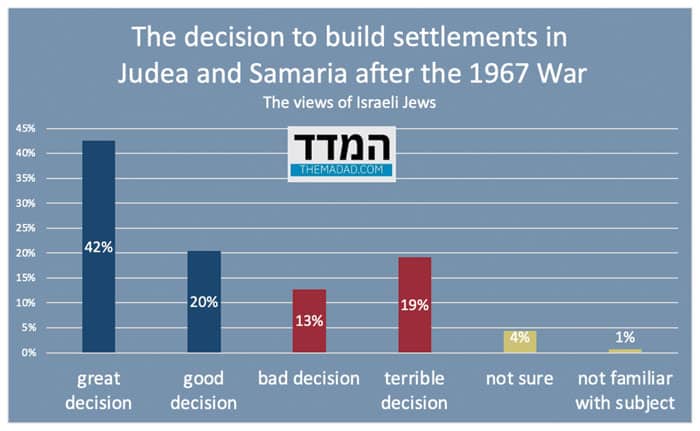
More from the Independence Day survey: 25 decisions in 75 years. 

A reader’s response:

Naomi Frank asks: “Do you think the coalition is going to fall?”

Answer: More likely – not soon. No coalition party has real incentive to initiate new elections (but you know… it’s politics and things could change fast). 


Shmuel Rosner is senior political editor. For more analysis of Israeli and international politics, visit Rosner’s Domain at jewishjournal.com/rosnersdomain.

Rosner’s Domain | Right Time for Deterrence Read More »