fbpx

April 14, 2023

Aaron’s Silence – Comments on Torah portion Shemini
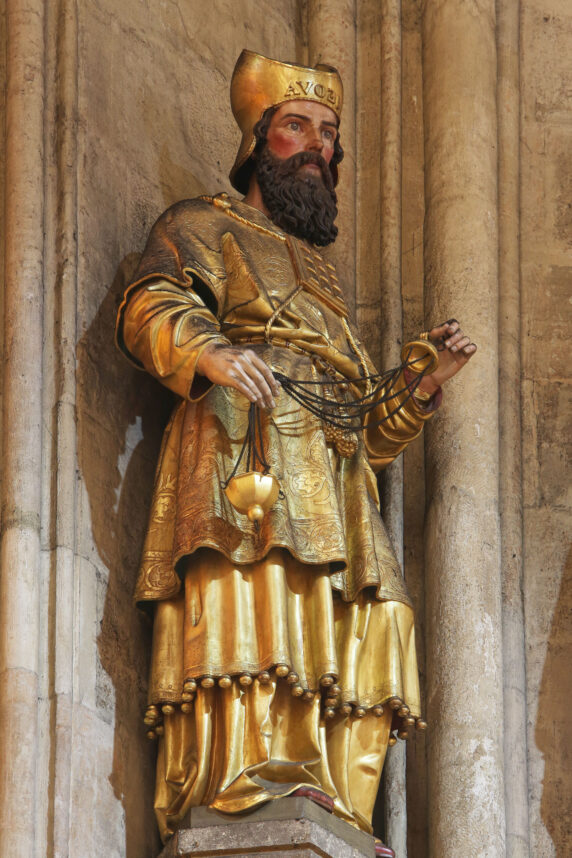
 

Aaron’s Silence

Comments on Torah Portion Shemini 2025

Please resist the temptation to moralize about the main narrative in our Torah portion, Shemini.

Two young men meet a sudden, tragic and horrific death in our Torah portion. They are burnt alive in their father’s presence. The event does not ask for a moral of the story. It asks for silence – shocked, stunned silence.

The scene is described tersely:

“Now Aaron’s sons Nadav and Avihu each took his fire pan, put fire in it, and laid incense on it, and they offered before Adonai alien fire, which God had not commanded them.

And fire came forth from Adonai and consumed them; thus they died in the presence of Adonai.”

Commentators for ages have asked, “Why did Nadav and Avihu concoct a ‘strange fire?’” and, “Was this enough of a reason for their being immolated by God?”

Most modern commentators draw a lesson in leadership. Nadav and Avihu, as sons of the High Priest, had an obligation to fulfill their tasks precisely as they were taught. They ought not be role models of “leaders can do anything they want,” but rather “leaders follow the rules.”

Most of you readers know that I avoid moralizing at a first pass when it comes to our holy texts, contrary to the modern focus on ethics as an interpretive tool. I start with reminding myself that this text from Leviticus 10 is literature, not journalism. The text is not an eyewitness report of what happened, but a literary creation by an author in a specific place and time, with a specific audience, with a specific concern. Literary authors are trying to tell us something about the world and ourselves.

I also remind myself to read the Bible as philosophic anthropology and not only as theology erthics. The Bible, in my mind, is far less concerned about what God does and is far more concerned with what humans do, especially as they provoke the God-character of the Bible. The biblical authors, I remind myself, often evince an uncanny psychological brilliance, asking us to seek the motivations for what people do in terse narratives such as this one. The Bible is also mythological and archetypal, discussing not what happened then, but what happens all the time. The Bible presents patterns of existence.

The Bible does not tell us the motivations of Nadav and Avihu in bringing their strange fire. For a moment, I want to avoid that question and the inevitable moralizing answers. Let’s leave it at this: minimally, they made a mistake. They got the ingredients or the measurements of sacred fire wrong.

Maximally, the young men played with the ingredients on purpose, but did not live long enough to tell us why they did so.

The text indicates to us that they did something wrong. But the text refuses to tell us why it was wrong, so wrong that the depiction of God in this chapter sets them aflame.

If their act was intentional, I will assume they did not predict what would happen next – that a fire would come from God and burn them alive. As far as I know, the laws of God up to this point had not covered alien fire to this degree. Maybe this was a special case, like the penalty for veering across the double yellow lines before the vehicle code was fully written out. And even so, what is the penalty for veering over the double yellow? How much does the ticket cost?  And what if, instead of correcting your course, you hit oncoming traffic. You break a traffic law that would usually just get you a ticket, but this time you kill someone. Who can be ready for the moment when a traffic infraction becomes negligent homicide?  I think we all have to be ready for that moment. In the wrong place and time, mis-measuring the incense might get you killed.

The slightest moment of inattention, an error that you might think of as insignificant, can have catastrophic consequences. We don’t know why these two young men did what they did, anywhere from inattention to being scofflaws. Whatever their mistake or intention was, they were set afire.

We readers are brought into the scene. What happens next?

Then Moses said to Aaron, “This is what Adonai meant when He said: ‘Through those near to Me I show Myself holy, and gain glory before all the people.’” And Aaron was silent.

What does that even mean? Moses is telling Aaron that God showed us God’s holiness just now, in this moment?  And gained glory before all the people?

If holiness here means “wholly Other” – then yes. An Other-ness far removed from the human condition of errors and sins. A holiness that is awesome but can also be awful.

“Gaining glory?” Does this mean we readers, through the narrative of Nadav and Avihu, have run, obliviously, into a core boundary of the glory of God? Are we being told that when we transgress certain things that God has not even told us about we could get killed?

Build a Molten Calf? Repentance is possible.

Bring unauthorized incense – okay now you hit the get-burnt-alive tripwire.

Whatever else this story is about, it is about jarring and painful mysteries.

***

What did these boys do and why did they do it?  What was it about “strange fire” that brought this reaction from the God image depicted here?  What did Moses mean by what he said? I don’t know and for a moment I don’t want to come up with an answer. I can’t think of any explanation or moral summation adequate for the story.

The only clear and understandable thing to me is “va-yidom Aharon” – “and Aaron was silent.”  Two of his children were killed before his eyes. Aaron perhaps believed he was going to bestow an incredible legacy upon his children, two of whom now lie smoldering.

I’ll venture this: Aaron did not know why this happened, and what his brother just said over the bodies was worse than meaningless. If Moses has a low point in the Bible, this is it.

I believe this little piece of literature is here to upset us. As we have seen many times before, the God of the Bible is dangerous and unpredictable. I think we should avoid for a moment the temptation to explain or moralize. We should allow ourselves to be shocked and dismayed, and then, for a moment, not to figure out what these boys did wrong or why God reacted as God did, but rather to think empathetically about Aaron’s broken heart.

Va-yidom” is a dark play on words. It means “and he was silent” and it can also mean “and he bled.” Bleeding silence.

A man just saw two of his sons suddenly die, right in front of his eyes. He does not want to hear us moralizing about what they did. Aaron is stuck – it is way too late to turn down the job of High Priest, even with this new information about what that job entails. He could not transfer out of this unit.

Moses orders Aaron to hold it together, not to mourn – the incense oil is still upon him. Aaron is still in his role. His persona right now is bigger than the bitter, silent bleeding heartbreak within. Every public person has been there – unspeakable suffering within that must stay silent – there is the role, and all the world is a stage.

Like any good literature, this narrative does not end with the clarity of one of Aesop’s fables. Whatever lessons there are to be learned about leadership are, in my mind, shadowed by the utter shock, Aaron’s unpermitted need to break down and cry, his aching realization of what things are like, what this job means, shadowed by Aaron’s guilt that his two sons maybe were not really fit for the job, but he got them the job anyway and it killed them.

I think that all the moralizing that goes on about Nadav and Avihu might be attempts not to face Aaron, not to allow him to finally cry, to break down in our arms.  If we felt his bleeding silence, we might feel what silently bleeds inside of us.

Aaron’s Silence – Comments on Torah portion Shemini Read More »
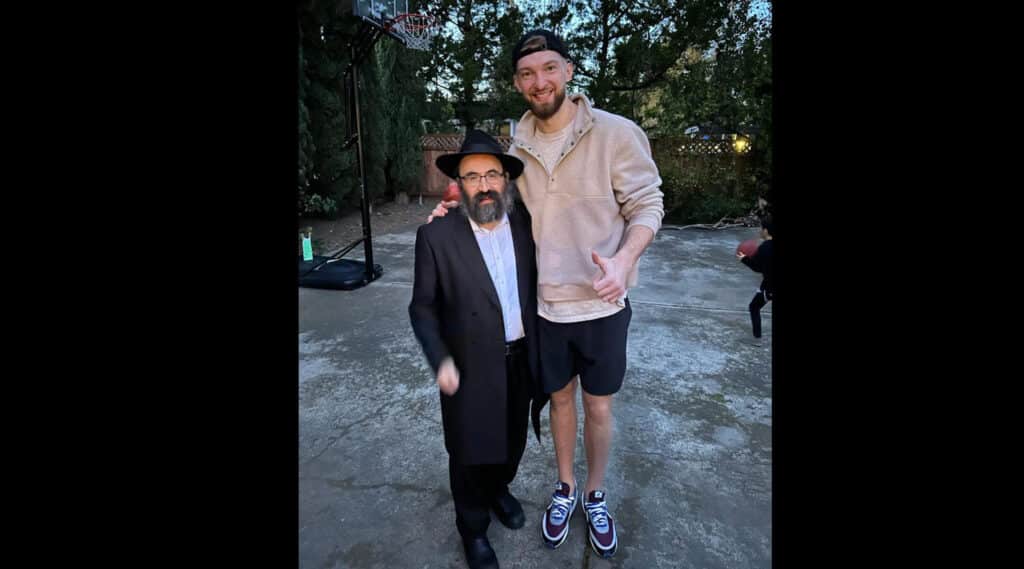
NBA Star Domantas Sabonis’ Wife Says He Is Converting to Judaism

When the Sacramento Kings face the Golden State Warriors in the first round of the NBA playoffs starting this weekend, they will be led by their Lithuanian-American — and soon-to-be-Jewish — center, Domantas Sabonis.

The 26-year-old All-Star is in the process of converting to Judaism, according to his Jewish wife, Shashana Sabonis (née Rosen). “We really haven’t talked about it [publicly],” she said in an interview this week. “He loves [Judaism] and really wants to be a part of it.”

Sabonis regularly studies on Zoom with Rabbi Erez Sherman of Sinai Temple in Los Angeles. Sherman, a Conservative rabbi who hosts the sports podcast “Rabbi on the Sidelines,” told J. that Sabonis is serious about learning more about Judaism.

“After [he had] a triple-double against the Houston Rockets, I get a text, like, ‘Hey can we find time to learn?’ I’m like, you’re for real,” Sherman said. “He’s always asking questions. He keeps kosher, and when he’s in Vilnius, he’s going to the kosher butchers to get chicken.”

While Sabonis is committed to his studies, his wife said, the demands of his job have made it impossible for him to commit to following all of the mitzvot. “He has to fly and he has to do those things, but he’s continuing his learning,” Shashana said. “We keep Passover, we keep Shabbat. We don’t drive, and we do Shabbat dinner every week.”

The couple were married by a Reform rabbi in August 2021. They have a year-old son named Tiger, and Shashana is pregnant with their second child.

They have a close relationship with Rabbi Mendy Cohen of Chabad of Sacramento, Shashana said. He put mezuzahs up at their house and recited the Megillah for them on Purim following the Kings game that night. Sabonis attended Chabad of Sacramento’s Purim party this year and signed autographs. In December, he sponsored a sufganiyot giveaway at a Kings home game.

Shashana, who grew up in Los Angeles and went to Jewish day schools, said her husband appreciates the support he has received from the Jewish community.

“People that follow me [on social media] see how we do the holidays and Shabbat, and I think it’s really fun for the Jewish community to see that representation in basketball,” she said.

There are two active Jewish players in the NBA and its developmental G League, Deni Avdija of the Washington Wizards and Ryan Turell of the Motor City Cruise. Former NBA player Amar’e Stoudemire stepped down last year as a Nets assistant coach after two seasons, citing conflicts with his religious observance. Stoudemire converted to Orthodox Judaism in 2020 after being raised in the Hebrew Israelite faith.

Sabonis, who is listed at 7-foot-1 and is the son of NBA Hall of Famer Arvydas Sabonis, had a breakout season in his second with the Kings, helping propel the team back to the playoffs for the first time in 16 seasons and ending the longest postseason drought in NBA history. He led the league in rebounds with 12.3 per game, while averaging 19.1 points per game, and he made his third All-Star team. He was drafted in 2016 and previously played for the Indiana Pacers and Oklahoma City Thunder.

Shashana said her husband is busy preparing for the Warriors series, which begins April 15 at Golden 1 Center in Sacramento, and was unavailable for an interview.

How does she think the Kings will fare against the defending champion Warriors?

“[The Kings] are going to win in six games,” she predicted. “We’re a really great team, and everybody is really determined to win.”


NBA Star Domantas Sabonis’ Wife Says He Is Converting to Judaism Read More »

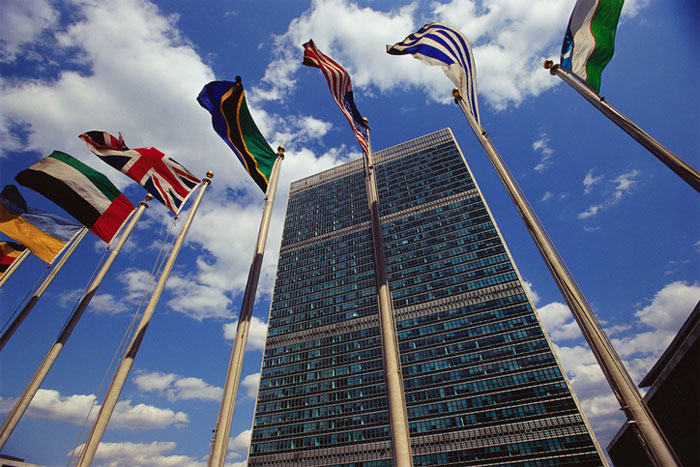
NGO Calls on UN to Fire Official Who Said Israel “Can’t Claim” Self-Defense

The International Legal Forum (ILF), an Israel-based NGO of 4,000 lawyers, issued a letter to the United Nations calling on the international body to fire Special Rapporteur for the West Bank and Gaza Strip Francesca Albanese over her recent comments regarding Israel’s right to self-defense.

The ILF wrote in their April 11 letter to the UN, which was obtained by the Journal, “Following the terrorist murder of an Italian tourist, Allesandro Parini (35), and British-Israeli sisters Rena (20) and Maya (15) Dee, Ms. Albanese explicitly and inexcusably, said that Israel does not have a right to self-defense against Palestinian terror, thereby directly endorsing the murder of Israeli civilians, including children. She has only further reiterated this position since. It is unfathomable that such a statement would ever be made by a UN representative, but this is just the latest in Ms. Albanese’s relentless, systematic and unhinged bias against Israel.” Albanese had tweeted, “The loss of life in the [Occupied Palestinian Territory] & Israel is devastating, especially at a time that should be of peace for all, Christians, Jews, Muslims. Israel has a right to defend itself, but can’t claim it when it comes to the people it oppresses/whose lands it colonizes.” After critics argued that Albanese had said that Israel didn’t have a right to defend itself, Albanese claimed to have been taken out of context, tweeting: “Israel justifies its repression of Palestinians as ‘self-defense.’ However, self-defense can’t be used as a blanket claim when the repression has mainly served to perpetuate the military occupation in West Bank/Jerusalem/Gaza, denying Palestinians their rights for 56 [years].”

The ILF argued in their letter that Albanese’s past comments––including her use of the term “Jewish lobby,” comparing Israel to the Nazis and telling a Hamas terror group conference in November 2022 that they “have the right to resist”–– and support for the Boycott, Divestment and Sanctions (BDS) movement shows that she “has a long history of antisemitism and virulent bias.” “As long as Ms. Albanese remains in this role and her entirely one-sided mandate is not removed altogether, antisemitism will continue to ravage your institution, while full equality and respect afforded to all UN member states, will remain to be denied to the one and only Jewish state, Israel,” the ILF wrote. “We therefore call on you to ensure that the UN lives up to its own rules and standards, and to send a clear message that antisemitism and endorsement of violence will not be tolerated at the United Nations, by dismissing Ms. Albanese and abolishing her position entirely.”

Albanese tweeted that she was “unfazed” by the ILF letter because, in her view, she was simply “stating basic [international] law principles, nor the immorality of some of its masterminds. What goes around comes around. I can’t be distracted. I must stay focused on my human rights work & the people under occupation, besieged & repressed.”

The Palestinian Ministry of Foreign Affairs also defended Albanese, tweeting that they were disappointed more people globally haven’t denounced “the malicious campaigns against the United Nations and its personnel, including the UN Special Rapporteur [Francesca Albanese].” The ministry also thanked Albanese “and all other human rights experts and defenders for upholding their mandates and advancing accountability for the sake of justice.” ILF CEO Arsen Ostrovsky tweeted that the fact that the Palestinian ministry is defending her is “quite telling.”


NGO Calls on UN to Fire Official Who Said Israel “Can’t Claim” Self-Defense Read More »

The Valley of Hinnom

R’ Yermiyah ben Elazar said: There are three entrances to Gehinnom. One in the wilderness, one in the sea and one in Jerusalem. (Eruvin 19a)

The hills of hell are green in spring, dotted
with plum and almond trees whose blossoms
cover scars, dug into muddy soil by bulldozers
slowly merging from both sides
Orange fences now wind through the terrain
like salamanders, where in late summer
sunflowers turned their faces toward me
as I walked to the bottom of the valley
where the light didn’t reach and it was very hot
like in a well of fire
where I wanted to forget what I could not
what I could only lay to rest in the caverns
facing Mount Zion that stands firm

No one here forgets anything

The meadows bleed like wet walls in a scaly house
where yellowed plaster flakes along the tiles’ edge
Can life burst forth from a stump?
6000 houses
6000 windows
6000 jugs of bitterness
In desolate places I have given birth to straw
and the shepherd’s speech has fallen silent
And yet it rains, has stormed, a lot, enough
to graze flocks in the wilderness
At night, green lights dot the opaque valley
facing Mount Zion that cannot be moved

Everyone here waits for a version of redemption

The Valley of Hinnom Read More »

Big Sunday Gala; Federation, Spago Seders; Meltzer Honored

Community nonprofit Big Sunday held its eighth annual gala, celebrating 24 years of the organization’s work promoting volunteerism as well as four distinguished honorees.

The March 23 event at the Candela La Brea honored Marc Canter of iconic Canter’s Deli; Emmy-winning writer and producer Lauren Pomerantz; actor Elizabeth Higgins Clark; and live entertainment company Live Nation.

Each of the honorees has contributed to Big Sunday’s mission of connecting people through helping and opportunities to volunteer. Canter’s Deli has provided food for thousands of people at countless Big Sunday events; Pomerantz and Higgins Clark supported Big Sunday relief efforts during the pandemic; and Live Nation has provided financial support.

“We have such wonderful honorees, and it’s a great way to celebrate an amazing year for Big Sunday, while kicking off a new one!” Big Sunday founder and executive director David Levinson said.

Big Sunday—which was launched in 1999—grew out of a mitzvah day event at Temple Israel of Hollywood. It is one of the country’s foremost organizations dedicated to encouraging people of all ages and backgrounds to volunteer.


Attendees of the Jewish Federation’s recent interfaith seder included (from left) L.A. Federation President Rabbi Noah Farkas; Federation Chair Orna Wolens; L.A. Mayor Karen Bass; County Supervisor Holly Mitchell; and Mary Kohav, vice president of JEDI and community engagement at the Federation. Courtesy of Jewish Federation of Greater Los Angeles
On the second night of Passover, the West Los Angeles Children’s Choir performs at Spago’s annual interfaith seder in Beverly Hills before a crowd of nearly 300 guests. Photo by Ryan Torok

In celebration of Passover, the Jewish Federation of Greater Los Angeles held an interfaith freedom seder in Culver City.

Drawing Federation leaders, elected officials and others, the April 3 event at the Wende Museum was held in partnership with the office of L.A. County Supervisor Holly Mitchell and included a conversation on overcoming historic and modern-day oppression.

People from multiple communities and faith backgrounds turned out to learn about the universal themes derived from the Exodus story. They also enjoyed self-guided tours of the museum’s exhibition, “Vietnam in Transition,” along with a dinner showcasing the diversity of the city.


Barbara Meltzer. Courtesy of Meltzer

Southern California Congressman Adam Schiff announced that West Hollywood resident Barbara Meltzer was among the 16 outstanding women from California’s 30th district—Schiff’s district—being recognized as a 2023 Woman of the Year.

Expressing his admiration for the honorees, Schiff said, “The 2023 Woman of the Year honorees are an inspiration to their communities for their passion and dedication to service. These women are not just leaders in their fields of work, but in their communities making our home a better place for all.”

“I am thrilled to have been given this honor by a person I so highly admire and respect,” Meltzer said. “The work that I do is in service of others without thought of awards, but it does feel quite wonderful to have received this.”

Throughout her career, Meltzer worked for entertainment companies including NBC before opening her own public relations and marketing firm. Her civic engagement efforts have focused on supporting people over the age of 50, and she has served on the Los Angeles County Commission for Older Adults. She is passionate about creating age-friendly communities.

Big Sunday Gala; Federation, Spago Seders; Meltzer Honored Read More »

Healthy Kugel Makeover: Reinventing Bubbe’s Traditional Kugel

Lokshen kugel has been around for generations. 

This version from amateur chef Eric Dolgin is the perfect comfort food for spring, after Passover ends. A practicing physician by day, Dolgin wanted to create a healthy-style kugel worthy of his Bubbe’s sweet-custardy recipe.

“My extreme makeover of the noodle dish was designed to retain all of the gooey-goodness, but rely on rarely used, healthy ingredients,” Dolgin told the Journal.

Dolgin figured he could modernize the old world Jewish dish, and keep it gluten-free, by using almond noodles. To ensure the gooey goodness of traditional kugel, while improving the nutritional value, he decided to boil the almond noodles in naturally sweetened non-dairy milks. 

The chef’s three-berry sweet-style kugel dish incorporates many of his bubbe’s favorite ingredients, such as a multitude of eggs, along with vanilla, cinnamon and rum-soaked raisins. His mushroom kugel recipe has a similar base, and is a delicious savory version.

When asked about his artisanal approach to kugel, Dolgin emphasized the importance of handing down age-old traditions through the centuries.

“My recipes are designed to duplicate the richness in flavor and texture of the original dishes, but without the unhealthy obvious sweeteners,” Dolgin said. “It’s obvious to a health-minded chef that organically produced whole foods bring more than just sweetness to a recipe.”

Photo courtesy Sherry Klinger

Three-Berry Kugel

2 packages of Capellas almond noodles
2 cans coconut milk
2 cans coconut cream
1/4 cup plain, unsweetened almond milk
1 dropper liquid stevia
1 cup rum soaked white or red raisins
6 eggs, beaten
1 orange and 1 lemon, zested
3 Tbsp maple syrup (sweeten
to taste)
½ cup toasted pecans, chopped
pinch of salt
1 Tbsp vanilla extract
1 Tbsp cinnamon
½ tsp allspice
½ tsp nutmeg
selection of 3 berries: 1 carton each:
blueberries, blackberries and
raspberries (feel free to vary the type
and amount of berries)
Butter or oil a large (appox 13 x 9) casserole dish.
Put the raisins and rum in a small pan and heat them over a low flame until hydrated.
Pour the coconut milk and cream in a saucepan and bring to a gentle boil. Add ¼ cup almond milk, if necessary for desired consistency.
Pour cooked noodles and coconut liquid into a casserole dish together (nothing goes to waste).
Allow the mixture to cool (don’t shortcut cooling time or eggs could scramble).
Mix together beaten eggs, maple syrup, stevia, spices, zest, and raisins with rum liquid for hydrating raisins.
Pour mixture over the noodles, but do not mix them yet.
Pour the berries on top of the noodle/liquid mixture.
Gently mix in all ingredients with a gloved hand.
Cook at 350°F for 40 minutes. Then cover with a foil tent and cook for another 15 minutes until the middle appears cooked.
Perfect for preparing a day ahead of the Seder. Ingredients will taste even more flavorful!

Mushroom Kugel

1.5 packages of Capella’s almond noodles
2 packages of mushrooms or equivalent
½ cup shredded parmesan cheese
1 can coconut cream
1 can coconut milk
4-8 oz. plain, unsweetened almond milk
3 eggs
1-2 oz dry sherry
1 Tbsp and 1 1/2 tsp Mushroom bullion
½ tsp salt
1 tsp thyme
2 Tbsp parsley
¼ tsp fresh nutmeg
½ tsp onion powder
Garlic to taste; I use 2-3 cloves, minced
and sautéed

Grease an 8 x 11 inch baking dish.
Sauté thinly sliced mushrooms in olive oil (add dry sherry to finish).
Pour coconut milk and cream in a saucepan and bring to a gentle boil. Cook the noodles and add almond milk, if necessary.
Pour cooked noodles and cooking liquid in casserole dish
Allow noodles and liquid to cool; do not shortcut the cooling process. Pour coconut milk/cream into a large mixing bowl.
Blend bouillon, remaining almond milk, coconut milk/cream cooking liquid and sherry until dissolved. Add salt, seasonings, pepper and eggs. Then buzz again in the blender until mixed.
Add 1 cup of mushrooms in the blender with the above liquid and buzz on low speed until the mushrooms are in small pieces (~ 2 mm).
Once noodles and liquid are cooled (to avoid cooking the eggs), pour liquid from the blender over the noodles.
Gently fold in the remaining mushrooms with the liquid and noodles in the casserole dish.
Bake at 350°F for 35 to 40 minutes or until golden brown.

Healthy Kugel Makeover: Reinventing Bubbe’s Traditional Kugel Read More »

A Free Man Instilling Pride in Jews

When Ben Freeman was growing up in his hometown of Glasgow, Scotland, he frequently faced antisemitism. 

“In middle school, I was told by a non-Jewish boy that being Jewish made me abnormal,” he told the Journal. “I was also asked by a friend to borrow money as we walked home from school. When I responded that I had no money, he said, ‘But all Jews are rich.’”

Unfortunately, these incidents weren’t isolated. While in university, Freeman’s peers and professors made anti-Zionist comments, and left-wing anti-Israel protests would become so violent that there was often a police presence at Jewish and Israel-themed events. Years later, when Freeman criticized Jeremy Corbyn, the leader of the British Labour Party who failed to confront antisemitism within his own party, Corbyn’s followers doxxed him.

“They contacted the school I worked at in Hong Kong for six years, where I taught the Holocaust and Jewish studies at various institutions, and tried to get me fired,” Freeman said.

Even though Freeman has experienced so much antisemitism, that doesn’t stop him from being proud of his Judaism. In his small community in Glasgow – which is home to 4,000 Jews today – he learned to stand up for himself.

“My parents had to work incredibly hard to instill a strong Jewish identity in me and my siblings, and that effort is what made me the proud Jew I am today,” he said. “I think sometimes Jews are more committed to their Jewishness when it is harder to be Jewish. This was certainly my experience.”

Now, Freeman speaks at Jewish organizations and posts about Jewish topics on his Twitter and Instagram pages, where he has large followings. He currently lives in London and focuses on antisemitism and anti-Zionism within the UK, where they have reached record levels.

“My mother experienced horrendous Jew hate in the UK, even at work in the NHS, the national health service, where she worked as a dietician,” he said. “Corbyn helped unleash Jew hate into the center of political and social life in the UK, which has since spread to the U.S., among other places.” 

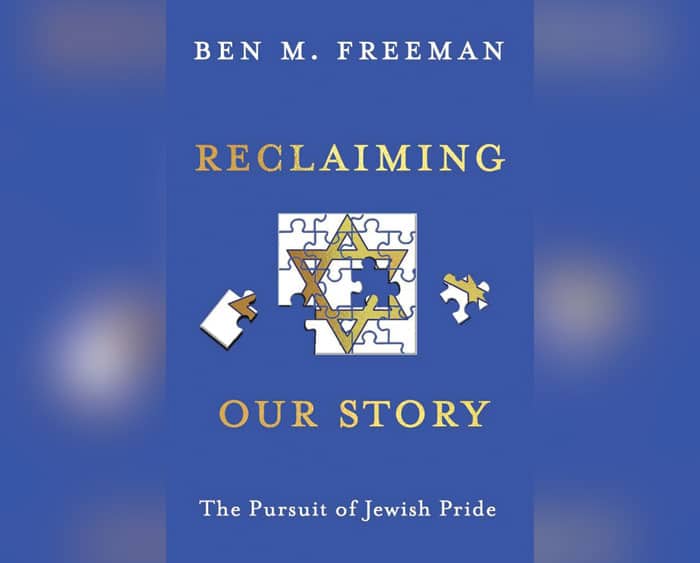
In August of last year, Freeman released his book “Reclaiming Our Story: The Pursuit of Jewish Pride,” which explores how Jew hatred has impacted the community throughout history and Jews have internalized this prejudice. The book also inspires Jews to reclaim their Jewish stories and have pride in their identities.

“Pride teaches us that we have value, and that we should not be treated in the way that we are,” he said. “Jewish pride is the most effective way to fight Jew-hate, because it empowers Jews to stand up and fight and to encourage our allies by being able to share our experiences. We should not be afraid to center ourselves in our own stories.”

In response to antisemitism, Freeman encourages Jews to stand up for themselves. It’s not effective to ignore it and hope it just goes away. 

“I heard high-profile Jews say we should keep quiet about Kanye in case he gets canceled, which would then be used as a kind of proof Jewish power,” he said. “That is an atrocious attitude. We must fight back.” 

Freeman’s point is that Jews have done nothing to deserve the treatment they’ve experienced throughout time. And Jews should never be ashamed of who they are. 

“We must live Jewish lives,” he said. “I see Jewishness as a great buffet table. It is loaded with Jewish goodies, which represent Jewish action, and each of us must get off our seats and choose something from the table. We may all choose slightly different combinations of Jewishness to engage in, and that is OK. Our community has and will always have great diversity, which is our strength. But we have to choose from the Jewish table.”

Freeman, who is in his 30s, believes that the Jewish community can encourage the younger generation to be proud by telling Jewish stories.

“As Jews, we are part of a much greater story, something bigger than us, and we have to help our young people understand that.” 
– Ben Freeman 

“As Jews, we are part of a much greater story, something bigger than us, and we have to help our young people understand that,” he said. “Similarly with Israel, we have to help people understand what we mean when we refer to it as ‘the promised land.’ What we really mean is that it is our indigenous land and that we have indigenous rights there, meaning we have the right to self-determination in it.”

By teaching pride to the Jewish community, Freeman said it could help Jews withstand the increasing hate from the world around them. 

“Being Jewish is a wonderful thing,” he said. “It’s my life’s work to help all Jews see that.”

A Free Man Instilling Pride in Jews Read More »

Second Documentary About Team Israel May Be Better Than The First

“We’re not going to the Olympics because we’re crap,” Danny Valenica says in the new film “Israel Heads for Gold.” The sequel to “Heading Home: The Tale of Team Israel” may be even better than the first because we see the vulnerability and commitment of those involved.

While the first film celebrated the Cinderella story of Team Israel’s improbable run in the 2017 World Baseball Classic, this film shows how the team was still a huge underdog in the Tokyo Olympics and explains why Valencia, a utility player who hit 18 homers for the Blue Jays in 2015, and played for several MLB teams, made the comment.

You will cheer when Valencia later crushes a key home run to left field.

There’s a lot to unpack in this movie, as it has moments of humor, gravity, the surreal and the unreal.

A clip shows Anke Spitzer at one point bashing the International Olympic Committee for not having a moment of silence for the group of 11 Israeli athletes/coaches who were murdered by terrorists in the 1972 Munich Olympics. Ankie’s husband, Andre was a fencing coach who was killed. The film shows that in the 2020 Tokyo Olympics, (the games were played in 2001 due to Covid)  and there finally was a moment of silence for the athletes who were murdered.

It is unclear if Spitzer’s previous comments had any impact.

“I think it was very meaningful to finally have a moment of silence and it meant a lot to the players,” director Daniel A. Miller told the Journal.

The film also shows how for this Olympics, flags of all countries were posted outside their living quarters, including the Israeli flag for Team Israel.

The majority of footage comes from players filming themselves as the directors were not allowed to come and be in their rooms due to Covid restrictions.

“That’s definitely something different from what we’re not used to,” Miller said. “But in a way, it allowed us to have more interesting and intimate moments that we might have otherwise had.”

There’s a funny moment, when most of the uniforms don’t fit and the day before the first game, they all line up, hoping Japanese tailors can fix their uniforms in time.

There is a pin exchange, where due to comradery, athletes exchange pins, but two athlete from England are not interested in engaging Israeli athletes. There’s the reality that the security includes factual recognition for the players to get to their rooms. Then there’s the unreal- Ben Wagner, an outfielder for Team Israel made a TikTok video to see how many players jumping on the beds made of cardboard would crush it. The number was nine. It was a funny video, and nobody with a brain would take offense. And yet, it became an international story with fools and possible antisemites posting online that the team should be sent home for this video. Wagner posted an apology and there was even an ESPN article about it.

“The players regretted making the video but there was no bad intent, and I don’t think anyone expected such a reaction,” Miller said, of what some players called “Bed-Gate.”

There’s a clip of Jewish actor Paul Rudd wishing the team well, saying they are “bad-asses.” The team has great success in Bulgaria, Lithuania and Germany and is one of six teams to be in the Olympics. There’s controversy, as in a 5-5 game against the Dominican Republic, Jose Bautista clearly strikes out on a curveball, but the umpire calls it a ball. There’s a great moment when Shlomo Lipetz, inducting former Met Todd Frazier into a double play. Lipetz is the coolest cat in the film and is alos the pitcher who gets the last out in the qualifying game for the Olympics. The relief pitcher, who was born in Israel, talks about how he’s aware “of the animosity that exists towards us.”

There’s a surreal moment when players are getting their Israeli citizenship and are told that Hamas has fired rockets into Israel.

There’s a surreal moment when players are getting their Israeli citizenship and are told that Hamas has fired rockets into Israel. General manager Peter Kurz tells the players of the attacks and talks about the importance of knowing where the “safe room” is.

Team Israel’s Blake Gailen seems surprised.

“That would be a big deal if a missile landed by Santa Monica Pier,” says the player, who grew up in West Hills, California.

There’s a moment where you may cry, as a player from Team Israel visits with Nathaniel Felber, a former Israeli soldier who was shot by a terrorist.  He gets a Team Israel shirt and squeezes the hand of the player.

We see people protesting the team, yelling “Free, Free Palestine.” 

One player talks bluntly about how Israelis don’t know much about baseball but there is the hope that the media attention from the team will make it become more popular. In the recent WBC, the team had a dramatic victory over Nicaragua, before falling in a perfect game losing soundly to other teams in Pool D, though there was a great moment when Orthodox pitcher Jacob Steinmetz struck out Manny Machado on a slider and blew a fastball by Juan Soto.

Miller said he was excited by the victory and said the truth of sports is that there are both great victories and difficult defeats. Yet in this WBC, it was clear the talent level of others team was far superior, with teams boasting multiple MLB All-Stars.

The film is inspiring, powerful and hits all the right notes, even though there is a bittersweet feeling when the team loses. It’s also sad to hear that France has decided to have breakdancing instead of baseball in the 2024 Olympics in Paris. So, for many of the players, some who are former Major Leaguers, and were never stars, it’s their last ride and your heart goes out to them. But at least their experience was recorded in a memorable film.

The film, which is also directed by Sthe Kramer and Jeremy Newberger, and by Menemsha Films, includes a clip of the late Rabbi Jonathan Sacks, who was the chief rabbi of England saying that “No Jew who is a true Jew can ever give up hope.”

Second Documentary About Team Israel May Be Better Than The First Read More »

Louise Palanker and Her Media Path

Louise Palanker has been podcasting since 2005. The radio veteran hopes her fifth podcast — the “Media Path,” which she co-hosts with Fritz Coleman, KNBC’s weather reporter for nearly 40 years — may be the charm.

With more than 100 episodes, “Media Path” explores “the deep dives we take into films, books, TV and music when we become obsessed with a given topic.” On each episode, Coleman and Palanker take listeners on a journey down a new path of remembering, learning and reevaluating shared memories and histories.

“It’s very rewarding,” Palanker told the Journal. Palanker and Coleman see it as a gift to get to know their guests and then interview them. 

“We wouldn’t have an author on without first reading the book, or we wouldn’t have a filmmaker on without first seeing the film,” she said. “I think our guests enjoy the conversations because people feel more like themselves when they know that you know them.” 

Media Path’s eclectic guests range from television legend Henry Winkler to congressional leader United States Representative Adam Schiff (D-Burbank). Every show, which is released on video as well as audio, includes a discussion of current cultural events and recommendations from the hosts, as well as extended, deep-dive discussions with figures who have had meaningful and memorable impact on the media world.   

Palanker said that when she and Fritz met, they just clicked. He was her dream podcasting partner. However, it wasn’t until he retired from doing the weather two years ago that he was able to explore podcasting. “He was contractually obligated not to discuss anything other than the weather, outside of his weather job, because you certainly don’t want your weatherman out there selling donuts or something,” she said.

Palanker, a cofounder of Premiere Radio Networks (now a division of iHeartMedia), has been producing radio entertainment for decades. A writer, producer, director, comedian, filmmaker, photographer, songwriter and drummer, her previous podcasts include “Weezy and The Swish,” “Talk It Over,” “Journals Out Loud” and “Things I Found Online.” 

The granddaughter of immigrants (second generation), Palanker grew up in Buffalo, New York, and now splits her time between Los Angeles and Santa Barbara with her husband, attorney Ron Zonen. 

Palanker and Zonen are involved with the Jewish Federation in Santa Barbara. After interviewing Holocaust survivors about 15 years ago, she made her first film, “We Played Marbles: Remembering a Stolen Childhood.” She also made the 2019 documentary, “Margaret Singer: Seeking Light,” featuring local artist and Holocaust survivor Margaret Singer, which was selected  by the Santa Barbara International Film Festival. Singer got to see it with her community mere months before she passed away.

“I always wanted to be in the entertainment business, but nobody in Buffalo is, so there’s really no one to ask,” Palanker said. “And it’s not something that you even want to say out loud, because it sounds kind of silly. Also it was pretty clear to me by the age of 10 that I wasn’t particularly good at singing or acting, even though I tried.” 

Palanker wasn’t sure of her other options: “What else was there to do in entertainment?” She would have to grow up and figure it out. 

After staying on the East Coast for college, Palanker told her family she wanted to go to Los Angeles for grad school, knowing that as soon as she got situated, she would figure out how to get into show business.

Her cousins, who went to UCLA, would write down the internships listed on the job board at school, and give them to Palanker. Those internships led Panaker to securing a job as a studio page (an usher for the studio audiences that come to tapings). After a year, that led to a job on a show called “PM Magazine,” where she came to the attention of Rick Dees, the Los Angeles disc jockey best known for 1976’s chart-topping novelty hit, “Disco Duck.” 

“He liked the way I wrote, and he offered me a job writing his new syndicated radio show, called ‘The Rick Dees Weekly Top 40,’” Palanker said. That led to her meeting her Premier Radio partners and “the rest is history.”

When asked how her Jewish background has impacted her storytelling path, Palanker said, “It could be hereditary or it could just be generations of sharing stories.” 

When asked how her Jewish background has impacted her storytelling path, Palanker said, “It could be hereditary or it could just be generations of sharing stories.” 

She explained how when our ancestors were on the run, all they had was their identity, their memories and what’s been handed down. In any ethnicity or any cultural background, it becomes what creates you or what formed the basis of your sense of identity.

“For Jewish people it has been perseverance, love, knowledge, wisdom and becoming lifelong learners,” she said. “[We] celebrate knowledge and the sharing of information and humor. And that is how we persevere.” 

Palanker believes it’s a part of who we are. “If you meet someone and you learn that they’re Jewish, you just know a certain amount about each other with it being unsaid, and I’m sure that’s the way with every cultural identity,” she said. “With ours it’s both a religion and an ethnicity, so it runs deep. We’re definitely very funny, loving storytellers. So I know that informs me in every possible way.”

Louise Palanker and Her Media Path Read More »

Lost Luggage: A Lesson on Worrying

Recently, while I was traveling with my family, the airline lost my baggage. My husband Daniel and I waited at baggage claim for our luggage but when the last piece dropped onto the carousel, it wasn’t ours. We went to the service desk, confident it was there … and it wasn’t. It was lost in a foreign country. They told us the tag must have slipped off. They repeatedly reassured us that they would find our black bag. Our bag was maroon. 

I immediately began panicking. There were priceless items in that bag. There were things I needed right away. The airline seemed like they didn’t have a clue what was going on. Were my things lost forever? 

I broke out into a sweat trying to remember everything I had packed. I went through the scenarios in my head and tried to figure out how I’d replace my belongings. Was I going to have to fight with the airline for reimbursement? The more I thought about it, the more my heart raced. I was working myself up into a frenzy. 

And then, I got ahold of myself. I remembered: I believe in God.

As a believer, I know that everything happens for a reason, even if I don’t understand it. But being the logical person I am, I started coming up with possible reasons. 

Daniel and I had trouble carrying all of our bags and pushing our two young daughters in their strollers. Perhaps God wanted to take the load off of us and personally deliver our luggage to our house. 

Or, maybe in the future, my luggage is going to get lost again. If it happens now, I will know not to put priceless things in it the next time around. I will also get baggage insurance to prevent any further loss. 

If anything, I thought, God was testing me to see if my faith was strong enough to survive losing a bag. I was determined to pass the test.  

In the grand scheme of things, this wasn’t a big deal. I was safe and healthy and so was my family. We’d had a nice vacation, and aside from losing the bag, we were fine. I visualized being reunited with my bag the next day in Los Angeles. I thought about going through my things and putting them back in my drawers and storing my luggage in my garage. 

I pushed the negative thoughts out of my head and I stopped worrying. I knew that worrying wouldn’t do me any good. 

For the next day, I spent hours on the phone with the airline to figure out where the bag was. I unpacked my other luggage and didn’t think about my bag. I prayed to God multiple times that it would be returned to us. At the end of the day, I was told that my luggage was on the next flight to LA. Around midnight, Daniel went to LAX and got the bag. When I was reunited with my luggage, after 48 hours apart, I literally hugged some of the more precious items. I thanked God over and over.

I was so glad that I stopped myself from worrying those entire 48 hours. I freed up so much space in my head. I saved so much time. And, most importantly, I strengthened my faith. 

I was so glad that I stopped myself from worrying those entire 48 hours. I freed up so much space in my head. I saved so much time. And, most importantly, I strengthened my faith. 

God taught me a powerful lesson. There is no use in worrying, because I don’t have control over the outcome. Only God does. And whatever the outcome is, it’s for the best. I know that He’s controlling the show, and I’m only along for the ride. 

I once saw a picture that said if you go through school with anxiety, you’re going to work with anxiety, date with anxiety, be married with anxiety, have kids with anxiety, etc. It never ends. Or, you could stop being anxious, not worry, put your faith in God and live. 

I choose to live.

Want to share a story about faith with me? Email me at Kylieol@JewishJournal.com


Kylie Ora Lobell is the Community Editor of the Jewish Journal 

Lost Luggage: A Lesson on Worrying Read More »