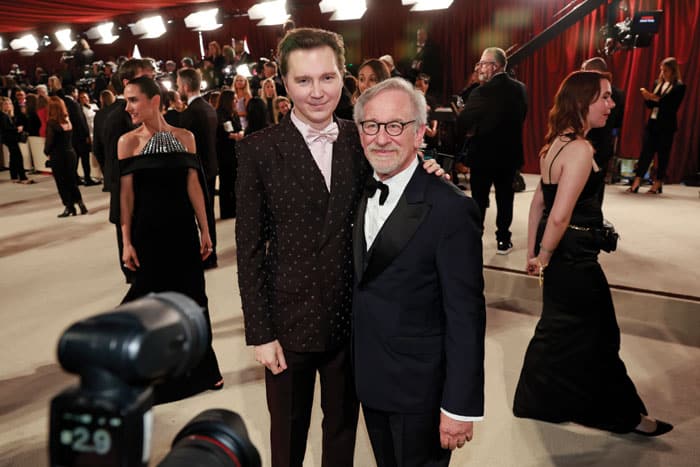
With seven nominations for his most personal film ever, this could have been Steven Spielberg’s biggest year at the Academy Awards. But the hot-dog fingers had other plans.
“The Fabelmans,” the director’s highly personal dramatization of his Jewish upbringing, didn’t win a single one of the Oscars it was nominated for Sunday night. Spielberg’s film lost out on the biggest categories, including best picture, director, actress, and original screenplay, all to the same movie: chaos-theory multiverse comedy “Everything Everywhere All At Once,” where the aforementioned hot-dog fingers play a starring role.
But while the most Jewish movie came up empty-handed, other Jewish stories played out on the movies’ biggest night. Here’s what you need to know.
Spielberg’s autobiographical opus may have come up empty-handed Sunday, but it got a booby prize: “The Fabelmans” was host Jimmy Kimmel’s favorite punchline.
‘Fabelmans’ follies
Spielberg’s autobiographical opus may have come up empty-handed Sunday, but it got a booby prize: “The Fabelmans” was host Jimmy Kimmel’s favorite punchline. Kimmel used his monologue to drop a series of jokes about the film, including dubbing Spielberg and star Seth Rogen “the Joe and Hunter Biden of Hollywood”; speculating that nominated co-star Judd Hirsch was actually absentee Tom Cruise in a mask; and warning anyone plotting to slap him Will Smith-style, “You’re gonna have to go through the Fabelman to get to me.”
Later, Kimmel kept up the bit, introducing Paul Dano and Julia Louis-Dreyfus to present an award. Kimmel billed them as “Steven Spielberg’s dad and Jonah Hill’s mom,” referencing not only Dano’s role in “The Fabelmans,” but also Louis-Dreyfus’ part as a clueless white Jewish mother in the much-maligned Netflix film “You People.”
Getting loud for ‘All Quiet’
“All Quiet on the Western Front,” Netflix’s grueling drama about German soldiers on the frontlines of World War I, ended the night with four Oscars: international feature film, original score, cinematography and production design. In addition to having a Jewish producer, the movie was also adapted from a novel and 1930 film that both met the ire of the Nazi party and were tarred as Jewish plots to destroy the German state.
Another anti-dictator winner on Sunday was “Guillermo Del Toro’s Pinocchio,” which won the animated feature Oscar. Set in Fascist Italy, the Netflix film features a scene of Pinocchio mocking Il Duce himself, Benito Mussolini.
A Jewish ‘Goonies brother for life’
One of the most heartwarming moments of the evening was the best supporting actor win for Ke Huy Quan for “Everything Everywhere All At Once.” Quan, a former child actor, had abandoned his onscreen career for decades before his big comeback role last year. In his emotional acceptance speech, Quan gave a special shout-out to “my ‘Goonies’ brother for life,” Jeff Cohen — a Jewish former child star turned entertainment lawyer. Cohen and Quan appeared in “The Goonies” together in 1985, and when Quan landed his big “Everything Everywhere” role, Cohen negotiated the terms of his deal.
Jamie Lee Curtis and Sarah Polley
There were a couple big-name Oscar winners with Jewish parents. Immediately after Quan’s big moment, veteran actress Jamie Lee Curtis picked up her first-ever Oscar, also for “Everything Everywhere.” It was also a big moment for the “Halloween” star. “My mother and my father were both nominated for Oscars in different categories,” Curtis noted during her speech. Tony Curtis, Jamie Lee’s Jewish father, was one of the biggest stars of Golden Age Hollywood yet received only one Oscar nomination, in 1959 for “The Defiant Ones.” Jamie Lee Curtis is involved in restoring the synagogue in her grandparents’ Hungarian hometown, where no Jews now live.
Another winner with a Jewish father: the writer-director-actor Sarah Polley, who won best adapted screenplay for “Women Talking.” Polley explored the secret of her biological parentage in her 2013 documentary “Stories We Tell.” “Women Talking” is set inside a different religious community: an isolated Mennonite society in which the women have been systematically, sexually abused by the men.
Navalny and the neo-Nazis
The winner for best documentary went to a profile of Russian opposition leader Alexei Navalny, whose 2020 poisoning by KGB agents after he publicly criticized Vladimir Putin was an international scandal. Navalny is currently imprisoned in Russian solitary confinement; the filmmakers dedicated the award to him. The documentary also details an aspect of Navalny’s campaign more controversial to Western observers: his onetime support of the “Russian march,” a gathering of Russian neo-Nazi organizations.
Diane Warren’s no-win situation
Did you know the songwriter Diane Warren is a 14-time Academy Award nominee? Singer Sofia Carson reminded everyone in the middle of the evening’s first performance for best original song. Warren, who is Jewish, joined in the performance of “Applause,” her composition from the feminist documentary “Tell It Like A Woman.” She has never won an Oscar, and unfortunately for her, the streak continued Sunday night as the viral sensation “Naatu Naatu,” from the Indian film “RRR,” took the prize. (As a consolation, Warren received an honorary Oscar at the Governor’s Awards preceding the telecast.)
Another Jew-ish shutout
Also drawing blanks was “Tár,” the cerebral classical-music psychological drama with somewhat inexplicable Jewish themes.
Hollywood’s Jewish history gets a nod
The broadcast included a promotional video for the Academy Museum, which opened last year to celebrate the history of Hollywood. In the video, a curator named Dara Jaffe explains that one of the museum’s roles is to “bring important film histories to light, from the Jewish immigrants who founded the Hollywood studios to the early innovators of African-American cinema.” The inclusion is notable because the museum drew steep criticism when it first opened for giving short shrift to the industry’s robust Jewish history; Jaffe was appointed to put together a permanent exhibition about that history in response. The exhibition has not yet opened.
I have started taking stock of all the chametz in my house. The frozen challah in my freezer, the many snack bars and huge boxes of cereal I bought at Costco that my kids have stopped eating, and the Australian chocolate and biscuits that I have stashed in my bedside table. I’m desperately figuring out how to discreetly get rid of it all.
An indispensable ingredient in Moroccan cooking, preserved lemons add a unique, umami flavor to any fish, chicken or lamb tagine.
Rachel is ahead of the Passover game and has already started to preserve her kosher for Pesach lemons. An indispensable ingredient in Moroccan cooking, preserved lemons add a unique, umami flavor to any fish, chicken or lamb tagine. (They also add a burst of sunshine and perfect brine to any salad.) This week Rachel shares her mother’s mouthwatering chicken and olive tagine recipe. It is perfect for Pesach and all year round.
Now, a tagine is the traditional, distinctive, clay cooking vessel used in the North African kitchen. The circular base of the dish is wide and shallow and the tall conical lid fits inside. As the food simmers over the flame, the steam rises into the cone, then condenses, allowing the moisture to drip down the sides of the dish, resulting in a rich, slow-cooked, flavorful stew. But the good news is that you don’t need a tagine to make a tagine stew. Just use any heavy bottomed pot with a snug-fitting lid.
And the even better news for those of us still grappling with Passover cleaning, Rachel shares an easy hack for quick preserved lemon.
—Sharon
As a young bride, Moroccan lemon and olive chicken tagine was the first dish my mother taught me to make. It was the beloved recipe that she made every Friday night. In the first years of our marriage, I took the time to prepare chicken tagine. I lovingly marinated the chicken in a charmoula paste made of chopped herbs, preserved lemon and lots of spices. I braised the chicken in a bed of softened onion. And waited patiently for the chicken to simmer in the broth until it was so tender and juicy that it fell off the bone.
Then I became a working mom. I would do the Shabbat food shopping during my lunch break on Thursdays. And I would cook late into the night, after the kids went to bed. I would be at work by 8am the next day, my fingers yellow from cooking with turmeric. No one had a clue that I had been cooking and baking until 2 o’clock in the morning. In retrospect, I have no idea how I had the stamina.
I figured out that the cooking went faster and easier if I just roasted everything in the oven. So my mother’s recipe for tagine was transformed into a more simple, straightforward roasted chicken with lots of onion and potatoes smothered in a lemony Dijon mustard sauce. As my children got older and their palettes matured, I added olives.
I also began to make my own preserved lemons. And naturally, I was tempted to add them to the roasted lemony Dijon olive chicken. Imagine my thrill when I got the thumbs up from Neil and the kids!
Recently, I have been reminiscing about my mother’s cooking and all her wonderful recipes. I realized that almost everything she made was slow-cooked on the stove top, a cooking method that is described in Spanish as “A Comida.” And though my mother utilized the tagine method of cooking, she never actually owned an earthenware tagine.
My cousin Simy loves to cook with her tagine and she always encourages me to try cooking with one. I purchased my own treasured tagine at Walmart, but I rarely use it because of my fear that the flame will crack the pot. I recently bought a heat diffuser (a metal plate that sits between the flame and the pot), so let’s see if that gives me more confidence to use the tagine.
Now that I have more time in the kitchen, I have started slow cooking more of my chicken, meat and fish dishes. The resulting flavors are truly spectacular! The slow simmer tenderizes the proteins, softens the vegetables, melds the flavor of the spices and creates the most delicious sauce.
This is the way our grandmothers cooked and you can really feel (and taste) the love.

—Rachel
Maman’s Moroccan Lemon and Olive Chicken Tagine
1 medium chicken, cut into 8 pieces or
8 chicken thighs
1 generous pinch of saffron soaked for
10 minutes in 1 cup of warm water
Ingredients for Chicken Marinade
Pulp of 1 large preserved lemon, reserve
lemon skin for tagine
1/2 cup cilantro, finely chopped
1/2 cup Italian parsley, finely chopped
2 large garlic cloves, crushed
2 teaspoons sweet paprika
1 teaspoon ginger powder
1/2 teaspoon cumin
1/4 teaspoon of freshly ground black
pepper
2 tablespoons saffron water
2 tablespoons extra virgin olive oil
Marinating the chicken
In a large bowl, combine parsley, preserved lemon, garlic, paprika, ginger, cumin, pepper, saffron water and olive oil. Mix well.
Place the chicken in the bowl with the charmoula marinade and massage into the flesh.
Cover and refrigerate for at least 1 hour or overnight.
Ingredients for the Tagine
2 onions, finely grated
¼ cup extra virgin olive oil
½ teaspoon salt
1 teaspoon turmeric
1 tablespoon fresh lemon juice
8 medium golden potatoes, peeled and
quartered
1 cup canned green olives, rinsed and
drained
1 cup dry white wine
Skin of 1 preserved lemon, cut into strips
1/4 cup cilantro, roughly chopped plus
more for garnish
1/4 cup Italian parsley, roughly chopped
plus more for garnish
Warm the olive oil over medium heat in a Dutch oven or heavy pot, then add the onions.
Sprinkle salt and turmeric into the pot.
Place the chicken, skin down on top of the onions. Pour in any leftover marinade and add lemon juice.
Simmer for 15 to 20 minutes, until the liquids start to slowly bubble.
Flip the chicken pieces over, then add the potatoes and olives and stir well. Add the remaining saffron water and white wine and cover the pot.
Reduce the heat to low and simmer for 1 to 2 hours, until the chicken and potatoes are fork tender.
Uncover the pot and add the preserved lemon skin and fresh parsley and cilantro.
Continue cooking uncovered on low for 15 minutes until the liquid has evaporated and the sauce has thickened.
Taste sauce and add salt if necessary (the preserved lemons are already salty!)
Garnish with fresh cilantro and parsley.
Serve on a beautiful platter or straight out of the pot.
Quick Preserved Lemon
Preserved lemon is magical and is very simple to make. Pickling fresh lemons with kosher salt in a jar for 1 month yields incredible flavor. (Recipe on our website sephardicspicegirls.com.) But if you don’t have time, try this quick hack.
4 lemons, washed and dried
1/2 cup kosher salt
Slice lemons in 1/8 inch slices and remove any pits. Place in a bowl and cover thoroughly in kosher salt.
Place salted lemons in a freezer bag or tightly sealed container and freeze overnight.
Rachel Sheff and Sharon Gomperts have been friends since high school. They love cooking and sharing recipes. They have collaborated on Sephardic Educational Center projects and community cooking classes. Follow them on Instagram @sephardicspicegirls and on Facebook at Sephardic Spice SEC Food.
The fact that Rabbi Marvin Hier is stepping back from his many years at the helm of the Simon Wiesenthal Center is a major transition in American Jewish leadership. While we have not always agreed — our politics are different, and we may diverge on some of our views of Israel — I have been a close observer of his work for the past 45 years and most especially in the past 25 years that I have lived in Los Angeles.
“Let others praise you and not your own tongue” was the advice of Proverbs. Thus, let us begin with praise.
Hier’s accomplishments have been monumental. He created something out of nothing. One can see what he has done merely by looking at Pico and Roxbury.
Hier’s accomplishments have been monumental. He created something out of nothing. One can see what he has done merely by looking at Pico and Roxbury. The Museum of Tolerance sits catty-corner to the Simon Wiesenthal Center. Adjacent to the Museum is the campus of Yeshiva University Los Angeles, not quite a university, but a significant Yeshiva high school for boys along with its sister institution on Robertson Boulevard for girls. None of these institutions existed before Hier came to LA, and none would have come into being without his vision, skill, drive and leadership.
Hier created the Simon Wiesenthal Center, a Jewish advocacy group that is unabashedly Zionist, leans toward the political right, and represents with pride and vigor the Orthodox community in which Hier is so deeply rooted. Its creation anticipated and modeled the arrival of the Orthodox community into the mainstream leadership of American Jewry and its claim to a rightful place in the American political scene.
Hier was a pioneer in the use of direct mail — remember those days? — and used this fundraising tool of the 1970s and ’80s to develop a constituency for the Center, to establish its credibility and its legitimacy. Jews and non-Jews supported his efforts and he could rightfully claim that he represented their views and spoke in their name, but always in his unique voice. He did it his way: It is said that Elizabeth Taylor offered to personally pay for his speech lessons so he could lose his decidedly New York (Lower East Side) accent. He refused. Instead, he continued to speak in the way he always had, making him an outsider—and an insider—in his adopted town of Hollywood. He showed that one need not conform in order to succeed. It also literally made his voice a unique one in LA and helped him stand out in Hollywood. He was attracted to the stars, but did not fully go native.
He was among the most empowered, if not the most empowered, Jewish executive in American Jewish life. He could speak freely and immediately without going through a whole host of committees and processes that seemingly delayed and even paralyzed other organizations. In the last century — the days before cell phones provided immediate access —being on the West Coast, he was at his desk when East Coast executives had gone home; thus, he could comment on late breaking stories, often to the consternation of the rival heads of other organizations who regarded a mention in The New York Times as gold in the bank. His voice often became the American Jewish voice even if it represented a view that differed from many in the American Jewish community.
His prestige was never higher than when he was invited to offer a prayer at the inauguration of President Donald J. Trump in 2017. According to exit polls, three out of four Orthodox Jews supported Trump while 75% of the Jewish community did not. His blessings, which looked so good to so many after the movement of the Embassy to Jerusalem and the Abraham Accords, looked decidedly different after Charlottesville, after the manifestly false claims of a stolen election, after January 6th, and after dinner with Kayne West and company.
The Museum of Tolerance grew from one room in the Center into an institution that stood on its own. Well before any other institution, he linked the Holocaust to tolerance and to his credit reached well beyond his immediate comfort zone in the Orthodox Jewish community and many survivors to include other groups. He used the name Simon Wiesenthal as a badge of courage and for Holocaust credibility that he might not have obtained on his own. He faced criticism in those days that suggested he was diluting the uniqueness of the Holocaust, the singularity of the Jewish experience, equating rather than comparing and contrasting the Shoah with other genocides and other instances of mass murder. Again, Wiesenthal’s voice was his protection.
Let me cite two events. In 1997 the Museum of Tolerance hosted a 50th anniversary celebration of Jackie Robinson breaking the color barrier in baseball. His teammate, famed Dodger pitcher Don Newcombe, spoke as did Tom Hawkins, the first Black man to play for Notre Dame. He understood the importance of that moment in 1947 when he was but a child in New York and its enduring importance to the United States and to tolerance itself.
Years later I was invited to speak on a panel with Rabbi Yitzchok Adlerstein and Father Ron Schmidt, S.J. after the showing of a profound and deeply religious film “The Labyrinth,” which was the written and artistic testimony of prisoner 432 at Auschwitz, Marian Kolodziej, who after a stroke broke 50 years of silence by offering his testimony, He experienced Auschwitz as a Polish Catholic, one who was deeply respectful of the Jewish experience even as he drew explicitly Christian iconography. Few Orthodox rabbis could have handled the event as spiritually as Rabbi Adlerstein and the Museum of Tolerance, which was, true to its name, tolerant and open. I became fast friends with Rev. Schmidt and deeply respectful of the openness of MOT.
Rabbi Hier did not work alone. I am fond of saying to all who will hear that Rabbi Abraham Cooper, associate dean of the Wiesenthal Center is the best number two man in the history of number two men: loyal, persistent, able, indefatigable. And Rabbi Meyer H. May has taken some of the fundraising burden off Hier’s back. Liebe Geft has been skillful and gracious as director of the MOT, Rick Trank has guided Moriah Films and the Center’s film productions, earning Academy Awards; Dr. Efraim Zuroff has played an essential role of assuming the legacy of Nazi hunter Simon Wiesenthal, going after the remaining Nazi war criminals with scholarship and boldness. As they have died, he has gone after Holocaust distortion and denial with equal vehemence. He also offered scholarly credentials to an unscholarly institution. And Mark Weitzman, who recently left to head the World Jewish Restitution Organization, skillfully and more diplomatically than his colleagues handled some essential diplomatic work for the Center. His major achievement, a central role in drafting IHRA’s antisemitism statement came outside of the formal rubric of his role in the Center. None are likely to succeed him as the search for Hier’s successor has begun, and a successor whose skillset and values align with the Center will not be easy to find.
Transitions are always challenging, but especially so when a major global institution must find a new leader.
Hier steps back with more tasks to complete. Transitions are always challenging, but especially so when a major global institution must find a new leader. The massive Museum in the heart of downtown Jerusalem, adjacent to Independence Park, has been plagued with endless delays, the latest being due to the COVID pandemic. Its title as the Museum of Tolerance is made more difficult as Jerusalem becomes ever more intolerant a city, divided in spirit even if united physically. Tolerance is desperately needed in Jerusalem, and in Israel. It will take all the imagination of creative thinkers and designers at the Museum to deal with the tension between religious and secular and between the various wings of Orthodox Judaism in Israel, not to mention the ever-present conflict with the Palestinians. In short, a Tolerance Museum in Jerusalem has become ever more urgent even as its task becomes ever more difficult.
Hier’s successor will have big shoes to fill; replacing a charismatic founder is never easy. He or she will need the support not just of the board, donors and the staff, but of the community as well.
Mishneh Avot 2:16 teaches us: “It is not incumbent on you to complete the work but neither are you at liberty to desist from it.” Rabbi Hier has completed countless projects and initiatives over more than four decades, and while the work is still not complete, it is to our benefit that he never desisted from it.
Michael Berenbaum is director of the Sigi Ziering Institute and a professor of Jewish Studies at American Jewish University.
It’s an invitation to take time at the end of the week to unwind and connect with your family, your community, your religion. No matter what your Jewish background, sharing a Friday night Shabbat meal is like hitting the reset button.
OneTable is on a mission to help young adults (ages 21-39) establish and maintain a Shabbat practice by making Friday night dinners accessible, sustainable and valuable.

“I firmly believe that the best kinds of interpersonal connections happen around the Shabbat dinner table period,” Aliza Kline, founding president and CEO of OneTable, told the Journal. “I think there’s something magical and intentional about it.”
OneTable is like an Airbnb for Shabbat. The website connects hosts with guests and vice versa. There are a variety of options on the site, so guests can find a dinner that is near them, that fits their needs and has like-minded people.
“They might be vegan,” Kline said. “They might be Shomer Shabbat. They might want to talk about Israel. They might not want to talk about Israel. All of those different things.”
Over the past nine years, nearly 200,000 people have participated in OneTable; more than 90,000 Shabbat dinners have been posted by and for young adults. In Los Angeles, there have been more than 1,200 dinners and 4,000 unique people with nearly 9,000 seats.
In 2014, OneTable was started by two philanthropists. Now, it is supported by those same philanthropists in addition to family foundations, Jewish federations and individual donors, Kline explained. They wanted to find a way to engage and unite the next generation of Jewish young adults through a powerful experience, similar to the bonds created in birthright.
Plus, even before the pandemic, there was a well-documented epidemic of loneliness disproportionately affecting young adults.
“We want to create an opportunity for Judaism and Jewish community to be an antidote to that loneliness, and also to [create] some stickiness to Jewish culture, religion and tradition.” -Aliza Kline
“There was Pew Research, initially in 2013, and then reinforced in 2020, about the ways in which young adults were feeling much more disassociated from Jewish life,” Kline said. “We want to create an opportunity for Judaism and Jewish community to be an antidote to that loneliness, and also to [create] some stickiness to Jewish culture, religion and tradition.”
Shabbat, Kline said, creates a literal place to come together. All you need is a location.
Mickey Karbal, who identifies as Conservadox and lives in Studio City, has been hosting at OneTable for a couple of years. Whereas he used to do smaller dinners with close friends, for almost a year he has been hosting large dinners, sometimes with 50 to 60 people.
“I’ve had people who were not so aligned with their Jewish roots, so to speak, come up to me and tell me how important these events are, so much so that they become hosts on OneTable, as well,” Karbal told the Journal.
Karbal grew up Modern Orthodox, so Shabbat was always important in his family.
“There was a dinner every Friday night without fail that would eventually end in a game of Monopoly, or just a bunch of boys running around the house and causing havoc,” Karbal said. “That said, no kid really wants to be told what to do and I was no different. I started disliking all the rules that came with Shabbat, and began to ‘rebel’ from the halachot.”
Now that he’s a bit older, Karbal views Shabbat as a sacred time that he looks forward to all week. “It has become associated in my mind with relaxation, no work, no exercise,” he said. “Just family, friends and love.”
For his OneTable experiences, Karbal cultivates a no-pressure space.
“I happen to work in the music industry so I’d say a good chunk of people that show up are in the biz,” he said. “But I never really want Shabbat to be a networking thing. I think that’s corny.”
There’s no TV in Karbal’s apartment, so they play anything from Nirvana to Paul McCartney to Miles Davis on his little bluetooth speakers.
“Before dinner, which I usually cook or have someone help me cook, I give a speech to a room full of 20 to 40 people,” he said. “Maybe [it’s] something about the week or how I’m feeling in general. Then we all get to know each other. And at some point we always end up doing karaoke in my music studio.”
OneTable also provides support to help the hosts create an inviting and beautiful experience for their guests.
“We offer nourishment credit, which is really financial support in the form of an online gift card,” Kline said. “That might help someone buy the prepared foods to elevate their meal or groceries or a tablecloth.”
They provide coaching on everything from how to cook a chicken and get it out of the oven on time to how to properly say the blessings. Plus, there are articles, recipes and resources on OneTable.org.
“We have a whole new campaign called, ‘How I Shabbat,’ which gives different young adult voices with different interpretations of the Shabbat blessings, for example,” she said. “So the young adults can see themselves in it and can feel empowered to do it themselves.”
Carrie DiGregorio’s Shabbat table (Photo by Katherine Shifke)
An executive assistant in the entertainment industry, Carrie DiGregorio, who is Reform and lives in Hancock Park, hosted her first OneTable Shabbat last month.
Right before everything shut down in March 2020 she had been invited to a OneTable Shabbat, which was canceled due to rising COVID cases.
“[Earlier this year], one of my friends and I were talking about wanting to feel more connected to our community here in L.A. and to connect more to our spiritual sides,” DiGregorio told the Journal. “She mentioned she was interested in hosting a Shabbat and I remembered … that there was an organization who could help us with that. Thus the pieces all came together and I signed up to host with OneTable.”
DiGregorio’s family was never very religious, so she didn’t start celebrating Shabbat until college when she worked as a graphic designer for Tulane Hillel. The other Hillel employees encouraged her to come to Shabbat dinners, and it quickly became one of her favorite Friday events.
“I just loved seeing everyone that I loved and having a great meal and great conversation to end a hard week,” she said. When DiGregorio, who’s originally from Baltimore, moved to L.A. she says she fell out of practice celebrating Shabbat.
DiGregorio and her friend agreed to host a Shabbat at least once a month. She made the challah, her friend made the main course and guests brought a few sides and desserts.
“We tried to keep the rituals that were meaningful to us: the lighting of the candles, blessing of the wine, blessing of the challah and setting an intention for what we wanted everyone to get out of this meal.” – Carrie DiGregorio
“We tried to keep the rituals that were meaningful to us: the lighting of the candles, blessing of the wine, blessing of the challah and setting an intention for what we wanted everyone to get out of this meal,” she said. “I’m really glad to have this opportunity to reconnect with my community and my spiritual side.”
OneTable has made hosting Shabbat feel less intimidating. And, even though DiGeorgio is new to the organization, she is moved by their mission. It has inspired her to create her own traditions without feeling like they aren’t Jewish or traditional enough.
A OneTable Shabbat dinner (Photo courtesy OneTable)
“[OneTable] eliminates the barrier to entry for Jews and non-Jews alike to join in this celebration of rest,” DiGregorio said. “There are so many great Jewish traditions that I think everyone, regardless of creed, can enjoy. I think everyone can use a little shabbat in their life. Modern life does not revolve around rest and if I can encourage those around me to take a step back on Friday nights and make time for friends, food and rest I want to spread that message to everyone I can!”
During the pandemic, people were so desperate to feel connected that they celebrated Shabbat with their pod, roommates, families (because they moved back home), by themselves or on Zoom.
OneTable did not allow virtual Shabbat dinners until the pandemic. The whole point was to use technology to give people an IRL (in real life) experience. However, once the pandemic hit, they wanted to make virtual available right away.
They also lowered the minimum number of people required at a OneTable dinner. Before the pandemic, it was required to have at least five people: the host plus at least four others. The ideal number of people per dinner was eight and the average number was 12 to 14. The new minimum was one person.
“We had people who were immunocompromised or were living by themselves, who learned to create a beautiful Shabbat dinner for themselves,” Kline said. “We created a solo Shabbat guide.”
They also encouraged couples to use the platform.
“You know, all those stories about couples living at home and trying to navigate their relationship,” Kline said. “Shabbat [could] provide a punctuation to the week, so they would use the platform to invite each other: “Dear Beloved, Please come be my guest at Shabbat dinner.”
Previous to the pandemic, OneTable provided financial support only once a month, a policy they have since eliminated. They did not want to create any additional barriers for connection and Jewish celebration and togetherness. Within one month, they went from having 200 to 250 dinners a week to 400.
The number of dinners grew overall from about 9,000 a year in 2019 to 17,000 in 2020. And the numbers have continued to grow.
Kline explained how young adults started repeating more and intensifying their experience. Shabbat became a way for them to cope through this journey.
Now, while there are still some who go virtual — during the pandemic virtual dinners never made up more than 30% of dinners in a given week — the focus continues to be on in-person interpersonal connections.
The virtual option tends to be used by affinity groups. Los Angeles has a huge cross section of people, but that’s not the case everywhere. It’s easier for people who have very specific needs or connections (Jews of Color, LGBTQ and others, for example) to find one another on Zoom, as opposed to locally.
“There may not be enough plant-based food Jewish Shabbat aficionados in Tallahassee, Florida, but they could join a Zoom call with other people who are interested in plant-based food for their Shabbat dinner experience if it’s national,” she said. “One of my favorite virtual Shabbat dinners we did was for deaf Jews, and because they could use ASL in Zoom. We just hadn’t even thought about that.”
Kline explained that there are a few different young adult populations that engage with OneTable. For some, Shabbat is new; they come to OneTable as a guest. Others grew up with Shabbat, but got away from the rituals and want to re-embrace it. The third population is those who are making an intentional decision to find something meaningful.
“In all cases, they’re young adults who are forming their own identity and relationship with Judaism,” Kline said. “We call it OneTable, because it’s very unifying, very collective, and very engaging. But it’s very personalized also. We are helping people do what they’re inclined and desiring to do, but are not able to do it without our help.”
Sarah Fanchon Cohen, change management consultant/facilitator/producer in Pico-Robertson, attended OneTable dinners when she was living in her hometown of Chicago from 2016 to 2018. She started hosting at OneTable in Los Angeles 2020.
“My family always hosted Jews and non-Jews alike for Shabbat and holidays, and I love to continue that tradition,” Cohen told the Journal. “I find I often connect even more deeply with my Jewish roots when sharing the customs and traditions with my wider, and often non-Jewish, community.”
Shabbat is timely, but also timeless. This ancient ritual provides a contemporary solution for young people who want to have conversations, while forming community and deep connections.
You can think of almost anything going on in the world, and you will find a lot of young people who are affected by it, whether it’s climate change, social justice or the rising tide of antisemitism.
“The weeks that the Kanye West ugliness was in the news every minute, our numbers shot up,” Kline said. “People say, ‘I want to come together for Shabbat to talk about what’s going on in the world and I just want to be amongst my people. I want to be in that kind of safe environment.”
Others just say, “I really need Shabbat this week.” And this is true of all ages and populations, not just the young people who are using OneTable to explore their own Jewish identity.
OneTable host Aliana Turkel is a Jewban (Jewish and Cuban) freelance photographer in Echo Park. Born and raised in Miami, Florida, Turkel practices Reform Judaism.
During quarantine in 2020, when Turkel was craving ritual, and wanted to incorporate some sort of sanctity into life, Turkel jumped on the bandwagon of pandemic bread baking with a twist: baking challah on Shabbat.
“At the time I was living in an old Victorian home in DTLA that had been converted into several apartments,” Turkel told the Journal. “Fortunately my roommate and I were very close with the other tenants. Every Friday, when folks in the house would smell my challah in the oven, people would file into our apartment to break bread and celebrate the Sabbath.”
During Passover 2022 Turkel became a OneTable host.
“Working with OneTable has been a true blessing,” Turkel, who felt pretty shaky hosting dinners at first, told the Journal. “Between their Shabbat guides and nourishment resources, I’ve learned how to reconnect with my Judaism and how to help others connect,” Turkel said. “And OneTable has sparked this domino effect around me. I’ve had so many friends (Jewish and non-Jewish) come to me about wanting to start integrating Shabbat into their lives. It’s SO beautiful!”
Turkel believes what OneTable offers Jews in their 20s and 30s is priceless.
“What is unique and especially appealing about OneTable is that they guide you to find ritual that resonates with your Jewish practice rather than offering prescriptive ways to celebrate,” Turkel said. “I’ve had countless calls and email exchanges with OneTable’s field managers (shoutout to Naomi, Abbie, Dani and Talia) about how to craft a Shabbat experience that feels true to me and my practice.”
Of course, OneTable is hardly the only group promoting the Friday night Shabbat experience. On college campuses across the nation, for example, Hillels and Chabads have made Friday night a centerpiece of their programming. And in the wake of the pandemic, many synagogues are using the Friday night meal to help their communities reconnect.
Indeed, for the Jewish community, Shabbat is the gift that keeps on giving. Kline feels like Shabbat is her oxygen. “It helps me sustain,” she said.
“The way that we have seen young adults embrace [Shabbat] has been just outstanding. And totally gratifying for those of us who love community, food, connection and Judaism.” – Aliza Kline
“The way that we have seen young adults embrace [Shabbat] has been just outstanding,” Kline said, “And totally gratifying for those of us who love community, food, connection and Judaism.”
How OneTable Works
Go to OneTable.org and click, “Get Started.” It takes you through a very sweet user journey, so that you feel like a little taste of Shabbat.
The interface asks a few questions in order to curate and share resources about how you can elevate your own Shabbat practice. After you answer those questions, it literally will say, “Hi, Nice to meet you.”
Then, you can choose between “I’d like to find a dinner to attend” or “I’d like to host a dinner.”
If you’re ready to host a dinner, you’ll be taken to an online application.
“We want to know a bit more about you, your motivation and how we can help elevate your experience,” Kline said. “Because we’re going to give you a micro-grant, we want to have accountability there.”
Once accepted, when you go to create a dinner on the website, you are given the option to pick what type of dinner you would like to have (virtual, private, open, etc.), along with minimum number of people, time, date, etc.
If you want to attend a dinner, you will see the dropdown of cities where dinners are taking place. There are about 600 cities across the country. Some dinners are open to anybody, for others you need to request a seat (you go through a vetting process with the host). Then there are some dinners that are completely private.
“That’s something that we have always allowed, but it became even more important during the pandemic, and potentially even more with rising anti-semitism,” Kline said. “We don’t advertise people’s addresses in a way that is unsafe. Some people may intentionally [just invite] friends and friends of friends, and [use] a private URL to RSVP.”
Jake’s Perfect Challah
From OneTable friend and board member Jake Cohen’s cookbook: “JEW-ISH: A Cookbook: Reinvented Recipes from a Modern Mensch.”
“I love serving up one ornate challah at Shabbat, but if you’re keen on serving two for tradition, you can easily split this dough in half before dividing it into balls, rolling, and braiding,” Jake says. “They can be baked on the same half sheet pan—just be sure to space them at least 4 inches apart.”
Prep Time: 40 minutes, plus 2 hours 30 minutes proofing Time
Cook Time: 35 minutes
Ingredients:
1 cup water, heated to 115°F
½ cup (100g) granulated sugar
1 (¼-oz) packet active dry yeast (2¼ tsp)
6 tbsp vegetable oil
¼ cup honey
4 large eggs
5½ to 6 cups (745g to 810g) all-purpose flour, plus more for dusting
2 tsp kosher salt
1½ tsp assorted seeds, such as sesame, fennel, poppy, nigella, and/or cumin, for garnish
Flaky sea salt, for garnish
1. In the bowl of a stand mixer fitted with the whisk attachment, mix the warm water and 2 tablespoons of the sugar to dissolve, then sprinkle the yeast over the top. Let stand until foamy, 5 to 10 minutes. Add the remaining 6 tablespoons sugar, 4 tablespoons of the vegetable oil, honey, and 3 of the eggs, then whisk on medium speed until incorporated.
2. Switch to the dough hook. Add 5½ cups flour and the salt to the mixture in the bowl and, beginning on low speed and gradually increasing to medium, knead until a smooth, elastic dough forms, 3 to 4 minutes. (Your dough will be tacky but shouldn’t be sticky. If it’s sticky, mix in additional flour, a few tablespoons at a time, until tacky.) Transfer to a lightly floured work surface with floured hands and continue to knead by hand, dusting with flour as needed, until a very smooth ball forms, another 3 to 5 minutes. (Alternatively, if you make this dough entirely by hand, it will require about 10 minutes of kneading on a clean work surface after incorporating the flour.) Grease a medium bowl and your hands with the remaining 2 tablespoons of vegetable oil and add the dough ball, turning gently to coat. Cover with plastic wrap or a kitchen towel and set aside in a warm place until doubled in size, 1½ to 2 hours.
3. Transfer the dough to a clean work surface and divide into 6 equal pieces. Roll each into a long rope, about 18 inches in length and slightly thicker at the center and thinner at both ends. Lay out all the ropes vertically, then link the top of each rope and pinch together to seal, tucking the sealed end under itself slightly.
4. Take the outer two ropes and cross them over each other to switch places, crossing the rope from the right under the rope from the left. Take the farthest rope on the right and cross it over to be in the middle (with 3 ropes on the left of it and 2 ropes on the right). Then, take the second rope from the left and cross it all the way to the far right. Now, take the farthest rope to the left and move it to the middle (with 2 ropes on the left of it and 3 ropes on the right). Take the second rope from the right and cross it all the way to the far left. Repeat this process until there are no more ropes to braid, then pinch the ends and tuck them under the end of the challah. Using your hands, carefully transfer the challah to a parchment-lined half sheet pan, placing it on a diagonal.
5. Beat the remaining egg and brush liberally on the challah. Let the challah rise again, uncovered, until doubled in volume, about 1 hour.
6. Preheat the oven to 350°F.
7. Brush the challah again with the remaining beaten egg, then sprinkle with the seeds and a heavy pinch of flaky salt.
8. Bake, rotating the pan halfway through the cooking time, for 35 to 40 minutes, until the challah is golden brown and has reached an internal temperature of 190°F. Remove from the oven and let cool completely before slicing. Serve the challah the same day you bake it.
The recent turbulence in Israel has already troubled American Jews who are now pondering how to respond to what seems like an assault from within on the Israeli democracy. They are worried, because they are invested in the Jewish state both materially and emotionally. According to the 2020 survey of the Pew Research Center on their attitudes towards Israel, “(n)early six-in-10 U.S. Jews say they are either very emotionally attached (25%) or somewhat emotionally attached (32%) to the modern state of Israel.” It is no wonder, then, why they are alarmed by the recent aggressive legislative campaign by the Israeli government that, if it goes through, will critically weaken the democratic nature of Israel. Putting words into action, Julie Sandorf, president of the Revson Foundation, came up with a creative idea: Holders of Israel Bonds, instead of welcoming to their conference Finance Minister Bezalel Smotrich (who had said that the Palestinian village of Hawara should be wiped out), should cash these bonds and allocate the money to Israeli organizations which promote democracy for all.
Indeed, all this mayhem came as a big surprise. When Prime Minister Benjamin Netanyahu launched his current government, he presented three top priorities for his new government: “stopping Iran’s nuclear program, developing state infrastructure — with an emphasis on connecting the so-called periphery to the center of the country — and restoring internal security and governance.” In reality, however, these three priorities have been left aside, and a new one suddenly emerged, which had hardly been mentioned in the election campaign: Reforming the judicial system by weakening the Supreme Court and giving the government almost unlimited power. In a country which doesn’t have a constitution, this means an immediate threat to human and civil rights, and in general, might move Israel towards the authoritarian model of the regimes of Hungary and Poland.
The conventional wisdom is that while disguising this constitutional revolution as a necessary reform of our judicial system, Netanyahu cunningly masterminded it in order to get away from the charges of corruption he is facing. If he can decide who the judges are, and he can pull off a Trumpesque move and fire the Attorney General and appoint someone to his liking, and the government can overrule any decision of the court, then he can escape justice.
There might be another explanation to this Bibi frenzy. After ruling Israel for so long, he made himself believe – like French king Louis XIV in the 17th and 18th Century – that “L’état, c’est moi,” meaning that “I myself am the nation.” Gen. Giora Eiland, former Head of the National Security Council, agrees: Bibi has become weary of being “just” an ordinary prime minister, who is limited by parliamentary majority and by a restricting Supreme Court. And Tamir Pardo, former Head of the Mossad, who worked closely with Netanyahu, believes that the turning point was 2015, when, against all odds, Netanyahu won the elections singlehandedly, and since then started to see himself as a giant surrounded by dwarfs.
This time, Netanyahu, who is traditionally considered a political wizard, grossly miscalculated, unleashing an unprecedented volcano of popular rage.
Having said all that, here is the good news. This time, Netanyahu, who is traditionally considered a political wizard, grossly miscalculated. By launching this set of crazy moves against our democracy, he has unleashed an unprecedented volcano of popular rage. For the last 10 weeks, hundreds of thousands of Israelis have been taking to the streets, Israeli flags in their hands, to protest against this onslaught on their liberty. They will never let this happen.
Furthermore, now that this authentic popular response has erupted, there is no way back, and the protesters – the best people Israel can put forward – are starting to also question some basic tenets which were taken for granted for too long. For example, the fact that the Haredim, who don’t serve in the IDF but nevertheless demand that the rest of us should fund them. Or the issue of the West Bank: Isn’t this a time to wonder what happens if Netanyahu’s other radical partners, Itamar Ben Gvir and Bezalel Smotrich, succeed in fulfilling their dream of a single state between the Jordan River and the Mediterranean, where 3 million Palestinians will be without any rights.
Jewish American friends of Israel, then, shouldn’t give us up at this crucial point. On the contrary, they should collaborate with us in stopping this attack on our democracy. Together we will save Israel.
Uri Dromi was the spokesman of the Rabin and Peres governments, 1992-1996.
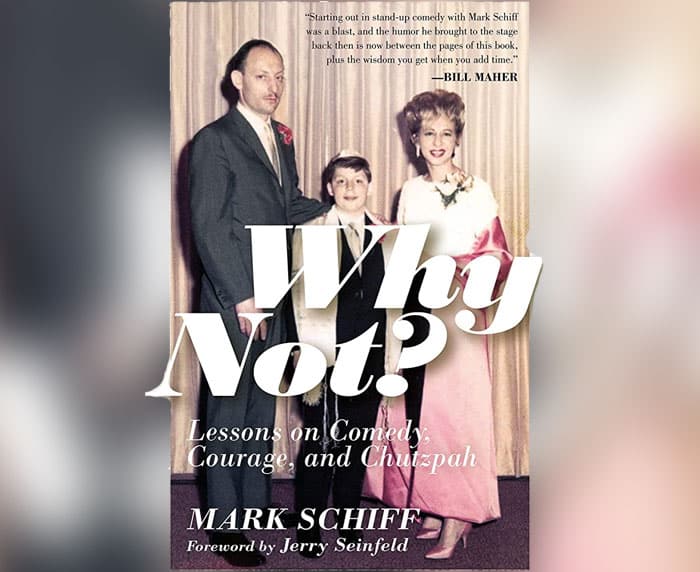
My book “Why Not? Lessons on Comedy, Courage, and Chutzpah” had been out a few weeks when my friends, Eric and Beth Shapiro called, “Do you know your book is number one on Amazon?”
I said, “Hold on.”
Clicking quicker than a 12-year-old on Ritalin, click, click, there it was, a Kindle Best Seller, number one in Jewish Lives, and number three in Comedian Biographies.
Click, click to our family chat, I zapped a screenshot from Amazon with the words “Best Seller.” Then I sat and waited for those tiny dots that fly around when people are texting back. After an agonizing two minutes of no texts back, I assumed they didn’t love me. You’ll all agree that’s normal thinking on my part.
Then there they were, the spinning dots followed by the word: “Amazing.”
Then from my wife, “So proud of our Mark.”
Then, “Not fair Trevor Noah’s beating you.”
And my favorite, “Do you think you’ll make a million dollars?” That son, who will go unnamed, is the one most eager to read my will.
While enjoying the great feeling of this success, I found myself in disbelief. How did it happen that my book became a best seller? How did it happen that I managed to write a book at all and one with my bar mitzvah photo on the cover?
When my agent Murray sent the book out to publishing houses, he received back plenty of emails that included things like, “We’re looking for gay, trans, black, and LGBTQ writers.” Nobody wrote back, “If you have a white, Jewish 70-year-old male who believes in God, loves America, and is happily married with kids, that’s our man.” I have never been and never will fit any other demographic.
I’ll tell you what I believe happened. My goal was not to write a best seller or even to get a publisher (though I was lucky enough to find one eventually). Rather, my goal was to write stories for my family and friends and leave behind a record that I’d been here. I didn’t even set out to write about my Jewish life. It just happened. First David Suissa asked me to write an article. Then he kept asking for more. So a few hours a day, I put one finger in front of the other and, boom, I had a book.

It happened because I tried my best to write honestly and not to think too much about money or prestige. It wasn’t a conditional thing. There was no this or that that had to happen. There was no “I must be successful.” I simply followed a path that felt as though it was being laid out in front of me.
I also realized that I probably wouldn’t succeed if I did things on my own. So, I asked for help. First, from the source of all help. I would sit down at the computer and ask God to help me write my stories. I would say, “God, just for today, please give me the right words. God, please make it so you’re proud of me.” Then the ideas flowed into my head while sitting at my escritoire. And like a good secretary, I sat, with my legs crossed, and took dictation.
Spelling and editing are not God’s thing. He’s an ideas man. But because I asked for help, he sent lots of people my way. Friends and family and a great editor all helped by believing in me. People believing in me helped me take this across the finish line. So many stepped up at just the right time with the right words of encouragement. Honest encouragement can and will make your work better, and help you keep going when you want to quit.
So, when I ask myself how my book happened, I see it clearly now. I set out to write honestly and asked for help along the way. I knew I could never do it by myself. That’s a type of chutzpah you don’t want. Nobody steps into the cockpit of a plane for the first time and thinks, “I can do this. I don’t need lessons”
“I” can’t, but “we” can.And if I’m going to be truthful, it’s not a bad feeling having a best seller.
Mark Schiff is a comedian, actor and writer, and host of the ‘You Don’t Know Schiff’ podcast. His new book is “Why Not? Lessons on Comedy, Courage and Chutzpah.”
I first met Sarah back in 2014, when I was studying for my conversion to Judaism and she agreed to be my teacher. Sarah, an Orthodox Jewish woman, a wife, a mother of eight and a brilliant businesswoman, lived in an immaculate, calm home, which also doubled as a synagogue. When she taught me about Torah, I felt at peace. I knew I was in the presence of greatness.
Sarah is one of the many Jewish women who inspire me. She is not only deeply dedicated to her family and her Jewish values, but she is also very intelligent and has an impressive career, too.
Our culture puts certain people on a pedestal and tells us we should worship them. We should all aim to be like the Kardashians or follow Justin Bieber’s every move. We are supposed to look up to the rich and famous and aim to become rich and famous ourselves. Isn’t that what life is all about?
As I looked around me, I saw how much Jewish women were impacting the world, often in quiet but powerful ways. I wanted to be like them instead.
I used to revere celebrities and want to be like them. Heck, when I was a kid, I learned all of Britney Spears’ dance moves and dreamed of being a wildly successful pop singer myself. But once I decided to convert to Judaism and become observant, my whole perspective changed. I was done idolizing celebrities. As I looked around me, I saw how much Jewish women were impacting the world, often in quiet but powerful ways. I wanted to be like them instead.
Along with Sarah, I had other role models, such as my mother-in-law, Vivien. I call her “Eema.” Eema is always looking out for other people, making beautiful mishloach manot during Purim, inviting guests to her Shabbat table and sending gifts to her kids and daughters-in-law when she finds something she thinks they’ll like. Even though we’re on the West Coast and she’s in New York, I frequently get cards and gifts in the mail from Eema for no apparent reason — she was simply thinking of me and wanted to let me know she loves and misses me.
Another Jewish woman I admire is Deb, who lives in my neighborhood and is a family friend from New York. We call her Aunt Deb; when I had my second child, she made a delicious Shabbat dinner for us that week, and she frequently brings over toys for our little girls. When I recently posted on Facebook that I was looking for office space in the neighborhood, she immediately commented that I could use her house anytime. I wasn’t surprised. Deb is a giver at her core.
While I’m mentioning incredible Jewish women, how could I forget Sara, a local rebbetzin in our community who makes all the food for a 100+ person kiddush at her synagogue every week while raising six children? Or how about Evey, a mother who responds to every person who needs something on our local WhatsApp chat within minutes and, in honor of her late mother, created the Perla List, a huge listing of Megillah readings around L.A. every year?
The Jewish women I know are amazing. They have so much going on, and yet they manage to fit it all in … and more. They are shining examples of the phrase, “If you want something done, ask a busy person.” Not only do they take care of their families and homes, but they also excel in their careers, learn Torah and find time to volunteer and give back in innumerable ways. They are modest and humble, and do it all with a smile.

I’m constantly refining my character and trying to be a better Jewish woman. These women show me what that looks like. They inspire me to always strive for more. They inspire me to fill every day with mitzvot, and to spread as much love and light as I can to make this world a better place. What could be more important?
These are strange times. Mobs of Jewish rioters commit a pogrom in Huwara ahead of Shabbat Zakhor while the Temple Institute posts pictures on Instagram of its genetically modified red heifers ahead of Shabbat Parah. We are living in a Jewish science fiction novel, where the words of our sacred texts have escaped their bindings and now run rampant in the streets.
These are dark times. The land is filled with violence. Extremists control the levers of Israeli state power while their vigilante lackeys throw rocks and set fires. Meanwhile, gunmen darken the threshold of our synagogues and kill Jewish worshippers on the Sabbath. Young men are felled in the street.
These are unexceptional times. We are divided now, but we were divided in the 80s during the Lebanon war. Our internecine struggles are brutal now, but they were brutal in 1948 after the Altalena Affair. We are tribal now, but we were even more so when ancient Israel split from ancient Judah. Our politics are bitter and hateful now, but they were worse for King David and Saul.
These are ordinary times. The headlines shriek and the TVs blare and the protestors protest but all the while the stores open and the stores close, the buses rumble from stop to stop, the birds chirp, the people go to work, the grandmothers squeeze fruit in the market, the Shabbat candles are lit and burn out. This is the unsung power of ordinariness, which overpowers national calamities like a river carving a path through stone.
In Israel, stark divides between religious and secular begin to soften and blur, paving the way for a new Judaism of continuity and flexibility.
This is a golden age. In Jerusalem and around the world, more and more Jews are becoming empowered to read our ancient holy books. Jews who have traditionally been excluded now become experts in Talmudic Aramaic and Biblical Hebrew, finding new ways into the tradition and clearing new paths for others to follow. In Israel, stark divides between religious and secular begin to soften and blur, paving the way for a new Judaism of continuity and flexibility.
These are desperate times. The conflict with the Palestinians has never so seemed intractable. In Gaza, we see the failure of the two-state solution. In the West Bank, we see the failure of the one-state solution. As hope in diplomacy dissipates, resentment and aggression rise to fill the vacuum. The left struggles to regain control of the steering wheel, but it senses that it is living on borrowed time. After all, demographic trends point to a future in which Israel is a Haredi state in which strident rabbinic authorities rule over a cowed secular minority with an iron fist.
When we witness what happened in Huwara, we fear that we have forgotten the lessons of our own history. Images of broken glass make us wince.
,This is a shameful chapter. When we witness what happened in Huwara, we fear that we have forgotten the lessons of our own history. Images of broken glass make us wince.
This is a proud chapter. Israelis by the hundred travel to Huwara to wage peace, raising money for the victims of our own wayward extremists. They reach out a hand. They offer an embrace. They vow to do something to make a difference. Meanwhile, Israelis by the thousands take up flags and march in the street week after week. In these protests, a fear of tyranny turns into a hope — for we see that we are not a people to walk blindly off the cliff. We will fight for an Israel we can be proud of, and for a Judaism that is a source of life and goodness.
These are interesting times. And yes, it seems that the ancient Chinese saying—may you live in interesting times—has indeed fallen upon our heads. Like the utterances of Balaam in the Torah, it is impossible to tell if this is a blessing with the undertone of a curse or a curse with the undertone of a blessing. In either case, may we find a way to survive these interesting times together, standing steady in the troubled river of history, and playing our roles with integrity.

Matthew Schultz is the author of the essay collection “What Came Before” (2020). He is a rabbinical student at Hebrew College in Newton, Massachusetts.