fbpx

March 2, 2023

Do Animals Not Count?

In his 2021 book “Jews Don’t Count,” British comedian David Baddiel asks why today’s intersectional ideologues and social justice activists so often leave Jews out of the equation when grinding their trademark axes about equity, inclusivity and representation. 

His point is well made. Indeed, it often feels like the progressive circle of moral concern includes every ethnic, racial and sexual minority under the sun except for Jews. The absence — to those who have such things on their radar — is glaring. 

There is, however, an even more glaring absence. Missing entirely from the agenda are non-human animals, who remain among the most oppressed members of our society.

According to the progressive worldview, every decade should bring more liberties for more people. The arc of history, in other words, is long and ought to bend toward justice. For domesticated farm animals, however, the arc of history is long and bends toward an abyss. With each year, new technologies combine with outrageous market demands to make their lives more cramped, joyless, painful and grotesque. 

Despite this, the progressive vanguard in America has nothing to say on this matter. Factory farming is discussed solely as an environmental issue. In certain rarefied circles, beef has become politically incorrect, but the reasons given have everything to do with continued human thriving on earth, and nothing to do with the well-being of the animals themselves. 

And so it is that those who claim to care about marginalized voices have nothing to say about those who have no voice at all. Those who champion the cause of vulnerable bodies ignore the plight of those whose bodies are bred specifically for a life of torture, sickness and slaughter. Those who speak of intersectionality are uninterested in the way that issues of animal justice, social justice, ecological justice and feminist justice intersect in the plight of female farm animals like dairy cows, for instance, whose suffering is indeed compounded on account of their sex. 

When it comes to animals, the progressive catechism is thrown out the window. Take, for instance, the idea that “silence is violence.” Under this banner, we are enjoined to loudly profess our allegiance to the cause. To do otherwise — refraining from posting the black square on Instagram or placing the “in this house we believe” sign in our yards — is to be somehow complicit with white supremacy, colonialism or the patriarchy.

In the case of animal rights, we are encouraged to keep quiet. After all, nothing is more annoying than a vegan on a soapbox — a point with broad bipartisan support.

In the case of animal rights, however, we are encouraged to keep quiet. After all, nothing is more annoying than a vegan on a soapbox — a point with broad bipartisan support.

A common joke goes like this: How do you know if someone is a vegan? Punchline: Don’t worry, he’ll tell you. In truth, most vegans I know go to lengths not to say anything that would make meat-eaters feel uncomfortable. When asked, as we inevitably are, why we are vegan, we know that the polite response is to say “for health reasons” or “for the environment.” To say the truth — that one is vegan for the animals, is too sanctimonious.

We are told that “injustice anywhere is a threat to injustice everywhere.” Hence, one finds Palestinian flags at BLM protests, the idea being that one fight for justice cannot truly be separated from another because in all cases the oppressor—some manifestation of white supremacy, colonialism or the patriarchy — is the same. 

The rule finds its exception in the case of animals, whose cause is isolated from all others. I personally have been told that raising the matter of animal rights is to unfairly steal the spotlight from more important human causes. Moreover, to draw any comparison between animal suffering and human suffering, as Isaac Bashevis Singer infamously did when he compared factory farms to death camps, is to break an inviolable taboo — not necessarily because the comparison isn’t apt, but rather because it is considered an insult to human dignity to even suggest that animals suffer like we do.

Well, it’s true that humans and animals are different, but not incomparably so. We are smarter and have more complex societies — that’s clear enough. What’s unclear is why that makes us and only us worthy of moral consideration.

As philosopher Jeremy Bentham said in 1789, “The question is not, can they reason? nor, can they talk? but, can they suffer?” 

As philosopher Jeremy Bentham said in 1789, “The question is not, can they reason? nor, can they talk? but, can they suffer?” 

Or, as Maimonides said even before that, in regards to the prohibition of slaughtering a mother cow and its calf on the same day, “there is no difference … between the pain of human beings and the pain of other living beings, since the love and tenderness of the mother for her young ones is not produced by reasoning.”

The Talmud recalls the story of a calf being led to slaughter. As it passed Rabbi Yehuda ha-Nasi, it hung its head on his leg and wept. Rabbi Yehuda ha-Nasi said to it, “Go. For this purpose you were created.” At this moment, he was judged by the heavenly court for his lack of compassion (b. Talmud Baba Metzia 85a).

Our tradition does not require us to be vegans. As the story of Rabbi Yehuda ha-Nasi reveals, however, this does not get us off the hook when it comes to taking the suffering and moral value of animals seriously. 

After all, they are living beings — heir to all the potential joy and pain inherent therein. That we are gravely mistreating them should thus be a source of outrage. All humans — especially those who claim to be committed to the ideal of justice—should care.


Matthew Schultz is the author of the essay collection “What Came Before” (2020). He is a rabbinical student at Hebrew College in Newton, Massachusetts.

Do Animals Not Count? Read More »
Author Describes Her Return to Judaism in ‘God Said What?!’

When Miriam Racquel (Meryl) Feldman was 23 years old, living a free-spirited hippie lifestyle in Berkeley, Calif., she received an alarming letter from David, her ex-boyfriend.

“I finished my program in Yugoslavia, traveled around Europe, earning my keep by playing guitar on the subways and now I’m in Israel!” David wrote. “I was hanging out at the Western Wall — it’s called the Kotel in Hebrew — and met a really nice man who invited me for a Sabbath meal. You know the Jewish Sabbath thing, right? From Friday night to Saturday night, you spend time together eating meals, singing, going to the synagogue and having really interesting conversations.”

David talked about how he was now studying in an Orthodox Jewish yeshiva and absolutely loving it. Feldman, who was a secular Jew and an atheist, was worried and shocked. Was David in a cult? She turned to a local rabbi she’d found in the Yellow Pages, who warned her about David.

Miriam Racquel (Meryl) Feldman

“These very friendly Jews want to influence non-religious Jews to become Orthodox and change their lives around,” the rabbi told her. “They want them to live as they do and hold onto the relics of the past. You know, things like keeping the restrictions of the Saturday Sabbath and a kosher diet. They then marry them off and encourage them to have a ton of kids.”

“Do you live like that?” Feldman asked the rabbi. “No,” he said. “I’m different than the Orthodox; I don’t believe that those restrictions apply today.”

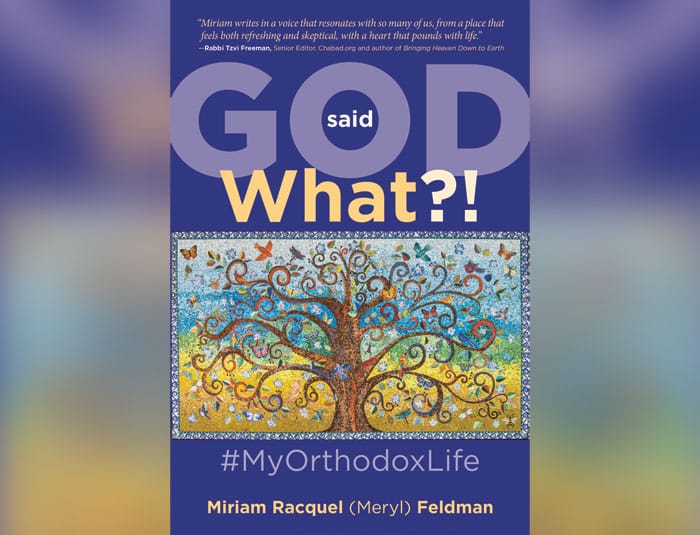
Feldman was scared about what was going to happen to David, so just two weeks later, she hopped on a plane to Jerusalem to rescue him. But when she got there, things didn’t go as expected. Instead of saving David from “the cult” of Orthodox Judaism, she connected with her Jewish roots and became a baal teshuva, writing her story in her new memoir “God Said What?! #MyOrthodoxLife.” 

Feldman, who now lives in the Midwest, works as a somatic healer and is married to David, wrote her memoir to share her story and bring joy to other people’s lives.

“I felt compelled — and compelled is the word — to share my journey from an atheist to a woman of faith.”

“I felt compelled — and compelled is the word — to share my journey from an atheist to a woman of faith because besides the humor it could bring to others, it is a story of hope,” she said. “The hope that as humanity we are not heading towards self-destruction but towards a time of peace and goodness.”

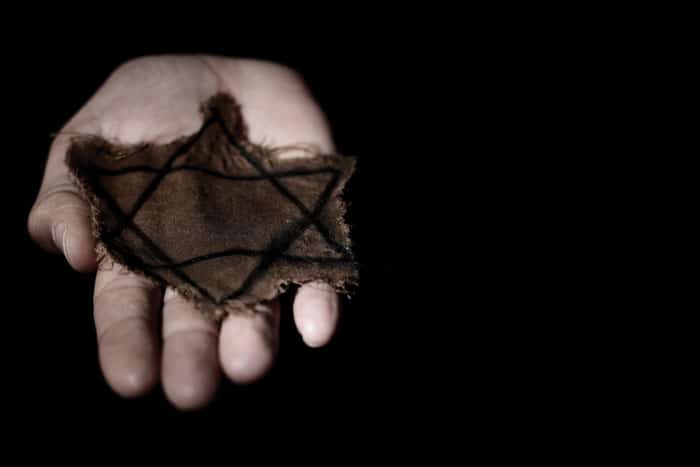
The author grew up as a secular Jew in New York and rejected religion early on; she didn’t understand it, and what little she did know didn’t appeal to her. Most of her relatives had been murdered in the Holocaust and the three that survived had numbers tattooed on their arms. When she was in high school, she participated in a German exchange program, and came away with the conclusion that assimilation was the answer to hatred. 

“The belief that I practiced was, ‘the more blending of people, the better,’” she said. “Basically, assimilation was the solution to antisemitism. If you join them, then they won’t want to kill you.”

But when Feldman traveled to Israel to meet David and subsequently enrolled in a seminary, she had a revelation that changed everything.

“I was at a Shabbos table, and after I got off my soapbox about assimilation being the key to get antisemites to stop hating us, the hostess said to me, ‘Don’t you know that German Jews were the most assimilated? They considered themselves Germans first, Jews second. And yet that did not stop their neighbors, co-workers, friends and government from killing them,’” she said. “That ‘aha’ landed deeply in my soul.”

Feldman’s path to observance took many twists and turns — for instance, she was drawn to Chabad-Lubavitch, while her husband was litvish (a non-Hasidic Haredi Jew) — but she ended up figuring out her place in the community. Today, she is a mother and grandmother, and she and David are still on their journey together.

“If we recognize that oneness bonds us together, then we can embrace this direction towards goodness and peace.”

She hopes that when people read her book, whether they are observant or secular, Jewish or not, they can understand that as different and complex as everyone is, we’re all unified in our purpose. “If we recognize that oneness bonds us together, then we can embrace this direction towards goodness and peace,” she said. “And that there is a plan. I wrote my book for people of any background and faith so it can easily be understood by all.”

Clearly, Feldman said, God has a plan for everyone. It’s up to us to try to tap into it and fulfill our life’s purpose, like she is still trying to do every single day. “We just have to open up our minds and hearts to see that,” she said. “We can all unite under the banner of bringing heaven down to earth. There is a beautiful garden in this world that Hashem wants to dwell in, and we are partners in making that happen.”

Author Describes Her Return to Judaism in ‘God Said What?!’ Read More »

“The Three Hebrew Words that Make All the Difference.”

Dear all,

ואהבתה לרעך כמוך / V’ahavta L’rei-echa C’mocha /

Love Your Neighbor as Yourself.

Three simple Hebrew words from the book of Leviticus.

Three simple words that often are not all that simple to do.

BUT ….

Three simple words that can put our actions into perspective.

Three simple words that can focus our interactions.

Three simple words that can change our mindset.

Three simple words that can transform a vacant landscape into a moment in time.

Let’s take those three simple words and embrace the future!

With love and shalom,

Rabbi Zach Shapiro

“The Three Hebrew Words that Make All the Difference.” Read More »

From West Hollywood to Yeshiva University: A Sephardic Jew’s Journey in the World of the Holocaust

I grew up in an apartment building in West Hollywood. My parents were from Morocco and Algeria, my sisters were born in Montreal, and I am a first-generation American. We spoke French at home, and our narrative was very different than that of our neighbors in the building. I grew up on stories about the rabbis, synagogues and way of life in Marrakesh, about my father’s volunteering in Israel’s War of Independence, and the life my parents lived as a young married couple in Paris. These were mostly happy stories with fond memories.

My first encounter with Holocaust survivors was not in a museum or a lecture, but with the neighbors I would see every morning on my way to school… Were Sephardic Jews not part of the Holocaust, I wondered?

Our neighbors had very different memories and stories to tell. They told sad and tragic stories about places called Auschwitz, Buchenwald and the Lodz Ghetto. My first encounter with Holocaust survivors was not in a museum or a lecture, but with the neighbors I would see every morning on my way to school. When I first saw a Holocaust film, it was with them that I discussed what I saw, not any of my teachers in Jewish day school.

Their stories intrigued me. I was fascinated by what they went through and how they were able to survive and rebuild their lives. I also wondered why this was not taught in my Jewish Day School, and why this happened primarily in Europe, and not to my family. Were Sephardic Jews not part of the Holocaust, I wondered?

It was not until high school when my father told me of his experiences living under the pro-Nazi Vichy regime in Morocco. As a young boy, he was tasked with going door to door in the Mellah of Marrakesh, making lists of how many children lived in each household. The plan was to deport these children to concentration camps, where they would meet the same tragic fate as millions of Jews in Europe. Were it not for Operation Torch – the Allied Invasion of North Africa on November 8, 1942 – our Sephardic-Moroccan stories in my home may have resembled those of our neighbors. With that, I suddenly felt closer to the Holocaust experience.

Growing up at Sephardic Temple Tifereth Israel, and later serving as its rabbi for 17 years, I learned first-hand that Sephardic Jews in Europe shared the fate of their Ashkenazi brothers and sisters. Ninety-five percent of Salonika’s Jews were wiped out, and many of their few survivors were members at Sephardic Temple. Year after year, I had the privilege of presiding over a Yom Hashoah service that featured Ladino Holocaust poems and Holocaust testimonies in Greek and Ladino. By officiating a number of their funerals, I learned even more about their tragic and heroic stories. By being their rabbi, I felt an even closer connection to the Holocaust.

I always wanted to explore the Holocaust on a deeper level. I read books, visited museums, watched films, and spoke to survivors. As a Sephardic rabbi, I made it a point – whether leading a group in Israel or observing Yom Hashoah in the U.S. – to make the Holocaust a core part of the experience for my students or community. I wrote articles, gave sermons, and even contemplated writing a book exploring the Holocaust from a Sephardic perspective.

It was a few years ago that the program of my dreams came to my attention: The Emil and Jenny Fish Center for Holocaust and Genocide Studies at Yeshiva University (YU). As a rabbinic alumnus of YU, I received an email announcing this new program, and inviting me to apply. It’s one of the best emails I ever received.

What is The Emil and Jenny Fish Center for Holocaust and Genocide Studies? The Fish Center is an academic program whose core mission is to professionally train educators in the field of Holocaust and Genocide Studies. Through a rigorous interdisciplinary master’s program, a new generation of Holocaust educators are currently being trained at the Fish Center, empowering them with knowledge to assure that the memory and lessons of the Holocaust survive well into the future. The program is entirely online, creating a diverse international community of Fish Center M.A. students. I am proud to be one of those students.

The Fish Center’s faculty draws from YeU’s professors, as well as scholars from all over the world. Courses include in-depth explorations of the Holocaust in film, literature, history, rabbinic texts, theology and philosophy. There are also courses studying other genocides, including law school seminars that study the legal methods to prevent genocide, atrocity crimes and crimes against humanity.

In addition to completing coursework, students can either write a classic M.A. thesis or choose to do field work in an institution related to the Holocaust or genocide prevention. I plan on writing about one of my Sephardic rabbinic role models – Rabbi Ben-Zion Meir Hai Uziel – and his unique writings and activities directly relating to the Holocaust. The Fish center’s courses have taught, enabled and empowered me to pursue further research into my family’s own Holocaust history, as well as into the overall Sephardic experience in the Shoah.

This unique program was established by Mr. Emil Fish, a Holocaust survivor well known to many in the Los Angeles community as a successful businessman, philanthropist, and Jewish community leader. 

“We must know the history about what happened and why and what are the implications for today,” Mr. Fish said. “The Fish Center educates young people and adults about a singular event in history that, regrettably, too few people understand, including what conditions existed before the Nazis ascended to power, how they rose to leadership positions and why they targeted Jews.”

In the vast world of Holocaust institutions and organizations, Mr. Fish’s decision to preserve the memory and lessons of the Holocaust by endowing an academic program geared to educators is refreshing. It speaks to Judaism’s long-standing belief and commitment to learning, teaching and education as the core values that will assure our continuity. It also speaks to a larger mission of this program: to apply the lessons learned from the Holocaust and other genocides to combat prejudices, hateful ideologies and future atrocities. Monuments cannot do that. Only educated human beings can.

Emil Fish was 9 years old when he and his family were captured and arrested by the Gestapo in 1944. His father was sent to Buchenwald, and he, his mother and sister were sent to Bergen-Belsen. They thankfully survived these concentration camps, and in 1955, Mr. Fish and his family immigrated to Los Angeles. 

When I read his story, I feel Mr. Fish could have been one of my neighbors in that building where I grew up in West Hollywood. Many years later, I now have the privilege of exploring the Holocaust in depth, thanks to his vision.

On March 15, Yeshiva University will honor Mr. Emil Fish at a special evening benefitting the Center. For more information, please contact Michal Kleiman at 646.592.4514 or by email at michal.kleiman@yu.edu.

From West Hollywood to Yeshiva University: A Sephardic Jew’s Journey in the World of the Holocaust Read More »

This Poem Counts as Rabbinic School – A poem for Parsha Tetzaveh

You shall slaughter the ram, take [some] of its blood and put it upon…the thumbs of their right hands, and upon the big toes of their right feet
-Exodus 29:20

I’m what’s known as a Cantorial Songleader.
And by what’s known I mean I made that term up
to refer to what I am lucky enough to stand before
the people of Israel and do.

Most people say Cantorial Soloist but that term
rubs me the wrong way in that this work isn’t about
what I can do, but wholly about what I can get
the people to do.

Speaking of rubbing, I’m reminded how many
paths to becoming clergy of one kind or another
there are. You might be given s’micha by
colleagues who have determined you have
learned what there is to learn.

You might attain an advanced degree at
an institution of higher learning after years
of study in a thoughtfully curated program.

It’s possible the Rabbi might be away on a trip
and ask you to say the things that need to be said
on a Friday night since he’s seen you do it before
and he has all the confidence.

And then there are the oldest ways. The ways involving
the blood of a ram, this time smeared on your
right ears, the thumb of your right hand and
the big toe of your right foot. (Sorry lefties.)

Later on, you’ll wave both the breast of the
ram of perfection and the thigh of the uplifting
in the air (like you do care) before you eat it
as a sign to The Lord before you eat it and
become fully invested.

Times have changed and I don’t think much
happens involving waving meat in the air
at rabbinic school. Maybe at cantorial school.
You need a lot of energy to sing Kol Nidrei.

I do know everyone has the potential to
give blessings; or better yet, to show the
ones being blessed that they are a blessing.
But just in case, pass me the tofu thigh of uplifting.
There’s work to be done here.


God Wrestler: a poem for every Torah Portion by Rick LupertLos Angeles poet Rick Lupert created the Poetry Super Highway (an online publication and resource for poets), and hosted the Cobalt Cafe weekly poetry reading for almost 21 years. He’s authored 26 collections of poetry, including “God Wrestler: A Poem for Every Torah Portion“, “I’m a Jew, Are You” (Jewish themed poems) and “Feeding Holy Cats” (Poetry written while a staff member on the first Birthright Israel trip), and most recently “I Am Not Writing a Book of Poems in Hawaii” (Poems written in Hawaii – Ain’t Got No Press, August 2022) and edited the anthologies “Ekphrastia Gone Wild”, “A Poet’s Haggadah”, and “The Night Goes on All Night.” He writes the daily web comic “Cat and Banana” with fellow Los Angeles poet Brendan Constantine. He’s widely published and reads his poetry wherever they let him.

This Poem Counts as Rabbinic School – A poem for Parsha Tetzaveh Read More »

The Silver Lining Playbook of Antisemitism

With Purim upon us, the lesson of the Jewish community rising up and stopping forces in Persia from slaughtering the community is as salient as ever as many Jews in America are regularly confronting waves of antisemitism around the nation. A week rarely goes by without terror alerts against the Jewish community from the recent so-called “National Day of Hate” to multiple shootings outside synagogues in Los Angeles. The Anti-Defamation League (ADL) reported last year that antisemitic incidents reached an all-time high of seven incidents per day in the United States in 2021, which was the highest number of incidents on record since ADL began tracking antisemitic incidents in 1979 and a 34 percent increase year over year. While horrifying, a silver lining emerges: the surge in antisemitism may help engage the fractured Jewish community and encourage it to find a unified voice—not only in responding to the threat, but also in other domains as well.

The data are powerfully clear: antisemitism is rising in the United States and Jews are well aware of it. From a series of conducted by the American Jewish Committee (AJC) in the fall of 2022, we learn that more than four in 10 American Jews  felt less secure in 2022 than the year before and almost all (90 percent) of Jews believe that antisemitism is a problem in the nation today. The AJC  describes the rising levels of antisemitism in stark terms: “The antisemitism that we’ve seen has a real and frightening impact on the attitudes of American Jews, on the comfort of American Jews in American society, at their workplace and in their educational institutions.”

The surveys found that 26 percent of Jewish respondents were personally the target of antisemitic incidents in 2022. These include antisemitic physical attacks as well as antisemitic remarks in person or online. Concurrently, 87 percent of Jewish respondents have seen antisemitic content online and another 23 percent are affiliated with an institution that has been targeted by antisemitism in the past five years. Thirty-three percent of respondents said that they have experienced anti-Jewish bias or discomfort in the workplace, while 36 percent of students, recent graduates and their parents said that they had experienced issues on their collegiate campuses.

Moreover, significant numbers of Jews have changed their behaviors out of safety concerns, such as modifying where they go, what they wear or carry or what they post online, and half said that institutions such as synagogues and Jewish Community Centers have increased security in recent years.

These data are not at all comforting, to say the least. But, the fact that there is almost unity among the American Jewish community suggests that there is a strong sense of linked fate now—a helpful sign for the Jewish community today.

While the Jewish community is politically fractured and unorganized, when there is a deep threat to a group, selfish and inward-looking differences often become trivial, and members of a group can become cohesive and organized to promote social change. Ample research has demonstrated that outgroup threats promote the emergence of cohesive groups. Put somewhat differently, as President Reagan noted, unity often emerged in the face of “some outside, universal threat to make us recognize this common bond.”Linked fate has been seen within the African-American, Hispanic, and LGBTQA+ communities and had resulted in powerful social change.

Ample research has demonstrated that outgroup threats promote the emergence of cohesive groups.

Given the near-universal acknowledgment within the Jewish community of the serious antisemitism problem in the United States, various Jewish movements, congregations, and institutions must now organize to assert Jewish peoplehood and more strongly counter so much of the erasure of Jews from American life. The culture wars have placed Jews in a precarious spot when it comes to questions of politics, identity, and questions of equity, but that does not mean Jews should cease to be a real part of social and political life today.  Religious and communal leaders must continue to demand greater government accountability and intervention for the seemingly unending attacks and habitual threats that Jews must manage on a daily basis. Clearly, all Jews have a vested interest in pushing back.

If collective mobilization is one piece of the silver lining of antisemitism, individual mobilizing is the other. Certainly the major national organizations and local institutions have rallied in defense of the Jewish community, and engaged in successful lobbying and advocacy of government, local and national. Yet rabbis, educators, and their backers have so far ignored the potential of antisemitism awareness to ignite individuals’ Jewish passions and feelings of solidarity. The questions we should be asking are not only about how to fight antisemitism, but how to use antisemitism to provoke higher and sustained levels of Jewish engagement. What lessons do we want to teach? Who should teach them – and how? How can we utilize influencers, social media, op-eds, classrooms, culture, mass media, and so forth to stimulate greater Jewish identification and solidarity?

No American should live in fear for the expression of faith or group ties and the American Jews now face antisemitism epidemic. Thus, the Jewish community’s shared fate is in play and this may help it unite and demand an end to this dangerous and destructive phenomenon hitting virtually every Jew in some form now. Sadly, like with Haman, Jews have had to confront calls for their destruction and have risen to the challenge in past and the community – and Jewish individuals — must now do so again. Yes, we are doing a lot; but we can do so much more.


Samuel J. Abrams is a professor of politics at Sarah Lawrence College and a senior fellow at the American Enterprise Institute.

The Silver Lining Playbook of Antisemitism Read More »

Does an Israel/Palestine Joke in ‘Succession’ Trailer Tell Us Anything About Season 4?

At the end of Season 3 of “Succession” on HBO Max, one question fans had when Josh Aaronson (Adrien Brody) walked with Logan Roy, the CEO of Waystar Royco, a global media and entertainment conglomerate (the awesome Bryan Cox) was whether Josh intended for Logan to have a heart attack due to the walk.

“Succession” tells the story of the Roy family and the machinations of Logan’s three children, the attention loving Kendall (Jeremy Strong), the sardonic Roman (Kieran Culkin) Logan’s favorite, who is facing a sex scandal and Siobhan (Sarah Snook), Logan’s only daughter, aptly called “Shiv.” Cox is magnificent as Logan, a brash, intimidating and cutthroat patriarch, and each child tries to get in his good graces and  be named his successor.

Well-written and acted, “Succession,” like “Billions” on Showtime and “House of Cards” on Netflix, takes viewers behind the scenes of the rich and powerful. People love those shows because of the power struggles, as they try to predict who will come out on top and who will fall to the bottom.

In the trailers for Season 4, Greg (Matthew Macfayden, excellent as Tom Wambsgans, Shiv’s husband) is a man with a penchant for sticking his foot in his mouth, especially during government hearings. It’s a trait shared by Greg Hirsch, Logan’s anxious grandnephew, played by Nicholas Braun.

As comic relief, Tom often tries to warn or teach Greg, even though Tom often doesn’t know what he is talking about. He’s trying to figure out if he should try to hitch his ride to the woman he married, Logan’s daughter, or Logan himself. Last season, Shiv and her brothers tried to take down their father. It might have worked had Logan not been warned in advance by Tom.

In the trailer, Tom and Greg are discussing what would appear to be strategy: Whether or not to align with Logan or a venture by the three children. “This is a chessboard and every move is crucial,” Tom tells Greg. “Like Israel and Palestine, Greg, but harder and much more important.” (In the Season 3 finale, there was talk of an Israeli A.I. operation.)

Neither trusts the other, and it may be impossible to come to any agreement that would be beneficial to both. We’re not sure if he tells Greg this to help or trip him up. Tom also worries if his position would be affected if he and Shiv divorce. Fans are already speculating about what moves the children could potentially make. In the finale to last season, Tom asks Greg to be his attack dog. “What am I gonna do with a soul anyway?” Greg responds. “Souls are boring.”

The relationship between the Logan children and their father is so strained that they negotiate about something as simple as a phone call.

When the fourth season premieres Sunday, March 26 on HBO Max, viewers will once again be treated to one of the best shows on television. Logan, in poor health, is still able to outmaneuver his children, mostly due to a traitor who tipped him off.

Will the three children be able to be stay afloat with a new company or will they be destroyed? After not being consulted regarding a merger with a tech company, where their positions would be in doubt, will their aggressive response lead to a loss in fortune?

Strong is superb as a man possibly having a mental breakdown, while Culkin consistently provides comic relief. Snook shines as the woman who assumes she has the brains because she is more cerebral than her brothers.

They’ve lost the battle, but it’s unclear if they have lost the war.

The new season, which series creator Jesse Armstrong recently said will be the last, will reveal whether the brothers and sister can find some new ammunition to fire. They’ve lost the battle, but it’s unclear if they have lost the war.

Does an Israel/Palestine Joke in ‘Succession’ Trailer Tell Us Anything About Season 4? Read More »

Rereading Ahasuerus: Roger Williams and Religious Liberty

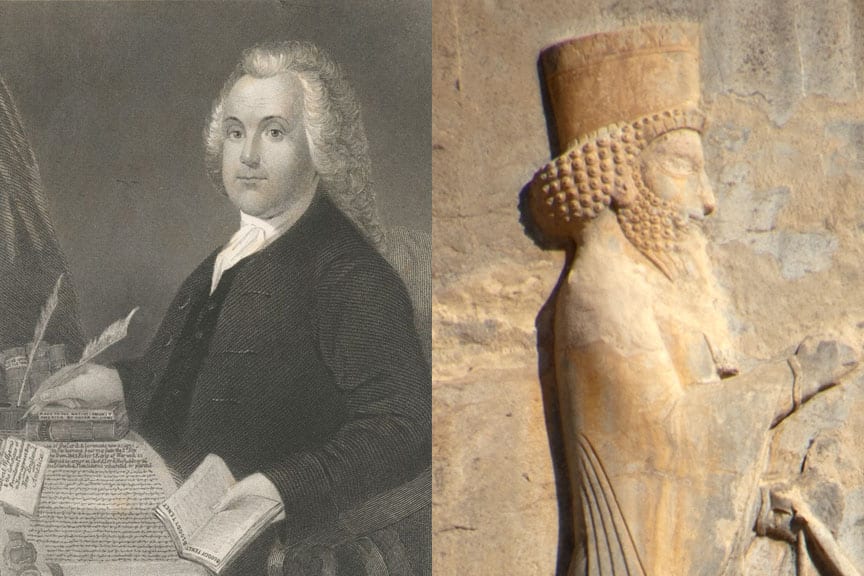
You’re undoubtedly familiar with the Book of Esther, but you probably haven’t thought much about what happened after the Purim story. For the first time in the history of the Jewish Diaspora, Jews enjoyed an unparalleled degree of political power. In Ezra 7:11-28, King Artaxerxes wrote a letter to Ezra expressing unprecedented support for the Jews. This obscure passage has remained largely forgotten in the quagmire of biblical chronology. But it served as a surprisingly significant touchstone in debates about the relationship between church and state in colonial America. Most notably, Roger Williams, founder of Rhode Island, invoked Artaxerxes as a model for religious liberty, challenging the Puritan theocracy in Massachusetts.

Before delving into this history, it’s worth taking a closer look at the biblical text. In his letter, Artaxerxes begins, “I hereby issue an order that anyone in my kingdom who is of the people of Israel and its priests and Levites who feels impelled to go to Jerusalem may go with you. For you are commissioned by the king and his seven advisers to regulate Judah and Jerusalem according to the law of your God, which is in your care” (7:13-14). He also expresses his support for rebuilding the Holy Temple and authorizes funds to fulfill Ezra’s requests. “Whatever is by order of the God of Heaven must be carried out diligently for the House of the God of Heaven, else wrath will come upon the king and his sons” (7:23).

Additionally, Artaxerxes provides a litany of legal protections for the Jewish clergy: “We further advise you that it is not permissible to impose tribute, poll tax, or land tax on any priest, Levite, singer, gatekeeper, temple servant, or other servant of this House of God” (7:24). Finally, and most shockingly, the king grants the Jews an autonomous legal system with the power to enforce capital punishment:

And you, Ezra, by the divine wisdom you possess, appoint magistrates and judges to judge all the people in the province of Beyond the River who know the laws of your God, and to teach those who do not know them. Let anyone who does not obey the law of your God and the law of the king be punished with dispatch, whether by death, corporal punishment, confiscation of possessions, or imprisonment. (7:25-26)

There were essentially two ways of extracting political theory from this passage. Mainstream Puritans, such as theologian John Cotton, argued that Artaxerxes’ involvement with Jewish affairs indicated that the state should intersect with the church and advance the cause of religion. Cotton cited the “King of Persia” in Ezra 7:23 to argue that civil law has the authority to “punish spiritual offenses” since they “provoke wrath against a civil state.”

In contrast, Roger Williams opposed state compulsion of religious practice, one of the reasons why Massachusetts banished him from the colony in 1636. Williams reinterpreted Artaxerxes to argue for religious liberty. The king’s “acts of favor…[did] not amount to a positive command, that any of the Jews should go up to build the Temple, nor that any of them should practice his own worship.” Rather, Artaxerxes “freely permits them, and exercises a bounteous assistance to them.” Instead of commanding the Jews—or any other community—to follow a particular religion, Artaxerxes merely allowed and assisted them to do so.

Williams also dismissed Artaxerxes as an idolatrous tyrant and likened the state of the Jews to “sheep in the jaws of the lion.” Why, then, did Artaxerxes act so kindly to the Jews? Williams pointed to the wrath of God that Artaxerxes invoked in Ezra 7:23. Sometimes, he surmised, “it pleases God to open the hearts of Tyrants greatly to favor and further his people.” But did God move Artaxerxes to enact a wider enforcement of religion, “to restrain upon pain of Death all the millions of men under his Dominion from the idolatries of their several and respective Countries? To constrain them all upon the like penalty to conform to the Worship of the God of Israel?” Surely not. Artaxerxes’ order was not state enforcement of religion per se, but rather creating the liberty of political autonomy within a religious community.

But what, you may wonder, does any of this have to do with Esther? The answer, though not suggested by Williams himself, appeared several decades earlier in the work of English explorer Walter Raleigh. In his History of the World (1614), Raleigh identified Ahasuerus as the Artaxerxes of Ezra 7: “His favor was exceedingly great to the Jews, as appears by the Histories of Ezra and Nehemiah, which fell in his time…. This was likewise that King Ahasuerus who mar­ried Esther.” Raleigh’s emphasis on the monarch’s affin­ity for Jews paralleled his own tolerant attitude toward other religions.

Around a century later, Puritan theologian Cotton Mather surveyed the various scholarly theories about Ahasuerus’ identity in his Biblia Americana (1693-1728), reaching the same conclusion: “And the extraordinary favors…unto the Jews, beyond any former Kings of Persia, sending first Ezra, and after­wards Nehemiah, for the restoring of their ancient Prosperity, agree well in their having in his bosom such a powerful Advocate as Q. Esther for them.” While Mather did not agree with Williams’ and Raleigh’s approach to religious liberty, and he had little tolerance for real-life Jews, he shared their understanding of Esther’s husband.

For early modern readers, who often conflated Artaxerxes with Ahasuerus, a new redemptive perspective emerges on the biblical character. The once-tyrannical king who nearly allowed the annihilation of Jewry becomes a model for benevolent governance and, in a sense, religious liberty. As the Purim story concludes, “For Mordecai the Jew ranked next to King Ahasuerus and was highly regarded by the Jews and popular with the multitude of his brethren; he sought the good of his people and interceded for the welfare of all his kindred” (Esther 10:3). With this extraordinary degree of political influence, the exceedingly pro-Jewish events of Ezra 7 fell into place.

Regardless of the historicity of this early modern reading—most modern scholars identify Ahasuerus as Xerxes I—Artaxerxes’ letter and its American afterlife holds great significance. Roger Williams’ reading of Ezra 7 may have inspired the lack of religious coercion in colonial Rhode Island. And the arguments of Raleigh and Mather suggest that a king capable of great evil can still have the possibility of redemption.

Jewish tradition, which identifies Artaxerxes as the son of Ahasuerus, states that the Jews reaccepted the Torah during Esther’s time (Shabbat 88b). But it is also significant that Artaxerxes gave us the liberty to follow Jewish law, granting a degree of freedom to pursue our faith perhaps never repeated in Jewish history until the modern State of Israel.

This essay is adapted from my chapter in Stuart Halpern’s edited volume Esther in America (2020). Biblical quotations are from Sefaria, and early modern quotations have been modernized for clarity.


Yisroel Ben-Porat is a PhD candidate in early American history at CUNY Graduate Center and Managing Editor of Lehrhaus.

Rereading Ahasuerus: Roger Williams and Religious Liberty Read More »

Ethno-Nationalism Defeated on Purim

Ethno-nationalism may well be the basic cause

of Putin’s war against Ukraine.

It’s what drove Haman quite insane,

inducing him to violate the dat, denoting laws


of decency, such as the right of every nation

to follow its traditions and to speak

its language, radically against the chic

of ethno-nationalism, an abysmal aberration.


Putin hopefully will be defeated by a Jew

who leads his nation. Maybe one-two-seven

nations will, with hidden help from heaven,

depose him, as Jews deposed Haman in a Purim coup,


aided by two Jewish people, Mordecai and Esther,

whose names were hardly Jewish but behave

as bravely as a Jew who may yet save

a nation that’s not his, as cursèd Putin’s blessed detester.


The Talmud states in bMegillah 7b:

Rava said: A person is obligated to become intoxicated with wine on Purim until he is so intoxicated that he does not know how to distinguish between cursed is Haman and blessed is Mordecai.

Inspired by “Putin’s War on Ukraine Is About Ethnicity and Empire,” NYT, 3/16/22, by Steven Erlanger:

President Biden took office with the idea that this century’s struggle would be between the world’s democracies and autocracies.

But in waging war on Ukraine, President Vladimir V. Putin of Russia has been driven by a different concept, ethno-nationalism. It is an idea of nationhood and identity based on language, culture and blood — a collectivist ideology with deep roots in Russian history and thought.

Mr. Putin has repeatedly asserted that Ukraine is not a real state and that the Ukrainians are not a real people, but actually Russian, part of a Slavic heartland that also includes Belarus.

“Putin wants to consolidate the civilizational border of Russia, as he calls it, and he is doing that by invading a sovereign European country,” said Ivan Vejvoda, a senior fellow at the Institute of Human Sciences in Vienna.

In this sense, argues Ivan Krastev, the war is one of recolonization, capturing lands ruled by the Russian empire and the Soviet Union. “Even if Ukraine were autocratic, it would not be tolerated by Putin,” he said. “He’s reconsolidating imperial nationalism.’’


Gershon Hepner is a poet who has written over 25,000 poems on subjects ranging from music to literature, politics to Torah. He grew up in England and moved to Los Angeles in 1976. Using his varied interests and experiences, he has authored dozens of papers in medical and academic journals, and authored “Legal Friction: Law, Narrative, and Identity Politics in Biblical Israel.” He can be reached at gershonhepner@gmail.com.

Ethno-Nationalism Defeated on Purim Read More »

A Bisl Torah – We’re Still Here

In just a few days we will be celebrating one of the most joyous Jewish holidays, Purim. We wear costumes, eat hamantaschen and dance with frivolity. And yet, the holiday is one woven with a serious story. Queen Esther is chosen to save the Jewish people from impending doom. She and Mordecai are unsure of the King’s approach. Will he take sides with the evil Haman or will Esther’s courage nudge the King to tip the scales towards a righteous victory?

I recently learned that historically, Jewish communities throughout the world have declared multiple Purims. In Philip Goodman’s The Purim Anthology, we glean that “private families often instituted the observance of a Purim to mark an escape from a danger that may have threatened the patriarch of the family or possibly the whole family.” There was a separate Purim commemoration instituted by the Jews of Shiraz in Persia, a Purim of Castile, a Second Purim of Saragossa, a Purim in Prague and more. These Purim holidays were celebrated in addition to the merriment surrounding Esther and Mordecai. Whenever and wherever the Jews were threatened, there was an opening to gather, sometimes refrain from eating to mark the day’s solemnity and then feast to acknowledge the ability to seize another day of life.

It is a beautiful lesson of our tradition. Purim should be taught as the eternal reminder to our people: we will not let the voices of evil diminish and destroy our Jewish spirit. Just last week, the Jewish world was told to keep watch as a “Day of Hate” was declared by antisemitic forces. In a sense, another Purim was brought forth. Last Shabbat, Jews around the world lit candles, baked challah, attended Shabbat dinners, gathered in prayer and like Queen Esther, stood with pride for who we are and who we will always be.

Our history teaches a harsh reality: we may have many more Purims to commemorate in our lifetime. But our history also teaches a hopeful silver lining. With the Hamans of each generation, take note:

We’re still here.

Shabbat Shalom


Rabbi Nicole Guzik is a rabbi at Sinai Temple. She can be reached at her Facebook page at Rabbi Nicole Guzik or on Instagram @rabbiguzik. For more writings, visit Rabbi Guzik’s blog section from Sinai Temple’s website.

A Bisl Torah – We’re Still Here Read More »