fbpx

February 15, 2023

Uptown Girl ft. Dalya (aka thesoutheryid)

This week Libby and Marla give some exciting updates, debate coffee dates vs. drink dates, discuss Jewish mother’s attitudes towards their kid’s failed dating experiences and welcome on the wonderful Dalya aka TheSouthernYid to Schmuckboys! Dalya brings a new and interesting perspective this week, talking about her experiences growing up Jewish in the south. She shares about her journey with Judaism and how her observance has changed over time. The girls also discuss the differences in Jewish life and dating between a small town in the south with few Jews v.s. in the UWS of NYC where Dalya has recently moved. She also shares her love for cooking and how she has grown her following on TikTok. The girls also discuss assimilation and end with a game of “Cute or Cringe.”

Uptown Girl ft. Dalya (aka thesoutheryid) Read More »

Jewish Football Players Who Have Won a Super Bowl (or an NFL Championship)

There are 18 Jewish football players who have won a Super Bowl or NFL Championship as a player.

What’s the difference between the NFL Championship and the Super Bowl?

The Super Bowl wasn’t played until 1967, a year after the National Football League (NFL) and the upstart American Football League (AFL) agreed to merge. the Green Bay Packers defeated the Kansas City Chiefs at the Los Angeles Memorial Coliseum. The game at the time was known as The AFL-NFL World Championship Game. Tickets cost $10 and the game didn’t even sell out.

What’s the AFL?

The NFL was founded in 1920, while its competitor AFL was founded in 1959. The two leagues operated as separate entities from 1959-1970; their seasons ran simultaneously, but each league had their own playoffs and champions., with the more-established NFL considered the superior league.

What has now retroactively become known as “Super Bowl I” marked the first time that the champions of both the AFL (Kansas City Chiefs) and NFL (Green Bay Packers) met after winning their respective league championships.

It wasn’t until the fourth AFL-NFL Championship game that the words “Super Bowl” even appeared on the game ticket—that game is now known as “Super Bowl IV” and was played in January of 1970, the same year the two leagues completed their merger.

With the merger completed, the NFL teams became the National Football Conference (NFC) and the AFL teams became the American Football Conference (AFC)  in a united league called the NFL. Three NFL teams moved to the AFC following the merger: the Pittsburgh Steelers, Baltimore (now Indianapolis) Colts and Cleveland Browns.

To confuse things even more, from 1920-1932, no NFL Championship Game was played. At the end of the season, whichever team had the best record was deemed the NFL Champion.

From 1933-1969, the NFL held playoffs to determine the champion.

Why does this matter for this article? Because six Jewish NFL players won NFL Championships before the Super Bowl era. And another two Jewish football players won a championship on an AFL team.

So what team has won the most Super Bowls? There are two ways to answer the question:

The first way is to simply count the wins from Super Bowl I onward. The Pittsburgh Steelers and New England Patriots have each won six Super Bowls. However, since the founding of the NFL, the Green Bay Packers have been champions of the league 13 times (nine NFL championships and four Super Bowls victories).

Why does the Super Bowl use roman numerals while the NFL Championships use years?

Since the Super Bowl era began (retroactively to 1967), the big game has been played in a different calendar year than the rest of the regular season. By contrast, Major League Baseball, the National Basketball Association and the National Hockey League play their entire regular season, playoffs and championship in the same calendar year.

History lesson over, and now a few quick facts about the Jewish football players who have won a Super Bowl (or NFL Championship).

Sid Luckman is the only Jewish quarterback to win an NFL Championship, winning four while leading the Chicago Bears.None have won a Super Bowl.

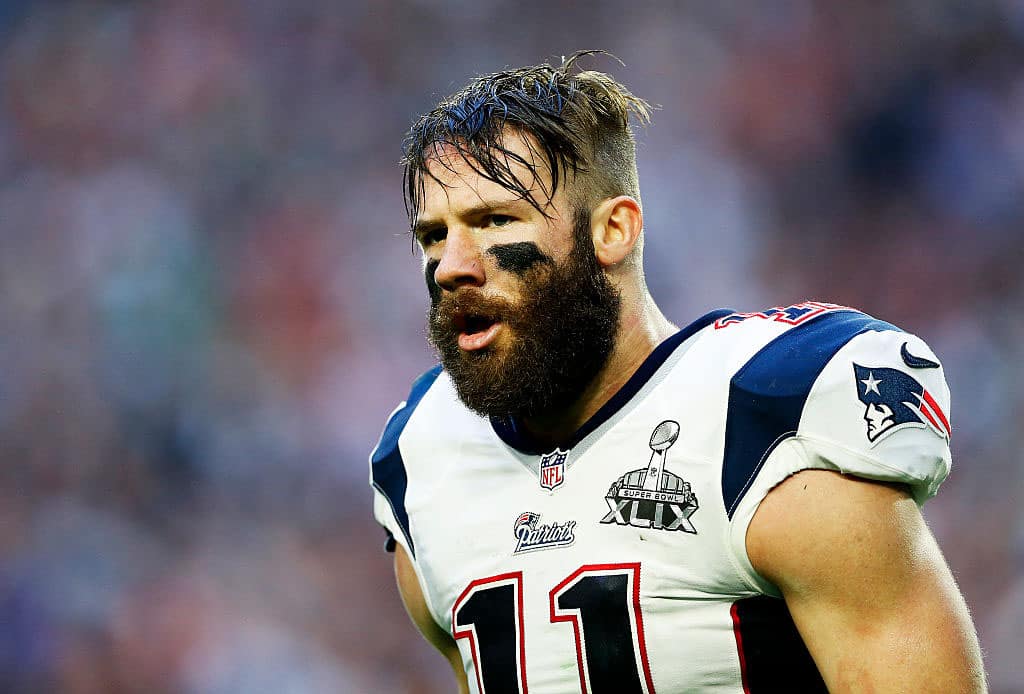
Julian Edelman is the only Jewish NFL player to win the honor of Super Bowl MVP. Edelman and teammate Nate Ebner won three Super Bowls as teammates on the Patriots. Greg Joseph and Ali Marpet won one Super Bowl as teammates with the Buccaneers.

The 1950s were the only decade when no Jewish player won an AFL or NFL Championship. The 1960s were the only decade when no Jewish player won an NFL Championship.

Offensive Tackle Ron Mix, who played with the Los Angeles  Chargers,  is the only Jewish player to ever win an AFL Championship.  That team was led by Jewish Head Coach Sid Gillman, the only Jewish head coach to win an AFL or NFL championship. .

Confused yet? Let’s just skip to the list of Jewish football players who have won a Super Bowl (or NFL Championship). 

* Denotes a pre-AFL-NFL merger NFL Championship.

# Denotes a pre-AFL-NFL merger AFL Championship.

4 RINGS: JEWISH FOOTBALL PLAYERS WHO WON FOUR SUPER BOWLS OR NFL CHAMPIONSHIPS:

Quarterback Sid Luckman won the NFL Championship in 1940, 1941,1943 and 1946 — all with the Chicago Bears.*

Tight end Randy Grossman won Super Bowl IX in 1975, Super Bowl X in 1976, Super Bowl XIII in 1979 and Super Bowl XIV in 1980 — all with the Pittsburgh Steelers.

3 RINGS: JEWISH FOOTBALL PLAYERS WHO WON THREE SUPER BOWLS OR NFL CHAMPIONSHIPS:

Guard and running back Charles “Buckets” Goldenberg won the NFL Championship with the Green Bay Packers in 1936, 1939 and 1944.*

Offensive tackle Harris Burton won Super Bowl XXIII in 1989, Super Bowl XXIV in 1990 and Super Bowl XXIX in 1995 — all with the San Francisco 49ers.

Wide receiver Julian Edelman won Super Bowl XLIX in 2015, Super Bowl LI in 2017 and Super Bowl LIII in 2018—all with the New England Patriots. He was named Most Valuable Player of Super Bowl LIII.

Safety/Special Teamer Nate Ebner won Super Bowl XLIX in 2015, Super Bowl LI in 2017 and Super Bowl LIII in 2018—all with the New England Patriots.

2 RINGS: JEWISH FOOTBALL PLAYERS WHO WON TWO SUPER BOWLS OR NFL CHAMPIONSHIPS:

Tight end John Frank won Super Bowl XIX in 1985 and Super Bowl XXIII in 1989—both with the San Francisco 49ers.

Outside linebacker Terrell Suggs won Super Bowl XLVI in 2013 with the Baltimore Ravens, and Super Bowl LIV in 2020 with the Kansas City Chiefs.

1 RING: JEWISH FOOTBALL PLAYERS WHO WON ONE SUPER BOWL,NFL CHAMPIONSHIP OR AFL CHAMPIONSHIP:

Guard Joseph “Doc” Alexander won the NFL Championship in 1925 with the New York Giants.*

Halfback Harry Newman won the 1934 NFL Championship with the New York Giants.*

Guard Leonard “Butch” Levy won the NFL Championship in 1945 with the Cleveland Rams.*

Halfback Marshall Goldberg won the 1947 NFL Championship with the Chicago Cardinals.*

Offensive tackle Ron Mix won the American Football League championship in 1963 with the San Diego Chargers.#

Head coach Sid Gillman won the American Football League championship in 1963 with the San Diego Chargers.#

Guard Ed Newman won Super Bowl VIII in 1974 with the Miami Dolphins.

Defensive End Lyle Alzado won Super Bowl XVIII in 1984 with the Los Angeles Raiders.

Punter Josh Miller won Super Bowl XXXIX with the New England Patriots in 2005.

Tackle/Guard Alan Veingrad won Super Bowl XXVII with the Dallas Cowboys in 1993.

Offensive Tackle Mitchell Schwartz won Super Bowl LIV in 2020 with the Kansas City Chiefs.

Placekicker Greg Joseph won Super Bowl LV in 2021 with the Tampa Bay Buccaneers.

Guard Ali Marpet won Super Bowl LV in 2021 with the Tampa Bay Buccaneers.

Jewish Football Players Who Have Won a Super Bowl (or an NFL Championship) Read More »

Jewish Man Shot in Pico

A Jewish man was shot in the Pico-Robertson area on February 15 after leaving a shul.

The Forward reported that the victim, 47, was shot twice while walking to his car following morning services and was hospitalized in moderate condition. A spokesperson for the Los Angeles Police Department (LAPD) told the Journal that the shooting occurred at the 1400 block of S. Shenandoah Street at around 9:55 a.m. Magen Am President Rabbi Yossi Eilfort told the Journal in a phone interview that the victim has since been released from the hospital and was shot about a block away from the synagogue. He added that while the victim was wearing a yarmulke at the time of the shooting, the police do not currently believe the shooter was motivated by antisemitism. Police have said that the suspect, who is currently still at large, is a middle-aged Asian male with a goatee, per Eilfort. The LAPD spokesperson told the Journal that they do not believe the shooting was gang-related.

Anti-Defamation League Los Angeles Regional Director Jeffrey I. Abrams said in a statement, “We are horrified by the shooting of a Jewish man leaving prayer service in the Pico-Robertson neighborhood of Los Angeles today. We are grateful the victim is in stable condition. The suspect is still at large and ADL Los Angeles is closely monitoring the investigation, including LAPD’s investigation. We will provide updates as we learn more.”

American Jewish Committee Los Angeles Regional Director Richard S. Hirschhaut told the Journal in a phone interview, “We pray for this individual’s full recovery, swift apprehension of the perpetrator of this horrific act of violence and then we have to determine, of course, whether or not there was an anti-Jewish animus that motivated the shooter.”

This is article has been updated.

Jewish Man Shot in Pico Read More »

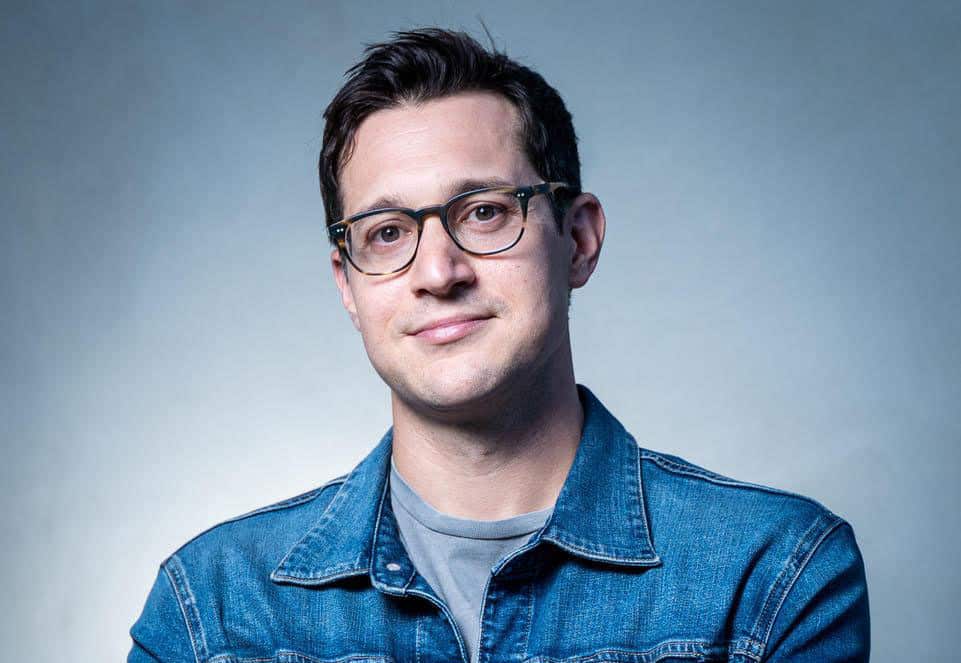
Comedian Dan Levy Dishes on Putin, A TV Show He Hosted and How His Father Got In Trouble

Comedian Dan Levy admits he enjoys gossip. Asked if there is something wrong with the world when an article about Russian president Vladimir Putin gets little engagement or reaction, while an article about whoever Leonardo DiCaprio is dating gets a huge one, he said the answer is simple.

“That’s because Leo is so damn hot,” Levy told the Journal. “I think if Putin worked on getting hotter, more people would pay attention to him.”

Levy, who married actress Rachel Specter in 2010, said he is excited to perform at the Chosen Comedy Festival at The Orpheum Theater on February 14, hosted by Elon Gold and Modi Rosenfeld.

“It’s gonna be a fun time,” Levy said. “I love all the comedians performing.”

The Emerson College graduate, who moved from Connecticut to Los Angeles for a career in comedy, created the 2020 NBC series “Indebted” starring Fran Drescher and Steven Weber. The show focuses on parents who move in with their kids.

“She was really nice and made us chopped liver,” Levy said of Drescher.

Levy has also written several episodes of the ABC show “The Goldbergs” featuring Jeff Garlin as Murray. Garlin, who also is known as Jeff Greene on “Curb Your Enthusiasm” is performing at the festival along with Moshe Kasher and his wife, Natasha Leggero. Leggero and Levy co-hosted an HGTV show called “House Hunters: Comedians on Couches.” On the fourth episode, they were joined by JB Smoove, who plays Leon on “Curb,” to watch the show about homes and provide commentary. Levy noted the absurdity of a man named Dane telling his wife he needed to build a cat tube for whatever house they selected. “The biggest question is who gets the cats when this couple splits in 25 minutes,’ Levy joked in the episode.

Levy recently returned from a tour with comedian John Mulaney, including this past summer when they performed at the Hollywood Bowl as part of the “Netflix is a Joke” festival. He said his parents were supportive of his decision to be a comedian and even came to see him perform in Honolulu.  

During an appearance on “Late Night With Seth Meyers,” Levy joked that he drinks coffee like a homicide detective. He also said he has been friends with the “Schitt’s Creek” actor who shares his name” for about 15 years. And he recalled a time where his roommate accidentally ate pot cookies, thinking they were regular cookies and then thought he was having a psychotic break. As most can relate to family members who don’t listen to instructions, he said when his family thought they were going on a mild boat ride, it turned out to be whitewater rafting. His father fell out into the water and did the opposite of what they were told to do.

“He totally didn’t listen, but he was okay,” Levy said. “He had a life vest.”

His special, “Dan Levy: Lion,” on Amazon, gets its name from his personal trainer asking him if he is a zebra or a lion. He says his son’s name is Abe, in case you didn’t know he was Jewish. He also explains to the crowd what a bris is, and says it was odd that the mohel was killing it with his jokes, saying: “’Don’t stand too close, you’ll get snipped too. Who wants bagels?..’ He was crushing. My aunt Phyllis choked on whitefish. It was crazy.”

With the talent that will be on stage, the comedians won’t have to fish for laughs. 

Levy, who is a big fan of challah and has three children, said on stage, he mostly stays away from politics.

“I will not be making any jokes about (President Joe ) Biden’s State of The Union Address,” Levy said. 

Comedian Dan Levy Dishes on Putin, A TV Show He Hosted and How His Father Got In Trouble Read More »

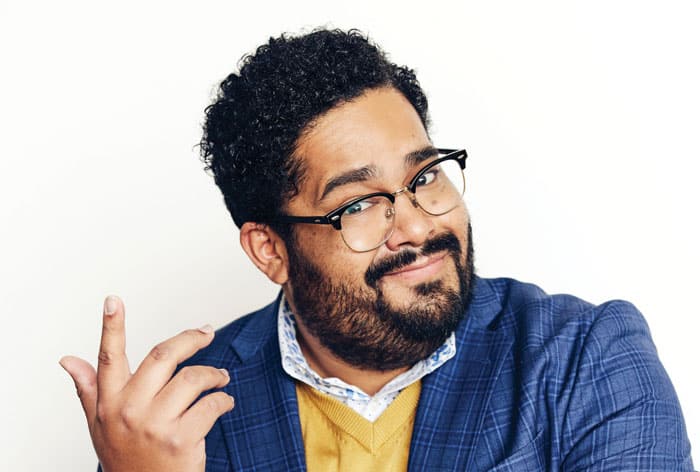
Josh Banday’s Got Killer Jokes For Days

Death isn’t supposed to be funny.

But actor Josh Banday is a great comedic talent who has happened to be involved in projects that involve that subject.

On Amazon Prime’s mind-bending and groundbreaking sci-fi comedy “Upload,” he plays Ivan, an “angel,” or a living tech support person, for people who have died and been uploaded and are now living in digital form. The story follows Nathan Brown, (Robbie Amell) who is critical condition after a car accident. His girlfriend Ingrid (Allegra Edwards) has him uploaded to Lakeview, a kind of Heaven for people who have someone that can pay a lot of money to Horizen, the company that handles it all. Nathan develops feelings for another angel named Nora (Andy Allo) and she wonders if she can have a romance with a man who is handsome and charming but not alive.  Some interesting scenes involve a memory parlor where people can flash back to a video of any memory. If that could be done, what would Banday like to see?

“I had some really good times with my dad,” Banday told the Journal. “He was a surfer and he just passed away this year. He was a really good guy and he’d been sick for a long time but there was a time when he was younger and I was younger and he was a rascal and we would have adventures, play tennis, and just having him push me on a surfboard. I would watch that over and over again.”

On the show, Nora’s father is ill and she tries to convince him to be uploaded and they go to a community that is anti-tech due to the socio-economic polarities it has created.  Ivan plays both sides and also is thirsty for some of the female characters, but he manages not be sleezy. He said that was something he specifically went over with executive producer and showrunner Greg Daniels, (who also was the executive producer of “The Office” and “Parks and Recreation”) prior to filming. Andrea Rosen, who plays Lucy, his boss on the show is mean and yells at thew workers.

“If Ivan was boss, I think nothing would get done,” he said.

The Los Angeles resident attended Westchester Neighborhood School, where he said he learned aspects of Jewish culture. Banday, who has Jewish ancestry on his grandmother’s side, said he had great fun at the elementary school.

“Hannukah had the best food with latkes,” he said, adding that he likes to spin the dreidel.

But it was skill and not luck that Banday the role of Dennis, an editor who is now the boss of his friend Nell (Gina Rodriguez) on ABC’s “Not Dead Yet.” He puts her on the obituary beat, but the kicker is her subjects come alive for only her to see. The show premiered on February 8. The cast includes Hannah Simone (Cece on “New Girl”) as Sam, Lauren Ash (Dina from “Superstore”) as Lexi. Dennis gives Nell her first assignment about a musician named Monty, a bubblegum jingle writer who died of prostate cancer. 

“Don’t judge a person by their jingle, Nell,” Dennis tells her. “Everyone has a story …” He tells her it’s her job to find it.

“I’m really excited because it’s an amazing cast and I’m the type of person who likes to get to know my castmates,” Banday said.

He recalled a time where he sang with Allo on the “Upload” set. He sings and plays guitar and one day he jammed with Allo (who has a drop-dead gorgeous voice that you must check out) and he was surprised she took out her computer and the two were on her Instagram Live.

“I was like ‘oh my God, what is going on here?” Banday said.

On “Upload” and in “Not Dead Yet,” Banday dons dangerously dapper suits. “If you’re looking for them, they may or not be in my closet,” Banday said.

Being Black, and having Jewish blood, Banday was asked if he had any ideas on how to tackle the rising incidents of racism and antisemitism.

“It’s obviously very difficult, but I would urge people to get involved in sports, music, acting or (something in) the Arts,” he said. “When you connect with people in a fun collaborative setting where people showcase their lifelong ability, I think it widens the capacity to connect and view people for who they are and narrows the ability to view a person by a prejudicial covering that one may have been taught.”

Banday appeared as a doctor on the show “Murderville” and got this reporter to laugh when he described his episodes of Hulu’s “Pam & Tommy.” “I was like, ‘are you sure the contract is right? There is no death happening,” he said.

Banday grew up in South Central, Los Angeles, said he’s proud to be able to do imitations, including a good one of Morgan Freeman. A fan of “Seinfeld” and “Friends” he has a scene on “Man With a Plan” which features Matt Leblanc, who played Joey on “Friends.” Banday said LeBlanc was very warm on set.

What’s Banday’s plan?

“I think it’s super important to be prepared and be versatile and not to let naysayers control you,” he said. “When I tried out for “Upload’ I didn’t think I got the past because the woman was mouthing the words of my lines. I got the part. I had a mentor who said I would never make to The Groundlings or Second City. But rather than take what he said at face value, I said, let them tell me. So, I auditioned, and I got it. It’s a hard craft and there for sure are rejections, but I always believed in having positive energy, and working hard to make your dreams come true.”

What will we see from Ivan when “Upload” releases its third season?

“All I can say is Ivan is a guy who raises questions.  What I hope people take away is that our life is precious and it’s so easy to be jaded, but we have a limited time here. At times we might focus on bad things, but there are so many amazing times of laughter, love and beauty, whether it’s with our children, other family members or friends. People should not be in such a rush in their life that they miss it.”

Josh Banday’s Got Killer Jokes For Days Read More »

Within (and Without) Languages: A Jewish Writer’s Translingual Adventures

In different ways, I’m rooted in three cultures—Russian, Jewish and American. Yet a writer’s life is about much more than one’s sense of roots. It’s about floating in spacetime, about the texture, scent and taste of words. And the life of an immigrant writer is always and inevitably a story of unburdening oneself of the past and a history of border crossing. The borders—or boundaries—include those of languages, cultures and countries, some of them invisible while others still guarded with silences or even barbed wire. And the attempts at border crossing sometimes delight or enchant the transgressor while also auguring disappointment, heartbreak or even real danger.

I first started thinking about the interrelationship of origins and literary language after coming to the West in the summer of 1987. The black sand of a seedy Tyrrhenian public beach in the Italian town of Ladispoli was my open-air reading and writing room. My parents and I had recently left Moscow for good after eight and a half years of a refusenik limbo. We were spending the summer in Italy while our U.S. refugee visas were being processed. We had brought four suitcases, one of them containing three or four tattered family photo albums, and two manual typewriters, one my father’s, the other mine. The typewriters have survived all the peripeties of transit and still function today, although not much besides those typewriters and some Russian books from our old Moscow library remains of the material baggage of our Soviet past. As to the memory of our lives before emigration, it’s taken much longer to dispose of the immaterial baggage of exile.

It was a summer of transit, a time of many discoveries. In Italy, still waiting for America, I pored over books by Russian exiles who had faced the predicament of choosing another language of self-expression. First on my list was Vladimir Nabokov, the great Russian-American writer, author of “Lolita” and “Pnin,” who remade himself after coming to America as a refugee in 1940, having rescued his Jewish wife and son. I was also reading the novels and stories of Mark Aldanov, who wrote in Russian and actively published in English and who, in the 1940s and early 1950s, before the “Lolita” explosion, was the most commercially successful living Russian author in America. With me, copied into a small leather-bound notebook, was two-thirds of what would become my first poetry collection, to be published in New York in 1990. Would I ever be able to write in another language? I wondered that summer. What would be the price of losing—of abnegating—what I thought at the time to be my own Russian voice?

Four months later, on a wet November afternoon of my first American autumn (which was balmy by Moscow standards), I walked across the campus of Brown University and knocked on the office door of John (Jack) Hawkes. Author of “The Passion Artist,” Hawkes was a legendary American postmodernist, the most famous writer on the Brown faculty. He was retiring the following year. A recent immigrant studying literature and literary translation, I desperately wanted to take Hawkes’s last fiction-writing seminar. All the twelve slots were taken.

Silver-haired, witty, verbally perverse, Hawkes listened to my rambling account of leaving the USSR, of writing poetry and fiction in Russian, and of coming to the U.S. He waited, silently, lips twitching, then asked:    “Have you read Nabokov?”

Hawkes pronounced the second “o” in Nabokov’s name with an extra roundness, as if caressing the stressed Russian vowel. “Nabokov?” I asked, in disbelief. “Of course I have.”

“He’s remarkable,” said Hawkes. “I first read him in 1945—in San Marino.”

“My grandmother got lost in San Marino last summer,” I commented. “She ended up on the local emergency radio broadcast.” Hawkes looked at me with bemusement. In 1965 his novel “Second Skin” competed with Nabokov’s “The Defense” and Bashevis Singer’s “Short Friday” for the National Book Award for Fiction. Saul Bellow’s “Herzog” took the prize.

Hawkes had no interest in Soviet politics, no ear for Jewish immigrant anxieties. Yet he let me into his fiction seminar as the thirteenth student and even had his own plans for my literary future. Hawkes wanted me to write surrealist, pathological tales set in the Russian countryside. In the spring of 1988, a translingual novice surrounded by other young writers—all of them American-born—I first tried my hand at composing fiction and nonfiction in English. I’m forever grateful to Jack Hawkes, whom I ended up disappointing with what was then my passion for politics-infused narratives.

Over thirty-five years have gone by. I’ve now lived in Boston much longer than in my native Moscow. Many times I’ve asked myself, sometimes happily, sometimes wistfully, what it means to write translingually. (In the context of literary studies, the scholar Steven G. Kellman was the first to speak of translingual writers.)

Over the years I’ve learned that there’s more to translingualism than working not just in one language but in two or more, simultaneously or consecutively. In the not so recent past, translingual writers used to be all alone, artistically homeless, culturally stateless. Think of the loneliness of Rahel, arguably the first modern Hebrew woman poet, who was born in 1890 in Saratov on the Volga and died in Tel Aviv in 1931, leaving for posterity two published collections of Hebrew verse and an unpublished volume of Russian poems. Think also of Paul Celan, a multilingual Jew from Northern Bukovina who lost his family during the Shoah, went on to write and publish peerless German-language poetry, and in 1970 killed himself in Paris. Think, finally, of the less unhappy yet still lonely story of Samuel Beckett, the Irish literary genius who spent much of his adult life in France and translated most of his French works into English. Is a translingual writer who has found a new home no longer writing in a trance, no longer living in transit?

Over the years I’ve learned that there’s more to translingualism than working not just in one language but in two or more, simultaneously or consecutively.

Perhaps literary translingualism means, as the fervently monolingual American poet Robert Frost might put it, “betwixt and between,” both here and elsewhere. If so, what happens when we discover a literary community of fellow translinguals? What changes when we perceive ourselves—and are perceived—as a trend, a literary movement, a school?

Let me turn, briefly, to the story I know best and sometimes call my own, that of ex-Russians—and ex-Soviets—writing in English. When the Russian diplomat Pavel Svinyin (Svenin) lived and published in Philadelphia in the 1810s, he was in a league of his own. When the Yiddish- and Russian-speaking Abraham Cahan, the legendary editor of The Forward, an immigrant from the Russian Empire, was learning to write fiction in English in the 1900s, he, too, did not have many interlocutors. The St. Petersburg–born Vladimir Nabokov had very few artistic colleagues in the truest sense of the word when he arrived in America as a refugees after having rescued his Jewish wife and son.

In the 1970s and 1980s, many more writers came to the U.S. and Canada from the USSR, riding the wave of the great Jewish emigration. These new Russian-American writers—Joseph Brodsky most famously—sought to write in English Russianly, and not so infrequently this ambition stood in the way of their styles and voices as they forded the Hudson and the St. Lawrence. It has taken at least a generation for Soviet immigrants to find their literary bearings in the New World, and perhaps even longer to form a translingual neighborhood—a community—both in their own eyes and in the eyes of the American and Canadian cultural mainstream. Some of today’s translinguals left the former Soviet Union as children and young people. They have their literary great-uncles and great-aunts on both sides of the Atlantic.

Representatives of this new wave of American and Canadian translingualism write in English and do so by hearkening back to such major Jewish-Russian authors as the incomparable short-story writer Isaac Babel and also to llya Ilf and Evgeny Petrov, who coauthored their popular satirical novels. At the same time, not surprisingly, some of the Russian-American authors also nominate Bernard Malamud, Philip Roth and Mordecai Richler as their literary ancestors. Today we have translingual literary lovers and partners, editors and publishers, friends and next-door neighbors. A greater sense of shared cultural ancestry and thematic unity makes the circle of today’s Anglophone writers from the former USSR something of a Russian family business and also something of a Jewish community affair. Only time will show whether we’re bound to lose our Russian-American and Russian-Canadian voices tinged with a Jewish accent.                                                                                                                    

Only time will show whether we’re bound to lose our Russian-American and Russian-Canadian voices tinged with a Jewish accent.

Over the years of living—and writing—away from Russia, I have gone through periods of writing literary texts only in Russian, of writing no literary texts in Russian, of writing poetry in Russian and literary prose in English, and of writing only literary prose in English. The final year of the Trump rule and the onset of the COVID pandemic led me to the composition of English-language poetry, some of it in the satirical mode. And throughout these years of living as an émigré and a translingual subject, I have always been involved in one or another form of self-translation. Self-translation has evolved from attempts to give previous Russian texts another life in English (a life they may or may not have deserved)—through creatively revising my English-language fiction and nonfiction—to parallel compositions of texts in both English and Russian, a mode that I presently find most stimulating.

In what language do you think? I’m often asked during readings and literary events. Is it Russian? English? Both? I reply, honestly, that in a sense it does not matter for the creative outcome. Over the years, I have had vivid dreams in which I lectured in French about sophisticated matters of culture and history. When I’m awake, my command of French is limited. In the spring of 1993, when I was living and doing research in Prague, I experienced dreams in which I had extensive debates about politics with the former vintage 1968 Czech dissidents. In reality, my Czech is quite rudimentary. I’m pointing this out because dreams give us deeper access to mechanisms of culture production—mechanisms that probably impact translingual writers most profoundly by revealing the hidden texture of exile.

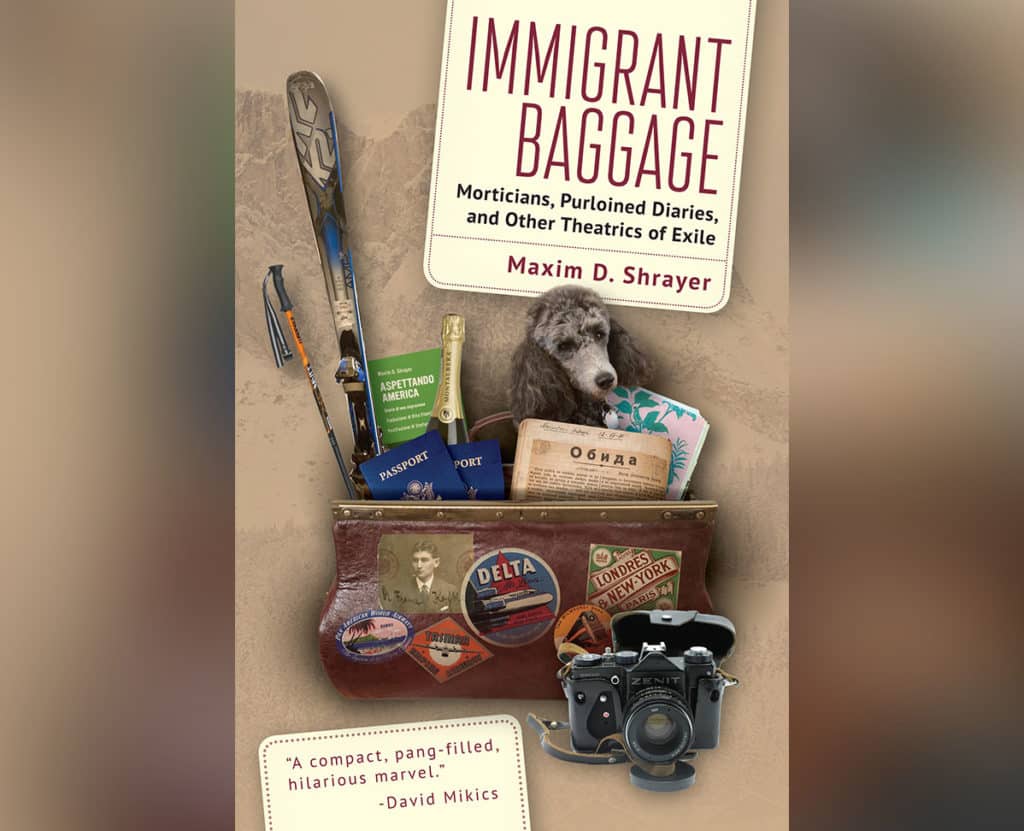
To return to my own translingual beginnings, my 1987 experience as a Soviet refugee in Italy eventually informed the writing of my literary memoir “Waiting for America: A Story of Emigration,” in which discoveries of new worlds, and words, are measured on the rusty scale of nostalgia. Three and a half decades after emigrating from Russia, I finally felt ready to describe what it had been like to live both within and without languages. “Immigrant Baggage,” my new memoir, is a story of the translingual self that refuses to be trapped in museums of culture and identity. Now feeling less of a stranger among American writers, I’m still learning the secret craft of writing in tongues.


Maxim D. Shrayer is an author and a professor at Boston College. His recent books include “A Russian Immigrant: Three Novellas” and “Of Politics and Pandemics.” This essay was adapted from Shrayer’s new memoir, “Immigrant Baggage,” forthcoming in the spring of 2023.

Within (and Without) Languages: A Jewish Writer’s Translingual Adventures Read More »

Three Jewish Students Dorm Rooms Vandalized at University of Denver

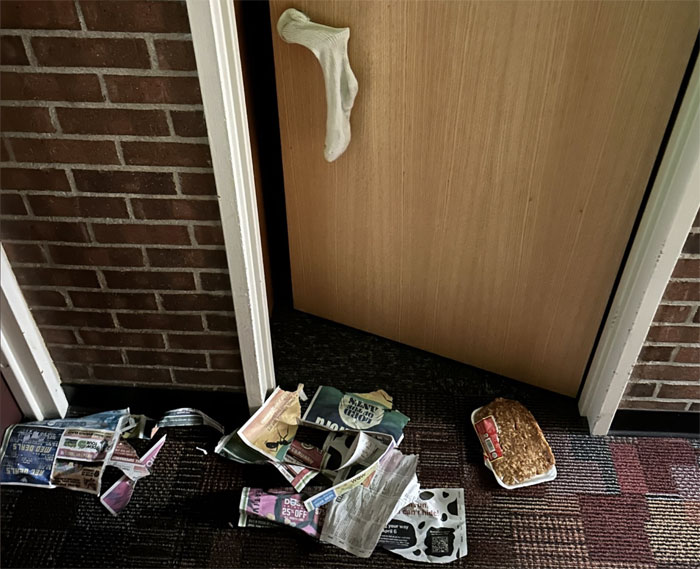
The dorm rooms of three Jewish students at the University of Denver (DU) were vandalized sometime during the timeframe of February 9-12.

StandWithUs announced in a press release that one student’s dorm was smeared with pork and the pork was left in front of their doorstep; two other students’ dorms had their mezuzahs torn down. 

University Vice Chancellor of Student Affairs and Inclusive Excellence Todd Adams said in a February 13 letter to student that the university investigating the matter. We want to be very clear that these acts are NOT acceptable within DU’s community, and acknowledge the harm that has been caused to members of our community,” Adams said. “Every student, faculty, and staff member deserves a place to live, learn, and work that is respectful, welcoming, and safe. Each of us shares the responsibility to foster that environment through our actions.”

He also urged “community members to be accountable for our community. This means holding oneself and one’s community responsible when harm is caused, seeking ways to prevent harmful acts from occurring in the future, as well as engaging in campus life, including cultural and educational opportunities, to make connections across the DU campus.”

The Hillel of Colorado said in a statement, “We are shocked and angry to learn about three acts of antisemitism at our University of Denver campus this week. We have confirmed that three students had mezuzot … taken down and defiled and one had pork products glued to their door. Small acts of hate lead to bigger ones and make life unsafe for all students.” The statement concluded with a call to “stand up for your Jewish friends and do not be a bystander.”

StandWithUs CEO and Co-Founder Roz Rothstein said in a statement, “As a daughter of Holocaust survivors, I am shocked and horrified by the religious nature of these antisemitic assaults taking place in 2023. It is no coincidence that the rise in anti-Zionist and anti-Jewish rhetoric and campaigns on campus have contributed to a rise in antisemitic incidents targeting Jewish students. University administrators must recognize this problem and address antisemitism on their campuses swiftly and seriously.”

Stop Antisemitism tweeted, “Antisemitism is skyrocketing in the U.S., specifically on university campuses. Often times, administrations attempt to brush these types of incidents under the rug. We need to ensure that doesn’t happen and a full investigation happens.”

Three Jewish Students Dorm Rooms Vandalized at University of Denver Read More »

Who Was Murray Schiff?

Murray Schiff was my uncle.

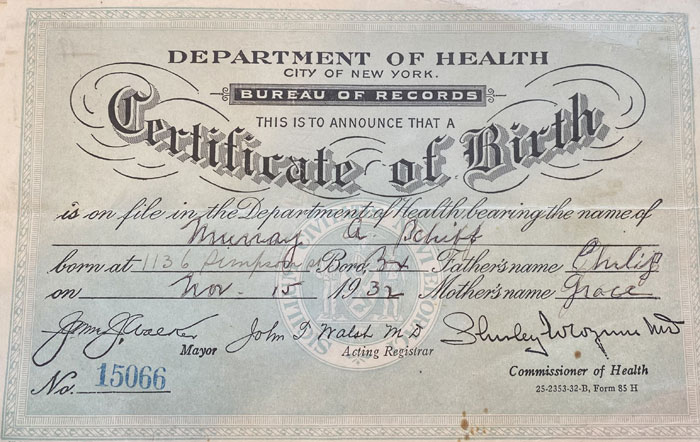
Murray was born in the Bronx on November 15, 1932, and died on July 2nd, 1933. He lived 229 days.  A month and a half longer than baseball season. 

Murray died from complications of pneumonia.

He was the third of four Schiff boys. The oldest was my dad Julian, then Harold, Murray, and Stanley. But who was Murray? And what was special about him?

Murray is buried at Beth-El Cemetery in New Jersey. Also buried at Beth El is the Gamzon family. The Gamzons are my mother’s side of the family. 

My parents went to Jersey for only three reasons: To buy cheap gas, to visit the cemetery, or to get buried there. 

While the Gamzons’ plots are all together Murray is off by himself in a section just for children. It’s a section with tiny gravestones. 

Even though it’s a short two-minute walk from the Gamzon graves, Murray’s section seems much more isolated and lonelier. 

His stone has only his name, birth, and date of death. After 90 years of brutal East Coast weather, his chiseled name is barely legible. 

There was nothing else to write about him because he had not accomplished much.  Or did he?  

After a few minutes with the Gamzons, my father would quietly say, “I’m going over to see Murray.”  I always walked with him. While walking over he was always silent and occasionally he’d kick some dirt. Mom would stay behind and chat with her folks. This was my dad at his loneliest.

My grandmother carried Murray for nine months– that’s two months more than he lived. So let me tell you who I think my uncle Murray was. Because he was something special.

My grandmother carried Murray for nine months that’s two months more than he lived. 

Because Murray ran out of time so quickly nobody got to know him. 

Murray never learned to walk, talk or even play. He spent most of his short life on his back staring up to heaven. 

Even though antibiotics were invented in 1928, there was no saving Murray. Murray was in a rush to leave. He got pneumonia and probably cried a bunch then went to sleep and never woke up. 

So let me tell you who I think my uncle Murray was. Because he was something special.

Murray was not just an infant that did nothing. Not at all. Like all of us, Murray had a purpose. You might say he was purpose driven. Murray added so much to people’s lives that 93 years later we’re still thinking about him. So I’ll tell you who Murray was: Murray was the baby that everyone loved. Even though I never met him I love my uncle Murray and, in some way, I miss him. I heard he made everyone laugh. That means he made them happy. 

I was never there but I didn’t have to be. I could see it in the sadness and tears and on their faces when they would bend down and pull up weeds from the dirt surrounding his grave. They wanted to make Murray’s grave look clean and neat.Then before leaving they would each get a rock and put it on his gravestone.  The rock is a little gift you leave behind to let him know he was remembered and cared about. Some believe the soul lingers there. 

I know who Murray was. Murray was a little Jewish baby boy who smiled from the day he was born till the day he died. Murray was so pure that not one person ever had a bad thing to say about him. The fifth commandment Kibbud Av Va-em (honoring your parents) is one of the hardest commandments to keep and nobody was better at it than my uncle Murray. Murray was as close to being an angel as any person can be. I’ll go out on a limb and say Murray was perfect. In some ways, Murray accomplished more than many of us. Murray entered the world with a clean slate and left the same way. No need for him to bang his chest on Yom Kippur. What more could be asked of someone? Yes, I know Murray. I know him well. In some ways, Murray was my teacher, one of my role models. Uncle Murray was pure heart and soul.


Mark Schiff is a comedian, actor and writer, and host of the ‘You Don’t Know Schiff’ podcast. His new book is “Why Not? Lessons on Comedy, Courage and Chutzpah.

Who Was Murray Schiff? Read More »

Open Letter to Joe Rogan on Antisemitic Tropes

Dear Joe,

On your podcast recently you casually mentioned one of the most prominent and persistent anti-Jewish tropes the world has ever seen: the idea that Jews love money. But instead of dispelling it, you laughed and said that it was obviously true, and you even expressed disbelief that Ilhan Omar (D-Minn.) felt the need to apologize for using it. 

You are one of the most influential people in the world, and an incredible podcast host. In general, you expect your guests to educate you about topics on which you are not an expert. In this instance, your guests utterly failed to correct your mistake and indeed doubled down on the offensive stereotype. Please consider this letter in the spirit it is written — as the correction your guests should have made.

Part of the myth about Jews and money goes all the way back to the New Testament, in which Judas betrays Jesus for some silver. By the Middle Ages he was depicted in art as a caricature of evil, dressed in a distinctive bright yellow cloak (the color of gold) that distinguished him as a traitor — branding that the Nazis would later reintroduce in the form of the yellow star.

The myth of Jews and money gained new life in medieval Europe, when Jewish people were openly discriminated against, by law, and forced to live in the margins of society. 

The myth of Jews and money gained new life in medieval Europe, when Jewish people were openly discriminated against, by law, and forced to live in the margins of society. They were excluded from participating in most professions, and in most cases from owning land; sometimes their only option for survival was crediting on interest. This worked out well for the Christian rulers who considered doing so a sin, and so they recruited their local Jews to do it for them. The nobleman would loan money to the Jew, and the Jew in turn would loan money to the non-Jewish peasants around him. If the Jew did not collect on time, the nobleman would kill him. As a bonus, whenever things went bad and people complained to their leaders about their difficult financial straits, there was a ready-made scapegoat built into the equation in the form of the exaggerated money-hungry Jew.

Whether people are rallying against the Rothschilds or George Soros, there always seems to be a rich Jewish bogeyman secretly pulling the levers of power to bend the world to their will. 

Antisemitic ideas about money-loving Jewish traitors are also tied directly to the ones about Jewish power and control. This triad was concretized, for example, in “The Protocols of the Elders of Zion,” a wildly racist paranoid fantasy first published in Russia in 1903. It describes a plot by a secret cabal of wealthy Jews to subvert and control the world through their finances, and it quickly became the most widespread and one of if not the most influential pieces of antisemitic literature ever written. You might be shocked to learn just how many Americans still believe this trash, on both sides of the spectrum; whether people are rallying against the Rothschilds or George Soros, there always seems to be a rich Jewish bogeyman secretly pulling the levers of power to bend the world to their will. The “Protocols” was used by the Nazis as “proof” of the Jewish people’s wickedness, greed and disloyalty, and the manuscript formed an important part of the Nazis’ justification for Jewish genocide. On your podcast, you said that saying Jews love money is just like saying Italians love pizza. But Jews did not invent money, and as David Baddiel has pointed out, Italians have not been slaughtered throughout history for loving pizza. 

So no, Joe, Jews don’t love money any more than any other group. In fact, studies have shown that American Jews give a disproportionately large amount of their money away to charitable causes. Even if it is part of comedy for a comedian to play with stereotypes, when you tell a worldwide audience that a dangerously offensive antisemitic trope is true, in dead earnest, without a hint of irony, outside of any routine, and that people who disagree are just stupid, well that isn’t comedy, and that only feeds hateful stereotypes that have always led to violence against innocent people. 

It is also worth noting how quickly your guest gleefully built off your comment to explain how “Jews love money” justifies Omar accusing American Jews of dual loyalty (yet another related trope) and outright bribery, all for the heinous crime of legitimate participation in the American political process. See how quickly the conversation can shift from Omar’s comments about how American politicians’ support for Israel is based on money rather than principle, to “Jews love money,” right back to “and that’s why American Jews with their dual loyalty conspire to pay off politicians with their money to support Israel”? Welcome to modern antisemitism.

Ilhan Omar “apologized” for using antisemitic tropes because she knew better — certainly after the first time, or the second time, or the third time she was told. You are different, and you have no responsibility to apologize. But especially in a time of rising antisemitism, even (and especially) among influential celebrities, you do have a responsibility to correct the record for your listeners. As a fan, I sincerely hope that you do.


Dr. Mark Goldfeder, Esq. is an international lawyer and Director of the National Jewish Advocacy Center.

Open Letter to Joe Rogan on Antisemitic Tropes Read More »

As Fear and Frustration Rise in Iran, What is Our President Doing?

They picked the location: a main square with the backdrop of Tehran’s famous Azadi (“Freedom”) Tower, a sensitive location, to say the least. The Azadi Tower opened in the early 1970s under the rule of the secular, modernizing Shah, Mohammad Reza Pahlavi and was meant to celebrate 2,500 years of the Persian Empire. Back then, it was called the Shahyad (“In Memory of the Shah”) Tower and was designed by a Bahá’í architect named Hossein Amanat, whose faith isn’t even recognized in Iran today, and who now lives in exile (he also designed the Bahá’í Arc buildings in Haifa). 

With the location in place, he took her hand and they began to dance together. At one point, Amir Mohammad Ahmadi, 22, lifted his bare-haired fiancée, Astiyazh Haghighi, 21, in the air as they swayed gracefully. Her hair flowed freely. He dipped her. They kissed. 

Last fall, the couple, who are bloggers, posted the video to Instagram, where it received millions of views by Iranians at home and abroad. And then they were arrested. According to the Human Rights Activists News Agency, Haghighi and Ahmadi were denied a lawyer. 

Their conviction for dancing together in public is so extreme that one may have to read it twice to believe it. The couple was charged with “spreading corruption, vice, and prostitution, assembly and collusion with the intention of disrupting national security, and propaganda against the establishment.” In early February, they were each sentenced to five and a half years in prison.

Such is the current state of affairs in Iran. And these days, I’m asked one particular question, whether by friends, readers or on social media, that truly pains me: “Are the protests in Iran dying out?”

It may seem like an innocent question, but to Iranians in the diaspora, it’s loaded with pain and anxiety. You see, we may not be able to fight for freedom on the streets in Iran, but we, too, have a lot riding on this revolution. In fact, it’s painfully nuanced: We desperately want the revolution to succeed, but we don’t want more innocent Iranians killed, injured or imprisoned. I know that sounds naive, but it’s true. 

Since protests erupted in Iran after the September 2022 murder of Mahsa Amini, nearly 20,000 people have been arrested and at least 522 have died (70 of them minors), according to the NGO Human Rights Activists in Iran, which has been monitoring the protests along with several other groups.

I’ll spare readers the horrifying crimes that have been perpetrated against those who have been arrested (including rape against men) and even their families, but suffice it to say, stories of such brutality and the sheer force of the police have undoubtedly had an impact on protestors.

The Iranian revolutionary train has left the station. But Americans deserve to know why President Biden just derailed its historic departure. 

When asked if the protests are losing momentum, Iranian dissident and Nobel Prize laureate Shirin Ebadi, who is based in London, compared the revolution to “a train that left the station” during a February 10 panel of key opposition leaders sponsored by Georgetown’s Institute for Women, Peace and Security. The event, which was held in person and included televised remarks from speakers abroad, was broadcast live around the world, including in Iran. Ebadi was the first female president of a Tehran city court (and one of the first female judges in Iran), but after the 1979 revolution, she was dismissed. In 2000, Ebadi was arrested for advocating on behalf of oppressed Iranians.

“The next wave will come, and it will be heavier,” added Canada-based Hamed Esmaeilion, president and spokesman of The Association of Victims’ Families of Flight PS752 (Esmaeilion lost his wife and 9-year-old daughter when the Iranian Revolutionary Guards Corps shot down a Ukrainian airliner in 2020 using two surface-to-air missiles, killing all 176 onboard). To see Esmaeilion’s face is to see the countenance of a broken man who is as much fueled by love for his lost family as by seeking justice against those who took their lives.

“The revolution isn’t dead; the regime is dead in the hearts of the people.”

Exiled Iranian journalist and Nobel Peace Prize nominee Masih Alinejad said, “The revolution isn’t dead; the regime is dead in the hearts of the people.” She also reminded viewers that revolutions take different forms, and protests in the streets are one of those forms. Exiled Prince Reza Pahlavi, son of the Shah, asked whether the civil rights movement in the U.S. ended when Martin Luther King, Jr. was assassinated. Claiming that the revolution in Iran has died down is “offensive,” said Pahlavi. Each of the exiled leaders who spoke live or via video stressed that Iranians must be united for an opposition movement to have a chance of succeeding. 

Last week, Nasrin Sotoudeh, a prominent Iranian human rights lawyer, told CNN’s Christiane Amanpour that “the protests have somewhat died down, but that doesn’t mean that the people are no longer angry … they constantly want and still want a regime change. They want a referendum.”

Sotoudeh wasn’t speaking in-person with Amanpour in the West, but live via video from her home in Tehran, where she is currently on medical furlough from jail. Did I mention that Sotoudeh, one of the most brilliant legal advocates for women and children’s rights in Iran, has been sentenced to 38 years in prison and 148 lashes? 

And then, there’s Dr. Farhad Meysami, a 53-year-old physician who was finally released last week after being in jail since 2018 for supporting Iranian women who’ve fought against the mandatory hijab (Islamic head covering). Meysami began a hunger strike on October 7 and, according to a tweet by his lawyer, has lost 115 pounds. Images of his emaciated face and body, with protruding ribs, recently went viral, to the horror of millions. From attorneys to physicians, singers, athletes and even award-winning directors, some days, it seems like the regime is arresting virtually everyone. I urge readers to Google the now famous photo of Meysami on his hunger strike. If his suffering doesn’t make you grateful for your own life and freedoms, I don’t know what will. 

Amid this backdrop of horrifying human rights abuses in Iran came news last week that the Biden administration is partially waiving sanctions on the regime to allow Russia (specifically, Rosatom, Russia’s State Nuclear Energy Corporation) to work with the mullahs without facing U.S. sanctions. It’s a win-win: Iran will be allowed to continue development of its nuclear program while enriching a Russian state-controlled organization. 

Iranians know that waiving sanctions, even partially, means only one thing: The regime will receive more money to crush this revolution even more harshly. A collective cry of outrage (plus a few expletive-filled outbursts) emanated from many Iranian Americans, myself included, when the Biden administration announced this roll-back of sanctions last Friday, just in time for Shabbat. 

Last Saturday marked the 44th anniversary of the Islamic revolution in Iran, and while state-organized rallies around the country touted the regime’s virtues, in the U.S., anti-regime rallies, including one in downtown Los Angeles, brought thousands of exiled Iranians together. In Iran, President Ebrahim Raisi’s televised speech was interrupted by an anti-government hacker group by the name of Edalate Ali (Justice of Ali). In the background, a voice shouted, “Death to the Islamic Republic.”

Incidentally, that televised speech was held at Tehran’s Azadi Square, home to the Azadi cultural complex mentioned at the beginning of this column. One space, two starkly different meanings. 

For one couple, it meant a 10-year prison sentence. For a regime head famously known as “The Butcher of Tehran,” it meant celebrating (if you can call it that) half a lifetime of brutality (44 years). And in Washington, D.C., the ultimate symbol of freedom worldwide, the most powerful man in the world decided to loosen sanctions and strengthen both Iran and Russia. In doing so, he just signed a death sentence against hundreds more who seek freedom in Iran. 

The Iranian revolutionary train has left the station. But Americans deserve to know why President Biden just derailed its historic departure.


Tabby Refael is an award-winning, L.A.-based writer, speaker and civic action activist. Follow her on Twitter and Instagram @TabbyRefael.


As Fear and Frustration Rise in Iran, What is Our President Doing? Read More »