
fbpx

December 8, 2022

A Moment in Time: “Did You Catch the Name of YOUR Angel Today”

Dear all,

Last Friday I met an angel. Her name was Dana.

Dana works for Boeing, and she was attending a private event at the Flight Path Museum at LAX. I took the kids there after school, and we were disappointed upon arrival that we couldn’t enter due to the event.

Dana overheard our situation. (Having two toddlers express their frustration hardly make us inconspicuous!) She ran after us as we walked away and invited us to attend as her guests.

What could have been a failed excursion transformed into a wonderful afternoon.

All because of a chance encounter in that moment in time.

We all meet angels – each and every day. We just need to open our eyes to notice them. Who will you meet today? (And perhaps, just perhaps, you will be the angel to someone else).

With love and Shalom,


Rabbi Zach Shapiro

A Moment in Time: “Did You Catch the Name of YOUR Angel Today” Read More »

How Tech and COVID Altered Sam Glaser’s Musical World

As a popular and well-traveled performer in the world of Jewish music, Sam Glaser’s career was sailing – until two unanticipated disruptions threatened the journey.
Since 1997 Glaser has been performing concerts in 50 cities a year in the U.S. and around the world. Producing albums and videos, whether singing or at the piano, he has been thrilling audiences, and the feeling was mutual.

Then Big Tech struck, closely followed by the COVID pandemic. These threw him for a loop.

“Essentially,” Glaser said, “since 2020, going places has been challenging. After the streaming services started up — the Apple Musics and Spotifys — the life of a musician pretty much became go live or go home.”

Digital technology has drastically shrunk income.

“The common multiplier,” he said, “is about .003 cents per stream. A thousand new listeners to one of my songs, and supposedly I have made $3.”

Not quite. “That is before other people take their cut.”

Seated at a large console in his fully equipped backyard studio in Pico-Robertson, Glaser was asked about his countering strategy.

“There really is no countering it,” he said. “Essentially, Big Tech came and overwhelmed the industry. It was a better way to get music to consumers. More accessible. Universally adopted. You didn’t even need the MP3 player or an Ipod to load full of songs because the songs are in the ether forever – for free.”

He recalled driving through downtown Los Angeles a day earlier, spotting a sign that read “Apple Music: 100 Million Songs for You.”

With Big Tech’s arrival, “artists pretty much had to go to live music. Then live music became an endangered species during the pandemic.”

With Big Tech’s arrival, “artists pretty much had to go to live music,” he said. “Then live music became an endangered species during the pandemic, although it seems to have come back gangbusters this year.”

An exception, he quickly added, is his arena: “It has not yet come back in my genre in the Jewish world,” Glaser said.

“The pandemic has had a deleterious effect on the financial health of a lot of synagogues around the country, specifically in the Reform and Conservative movements.”

After 33 years of performing, Glaser has learned to adapt.

“My strategy always has been a triumvirate of earning possibilities,” said Glaser, “live, studio and my recordings.

“The pandemic took out live and recordings. Something has to make up for it. So, thank God, I run this room you are sitting in. I spend my days producing albums. I do music for all media: film, TV, books, games and podcasts.

“I am either writing the music or producing the music other people have written and bringing it to fruition.”

He anticipated the question of whether this is a satisfactory substitute for his original form of parnassah (livelihood).

“As a Jewish husband,” Glaser said with a shrewd smile, “cash flow keeps shalom bayis (peaceful vibes in the home) flowing. We depend on my income. Thankfully I made enough to get my three kids through 12 years of Jewish day school!”

“Thank God,” said Glaser, his plan is working. “Any time I despair, like I just finished a bunch of big clients. Now what? My wife always reassures me. She says, ‘You know, Sam, HaShem always has taken care of us.’”

One crucial reason is that the versatile, multi-talented Sam is as much engineer as performer. “When there is a breakdown, you do not make a phone call. You dive in.” Perhaps his most insightful moment surfaced when he declared: “I am a technician because I refused to not be able to make music.” On his website, Glaser says he is “equally comfortable behind a grand piano in intimate solo concerts, leading his eight-piece band or headlining with a full orchestra.”

“When I got out of (the University of Colorado) and tried to open my first recording studio, I had no idea what I was doing,” he admitted. “I was working with what was really primitive equipment. I figured out how to cobble together a decent finished product. My first few projects for people might not have been the best. But you figure it out. I have had years to figure it out, thank God.”

He seems to have been born with tech skills. “In my own realm, I can get the job done, and it really is a miracle,” Glaser said. “Let’s say something breaks down in the studio. You don’t necessarily want to call a tech. So what do you do? You have to troubleshoot, brainstorm, determine the source of the problem.”

As the youthful Glaser turns 60 this month, fixing what was broken has been a lifelong gift.

A performer since age seven, Glaser did not learn Mr. Fix-it from his parents.

“I am just really stubborn – or tenacious, either way you want to look at it,” he says.

After college, Glaser spent five years in the garment business with his father, while also trying to become a rock star. One day, he woke up and realized that after working a full-time job, 10 hours a day, he had nothing left at the end of the day to pursue his true love, music.

“Then my father lost his company,” Glaser said, “and I had to decide: Do I want to go into the music industry or the garment industry?” The question was not tough to answer. “In 1990, just before turning 28, I made a pledge to myself that I wanted to strike it out in music.”

“That is part of what makes this business interesting. You have to continuously reinvent yourself.“ 

Glaser soon learned that earning a living in show business is a constantly evolving challenge. “That is part of what makes this business interesting,” he said. “You have to continuously reinvent yourself. I never have had a paycheck since that year that was a regular do-the-job-and-get-a-paycheck. You have to continuously hustle.”  Does he find that energizing or frustrating? “Both,” Glaser said, “because you have to adapt.”

How Tech and COVID Altered Sam Glaser’s Musical World Read More »

Tom Tugend, War Veteran and Lifelong Jewish Journalist, has Died at 97

Editor’s note: this obituary has been expanded from a previous version announcing his passing.

Tom Tugend, a dogged and prolific journalist who fought in three wars, then focused on writing the news of the Jewish world until his last days, died Wednesday, Dec. 7, 2022, at his home in Sherman Oaks, CA. He was 97.

It is not an overstatement to say that throughout his life Tugend witnessed many of the key moments in modern Jewish history.

Born Thomas Joseph Tugendreich in Berlin on June 30, 1925, his early years in an affluent Jewish family at the dawn of the Third Reich were marked by being sent off to a Jewish-only boarding school – housed in Albert Einstein’s summer house — which he loved, and then escaping with his family to the U.S. Tugend’s life was shaped by the Holocaust, though he left his home in Germany before the worst horrors of the Shoah occurred.

In 1939, as Hitler celebrated his 50th birthday with a military parade through the streets of Berlin, Tom, who was just approaching his bar mitzvah, stood on the balcony of his family’s apartment and watched the festivities with awe and little understanding of the significance of the moment. Days later, he, his mother and older sister, shipped off to America, where Tom’s father, a renown German-Jewish pediatrician named Gustav Tugendreich, had already found work.

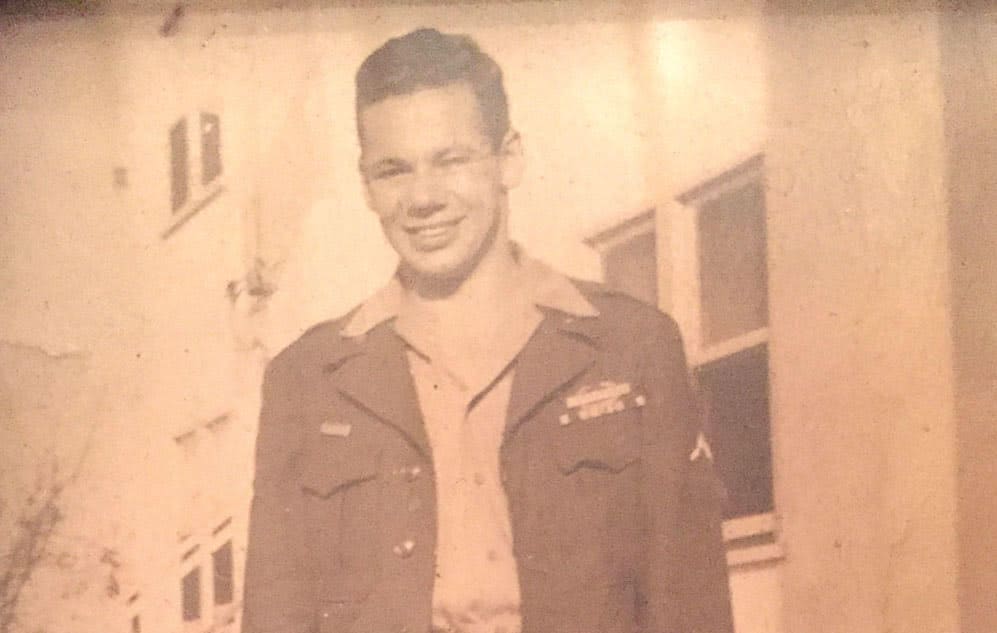
The transition to American life was not easy for the family, especially for Dr. Tugendreich, and once Tom turned 18, he left home by registering for the draft. He was quickly called to serve in the United States Army, though still technically classified as an “enemy alien.” He was sworn in as a U.S. citizen while in basic training, shortening the family name to Tugend, and soon after setting out for Europe to fight the Nazis. Tugend served in the United States Army in the recently formed 63rd Infantry Division, which was shipped to Marseilles. His 254th regiment fought SS units alongside the French, spending months freezing in foxholes in the Vosges Mountains. For his service, he received a Combat Infantryman Badge, Bronze Star Medal, and Presidential Unit Citation.

Photo courtesy of the Tugend family

Near the end of the war, as Tugend told the story, his fluency in German led him to be assigned to an army counterintelligence unit, for which he set out to find Nazis remaining in the German countryside. As he wrote: “Of course, every German I interrogated said that everyone, including his brother, had been an ardent Hitler follower—everyone except himself, of course. Invariably, the informant had been a stout anti-Nazi.”

With his characteristic humor, Tugend recalled decades later: “One day, I went to a village, and everybody identified an 80-year-old blind poet as the village’s premier Nazi. When I confronted the man, he readily agreed and pledged his continued fidelity to the Führer. I didn’t arrest him but returned to my headquarters, demanding recognition for having found the only Nazi in all of Germany.”

After World War II ended, Tugend returned to the U.S., only to enlist again, this time to serve as a squad leader in an Anglo-Saxon anti-tank unit during Israel’s War of Independence. Always in the thick of it, Tugend’s unit was among those encircling an Egyptian regiment in the Negev’s Fallujah Pocket led by Col. Gamal Abdel Nasser, who would later become president of Egypt.

After the war, Tugend returned to the U.S. to earn a journalism degree from UC Berkeley, where he also wrote for a student humor magazine, “The California Pelican.” Soon after graduating, he was drafted again, this time to serve in the Korean War, however his degree helped him evade combat; he spent his stint in San Francisco editing a newsletter for the Army Medical Center.

Photo courtesy of the Tugend family

Though Tugend did not always bring it up, his three-part military experience would shape his life as much as his Holocaust experience. As the esteemed Holocaust scholar Michael Berenbaum put it, “Tom Tugend fought with valor as an American soldier in World War II, gaining valuable, dangerous combat experience. Then, rather than staying home, getting on with his life and basking in the glory of victory, he interrupted his life to battle for the Jewish State as part of MAHAL – the volunteers from outside the Land of Israel — bringing vital experience to its nascent army and giving voice to his Zionist values.”

Tugend, Berenbaum said, “had earned his stripes as an American and earned them again as a Zionist. In both he was living as a proud Jew. For him, the values were joined; the America he fought for was the land of liberty, democratic, pluralistic, tolerant, a haven for Jews. And the Israel he fought for was to be a land of liberty, democratic, pluralistic, tolerant, a haven for Jews, protective and respectful of the rights of its Arab and Jewish citizens. He lived those values to the end of his long life.”

Tugend’s journalism skills, as well as his perpetual curiosity about the world and his gift with words, would keep him writing for more than seven decades. After his military service, he worked for a time at the San Francisco Chronicle, the Associated Press in Spain, and on the night desk at the Los Angeles Times.

Writing was his calling, but Tugend claimed he had no high aspirations as an author, and after marrying the Jerusalem-born Rachel (neé Spritzer), who would become his wife of 66 years and who survives him, he set out to make a living to support their family of three daughters.

He first wrote pilot manuals at Boeing, then spent 30 years as a science writer at UCLA.  At one point, the family moved to Israel so that Tugend could work at the Weizmann Institute of Science as head of its public relations department, but after a year they returned to Los Angeles. Throughout his university career, he continued freelancing for multiple Jewish publications.

After retiring from his post at UCLA in 1989, at 64, Tugend began what would be a full career in Jewish journalism, writing for the Jerusalem Post, JTA, Hadassah Magazine, and most of all as a regular contributor to the Jewish Journal, starting in 1993. He also wrote on occasion for the Los Angeles Times about entertainment. Tugend would later be named a Contributing Editor at the Journal, writing hundreds of pieces over nearly 30 years, many times multiple articles in a single issue. His last piece for the Journal was published in November.

Rob Eshman, formerly the longtime editor of the JJ, worked for decades with Tugend: “My biggest worry was that I could never be Tom Tugend’s boss. Tom had reported on wars. He’d fought wars! And he filed more copy in 10 years than I would in a lifetime— how dare I tell Tom Tugend what to do?” Eshman wrote in an email to the Journal.

“And I never did. Tom was my journalistic role model. His first answer to every assignment was yes. He showed up, wrote what he saw, kept his opinions to himself, and turned in clean copy. Only after years of working with him did I discover Tom had strong opinions and an unrelenting sense of humor. He had seen, and experienced, so much hardship and tragedy, and his answer was to write it down, to bear witness, to record the stories of our lives in tight, descriptive paragraphs.”

In Los Angeles and throughout the Jewish diaspora, a call from Tugend meant that a good story would follow; his subjects ranged from news to arts coverage. Among Tugend’s most famous subjects – and most beloved – was the filmmaker Steven Spielberg, whom he interviewed on multiple occasions. While Spielberg was always cautious around journalists, the director also recognized Tugend as a critical record keeper of Jewish history, and a valuable chronicler of the creation of the Shoah Foundation, now the USC Shoah Foundation. In Tugend’s home office are two treasured mementos, the first a photo inscribed by Spielberg that says: “To Tom, You have such an important voice. Many, many thanks, Stephen Spielberg.”

On Tugend’s office wall hangs a typed letter from the director congratulating Tugend on the honor of becoming a Knight in the National Order of the Legion of Honor in 2016. “For decades,” Spielberg wrote, “you have committed your life to ethical reporting and responsible journalism. For that, I sincerely thank you – and for your distinguished service in World War II, the 1948 War of Independence for Israel, and the Korean War; we all thank you.”  The letter is signed, “With great admiration, Steven.”

Tugend loved to write about movies with Jewish content and would consistently marvel at how many Holocaust-themed films would appear each year; he loved to chronicle the best of them, especially during Oscar season.

Though Tugend often seemed ageless to those who knew him, as he entered his late 80s and into his 90s, he was urged by many to write about himself, which he did on a few occasions, albeit, at least at first, only reluctantly. For a Father’s Day issue of the Journal in 2006, he wrote about his esteemed pediatrician father’s challenges as a German immigrant to the U.S. He also wrote lovingly about his wife at the time of their 50th wedding anniversary, in October of that same year. Along with jokingly describing how their taste in breakfasts differed (he liked pancakes, she made breakfast Israeli salads with cucumbers, olives and tomatoes), Tugend wrote heart-wrenchingly of battling depression, and how his life was saved by his wife and daughters.

In person, he was a beer-drinking raconteur and loved to laugh. This despite his deep sensitivity to the hardships in others’ lives. In 2019, Tugend, along with his daughter Alina (also an esteemed journalist), returned to Berlin to place one of the iconic brass plaques known as Stolpersteine (Stumbling Blocks) in front of his family’s former home. In an opinion piece in the L.A. Times, Alina described the story behind the placement of the plaque to commemorate their Jewish family, forced to leave their home by the oncoming terrors. Benjamin Kuntz, a German public-health researcher had been writing about Tugend’s father’s research on the healthcare of infants and children. Seeing an opportunity to commemorate his subject, Kuntz reached out to ask whether a Stolpersteine might be placed in the Tugendreich family’s honor.

Photo courtesy of the Tugend family

Despite 80 years having passed since he had left, Tugend, then 94, spoke fluent German at the gathering, describing his parents and the life they left behind. The gathering included the current residents of Tugend’s childhood home, who invited the Americans inside for a visit.

Many, if not most, of the Stolpersteins commemorate those murdered by the Nazis, but the one dedicated to Tom Tugendreich’s also commemorates an extraordinary life dedicated to Jewish resilience. The Jewish commandment to remember history was not lost on Tom Tugend, who was a consistent contributor to the Jewish Journal until his final piece for the newspaper, an obituary published just over a month before he passed. When Tugend attended the Jewish Journal gala on November 14 at the Beverly Hills Hotel, he was recognized from the stage by current editor-in-chief David Suissa and received a standing ovation.

As Eshman wrote upon the news of Tugend’s passing: “Tom was a man with far less ego than he rightly deserved, a gift to all those who knew him, and all who read him. When someone dies, we say may someone’s memory be a blessing. But Tom’s superb life’s work blessed us with the very ability to remember. He was the preeminent storyteller of Jewish L.A.”

Adds David Myers, distinguished Professor and Sady and Ludwig Kahn Chair in Jewish History at UCLA, “Tom Tugend was, simply put, the gold standard for Jewish journalism.  Who could possibly match his extraordinary mix of lived experience, unparalleled knowledge, deep passion, critical wit, wry humor, integrity, and irresistible charm?  He witnessed first-hand many of the momentous events of modern Jewish history—in Germany, Israel, and the United States.  And he reported on them in his characteristically balanced and lucid prose.  Remarkably, Tom not only survived the long and harsh twentieth century; he had a second wind in the twenty-first. An amazing second act.

“In thinking of a fitting epitaph for this great journalist and true mentsh, I’d say only: he was a lover of his people, and he was a lover of truth.  Such a rare combination today, but therein lies Tom’s greatness.  May his memory be a blessing to us all.”
Photo courtesy of the Tugend family

Tugend is survived by his wife, Rachel, daughters Orlee Raymond (Dani Raymond); Alina Tugend (Mark Stein); Ronit Austgen (Tim Austgen), as well as eight grandchildren and one-great grandchild.

In lieu of flowers the family has asked that donations be made to https://jfr.org/ the Jewish Foundation for the Righteous.

Tom Tugend, War Veteran and Lifelong Jewish Journalist, has Died at 97 Read More »

Print Issue: Why Are We so Silent About the Uprising in Iran? | December 9, 2022

CLICK HERE FOR FULLSCREEN VERSION

Print Issue: Why Are We so Silent About the Uprising in Iran? | December 9, 2022 Read More »

Is It Cool to Be a Jew?

Recently, during a lively conversation about religion, being a Jew and life on a college campus, one of the professors in a department of Jewish Studies, a young Jewish woman, said “It’s not cool to be Jewish.” That thought perplexed me, so I reflected on its possible meaning.

I am a child of Holocaust survivors. I grew up aware of my family’s suffering though not a word was shared about their experiences to me directly. I saw their numbers, I felt their emotional tenor in our home, the great elephant in the room that really was never acknowledged. I also felt my mother’s survivor guilt and her overwhelming sadness and depression having lost every one of her family members.

Yet my synagogue experience, the attention to ritual life and holidays at home, the kinds of books on our shelves, the music that wafted through the rooms in our home, and the conversations shared with their friends, mainly other Holocaust survivors, all left me with a great love of my religion. It gave my soul nourishment and happiness to be identified as a Jew. Meeting and marrying Rabbi Steve, this most erudite of rabbis, opened the door even wider in ways I never could have imagined. But did all of this make it “cool” to be a Jew?

What is it that makes anything cool? Does the darkness of the Holocaust — or any suffering — preclude any coolness? That would be true if coolness meant only things that are fun and popular.

What is it that makes anything cool? Does the darkness of the Holocaust — or any suffering — preclude any coolness? That would be true if coolness meant only things that are fun and popular.

But if we expanded the view of cool to include pride, I believe we’d be on to something.

There are people, particularly young adults on college campuses, who are ashamed and probably fearful of calling themselves Jews. My husband Rabbi Steve’s recent sermon spoke to that discomforting reality as expressed in the book, “It Can Happen Here,” by Jonathan Greenblatt. The book is a reminder of the potential harm that lays in wait to those of us who call ourselves Jewish. Our options are to either cower, hide from who we are, or find virtue and pride in being a Jew. I believe that part of countering adversity and antisemitism is being present, fully engaged, and showing the world the strength, the virtues, and the Jewish pride in who we are and how we live our lives. 

The more I learn about Judaism the more I am astounded by its depth of wisdom and its breadth of human understanding. The psycho-emotional and spiritual underpinnings provide us with a pathway to understand our lives with greater awareness and enlightenment, to explore our inner world with more compassion and conviction, to experience the calendar with richer textures and elevated personal and home rituals. Our tradition is not just routine performance. It is a layering of meaning and purpose to the ordinary in our lives and lifting them with holiness, but also surrendering to the sacred, paying attention to all life-cycle and ceremonial moments over the course of our lives. 

Our tradition is living values and morality that cares about the other, that asks for empathy and compassion in all things personal, professional, and familial. It honors the frailty and the mortality of being human and gives us the gift and opportunity to correct, change, enhance, or transform any moment in which we have gone astray, disappointed others, or ourselves. It is a tradition that honors the need to nourish the mind, the body, and the soul recognizing that all three are essential and deserve respect and ones’ attention. 

There certainly will be difficult issues that we must face in the Jewish world and of course in Israel. If we care about freedom and dignity for all then we must be willing to speak for what is right. Jews are not perfect, and Judaism struggles as well amongst itself. To be Jewish is to struggle. 

This constant spiritual struggle defines our identity and nourishes our Jewish pride. It gives us the courage to wear our Jewish stars, to honor our ancestors, and to never be afraid to own up to who we are, imperfections and all.

I would argue that’s pretty cool.


Eva Robbins is a rabbi, cantor, artist and the author of “Spiritual Surgery: A Journey of Healing Mind, Body and Spirit.”

Is It Cool to Be a Jew? Read More »

The Kippah That Traveled the World

The Old Jerusalemite shuffled into a tiny shul in Meah Shearim, one of the strictest Orthodox neighborhoods in Jerusalem. Clad for Shabbat in a shtreimel and robe, he joined the other members of the minyan. On this Shabbat, there were visitors: Rabbi Shalom Rubanowitz, rabbi of the Shul on the Beach in Venice, California, and his videographer and congregant, Drew Rosen. They were in Israel to participate in the annual charity bike ride for Jerusalem’s ALYN Children’s Hospital. They had sought out this shul because Rabbi Rubanowitz’s great-grandparents were among those who founded it in 1899, and he wanted to sponsor a kiddush in their honor. 

When Rabbi Rubanowitz introduced Rosen and mentioned that he made films, one of his hosts exclaimed, “Hollywood man? We have a Hollywood man, too!” Pointing at the regally attired Old Jerusalemite, he beckoned Rosen to meet “our Mr. Hollywood,” Reb Yosef Suker.

Rosen had brought several Shul on the Beach kippot, which he judiciously offered to people he met. During the kiddush, he and Reb Yosef were engrossed in conversation. Afterward, Rosen took Rabbi Rubanowitz aside, pointed to Reb Yosef, and said, “He has a Shul on the Beach kippah in his pocket!”

“Of course,” replied Rabbi Rubanowitz, “you just gave him one.”

“No,” exclaimed Rosen, “He already had it. He says he always carries it with him.”

Intrigued, they asked Reb Yosef to share his story. He said he’d been raised in a secular Israeli home. His only connection to religion were memories of his mother, a Holocaust survivor, taking him to stand outside the window of a shul in Haifa. Never entering the shul, little Yosef and his mother listened to the haunting tunes of “Kol Nidre,” the only religious song his mother seemed to remember. Reb Yosef grew up to be a television producer and filmmaker with no attachment to Jewish life.

Forty years ago, Reb Yosef found himself in LA after wrapping up a major Hollywood production. Wandering down Ocean Front Walk in Venice, looking out at the ocean, he thought, “What’s next?” He came to the open door of the Shul on the Beach in Venice, where he heard the familiar strains of “Kol Nidre.” Feeling he was dressed inappropriately, he did not enter the shul, but stood outside like he did as a child. But this “Kol Nidre” struck a chord. He had been so lost he had forgotten it was Yom Kippur, but now he remembered he was a Jew. That was the moment he decided to return to Israel and explore his Jewish roots. He returned, studied Torah and became the “Old Jerusalemite” whom Rosen and the rabbi met.

But how had he gotten the kippah?

Reb Yosef wrote a memoir describing his spiritual journey, highlighting the Shul on the Beach’s role in his transformation. Two years ago, his friend Rabbi Mota Frank, a prominent Breslov Rav, was traveling to LA. Reb Yosef asked his friend to carry his book to Venice. Reb Mota gave the book to Alan Danziger, president of the Shul on the Beach. Alan gave him a Shul on the Beach kippah. Rav Mota gave the kippah to Reb Yosef.

“I carry that kippah in my pocket all the time to remind myself where I started.“ – Reb Yosef

Reb Yosef said, “I carry that kippah in my pocket all the time to remind myself where I started. Every Yom Kippur, at Kever Rachel (Rachel’s Tomb in Hebron), I wear it underneath my regular yarmulke. And I remember the Shul on the Beach every day of my life.” Rabbi Rubanowitz and Rosen were astounded. Of all the shuls in Jerusalem, Reb Yosef had chosen the one founded by the ancestors of the rabbi of the Shul on the Beach.

Every Shabbat, hundreds of people stroll by the shul in Venice. Many current members found their way back to Judaism in the same way that Yosef Suker did — walking by and feeling the pull of their tradition calling them from this unassuming synagogue amid the tumult on the boardwalk. Reb Yosef need not have felt self-conscious about his attire; the shul welcomes Jews from all backgrounds and levels of commitment.

At a time when many observant Jews feel they must circle the wagons and keep outsiders out, let’s remember the power of an open door. 
To learn more about the Shul on the Beach in Venice, visit www.shulonthebeach.com.


Elizabeth Danziger is the author of four books, including Get to the Point, 2nd edition, which was originally published by Random House. She lives in Venice, California.

The Kippah That Traveled the World Read More »

AJU Panel Unpacks Iranian Unrest

Elica Le Bon, a British-born Iranian attorney, believes this pivotal moment in Iran — in which the death of a young woman for not properly wearing her headscarf has caused widespread unrest — resembles what happened here after the police-involved death of George Floyd. 

When Floyd was killed due to a police officer’s prolonged kneeling on his neck, the thousands of protestors in the streets were not merely reacting to his death — they were responding to hundreds of years of mistreatment of this country’s Black people, Le Bon said.

Similarly in Iran, while 22-year-old Mahsa Amini’s death in the custody of the morality police surely triggered the country’s current protest movement, the demonstrators are emboldened not just by her murder but by decades of human rights abuses perpetuated by the hardline Iranian government. 

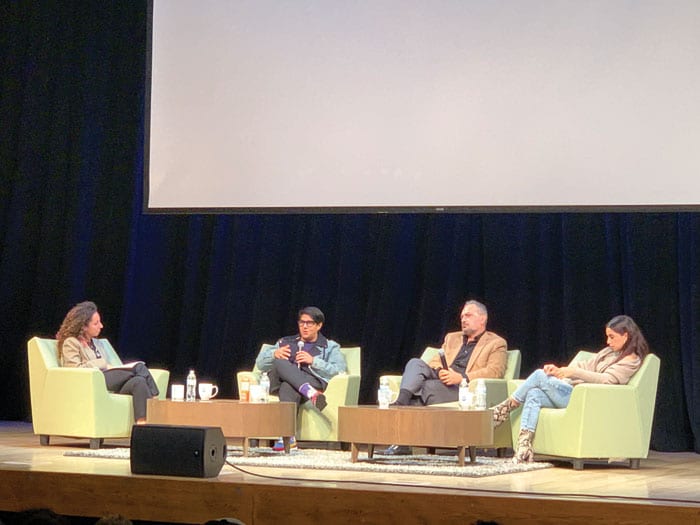
Le Bon offered her take on Nov. 4 during a timely panel discussion – titled “Baraye Iran,” or “For Iran” – at American Jewish University (AJU).

Rabbi Tarlan Rabizadeh, vice president of Jewish engagement at AJU and an Iranian American, moderated the discussion, which was organized following approximately 80 consecutive days of demonstrations in Iran.  

According to media reports, since protests began in September against the Iranian regime, which governs in accordance with strict Islamic law, thousands of people have been injured; hundreds of Iranians have been killed; and there have been accounts of sexual violence against detainees.

Although the number of Jews currently living in Iran is relatively few, the David vs. Goliath circumstances are resonating with this city’s Jewish community, particularly the sizable local Iranian population, many of whom fled Iran, or had parents who did so, and thus are sympathetic to the plight of those living under oppressive mullah rule. 

Much of the diaspora activism on behalf of on-the-ground demonstrators has taken place over social media. Moj Mahdara, one of the three panelists on Sunday night, spoke about her ongoing advocacy campaign supporting regime change in Iran. 

“We’re going to ‘cancel’ the Islamic Republic,” Mahdara said, describing virtual efforts to erase the entity from existence. Mahdara, a digital entrepreneur, is the founder of the Iranian Diaspora Collective, a nonpartisan group committed to amplifying Iranian voices. 

Houman Sarshar, another of the panelists, is a contributor author to Encyclopedia Iranica. On Sunday, he provided an overview of social grievances in Iran, discussing the 1979 Iranian revolution and the moment when the Iranian supreme leader replaced those who dissented from his point of view with religious clerics willing to follow orders unquestioningly.

Rabizadeh asked the trio of speakers, “Why aren’t more people paying attention to the story?”

Near the conclusion of the hourlong discussion, Rabizadeh asked the trio of speakers in the Gindi Auditorium, “Why aren’t mainstream news sources covering unrest in Iran as much as they could be? Why aren’t more people paying attention to the story?”

Le Bon, who has spoken out about events in Iran on TikTok and has a significant following on the platform, attributed ignorance about the situation to an active misinformation campaign. She said people on the extreme left are parroting talking points from the Iranian government. And as an example, she pointed to Sunday’s news, reported by outlets including the New York Times, that Iran’s morality police — a feared law enforcement body responsible for implementing Iran’s hijab law — had been abolished, when that hadn’t been confirmed. 

About 200 people turned out for the conversation, which was free and open to the community. A dessert reception in the AJU lobby began the program. Around 6 p.m., attendees, including Rabbis Noah Farkas, Yoshi Zweiback and Erez Sherman, entered the auditorium. 

Evening co-organizers included 30 Years After, The European Leadership Network (ELNET) and the Iranian American Jewish Federation.

AJU Panel Unpacks Iranian Unrest Read More »

Table for Five: Vayishlach

One verse, five voices. Edited by Salvador Litvak, the Accidental Talmudist

Esau ran to greet him. He embraced him and, falling on his neck, he kissed him; and they wept.

– Genesis 33:4


Alissa Thomas-Newborn
Rabbanit, New York-Presbyterian Columbia University Irving Medical Center and Netivot Shalom Congregation

While many question whether Esav’s intentions are genuine, the Ibn Ezra emphasizes that Esav never intended Yaakov harm. He bases this on the verse’s ending, which mirrors the tearful reunion between Yosef and his brothers when Yosef reveals his identity. Since Yosef had pure intentions in embracing, kissing, and crying together with his brothers, the parallel language here suggests that Esav did too. 

In each case, there is emotional baggage that justifies suspicion (Yosef having been thrown in a pit and sold, and Esav having his blessing stolen). The unifying theme is the potential for emotional walls to come down through vulnerability. After much has been lost, including time together, the brothers in each story embrace and cry together. Their tears mourn all that has happened and express gratitude for the time they have left together. 

When someone who hurt us expresses remorse, we can be surprised by our reaction. This is because when we are met with an open heart, even amidst the baggage, we are inspired to let go of our pain and receive love and relief in its place. God put this into our spiritual DNA. Let’s reflect on why this is such a central theme in our Torah’s wisdom. Perhaps it gets at one of our most profound spiritual responsibilities: To recognize hurt and distance (between each other and between ourselves and God) and to have the courage and humility to cultivate reunion and forgiveness. What tearful embrace are you in need of right now?


David Porush
Student, teacher, writer at davidporush.com

What kind of a kiss is this? What kind of tears? After all Jacob’s prostrations, after all Esau’s saber rattling, do they really fall on each other’s necks as loving long-lost twins? Are we to believe they truly reconciled here? 

Rashi says Esau’s kiss is half-hearted. 

Rabbeinu Bachya quotes Proverbs: “Many are the kisses of an enemy.” 

Rav Hirsch says “you can fake a kiss, but tears drop from the innermost part of the human soul.” 

Radak says they’re sincere, but R’ Yannai claims that Esau meant to bite Jacob’s neck! 

The Targum of Jerusalem totally waves off any sentiment: Esau wept because of (metaphysical?) pain in his teeth, and Jacob cries because of pain in his neck. 

Luzzatto, citing the analogy of Jacob’s other heartrending reunion – with Joseph in Egypt – says if Esau and Jacob were sincere, they would be too overwhelmed to kiss. i.e., it was all just Middle Eastern kabuki. 

Kabbalah says poetically, “There are kisses that hate … Like a crocodile, they watered and wept.” Crocodile tears.

I choose to follow the warmhearted Netziv, R’ Berlin: “They wept with sincere passion … Love for Esau awakened in Yaakov.” He sees their reunion as prophetic. “Whenever Esau’s descendants genuinely acknowledge Yisrael’s greatness, Yisrael reciprocates with feelings of brotherhood.” 


Rabbi Scott N. Bolton
Congregation Or Zarua, New York, NY

Why run? Towards whom? When his brother came running at him, I imagine Jacob felt like the man on the bridge in the famous Kafka short story. 

Multiple possibilities arise in that three-paragraph tale. When the man sees the runner, inner fears and stories start to flow: “He’s running at me to kill me!” Questions rise: “Is he running from a crime? Maybe he and his friend are trying to outrun a pursuer? Is this just for amusement?” 

As Esau ran towards Jacob we remember that Jacob ran away from his belligerent, begrudged brother years earlier. “Kum, b’rakh lekha!” (rise and flee!) Rebecca commanded and Isaac barked “kum, lekh!” (get up and go!). Now Esau “Va-YArotz” (he ran) towards Ya’akov. 

Forget the kisses; stop and  focus on the running. This is holy running! A running of t’shuvah, reconciliation and reunion. Holy running. Before this in Torah the verb “and he ran” (“va’YArotz”) was associated with Abraham meeting three angels at his tent and Eliezer running towards Rebecca at the well to affirm she would be the next matriarch. Rashi notes that Esau found compassion and mercy at the moment of his reconnecting with his brother. It was not just in the embrace and kisses that Torah expresses his true feelings. His deep desire to reunite was evidenced by his running towards his estranged brother. It makes me think, as we stand on that proverbial bridge, what kind of holy running and towards whom is in our futures?


Sarah Pachter
Author and Speaker

Pirkei DeRabbi Eliezer 37:8 states, “Do not read vayishakêhu (and he kissed him), but (read) vayishkêhu (and he bit him).” 

The commentaries disagree regarding Eisav’s true intention regarding Yaakov. Was he coming to Yaakov with love and willingness to move forward? Or was he holding a grudge? 

Some state that because Eisav wept during the reunion it showed that he truly had feelings of love towards his brother, because tears are an expression of the soul. 

No definitive answer is given. Perhaps, this is to suggest that a person can hold two opposite feelings in their heart simultaneously. The human heart can contain tremendous joy and sadness, all at once. Under the chuppah, when we have extreme joy, we simultaneously break the glass while we express our sadness and commemorate the destruction of the temple. 

Similarly, we can feel disappointment in a child and love that child all at once. One can also be hurt by one’s parents and simultaneously express gratitude towards them. We have the capacity to forgive someone, while still feeling sadness and pain over the lost opportunity for connection. 

Like Eisav and Yaakov, we too can weep tears of genuine happiness to see one another and simultaneously weep over the loss of a potential relationship with a sibling. 

May we all have the courage and strength to peel away the outer layer of anger and choose the deeper, more hidden layer of forgiveness and enjoy the inner peace that comes along with that brave choice.


Rabbi Nolan Lebovitz
Valley Beth Shalom

From Cain’s murder of Abel, to Ishmael’s inappropriate behavior with Isaac, to Esau’s vow of violence against Jacob, the depiction of sibling relationships in Genesis reflects a sombre reality. 

Yet, after years of anxiety, years of heartache, years of separation, we finally see that reconciliation between Esau and Jacob is possible. In this moment, the Torah teaches us that the choices within deep-seated struggles do not have to be restricted to violence or separation. There is another path forward: the journey to reconciliation, resolution, and perhaps even return to love, is within reach. 

For many of us, our closest relationships remain our most complex. 

Perhaps, it is from this moment that Esau and Jacob embrace that the Jewish People learns to include our Wicked Child at our Passover Seders. Perhaps, it is here that we begin to ignore the significance of birth order and love equally. 

The Torah’s portrayal of siblings evolves from violence in Genesis to support in Exodus. Long ago, the Psalmist expressed a degree of hope in saying, “How good and how pleasant it is when siblings can dwell together.” (Psalm 133) While that goal remains, the artist Bob Dylan cautioned that relational development takes time, “As the present now will later be past/the order is rapidly fadin’/ And the first one now will later be last/For the times they are a-changin’.” 

Do not let too much time pass before connecting (or reconnecting) with your siblings. How good and pleasant it will be!

Table for Five: Vayishlach Read More »

Do You Believe in Magic: Orange Semolina Cake

It was a magical night by the Aegean Sea in Bodrum. The waves rippled softly, reflecting the light from our hotel. We were mesmerized by the shimmering blue and the sparkling white and silver of the water. The water was so magical that I almost expected to see a mermaid emerge.

Of course, there was no mermaid, but Neil and I were served the most heavenly orange cake. 

This summer Neil and I took a short flight from Istanbul to Bodrum, a city that hugs the southwestern coast of Turkey. Founded by Dorian Greeks, the city later fell under Persian rule. One such ruler was Mausolos and when he died in 353 BCE, his wife Artemisia built him a tomb called the Mausoleum. This structure was known as one of the seven wonders of the ancient world (and now you know how the word mausoleum entered the English language). The area was conquered by Alexander the Great and ruled by Hellenists. Then it was ruled by the Romans. 

The Knights Hospitaller arrived in 1402 and used the remains of the Mausoleum to build Bodrum Castle, a beautiful Gothic structure that still dominates the skyline. 

In 1522, when Suleiman the Magnificent conquered the nearby island of Rhodes, the Knights left Bodrum for Europe and the area fell under Ottoman rule. 

Once upon a time, the people of Bodrum earned a living from fishing and sponge diving. More recently, Europeans discovered the charm of this sunny, idyllic spot and tourism has become the main industry. The life there still beats to a simple rhythm and the locals are so warm and kind. There is a farmers market overflowing with the fresh produce grown in the local hills and low mountains. I have honestly never tasted such incredibly sweet and juicy figs. There is an abundance of dried fruits and nuts, aromatic spices and fresh herbs like oregano and za’atar. Piles of fresh fish glisten, recently caught in the fishermen’s nets. And the Greek influence is evident in the tons of fresh feta and other homemade cheeses.

Every afternoon, Neil and I indulged in a Turkish coffee and syrupy, honeyed baklava, in lots of different shapes and varied fillings. It was wonderful. 

But that cake! I took one bite and had the most intense flavor flashback. I was instantly transported to the cakes of my childhood, which were always flavored with orange zest or lemon zest or orange blossom water. 

Neil and I took bite after blissful bite. And then we asked the waiter “What is this cake?”

He replied “The chef’s family recipe. It’s a Greek recipe because we are so close to Greece.”

“Wait!” I begged. “Please tell me more.“

He went to the kitchen to ask the chef about the ingredients. He told me that the cake was made with semolina and syrup and lots of fresh oranges.

—Rachel

Did you know that oranges, in all their infinitely sweet, juicy, bright, citrusy wonder, were engineered in ancient China by crossing mandarin with pomelo?

From there, orange varieties spread into Myanmar, Northern India, Persia, the Middle East and North Africa. 

The Moors brought oranges to Spain and Portugal. But in the 15th and 16th centuries Portuguese Jewish merchants traveled throughout the Mediterranean, selling citron (etrogim) to their Jewish brethren and sweet oranges to the non-Jewish populations of Italy, France and later Germany.

In Arabic, oranges are called burtaqal, denoting this connection to Portugal. 

In most other languages, orange the color and orange the fruit are interchangeable. However, in Hebrew the word for the color orange is katom and the word for the fruit is tapuz, an acronym of tapuchei zahav (apples of gold).

With their deliciously refreshing flavor and storied history, it is no wonder that oranges play a huge part in the flavor profile of Middle Eastern and Sephardic cooking. 

With their deliciously refreshing flavor and storied history, it is no wonder that oranges play a huge part in the flavor profile of Middle Eastern and Sephardic cooking. 

—Sharon

When I came home, I was obsessed with that cake. I worked hard to replicate the recipe. My first cake wasn’t moist enough because I wasn’t generous enough with the syrup. 

But this recipe is magical and it’s just in time for peak orange season. 

We hope you bake this special cake soon. 

—Rachel 

Orange Semolina Cake

1 cup fine semolina flour
1 cup all-purpose flour
2 teaspoons baking powder
1/8 teaspoon of salt
½ cup orange juice
1 teaspoon vanilla essence
2 sticks softened butter or vegan butter
1 ¼ cup sugar
3 large eggs, at room temperature

For the syrup
3/4 cup orange juice
Zest of 2 oranges, finely grated
3/4 cup sugar
2 tablespoons orange blossom water

For decoration
1 cup Greek yogurt or coconut milk yogurt
(non-dairy option)
¼ cup sugar
Candied oranges or toasted pistachios

  • Preheat the oven to 350°F.
  • Line the bottom of an 8 inch springform pan with parchment paper, then grease the sides with oil spray.
  • In a medium bowl, place the semolina, flour, baking powder and salt and mix well.
  • In a small bowl, combine the orange juice and vanilla, then set aside.
  • In the bowl of a stand mixer, beat the butter and sugar until very creamy and pale white.
  • On the low setting, add half the flour and half the orange juice, mix until just combined.
  • Add the remaining flour and orange juice. Do not over beat.
  • Pour the batter into prepared pan and bake for 45 minutes or until a toothpick comes out clean from the center of the cake.
  • Place on a cooling rack.
  • Prepare the syrup by combining the orange juice, orange zest, sugar and orange blossom water in a small sauce pan.
  • Bring to a boil over medium heat. Stir well, then lower heat and simmer until the syrup begins to thicken.
  • Remove from heat and allow syrup to cool.
  • Once the cake has cooled, poke holes in the top of the cake with a toothpick.
  • Pour syrup over the cake.
    Wrap cake tightly with plastic wrap.
  • Just before serving, beat the yogurt with the sugar and pour over the cake.
  • Decorate with pistachios, or fresh candied orange slices.

Candied orange slices
2 oranges, washed and dried
1/4 cup sugar
Fresh rosemary, optional

  • Slice oranges into thin rounds and remove any pits.
  • Place in a pan with ¼ cup of sugar and rosemary.
  • Simmer until sugar becomes syrupy and orange slices have released their juice.
  • Set aside to cool.

Rachel Sheff and Sharon Gomperts have been friends since high school. They love cooking and sharing recipes. They have collaborated on Sephardic Educational Center projects and community cooking classes. Follow them on Instagram @sephardicspicegirls and on Facebook at Sephardic Spice SEC Food.

Do You Believe in Magic: Orange Semolina Cake Read More »

Campus Watch Dec. 8, 2022

GWU Investigating SJP for Protesting Hillel Event

George Washington University (GWU) is investigating the campus Students for Justice in Palestine (SJP) chapter over their protest of a Hillel event.

The Algemeiner reported that the investigation stemmed from an October 11 event featuring former Israeli intelligence official Doron Tenne. According to The GW Hatchet, the students are facing probation for damaging benches during the protest through “wheatpasting,” a term used to describe using water and starch to hang posters. The university is expected to make a decision this week, per The Algemeiner.

Tufts SJP to Host Event Attacking Liberal Zionism

The Students for Justice in Palestine (SJP) chapter at Tufts University is hosting an event on December 7 attacking liberal Zionism.

The event, according to the pro-Palestinian group’s Instagram page, is titled “Unpacking Liberal Zionism: Our Boycott of Student Groups” and the caption states that liberal Zionism is “harmful to the movement for Palestinian liberation.” Jewish on Campus noted in a December 5 Twitter thread that in April, Tufts SJP had pledged to boycott all student groups that normalize Israel. 

“By choosing to only work with anti-Zionists, SJP has provided a litmus test to Jewish students, ignoring the overwhelming majority of American Jews who believe in Israel’s right to exist,” Jewish on Campus tweeted. “Their campaign is inherently antisemitic.” They later added: “We refuse to be boycotted from spaces on campus. Jewish students deserve to be safe.”

Anti-Israel Flyers at CUNY School

A slew of anti-Israel flyers were found at the City College of New York (CCNY), one of the schools under the umbrella of the City University of New York (CUNY).

Stop Antisemitism tweeted out photos of the flyers on November 30; the flyers called Israel a “colonialist apartheid project” and accused Israel of targeting hospitals and schools with missiles. Another flyer stated “from the river to the sea Palestine will be free.” In response to the Stop Antisemitism tweet, CCNY tweeted that the college “stands firmly against antisemitism and bias of all kinds.” 

StandWithUs Urges Texas A&M to Take Action Against Students Behind Antisemitic Snapchat Story

At the request of and together with students at Texas A&M, StandWithUs sent a letter to Texas A&M on December 1 urging the university to take action against students who were behind an antisemitic Snapchat story.

The letter described the story as featuring “crass references to the Holocaust, defense of those who perpetrated the Holocaust, and a post, ‘we should’ve let the “ant exterminator” do his job back in WW2’ — a reference to Hitler and his attempt to annihilate all Jews … These posts promote antisemitism through Holocaust distortion and glorifying the killing of Jews.” The letter argued that because the Snapchat account is exclusive only to students, “it is therefore part of the university’s ecosystem of student offerings” and the university is obligated to enforce its policies against the students. 

“We ask that you address this matter by issuing a statement of public condemnation, identifying the posts as antisemitic, and outlining when such rhetoric crosses the line into harassing or threatening language that violates student policy,” the letter added.

Panelists at SJP Event Call for Removal of Israeli-Canadian’s Name from Carleton University Buildings

Various participants in a November 18 Students for Justice in Palestine panel called for Carleton University buildings named after a prominent Israeli-Canadian philanthropist to be removed because of his support for pro-Israel organizations.

The Charlatan reported on November 27 that the members had accused the philanthropist, David Azrieli, of being “a willing participant in a campaign of killing, dispossession, and ethnic-cleansing, directed towards the Indigenous Palestinian population, with the purpose of establishing a Jewish state on their land.” Azrieli has been the president of the Canadian Zionist Federation and a board member of the Canadian Israel Committee. The university has rebuffed efforts to rename the buildings, finding “no issues or concerns” with Azrieli’s philanthropy.

CT School Board Reverses Decision to Remove Jewish Holidays from School Calendar

A school board in central Connecticut reversed their decision to remove Jewish holidays from their schools’ calendars in November 14.

According to a Twitter thread from Stop Antisemitism, the Farmington Board of Education concluded that Jewish holidays like Rosh Hashanah and Yom Kippur “do not rise to the level of an operational disruption. Thus, both observances were not approved as days off from school.” Following backlash against the decision, the board issued a statement on December 5 saying that the decision was not rooted in antisemitism and they denounce antisemitism and all other forms of hate. During a December 5 meeting, the board voted unanimously to reverse their decision, per Stop Antisemitism.

Campus Watch Dec. 8, 2022 Read More »