fbpx

October 5, 2022

Cover Story: We Can’t Zoom Sukkot

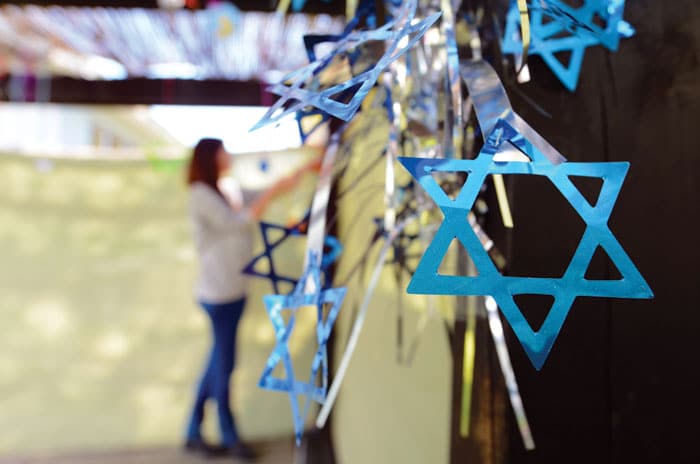
Growing up in the Five Towns of Long Island as someone with a Jewish heritage, but without a Jewish identity, was a blend of confusion and curiosity. I witnessed a consistent litany of Jewish images such as the parade of well-dressed neighbors walking to shul every Friday night (and my feeling of being puzzled when the procession was on a Tuesday or Wednesday night), the mystery of the “women’s bath next to the middle school,” and the “huts” built every fall. Those “huts” were, for me, perhaps the greatest curiosity of all.

With autumn leaves beginning to change, and the rains beginning to fall, I would observe neighbors having meals, parties and even staying overnight in these odd huts, which I later learned were called “sukkahs.” Through years of reclaiming my own Jewish identity, more than any other ritual, the sukkah has become the highest point of Jewish symbols and rituals in my life. 

Before my children’s births, every year I had my own pilgrimage: to Home Depot for Sukkot for my annual sukkah construction project. There, I cut wood, choosing slats of fine grains and smells. I’d use a hammer and nails and construct a unique design with elements inspired by sukkah projects around the world. That never changed for me, even after having given birth to my first child, when every ritual felt like a pilgrimage of bringing a bull offering to the Temple Mount. That year when Sukkot arrived, I was resolute: My daughter would sleep in the sukkah in her first year of life, and off to Home Depot we went.

Over the years, days have been spent designing, planning, hammering into the night, threading tapestries with loops for decorations … I would scent-test dried fruits alongside herbs that I would string through my sukkah …The smells intoxicated the dweller. 

Over the years, days have been spent designing, planning, hammering into the night, threading tapestries with loops for decorations, tying sides tautly to ensure that my sukkah was kosher. I would scent-test dried fruits alongside herbs that I would string through my sukkah, wrapping and draping what I considered a living womb for Sukkot rebirth. The smells intoxicated the dweller, the visuals bordering on psychedelic. Each year, I would wonder, can’t I just keep it up? It is really the extra room I always wanted, but inevitably I would dismantle the masterpiece, ephemera never to exist again in quite the same form. All that would remain would be photos of Sukkot parties of years’ past filling my iPhone storage, with eight nights of meals and friends over decades, lying in a cuddle puddle of comfort and fidelity. It’s called “mo’adim l’simcha” (a time for rejoicing) for a reason.

No virtual backdrop can rival the vivid sensuality of lying on one’s back in a sukkah with nothing to do except count the stars.

Sukkot is also called “HeHag” (“The Holiday”) as there is no other observance like it. Where Rosh Hashanah can be experienced in a shul or in one’s living room, Passover in person or even on Zoom these days, Sukkot is the one Jewish observance where you can’t show up virtually. There is no way to “break out group” into the smells of the air while sitting in a sukkah, evoke the awe of looking into an endless night sky, or arouse the senses to the changing of season in a screen share. No virtual backdrop can rival the vivid sensuality of lying on one’s back in a sukkah with nothing to do except count the stars. And as I look up into mine, I see the growing collection of hanging lanterns housing tealights, tiny glowing fires that both delight and horrify me for fear of a blaze. I watch their tiny flames, like static fireflies, above my head, falling asleep with one eye open to ensure that nothing catches aflame.

Judaism is sticky, sensual and radiant and Sukkot is the perfect time to say unapologetically: The time has come to rededicate ourselves with radical rituals that intoxicate and arouse all of our senses in a post-COVID world.  

A post-COVID existence is here for the long run. A blessing we can put forth is simple and imperative for the perpetuation of Jewish life: Let us pronounce this to be the year of the sukkah. While we can’t make COVID go away, we can continue to have safe gatherings outdoors. But sitting in a row of chairs or merely taking a walk together isn’t enough. Judaism is sticky, sensual and radiant and Sukkot is the perfect time to say unapologetically: The time has come to rededicate ourselves with radical rituals that intoxicate and arouse all of our senses in a post-COVID world.
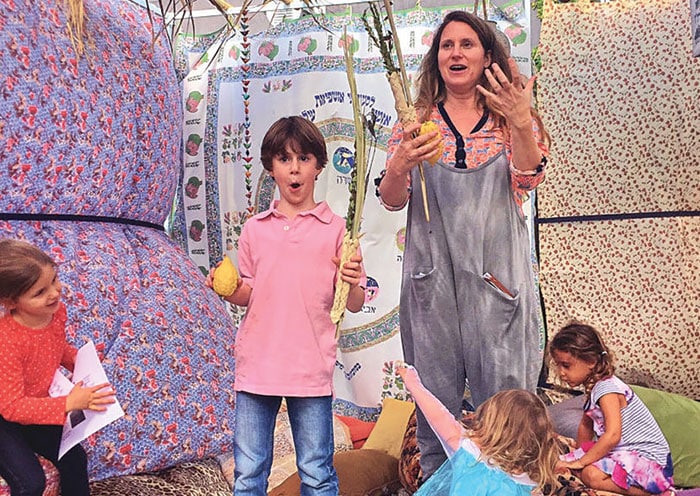
Rabbi Lori Shapiro

The femininity of the festival should not be overlooked — its cycles of birth, death and rebirth, the vivid reds of the pomegranates cut open and staining our pillows with memories for years to come, the cornucopia of voluptuous local fruits with their come hither plumpness. Sukkot, in all of its nubile radiance, is immodest; it calls to us to look at the visions of raw, unapologetic fecundity. The images arouse us into an awakened state reserved for mystics and the modern day psychedelic journeyer, awakening us into our bodies and the evanescent truth of being: We are here now and someday we, too, will be gone.

Crawling into my sukkah, I more than invoke the presence of cultivating future generations, but do so with the presence of our shared ancestors. As we welcome in our ushpizin (the ritual invoking the presence of our bloodline all the way back to the Patriarchs and Matriarchs of the Torah into our sukkah), we are reminded that we are part of a “great chain of becoming.” 

Each year, I attempt to go further back in my bloodline, with mobiles I have created through the years of my ancestors in an embodied experience of my personal story in space and time. It was in my sukkah that I began to become curious about who my grandparents’ grandparents were, and first signed up for a genealogy website. Beneath the stars of a roof festooned with s’chach, I tested my husband while dating to see if he would actually sleep in a sukkah with me all night (he passed).

Sukkot is an ideal time to bond not just with our ancestors, but with nature. As Los Angeleans, we share the same latitude as Israel and live in a similar seasonal rhythm.

Sukkot is an ideal time to bond not just with our ancestors, but with nature. As Los Angeleans, we share the same latitude as Israel and live in a similar seasonal rhythm. Our Sukkot observance holds a similar flavor palate as our ancient Israelite ancestors’ who had to set up Sukkot in the fields to gather their harvest’s bounty. We can enjoy the same ripened pomegranates and forage in our neighborhoods for fallen fruits on local trees, a sensory visitation from biting into our local produce, reminding us that Israel is as much a state of mind and imagination as it is a geographic region.  

But we can’t do this on Zoom. We can’t do this through Facebook live, FaceTime, Vimeo or YouTube. The only way to do Sukkot is to get outside and do the work, and when we are done, lie on the earth and look at the stars.

Throughout COVID restrictions, we’ve tried to infuse this organic “Sukkot energy” at Open Temple by doing as many things as possible offline and outside. From Drive-in Shabbat to Bike Shabbat, Silent Beach Discos at Sunset for Havdalah to Purim in a parking lot with aerialists lit in LEDs telling the story of Esther, our commitment was to preserve the necessity (and humanity) of (safe) human contact through a time where that seemed almost impossible. 

This Sukkot, we will offer a different happening every night of the holiday, with events such as Sukkot Kayak Shabbat, where a floating Sukkah will lead a fleet of kayaks down the Venice Canals. Open Temple expresses the essence of  Sukkot as an intermix of ancient rituals, earth and senses into the world in which we live.

This year more than ever, Sukkot is a call to all of us to get out and live again. It’s a call to have people over, return to the sensual pleasures of redolent fruits and tactile handling of plant species. It’s the clarion call to return to the roots of community.

Sukkot, this year more than ever, is a call to all of us to get out and live again. It’s a call to have people over, return to the sensual pleasures of redolent fruits and tactile handling of plant species. It’s the clarion call to return to the roots of community. It’s a reminder from our shared ancestral history that we are a part of a multi-cultural experiment of religious significance — that rejoicing with community in a shared experience of earthly pleasure is as important as justice and mitzvot. In 5783, to build a sukkah and to dwell in it is to reenter our lives and truly reclaim a Judaism that doesn’t zoom through life.


Rabbi Lori Shapiro is the founder and artistic director of The Open Temple in Venice. 

Cover Story: We Can’t Zoom Sukkot Read More »

Iran Protests at a ‘Tipping Point,’ Activists Say

Activists across the Iranian and Jewish communities are expressing support in the ongoing protests in Iran, calling them a “tipping point” for the country.

The protests were sparked on September 16 after 22-year-old Kurdish woman Mahsa Amini died while in police custody. She was arrested by Iran’s morality police for improperly wearing a hijab as she was exiting a Tehran subway. The Iranian regime claimed Amini died of a heart attack, but her family has countered that she did not have any preexisting heart conditions prior to the arrest. Iranian-American human rights attorney Gissou Nia told Slate that a photo had emerged of Amini “in a hospital bed looking beat up, with gauze around her neck, hooked on an air device to help her breathe,” adding “it was absolutely shocking to see this young, beautiful woman in the hospital bed like that, and the photo went viral.” And thus the protests started, and the Iranian regime has responded by cracking down on the protests; at least 83 have died and more than 1,500 have been arrested, including journalists and celebrities.

“What we’re seeing unfolding right now in Iran is a full-blown revolution throughout the country being led by the younger generation of Iranians that are fed up with the regime’s repression of their rights, suffocating their voices and terrorizing them on a daily basis.”
– Karmel Melamed 

“What we’re seeing unfolding right now in Iran is a full-blown revolution throughout the country being led by the younger generation of Iranians that are fed up with the regime’s repression of their rights, suffocating their voices and terrorizing them on a daily basis,” Iranian—American journalist Karmel Melamed told the Journal. “They’re frustrated that the Biden administration and European powers continue to negotiate with this regime in a potential deal that would enrich the regime and allow it to continue its reign of terror over them. They’re not very well organized right now, but they’re telling us in very clear language they want regime change in Iran and America’s support in their quest for real freedom and a representative democracy instead of the Ayatollah regime that rules them right now with an iron fist.” 

Ellie Cohanim, the Iranian-born former Deputy Special Envoy to Monitor and Combat Antisemitism, told the Journal that the protesters have been chanting “Death to the Dictator” in more than 80 cities in Iran. “Iranians are calling for an end to the Islamic Republic regime,” Cohanim said.

“This is the most brazen we’ve seen in the Iran protesters in 43 years,” Iranian-American journalist Lisa Daftari told the Journal in a phone interview, adding this is different from prior protests because “people have truly had enough.” “There’s always some sort of tipping point in society where people think, ‘I truly have nothing to lose at this point, I am willing to give up my life. And that’s exactly what we’re seeing from these young protesters.”

“Iranian women have a long history of protesting and defying authority in Iran,” American Jewish Committee Director of Training and Education Saba Soomekh said in a statement to the Journal. “In the 19th century, women participated in street protests, and in Iran’s first democratic uprising in 1905, many towns and cities formed local women’s rights committees.  In 1979, when [former Iranian Supreme Leader Ruhollah] Khomeini announced that all women must wear the hijab, tens of thousands of unveiled women marched in protest on International Women’s Day. The wave of protests that we are seeing in the Islamic Republic today is not only about women’s rights, but human rights. We are seeing men joining women. We are witnessing protests coming from people from all economic and religious backgrounds, from some of the most conservative cities in Iran such as Qom and Mashhad. The Iranian people deserve to have human rights and live free from a regime that has politicized religion in order to justify their misogyny and human rights violations.”

Associate Dean and Director of Global Social Action Agenda at the Simon Wiesenthal Center Rabbi Abraham Cooper told the Journal that the protests are “intensely personal” for the Persian Jewish community in Los Angeles. “This was their homeland,” Cooper said. “I think there’s also a sense of pride that the next generation has stepped up.” 

“Obviously it’s very emotional for Iranian expatriates to be so far from the country that they love at a moment where so much is going on,” Daftari said. “I think this is a moment where a lot of Iranians and non-Iranians can really unite regardless of religion or political persuasion. I think this is truly just a fight for freedom.”

Daftari added that “the Achilles heel of the Iranian regime” is the Iranian people, and the regime’s “biggest fear is that the people of Iran will rise up and that’s because that’s how they come to power… they know it will take a people’s revolution to take them out of power, and that’s why they’re cracking down so brutally on the protesters.”

Melamed estimated that “Iran’s population right now is about 80 million people and nearly 70 percent of Iranians are under the age of 40, so I highly doubt the current Ayatollah regime can continue to strangle hold such a huge segment of the country who have access to social media and see the rest of world and the Middle East progressing and enjoying freedom while they suffer financially and without basic freedoms and human rights.”

But the community believes that the world has to take action now. In an Instagram post, Iranian-Jewish-American organization 30 Years After wrote that they echo the protesters’ demands for “justice and accountability” for Amini and all the protesters the regime has cracked down on, removing Iran from the United Nations Commission on the Status of Women and for the people of Iran to live under “democracy and freedom.”

Dr. Sharon S. Nazarian, Senior Vice President of International Affairs at the Anti-Defamation League and founder of UCLA’s Y&S Nazarian Center for Israel Studies, told the Journal, “This is a moment in time for the world to recognize that the Islamic Republic of Iran poses a dire threat to its own people, be it its courageous women citizens as we are all witnessing on the streets of dozens of Iranian cities, be it to its religious, ethnic and sexual minorities, as we have witnessed the regime’s systematic attack on Bahai, and LGTBQ minorities, and its assault on the totality of Iranian people through repressive and corrupt policies … The world must recognize that this regime is also the number one state sponsor of antisemitic rhetoric, Holocaust denial and acts of terrorism aimed at Jewish communities and Israeli citizens around the world. It is high time for the US administration and our Congressional leaders, the European Union and member countries, and all freedom loving people to stand with the people of Iran and to delegitimize the Islamic Republic by cutting off all political and economic engagement with the regime until it stops this murderous assault on its own people. The Islamic Republic of Iran is a threat to its people and to the international community.”

In a statement to the Journal, Siamak Kordestani, board member of Jews Indigenous to the Middle East and North Africa (JIMENA) and West Coast Director of ELNET, the European Leadership Network, said “The international community must stand with the women of Iran, who have been brutally repressed for over four decades … It has been heartwarming for me, as an Iranian Jew, to see so many Jews and Israelis around the world express solidarity with Iran’s people.”

Solidarity is fine, Daftari said, but the protesters need “material support” in addition to verbal support to take down the Iranian regime

Iranian Supreme Leader Ayatollah Ali Khamenei took to Twitter on October 3 to claim, without evidence, “that the recent riots & unrest in Iran were schemes designed by the US; the usurping, fake Zionist regime; their mercenaries; & some treasonous Iranians abroad who helped them.” The Atlantic’s Yair Rosenberg tweeted in response that Khamenei’s tweet was laced with “antisemitism and misogyny.” “His assumption is that the women of Iran have no agency and couldn’t possibly be behind their own protests, so they must be the pawns of others, like the Jews,” Rosenberg wrote, adding that “if Twitter were serious about free expression, it would ban all world leaders who restrict Twitter for their own citizens while allowing themselves unencumbered access. This would punish a lot of bad actors and incentivize greater freedom around the world.”.

Many expressed opposition to the Biden administration’s efforts to revive the Iran nuclear deal amidst the protests.

“It is unfathomable for the Biden administration at this same moment that the regime is crumbling to send them a significant lifeline, which is what the Iran deal is,” Cohanim said. “We saw statements this week from [National Security Adviser] Jake Sullivan making the same tired argument… that the Iran deal will stop the regime from developing nuclear weapons. The reality is that Biden’s Iran deal gives the regime billions in immediate sanctions relief for the promise of future compliance. Biden’s Iran deal is a lifeline to the Islamic Republic regime — Iranians don’t want this regime resuscitated, Americans don’t want this regime resuscitated and certainly our allies in the region don’t want to see that outcome either.”

Daftari echoed Cohanim’s claim. “Ever since the Biden administration came into office, the centrifuges have been spinning in Iran. They’ve been enriching uranium at over 60%, they have shut off more than 27 IAEA surveillance cameras, they have turned away nuclear inspectors, the human rights abuses have been egregious, they voted in The Butcher of Tehran as their president and they continue making threats against America and Americans. They actually threatened to assassinate American political leaders and we allow them to get visas and come to the UN and spew more hatred and more garbage at the podium. So this has to stop.” She added that the Iran deal would give them “a lifeline and money” to put toward terror groups like Hamas, Hezbollah, Islamic Jihad and the Houthis in Yemen.

“The murderous Iranian Islamic regime’s horrific abuses of its own citizens’ human rights demonstrates once again that the U.S. must not enter into an Iran deal that provides hundreds of billions of dollars which ends up funding other terrorist ground and legitimizes Iran’s rapid march towards full nuclear capability,” Zionist Organization of America National President Morton A. Klein said in a statement to the Journal. “It’s time for the U.S. to end the sham that negotiations will work, and to assure a credible military option against Iran’s rapid March toward nukes and long-range nuclear missiles which will be used against Israel and the West.”

Iranian Americans for Liberty Executive Director Bryan E. Leib told the Journal  “the time is now for the Biden Administration to stop tweeting about their support for the Iranian people and to take tangible actions to show the Iranian people they support them and not the Khamenei regime … The easiest way to do this is for the Biden Administration to publicly call for an end to their efforts to revive the Obama nuclear deal and to pivot back to maximum sanctions [and] maximum isolation [against the Iranian regime].”

Cooper told the Journal that even Senator Bernie Sanders (I-VT) has condemned the Iranian regime’s crackdown of the protests and that now it’s up to Biden and Secretary of State Antony Blinken to take action. In Cooper’s view, that includes reimposing sanctions against Iran and walking away from the Iran deal negotiations. “I think I saw a news item that Iran was able to sell China $38 billion in oil,” Cooper said. “That’s from one client. If the United States, Great Britain, France, Germany wanted to make a difference, they can do so. Let the regime really feel the pain.”

But he warned that if the protests go the way of the 2009 Green Revolution with then-President Barack Obama “sitting on his hands,” then “it’s not going to end well.” “There will be not hundreds but thousands of casualties. There’ll be tens of thousands of people incarcerated or worse,” Cooper said. “This is a tipping point … it is a very dramatic moment in history. I hope that our nation and the world leads are up to it, because right now the only thing between the ayatollah and the graveyard of history is the failure and refusal of Western democracies to stand up with the people of Iran against this brutal murderous regime.” 

Author Elham Yaghoubian, a human rights activist and Iran expert, told the Israel-based Hebrew newspaper Ma’ariv that “in all previous movements in Iran, the regime tried so hard to divide people by any possible means. This time though, its vicious strategy of “divide and conquer policy” seems to be a complete failure. People in Iran showed – despite their different ethnoreligious backgrounds – that they are together to change this regime. Maybe this is the first time in Iran that all different pro-democracy parties both in Iran and outside are together for one goal. We are hoping that the current U.S administration considers what the Iranian nation wants before going back to the negotiation table with regime leaders.”

Iran Protests at a ‘Tipping Point,’ Activists Say Read More »

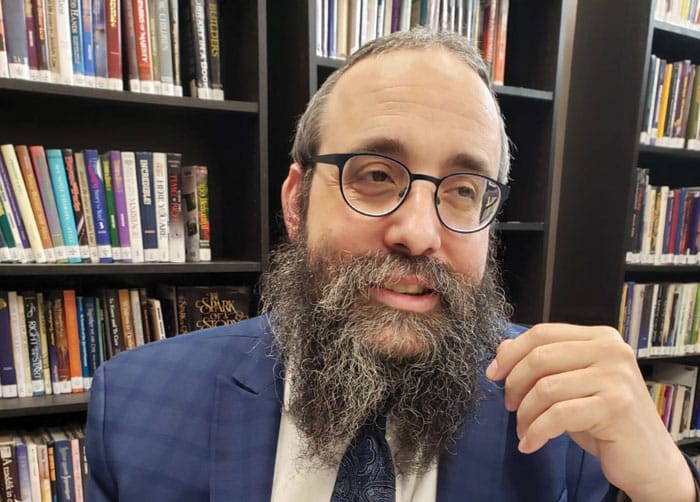
Rabbis of LA | Rabbi Moshe Levin: Filling Every Moment with Mitzvot

Fourteen years ago, Rabbi Gavriel and Rivkah Holtzberg, directors of Chabad-Lubavitch of Mumbai, were killed during a horrific terrorist attack. In the year following the tragedy, it was a hakhel year, traditionally when all the Jews would go to Jerusalem to hear the Jewish king read the Torah.

In light of the tragedy, and the following hakhel year, Rabbi Moshe Levin of Bais Bezalel Chabad in Pico-Robertson started a new project to spread light and Jewish teachings around the world. 

He created One Minute Daily Torah Thought, a robocall that people could receive and hear the rabbi teaching Torah for a minute. That morphed into a podcast that listeners from all over the globe tune into every day. 

“My listeners will call me and ask me for advice,” said Levin. “I feel very close to them.” 

The rabbi tries to fill every moment of his day doing mitzvot, and he makes Torah teachings as digestible for people as possible. He wants to ensure it’s easy for other Jews to perform mitzvot as well. 

He starts his days teaching a class in Hasidic philosophy to his congregants and students. 

“I wouldn’t miss that for anything,” he said. “That gives me my inspiration.”

After the morning prayers, he carpools his kids, and then he teaches Torah to students who don’t go to Jewish schools. During the lockdowns, a lot of public school kids were home, and their parents were looking for something for their children to do in between Zoom classes. Students would go to Bais Bezalel, take their classes on their laptops and learn Jewish heritage in between their lessons.

“Parents thought this was very special,” Levin said. “They never thought Jewish school was an option for their children.” 

Levin also spent the pandemic starting the Jewish Family Library of Los Angeles at the shul, which provides books to Jewish children of all different backgrounds. He is usually on-site to help families in between arranging food for people in need and putting tefillin on Jewish men and boys throughout Los Angeles. His philosophy – and the Chabad philosophy in general – is that doing just one mitzvah can be transformative.

“Years ago, I met a man at the Grove when I was giving out menorahs,” he said. “He told me he didn’t want a menorah because he knew that one mitzvah would lead to another. He said, ‘I know where this is going.’”

More recently, a friend of the rabbi made a business deal with another man, and as part of the deal, the man would have to put on tefillin three times with Levin.  

The man had no interest in doing this, but once he started, he wanted to keep on going. 

“He said, ‘I don’t know why. I cannot explain it, but I don’t want to stop,’” Levin said. “We have an inborn connection to God. Everyone has that yearning to learn about their Judaism and discover their personal connection to God.”

Levin comes from a legacy Chabad family. His great-grandfather, who would pray four hours a day, was incarcerated for teaching Torah in Soviet Russia. 

The previous Lubavitcher Rebbe, Yosef Yitzchak Schneersohn, sent Levin’s grandfather to serve the Worcester, Mass. Jewish community. He worked there for over 70 years.

“There was nothing going on there before he came,” said Levin. “He did everything from scratch. He built a day school, a mikvah and a high school for girls. He was really an inspiration to me.” 

Levin grew up in Worcester, and decided to follow in his grandfather’s footsteps. Nineteen years ago, he moved to Los Angeles to teach at Yeshiva Ohr Elchonon Chabad, but realized that teaching on a full-time basis was not for him. When the previous rabbi of Bais Bezalel, Rabbi Binyomin Lisbon, was leaving to focus on his career in kashrus, he asked Levin to take over. 

No matter what Levin is doing in his day-to-day activities – whether it’s helping students learn about Judaism, wrapping tefillin on men, recording his podcast or teaching his class – he knows his role is to keep igniting Jewish souls.

“We just need to provide a match so every person’s fire can rise on its own.”

“The fifth Chabad Rebbe, Rabbi Sholom Dovber Schneersohn, once said that every Jew is meant to be a lamp lighter,” Levin explained. “We have to kindle each other’s souls and create a fire in another person. The fire is there. We just need to provide a match so every person’s fire can rise on its own.”

Fast Takes with Moshe Levin

Jewish Journal: What is your favorite food to eat during the High Holidays? 

Moshe Levin: Whatever my wife makes. She puts love into it. It doesn’t matter what it is. 

JJ: If you weren’t a rabbi, what would you be doing for work?

ML: I don’t think the word “rabbi” has a one-size-fits-all translation. Whether I’d be in a congregation with a community or not, the role of being a Jew who inspires another Jew is the role of every person in our entire generation. It’s not unique to being a rabbi. Every soul is empowered to inspire other souls.  

JJ: What is your favorite thing about Sukkot? 

ML: After Yom Kippur, when God cleanses the soul, you have a new kind of attachment to God. While in the sukkah, we experience God’s love. I like being in that holy space. It’s very meaningful. 

Rabbis of LA | Rabbi Moshe Levin: Filling Every Moment with Mitzvot Read More »