fbpx

September 20, 2022

Radicalization 101: How Anti-Western Forces Infect American Campuses

How many times have we heard about radical professors brainwashing students into Marxist, anti-Western and even pro-terror ideals? Or of students chanting “death to Israel, death to America,” like those heard in the summer of 2020? While much has been written about indoctrination in academia, seldom has the public been offered a direct view into how this can occur. But a recent two-day conference hosted in Beirut, Lebanon on September 10-11 by the Arab and Muslim Ethnicities and Diasporas Studies department (AMED) at the taxpayer-funded San Francisco University, which featured a variety of unsavory characters belonging to U.S.-designated Palestinian terrorist organizations, is perhaps the greatest showcase of radicalization happening right before our very eyes.

According to the Jerusalem Post, the conference was also broadcast on AMED’s social media pages as part of the department’s “Teaching Palestine” project and was spearheaded by AMED director and SFSU professor Rabab Abdulhadi. It was ostensibly meant to commemorate several notable anniversaries for Palestinians, such as the Sabra & Shatila massacre and Israel’s assassination of terror leader Ghassan Kanafani.

Among the speakers was Salah Salah, one of the founding members of the Popular Front for the Liberation of Palestine (PFLP), a U.S.-designated Marxist terror group with American blood on its hands, including 17 Christian pilgrims from Puerto Rico who were murdered in the 1972 Lod Airport Massacre. The mastermind behind the attack, Kōzō Okamoto, was honored by the PFLPin a 2016 ceremony, where Salah attended and sat next to Okamoto. At one point during Salah’s panel, he and Abdulhadi joined in a friendly embrace.

Another guest speaker was Sami Al-Arian, a former professor at the University of South Florida who pled guilty in 2006 to assisting the U.S.-designated Palestinian Islamic Jihad (PIJ), and was subsequently deported to Turkey.

The most high-profile would-be guest of the evening was PFLP airplane hijacker Leila Khaled, who was set to appear via Zoom on a panel alongside Al-Arian and Prof. Abdulhadi, but last-minute technical difficulties prevented her participation.

The conference participants are bad enough. Yet, equally troubling is that SFSU has allowed, time and again, Abdulhadi to continue recruiting these extremists for her “educational” curriculum. Back in September 2020, AMED produced headlines when it tried to host Khaled for a lecture over Zoom until the platform forcibly canceled the event. While Zoom took commendable action, SFSU rejected multiple requests to shutter it beforehand.

Some may contend that Prof. Abdulhadi is a rarity—an anomaly being exploited to cast wide, unfair aspersions on academia and the state of affairs on college campuses.

That is wrong.

In June 2021, for example, an event organized by the same Sami Al-Arian, which took place under the auspices of the Muslim Brotherhood and Turkish government affiliates, enjoyed the participation of nine professors from public universities, including the University of Denver, Columbia University, Ohio State University, UCLA and the University of Arizona. Of course, SFSU’s very own Prof. Abdulhadi was there as well.

When approached about Abdulhadi’s Beirut conference, an SFSU spokesperson replied that it was “neither sponsored nor authorized by SF State, and we have contacted organizers to notify them of unauthorized use of the SF State name.”

This response is unsatisfactory.

Based on the open letter of support published in Mondoweiss this week detailing so-called “injurious actions” taken against Abdulhadi since June 2022, it appears that SFSU’s administration was aware of the Beirut conference in advance and pressured Abdulhadi not to affiliate the university with it—a request she clearly denied by advertising the event on AMED’s social media pages and placing a large AMED banner on the conference stage.

Whether SFSU had prior knowledge of the event or not, the entire incident is demonstrative of the fact that there is a clear pathway for academics to radicalize students, and that university administrations lack the tools, or rather the willingness, to stare that radicalism in the face and stop it from poisoning their campuses.

This complacency has real-world ramifications, including at SFSU, where Jewish students are demonized for their membership in campus organizations aimed at empowering Jewish identity.

This complacency has real-world ramifications, including at SFSU, where Jewish students are demonized for their membership in campus organizations aimed at empowering Jewish identity. But perhaps the most concerning consequence is that often, fanatical students become professors themselves, thereby perpetuating a cycle of radicalization.

The point is that the same extremism that Abdulhadi has spent years infusing into her curricula and instilling into her students doubtlessly plagues other academic institutions as well, while administrators effectively turn a blind eye. The only way to begin solving this problem is to take a real look and tackle it head-on. Maybe then we’ll finally figure out how to prevent our fellow citizens from yelling “death to America.”


Eitan Fischberger is an international relations and Middle East analyst based in Israel. His work has been published in NBC News Think, National Review, and more. Tweet him @EFischberger.

Radicalization 101: How Anti-Western Forces Infect American Campuses Read More »
If Bibi Knew

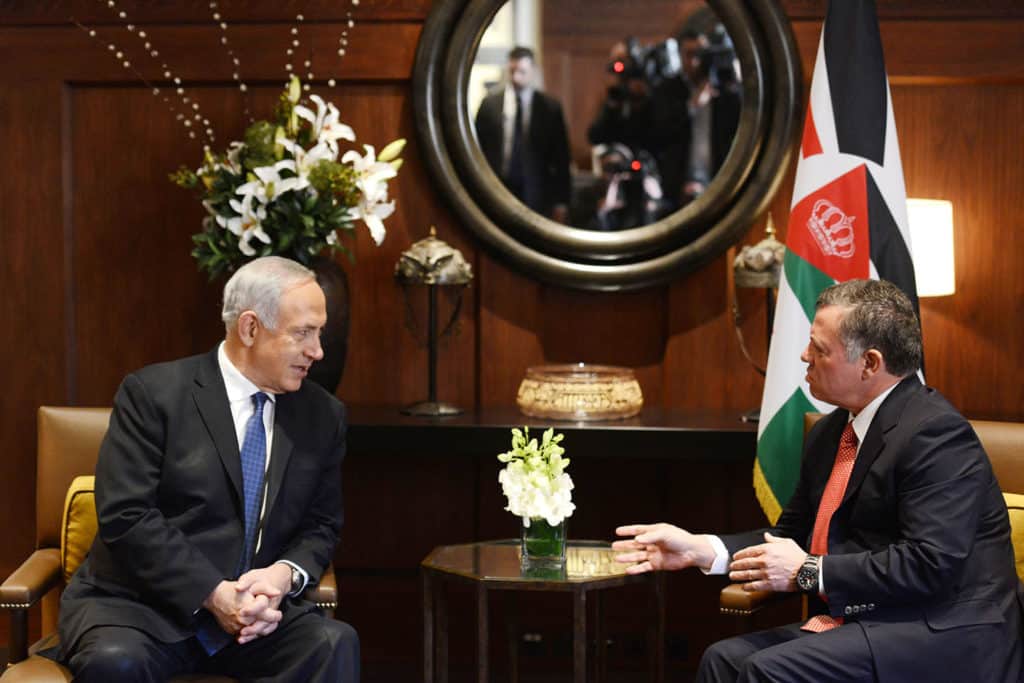
Last week, The Washington Post reported that in 2018, President Donald Trump offered the entire territory of The West Bank to King Abdullah II of Jordan. The scoop came from “The Divider: Trump in the White House 2017-2021,” a yet to be released book on the Trump administration written by Peter Baker of The New York Times and Susan Glasser of The New Yorker. According to “The Divider,” President Trump made the gesture believing he “was doing the Jordanian king a favor,” and that Abdullah “thought he was having a heart attack” when the phone call came. “I couldn’t breathe. I was bent-doubled over,” the sovereign of the Hashemite kingdom is quoted in saying.

If Baker and Glasser are accurate in their reporting, this never-to-be arrangement is quite the dramatic political story. The offering of the West Bank to Jordanian rule relates to nearly every aspect of the Israeli-Palestinian conflict, from its bloody beginnings to its coveted peaceful conclusion. But before any analyses can be made, one crucial question must be answered, a question that was curiously not acknowledged in the initial Washington Post article: Did Benjamin Netanyahu know? Whether or not Israel’s former (and possibly future) Prime Minister of Israel knew of President Trump’s plans in 2018 carries important implications for the stability of the region and regarding what the players in the peacemaking process are actually after.

The first hypothesis is that Benjamin Netanyahu was not aware of the proposal made to Abdullah. This narrative seems to coincide more fully with what most of both Americans and Israelis understand about the conflict. Netanyahu leads a right-wing coalition in the Knesset made up in large part of religious Zionists. A cornerstone of religious Zionism is the conviction that the Jewish people must settle the entire land of Israel to redeem some higher spiritual purpose. Another common belief is that Israel must continue the occupation for security concerns: that the Palestinians have relinquished their opportunities to govern themselves after decades of rejectionism and terrorism. The nationalist right is also quite uncompromising on settlers in what they call “Judea and Samaria ” being evicted from their homes in the same fashion as the Gush Khatif settlers of Gaza in 2005. Therefore, it would seem outside the realm of possibility for Netanyahu to betray the foundational support he receives politically by not obstructing President Trump in his offer to King Abdullah. “The Jordan option” remains only of interest to those who feel no physical or religious attachment to the land between the green line and the Jordan River, and this category of Israeli voters are most likely not voting for Mr. Netanyahu.

Then there is the second hypothesis, which is significantly more interesting should it be true. In this scenario, Prime Minister Netanyahu was aware of the call between Trump and Abdullah and neither privately nor publicly expressed opposition. This would mean that Netanyahu was at least entertaining the Jordanian option during his last premiership, which could be verified by a comment made in 2018 by Gideon Sa’ar, then a powerful member of Netanyahu’s Likud party, when he spoke of the possibility of a “link in the future between an Arab autonomy in Judea and Samaria and the Kingdom of Jordan.” If, when in power, Likud was not diametrically opposed to giving up land conquered by Israel in the 1967 war, then contrary to widespread belief, Likud is not a party hellbent on annexing the West Bank, a notable contradiction to Israel critics who see a right-wing government as a stepping-stone to a one-state, apartheid-adjacent future for the region. If Bibi did know, then the mainstream Israeli right is more reasonable than we thought and is only flexing its hardline policies on the Palestinians in the West Bank as part of a strategy of maximum pressure on the Palestinians to come to the negotiating table.

If Bibi did know, then the mainstream Israeli right is more reasonable than we thought and is only flexing its hardline policies on the Palestinians in the West Bank as part of a strategy of maximum pressure on the Palestinians to come to the negotiating table.

Such a position could be supported by previous political moves. In 2020, Mr. Netanyahu proposed plans to annex the Jordan Valley, a strip of fertile land on the east side of the West Bank, into Israeli sovereignty. However, these plans were scrapped immediately after the United Arab Emirates and Bahrain signed normalization agreements with Israel, leading many to theorize that the plan for annexation, which received widespread criticism and outrage from liberals in Israel and all over the world, served the purpose as a bargaining chip to pressure Arab countries to move on establishing diplomatic ties with Israel and was subsequently a scare tactic. Such a political maneuver, of holding on to land until cards fall in your favor, is congruent with Israeli history.

In the 1970s, Israel handed the Sinai Peninsula it had conquered in the 6-Day War back to Egypt in exchange for peace. In the decades following, Israeli governments, both right-wing and left-wing, routinely offered most if not all the West Bank and the Gaza Strip to the Palestinians in exchange for a never-to-be cease in hostilities. Israel has, on every occasion, signaled that it will relinquish treasured territory and swallow hard compromises to live out the rest of its days without the threat of imminent invasion. Thousands of left-wing journalists and commentators have claimed that this compulsion is gone, swept into the dustbin of history. They are increasingly certain that Israel will only steal more land, throw more Palestinians off theirs, and continue their military occupation no matter how many surrounding Arab nations agree to make amends with their Jewish neighbor. But if Benjamin Netanyahu knew about the call between President Donald Trump and King Abdullah of Jordan and did nothing to interfere with the proposal regardless of how doomed it was, then these thousands of talking heads would be proven undeniably incorrect. It would suggest that the Abraham Accords-esque strategy of fomenting agreements with surrounding Arab nations to solve the Palestinian problem, rather than the other way around, is being pursued more broadly.

A possible rebuttal to this argument, assuming that Benjamin Netanyahu knew about President Trump’s offer, is that Bibi only greenlights potential peace deals he knows are going to fail. The “Trump Peace Plan” of 2020, which offered the Palestinians a state in only fragmented and noncontiguous sections of the West Bank, was certainly not going to end the conflict. A confederation with Jordan and Israel is also (for now) destined to fail, in part because of the political aspirations of the Palestinians and also the intransigence of the Hashemite kingdom in absorbing hundreds of thousands of more Palestinians. Yet even if this is true, it should still be a bigger story that Netanyahu was at least willing to offer the Jordanian option, because it shows that the hardline annexationist right does not have a chokehold on Israel’s largest right-wing party or even on Israel’s most popular right-wing leader. It shows that Benjamin Netanyahu knows that the reality of Israeli occupation in the West Bank is a potential bargaining chip, and that Netanyahu does not represent a radical departure from previous prime ministers and governments who understood that the land for peace equation can in fact work, given the right conditions.

At the time this piece is published, I will be an Israeli citizen, just days ahead of my Aliyah flight. I will certainly not be voting for Netanyahu or any right-wing party in the next election. I am what modern Israelis may call a naive 1990s-era peacenik, continually thinking about the day the conflict does end and the steps we as a country can take to get us there (other Israelis might call me an arrogant American who is trying to fix Israel after being here for three days, and to that I say, guilty as charged.)

Nonetheless, conflict resolution as a possibility is a brute fact of Israel’s existence, because even the most existential and bitter conflicts have ended before. And I’m willing to seek out glimmers of hope in getting us there even in the leaders I disagree with the most.


Blake Flayton is the New Media Director and columnist for the Jewish Journal.

If Bibi Knew Read More »

Iranian President to 60 Minutes: “There Are Some Signs” the Holocaust Happened

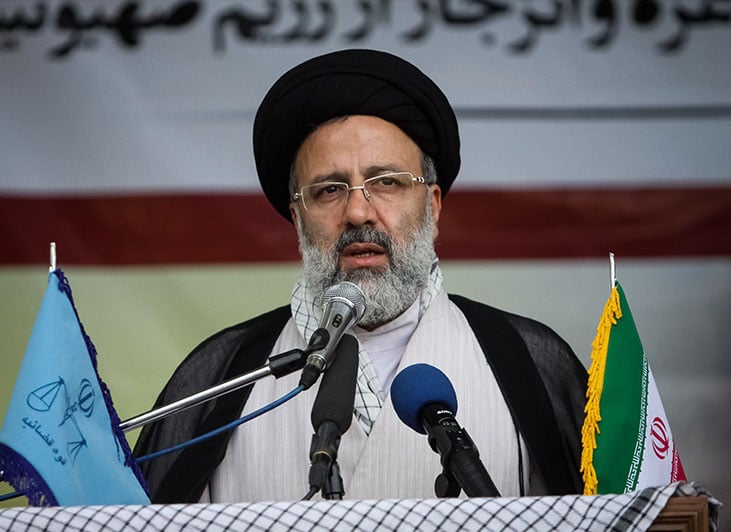
Iranian President Ebrahim Raisi told CBS News’ “60 Minutes” in an interview that aired on September 18 that “there are some signs” that the Holocaust happened and that Israel is a “false regime.”

CBS’ Lesley Stahl asked Raisi if he believed that the Holocaust was real. “There are some signs that it happened,” Raisi replied. “If so, they should allow it to be investigated and researched.” Stahl also asked Raisi if he supported Israel’s right to exist; he replied, per The Times of Israel: “The people of Palestine are the reality. This is the right of the people of Palestine who were forced to leave their houses and motherland. The Americans are supporting this false regime there to take root and to be established there.”

In response to Raisi’s remarks, Israeli Prime Minister Yair Lapid tweeted out four pictures showing the barbarity of the Holocaust and the words “some signs,” per the Associated Press.

U.S. Special Envoy to Monitor and Combat Antisemitism Deborah Lipstadt condemned Raisi’s remarks in a tweet. “Iranian President Raisi’s call for ‘research’ to determine whether the Holocaust happened is ludicrous and dangerous. His statement is a form of Holocaust denial and a form of antisemitism.”

Anti-Defamation League CEO Jonathan Greenblatt tweeted that Raisi’s comments “were part of a pattern” of “Holocaust distortion and hateful #antizionism.” He also noted that Raisi “tries to kidnap & kill our citizens,” “threaten our political figures… or bomb our troops [with] impunity.” “Alas the only “false regime” is the one in Tehran that sustains itself by assaulting women like #MahsaAmini, beaten to death in broad daylight because of the “crime” of how she wore her hijab or by spreading terror against its neighbors,” Greenblatt wrote. He concluded his Twitter thread by calling for Twitter and other social media companies to deplatform Iranian Supreme Leader Ayatollah Ali Khamenei.

The American Jewish Committee tweeted, “The Holocaust is not up for debate. We are not even 80 years removed from a genocide that killed more than one-third of the entire global Jewish population. Raisi’s Holocaust denial is a form of antisemitism, plain and simple.”

The Simon Wiesenthal Center tweeted, “Iranian regime denies Nazi Holocaust. You can’t trust or believe anything they say.”

StandWithUs CEO and Co-Founder Roz Rothstein tweeted: “Watch as #Iranian President Raisi conveys that he is not quite sure that the #Holocaust ever happened. Perhaps he can explain to people like me, (children of people who DID survive the barbaric atrocities), why we grew up with few (if any) relatives.”

AIPAC tweeted that Raisi basically told CBS that he “denies the Holocaust,” “rejects Israel right to exist,” and “opposes Arab-Israeli peace deals.” Raisi had told Stahl regarding the Abraham Accords: “If a state shakes hands with the Zionist regime, then they are also an accomplice to their crimes.” “Would we really strengthen the Iranian regime with $100 billion per year for only temporary nuclear restrictions?” AIPAC asked.

Siamak Kordestani, West Coast Director of the European Leadership Network and an Iranian Jewish refugee, tweeted: “No one understands the antisemitism of Iran’s regime better than Iranian Jews, a 2,500-year-old community. Most of us fled because of this Holocaust-denying, misogynist, ultra-homophobic regime. Believe us when we say: Iran’s leaders CANNOT be reformed.”

Former U.S. Deputy Special Envoy to Combat Antisemitism Ellie Cohanim, who was born in Tehran, tweeted, “You know what’s disgusting? Watching Western women like @60Minutes
Leslie Stahl wear a hijab to please the Mullahs she’s interviewing while the regime murdered #Mahsa_Amini for ‘improper hijab.’ Stop appeasing the regime & start supporting the women of Iran!”

Iranian Americans for Liberty Executive Director Bryan E. Leib asked in a tweet, “Why did @60Minutes give him a platform? What was the purpose of this interview?”

Iranian President to 60 Minutes: “There Are Some Signs” the Holocaust Happened Read More »

you-dont-know-schiff

Paul Reiser Part 1 – REBOOT

This week we reboot our Part 1 episode with Paul Reiser just in time for his new show Reboot which is available now on Hulu!

Mark and Paul came up together as comedians in NYC in the 70’s and have been friends ever since.  in this episode Paul discusses, among other things, his start in comedy, his passion (and if we may say so, his gift) for playing piano, landing the role in Diner which launched his acting career, his friendship with Yoko Ono and memories of walking to the Dakota with Mark the night John Lennon was killed.

Paul is touring the country! Be sure to check out his list of shows:
http://paulreiser.com/
Follow him on Instagram & Twitter:
https://www.instagram.com/paulreiserofficial/
https://twitter.com/PaulReiser

Be sure to check out Mark’s books!
Available November 8, 2022.”Why Not: Lessons on Comedy, Courage, and Chutzpah.”
Click on these links to buy:
Amazon
Barnes & Noble
Books-A-Million
Bookshop.org

Read road stories from some of the best comedians of our generation in Mark’s first book  “I Killed: True Stories of the Road from America’s Top Comics” available now!

Please follow “You Don’t Know Schiff” so you don’t miss out on any exciting episodes. Click here to subscribe on Apple Podcasts (and please leave us 5 stars and a positive review – your support means the world to us and it helps us get discovered by new listeners):

Your hosts:
markschiff.com
Twitter: @markschiff
Instagram: markschiff1
 

Lowell Benjamin
Twitter: @lowellcbenjamin
Instagram: @lowellcbenjamin


Paul Reiser Part 1 – REBOOT Read More »