fbpx

August 30, 2022

Mikhail Gorbachev, Soviet Leader Whose Reforms Included Letting Jews Leave for Israel, Dies at 91

Mikhail Gorbachev, the Soviet leader whose reforms, including allowing massive numbers of Jews to emigrate to Israel, changed his country and the world, died at 91.

Russian media said Gorbachev died Tuesday in a Moscow hospital.

“Michail Gorbachev has died,” Rabbi Pinchas Goldschmidt, Moscow’s chief rabbi from 1993 until this year, said Tuesday on Twitter. “3 million Soviet Jews owe him their freedom.”

It was clear when Gorbachev rose to power in 1985 that he would be different from his predecessors as secretary general of the Communist Party. He was younger, more vibrant, more open to acknowledging where communism had fallen short in the Soviet Union.

But his rise was at first was inauspicious for the movement that had sought for decades to allow Jews to freely emigrate, against the Soviet regime that prevented them from leaving and often punished them for seeking exit at all.

The number of Jews allowed to emigrate in 1985 was already low, 1,140, and slipped further to 914 in 1986. The sense among Soviet Jewry activists was that the new and relatively young leader was even more regressive than his predecessors.

His Western outlook seemed cosmetic. Visiting Britain in 1984 as a senior member of the Politburo, a year before his rise to leader, he shopped and joked — and snapped at a lawmaker who asked him about religious restrictions, “You govern your society, you leave us to govern ours.”

But then in 1987, the numbers of Jews emigrating began rising precipitously, reaching 185,000 in 1990, spurred in part by bold advocacy by American Jews that made releasing their Soviet brethren a politically wise maneuver for Gorbachev. At the same time, Gorbachev oversaw an end to restrictions on religious worship and most dramatically, opened the gates for the most famous of refuseniks and so-called “prisoners of Zion,” or those who had been imprisoned for their Zionist activity, including Natan Sharansky, Ida Nudel and Yosef Begun.

In a statement an aide delivered in 1991 at Babyn Yar, the killing field in Ukraine where Nazis launched the final solution seeking the annihilation of Jews, Gorbachev condemned all forms of antisemitism.

Gorbachev’s reforms affecting Jews were part of a much broader revolution he led to end the Cold War, the decades-long Soviet-U.S. standoff that many in the west feared would heat up into a nuclear conflict.

He and U.S. President Ronald Reagan joined in successful disarmament talks, and Gorbachev’s policies of perestroika (reconstruction) and glasnost (openness) introduced unprecedented freedoms of expression and organization to the Soviet Union. He decentralized the confederation, handing more power to the republics in a move that would eventually lead to their independence.

Gorbachev resigned after a failed coup in December 1991 that sought his ouster. He had bested the plotters but the economic uncertainty and the devolution of power created a sense of chaos and left him open to criticism that he was no longer the right man to lead Russia in an age of monumental transformation. He slipped into the obscurity of private life, much of which he spent with his beloved wife Raisa until her death in 1999.

Leaders of American and western Jewish organizations surprised themselves after his ouster by praising the leader of a nation they had once joined Reagan in reviling as an evil empire.

“Though Gorbachev was late in breaking out of the human rights gate, the positive changes he ultimately initiated would have been unthinkable to us in the Soviet human rights advocacy movement a decade ago,” the Student Struggle for Soviet Jewry, among the most strident of advocacy groups, said at the time.

A pocket of admiration endured in Israel, where Gorbachev got a hero’s welcome in 1992. He got awards, honorary degrees and, much to his bemusement, a new breed of potato named for him.

Gorbachev delivered during that visit a nuanced assessment of the antisemitism that had plagued his country. Antisemitism, they said, was “officially denied in policy but encouraged in practice.”

“In the days of Stalin, especially after World War II, antisemitism was introduced into domestic and foreign policy,” Gorbachev said. “Even after the death of Stalin, this state of affairs continued, but not in openly repressive forms.”

Speaking to a reporter after that speech, he said he also regretted the results. The exodus of what by then was at least 350,000 Jews, was, he said, a “loss for our land and society.”

Gorbachev had not publicly commented on Russia’s invasion this year of Ukraine, formerly part of the country he governed, although his foundation urged its speedy end. The invasion has cooled relations with the west that Gorbachev had warmed — and has spurred yet another wave of Russian Jewish emigration, to Israel and elsewhere.

Mikhail Gorbachev, Soviet Leader Whose Reforms Included Letting Jews Leave for Israel, Dies at 91 Read More »

Is Biden Trusting Putin With Iran’s Enriched Uranium in Revived Nuclear Deal?

When a subject is complicated and has multiple layers, it’s easy to get lost in a morass of arguments.

President Joe Biden’s zeal to revive the Iran nuclear deal, formally known as the JCPOA, gives off those optics of complexity. The parties have been negotiating, on and off, for close to 18 months, and now appear close to a conclusion. A million issues have come up.

Sounds complicated, right?

Indeed, there’s no better illustration of those complex optics than the “16 questions” addressed to President Biden on March 10 from a bipartisan group in Congress. Demanding transparency, I listed all 16 questions in a Journal cover story a few months ago.

The questions are so compelling it’s worth repeating them. Here are 15 you can skim through quickly:

  1. Will an agreement be presented to Congress pursuant to the Iran Nuclear Agreement Review Act (INARA)? Regardless of any substance, the law and proper oversight role of Congress must be respected.
  2. What will Iran’s breakout time be when the agreement is implemented?
  3. What will Iran’s breakout time be in January 2024, and each subsequent year until 2031? In calculating breakout time, please assume that Iran carries out the maximum allowable uranium enrichment activity pursuant to the JCPOA.
  4. Is there a consensus within the U.S. government on these breakout time figures? If not, please detail the differing views within the Administration. Similarly, is there consensus on these figures by our international partners?If not, please provide details on any differing views amongst our allies.
  5. Will Russia gain any economic benefit from an Iran agreement?
  6. How much money will Iran gain immediate access to when a deal is announced? What is the estimated value of sanctions relief in year one of the agreement, and for each subsequent year through 2031? If there are differing views on these figures within the Administration, please provide details on these differences.
  7. Does the Administration intend to request Congress pass legislation to lift the Iran Sanctions Act (ISA) in 2023 as required by the JCPOA? If Congress does not lift ISA, what actions does the Administration expect from Iran?
  8. Does the Administration support the lifting of U.N. Security Council prohibitions on outside support to Iran’s ballistic missile program? Such prohibitions are currently set to occur in October 2023 pursuant to Security Council Resolution 2231.
  9. The snapback mechanism in U.N. Security Council Resolution 2231 expires in 2025. What recourse will the U.S. have should Iran violate the agreement after that time?
  10. Does the Administration intend to remove the Foreign Terrorist Organization designation of the IRGC? Will sanctions on the IRGC in any other way be diminished?
  11. Will sanctions targeting the Supreme Leader, his office, subordinates, or associated foundations be lifted or lessened in any way?
  12. Will sanctions on the Central Bank of Iran (CBI) be lifted or lessened in any way? If so, can the Administration certify that the CBI has in no way been engaged in any support for terrorism in facilitation of transactions for terrorist entities (including the IRGC) in the past year?
  13. Will sanctions be lifted, or lessened in any way, on any other entity or individual that has engaged in support for terrorism, or been designated under Executive Order 13224 for providing material support to a designated terrorist entity?
  14. Will Iran be required to satisfactorily answer outstanding questions from the International Atomic Energy Agency (IAEA) regarding the discovery of undisclosed uranium particles at multiple cites?
  15. Will U.S. human rights programing in Iran continue subsequent to an agreement?

I left one question until the end because that one alone should be a deal killer. It relates to the controversial clause that transfers Iran’s extra enriched uranium into the custody of Russia. Here it is:

If Iran subsequently believes the agreement has been violated, or that it has not received the promised sanctions relief, will Russia be in a position to return enriched uranium to Iran? In essence, will Vladimir Putin become the de facto judge of compliance with an agreement?

Of all the arguments that have been made against the deal—it’s only temporary, it doesn’t address terror activities, you can’t trust a regime that cheats, etc., — putting a murderous Putin in a position of compliance arbitrator is arguably the most potent.

It’s a lightning bolt of clarity that cuts through the morass of arguments. You don’t need to be an expert on centrifuges to figure out the danger of trusting a cruel sociopath who hates the West on a deal that can really hurt the West. This doesn’t even get into the economic benefits that will ostensibly flow to Russia, which would turn the deal into a bonanza for two of the most evil regimes on the planet.

Which brings us to that other bolt of clarity: money.

In return for a horribly flawed deal, the West is preparing to eventually hand over, according to some estimates, up to $150 billion a year in sanctions relief to the world’s #1 sponsor of terror. Yes, there’s something wrong with this picture.

So here’s the deal, Mr. President. I’ll repeat what I wrote several months ago: You report to us. You owe us transparency. You owe us answers.

If you prefer not to answer all 16 questions from our representatives in Congress, at least answer this one: Is it true that you will trust Putin to make the deal work, and if so, why?

Is Biden Trusting Putin With Iran’s Enriched Uranium in Revived Nuclear Deal? Read More »

Time to Confront, Not Coddle, the Iranian Regime

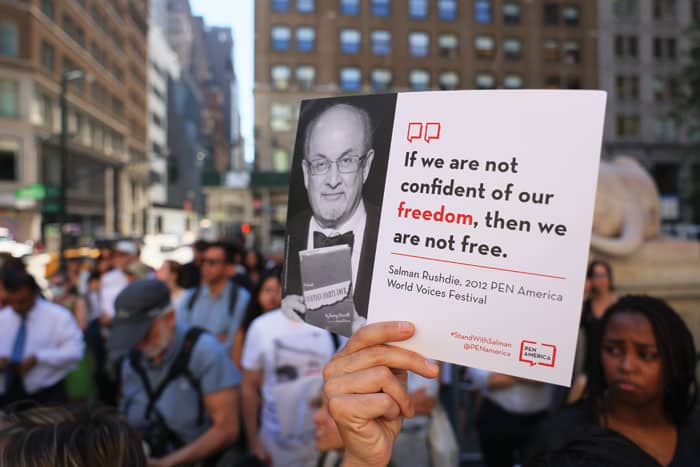
On August 12, 2022, the famous Indian-born novelist Sir Salman Rushdie was attacked and stabbed repeatedly while lecturing at the Chautauqua Institute in upstate New York. A strong 75-year-old, he appears likely to recover, but as of this writing, is reported to have suffered liver damage and nerve damage to his arm, and to be likely to lose an eye as a consequence of the attack. The assault represents the culmination of over three decades of fear for the author, who since 1989 has been living under the threat of a bounty for his death, currently set at $3 million, offered by the government of Iran. Now that Iran’s gangster policies have borne bloody fruit, the United States must respond in defense of free speech. Above all, the Biden Administration must cease efforts to rehabilitate the Iranian regime as a respectable player in the region with an ill-considered nuclear deal and must instead apply consistent pressure to defeat Iran’s terrorist policies.

After decades of pursuit, the agents of Iranian transnational oppression have demonstrated how difficult it is for a private citizen to escape targeting by a state actor, even in the United States—perhaps especially here, given the low level of public security and easy availability of advanced weapons. This threat must be taken seriously, given that Iran has shown a repeated pattern of targeting American citizens and residents. According to court documents, the Iranian Revolutionary Guard Corps (IRGC), the terrorist-liaison branch of Iran’s armed forces, itself a designated terrorist organizationattempted to assassinate former U.S. National Security Advisor John Bolton in 2021. Also in 2021, the FBI narrowly thwarted a plot to kidnap Iranian American journalist and regime critic Masih Alinejad in Brooklyn and smuggle her to a Middle Eastern country.

The bounty for Rushdie’s death was issued under the rubric of a fatwa, a religious edict, issued by the late Ayatollah Khomeini, Supreme Leader of Iran, over accusations of blasphemy against Islam by a character in one of Rushdie’s novels (“The Satanic Verses”), which Khomeini reportedly never even read. Rushdie spent thirteen years hiding under a pseudonym to avoid assassins but emerged to live a public life in 2001. As recently as 2017, Iran’s current Supreme Leader, Ayatollah Khamenei, confirmed that the fatwa remains in effect. In 2019, Twitter temporarily banned Khamenei over a direct threat to Rushdie’s life; however, the account has been fully restored and remains active.

Rushdie reportedly had three close calls before with Iranian-inspired assassins, including a 1989 incident where a man tried to kill Rushdie at a London hotel with a bomb filled with explosives, which detonated early and killed the terrorist instead. In 1991, Hitoshi Igarashi, who translated “The Satanic Verses” into Japanese, was stabbed to death in Tokyo in a crime that remains unsolved. In 1993, Turkish novelist Aziz Nesin, who had published a translated excerpt of the novel, narrowly escaped a hotel set on fire by Iran-inspired terrorists targeting him, but 37 others died in the inferno. Also in 1993, the novel’s Norwegian publisher, William Nygaard, was shot three times outside his home in Oslo. Iran has denied responsibility but justified the most recent attack on Rushdie, which it claims he brought on himself by insulting Islam (although Rushdie is a Muslim himself).

How has the United States responded to this catastrophe so far? Not with air strikes, as might have been expected, but instead with attempts to rehabilitate the Iranian regime under the framework of a European-brokered nuclear deal. Talks broke down earlier this year over the Iranian regime’s insistence that the U.S. delist the IRGC as a terrorist organization. The IRGC, among other things, is the very entity attempting to chill speech in the West in the most brutal way possible: via assassinations and kidnappings. It is profoundly hoped that the U.S. and its allies will not be so irresponsible as to empower these thugs and the regime that backs them— the world’s top state sponsor of terrorism.

Until the United States gets serious about this threat, free speech is in serious jeopardy. We need to call out violent Islamic extremism as quickly as we do violent white supremacism.

Speaking frankly, until the United States gets serious about this threat, free speech is in serious jeopardy. We need to call out violent Islamic extremism as quickly as we do violent white supremacism. Any person, government, or organization calling for harm of a people or person due to a disagreement in speech or belief should be held to the same standard. Shockingly, the Members of Congress most notably opposed to Iran’s mortal enemy, the democratic State of Israel—Alexandria Ocasio-Cortez, Rashida Tlaib and Ilhan Omar—have made no public mention of this violent attack on American soil and American freedoms.

Today, free speech in America is in a perilous state. Any speech that offends Iran, or similarly minded regimes such as Russia and China, can now be foreseen to endanger the lives of speakers residing in the United States. The question isn’t how Rushdie’s safety was compromised; it is whether anyone in the country without round-the-clock security protection is safe from the agents of hostile foreign powers. At the moment, not only are we not protected, but also the U.S. is on the cusp of further emboldening hostile regimes by rewarding Iran with diplomatic concessions, rather than military repercussions, the very week of the attack on Rushdie. The only thing that will chill the intimidators would be a final end to the Iranian nuclear negotiations—and an appropriate security response.


Dr. Sheila Nazarian is a Los Angeles physician and star of the Emmy-nominated Netflix series Skin Decision: Before and After whose family escaped to America from Iran. 

Time to Confront, Not Coddle, the Iranian Regime Read More »

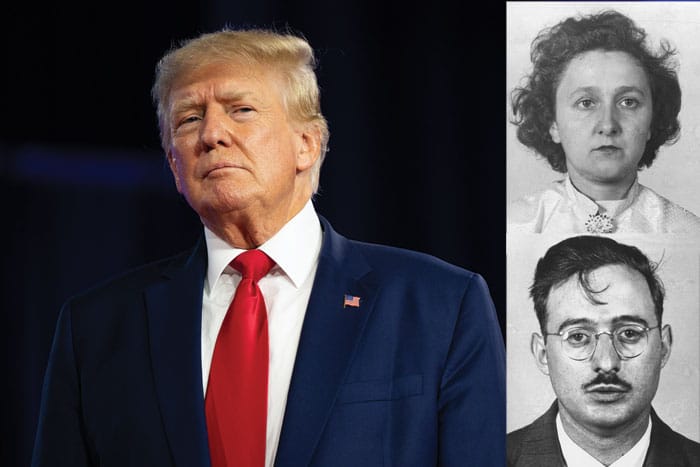
Is Trump the Rosenbergs?

Many Americans would just love to throw the book at Donald Trump, perhaps the most polarizing person in American history. Any book would do. Preferably, a heavy one — but what most have in mind is a law book that comes with prison time and a lifetime ban from public life.

His presidency started with a Justice Department inquiry into his possible involvement with Russian meddling in the 2016 election that catapulted him into the White House. Another investigation has commenced regarding the January 6th Insurrection and an alleged plot to overturn the 2020 election, keeping him in the Oval Office. 

After two Senate Impeachment Trials, a criminal prosecution against the Trump Organization still ongoing in Manhattan, a civil case brought by the New York Attorney General into Trump’s business practices, and a criminal probe in Georgia that involves alleged election tampering, one wonders how Trump has managed to accomplish anything while being so relentlessly preoccupied with legal matters. 

So far, not a single one of those legal actions have yielded a criminal conviction or civil penalty against the former president.

Yet, Trump might end up being better known as an American defendant than president. His post-presidency continues to be mired in legal entanglements. There’s never a dull moment on the Trump docket sheet. 

We now have an FBI search of his very own Shangri-La, called Mar-a-Lago, to retrieve classified, top secret, special-access-only documents that should have been left with the National Archives and Records Administration and might pose a national security risk while in his possession. No former president has ever had his personal residence raided, or searched, and possibly subject to criminal charges of any kind.

Naturally, the president’s many supporters — at least half the country — are wondering about the double standard. Hillary Clinton’s private server, used to send and receive thousands of classified emails while she ran the State Department, apparently presented no threat to the nation and warranted no prosecution. The Hunter Biden laptop, and what it might reveal about influence peddling with foreign entities and associated benefits to his father, has sparked little interest by the Justice Department.

Entering the president’s home without his permission. Rifling through his personal effects. Removing documents that may be personal or subject to Executive or Attorney-Client Privileges. Trump and his lawyers maintain that they were in continuous contact with the National Archives and had already returned 15 boxes, containing 100 classified documents, back in January.

A heavily redacted affidavit in support of the search, which was publicly disclosed last week, answered no real questions about this unprecedented action.

The Attorney General has intimated that the mishandling of these sensitive materials didn’t just overstep the Presidential Records Act, which is not a crime, but possibly violated the Espionage Act of 1917. This would be the most severe crime of all — a singular act of disloyalty possibly causing irreversible damage to America’s national security.

Criminal charges of this nature would reduce all other legal challenges to mere misdemeanors. After all, if the Espionage Act had been passed by the Continental Congress, Benedict Arnold would have been convicted and received the death penalty,  had he not absconded to England during the Revolutionary War.

In more recent times, the leaking of state secrets is the reason why Chelsea Manning, Edward Snowden and Julian Assange were charged with violating the Espionage Act. 

The Act was created shortly after the start of World War I to prosecute those who interfered with military operations and recruitment. The law has since been applied to punish insubordination, disloyalty and, most crucially, providing material support to America’s enemies. 

Along the way, the Espionage Act clashed with the First Amendment. The freedom to express an opinion might be judged to interfere with the national defense. Supreme Court Justice Oliver Wendell Holmes’ “clear and present danger” test arises from just such a case, one in which the Espionage Act prevailed over the First Amendment. 

Avowed socialists such as Eugene V. Debs and the Soviet-sympathizing magazine, The Masses, ran afoul of the Espionage Act. The Red Scare put a good many allegedly subversive Americans either in jail, or had them deported, under the law. 

Discussions about “subversives” have been an especially delicate subject for American Jews. From the earliest days of the Espionage Act, Jews found themselves implicated. In addition to Emma Goldman, who was deported to the Soviet Union, Julius and Ethel Rosenberg were executed for passing atomic secrets to the Soviets (it appears that Ethel was completely innocent of the crime); Morton Sobell and David Greenglass (Ethel’s brother) were imprisoned on similar charges; two lobbyists from AIPAC and Jonathan Pollard, in separate incidents, were indicted and imprisoned for disclosing national defense information to Israel; and, most recently, an FBI translator, Shamai Leibowitz, faced legal jeopardy under the Espionage Act.

Some possessed special military information and wished to provide Israel with a qualificative edge in its own national defense. That, of course, raises the specter of “dual loyalty.” The earlier cases evoke the Jewish flirtation with socialism. For those who wonder what possible appeal the Squad and Bernie Sanders could have to American Jews, it’s worth recalling the long history of radical politics among Jews on the hard left. 

Sometimes the cause was worthy of democratic ideals. For instance, many Jews tested the limits of the First Amendment — six of the 10 blacklisted McCarthy-era scriptwriters known as the Hollywood 10, and scores of TV and film actors, writers and directors suffered the consequences of their beliefs and were professionally ruined, with some landing in jail. 

In an early and pivotal Espionage Act case that went before the Supreme Court, Abrams v. United States, all six defendants were Jews who distributed leaflets in Yiddish supporting the Russian Revolution and opposing America’s entry into WWI.

There’s a big difference between lawful political association and assembly — activities protected under the Constitution—and clandestinely serving as an agent of a foreign government.

Throughout his sordid life, Trump has shown himself to be impulsive, reckless, irresponsible and implacably defiant of rules and protocols. That’s not the same as being a spy or spilling secrets.

No charges have yet been filed against Trump. Is he simply in possession of top-secret documents — without evidence that he either attempted to destroy or disseminate them? All throughout his sordid life, Trump has shown himself to be impulsive, reckless, irresponsible and implacably defiant of rules and protocols. That’s not the same as being a spy or spilling secrets, which is usually how the Espionage Act has been deployed.

American Jews surely should know the difference.


Thane Rosenbaum is a novelist, essayist, law professor and Distinguished University Professor at Touro University, where he directs the Forum on Life, Culture & Society. He is the legal analyst for CBS News Radio. His most recent book is titled “Saving Free Speech … From Itself.”

Is Trump the Rosenbergs? Read More »

Wolf Blitzer’s Father and the Bombing of Auschwitz

Has Wolf Blitzer’s father just pulled the rug out from under filmmaker Ken Burns?

Testimony from the late David Blitzer about his experiences in Auschwitz was featured in CNN’s August 26 special about the Holocaust, hosted by his son, anchorman Wolf Blitzer. Among other things, the elder Blitzer denounced the Roosevelt administration’s refusal to bomb the railways leading to Auschwitz.

The airing of the Blitzer testimony comes just weeks before the PBS broadcast of a new documentary film by Ken Burns about America’s response to the Holocaust. In recent interviews, Burns has minimized the Roosevelt administration’s abandonment of the Jews and suggested there was not much the U.S. could have done to rescue Jews from Hitler.

Wolf Blitzer himself has written (in the Wall Street Journal in 1985) of what he called “the documented abandonment of European Jewish refugees before and during World War II.” And now the powerful testimony of his father has cut through all the excuses and rationalizations:

“The biggest puzzle for me is that they did not bombard the railroads leading to the crematoria. This is the biggest puzzle. We saw the airplanes—in 1944, we saw airplanes bombarding cities. We were laughing, we were happy, we were even praying to God—we could get killed from those bombs, but we couldn’t understand why they did not bombard—every day, thousands of people were burned and gassed in the camps, only because they had the possibility to bring those trainloads of people. If those rails had been bombarded, they couldn’t have done it so perfectly.”

In just a few sentences, the elder Blitzer reminded us of three key aspects of the bombing issue:

First, bombing the railroads and bridges leading to the camp would have disrupted the mass murder process. Hundreds of thousands of Hungarian Jews were deported along those routes in the spring and summer of 1944. Twelve thousand were being gassed daily in Auschwitz. Damaged railways took time to repair—and damaged bridges took even longer. Every delay in the deportations—whether for hours or days—would have saved lives.

Those who today excuse the failure to bomb Auschwitz on the grounds that prisoners might have been harmed, are ignoring the fact that hitting the railways and bridges would not have involved a risk of civilian casualties.

Second, American planes were already flying in the area—they were bombing German oil factories in the industrial section of Auschwitz, just a few miles from the gas chambers. At the time, Roosevelt administration officials falsely claimed they would have to “divert” planes from distant battle zones if they wanted to hit Auschwitz. But as David Blitzer said in his testimony, “we saw planes bombarding” the region. He was probably referring to the American planes bombing the oil factories, since those raids were close enough for Blitzer and other prisoners to have witnessed them.

George McGovern was one of the pilots. The future U.S. senator and 1972 Democratic presidential nominee flew a B-24 Liberator bomber in World War II and took part in the 1944 strikes on the Auschwitz oil sites. There is no question we should have attempted…to go after Auschwitz,” McGovern said in a later interview. There was a pretty good chance we could have blasted those rail lines off the face of the earth, which would have interrupted the flow of people to those death chambers, and we had a pretty good chance of knocking out those gas ovens.”

Third, the prisoners themselves were, as Blitzer said, “praying” for the Allies to bomb the gas chambers and crematoria in Auschwitz, despite the risk that Jews might be harmed, because they knew the prisoners were doomed anyway and hoped something would be done to disrupt the mass-murder machinery.

Elie Wiesel was a slave laborer in those oil factories. In his famous book, Night, he described the prisoners’ reaction when U.S. bombers struck on August 20, 1944: We were not afraid. And yet, if a bomb had fallen on the blocks [the prisonersbarracks], it alone would have claimed hundreds of victims on the spot. But we were no longer afraid of death; at any rate, not of that death. Every bomb that exploded filled us with joy and gave us new confidence in life. The raid lasted over an hour. If it could only have lasted ten times ten hours!”

The Roosevelt administration’s decision to refrain from bombing the gas chambers and crematoria had nothing to do with concern about harming prisoners. The U.S. policy was based on the principle that military resources should not be used for humanitarian purposes, a principle that was established before there were any requests for bombing Auschwitz, and without reference to the issue of civilian casualties.

The planes were sent to bomb the Auschwitz oil factories in broad daylight, when it was likely the sites would be filled with Jewish slave laborers. As Martin Gilbert notes in his book Auschwitz and the Allies, forty Jews were killed in the U.S. bombing of the oil targets on September 13, 1944; thirty more were killed by stray bombs in that day’s raid. But that didn’t deter the Roosevelt administration from carrying out additional attacks there.

Likewise, U.S. planes were sent to bomb a rocket factory in the Buchenwald concentration camp on August 24, 1944. They struck in the early afternoon, when there was every reason to believe Jewish prisoners would be working there. Over three hundred prisoners were among those killed by the American bombers. The Roosevelt administration considered that to be a price worth paying in order to hit that military target.

The original interview with David Blitzer was conducted by the American Gathering of Jewish Holocaust Survivors on April 13, 1983. We are all indebted to those who have conducted oral history interviews with Holocaust survivors over the past several decades. Every time some partisan tries to distort the historical record, we can turn to an actual witness, such as the late David Blitzer, to remind us of the painful truth about the Roosevelt administration and the bombing of Auschwitz.


Dr. Medoff is founding director of The David S. Wyman Institute for Holocaust Studies and author of more than 20 books about Jewish history and the Holocaust. His latest is

America and the Holocaust: A Documentary History, published by the Jewish Publication Society & University of Nebraska Press.

Wolf Blitzer’s Father and the Bombing of Auschwitz Read More »

“Jerry Maguire” Agent Leigh Steinberg Still Leads with Jewish Values

Outside of the sports world, he’s known as the inspiration for the character “Jerry Maguire,” played by Tom Cruise in the 1996 Cameron Crowe film. But inside the sports world, Leigh Steinberg is still an influential figure. 

While in the film, the titular character’s epiphany left him with only one client (an NFL player played by Cuba Gooding, Jr.), the real-life Steinberg still represents top talent in the sports world, including Super Bowl MVP Patrick Mahomes of the Kansas City Chiefs, Jalen Reynolds of Maccabi Tel Aviv basketball, and Darrell Henderson, Jr. of the Los Angeles Rams. He has also represented a record eight number one NFL Draft picks, including 1989’s top pick, UCLA quarterback Troy Aikman. 

Steinberg’s advocacy goes beyond negotiating contracts for sports stars. Steinberg invests an equal amount of time and work on advocating for concussion victims, mentoring future sports agents, and combating antisemitism and hatred in the United States. 

“I was raised by a father who had two core values: one was to treasure relationships, especially family,” Steinberg told The Journal. “And the second was to try to make a meaningful difference in the world and help people who can’t help themselves. Those are classical Jewish values.”

Steinberg’s grandfather, Dr. Leo Glass, was a doctor in Los Angeles who in 1913 helped form City of Hope National Medical Center in Duarte. Since then, it has grown exponentially. Originally founded as The Jewish Consumptive Relief Association,  a sanatorium for tuberculosis, it was officially renamed “City of Hope” in 1949; by 2011, City of Hope performed its 10,000th bone marrow transplant.

Beginning in 1947, Dr. Glass went to Israel to assist in Israel’s war of Independence. He was killed while in a convoy that was hijacked between Tel Aviv and Jerusalem. He is buried in Tzfat. 

His grandfather’s devotion and ultimate sacrifice marked Steinberg. “I was hardwired to try to make a difference in the world, and we’ve done it through athletes and their role-modeling programs,” he said. 

One of the things he has his agency do is have the athletes retrace their roots to the high school, collegiate and professional communities to make a difference. A few years ago, Steinberg started a volunteer program with the Anti-Defamation League called Steinberg Leadership.  “I was worried that skinheads and hate groups were emerging. I wasn’t alive during the Holocaust, but this was happening on our watch,” Steinberg said. The Steinberg Leadership program was “executed in the 30 biggest cities in the country, and it trained young professionals, doctors, lawyers, teachers — they got a year of training in how to spot skinheads and hate groups, how to do intelligence for police departments, and how to intervene in crisis situations and then how to go into school systems and promote ethnic tolerance. So I did it for a number of years and I think we trained about 8,000 volunteers.”

The Leadership program was discontinued for a time. But while sitting shiva for his mother (Dr. Glass’s daughter), who passed away this past summer, Steinberg decided it was time to resurrect it. The rise in antisemitic activity fired up Steinberg to take a stand.

“My basic feeling about it is, this is our time and our watch and we have to be active in rolling back the age- old prejudice that’s rearing its ugly head again,” Steinberg said. “So we can go to sleep every night, knowing there’s an advanced guard against hate.”

As nearly 70% of his clients are NFL players, concussions are a major concern for Steinberg, not only for his clients but for all contact sport athletes. Each year before the Super Bowl in the host city, he hosts an annual Brain Health Summit. 

“I had a crisis of conscience back in the late ‘80s, early ‘90s representing half the starting quarterbacks in the NFL — they kept getting hit in the head,” Steinberg said. “And right when we, the doctors, couldn’t tell us how many it was. We bring neurologists from across the country and innovators who have modalities that can help protect the brain or heal the brain.”

Earlier this year, Steinberg held the annual Brain Health Summit in Los Angeles, in advance of Super Bowl LVI at SoFi Stadium. 

He realizes the power of football. “Right now, pro football is not only the most popular sport. It’s the most popular television show — 71 of the 100 highest rated shows last year were NFL football games,” Steinberg said. “And so we’ve never had a sport before that was the most popular entertainment in the country.”

While the television revenue will keep the sport healthy, Steinberg said, the challenge is that few viewers understand that every time an offensive lineman hits a defensive lineman at the line of scrimmage, it produces a low-level subconcussive event. He hopes his Brain Health summits will lead to long-term solutions.

Beyond concussions, Steinberg’s annual Super Bowl weekend gatherings, including a party to honor humanitarians in sports, have become a staple in the NFL community. In the Phoenix area, where the next Super Bowl will be, he will partner with Champions for the Homeless.

And this November, when Steinberg hosts his annual Agent Academy in Las Vegas, there will be more than sessions on recruiting talent and inking endorsements. There are specific programs on training agents to assist their clients in running a charitable foundation. 

Steinberg’s earliest sports memories were watching minor league baseball at Gilmore Field (now the site of The Grove) with his father. He was at the first Dodger game played in Los Angeles at the Coliseum in 1958. He still looks at sports through the lens of his father’s core values of treasuring relationships and helping people who can’t help themselves.

“My father taught young people on biblical stories and those primary values, which are family, education and making a difference in the world.” – Leigh Steinberg

“My father taught young people on biblical stories and those primary values, which are family, education and making a difference in the world,” he said. “The responsibility to be your brother’s keeper and belief in the state of Israel were all fundamental values to me that have guided my life. When you represent an athlete, you cut up a little bit of your life to share. And I want to do that with young people who have good values, high character, want to make a difference in the world and be role models.”

The NFL season kicks off on Thursday September 8th, with the reigning Super Bowl champion Los Angeles Rams hosting the Buffalo Bills at SoFi Stadium in Inglewood.

“Jerry Maguire” Agent Leigh Steinberg Still Leads with Jewish Values Read More »

Are We Ready to Show Up?

One of the best compliments you can give to anyone is that “they show up.”

Think of that simple phrase — showing up. How do you not love someone who always shows up when you need them?

It can apply to all kinds of things—from showing up for meaningful and joyful events to visiting someone in the hospital. It can be showing up to help a friend who’s down or showing up to volunteer at a soup kitchen.

The idea is the same: People who show up don’t settle for just words or thoughts. They walk the walk.

As we slowly crawl out of a pandemic that shook up the planet, and with the High Holidays right around the corner, the question of “who will show up” in synagogues this year is front and center.

The past two High Holiday seasons were hobbled by COVID and its pesky variants. While we’re still not totally out of the woods, this year is markedly different. Events are back. Shops and restaurants are fully open. Restrictions have waned.

In other words, it’s a lot harder to use COVID as an excuse to not go to shul.

The problem is that habits that offer us maximum comfort are hard to shake. Especially for those in the non-Orthodox world who have gotten used to watching services on Zoom in the coziness of their homes, the choice of trekking back to shul is no longer obvious.

In a way, this is unprecedented. If there’s one thing we could always count on in the Jewish world, it’s that the great majority of Jews will attend Rosh Hashanah and Yom Kippur services. Just like in that famous “Curb” episode, the only issue is getting good tickets.

But in speaking to some rabbis across the community, there’s a general feeling, bordering on anxiety, that we’ve entered new territory.

In an impassioned recent sermon that would have been relevant in most synagogues, Rabbi David Wolpe of Sinai Temple called on his flock to “stop being observers and start being participants … and be a community again like we have been for thousands of years.”

He reminded them that a synagogue is not called a Bet Tefilla, a house of prayer, but a Bet Knesset, a house of gathering, and that without gathering, there is no community.

“It is impossible to live a full Jewish life without a community,” Wolpe said.

The rabbi focused on the Jewish communal ritual of gathering in a synagogue. But there are other uniquely Jewish rituals that beckon us. In her Journal cover story this week, Roberta Kwall argues that those rituals are crucial to nurturing a strong Jewish identity.

“The point is not to create Orthodox Jews,” she writes, “but rather to create more Jews who are committed to the practice of vibrant religiously liberal Judaism.”

Kwall acknowledges that the Torah underscores “the role of ethics, morality and social justice, values that are now seen as universally relevant,” and that “many modern American Jews embrace these universalized values as the essence of their Jewish identity.”

Her point is not to downplay these universal values, but rather to highlight the irreplaceable value of Jewish rituals in strengthening Jewish identity.

I call it the value of “going out of your way.”

If I base my Jewish identity mostly on societal and ethical values I would follow regardless of my Judaism, nothing Jewish stands out as my actions blend in with the world. I may be deeply satisfied, but that doesn’t mean I will feel more Jewish.

If I go out of my way, however, to attend synagogue, prepare and host Shabbat dinner, take Torah classes, celebrate Jewish holidays, and engage with other uniquely Jewish rituals, it follows that I will be nurturing a more distinct Jewish identity.

The ideal is to find enough joy and meaning in Jewish rituals so it won’t feel like you need to go out of your way.

If we hope to recapture this year the electricity of standing-room-only High Holiday crowds in our main sanctuaries, more Jews than ever will need to go out of their way. 

If we hope to recapture this year the electricity of standing-room-only High Holiday crowds in our main sanctuaries, more Jews than ever will need to go out of their way. That would mean leaving the comfort of backyard minyans in the Orthodox world or online services in the non-Orthodox world. 

If you’re one of those Jews feeling ambivalence, look at it this way: If going out of your COVID comfort zone means “to be a community again, like we have been for thousands of years,” isn’t that worth trekking back to your main shul to make your rabbis and community happy?

Don’t you want to be known as the kind of person who always shows up when people need you?

Don’t you want to be known as the kind of person who always shows up when people need you?

Are We Ready to Show Up? Read More »

Jewish Leaders Commemorate Herzl’s Vision on 125th anniversary of First Zionist Congress

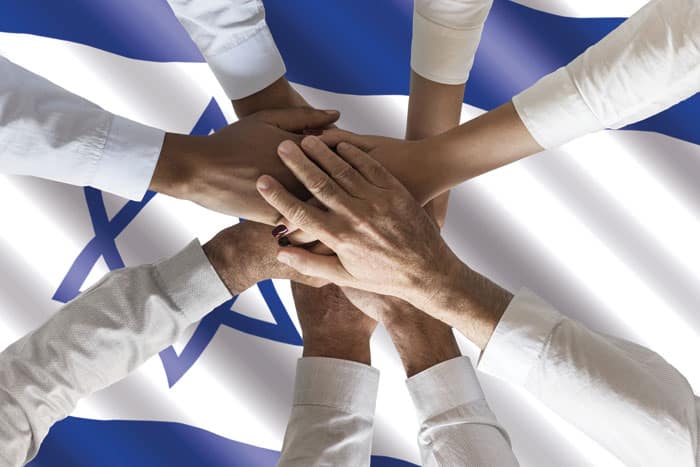
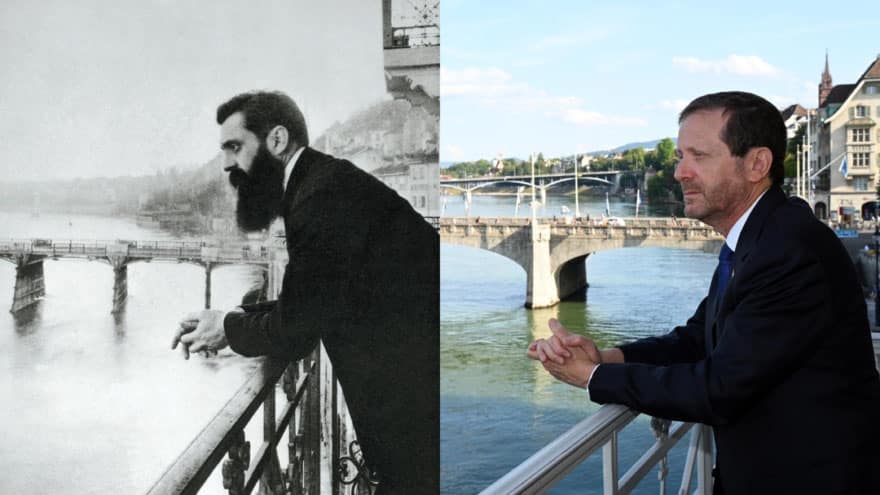
An event marking the 125th anniversary of the First Zionist Congress concluded Monday night in Basel, Switzerland with a gala ceremony that brought together more than 1,400 delegates from 40 countries.

On the one hand, the two-day conference celebrated how Theodor Herzl’s vision set forth on August 29, 1897 in Basel transformed into the thriving reality of modern Israel, participants said. On the other hand, the event distanced itself from setting any formal agenda or debating specific policies.

The event was organized by the World Zionist Organization (WZO), the same group created during the First Zionist Congress. At the first congress, 208 delegates from 17 countries voted to work together to establish “a publicly and legally assured home” for the Jewish people in Palestine.

“Herzl’s vision 125 years ago included not only the establishment of a Jewish state in the Land of Israel, but also the establishment of a model Zionist, leadership society committed to creating a better world,” explained WZO Chairman Yaakov Hagoel. “Herzl’s vision spoke of the establishment of a Jewish leadership that would lead the Jews of the world to one national home, and exactly 50 years after the establishment of his dream, the State of Israel was established.”

Due to threats of pro-Palestinian demonstrations, the Swiss government allocated more than 5 million Swiss francs to secure the event, and closed the Rhine River to ship traffic and the airspace above for the duration of the conference.

‘A breath of fresh air’

Delegates discussed the implementation of Herzl’s dream and their own vision for the Jewish people for the next 25 years.

The congress was divided into two parts: The Herzl Leadership Conference, focused on modern Zionism in light of Herzl’s vision, and the Impact Conference, which brought together 125 entrepreneurs and innovators to share ideas about how to ensure a Jewish future.

“This is a commemoration … not a meeting with resolutions or elections,” stressed Michael Jankelowitz, WZO’s international spokesman.

He told JNS that Hagoel’s idea was to bring together Zionists from around the world “for something festive—to celebrate, to have fun and to discuss the future.” He said the hope was that the event would give Jewish leaders “a push” to keep striving for Jewish peoplehood.

“It was a breath of fresh air to come to an international conference where there was no fighting, but people united with one goal: Jewish people, Jewish unity,” he added.

Jankelowitz said the Impact Conference was standing room only. A speech by businessman and philanthropist Sylvan Adams about the power of sports to unite Jewish people worldwide was chatted about in the corridors for hours after it was over.

A discussion with Prof. Isaac Ben-Israel on Israel’s impact in space was “very popular,” he added.

The 125th anniversary of the First Zionist Conference event. Photo: Michael Jankelowitz/Courtesy of the World Zionist Organization

Building bridges between Israel and the Diaspora

Prof. Yedidia Z. Stern, head of the Jewish People Policy Institute, told JNS that “the spirit was very optimistic, despite the fact that many of us feel that Jewish identity outside of Israel is eroding.”

He cautioned that “the Congress is a symbolic gathering where people talk. But we should take the next step.”

For example, he highlighted a pressing need for the U.S. and Israeli Jewish communities—the two largest communities in the world—to work together more effectively for a common future.

“Many of us believe that the relationship between Israel and the Diaspora is about to change,” he said.

If in the past, Israel was a needy country, today it is an economic superpower, he said. If American Jews used to see Israel as core to their identity, today around 40% of young Jews in North America do not consider Israel important to who they are.

He asserted that it is Israel’s responsibility to take the first steps toward supporting the Diaspora by offering affordable Jewish education abroad.

Stern added that Israel must also play a role in ensuring Jewish life can thrive in the Diaspora, such as opposing government policies that ban fundamental Jewish needs, like ritual slaughter or circumcision.

Finally, he said it is crucial for Israel to educate the young generation of Israel about Jews in the Diaspora.

“We talk very highly about Israel as a nation-state of the Jewish people. Nationality is the main thing for identity as Israelis,” Stern said. “But we talk about Israelis alone and not about a nation. We need to teach about the Jewish nation.”

He explained that the reason the WZO is essential is because Jews in the Diaspora do not vote for the Israeli Knesset and therefore their interests are “not in the heart of Israeli politics, which is a problem.”

Stern said, “We need a new Herzl and a new Zionist Congress, not for the purpose of establishing a state or defining identity, but to breathe the spirit of solidarity and Jewish brotherhood into an era of strife.”

“We have different visions about the future and each vision has its merit,” he continued. “Disputes make us a dynamic and rich society. But we need someone, a movement, a person, that will teach us how to live together despite the disputes.”

David Yaari, chairman of the Kol Israel faction, expressed similar sentiments. He told JNS, “Just like Basel was used as a place to declare what would drive the founding of the State of Israel, we have here the opportunity to bring leaders from around the world together to imagine the next 125 years. I hope there will be concrete next steps that can reinvigorate the Zionist movement globally.”

Jewish Leaders Commemorate Herzl’s Vision on 125th anniversary of First Zionist Congress Read More »

French Muslim Man Arrested for Allegedly Killing Jewish Roommate

A Muslim man was arrested for allegedly killing his roommate, Eyal Haddad, on August 20.

The Times of Israel (TOI) reported that the alleged assailant, Mohamed Dridi, confessed to killing Haddad, 34, because Haddad owed him 100 euros and because Haddad was Jewish. An axe to the head smashed Haddad’s skull and his body was subsequently torched and buried. Dridi eventually turned himself into the police. Haddad was originally from Tunisia and his family currently resides in Beersheba, Israel.

Various Jewish groups are calling for authorities to look into every possible motive for the killing, including antisemitism. An official in an unidentified Jewish organization told The Jerusalem Post that the killing appeared to be the result of a feud between friends rather than being the result of antisemitism. “It’s been three months with three Jews being killed in weird situations in France, so we need to understand if there is a reason behind these terrible situations,” the official said.

The Simon Wiesenthal Center tweeted, “Why is it that when a Jew is murdered in #France there is always a struggle to get all the facts from the authorities?”

Aviva Klompas, former head of speechwriting at the Israeli Mission to the United Nations, tweeted that the “ensuing silence” over Haddad’s death “is an outrage.” “Where is the media? Where are the French authorities? Where is the EU?” she asked. “Raise you voice and demand action.”

Former Miss Iraq Sarah Idan criticized French President Emmanuel Macron for not denouncing Haddad’s killing. “Islamists succeed when our leaders don’t condemn their crimes they’re emboldened when our mainstream media turn blind eye to their threat, they are empowered when people are afraid to criticize their ideology out of the fear of being labeled as islamphobes,” she wrote.

French Muslim Man Arrested for Allegedly Killing Jewish Roommate Read More »

you-dont-know-schiff

Talking Schiff with Mark & Lowell #8: Mark Talks About the Benefits of Not Having Teeth

In this week’s shmooze, Mark drops an unexpected information bomb on Lowell which leads them down a road discussing daunting dental difficulties.

Be sure to check out Mark’s books!
Available November 8, 2022.”Why Not: Lessons on Comedy, Courage, and Chutzpah.”
Click on these links to buy:
Amazon
Barnes & Noble
Books-A-Million
Bookshop.org

Available now:
“I Killed: True Stories of the Road from America’s Top Comics”

Please subscribe to “You Don’t Know Schiff” so you don’t miss out on any exciting episodes. Click here to subscribe in Apple Podcasts (and please leave us 5 stars and a positive review – your support means the world to us and it helps us get discovered by new listeners):
https://podcasts.apple.com/us/podcast/you-dont-know-schiff/id1592741666

Your hosts:
markschiff.com
Twitter: @markschiff
Instagram: markschiff1
 

Lowell Benjamin
Twitter: @lowellcbenjamin
Instagram: @lowellcbenjamin


Talking Schiff with Mark & Lowell #8: Mark Talks About the Benefits of Not Having Teeth Read More »