Sarah Ifft Decker: Jewish Women in the Medieval World
Sarah Ifft Decker is an Assistant Professor of History at Rhodes College.
Follow Shmuel Rosner on Twitter.
Sarah Ifft Decker: Jewish Women in the Medieval World Read More »
Sarah Ifft Decker is an Assistant Professor of History at Rhodes College.
Follow Shmuel Rosner on Twitter.
Sarah Ifft Decker: Jewish Women in the Medieval World Read More »
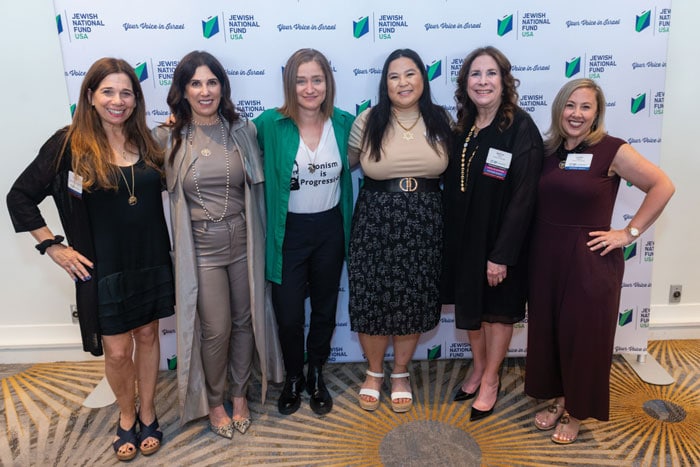
Nearly 250 female philanthropists from Los Angeles joined Jewish National Fund-USA (JNF-USA) at its annual Women for Israel luncheon at The Beverly Hilton on May 11.
The gathering was held in recognition of JNF-USA’s Women’s Month and celebrated supporting the land and people of Israel and Jewish people everywhere.
Marcia Selz, Laura Stein and JNF-USA Los Angeles Co-President Susie Toczek co-chaired the event.
In addition to learning about JNF-USA’s game-changing projects in Israel’s Negev and Galilee regions, attendees heard from two of the leading female Zionist voices of today: professional social media coach and Jewish activist Amy Albertson, creator of “The Asian Israeli,” and Los Angeles-based music and pop culture journalist Eve Barlow.
Barlow is an outspoken voice on Jewish identity, Zionism, and fighting anti-Semitism on social media.

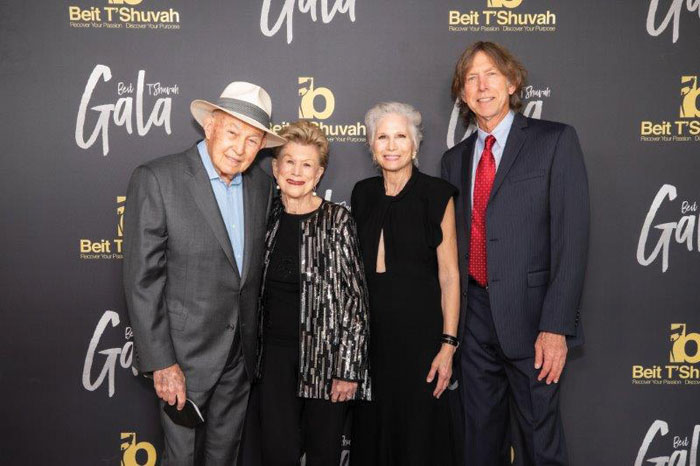
On May 15, Beit T’Shuvah, a Jewish faith-based recovery treatment center and synagogue, celebrated its 30th Annual Healing Broken Souls Gala at the Beverly Hilton.
This year’s honorees, Janice Kamenir-Reznik and Benjamin Reznik, have contributed to Beit T’Shuvah as well as the larger Jewish community. As lawyers and pioneers for positive change in the world, they have exemplified what it means to live in a life of service and action. Kamenir-Reznik’s mother, Charlotte, this year’s Spirit of Beit T’Shuvah Award recipient, is an exceptional woman who embodies Beit T’Shuvah’s message of hope, community, and connection. All three recipients are healing the world and exemplifying the Jewish sentiment of tikkun olam.
The event raised more than $1.7 million dollars to provide scholarships so that everyone can access Beit T’Shuvah services regardless of ability to pay. A majority of Beit T’Shuvah residents receive scholarship assistance.
As Jewish Federation of Greater Los Angeles CEO Rabbi Noah Farkas said in the gala honoree video, “To support Jewish life is a choice. To build Jewish communal structures, like Beit T’Shuvah, is a choice…and we need leaders like Janice and Ben to step into the light and say, ‘I choose to be Jewish. I choose to support those who need us the most because I am not going to allow my generation to be the last generation.’”

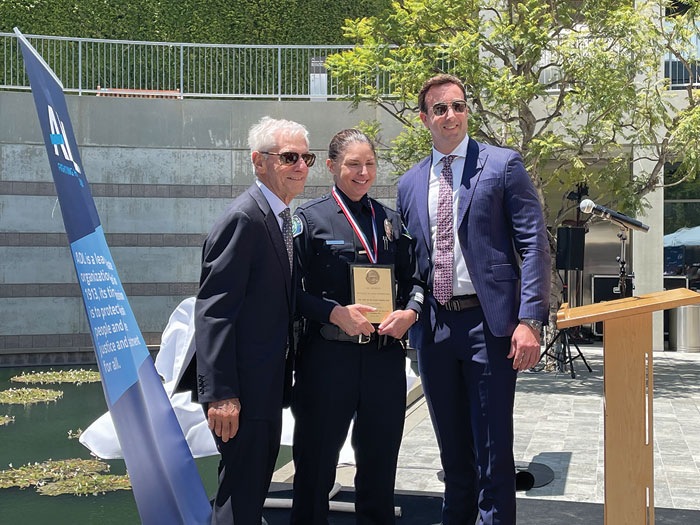
The Anti-Defamation League (ADL) honored law enforcement personnel with the ADL Helene and Joseph Sherwood Prize for Combating Hate, on May 26 at the Skirball Cultural Center.
The ADL recognized individuals and departments of law enforcement offices in Los Angeles, San Bernardino, Riverside, Kern, Orange, San Diego, Imperial, Ventura, Santa Barbara, and San Luis Obispo.

“Anti-Semitism, bigotry, and hate of all kinds are on the rise in our city, around Southern California, and across the nation. We see it from the tragic attacks on Poway to Pittsburg to Colleyville and most recently, in Buffalo and Laguna Woods,” ADL Regional Director Jeffrey Abrams said. “Our Sherwood Prize law enforcement honorees, who have worked alongside ADL and other community-based organizations, know this dark reality all too well and have dedicated their work to combating hate in a manner that goes above and beyond the call of duty.”
According to the ADL, the honorees have demonstrated an outstanding commitment to combating extremism, bigotry, and hatred by performing acts outside the normal scope of duties and made an impact on victims of hate crimes or bias-motivated incidents, among other achievements.
This year’s individual honorees were: Assistant District Attorney Paul Kim of the Los Angeles County District Attorney’s Office, Faith-Based Liaison Officer Kathleen Kooiman of the Orange County Sheriff’s Department; and Deputy District Attorney Leonard Trinh of the San Diego County District Attorney’s Office.
The departmental and group honorees were: the Criminal Intelligence Division of the San Bernardino County Sheriff’s Department; Hate Crime and Incident Response Portal of the Irvine Police Department; and the Mark Domingo Investigative and Trial Team.
The Sherwoods, who ran family-owned and operated Daniel’s Jewelers, created the award in 1996 to recognize those in the law enforcement community that go above and beyond their job descriptions in combating extremism, bigotry, and hatred.
JNF-USA Women for Israel Luncheon, Beit T’Shuvah Gala, ADL Honors Law Enforcement Read More »
As the COVID pandemic begins to fade and we recover from two years of devastation and isolation, we’re entering a transition phase, slowly coming out of hibernation, battered and numb, and still a little anxious. We’re gamely trying to reclaim our old lives, going to parties and events, mingling live and in person.
Many of us are socially rusty. No kidding.
I’m writing this from Montreal, where I grew up and where much of my immediate family still lives. It’s my first visit here in nearly three years, by far my longest absence from a town where virtually every street corner holds a personal memory.
But human beings are survivors. When a crisis disrupts our lives, we adjust and compensate. For me, compensating during the pandemic meant doubling down and tripling down on phone calls, especially to my mother in Montreal, who like millions of elderlies felt the sting of isolation. The simple phone became our lifeline. Calling her during the pandemic became a hard-wired habit. If I can’t hug those I love, I can fight back with my voice.
We shared a lot more than our voices on the first night of Shavuot, as our family gathered around the holiday table. Finally, we were face to face, just like the old days. It was like nothing had changed, as if three years had shrunk to two minutes. The familiarity of family returned in an instant.
One of my nieces got all excited when she heard the shehecheyanu blessing, which is recited on the first night of holidays. Given that it was nothing out of the ordinary, why did she get all excited?
It turns out that at the school where she teaches, they recently had their annual “hagiga” festival in person, after long stretches of COVID lockdowns. That in-person reunion triggered such elation that the whole school joined in reciting the shehecheyanu blessing. So, when my niece heard it again at the Shavuot table, it brought back pleasant memories.
The shehecheyanu blessing is traditionally recited when we do something for the first time that year — such as lighting Hanukkah candles, hearing the shofar, shaking a lulav and etrog during Succot, on the first night of holidays, or eating a seasonal fruit.
Over the years, though, more and more people have used the blessing to punctuate anything that feels new or feels like a “first.” It could be an extraordinary sunset that looks unlike any other, meeting an old friend you haven’t seen in a long time, or, in the case of my niece, holding an event in person after COVID lockdowns.
We’ll have an abundance of shehecheyanu moments to look forward to in the post-pandemic era. Every time we leave our cocoons to do something we haven’t done in a while, it’s another opportunity to recite this special blessing. That in itself is a blessing.
Of course, not everyone is hurrying to leave their cocoons. For those who have become addicted to the supreme comforts and convenience of staying home, it won’t be easy to break the habit. I’m sure that every synagogue in America is hoping that those pandemic homebodies will indeed break their habits and return in person to their synagogues— and join in reciting a communal shehecheyanu.
We should all hope for that. Communities, not to mention human relationships, can’t sustain themselves on virtual technology—whether it’s on Zoom or any new gizmo Big Tech will invent to keep us chained to our homes. There is no reclaiming of our lives if we’re stuck at home. If we don’t go out and re-engage, the schehecheyanu moments will be few and far between.
The beauty of a blessing is that it brings holiness to an ordinary act. It makes us pause and appreciate a specific moment. We don’t just drink a glass of water; we recite a blessing and then we drink. We pause for gratitude.
Shehecheyanu moments won’t run after us; we must seek them out. As we come out of our pandemic isolation to reclaim our lives, we can rejoice that we are alive to recite this sublime Jewish blessing of renewal.

The shehecheyanu blessing is perhaps the best known in our tradition. It has become a ubiquitous shorthand to signify anything new. But the blessing itself doesn’t spell it out:
“Blessed are You Eternal Spirit who has given us life, sustained us and allowed us to arrive in this moment.”
Where is the new? Where is the first?
They’re embedded in a deeper meaning. We give ourselves “life” by relying on what “sustains” us. And what sustains us to help us “arrive” at those moments that add meaning to our lives? Our relationships, our families, our communities, our tradition. The shehecheyanu blessing reminds us to return to the real, to rediscover what makes us human, to make the old new again.
Shehecheyanu moments won’t run after us; we must seek them out. As we come out of our pandemic isolation to reclaim our lives, we can rejoice that we are alive to recite this sublime Jewish blessing of renewal.
A World Bursting With Shehecheyanus Read More »
General Mills announced in a statement on June 1 that their recent decision to sell their stake from a joint operation in East Jerusalem had nothing to do with the Boycott, Divestment and Sanctions (BDS) movement.
Jewish Insider and Jewish News Syndicate reported that BDS activists had been pressuring General Mills to cease operating in the Atarot Industrial Zone––where the plant in which General Mills sold their stake was located––for years. Consequently, BDS activists celebrated the move as a victory for the movement, with the BDS movement’s official Twitter account tweeting “VICTORY!” and then stating that General Mills is divesting “from apartheid Israel, following several years of BDS pressure.”
VICTORY! @GeneralMills to divest from apartheid Israel, following several years of BDS pressure. https://t.co/StM9pWMpt2 pic.twitter.com/jkKi0OzCSM
— BDS movement (@BDSmovement) June 1, 2022
But General Mills said in their statement selling the Israel stake––as well as selling their European dough business in November 2021––are both the result of the company’s new efforts to increase “its focus on advantaged global platforms.”
“Any claims by others taking credit for this decision are false,” the company said. “We continue to sell our products in Israel and look forward to continuing to serve Israeli consumers with our other brands.”
Jewish groups thanked General Mills for the clarification.
“General Mills has made it clear that it will continue to support Israeli consumers,” the American Jewish Committee tweeted. “BDS activists seeking to spin this to their advantage are acting in bad faith.”
We thank @GeneralMills for clarifying its recent business decision in Israel.
General Mills has made it clear that it will continue to support Israeli consumers.
BDS activists seeking to spin this to their advantage are acting in bad faith. https://t.co/bvl0U167iZ
— American Jewish Committee (@AJCGlobal) June 2, 2022
StandWithUs Israel Executive Director Michael Dickson similarly tweeted: “Anti-Israel activists BDS claimed that @GeneralMills was boycotting Israel as part of their discriminatory campaign. General Mills have now made clear that BDS was lying.”
Anti-Israel activists BDS claimed that @GeneralMills was boycotting Israel as part of their discriminatory campaign.
General Mills have now made clear that BDS was lying: pic.twitter.com/VO6ujHyurp
— Michael Dickson (@michaeldickson) June 2, 2022
Human rights lawyer Arsen Ostrovsky, who heads the International Legal Forum, also tweeted, “Contrary to the lies of #BDS (as they always do), @GeneralMills decision to sell its stake in its joint venture in #Israel, has nothing whatsoever to do with their campaign of intimidation. Is purely business decision, full stop!”
Contrary to the lies of #BDS (as they always do), @GeneralMills decision to sell its stake in its joint venture in #Israel, has nothing whatsoever to do with their campaign of intimidation. Is purely business decision, full stop! #BDSLieshttps://t.co/Df5NG6c9gO
— Arsen Ostrovsky (@Ostrov_A) June 2, 2022
General Mills Says Selling Israeli Stake Had Nothing to Do With BDS Read More »
Actor, writer, comedian Maz Siam joins the podcast this week. Maz is an inspiration to anyone who’s ever thought it was “too late” to pursue a passion. With already over ninety credits to his name and counting, at fifty years old, Maz took his skillset as a successful salesman, paired it with his passion for creativity and has become a successful dramatic and comedic actor. Besides acting, Maz, Mark and Lowell get into topics including overcoming anger issues, parenting styles, sobriety, and how accepting others for who they are can make for better living.
Maz has been on a wide range of TV shows from “Hawaii Five-0” to “American Horror Story” to “The New Girl” and “The Affair.” Find out more about Maz on his website and by following him on Twitter:
https://mazsiam.com/
https://twitter.com/mazsiam
Your hosts:
Mark Schiff
markschiff.com
twitter.com/markschiff
instagram.com/markschiff1
Lowell Benjamin
twitter.com/lowellcbenjamin
instagram.com/lowellcbenjamin
Check out Mark’s books
“I Killed: True Stories of the Road from America’s Top Comics”
www.amazon.com/Killed-True-Stories-Americas-Comics-ebook/dp/B0024NP5DI
“Why Not?: Lessons on Comedy, Courage, and Chutzpah”
www.amazon.com/Why-Not-Lessons-Courage-Chutzpah/dp/1954641168/ref=nodl_