Representative Alexandria Ocasio-Cortez (D-NY) accused Israel of killing Al Jazeera journalist Shireen Abu Akleh during a May 19 Instagram Live video and said that there needed to be a “line” drawn over the United States’ funding of Israel.
Abu Akleh was shot in the head during an Israel Defense Force (IDF) raid in the West Bank village of Jenin in response to Palestinian terrorists entering Israel illegally from the village; it is currently unknown whether or not she was shot by Israeli or Palestinian gunfire.
“She was killed by Israeli forces,” Ocasio-Cortez said of the Al Jazeera journalist. “We can’t allow this stuff to be happening with our resources.” She rejected those who argue that she “is picking [Israel] out and treating them differently” because “our tax dollars are part of this. Our resources are a part of this. We can’t even get healthcare in the United States, and we’re funding this.”
On IG live, @AOC suggests cutting military aid to Israel in wake of killing of Shireen Abu Aqleh. "She was killed by Israeli forces. You know, we can't allow this stuff to be happening with our resources.. We can't even get healthcare in the U.S. — and we are funding this." pic.twitter.com/JMbElH7K4M
Ocasio-Cortez’s remarks drew fire from Jewish and pro-Israel groups.
“It’s dangerous to accuse Israel when even the Palestinian coroner has made no determination,” Israel Consul General of New York Asaf Zamir tweeted to Ocasio-Cortez. “This is exactly what leads to more violent antisemitism in NYC. As a new fellow New Yorker, I invite you to meet and discuss.”
Hi @AOC, It's dangerous to accuse Israel when even the Palestinian coroner has made no determination. This is exactly what leads to more violent antisemitism in NYC. As a new fellow New Yorker, I invite you to meet and discuss. Here's what I said about this on @CNN this week: pic.twitter.com/7XGCjicnT5
The American Jewish Committee tweeted that the alliance between the U.S. and Israel “creates enormous benefits for both nations and it is vital we keep this relationship strong. @AOC’s claim that military aid to Israel undermines adequate healthcare in the U.S is, at best, a cheap publicity stunt and, at worst, something far more insidious.”
The 🇺🇸-🇮🇱 alliance creates enormous benefits for both nations and it is vital we keep this relationship strong.@AOC's claim that military aid to Israel undermines adequate healthcare in the U.S is, at best, a cheap publicity stunt and, at worst, something far more insidious. https://t.co/L2CpnKeabc
— American Jewish Committee (@AJCGlobal) May 20, 2022
Tel Aviv Institute Fellow Hen Mazzig tweeted, “AOC went on Instagram and claimed that Americans ‘can’t get healthcare’ because of Israel. Scapegoating Jews for the struggles of the day is textbook antisemitism, even if you use Israel as the surrogate. She should apologize immediately — before her words cause hate crimes.”
AOC went on Instagram and claimed that Americans “can’t get healthcare” because of Israel.
Scapegoating Jews for the struggles of the day is textbook antisemitism, even if you use Israel as the surrogate.
She should apologize immediately — before her words cause hate crimes.
Human rights lawyer Arsen Ostrovsky, CEO of the International Legal Forum, tweeted that “whenever @AOC starts lecturing on #Israel, this video invariably comes to mind” and shared the viral clip of Ocasio-Cortez acknowledging in a 2018 interview that she is “not the expert” on the “geopolitics” of the Israeli-Palestinian conflict.
From the moment we open our most precious scroll, the very foundation of the world, according to the Zohar, we meet Judaism’s view of what is most powerful in Creation, the Hebrew language. Each letter is seen as a tool to innovate and each word is G-d’s implement to create, culminating in sentences that speak a reality G-d sets into motion, “Vayomer Elohim,” “And G-d said,” so there is.
The word “Abracadabra,” the oft phrase used by magicians, originates from the Hebrew “Abra K’Dabra,” “I create as I speak.” G-d, the first magician, pulls out of the tohu vavohu, the formless and chaotic presence, the beginning of all things. Through the Ruach Elohim, the spiritual wind blows shapes and forms, a speakable foundation for all things in the Universe: “The voice of the Lord is powerful, the voice of the Lord is majestic” (Psalms 29:4). We come to learn in that moment the most powerful tools we possess come from the mouth: “Death and Life are in the power of the tongue” (Psalms 18:21).
Watching the war in Ukraine we see this play out on the big stage. Putin and his supporters use language to convert the minds of their countrymen with images of horrific antisemitic rhetoric while Vladimir Zalinski uses language to inspire the hearts and souls of his countrymen to fight and lay down their bodies for what they treasure, their land. In our own country we see the minds of the naïve twisted by images and theories so absurd we would read them in underground fantasies, and the concept of truth is barely recognizable by many. What was once limited to local writing, land-lines or one-on-one conversations is now spread in a second through the magic of the Internet. Social platforms have become an opportunity to bring closeness and fill lonely moments for many but at the same time they have become the deadliest expression of judgment, hatred and punitive action. When once we played “telephone” as a party game, whispering in each other’s ears amazed at how at the end of the circle the first words had become so embellished and changed, now we barely express an opinion and it is fodder for the multitudes, liked by “friends,” and hated by “enemies.” Partisan kinship is often the marker of support, and truth or even objectivity become of little importance.
In a tradition where words are the essence of education, law, relationships, and even liturgy, we are hard pressed to see them as insignificant. Through them we both teach and learn facts and poetic surmises, establish right behavior and moral functioning, and share with those who are friends and family. And through them we speak to G-d with what weighs deep in our hearts and souls. They are the very foundation of our partnership with the Holy One in the continual completion of the world. Each individual, in their unique and special gifts, has a profound place in the world with the capacity to enhance the lives of others or detract from their light.
And when we work for institutions, who is truly responsible? When we speak personally is it a reflection of the company/organization in which we work? We frequently see expressed, both on television and in writing, “These words are not a reflection of this institution; they are the beliefs of the one who speaks.” Does the position or form of employment determine how much responsibility one carries in their speech on non-work related topics? Should institutions take a disclaimer or do individuals carry more responsibility?
As clergy we find ourselves under a heavier burden both in the example we must set and the expectations we should expect of our people. It is a double-edged sword to model goodness and choose our words wisely while being able to call out the falsehoods, the destructiveness of lying, as well as behavior that appears immoral. As Ecclesiastes says, “Though the word of a king is authoritative, who will say to him, “What are you doing?” Who will question our leaders? Moshe himself expresses the desire that each of us be prophets: “If only all the Lord’s people were prophets” (Numbers 11:29.( The prophet was the spokesperson for G-d, especially to call out behavior that was destructive and immoral. Like a spiritual alarm clock, his words rang out to remind the people when they went astray. As rabbis we follow the lineage of the prophets and isn’t it upon us to face our congregation, or even the public at large, when gross or inappropriate behavior shines bright. Though clearly law prohibits clergy of all religions from endorsing political candidates, must it also tie the hands of leaders because they fear losing followers or financial support? Is “righteous anger” no long acceptable?
It is a double-edged sword to model goodness and choose our words wisely while being able to call out the falsehoods, the destructiveness of lying, as well as behavior that appears immoral.
What of those of us who witness questionable behavior? Do we have the right to speak up? Can we comment, respond and/or agree with others who express our feelings articulately? Doesn’t Ecclesiastes teach us, “There is a time to be silent and a time to speak?” Are our Jewish institutions not responsible to speak out, to question, and not shrink for fear of controversy? And more importantly if mistaken or even foolish inappropriate behavior occurs are we not to follow Jewish protocol that allows for “reprove, rebuke, and T’shuvah with patience and instruction?” “Like an ornament of fine gold is a wise reprover to a listening ear” (Proverbs 25:12).
In a litigious world words have become a battlefield. On out-of-control social media platforms the extent of shaming young tender individual souls has motivated suicide as young people are afraid to face their peer groups. R’chilut, talebearing, can be incredibly destructive. Yet, walking the fine line of calling out truth versus speaking negatively about others is reflected in our multi-verse tradition: “By the mouth of the wicked it is torn down” versus “Like apples of gold … is a word spoken in right circumstances” (Proverbs 11:11, 25:11-12). It is no easy road we walk these days.
In one instance, believing I had witnessed a truth, I responded in the moment. We’ve all felt that outrage when we watch what we believe is inexcusable. And yet my response was wrong. It is not my place to speak about another. I regret responding, particularly impulsively, on a platform that clearly has no boundaries. Social media has become a corrosive venue where there is no control whatsoever. Even if my intent was not to hurt another, my tradition teaches that speaking about another person is not acceptable and considered a sin. I am sorry if I inadvertently hurt anyone, for this has been an important reminder of something I know and even teach to others that words are powerful. There are times when silence is necessary: “He who restrains his lips is wise” (Proverbs 10:19). Wel must stay focused on gratitude for the Presence of the Holy One and ask for G-d’s help to scrutinize what we say so that it is for good, and for truth, with a capital T.
Eva Robbins is a rabbi, cantor, artist and the author of “Spiritual Surgery: A Journey of Healing Mind, Body and Spirit.”
The proper observance of shmita has been a topic of perennial debate in Israel’s Orthodox community for the last 130 years. The rules of the sabbatical year, shmita, require farmers to desist from working their fields and to open up their fields, and all the produce within them, to anyone. But the Jewish agricultural communities established in the late 1800s were worried that shmita could undermine their viability, and that they simply could not afford to shut down for the entire year. At the time, the idea of a heter mechira was first proposed by several religious Zionist rabbis and endorsed by Rabbi Yitzchak Elchanan Spector, the leading halakhic authority of the time. The heter mechira means “permission through a sale.” It employs a mechanism where the fields are sold to non-Jews for the shmita year, and the Jewish farmer continues to work the very same field; after the conclusion of the shmita year, the Jewish farmer buys the field back. Even within the religious Zionist community there have been harsh opponents of the heter mechira. The religious Zionist pioneer Rabbi Yechiel Michel Pines wrote the following about the observance of shmita in 1889:
“The commandment of shmita has been an essential limb of our religion, one without which we cannot live. And now comes the first shmita in our settlements, and suddenly there appears the merciful ones, the sons of merciful ones, who have compassion on the colonists without even asking their opinions, and make a great tumult searching the world for a way to offer a halakhic permission (to work the fields on) shmita, and cut a limb off the Jewish people.”
These passionate words underline how important shmita is to Judaism. But why is shmita so significant? There are four theories in the commentaries regarding the purpose of shmita: to recognize God’s sovereignty, to support the poor, to offer the farmer a sabbatical year of contemplation, and to honor and protect the land. What is most fascinating is that there is a strong biblical basis for all four theories.
In this week’s Parsha, the Torah describes the shmita year as a Shabbat; shmita is also the seventh year, a “seven” just like Shabbat. This suggests that similar to Shabbat, the purpose of shmita is to recognize God’s sovereignty over the world He created. The Talmud emphasizes this point when it says: “The Holy One, Blessed be He, said to the Jewish people: plant for six years, and withhold during the seventh year, so that you will know that the land is Mine.”
Shmita centers on the importance of caring for the poor as well. In Exodus (23:11), the Torah says that the shmita is a time when the farmer opens their fields to everyone, and “Let the needy among your people eat of it, and what they leave let the wild beasts eat.” (Another rule of the shmita year also concerns the poor; the forgiveness of unpaid loans enables the bankrupt to get out of debt.) Charity is one of the chief purposes of shmita.
Shmita centers on the importance of caring for the poor as well.
The Torah also associates the shmita year with study and contemplation. The mitzvah of Hakhel follows the shmita year; at Hakhel, the entire nation gathers at the Temple to hear the King read the entire Torah. Hakhel’s connection to shmita has to do with the importance of learning. Ibn Ezra offers the fascinating theory that Hakhel occurs at the beginning of the shmita year, to inaugurate a year of communal learning; and like Shabbat, shmita is meant to be dedicated to learning. (In contrast to Ibn Ezra, the Talmud says Hakhel takes place right after the end of the shmita year. Even so, the connection between shmita and learning is clear.)
Finally, the Torah describes the land of Israel as “desiring” the shmita (Lev. 26:34), and the land “observing” the shmita. Abravanel sees this as highlighting the unique holiness of the Land of Israel; as a holy land, it too must be distinguished by a holy year of shmita. The holiness of the land of Israel requires the land itself to have its own sabbath, and to rest in a sabbatical year. A very different land-centered explanation is offered by the Rambam; he explains that the rest has a very practical purpose, because the land “improves when it remains fallow for some time.” To the Rambam, shmita is simply good agronomy.
Why does the Torah give so many different purposes for shmita? Perhaps because together, these four ideas represent a vision of returning to utopia. The farming life is bone-crushing and competitive, and alienates the farmer socially and spiritually. In the shmita year, farmers are able to reclaim their true self; in this year, they connect more deeply to God, their fellow man, and even the very land they farm each day. Rabbi Avraham Yitzchak Kook described the utopian beauty of shmita this way: “What Shabbat does for the individual, shmitadoes for the nation as a whole. … Our mundane lives, with their toil, anxiety, anger, and competition cannot entirely extinguish (our) creative force. On the shmita, our pure, inner spirit may be revealed as it truly is.”
Yet despite having such a profound appreciation of the beauty of shmita, Rabbi Kook and many others supported the heter mechira because of the practical issues involved. In the earliest years of the agricultural settlements, there was a real concern that shutting the farms for a year might cause those settlements to fail. There is some debate today whether those concerns are still relevant in 2022, in a country that has a well-developed agricultural sector. But there is a strong case to be made that they remain a serious issue. Currently, a small percentage of the population, and an even smaller percentage of the farmers, observe shmita. If shmita were a reality for the entire country, it would wreak havoc on the economy. Consider the supply chain implications of shutting down all of Israel’s farms for an entire year, and finding completely new sources for all agricultural products. Those who are stringent on shmita actually have to give thanks to those who are not; otherwise there would be runaway inflation and persistent shortages every shmita.
There is some debate today whether those concerns are still relevant in 2022, in a country that has a well-developed agricultural sector.
While practical concerns motivated the rabbis who proposed the heter mechira, their ruling stood on solid halakhic ground. The status of shmita in contemporary times is not completely clear. The majority of medieval authorities consider it to be only rabbinic in nature after the destruction of the Temple, and some even see it as simply a custom. In addition, after years of exile, it became unclear which year is actually the shmita year, and there is more than one way of reckoning the count of seven years; because of this, each shmita year carries the status of doubt. Because of these factors, the supporters of the heter mechira felt it was acceptable to circumvent shmita by selling farmland to a non-Jew. But this ruling attracted controversy from the very beginning, and that debate continues to rage until this very day.
The heter mechira debate is intertwined with multiple other debates within the Orthodox community. Should practical concerns shape how one relates to important religious goals? How significant is Jewish nationalism and a secular Jewish state in halakha? How do we relate to farmers who are secular, and are not willing to follow halakha? And all of these debates stand on the foundation of prior medieval debates regarding body vs. soul, “if there is no flour there is no Torah, and if there is no Torah there is no flour.” But I would argue that the heter mechira debate is also something else. It is a clash between two utopias: the utopia of the Tanakh, and the utopia of the simple Jew. The biblical utopia is the shmita, where humanity returns to the Garden of Eden, and achieves the original ideals of creation. This is an inspiring goal, but one that in reality, remains out of our grasp. Today, shmita is only practiced by a tiny group of farmers, who are supported by charity; the sad irony is that instead of wealthy farmers supporting the poor during shmita, it is now the farmers who need the support of others during shmita.
But there is another utopia, that of the simple Jew. For 2,000 years, he dreamed of returning from exile and having his own home in his own homeland. But this practical nationalist vision is actually a profoundly religious one, one that represents a messianic vision of “v’shavu banim l’gvulam,” “the children shall return home.” To walk in the streets of Israel, and see a thriving, living, Jewish State was only a dream in the 1800s; and for the simple Jew, Israel is truly a utopia. And after a journey of two millenia, the simple Jew embraces Israel as a slice of heaven, where every fruit tastes sweeter, every day is more beautiful than the next, and every child is exceptional. The heter mechira is there to support and strengthen the State of Israel, the utopia of the simple Jew.
For those of us who do rely on the heter mechira, it is critical that we don’t allow pragmatism to douse our idealism. Even if the utopia of shmita eludes us, we must embrace a utopia we all too often take for granted: the State of Israel.
Rabbi Chaim Steinmetz is the Senior Rabbi of Congregation Kehilath Jeshurun in New York.
Let there be no doubt about the central priorities in the intensely focused life of Grant Arthur Gochin, the honorary consul for the Republic of Togo and vice dean of the Los Angeles Consular Corps.
“Outside of my family, this is the most important thing in my world: educating about past genocides and preventing future genocides,” he said.
Gochin’s mission as a one-man, international human rights advocate began modestly.
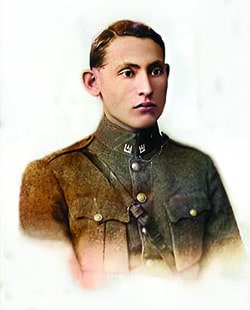
His grandfather, Sam Gochin, “simply was the most decent human being who ever lived,” he said. Sam and Grant were quite close throughout Grant’s childhood and teen years.
Sam Gochin
Since the elder Gochin frequently alluded to the family’s Lithuanian roots, Grant fervently wanted to know more – not realizing how much of an impact it would have on his life.
By his 20s, “I wanted a formal tie with Lithuania,” said Grant. He had no idea, though, of the nightmarish stonewalling and lying that he would face ahead. Nor did Lithuania.
In 1990, the year Lithuania gained its freedom from the Soviet Union, he applied for citizenship.
“I was met with utter deception when they denied me,” he said.
The persistent 27-year-old applied twice more. “Again, I met absolute dishonesty,” he said. “I was informally advised that citizenship of Lithuania was not available for Jews. I sued the government of Lithuania five times and exposed their Judenrein citizenship policy. Citizenship was required before anyone could claim restitution. To ensure no Jews could, they would deny Jewish citizenship applications.”
When the restitution claim period ended, the Lithuanian legislature changed the law, making citizenship available for Jews, Gochin believes, in part because of his work.
“I urge every Litvak entitled to Lithuanian citizenship today to claim it,” he said.
It would be almost impossible to exaggerate how fond young Grant and his grandfather were of each other.
Growing up in South Africa, he’d often hear stories about Lithuania from his grandfather.
Lithuania was behind the Iron Curtain. No one was allowed in or out.
“He always said to me, ‘If, in your lifetime, you are ever able to go to Lithuania, you need to go and say Kaddish. You also need to go and look for anybody who survived,’” said Gochin “This was something he put on me before my bar mitzvah. It always was understood he would die before me, and that was the charge he was giving me.”
While his grandfather would show him photographs from the old days in Lithuania, he never told the boy what happened.
“I did not grow up knowing 100 members of my family had been killed by the Nazis,” Gochin said.
And recently, he made a startling discovery, surrounded by almost unbelievable irony.
“In 1984, the German magazine Der Spiegel published the story that one Jonas Noreika was the murderer [of my family] in the edition of April 22,1984,” Gochin said. “I worked in a bookstore in South Africa. That is why I remember the date so well.”
Since copies were shipped to South Africa by boat, the April edition would have gone on sale at the end of May.
“My grandfather, because of his Yiddish, always read Der Spiegel. He also read Newsweek and Time. And he read the newspaper every day.”
Gochin calculates that at the end of May 1984, his grandfather definitely would have picked up Der Spiegel. The inveterate reader would have seen the article revealing that his whole family had been murdered, at least 100, that there had been no survivors, and that the person who murdered them was Jonas Noreika.
Gochin believes his grandfather would have read thestory on May 30, May 31 or June 1.
Those dates are crucial, because his grandfather died on June 2, 38 years ago.
“He had a massive heart attack and dropped dead,” Gochin said. “I don’t know if Der Spiegel was in his hands at the time. But I assure you he had read that article in the day or two before he dropped dead.”
Gochin’s descriptive recollection of Sam’s death is memorable: “It was like cutting off an arm,” he said.
Five years later, the love and imagery of his grandfather as fresh as it is today, Gochin began his one-man drive to expose the truth about Lithuania’s murderous conduct throughout the Holocaust.
He did not dream how many continents he eventually would impact or how long his journey would be.
“My whole childhood I heard about the old country,” he said. “Remember, all of the adults had the old Yiddish accent. When I grew up, everybody around spoke in Yiddish.”
But with the grownups, Yiddish would pass away when they did.
“They would not let the children learn,” Gochin said. ‘That is the old language,’ they would say. ‘You learn English.’”
When Gochin reflects, the picture he sees is that “we were innocent, ignorant children. I wish I would have learned Yiddish from my grandfather.”
As Gochin looks back on his younger days, he said, “all they did was take the shtetl from Lithuania and move it to South Africa.”
In the separatist 1970s and ‘80s, the Jews were the Jews and the non-Jews were the non-Jews in apartheid South Africa.
“I was one of those ‘naughty’ children in South Africa, demonstrating, teaching literacy to Black kids, feeding Black kids in the ghettoes,” he said.
“I was one of those ‘naughty’ children in South Africa, demonstrating, teaching literacy to Black kids, feeding Black kids in the ghettoes.”
He called it “a response to my grandparents’ victimization. They trained us in South Africa not to let the Blacks be victimized the way they had been victimized. In Lithuania, they could not defend themselves. In South Africa, we could. My grandparents certainly were not going to tolerate racism. It was a requirement of us children that we stand against bigotry.”
Gochin, who came to the U.S. in 1986, declares publicly to international audiences that he will not be deterred in his campaign to reveal the truth about Nazis in Lithuania and elsewhere.
He mentioned Dr. Efraim Zuroff, director of the Simon Wiesenthal Center in Jerusalem, who exposed Lithuania’s “rampant heroization” of Lithuanian murderers.
“Lithuania made all forms of promises, and kept none,” said Gochin. “They waited for people to get bored with that story and move on. Their strategy was to delay and obstruct until people were so tired, they would go away. They have never told the truth.”
He has filed between 20 and 30 lawsuits against the Lithuanian government, which never have left the ground. He used to believe truth would triumph.
“When I discovered that the murderer of my own family was Jonas Noreika, I was still naïve,” said Gochin. “I thought that the Lithuanian government would rectify the situation based on facts. Clearly, I have failed. Their strategy was to obstruct, deny and delay. They even threatened me with criminal charges for exposing their history. The threats of criminal charges against me still stand.”
“As a proud Litvak, I will not stand by as our families are revictimized. They require the truth. I will fight to my last breath to ensure they have it.”
When Gochin realized that “truth was not a component of their consideration,” he set out to get “every possible department on record as a participant in this fraud.”
In the dozens of legal actions he has filed against Lithuania, he proudly asserts that he has “exposed” virtually every corner of the government, courts, Parliament, public prosecutors, the president and prime minister.
“All of them are involved in this coverup,” Gochin said.
While Lithuania’s historic denials have been internationally acknowledged, the country’s official, unswerving response has been: “No partisan ever murdered a Jew.”
The Lithuanian government officially has announced that Noreika was saving the Jews he was murdering.
“Their strategy here is to say they will examine these statements and respond,” Gochin said. “These are just delaying tactics while waiting for everyone to forget. My lawsuits prove they will not examine the facts and will not respond.”
Decades into his work, Gochin is stunned by his findings, which is news to most of the world.
“Noreika is just one of very many murderers Lithuania has converted into national heroes,” he said. “They do it openly, deliberately. We cannot change Lithuania’s conduct. Their Foreign Ministry stands in front of Jews and tells us how sad they are that their Jews were ‘lost.’
He continued, “As if the Jews wandered off into the forest and kindly Lithuanians are still looking for them. If Lithuania cannot find them, I suggest they find new Jews and issue citizenship to 220,000 Israelis of Litvak heritage.”
It should not be difficult, he said, since Spain and Portugal did it.
Gochin does not believe Lithuania wants to “find” lost Jews.
“There is a very easy path,” he said. “Unless they do this, I never want to hear their ‘lost Jews’ garbage again.”
While Gochin declared that his “agenda is to educate Jews,” he is busy on numerous international fronts, including the often overlooked African continent – and stimulating memory is one of primary goals.
He recalled that Hitler bragged since “no one remembers the Armenian genocide,” therefore he was free to kill Jews.
Often, Gochin audiences are hearing for the first time that today, now, genocides are going on in Cameroon, in DRC (Democratic Republic of the Congo), in Ethiopia and in Darfur.
As a Jew and as a native of the continent, Gochin is disturbed that people discount the African genocidal leaders.
“This is a bad mistake,” he said. “They are highly intelligent people. They look at something like Lithuania and say they can just rewrite history and get away with it because there are not so many cameras in Darfur filming the atrocities.”
He reported that 5 million people in Tigray are being starved to death, “a deliberate genocide. They say, ‘Israel doesn’t recognize the Armenian genocide, but that is for geopolitical reasons. Ukraine, Lithuania, Poland, Hungary – they are all Holocaust revisionists.”
More than 80 years have passed since the Holocaust softly began stepping into news reports.
“Do our families not ever deserve the truth?” Gochin said. “Lithuanian government officials say tthe murders were committed by Nazis and ‘criminals.’ They avoid using ‘Lithuanian criminals.’ One is just supposed to interpret that these were random criminals.”
In Gochin’s view, “according to the Nuremberg Laws, every single member of their provisional government should be listed as a Holocaust perpetrator,” he said.
“Our families were murdered. Lithuania did not punish one single murderer. Not one.”
He prefers bold language: “I ask for no assistance,” he sad. “I do not expect to succeed. Others did not, and neither will I.”
But that kind of realism does not slow Gochin.
“The genocide of our people was the most industrialized in the world,” he said. “But 50 million Chinese were murdered by Mao. Genocides are happening all over the world. It is a natural state of humans to kill anybody you oppose. If we are ever to stop these genocides, perpetrators need to know they will be held to account.”
He warned that Lithuania he is different from his fellow activists and difference-makers.
“I am young,” said Gochin. “I have time. We have truth and dignity. Each time they deceive, I re-focus. I will not go away. As a proud Litvak, I will not stand by as our families are revictimized. They require the truth. I will fight to my last breath to ensure they have it.”
Over the past decade, nutrition labels and restaurants have been increasingly offering gluten-free options, bringing celiac disease into the public eye.
However, the disease is more serious than people realize. According to the Celiac Disease Foundation, a Woodland Hills-based organization that invests in biomedical research to find a cure, the disease causes the body a number of issues, including attacking its own small intestine. This can result in heart disease, cancer and other severe health conditions.
Additionally, celiac disease is one of the world’s most prevalent genetic autoimmune diseases and affects an estimated three million Americans. The only treatment, currently, is adhering to a radically gluten-free diet; ingesting even small amounts of gluten, even crumbs, can cause long-term health issues.
In May, which is Celiac Awareness Month, the Celiac Disease Foundation announced that the NIH issued its first research grant for celiac disease.
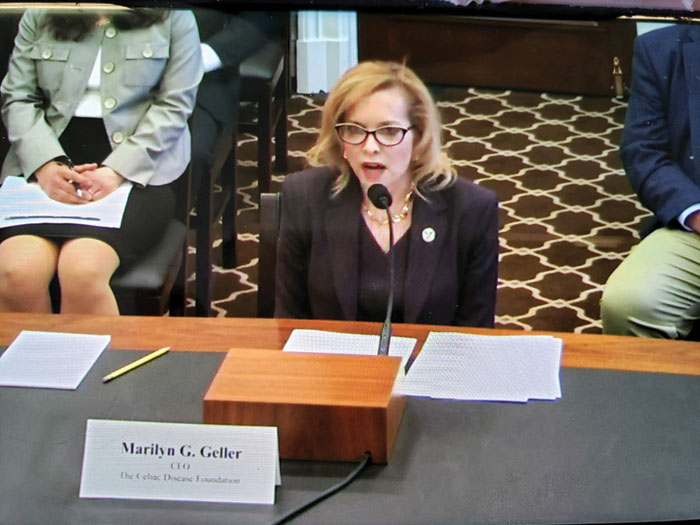
“Improving the quality of life for celiac disease patients and their families will always be the top priority of the Celiac Disease Foundation,” said Marilyn Geller, chief executive officer of the organization. “We are working tirelessly toward treatments and a cure for celiac disease.”
The NIH grant is significant, considering that there is currently a lack of research committed to celiac disease.
“Unfortunately, for the millions who suffer, the disease has largely been ignored by our federal government, which provides little to no funding for research nor for public awareness of its serious consequences,” said Geller. “NIH plays a central role in the expansion of biomedical knowledge. Every drug approved by the FDA since 2010 had its start with NIH-funded research.”
The NIH published the Notice of Special Interest funding opportunity for celiac disease research in December of last year. Before that, Congress launched the first Celiac Disease Caucus, chaired by Congresswoman Betty McCollum (D-Minn.), who has celiac disease.
While the foundation is celebrating the news, they are going to keep advocating for more research until a cure is found.
“Our work is not done, as each year we must ask Congress to continue to fund celiac disease research,” said Geller.
As a mother of a son with celiac disease, the issue is near and dear to Geller. Her son was ill from birth, and the best specialists in Los Angeles didn’t understand why.
“He suffered from unbearable pain, can’t-get-out-of-bed fatigue, endless stomachaches, headaches, medical procedures and, at the lowest point, in middle school, would say to me, ‘Mommy, my brain is telling me to kill myself again, and I don’t want to. Please help me,’” said Geller. “It was a 15-year ordeal until a doctor finally ordered a blood test for celiac disease.”
Although Geller said she was grateful to have finally received a diagnosis, the implications of celiac disease are physically and mentally taxing. Her son was diagnosed with thyroid disease and vitamin deficiencies, which is common in people with the disease.
“[He] continues to suffer from chronic back pain and fatigue, and will always have an increased mortality risk, even with his strict adherence to a gluten-free diet,” she said.
While gluten-free food is becoming more and more available, it’s not possible for people to always avoid gluten.
“There is no such thing as a gluten-free diet because of the constant risk of cross-contact with gluten, with gluten in 80% of our foodstuffs,” said Geller. “Something as simple as a server removing croutons from a salad that [my son] ordered without, instead of making a clean salad, can leave him experiencing symptoms similar to food poisoning for days.”
According to the foundation, which was founded in 1990, it’s not uncommon for celiac disease to go undiagnosed; an estimated 60-70% of Americans are still undiagnosed.
According to the foundation, which was founded in 1990, it’s not uncommon for celiac disease to go undiagnosed; an estimated 60-70% of Americans are still undiagnosed. In addition, people with a first-degree relative like a parent, sibling or child with celiac disease have a one-in-10 risk of developing it themselves.
The prevalence of celiac disease among Ashkenazi Jews is 1.83% and among Sephardic Jews is 1.39%, compared to the worldwide average of 1%l.
“Celiac disease is genetic and is strongly linked to the HLA-DQ2 and HLA-DQA genes, which are found more commonly in Caucasians of European ancestry,” said Geller. “However, while about 30% of the overall population carries these genes, only 3% of that group actually develops celiac disease. Because of this, researchers believe there may be environmental factors that trigger celiac disease.”
Along with advocating for research, the Celiac Disease Foundation promotes labeling standards for gluten-free foods, offers patient and provider education and has a network of student ambassadors. The foundation also provides a Symptoms Assessment Tool on their website that people can take and give to their doctor to see if they might be suffering from the disease.
Even though people joke about gluten-free and celiac disease being overdiagnosed, Geller stressed that it’s not a laughing matter.
“Americans are dying because we haven’t paid sufficient attention to this disease. We are working tirelessly toward treatments and a cure.” – Marilyn Geller
“Despite what you might see in popular media, celiac disease is not a fad,” she said. “It is not a punchline. Americans are dying because we haven’t paid sufficient attention to this disease.”
Still, she is grateful for those who do take the disease seriously, including the NIH and the foundation’s supporters.
“We are working tirelessly toward treatments and a cure for celiac disease,” she said. “All of our work on behalf of the celiac patient community, for adults and children, is made possible by the generous support of individual donors.”
This is a historic spring for NBA fans in Los Angeles.
Usually at this time of year, the Lakers are making a valiant run for the NBA Championship.
But not this year.
Since the Lakers moved to Los Angeles from Minneapolis in 1960, they have played in the NBA finals 27 times and won the NBA championship 17 times. In that 62-year span, there have been only four instances when neither the Lakers nor the L.A. Clippers qualified for the playoffs: 1994, 2005, 2018 and now 2022.
So the HBO series “Winning Time: The Rise of the Lakers Dynasty” is the closest thing Angelenos have to watching a hometown NBA team in the playoffs this spring.
The ten-episode series has generated a heated reaction from the people it portrays. Since the pilot episode aired in March, some of the real people depicted in the series have been irked by the creative license taken by the series in their portrayals.
Former Lakers player and coach Jerry West took the most exception to the series, threatening to sue HBO for misrepresenting him if they did not issue a retraction.
“The series made us all look like cartoon characters,” West told the Los Angeles Times. “They belittled something good. If I have to, I will take this all the way to the Supreme Court.”
HBO issued a statement emphasizing that the series is a dramatization.
“HBO has a long history of producing compelling content drawn from actual facts and events that are fictionalized in part for dramatic purposes. ‘Winning Time’ is not a documentary and has not been presented as such,” the company said in their statement. A disclaimer appears on screen before each episode reaffirming the same message.
Kareem Abdul-Jabbar also wrote a critical response to “Winning Time” on his Substack blog.
“The characters are crude stick-figure representations that resemble real people the way Lego Hans Solo resembles Harrison Ford,” Abdul-Jabbar wrote.
In the pilot episode, Abdul-Jabbar’s character is filming the legendary cockpit scene as Captain Murdock in the film “Airplane!” when he snaps a vulgarity at the child actor. According to the “Airplane!” filmmakers, that outburst never took place.
“We had never seen anything like that on the ‘Airplane!’ set,” David Zucker, Jerry Zucker and Jim Abrahams wrote in a letter to The Los Angeles Times. (The three filmmakers briefly appear in that scene.) The actor who played the kid, Ross Harris, said that he was never contacted by the “Winning Time” production team.
Max Borenstein, co-creator of “Winning Time” explained to Vanity Fair that he always strives to “root the show in facts.”
The viewers of the show have been entertained to say the least — millions regularly streamed the show week after week. By the fifth episode of season one, a second season of “Winning Time” was ordered by HBO.
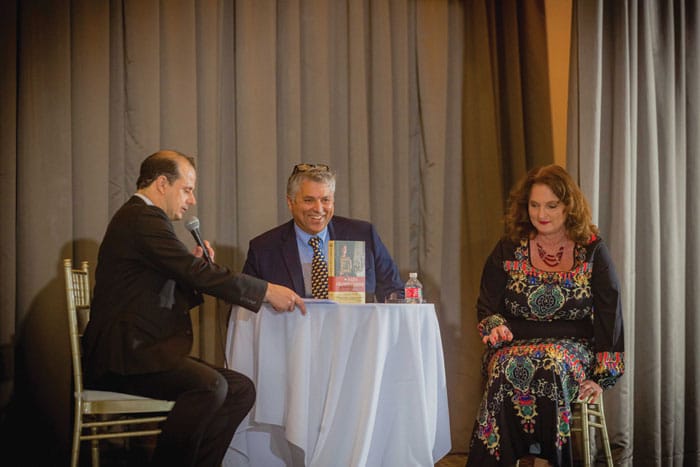
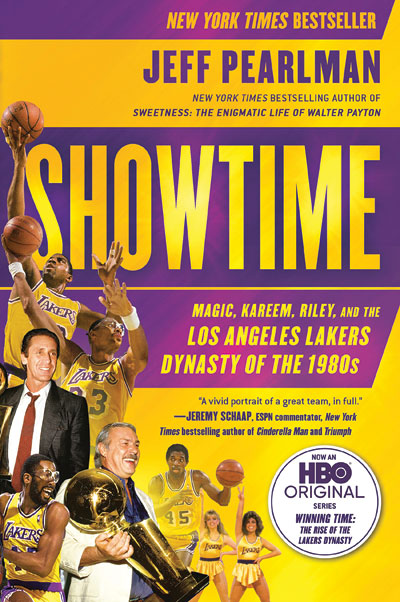
The events in the scripted series were distilled from the book “Showtime: Magic, Kareem, Riley, and the Los Angeles Lakers Dynasty of the 1980s” written by sports writer Jeff Pearlman in 2014. Out of the ten sports books Pearlman has written, “Showtime” is the first to be adapted for television.
Pearlman interviewed 350 people in his research for “Showtime” to ensure airtight facts — even if the top stars of the book refused to be interviewed for it.
As he does with all of his books, Pearlman interviewed hundreds of people in his research for “Showtime” to ensure airtight facts — even if the top stars of the book refused to be interviewed for it.
“Magic wouldn’t talk and Kareem wouldn’t talk,” Pearlman told The Journal.
That wouldn’t stop Pearlman from interviewing practically everyone else in the vicinity of the top two stars of the Showtime-era Lakers. He spoke with any available firsthand witnesses to the on-court success and off-court theatrics that characterized the Lakers of the 1980s. Pearlman interviewed lesser-known Lakers, including Wes Matthews, Larry Spriggs and Earl Jones. He interviewed current Lakers president Jeanie Buss for two and a half hours. He even developed an unexpected fondness for former Lakers coach Jack McKinney.
McKinney — Magic Johnson’s first coach with the Lakers — was Pearlman’s favorite character in the book.
“I would love for people to know Jack McKinney’s story,” Pearlman said. “And I think people forget there was this guy who coached the Lakers and he really mattered. He started [the Showtime Lakers’ style of play] and very few people know about him.”
McKinney coached only 14 games with the Lakers before he had a bicycle accident that would keep him from coaching the Lakers again. He would go on to coach the Indiana Pacers and Kansas City Kings, but never had anything close to the success that the Lakers would have in the 1980s. After “Showtime” was published, McKinney wrote Pearlman a letter praising the book as “good in so many ways.” Pearlman still keeps that hand-written letter as a treasure in his office. McKinney passed away in 2018.
Despite the backlash by some of the personnel who were portrayed, Pearlman sees his book and the HBO show each standing tall as two separate entities on the same subject.
“The people behind ‘Winning Time’ researched their asses off. Thorough beyond thorough. And while they tend to be too classy to clap back [at critics], I’m not,” Pearlman wrote in defense of the series. “If you’ve ever seen a sports movie, you know how these things go. ‘Remember the Titans’ takes leaps. ‘Rudy’ takes leaps. ‘42’ takes leaps. It’s just the way of Hollywood. You want to capture the spirit of the era, the spirit of the team, the spirit of the peeps, while also utilizing narrative storytelling. It’s NOT a doc. As a journalist — being honest — it’s been an adjustment for me.”
Pearlman grew up in a Jewish family in New Jersey where he was the only sports fan. But he vividly remembers the epic battles between the Boston Celtics and Showtime Lakers. He was only eight years old when the events of “Winning Time” began. And even as a young New Jersey Nets fan, he was quite taken by the emerging spectacle the NBA was becoming in the 1980s.
“I just remember being a kid and when the Lakers and the Celtics played, sitting in front of the TV, holding my basketball, just like emulating [Larry] Bird, emulating Magic, trying to be those guys, the no look passes,” Pearlman said. “Then you go outside and you try doing it yourself in the driveway.”
Pearlman is currently writing a biography of baseball and football star Bo Jackson. When asked to describe “Winning Time” as a mashup of two shows or films, Pearlman described it as “‘Entourage’ meets ‘Hoosiers.’”In an ironic twist, HBO did not use the title of Pearlman’s book since their rival premium television network happens to also be called Showtime.
“Winning Time” stars an ensemble cast, including John C. Reilly, Sally Field, Jason Segal and Adrien Brody. And amongst them are first time actors Solomon Hughes (Kareem Abdul-Jabbar) and Quincy Isaiah (Magic Johnson) who both put in strong performances.
So if you’re a basketball fan in Los Angeles longing to immerse yourself in hometown basketball glory, here’s two things you should do: watch “Winning Time” on HBO, then read the book “Showtime” and form your own conclusions on the entertainment value and perils of dramatic license.
For many people, their relationship with Judaism ends after their bar or bat mitzvah. After going through this coming of age ceremony, they become less and less engaged and eventually, unaffiliated altogether.
However, when they grow up, they still have fond memories of their bar or bat mitzvah, and they want the same for their kids. If they don’t belong to a synagogue or send their children to a religious school, they may not know how to make this happen.
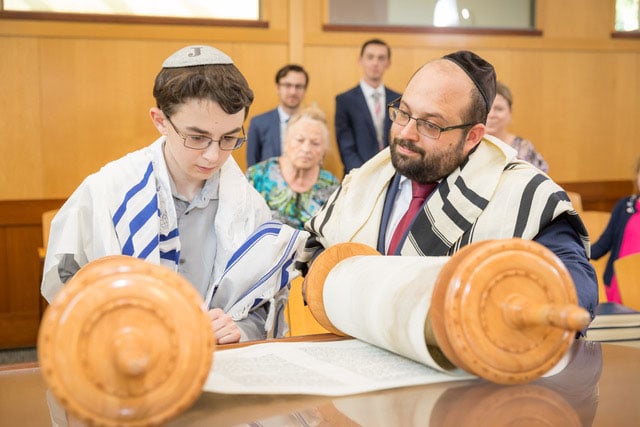
That’s where the Bar and Bat Mitzvah Experience program comes in. An initiative of The Community Shul, an Orthodox synagogue in Pico-Robertson, the program offers unaffiliated Jewish families affordable Sunday school lessons and a bar and bat mitzvah ceremony.
“If these families go to any other shul or temple, they may have to take out a membership or be a member for more than one year before being admitted into the bar or bat mitzvah program,” said Rabbi Moshe Cohen of The Community Shul. “There are too many hurdles. That’s how I came up with this idea.”
The Bar and Bat Mitzvah Experience started in 2017. During the six weeks of the program, presenters from around the community, including TV writer David Sacks of The Happy Minyan, screenwriter David N. Weiss and film animator Saul Blinkoff, teach the classes. Topics range from Israel to what it means to be Jewish and the definition of a bar or bat mitzvah. The son or daughter will study with their parents, making it a family affair.
During the six weeks of the program, presenters from around the community, including TV writer David Sacks of The Happy Minyan, screenwriter David N. Weiss and film animator Saul Blinkoff, teach the classes.
“It’s your family celebration,” said Cohen. “Each bar or bat mitzvah is unique. We’ve had people from very different walks of life and nationalities including Americans, Israelis, Ethiopians and Russians. We’re doing it as a service to the broader Jewish community who otherwise couldn’t or wouldn’t do it.”
One parent, Ami Curtis, enrolled her son in the program after her family couldn’t find a temple they wanted to join. Since he enjoyed the experience so much, she then enrolled her second son in it as well.
“The speakers and teachers were fantastic and really kept the boys and girls interested,” she said. “It was really like hiding the vegetables in the food. They didn’t realize how much they were learning while listening to and interacting with these fascinating people.”
When Anya Vaysman was looking at bar and bat mitzvah options for unaffiliated children online, she found the program. It stood out because it offered a traditional approach to Judaism and it wasn’t cost-prohibitive, like other programs.
“The classes were both very educational and entertaining at the same time,” she said. “They made my son more proud of his heritage and I believe they inspired him to learn more about Judaism. In fact, when a new Jewish club opened up at his public school, he was one of the first kids to join. I am extremely grateful to The Community Shul for providing such a valuable resource for the community.”
Debbie Hirschmann, the program director for the Bar and Bat Mitzvah Experience, said that the boys and girls can do as much or as little as they are comfortable with.
“Many kids are unable, uninterested or unwilling to do all the preparation for a traditional ceremony,” she said. “We make it possible to celebrate in a meaningful, but user-friendly way.”
According to Cohen, the boys and girls don’t read the entire parsha. “Most kids haven’t been to Jewish day school,” he said. “They don’t have any religious training so it’s too difficult for them to do.”
The goal is not to have a perfect ceremony but, instead, to inspire the teens to stay connected to Judaism even when the celebrations are over.
“We hope this program accomplishes planting a seed,” Hirschmann said. “[We’re] planting a positive connection to Judaism, and [they’re] seeing that Judaism can be a positive, relevant and meaningful part of their lives.”
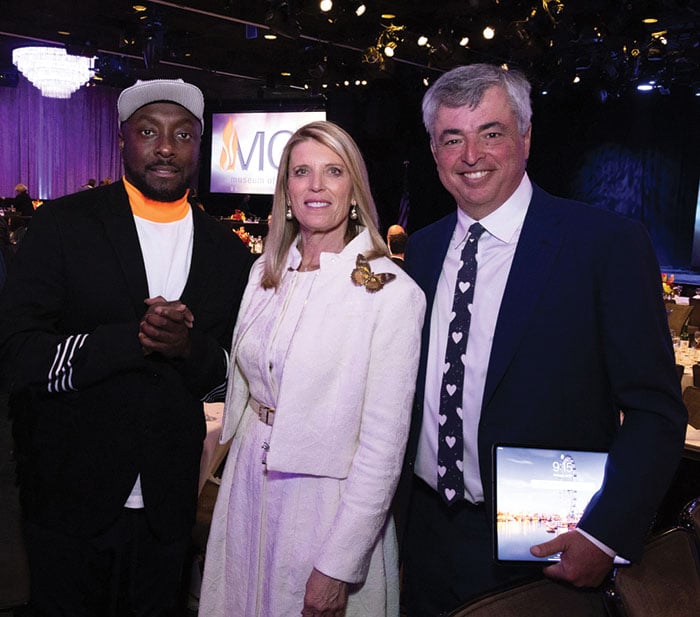
The Simon Wiesenthal Center (SWC) and Museum of Tolerance honored Apple’s Senior Vice President of Services, Eddy Cue, with the 2022 Humanitarian Award, the organization’s highest honor.
“For the past 45 years, this organization has been an essential leader in the fight for human rights, promoting tolerance and dignity for all,” Cue said, accepting his award.
The star-studded April 27 event at the Beverly Hilton also honored Ukrainian President Volodymyr Zelensky and the Ukrainian people in recognition of their courage and defense of democracy as well as Brooklyn Rabbi Moshe Margaretten, for his humanitarian work saving the lives of hundreds of Muslims in Afghanistan as well as the lives of Ukrainians.
Attendees included SWC Executive Director Rabbi Meyer May; Hollywood producer Jeffrey Katzenberg; SWC Board Chair Dawn Arnall and Co-Chairman Aaron Marzwell; SWC Associate Dean Rabbi Abraham Cooper; and entertainment executive Irving Azoff.
Katzenberg, who has chaired the Simon Wiesenthal Center’s Dinners for more than two decades, said, “intolerance has continued to be on the rise and today, almost no matter where we look, we see it vividly on display whether far off on the battlefields of Ukraine, or right here in Hollywood on the stage of the Dolby Theater. Which is why we need the SWC now more than ever.”
Serving as master of ceremonies, late-night host James Corden thanked everyone for attending and “supporting the vital work being done by the Simon Wiesenthal Center.”
A highlight of the evening was a live musical performance by Adam Levine of the band Maroon 5.
According to SWC, the gala was a record-breaking event, raising more than $3.7 million to support the global work of SWC and the Museum of Tolerance in Los Angeles.
From left: StandWithUs COO Jerry Rothstein, American-Israeli basketball legend Tal Brody, SWU President Esther Renzer, CEO Roz Rothstein and filmmaker Dani Menkin. Photo by Mher Hagopian, MTH Photographers
Pro-Israel education organization StandWithUs (SWU) and Hey Jude Productions, with the support of the Consulate General of Israel in Los Angeles, hosted 400 attendees for a special screening of award-winning documentary “Aulcie.”
Aulcie Perry, an Israeli-American basketball player, led Israel’s Maccabi basketball team to two European championships. He could not attend the May 2 screening at the Saban Theater due to a medical condition, but he shared his heartfelt message with the audience through a video.
Temple of the Arts Beverly Hills Rabbi David Baron welcomed the crowd, which included Israel Ambassador to the United Nations Gilad Erdan and Consul General of Israel in Los Angeles Hillel Newman.
After the screening, SWU CEO Roz Rothstein interviewed “Aulcie” filmmaker Dani Menkin and basketball legend Tal Brody. Brody led the Maccabi Tel Aviv basketball team to victory at the 1977 European World Cup. He now serves as a Goodwill Ambassador for Israel.Also attending was Sarah Idan, former Miss Universe Iraq and vocal supporter of Israel.
The festivities continued at the Saban on May 4 with “From Darkness to Light,” a community-wide event commemorating Yom Hazikaron and Yom HaAtzmaut, Israel’s 74th birthday. 800 people were in attendance and thousands watched virtually. Beverly Hills Temple of the Arts, Cheryl and Haim Saban, Friends of the Israel Defense Forces, the Israeli-American Council and StandWithUs, with the support of the Consulate General of Israel to the Pacific Southwest, co-organized the program, which began with a march by student members of Israel Tzofim (Shevet Harel) carrying Israeli flags down the aisles.
With Perry watching remotely, Rothstein, SWU COO Jerry Rothstein and SWU President Esther Renzer presented Perry and Brody with Lifetime Achievement awards.
Speakers included Jewish Journal editor-in-chief David Suissa, who spoke about Israel’s “five miracles,” including the urge to thrive, rather than just survive, and Israeli Consul for Public Diplomacy and Culture Jonathan Bar-El, who underscored Israel’s resilience.
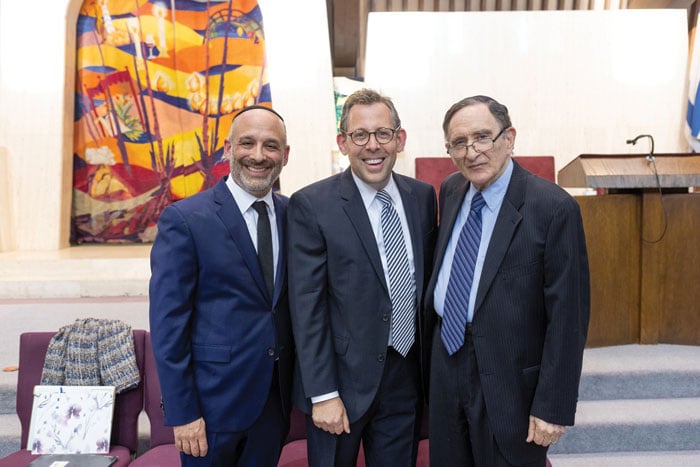
From left: Adat Ari El Former Senior Rabbi Jonathan Jaffe Bernhard; new Senior Rabbi Brian Schuldenfrei and Rabbi Emeritus Moshe Rothblum represent three generations of Adat Ari El clergy. Courtesy of Adat Ari El
Conservative congregation Adat Ari El in the San Fernando Valley recently celebrated the appointment of its new Senior Rabbi Brian Schuldenfrei.
On May 1, the North Hollywood-based congregation held a gala marking the formal installation of Schuldenfrei, who joined Adat Ari El last July from Congregation Ner Tamid. The entire community was in attendance, including Adat Ari El Executive Director Eric Nicastro, who was delighted to welcome Schuldenfrei to the historic synagogue.
“With Rabbi Schuldenfrei as our new senior rabbi, we feel a synergy and recognize we are heading towards a bright future,” Nicastro said.
In a statement, Schuldenfrei said he was excited to be joining the community, one of the oldest in the San Fernando Valley.
“Especially now as we begin to heal from the past two years of COVID, we can reach up to that which transcends us by reaching out to one another,” the rabbi said. “And the challenge of our times demands that we do this with creativity and care. We hope to nurture this approach at Adat Ari El.”
Representative Rashida Tlaib (D-MI) introduced a resolution in Congress on May 16 that recognizes the Nakba, Arab for “catastrophe” in referencing Israel’s declaration of independence in 1948.
The resolution stated that after Israel’s war for independence, the Jewish state “had depopulated more than 400 Palestinian villages and cities” and that “the Nakba refers not only to a historical event but to an ongoing process of Israel’s expropriation of Palestinian land and its dispossession of the Palestinian people that continues to this day through the establishment and expansion of approximately 300 illegal settlements and outposts in the occupied Palestinian West Bank in which approximately 674,000 Israelis reside as of 2020.” The resolution concludes with a call for the House of Representatives “to commemorate the Nakba” and endorses a right of return for the more than 700,000 Palestinian refugees who lost their homes during the war.
This resolution from Rashida Tlaib and a half dozen other Democrats on the “Nakba,” labels Palestinian Arabs as “indigenous inhabitants” of Israel implicitly denying the country as the Jewish homeland https://t.co/uGF0zlLx4S
“On this day, we must promote human rights & justice,” Tlaib tweeted. “The Palestinian people since the 48 Nakba have been living under oppression and violent racism. Silence + blank checks enables more death and violence.”
On this day, we must promote human rights & justice. The Palestinian people since the 48 Nakba have been living under oppression and violent racism. Silence + blank checks enables more death and violence.
— Congresswoman Rashida Tlaib (@RepRashida) May 16, 2022
Various Jewish groups criticized the resolution.
“The root of the catastrophe: the Arab world refused to accept the UN plan for a Jewish & Arab state in what was left of the UK’s Palestine Mandate after Jordan’s creation,” Democrat Majority for Israel tweeted. “Instead, 5 Arab armies invaded Israel, attempting to destroy it & push the Jews into the Mediterranean Sea.”
The root of the catastrophe: the Arab world refused to accept the UN plan for a Jewish & Arab state in what was left of the UK's Palestine Mandate after Jordan’s creation. Instead, 5 Arab armies invaded Israel, attempting to destroy it & push the Jews into the Mediterranean Sea. https://t.co/VTSgQy0fXm
— Democratic Majority for Israel (@DemMaj4Israel) May 16, 2022
Republican Jewish Coalition (RJC) Chairman Norm Coleman criticized the resolution in a May 18 statement, arguing that it “distorts history and international law in service to an anti-Israel agenda that has no place in the US Congress.” “This is another attempt by the most radical leftists in Congress to delegitimize our ally Israel and to promote anti-Israel and frankly antisemitic efforts to destroy the only democracy in the Middle East,” he said. “The fact that such a resolution could be introduced at all demonstrates that the Democratic leadership in the House is completely unwilling or unable to rein in the worst impulses of their caucus.”
Democratic leadership in the House is completely unwilling or unable to rein in the worst impulses of their caucus. @RJC's full response to the "Nakba" Resolution: pic.twitter.com/OR3cfXAapV
The Coalition of Jewish Values (CJV), which describes itself as an organization “representing over 2,000 rabbis in matters of American public policy,” condemned the resolution as being “openly antisemitic.” “Arab armies responded to Israel’s founding with a call for genocide, and have continued with repeated wars and horrific acts of terrorism for the sole purpose of killing Jews and destroying the world’s only Jewish state,” CJV Israel Regional Vice President Rabbi Steven Pruzansky said in a statement. “They proclaimed their intent in 1948 as a ‘momentous massacre,’ to kill all Jews in Israel as Hitler did in Germany, and what they call a ‘Nakba’ is that they fell 99% short of that obscene goal.”
Representative Lee Zeldin (R-NY), who is currently running for governor in New York, similarly said in a statement: “This resolution is just the latest in a long line of antisemitic, anti-Israel statements, policies and actions by the most radical voices in the Democratic Party. Whether it’s supporting the antisemitic Boycott, Divestment and Sanctions (BDS) movement against Israel, falsely accusing Israel of war crimes, or suggesting that support for Israel by members of Congress is ‘all about the Benjamins’, this group on the far-left never misses an opportunity to dangerously promote antisemitic and anti-Israel sentiments and agendas.”
He added: “What’s even more disturbing is the unwillingness of Nancy Pelosi and House Democratic leadership to condemn this vile behavior. Israel is our nation’s strongest ally, the only functioning democracy in the Middle East, and the victim of repeated attacks and threats of destruction from its hostile neighbors.”
The “Squad” just proposed a reso in Congress to force the US to formally recognize “Nakba”, labeling the creation of Israel a “catastrophe”. They never miss an opportunity to dangerously promote its antisemitic, anti-Israel agenda. pic.twitter.com/j3vL2veBZb
Daily Wire Editor Emeritus Ben Shapiro tweeted, “The Palestinian refugee issue exists because the Arab states refused to recognize literally any partition plan at any time, then kept them in refugee camps. It is that simple. 850,000 Jews were expelled from Arab countries during the same time period; all were absorbed by Israel.”
The Palestinian refugee issue exists because the Arab states refused to recognize literally any partition plan at any time, then kept them in refugee camps. It is that simple. 850,000 Jews were expelled from Arab countries during the same time period; all were absorbed by Israel.
Siamak Kordestani, West Coast Director of the European Leadership Network, similarly asked Tlaib in a tweet if “the resolution [will] also mention the 850,000 Mizrahi Jews ethnically cleansed by Arab countries in the 1940s and 50s.”
Will the resolution also mention the 850,000 Mizrahi Jews ethnically cleansed by Arab countries in the 1940s and 50s? pic.twitter.com/Wn9sMFMzOm
Iranian Americans for Liberty Executive Bryan Leib called Tlaib “a stain on American democracy” in a tweet and that “she should be stripped of all committee assignments once @HouseGOP takes back the majority this November.”
Rashida Tlaib is a stain on American democracy, and she should be stripped of all committee assignments once @HouseGOP takes back the majority this November. @RashidaTlaibhttps://t.co/9RZkvMihIP
Ellie Cohanim, former Deputy Special Envoy to Monitor and Combat Antisemitism, similarly tweeted that Speaker of the House Nancy Pelosi (D-CA) and Senate Majority Leader Charles Schumer (D-NY) need “to condemn those in the #Democrat party who would label the founding of Israel as ‘The Catastrophe’. It’s time to prove that your party is not anti-Israel.”





 That wouldn’t stop Pearlman from interviewing practically everyone else in the vicinity of the top two stars of the Showtime-era Lakers. He spoke with any available firsthand witnesses to the on-court success and off-court theatrics that characterized the Lakers of the 1980s. Pearlman interviewed lesser-known Lakers, including Wes Matthews, Larry Spriggs and Earl Jones. He interviewed current Lakers president Jeanie Buss for two and a half hours. He even developed an unexpected fondness for former Lakers coach Jack McKinney.