We’re seeing again how Israel can fight so well with real weapons but so badly with words.
Take the death of Al Jazeera journalist Shireen Abu Akleh, which has turned into an international incident. She was fatally shot during an Israeli anti-terrorist incursion into Jenin. An initial autopsy of Abu Akleh’s body by Palestinian coroners found that it was “not possible” to tell whether she was killed by Israeli or Palestinian gunfire.
Of course, that didn’t stop Palestinian Authority President Mahmoud Abbas from treating Israel as a murderous country and vowing that he would take it to the International Criminal Court.
“They committed the crime and we do not trust them,” Abbas said, contradicting his own forensic expert. “We hold the Israeli occupation authorities totally responsible for her killing. This crime cannot go unpunished.”
In addition to this brazen rush to judgement, Abbas declared that the PA would not participate in a joint investigation with Israel, which would enable ballistic tests on the fatal bullet and provide conclusive evidence of responsibility.
So, which party can’t be trusted– the party asking for a forensic investigation or the party running away from it?
For Israel, this should be a PR slam dunk: Israel wants to get at the truth, while Mahmoud Abbas wants another chance to malign Israel.
For Israel, this should be a PR slam dunk: Israel wants to get at the truth, while Mahmoud Abbas wants another chance to malign Israel.
But instead of taking the initiative, Israel has followed its usual timid playbook of playing defense and being extra cautious with its language. Maybe Israel is so used to being attacked in international circles for its aggressive posture against terrorism, it’s trying to overcompensate with its diplomatic posture.
The problem is that this just shows weakness. Israel has a strong case that Abbas must agree to a joint investigation. There’s no need to hedge or dilly dally. If Abbas continues to refuse to seek the truth, Israel should take him to the International Criminal Court.
After all, the Oslo accords require the PA to disband all terrorist groups, seize their weapons and outlaw them. Abbas has done none of that, which has forced Israel to intervene. Even the New York Times admitted that terrorists roam free in PA cities, reporting in 2014 that although Jenin is under the “full control” of the PA, “the Palestinian [security forces] did not generally operate in refugee camps.”
By failing to honor his obligations under Oslo, Abbas has put the lives of his own people in jeopardy, including journalists. Maybe that’s why he’s so aggressive with his accusations against Israel—it distracts from his own failures.
It’s time for Israel to turn the tables and take Abbas to the International Criminal Court. If any party deserves a trial, it should be the party that is afraid of the truth.
The Lord’s appointed [holy days] that you shall designate as holy occasions. These are My appointed [holy days]: – Leviticus 23:2
And God spoke to Moses, who spoke to me
through a long series of messages passed on
from person to person, like a game of Telephone
that has been going on forever.
For six days you will work, unless you live in the west
in which case you will only work for five, unless
you are a Jewish professional, in which case
some weekends and evenings may be required.
And on the tenth day, of the tenth month
you shall celebrate the poet’s birthday by
buying his books, and writing positive reviews
on The Amazon and sending offerings of
freshly baked goods. (Gluten is okay.)
And you shall bring a fire offering, and
place the fire inside an outside pizza oven
because, lo, the pizza is not good where you live
although there are other benefits such as
a lovely view and a nearby mule farm.
And you shall count the days between haircuts
and acknowledge, your favorite haircutter
no longer works at the salon and this is why
your son’s hair has grown to 1969 lengths
because no-one wants to start over with
a different haircutter.
And a meal offering shall be brought
but take care to take turns in a family setting
as no one wants to cook every day and
the weight of having to decide what to eat,
or what to cook, or what to order
is too much for any one family member.
And any kitten who walks by outside
harken! shall be brought inside, whether or not
it is unblemished, and it shall be given
full house privileges for all of its
natural and furry life.
And you shall dare not cut the rose bushes
planted by the warrior who lived in your house
before the paperwork put you in control.
Even though he lives by a lake in North Carolina now,
these flowers, teeming with all the possible colors
are a memory of what he did, and how he lived.
And he shall never be forgotten.
A debate is raging over whether Israeli soldiers or Palestinian Arab terrorists were responsible for the shooting death of an Al Jazeera reporter in Jenin. But nobody seems to be asking one important question: Why were Israeli soldiers in Jenin, anyway?
After all, way back in 1995, as part of the Oslo II agreement, Israeli Prime Minister Yitzhak Rabin withdrew all Israeli troops from the areas in Judea-Samaria where 98% of the Palestinian Arabs live, including all major cities such as Jenin.
So, the Israeli troops who were in Jenin last week were not there as part of the old occupying force. They were not there to establish a Jewish settlement. And they were not there to govern the city. Even Raja Abdulrahim, the pro-Palestinian reporter who was recently hired by the Jerusalem bureau of the New York Times, acknowledged in an article last month that “40% of the region is governed by the Palestinian Authority.”
So, if those Israeli soldiers were not in Jenin to govern, or to occupy, or to settle, then what in the world were they doing there? Why don’t they just stay within the Israeli-governed parts of the region? Why venture into PA territory, even for a few hours?
The answer is that the PA’s refusal to fight the terrorists forced the Israelis to go into Jenin and do the job themselves.
The Oslo accords require the PA to disband all terrorist groups, seize their weapons, and outlaw them—that is, to put them out of business.
One can understand the logic behind Prime Minister Rabin’s decision to out-source the fight against terrorism to the PA. After all, the PA security forces know the terrain. They know where the weapons depots and safe houses and training sites are located. And the PA certainly has the ability to do the job—it has one of the largest per-capita security forces in the world.
In short, they could smash the terrorist groups if they wanted to. But they just don’t want to. The PA never outlawed the terrorist groups. It has never made a serious effort to capture its members or seize its weapons, in Jenin or anywhere else. The PA treats the terrorists in Jenin and the other areas under its control like brothers, and allows them to operate freely.
That’s why here we are, 27 years after the PA became the sole ruler in Jenin, and the city is still filled with active terrorist cells from Hamas, Fatah, and Palestinian Islamic Jihad (the gang which murdered my daughter Alisa).
Even the New York Times occasionally admits that terrorists roam free in PA cities. On March 23, 2014, for example, the Times reported that Israeli troops were forced to enter the Jenin refugee camp in pursuit of terrorists because although Jenin is under the “full control” of the PA, “the Palestinian [security forces] did not generally operate in refugee camps.”
Why do the media and the United Nations treat Palestinian Arabs as if they are morally incapable of non-violence?
The PA, by its deliberate inaction, has forced the Israeli army to occasionally enter Jenin in pursuit of terrorists. The alternative would be for the Israelis to just sit back and wait for the terrorists to attack again. Obviously, they can’t do that. They have to chase them. And sometimes that means chasing them into a Palestinian Arab city.
No Israeli commander relishes sending his soldiers into a dangerous, populated area like Jenin. It means endangering the soldiers’ lives. It means the possibility of situations in which bystanders are inadvertently harmed. But the Israelis literally have no choice.
The Palestinian Arabs, however, do have a choice. They don’t have to pick up guns and shoot at the Israeli soldiers. In fact, if the Palestinians were as “moderate” and “peace-seeking” as J Street and the State Department are always telling us, they wouldn’t pick up guns at all—instead, they would cheer when the Israelis arrest terrorists.
Instead, the Palestinians shoot. And notice how the international community and news media treat such shooting—as if it’s perfectly acceptable behavior. When extremists in an American city open fire on police officers, there is unanimous horror. There are calls for stricter enforcement of laws restricting guns.
Why don’t we hear such calls when Palestinian pick up guns? How come nobody talks about “gun control” in Jenin? Why are scenes of Palestinian Arabs firing automatic weapons at Israeli soldiers considered normal and fine?
Or, to put it another way—why do the media and the United Nations treat Palestinian Arabs as if they are morally incapable of non-violence? Why do they act as if Palestinians are inhuman savages who must resort to murder? Those are the questions that I’d like to see asked at the next State Department briefing or J Street press conference.
Stephen M. Flatow, is an attorney and the father of Alisa Flatow, who was murdered in an Iranian-sponsored Palestinian terrorist attack in 1995. He is the author of “A Father’s Story: My Fight for Justice Against Iranian Terrorism.”
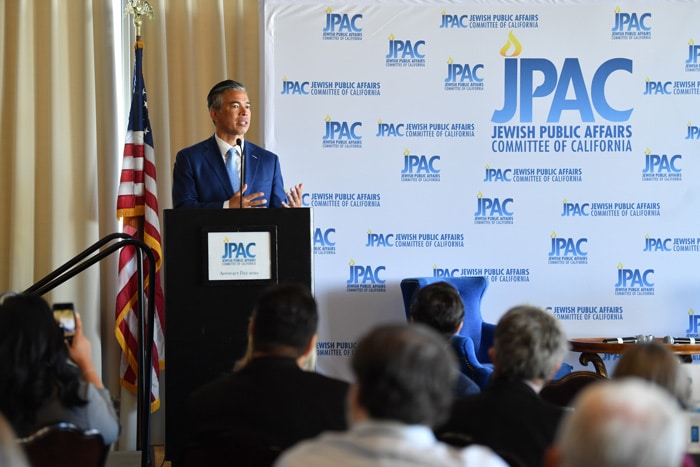
California Lieutenant Governor Eleni Kounalakis, Attorney General Rob Bonta and members of the state’s Legislative Jewish Caucus highlighted the speakers for the Jewish Public Affairs Committee’s (JPAC) Advocacy Day event.
The event went from May 9-10, primarily at the Citizen Hotel in Sacramento; 200 Jewish leaders and activists were in attendance, including 30 state legislators. The event focused on JPAC’s main priorities: combating antisemitism and other forms of hate and providing more services to immigrants and the elderly.
Kounalakis, a former United States Ambassador to Hungary and a Democrat, recalled how in Hungary they deal “with the horrific chapter of the Holocaust” nearly every day. Europe is “weighed down by history” and California is blessed to not be “not weighed down by history in the same way,” she said. However, she warned that she is “starting to see the same kinds of [antisemitic] tropes and language” in the state. “We have to be very vigilant when it comes to the education of our students that they understand how to know it when they see it,” Kounalakis said.
The lieutenant governor also pointed out that when she asked people in Hungary how the Holocaust was allowed to happen there, and she was told that “once you begin to chip away with how people see one another as humans, anything can happen.” Holocaust survivors told her that their neighbors shut them out and “didn’t offer to help.” “In European law there is now much more of this conversation about human rights I think in the context of the Holocaust because of this intention around never again,” Kounalakis said, “that we haven’t really caught up to out here.”
Kounalakis then turned her attention to immigration, pointing to how her father and her huband’s parents obtained “refugee status” to enter the U.S. She also cited figures showing that 27% of California residents are foreign-born––higher than the 14% figure nationwide––arguing that immigration and education created “the fifth largest economy in the world.” Kounalakis dismissed arguments that the increasing number of people leaving California shows that the state is heading in the wrong direction. “It’s always been the story of California that people come and go,” she said.
When Bonta spoke, he decried the “darkest times of the Trump administration” in which “our immigrant communities were under full-frontal assault.” He said that he had been talking to the Jewish community about how to protect immigrant communities. Bonta also praised the Jewish Caucus for being among the first ones “by our side” to combat the spike in anti-Asian hate during the COVID-19 pandemic.
“There is no place for antisemitism, not here, not anywhere, not now, not ever,” Bonta said, pledging to “use the full force of law… against the forces of hate.” He also championed himself as “the people’s attorney” in “standing up for racial justice,” being against “big polluters” and defending “reproductive freedom.”
Jason Elliott, Senior Counsel for California Governor Gavin Newsom (D), also spoke, decrying the “corrosive hate-filled dialogue” nationally toward “trans kids” as well as minorities and immigrants. He touted California’s GDP growth and the fact that they added an extra grade level, transitional kindergarten. “We’re not going to fix everything overnight but dammit we can make a difference,” Elliott said.
Assemblymember Jesse Gabriel (D-San Fernando Valley) headlined the Jewish Caucus speakers during the May 9 dinner; Gabriel chairs the caucus. He praised the caucus for being “as strong and as influential in the policymaking process as we have ever been,” pointing to their fight against antisemitism and in favor of Holocaust education as well as strengthening the relationship between Israel and California. The caucus chair also discussed the legislators’ “Tikkun Olam” agenda in supporting “wonderful” bills regarding immigration, the criminal justice system, people without access to healthcare as well as investing “very significant resources to homelessness.”
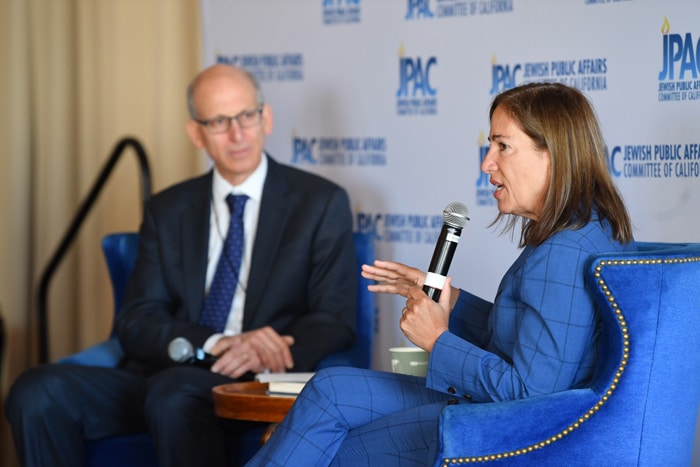
Lieutenant Governor Kounalakis in Fireside Chat with JPAC Vice Chair Marty Schenker / Photo courtesy of JPAC
On May 10, the JPAC event moved to the Capitol Annex Swing Space, where legislators are conducting their business while the capitol building is under construction. There, JPAC activists met with legislators in small groups to lobby for their legislative priorities. These included bills mandating social media companies be transparent about how they handle hate speech, establishing a study on the Holocaust and genocide are being taught in the state and providing $67.6 million toward Jewish and non-Jewish summer camps, community centers and recreation centers that have suffered extensive damage since the state wildfires began in 2017. Other bills supported by JPAC include extending unemployment benefits to illegal immigrants for a year and expanding Medi-Cal access to everyone who is income eligible regardless of immigration status.
Additionally, the JPAC event featured Assemblymember Adrin Nazarian being given the Legislator of the Year award for his work in fighting antisemitism and providing services for Holocaust survivors and the elderly. Lynn Bunim, JPAC’s board chair from 2019-20, also received an award for guiding the organization through the COVID-19 pandemic and Nancy Kirshner-Rodriguez also received the Barbara Yaroslavsky Award for being a female leader in Jewish civic engagement.
“We fight for issues that directly support the Jewish community, and we fight for issues that directly further Jewish values,” David Bocarsly, JPAC Executive Director, said in a statement.“In this moment and in our community, those pillars are manifesting into an acute need to fight antisemitism and hatred, and to support immigrants and older adults. At JPAC Advocacy, California’s diverse Jewish community came together as one voice to forcefully assert the importance of these issues to state lawmakers. We pushed large-scale, life-changing bills, and asked for over $300 million from the state budget to accomplish our key initiatives. We know this bold and unprecedented agenda is achievable because we’ve seen a glimpse of what’s possible when we unite as a community. This week, we showed our community’s strength in a powerful way, which will elevate our priorities this year and our work for years to come.”
Anti-Defamation League Los Angeles Regional Director Jeffrey I. Abrams said in a statement to the Journal, “ADL California well understands the importance of coalition building and community bridging to move the needle on policy aimed at improving the lives of Jewish Californians and all Californians.
ADL was the second largest contingency present at JPAC’s Advocacy Days and we diligently pushed for our key issues including the Social Media Transparency act (AB 587) and the Non-profit Security Grant (AB 1664). We are incredibly thankful for support of numerous legislators and staff members who took the time to meet with us to discuss these critical issues.”
I recently shared the following midrash with our religious school community:
When Hebrew slaves, Reuven and Shimon crossed the Sea of Reeds, they experienced a miracle of wonder and awe. They were walking towards freedom, a pathway entrenched between two walls of roaring water. However, all Reuven and Shimon noticed…was the mud. They looked downward, frustrated by the mud on their shoes. The two men cried out, wondering why they had left mud in Egypt only to find mud still encased around their legs. Human beings experiencing one of the greatest miracles of all time and yet, their vision was blurred by caked dirt, causing their eyes to focus on the ground. Focused on angst. Focused on what they left behind.
I asked the religious school where Reuven and Shimon should have looked. One student shouted, “Look up!” A parent offered, “Look forward!” In the moment, I realized they are both correct. If Reuven and Shimon looked up and looked forward, they would have witnessed the grandeur of our Creator and their ability to walk towards a better tomorrow.
This week, I took a few minutes to stroll around the neighborhood. Reuven and Shimon’s story was whirling through my mind. Instead of remaining glued to the emails on my phone, I took a deep breath in and looked up. A blooming, violet jacaranda tree stood overhead, majestic in beauty and scent. Smiling, I looked forward. I saw Sinai Temple and listened to the laughter of kindergarteners playing at lunchtime. The sounds of Jewish children infusing their lives with Torah, mitzvot, good deeds, and sacred connections. My day was renewed with awe and purpose.
Our minds have been trained to look down. Down towards the computer. Down towards the messiness of the day. Down towards the to-do-lists and complaints. But let us not be bogged down, tricked by the mud.
Look up. Look forward. Goodness awaits.
Shabbat Shalom
Rabbi Nicole Guzik is a rabbi at Sinai Temple. She can be reached at her Facebook page at Rabbi Nicole Guzik or on Instagram @rabbiguzik. For more writings, visit Rabbi Guzik’s blog section from Sinai Temple’s website.
Next week I will receive my “Doctor of Divinity,” from the Hebrew Union College – Jewish Institute of Religion (HUC-JIR). This honorary doctorate celebrates my 25 years in the rabbinate. It feels like it has been just a moment in time since I was ordained (photo is above).
These 25 years have given me perspective, and I want to share the most important lessons I have learned:
Take a step back. Then move forward.
Wisdom can unfold in every person, every tree, every stone, and every experience.
You never know how or where your words will land.
Make time to cultivate your hobbies.
Think about the people that you aren’t thinking about!
The Torah just sits there until we breathe spirit into it.
Judaism has so many treasures, and when we discover and rediscoverthem, life becomes really amazing.
Have convictions – but allow your heart to be open to communicate with those with whom you disagree.
Be a mensch.
Put your family first.
Friends, I am so honored to serve my community. I am so grateful for your love, your kindnesses, and your genuine embrace of me, Ron, and our children.
Please help me celebrate this milestone. I want to raise $25,000 to support HUC-JIR, ensuring that Jewish professionals will continue to have an excellent eduction. In addition, I want to raise $25,000 to support Temple Akiba of Culver City. Your gift(s) mean the world to me and to our future. You can use this link to easily make your donation via Temple Akiba. Please specify the contribution will go to the “Rabbi’s Discretionary Fund.” We will appropriate the funds accordingly.
Lag B’Omer is a day of joy. And, like most Jewish holidays, food is part of the celebration.
Lag B’Omer takes place on the 33rd day of the count of the Omer, which coincides with 18 Iyar. This year, it starts on the evening of May 18.Outdoor activities, bonfires and, of course, cookouts help to commemorate the day.
“Lag B’Omer is one of the most spiritually uplifting days of the entire year.“ -Chef Leonardo Nourafchan
“Lag B’Omer is one of the most spiritually uplifting days of the entire year,” Chef Leonardo Nourafchan, owner of Lenny’s Casita in Pico-Robertson, told the Journal. “It is the yartzeit of Rebbe Shimon Bar Yochai, who authored the Zohar, which is the foundation of all Jewish mysticism. I have no idea where I would be without the secrets of Torah derived from this tzadik.”
Chef Leonardo Nourafchan and Staff at Lenny’s Casita. Photo courtesy of Lenny’s Casita.
The anniversary of Bar Yochai’s passing is an especially auspicious time for revealed blessings, Nourafchan said, who, as is the tradition, often travels to his grave in Meron, Israel on Lag B’Omer.
“[I] dance together with Jews from all walks of life as brothers,” he said. “It’s incredible.”
When Nourafchanwas growing up, his family would light a huge bonfire and BBQ then sing and dance all night long.
And as far as food is concerned, “Lag B’Omer requires a feast of grilled meats,” the chef said. “[We had] simply prepared lamb chops or rib eyes seasoned with salt and pepper and then grilled over a charcoal flame, paired with some Israeli red wine. Nothing is more simple and delicious.”
Chef Danny Corsun, founder of Culinary Judaics Academy, and his daughter, Chef Zoey. Photo credit: Courtesy of Culinary Judaics Academy
Chef and educator Danny Corsun is founder of Culinary Judaics Academy, which infuses meaningful Jewish learning into cooking classes for Jews of all ages and levels of practice. Growing up in a Conservative home in New York City, Lag B’Omer did not have a large presence in his home. However, the two holidays that bookend it, Pesach and Shavuot, did.
“Today, I enjoy reflecting on the many debated origins and takeaways of Lag B’Omer,” Corsun told the Journal.
It’s a pause from mourning to allow for celebration, as well as recognizing brave men with strong, committed ideals. And then there’s the food.
“The time between Pesach and Shavuot likely would have been right after all the first crops had been planted for that year’s harvest, allowing the farmers a day to do all the things they could not focus on before,” he said.
While you can celebrate Lag B’Omer with the traditional singing, dancing and parades, Corsun opts for cooking.
Cooking with your kids, he believes, is a gift for everyone.
“There’s really nothing like the magical delight in the twinkling eyes of a curious young chef,” he said. “And the proud moment when they get to eat the fruits of their labor.”
Corsun’s cookout recommendation —Roasted Roots Mélange with Balsamic Glaze – uses fire on the grill as the chosen cooking method and utilizes a variety of root vegetables, so it relates to the harvest.
It’s his go-to that literally goes with anything or serves as a hearty standalone entrée for any vegetarians or vegans.
Chef Corsun’s Roasted Roots Mélange with Balsamic Glaze
Mélange:
1 purple yam
1 yellow yam
1 sweet potato
2 yellow potatoes
1 cup rainbow carrots
1 large onion 1 Tbsp garlic (fresh or powder)
1 tsp dried thyme
1 tbsp honey
½ cup olive oil
Salt and pepper to taste Sour cream
Slice or dice all veggies into thin pieces and place in a large bowl.
Combine oil, honey and seasoning in a bowl and whisk.
Toss together veggies and oil mixture.
Sauté mixture (or oven roast) in hot skillet until tender, about 10 minutes. Be sure to stir often so the veggies don’t stick and burn.
Serve hot with sour cream. Enjoy!
GLAZE:
2 cups balsamic vinegar
½ Cup brown sugar
Combine vinegar and sugar in a medium saucepan or pot, and stir continuously until thick and reduced; the glaze should coat the back ofwooden spoon.
There are many ways families can celebrate Lag B’Omer, whether you are outside playing field games, enjoying a picnic or telling stories and singing songs around a glowing bonfire.
Jennifer Cohen, Founder of Our Happy Tribe Photo Credit: Stefanie Cohen
“If you build a bonfire, you can tell your children to look up into the night sky and try to see if there are other bonfires brightening up the sky, too,” Jennifer Cohen, founder of Our Happy Tribe, said. “There’s a lovely feeling of warmth, not only beside the fireside, but also the warmth of the Jewish community and connectedness too. [You know that] other Jewish families are celebrating with a picnic and a bonfire too.”
Our Happy Tribe is a Jewish-focused family blog filled with crafts, recipes and activities. Cohen’s intention is for each post to be uniquely Jewish, whether it’s something obvious such as holidays and Shabbat or an understated Jewish connection, such as a Hebrew word, Jewish value or blessing.
Cohen suggested starting a family tradition where your kids help plan your Lag B’Omer picnic.
“Picnics are so versatile ,” Cohen said. “They can be held outside or even inside with a blanket on the floor. When my girls were young, they loved planning our picnic menu, and then we would spend the day together getting ready.”
Cohen’s favorite Lag B’Omer memory is from a few years ago. While planning a community-wide family picnic, two of her dear friends who grew up in Israel helped Cohen incorporate their childhood memories into the celebration.
“One friend who grew up in Kiryat Shmona told me that her family would roast potatoes in their Lag B’Omer bonfire,” Cohen said. “It was such a special memory for her that she baked 100 potatoes to share with friends and families at our picnic. Now, each year, when my family plans our Lag B’Omer picnic, we always make baked potatoes.”
No bonfire would be complete without s’mores. Cohen’s version is a “S’more Pop,” the perfect treat for any Lag B’Omer picnic.
Our Happy Tribe’s Lag B’Omer S’more Pops
Marshmallows ½ Cup Graham cracker crumbs 1 CupDipping chocolate (such as Baker’s Dipping Chocolate)
Lollipop sticks or bamboo skewers
After placing all your ingredients on the counter, start by melting your chocolate according to the package directions.
Next, take a bamboo skewer or lollipop stick and poke it through the bottom of the marshmallow until it’s nice and secure.
Dip the marshmallow into the melted chocolate about halfway up the marshmallow. Then dip the chocolate part of the marshmallow into the graham cracker crumbs and place the completed s’more pop standing up in a jar to dry.
Begin the process again using the remaining marshmallows, chocolate and graham cracker crumbs. This makes about 18 S’more Pops.
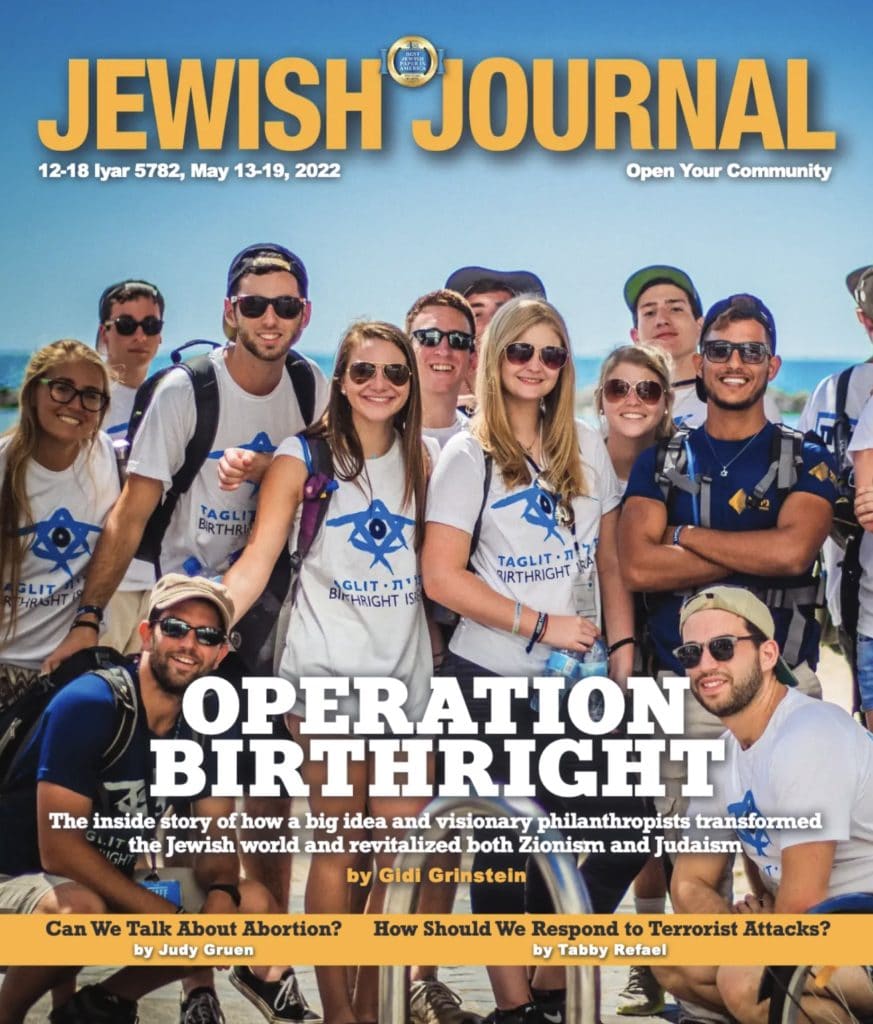
By 1993, the Jewish world needed to reinvent itself, as truths that had been in place for decades, generations and even centuries were suddenly rendered irrelevant.
Following the exodus of Soviet Jewry and the aliyah of Ethiopian Jews, oppressed Jewish communities hardly existed. Henceforth, all Jews living in the Diaspora would do so out of choice, and an entire generation of leaders, activists, philanthropists and institutions that came out of and thrived on the Let-My-People-Go campaign were now looking for a new cause to pursue. In addition, the Madrid Conference and the Oslo Process seemed to lead to a possible end to the Israeli-Arab conflict and to a secured existence for Israel. Against that backdrop, which compounded the concerns about growing assimilation and intermarriage, many sensed a dire need for a radical new idea that would serve the continued significant existence of World Jewry.
In that spirit, in 1994, an Israeli politician by the name of Dr. Yossi Beilin came up with a bold vision: Let’s bring every young Jew to Israel for a “free” visit that will be fully funded by the Jewish world. Beilin’s vision was game-changing on many levels. Management-wise, it meant multiplying the number of visitors to Israel 10-fold. Development-wise, it meant raising as much as two hundred million dollars per year. Ideologically, it challenged the prevailing Zionist outlook of the time, which saw aliyah as the sole purpose of coming to Israel, as well as the prevailing dogmas of market economy that frowned on freebies. Beilin’s idea, which would become Taglit Birthright Israel, was destined to be an uphill battle and was likely to never see the light of day.
Beilin’s vision was game-changing on many levels. Management-wise, it meant multiplying the number of visitors to Israel 10-fold. Development-wise, it meant raising as much as two hundred million dollars per year.
Indeed, the first five years were seemingly stagnant. A tremendous brainstorming and planning effort raised near-zero dollars, and sixty months into the effort not even a single bus had arrived in Israel. At that point, the journey could have been summarized as a frustrating muddle through.
But in 1998, Birthright saw a change of fortunes, when Charles Bronfman and Michael Steinhardt took interest in the idea and eventually each pledged eight million dollars to kick off the program in 1999-2000. For the following five years, twelve additional donors, including Edgar Bronfman z”l and Lynn Schusterman, pledged five million dollars each, which were matched by the Government of Israel to total an investment of roughly 140 million dollars. Thus, within a few months, Beilin’s idea was transformed from a vision into an emerging reality, which, over time, became a game-changing project for the entire Jewish people on a generational scale. That transition was made possible by that surgically calibrated venture-philanthropy intervention of Steinhardt and Bronfman.
In 1998, Birthright saw a change of fortunes, when Charles Bronfman and Michael Steinhardt took interest in the idea and eventually each pledged eight million dollars to kick off the program in 1999-2000.
Next week, twenty-four years later, the Gala dinner of Taglit Birthright Israel will celebrate Bronfman’s ninetieth birthday and honor his contribution, made possible by the professional leadership of Jeff Solomon, Yitz Greenberg and Barry Chazan. This article explores the secret sauce of Bronfman and Steinhardt’s singular philanthropic intervention.
The praises of Birthright are well-known. Birthright has directly affected close to eight hundred thousand participants, nearly 5% of the Jewish people, who are demonstrably more involved in Jewish life than those who did not go on the program. Birthright graduates are now assuming leadership positions in Jewish organizations, hailing their Israel-visit as a formative personal experience. Furthermore, Birthright inspired specialized trips that focus on specific populations such as students (Itrek), mothers (Momentum), and newlyweds (Honeymoon Israel), which bring thousands of participants per year, as well as multiple programs for longer stays, such as Masa. Also, an entire ecosystem of service providers emerged, including tour-operators, guides, hotels, caterers and bus companies whose contribution to Israel’s economy is estimated at billions of dollars.
Birthright has inspired the creation of an entire ecosystem of specialized trips that focus on specific populations such as students, mothers and newlyweds, as well as multiple programs for longer stays, such as Masa.
Drawing a direct line between Bronfman’s financial contribution to Birthright — which continued for many years and amounted to tens of millions of dollars —and the effects of Birthright would be simplistic, because the success of Birthright required “a village” of visionary, philanthropic, managerial and political contributions over more than a quarter of a century. Furthermore, the initial investment of Bronfman and Steinhardt and their fellow mega-funders in Birthright in 1999-2005 should be seen as a classic venture-philanthropy, while their later contributions, after establishing a proof-of-concept of the rationale of Birthright, should be viewed as a growth-capital philanthropy. The qualities of these two philanthropic investments are radically different. The latter makes Bronfman and Steinhardt two of many generous billionaire philanthropists, who leave a legacy of giving. The former inducts them into the “‘hall of fame”’ of Jewish philanthropy, crediting them with the vision to seed the Jewish world’s most consequential project of our time.
With these distinctions in mind, this essay focuses on Bronfman and Steinhardt’s venture philanthropy and seeks to explore the secret sauce of their success. This is not just a backward-facing analysis but also a forward-facing effort to highlight lessons that are relevant for contending with current challenges that face American and world Jewry today.
Birthright graduates are now assuming leadership positions in Jewish organizations, hailing their Israel-visit as a formative personal experience.
In September 1995, I was tapped by Beilin to build and lead the Israeli team that would eventually co-design Birthright. In late 1996, Avraham Infeld became the leader of our group, and in early 1997 we were teamed up with a McKinsey-based team, led by Laurie Blitzer. Together, we worked as volunteers until May 1999, which was roughly when Bronfman and Steinhardt’s venture-philanthropy pledge was matched by the Government of Israel and a full-time professional team, led by Dr. Shimshon Shoshani and Gidi Mark — who was Birthright’s first employee and rose to become its most remarkable professional leader — took over the project. It is from that particular vantage point that I humbly offer a few observations about the legacy of Bronfman and Steinhardt’s investment in Birthright, which can be summarized in three ideas: scalability, boldness and humility.
First, on Birthright’s scalability: Birthright was designed for scale since inception. Back in 1994, the number of visits of young adults to Israel was estimated at 10,000 per cohort. Beilin targeted 100,000 people per year — in other words, he envisioned ten-fold growth. Author and business expert Peter Diamandis explains this logic in simple terms: If you aim for 10 times and land at two times, you still did a great thing. Beilin wanted 10 times, and eventually got 5 times.
To actualize his vision, Beilin commissioned a team of veteran professionals to prepare a plan. Their report envisioned Birthright as a large tour company of sorts that would double the number of visits within a few years. Indeed, 100% growth can be very ambitious, but in this case it also implied that Beilin’s vision was unrealistic.
So, Beilin introduced a second team, which I led. While the “superpower” of Beilin’s first team was their knowledge of Jewish world, the superpower of our team was planning. We were blissfully ignorant about the organized Jewish world, and worked our way back from his vision, quickly setting the aspirational number of participants at 70,000 per year.
At that point, we immediately abandoned the structure of a “tour operator” and suggested that Birthright should be a “regulator” that facilitates the interaction among multiple program operators, on the one hand, and tens of thousands of participants, on the other. The basic unit of this project was to be a bus of participants, and its growth would be achieved by multiplying the number of buses. This meant that Bronfman co-made a “big bet” on a “big idea,” and also on an unprecedented organizational approach. Years later, Bill Gates would famously say: “Inspiration is retail. If you want to make a dent, you have to think wholesale.”
Yet, achieving scale requires time, and the founding mega-donors of Birthright gave it a five-year window to prove itself. In 1999, Birthright brought five buses, and by 2003 the annual number of participants of Birthright barely surpassed the average number of visitors to Israel in prior years. But these were misleading snapshots, because by 2003 Birthright was already growing in leaps and bounds, showing clear signs of exponentiality. As Diamandis teaches, in those years, Birthright was “deceptively small.”
Achieving scale also requires resources, and giant scale requires giant resources. We should all be grateful for the fact that Birthright’s founding funders were not deterred by that reality. Intuitively, they operated on the principle that “resources reveal themselves.” The logic is simple: A person who goes on a two-day walk should probably carry their own sustenance, but a one-month journey will require replenishing food and water along the way. Similarly, the ambitious social entrepreneur must believe that the value of their venture will then generate the resources that will allow its growth. Eventually, it was the incredible generosity of Dr. Miriam and Sheldon z”l Adelson that allowed Birthright to reach its full potential.
The ambitious social entrepreneur must believe that the value of their venture will then generate the resources that will allow its growth. Eventually, it was the incredible generosity of Dr. Miriam and Sheldon z”l Adelson that allowed Birthright to reach its full potential.
Furthermore, the concept of “Resources” should be understood to mean not just money but also new technologies that radically decrease costs and increase efficiency and effectiveness. In the late 1990s, Birthright was envisioned to rely on postal services; in the early 2000s it leveraged the rise of the internet; and as of 2008 it tapped into the smartphone and then the big data revolution. The rise of virtual reality and the expansion of the Metaverse are probably the new frontiers of this project.
The final point regarding Birthright scalability has to do with the fact that Bronfman and Steinhardt wisely re-launched the venture above the “line of super credibility.” Diamandis explains that all people intuitively react to every new idea. An idea that falls “under” the “line of credibility” is immediately dismissed, and if it falls above that line, it will be examined. Diamandis argues that an idea that is launched above the “line of super-credibility” triggers an immediate reaction of wanting to get involved.
Yes, by 1998-1999, Birthright had transcended the phase of a fantastic, unrealistic vision by having a plan that was developed by professionals and received feedback from hundreds of people over nearly five years. Furthermore, other programs of Israel-visits, such as the Israel Experience, which Bronfman had supported, indicated that Birthright could succeed.
But achieving the “super credibility” that enabled Birthright’s explosive growth required additional factors. They included the personal involvement of Bronfman and Steinhardt’s highly respected staff; the endorsement by a team of McKinsey consultants; Shoshani’s stature as a highly respected senior civil servant in Israel; validation of Birthright’s theory of impact by credible academic research; and the matching by the Government of Israel. With such a unique combination of attributes, Birthright was finally launched into orbit.
A second aspect of Birthright’s transformative impact was its multi-faceted boldness. Let’s begin with the ideological boldness of taking on century-old conventions of modern Zionism, which aspired to deplete world Jewry and bring all Jews to Israel. Hence, until Birthright, the goal of bringing Jews to Israel was Aliyah. In contrast, Birthright’s goal was to strengthen Diaspora communities and Jewish life outside of Israel through the visit to Israel. In the late 1990s this was a revolutionary and even subversive idea, which was met with harsh opposition and was sometimes referred to as “post-Zionist.” Indeed, the founding partnership of Birthright consisted of three iconoclasts: Bronfman, Steinhardt and Beilin—who were willing to take on established institutions, particularly the Jewish Agency.
Birthright founders were also bold in insisting on no-cost trips. Other philanthropists and experts relentlessly rejected that notion of “freemium,” which would degrade Birthright’s stature, subsidize well-to-do participants and simply save expenses for those who were willing to pay for their trips. Beilin’s counterpoint, endorsed by Bronfman and Steinhardt, was ideological: Visiting Israel was a right-by-birth for every Jew, granted by the Jewish people to its young adults. Furthermore, they argued that the gift of a Birthright trip represented a non-monetary exchange for a ten-day window of time spent in a program whose demanding terms were set by the organizers. The legend goes that at some point, Bronfman’s team said to the naysayers: “You can do your trips for money. We are doing Birthright for free.” The pathbreaking counter-intuitive notion of freemium — which later became commonplace — won.
The praises of Birthright are well-known. Birthright has directly affected close to eight hundred thousand participants, nearly 5% of the Jewish people, who are demonstrably more involved in Jewish life than those who did not go on the program.
The third major takeaway from Birthright’s legacy is humility. Yes, Birthright is a magnificent proof of Margaret Mead’s famous advice “to never doubt the ability of a small group of people to change the world, because it’s the only thing that ever does”, but it is also a proof of the cliche that a transformational project takes a village and a long time to be realized. Beilin and his close circle, my team and Avraham Infeld, the McKinsey team, Bronfman and Steinhardt and their teams, Birthright’s other mega-donors, Gidi Mark and Shimshon Shoshani — all were already named in this article. There were also Prime Ministers Netanyahu and Barak and civil servants in their governments ; nearly 17,000 additional donors and hundreds of Jewish communal leaders; as well as educators, tour operators and even the senior brass of the IDF. As crucial as many of these particular contributions were, in essence, Birthright has been a collective effort of the Jewish People. How beautiful is that?
In retrospect, it is not only the yesses that were crucial, but many of the nos were invaluable for crystallizing Birthright’s model. For example, while Beilin insisted on focusing on high school students, many rejected that idea and advocated for focusing on colleges. That debate and its resolution were crucial for Birthright’s success.
Eventually, by 1999-2000, a delicate balance was achieved. Birthright was still rejected by much of the existing established Jewish community that was vested in the status quo, but received a critical mass of endorsement and support from those who were seeking to create a new and better reality. In other words, at that point, Bronfman and Steinhardt had enough validation to make a big bet on Birthright, even if powerful objections persisted.
Furthermore, some issues simply could not be resolved. For example, what should be the duration of a formative trip? Longer trips were potentially more impactful, but also more expensive and meant that fewer people would go. Our team debated whether the trip should include one Shabbat, 10 days, two Shabbats, around 14 days, or five Shabbats, nearly six weeks. This debate could only be resolved through an experiment. Indeed, the format of 10 days proved to do the work. At the same time, as far back as 1998, our discussions highlighted the lack of pre-Birthright and post-Birthright programs and of a sustainable funding model. None of these issues was resolved when Birthright was launched in 1999. While the extreme success of Birthright is undeniable, it is also true that some of these “fires” continue to “burn” until today.
For the Israeli planning team, we also had our learning curve. For example, the original outline of the program included a four-hour interaction between the participants and Israelis. In our mind, that was sufficient for the Israeli side to “project” their inspiration unto the foreign participants. Years later, every Birthright bus includes 20 percent of Israelis who are part-and-parcel of Birthright, and are as affected by the experience as their world-Jewry friends.
Against this backdrop, what was the exact role of Bronfman and Steinhardt and their teams in the early phases of Birthright? Clearly, it went well beyond funding. Reid Hoffman, in his podcast, Masters of Scale, suggests a concept of Re-Founder, whose contribution to the success of the venture is as crucial as that of the founders. Under Beilin, Birthright was an incubating entrepreneurial, subversive and non-governmental initiative, which was led by a politician and volunteers in an intimate manner as if among family members. Bronfman and Steinhardt allowed the re-founding of Birthright as a professional government-backed venture that had direct access to power and global diplomatic reach.
The Gala dinner of Taglit Birthright Israel will celebrate Bronfman’s ninetieth birthday and honor his contribution, made possible by the professional leadership of Jeff Solomon, Yitz Greenberg and Barry Chazan.
Perhaps the ultimate moment of humility in the history of Birthright came from Beilin himself. It was early 1999, and Beilin had carried the mantle of Birthright for five years. At this point, Bronfman and Steinhardt had already pledged their support and Shoshani was now the director, ready and eager to engage the Government of Israel to receive the matching funds. Alas, there was one political problem: Netanyahu was the Prime Minister of a Likud-led government, and Beilin was a leader of the left and the ‘father’ of the Oslo Accords. So Beilin was faced with a touch choice: cling to Birthright and ensure his credit but also doom the project to remain small, or let go of Birthright and allow it to grow. Beilin’s advisors passionately argued both sides, with one faction begging him to hold on to what was rightfully his. He listened carefully and then concluded: “I have no immediate claim to fame” and took a step back, allowing Birthright to break through, free of any political friction.
Charles Bronfman Photo by Andrew Toth/Getty Images for Assouline Publishing
In retrospect, Birthright’s story has an aura of inevitability, but that is a fallacy. A number of critical turning points made the project possible such as when the original idea of Birthright as a ‘tour-operator’ was replaced with the current idea of Birthright as ‘regulator’ of ‘a platform’; when Infeld turned Birthright into a partnership between Israel and American Jewry; when the McKinsey team came into the picture; when Birthright shifted its focus from high school to colleges; and, most importantly, when the Government of Israel became a co-funder and partner of the project. Of course, surviving and transcending the Second Palestinian Uprising of 2000-2003 was no small feat. In hindsight, the entire path seems to be self-evident, with one step leading to another. The reality could not be further from the truth.
The legacy of Bronfman and his co-megadonors to Birthright isn’t just about “giving more” or “giving to Birthright.” Their legacy is about the art of big and smart bets on transformational projects. Bronfman’s generosity is evident to the naked eye, yet the secret sauce of his history-changing intervention requires nuanced observation of long-standing dynamics.
Birthright’s story should give us the confidence that the next big ideas of our communities are incubating among us, ready to be re-founded by their own Steinhardts and Bronfmans.
My primary take-away is that our community needs bold transformative ventures in order to reach new heights of wellbeing. Such ventures depend on a certain magic, which is created by the engagement among philanthropists and social entrepreneurs. In the crucial year of 1998-1999, Bronfman’s ripeness was met by Birthright’s ripeness to launch a project that years later would prove transformational for the entire Jewish world. Birthright’s story should give us the confidence that the next big ideas of our communities are incubating among us, ready to be re-founded by their own Steinhardts and Bronfmans.
Gidi Grinstein is the Founder and President of the Reut Institute, a leading Israeli think tank. Gidi also leads Tikkun Olam Makers, an Israeli-turned-global humanitarian venture. From 1995-1999 Gidi led the Israeli team that designed Birthright. Gidi is the author of “Flexigidity: The Secret of Jewish Adaptability.”
When the Nazis annexed Austria in 1938, George Kolber’s Viennese Jewish grandparents, Josef and Eva Kolber, knew they had to leave Europe. Where they went, however, was a bit unusual.
The two left Austria for Shanghai. Kolber’s grandmother took a land route using the Trans-Siberian Railroad while his grandfather traveled by sea. Eva’s predisposition for seasickness was likely the reason she chose to go the long distance by land, Kolber said, during an April 22 lecture at the Holocaust Museum Los Angeles.
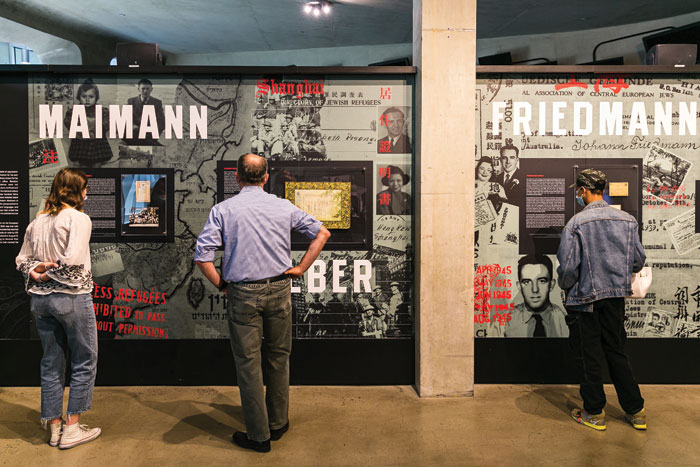
Kolber spoke at the museum in advance of the opening of its new exhibition, “Hidden History: Recounting the Shanghai Jewish Story.”
The Kolbers’ journey is one of five family stories highlighted in the exhibit, which opened April 24 and runs through mid-August. The exhibit spotlights the more than 20,000 stateless Jews that fled Europe for Shanghai, China between 1933 and 1941 while focusing on the stories of the Medavoy, Maimann, Kolber, Friedmann and Millett families.
On display are family artifacts, including postcards from concentration camps, a ketubah written in Chinese and a tallit embroidered with both the Magen David and a wreath of plum blossoms, which are symbolic of resilience and perseverance in Chinese culture.
On display are family artifacts, including postcards from concentration camps, a ketubah written in Chinese and a tallit embroidered with both the Magen David and a wreath of plum blossoms, which are symbolic of resilience and perseverance in Chinese culture.
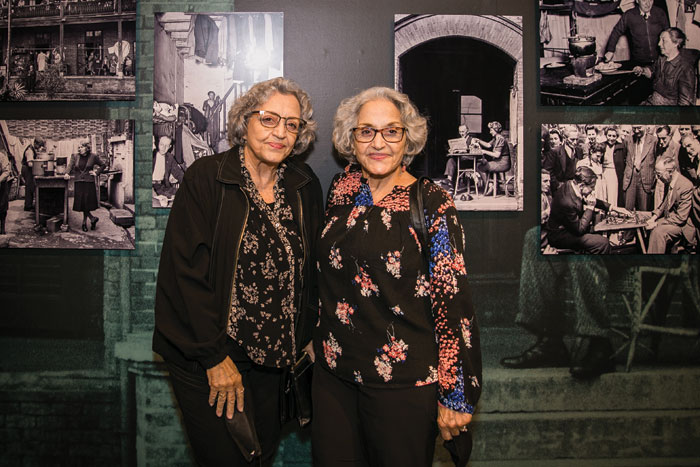
Twin sisters Monika White (left) and Gitta Morris, who were born in Shanghai during the war. Photo by Tamara Leigh Photography
Also featured is a blue yarmulke on loan from the Skirball Cultural Center – the Chinese believe blue represents advancement and immortality – as well as photographs of the Shanghai Jewish community taken by celebrated photojournalist Arthur Rothstein. In 1946, the United Nations Relief and Rehabilitation Administration assigned Rothstein with documenting the lives of displaced Holocaust survivors in the Hongkew ghetto in Shanghai.
The exhibition was originally supposed to open in 2020 but COVID-19 forced its postponement. Ultimately, the timing of the exhibit opening was fortuitous, because the story of European-Jewish refugees fleeing for their lives was particularly relevant given current events in Ukraine, Jordanna Gessler, vice president of education and exhibits at Holocaust Museum LA, said.
In the 1930s, Shanghai became an unexpected refuge for German and Austrian Jews because, until 1939, no visas were required for entering Shanghai. When the Japanese occupied Shanghai, in 1941, they forced the Jews there into Hongkew, a district of Shanghai. The area became known as the “Shanghai Ghetto.”
Still, while life for Jews in Shanghai was hard, those Jews who fled to Shanghai fared better than those who remained behind in Europe, Kolber said. In fact, the majority of Jews in Shanghai survived the Holocaust. While the Jewish population in Shanghai peaked around 20,000, today there are about 2,000 Jews remaining in Shanghai.
Prior to the Holocaust, a small population of Jews already lived in Shanghai, including 1,000 Sephardic Jews who arrived from Iraq in the mid-1800s.
The Jewish refugees who fled Europe for China during the Holocaust were not the first Jews in Shanghai. Prior to the Holocaust, a small population of Jews already lived in Shanghai, including 1,000 Sephardic Jews who arrived from Iraq in the mid-1800s as well as a few thousand Ashkenazi Jews who had fled the pogroms of Russia.
The family of Michael Medavoy was among those in Shanghai before the war. Born in Shanghai in 1941, Medavoy went on to become a successful Hollywood film producer. He took part in the April 24 panel marking the opening of the exhibition, along with Congressman Adam Schiff and Ted Lieu.
On April 22, the museum held an exhibition preview for museum board members and family whose artifacts were in it. In attendance were 82-year-old Monika White and her twin sister, Gitta Morris. Child survivors of the Holocaust, their parents fled to China from Germany in 1938, traveling to Shanghai by ship from Berlin. The family lived in Hongkew, sharing a one-room apartment with four families.
“We remember being hungry,” White said. “We remember being scared.”
The twin sisters remained in the Chinese city until they were eight-years-old, then came with their father to the United States with the help of the American Jewish Joint Distribution Committee. The family settled in Minneapolis, where there was a school for the girls, a job for their father and a house for the family.
For the twins, seeing the story of Shanghai’s Jewish refugees told in the exhibition was gratifying if for no other reason that people generally are not aware about Jews escaping to Shanghai during the war.
“Most of the Holocaust stories are about Europe and concentration camps,” White said. “Ours is a little bit different.”



 Los Angeles poet Rick Lupert created the