fbpx

February 17, 2022

By Lumping People Into Two Camps, the Anti-Racism Movement is Erasing Human Identities

The problem with the “anti-racism” movement sweeping the country is not that it tries to combat a social plague. Rather, the problem is that it lumps complex human beings into two categories, and, in the process, erases an essential component of the human condition—our cherished identities.

Here’s my theory for why this is happening: anti-racism has become, as much as anything, an anti-white movement. Railing against “white privilege” and “white supremacy” is a driving force of the movement, which has resulted in a simplified binary system—you’re either in the white camp or you’re not. Anything “in between” would just complicate the movement.

There is an activist logic to this dynamic—revolutions work best when there is a singular, powerful target. Because whites were the original slaveowners and founders of this country, and still hold enormous power, they make an ideal target. Fairly or not, all whites are now guilty by association. A poor white person in the Midwest is in the same camp as a wealthy white person on the Upper East Side.

But if there’s an activist logic to this framing, there’s also a high societal cost.

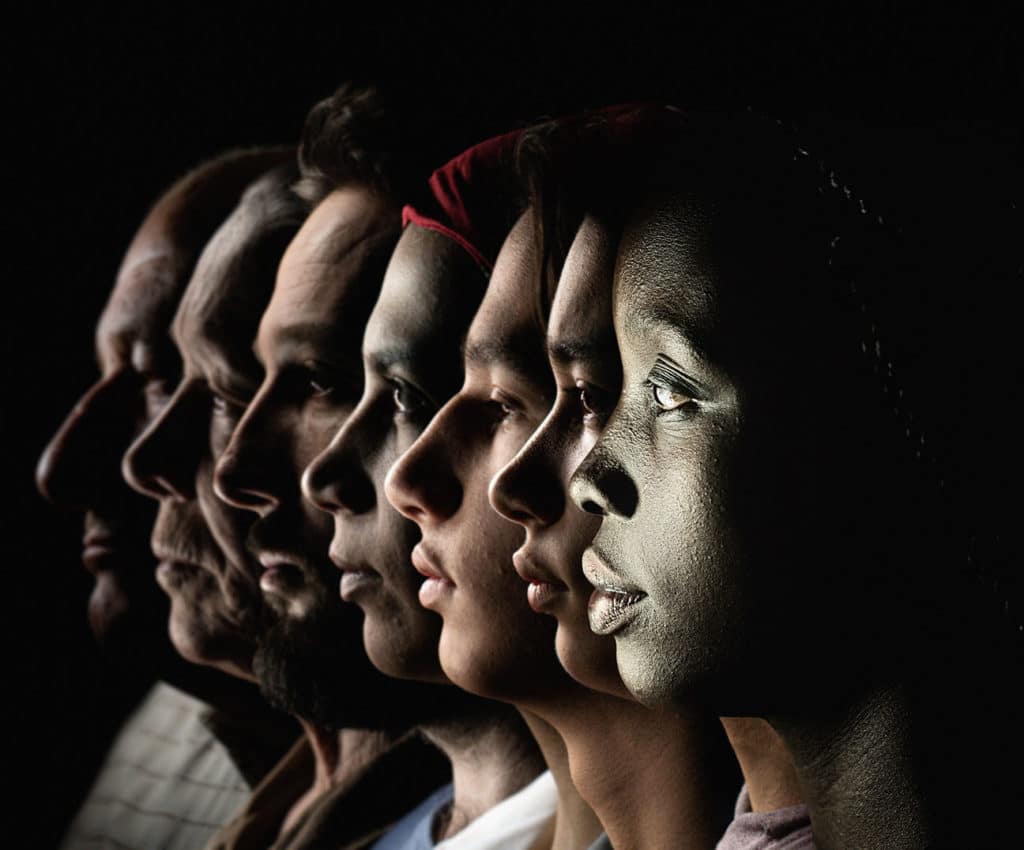
The first obvious cost is that it erases the rich kaleidoscope of ethnic identities. “Whites” come in all different hues and classes and national origins. Because I was born in Morocco, I’m a Sephardic “white Jew” with an olive complexion who some consider a “Jew of color.” I don’t fit neatly into any color category.

Similarly, how can we lump the multitude of ethnicities and nationalities that have landed on our shores over the past 150 years—Germans, Russians, Italians, Irish, and so on—into one category? The same goes for people with Hispanic origins– from Puerto Rico to Mexico to Guatemala to countless others– as well as the incredibly diverse Asian and Middle Eastern populations: How can we lump any of them into one category, whatever the category?

The point is, there are hundreds of identities and sub-identities throughout America that people are attached to. When Whoopi Goldberg described the murder of six million Jews as “whites killing whites,” it wasn’t just her ignorance of Holocaust history that offended me. It was also that she was erasing my Jewish identity. For me and many other Jews, that Jewish identity is a deep source of meaning and collective pride.

When Whoopi Goldberg described the murder of six million Jews as “whites killing whites,” it wasn’t just her ignorance of Holocaust history that offended me. It was also that she was erasing my Jewish identity.

Just like 330 million other Americans, I’m a lot more than a skin color who falls into one of two camps.

This is why the anti-white movement goes against American ideals. When immigrants landed in this country, regardless of their skin complexion, they kept their identities but added an American hyphen. There was profound satisfaction in becoming Italian-American or Jewish-American or Arab-American. Immigrants were honoring a fabled melting pot that simultaneously embraced their numerous identities.

But the highest cost, perhaps, of an anti-white movement is that it’s also anti-human. When you teach kids in school that a key part of their self-definition is their skin color, you are effectively diminishing their uniqueness as human beings.

I can’t think of anything more dehumanizing and less empowering than being defined by something I can’t change, like skin color. Teaching kids that whites fall in the “oppressor” camp and Blacks in the “victim” camp doesn’t give them valuable knowledge or tools for life. Rather, it triggers their emotions and undermines their ability to think for themselves.

When you define people by something as immutable as skin color, you shrink them. Instead of offering hope and nourishing identities, you offer a false choice of two opposing camps.

Further, accusing anyone who challenges this paradigm of being “racist” is a form of bullying that silences dissent and leads to self-censorship. It’s hard to see how this helps combat racism.

The great irony is that instead of reducing racism, one can fairly argue that the anti-racism movement is actually increasing racism by building silent resentment. When you define people by something as immutable as skin color, you shrink them. Instead of offering hope and nourishing identities, you offer a false choice of two opposing camps. Eventually, all camps come to resent that.

It’s clear that we must combat racism. I’m just not sure that lumping hundreds of identities into two categories will do the trick. We give justice a better chance when we elevate identities, not erase them.

By Lumping People Into Two Camps, the Anti-Racism Movement is Erasing Human Identities Read More »

God’s Face – A poem for Parsha Ki Tisa

You will not be able to see My face, for man shall not see Me and live.
-Exodus 33:20

What is it about God’s face
that would end it all for us
if we saw it?

And, whatever it is
has it stopped anyone
from looking?

I’ll tell you where I see It.
There is the obvious –
the faces of children

and kittens, of course,
which I only mention to
improve the metrics.

How about the rain
or, the lack of rain
if that’s your thing?

There’s a new flavor of
ice cream with pancakes in it.
I’m pretty sure God is in there.

Or at least on the face
of someone eating it.
(I may never know,

they don’t deliver it to my house.)
God’s face may be in my
Amazon deliveries.

I still remember when
getting a package was like a
treasure arriving at my house.

God’s face is in poetry.
Look at the spaces between
these lines. Do you see It?

God’s face is in the lines or
this poem that you write when
you’re finished reading mine.

Go on now.


God Wrestler: a poem for every Torah Portion by Rick LupertLos Angeles poet Rick Lupert created the Poetry Super Highway (an online publication and resource for poets), and hosted the Cobalt Cafe weekly poetry reading for almost 21 years. He’s authored 25 collections of poetry, including “God Wrestler: A Poem for Every Torah Portion“, “I’m a Jew, Are You” (Jewish themed poems) and “Feeding Holy Cats” (Poetry written while a staff member on the first Birthright Israel trip), and most recently “The Tokyo-Van Nuys Express” (Poems written in Japan – Ain’t Got No Press, August 2020) and edited the anthologies “Ekphrastia Gone Wild”, “A Poet’s Haggadah”, and “The Night Goes on All Night.” He writes the daily web comic “Cat and Banana” with fellow Los Angeles poet Brendan Constantine. He’s widely published and reads his poetry wherever they let him.

God’s Face – A poem for Parsha Ki Tisa Read More »

A British Israeli Composer Creates Music for the Queen

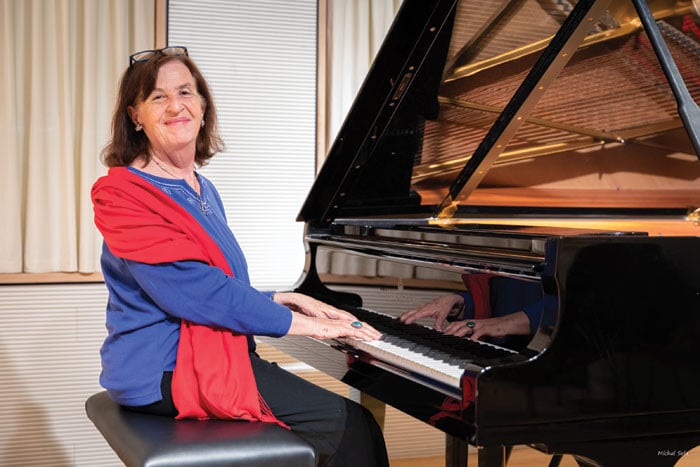
How does a Jewish British immigrant to Israel, Loretta Kay Feld, come to be the composer of music being played in honor of the Platinum Jubilee of Queen Elizabeth II?

Her latest compositions have gained attention throughout the world. One work is a deeply moving personal song called “The Queen’s Soliloquy”; the other is “70 Years a Queen,” a majestic piece which is music over film clips and photographs that span the Queen’s 70-year reign. There is a third tribute song that will be premiered at the Platinum Jubilee; they are preparing the video now.

“I’m beyond thrilled, I’m delighted, I’m ecstatic, I gave it my very, very best,” says Kay Feld.

How did it all begin?

Kay Feld was born in Stoke Newington, a “very Jewish area in London,” she says. She attended Avigdor Jewish Grammar School, studied voice, and later, she continued to train in music composition and drama at The Royal College and Guildhall School of Music.  She toured with plays and musicals in The West End of London and has published several books. Kay Feld is also the founder of The Chimes Organization which creates harmony in a multi ethnic society.

Kay Feld has written about herself that she was entranced by Mozart’s 40th Symphony in G minor that she heard in a store, and didn’t leave till the store closed. She was given a few of Shakespeare’s sonnets to learn and returned to school, having set them to music. She studied Russian ballet, and stuck with it “though it tortured my feet” just so she could listen to Tchaikovsky’s music. Verdi’s music also haunted her and she would sneak into the Royal Festival Hall during intermission until a kindly usher began saving her a seat. She continued to follow her dream of studying and writing music and songs, and one of her greatest supporters was her deaf mother, to whom she described her work.

Kay Feld went on to become a prolific, award-winning composer, lyricist and author.

And Israel?

“I wanted to come here [Israel] since I was a child in Hebrew school but life has a way of changing your plans.”

“I wanted to come here since I was a child in Hebrew school but life has a way of changing your plans. I got married and lived in America on Long Island. I used to give concerts all over Long Island and New York, from 1973 into the ‘80s; then I wrote for a children’s television network and composed all kinds of music — for ballet, classical music, country songs, many kinds of genre.” Kay Feld says she’s written about 900 songs and musical compositions. She composed “A Symphony of Synchronicity” for Uri Geller, which is on permanent display at his museum in Jaffa, Israel. She used to sing her works. “My voice has gone from soprano to alto. I now need a microphone when I used to smash lights,” she says with a smile.

She wrote a song, “Hymn for Israel,” which is on YouTube, that was sung by Cantor Stephen Stein of New York and was performed in a synagogue in Raanana the first time. “Thousands of people have seen it. I wrote it after the Yom Kippur War [in 1973] and I received letters from Moshe Dayan and Menachem Begin thanking me. The ’Shabbat Song’ I wrote is also on YouTube and is sung in communities all over the world.”

“’I’m Going to Keep America Singing’” she says, one of her favorites, “was performed at the inaugurations of Presidents Obama and Biden, played by the Marine band. I received a beautiful letter from President Obama about it. And here I sit, next to my piano.”

Eleven years ago, after traveling back and forth, her dream came true and she made aliya to Israel, to Raanana.

And then this other dream came true.

Kay Feld has always loved and been enamored by the British royal family. When she was nineteen, she performed for the Royal Family at the Variety Club for Great Britain at Victoria Palace and, after the show, was escorted to the box where the royals were seated. She remembers speaking with Princess Margaret and shaking hands with Queen Elizabeth II.

Will she be meeting the queen again?

“I would love to. I hope she stays well enough so I can meet her. The Queen has dedicated her life — 70 years – of service to her people and to the Commonwealth; it’s unbelievable.”

Kay Feld says her works were commissioned by one of the other royals, who prefers to remain anonymous.

The opening lyrics of the Soliloquy:

“You may ask me what I’m thinking on my Platinum Jubilee

And of all these celebrations, what they really mean to me

Well, my mind keeps drifting backwards, to a life yet unforeseen

Trembling at my coronation, unprepared to become a queen.”

Kay Feld says that the number 70 is written in the Bible. “God created the world in seven days, this is ten times that, and if we can make it to threescore and ten, we’re considered by Judaism to be filled with wisdom, and the Queen is definitely filled with wisdom. They say the Queen learned five languages when she was young, and one of them was Hebrew.”

She points out that Prince Phillip came to Israel to visit the grave of his mother, Princess Alice, who was recognized as a Righteous Gentile by Yad Vashem for hiding Jews in Greece during the Shoah, and that Prince Charles and Prince William have also visited Israel.

She points out that Prince Phillip came to Israel to visit the grave of his mother, Princess Alice, who was recognized as a Righteous Gentile by Yad Vashem for hiding Jews in Greece during the Shoah, and that Prince Charles and Prince William have also visited Israel.

Kay Feld says she was offered a singer from the Royal National Opera House for “The Queen’s Soliloquy” but she chose instead a Jerusalem woman, Shlomit Leah Kovalski, a classical and contemporary singer who has performed in concerts, and who is also a well-known actress on the Jerusalem theater scene. Kovalski is currently in her final year of MA studies at the Jerusalem Academy of Music and Dance as a classical vocal performance student and is completing a semester in Würzburg, Germany where she studied in their Hochschule Für Musik school.

Kay Feld says, “I have a studio I work with in Jerusalem — SoundSuite — they do post production of my music. They are a wonderful team. I was approached by the Royal National Opera House to do it there but I wanted someone to do it in Israel. And I loved working with Shlomit. She’s so modest. I wanted to give an opportunity to someone here and she did such a beautiful, perfect job.”

Kay Feld has a daughter, Dorothy Eisdorfer, a choreographer and dancer, and “I have two very musical grandsons.” She also has three children living in Los Angeles. Her son David James is a magician and filmmaker, son Adam Weinberger is a rare book dealer and her daughter, Claire Weinberger, is an artist.

I mention to Kay Feld that for someone whose music has been performed for presidents and queens, her humility is admirable. She replied, “I just believe everyone has a gift and if one can use the gift to make the world a better place, that’s what matters.”

The Creative Process

“I do not compose at a piano; I compose when I’m out walking along the sea, or in nature, and I think about what I’m composing and usually it just comes to me as if from the air, that’s the only way I can explain it, I write all the music in my head and the lyrics usually come at the same time and if they’re worth keeping I go home and write out the manuscript.”

As a lyricist, I mentioned to her that I sometimes feel songs come not from me, but “through me.”

She said, “That’s exactly it, as if someone else is writing them. You can’t explain it to other people unless they’ve experienced it.”

Some compositions she does “just because I love them,” but usually she is approached and asked to compose for a specific project, for example, she has worked on documentaries.

A New Victorian Musical

Kay Feld is especially excited about a new project she has been working on for a number of years called “Upstairs Downstairs 1897, the Musical.” It’s about Victorian England. There are 26 original songs and the choreography is by her daughter Dorothy.

“The story is about the degrading things they did, in Victorian times, but I want to tell the story with dignity. It expresses the desires of two women, one in the lower and one in the higher class. It’s filled with memorable songs. We put it on in Raanana a year and a half ago, as a concert, to an audience filled with Anglos, but Israelis also came and people were amazed; they didn’t want to leave the show and they all went out singing the songs.

“I was working on it with professionals from the Israel Opera before COVID happened. I’ve written the book, the lyrics and the music and now I’m going to go forth and put it all together because this is what Israel needs right now. My plan is to hire and to showcase all the wonderful talent we have here in Israel; there is enormous talent. Israelis suffered so much during COVID, I want to give all Israelis a lot more work now — an all Israeli cast, musicians, etc. What I’d like to do is find enough sponsorship and funding so I can pay all the performers fairly. I am 100% committed to doing it, and to filming and live-streaming it globally for all the world to see, so the world can know what talent Israel has. It will be a most splendid performance. This will be just glorious, about what Israel can produce.”

The Queen’s Singer

Shlomit Leah Kovalski, who sings “The Queen’s Soliloquy” so enchantingly, was born in Jerusalem to parents who made aliya – her father from Montreal and her mother from New York. She responded to a Facebook post by Loretta’s daughter, Dorothy, that they were looking for people for a preliminary reading for the “Upstairs Downstairs 1897” musical, that they were preparing to do in concert.  “I sent my material to Dorothy and they liked me,” says Kovalski, who also sang in the Raanana concert.  “And then, about half a year ago, Loretta said, ‘I’m sending you a song that I was asked to do as a commission to the Queen of England. Would you like to sing it?’ And I said, ‘Sure!’”

Shlomit sang in a choir in elementary school but seeing a teen performance of ‘Cinderella’ was the life-changer for her. “I was very socially awkward and was very shy and never wanted to show myself and that was the first time I thought, ‘This is what I want to do.’” A few years later she performed on stage. “It was a musical, and I remember the spark of pride in my father’s eyes.

“I love musical theater and opera, for the drama, the storytelling. I always love being a character in an opera or a play; I love the collaboration and ensemble work and working with everyone involved in theater – the backstage people, being involved in the creative thinking, and how we can work as a team.

“I love all of Loretta’s visions, and I’m so excited to see this new project happening. She is such an amazing person to learn from; she can actually help you make your dreams come true.”

How does she feel about all the attention she’s getting now “The Queen’s Soliloquy”?

“I’m very humbled and so honored by the opportunity and I’m so appreciative of all the support. A lot of people are so excited that Israel can be involved in something big like this. I feel blessed to have taken part in it. I thank God that He introduced me to Loretta and I hope I’ll be able to take part in her other amazing productions.”

Anyone familiar with Israel’s difficult history with the British, leading up to the War for Independence, a number of years before the current queen ascended to the throne, has to be touched by the fact that the music for her Platinum Jubilee has been composed – and her soliloquy is sung – by two Jewish Zionist Israelis living free in the State of Israel.

Post-production of Kay Feld’s compositions for the Queen were done by Jamie Clarkston Collins and Eli Schurder of the SoundSuiteMusic Studio in Jerusalem. The films are directed and edited by Jason Figgis.

Google “The Queen’s Soliloquy” and “70 Years A Queen.”

And kvell.

Anyone interested in supporting “Upstairs Downstairs 1897” can write to Loretta at: lorettakayfeld@gmail.com.


Toby Klein Greenwald is an award-winning journalist, artistic director of Raise Your Spirits Theatre and editor-in-chief of WholeFamily.com.

A British Israeli Composer Creates Music for the Queen Read More »

A Bisl Torah – The Courage to Build

Why would Moses keep the broken tablets?

If you remember the story of the Golden Calf, Moses is enraged when he comes down Mount Sinai and sees the children of Israel worshipping an idol. Celebrating, singing, and dancing, seemingly forgetting their connection to Moses, and denying their loyalty to God. In response, Moses reacts. He hurls the first set of tablets and watches them shatter, divine words now rubble. Nothing but broken shards.

In an act of mercy, God offers the people a second set of tablets. Whole, untarnished, complete. And yet, the Torah explains that as Bnai Yisrael marches through the desert, the Ark travels first. An Ark holding both tablets: the broken with the whole.

Rabbi Harold Kushner cites a midrash in which Moses sees the Israelites dancing with the Golden Calf and shockingly, God’s letters fly off the tablets. Moses wrongly perceives he no longer has anything to offer. He smashes the tablets in response to what seems like a hopeless situation. Says Kushner, “When there is a purpose to what you are doing, you can do things which are too hard for you.” But likewise, when you sense despair, it is hard to see past the immediacy of the moment. And Kushner reminds us, “When you are standing very close to a large object, all you can see is the object. Only by stepping back from it can you also see the rest of its setting around it.”

In other words, Brokenness is what we feel. But the Torah begs us to zoom outward. Brokenness is not who we are.

The traveling tablets urge us to look past the immediacy of a moment. We all go through periods of angst. Personally, professionally, communally. The Ark held both the broken and the whole as fervent reminders of the human spirit: troublesome moments are inevitable. They cannot be ignored. But determiners of Jewish history were brave enough to know that moments pass. Jewish spirit and continuity thrive when we are cognizant of a greater communal purpose: to let Torah guide our steps, reminding us to be God’s messengers of goodness.

Brokenness is what we may feel.  But builders and beacons of light—that is who we are.

Shabbat Shalom


Rabbi Nicole Guzik is a rabbi at Sinai Temple. She can be reached at her Facebook page at Rabbi Nicole Guzik. For more writings, visit Rabbi Guzik’s blog section from Sinai Temple’s website.

A Bisl Torah – The Courage to Build Read More »

A Moment in Time: Conversations with Dad, of Blessed Memory

Dear all,

This week my family commemorated my father’s first yahrzeit (anniversary of death). We gathered at the cemetery and supported one another, having experienced a “year of firsts.”

Over the year, I’ve had many conversations with my father. I’ve asked questions about child-raising, investing, and leadership. I tell him about his grandchildren, about Temple Akiba, and about the latest aviation news. I let him know that we are surrounding mom with love.

And Dad always guides me with the same advice at the end of our conversations: “Everything is easy if you have the right tool.”

(Finding the right tool, however, is often pretty hard!)

If you ever wonder what your loved ones who have died are sharing with you, just stop – for a moment in time – and listen. Their voices are calling to you, just waiting to have a conversation.

With love and Shalom,

Rabbi Zach Shapiro

A Moment in Time: Conversations with Dad, of Blessed Memory Read More »

“As We See It” Shines a Light on Inclusion and Belonging

“As We See It,” the Amazon Prime series that debuted on January 21, is a vivid statement of what’s possible when you create art in an inclusive atmosphere. Rick Glassman, Sue Ann Pien and Albert Rutecki play 20-something roommates on the autism spectrum who are trying to find their independence and their place in the world. Neurodiverse actors play the show’s leads; plus, there are neurodiverse supporting actors, background players and production assistants.

“The show seriously personifies what [February’s] Jewish Disability Awareness, Acceptance and Inclusion Month (JDAAIM) is all about,” Elaine Hall, the show’s access coordinator and on-set advocate, told the Journal. “One of the greatest mitzvahs you can do is give someone a job. And 80% of people on the spectrum are unemployed or they’re underemployed. So let’s not only give them a job. Let’s show the world what’s possible.” 

A pioneer in creating neurodiverse experiences and opportunities, Hall is the founder and artistic director of The Miracle Project, a fully inclusive theater, film, social skills and expressive arts programs for individuals with autism and all abilities. Many of The Miracle Project’s participants appear on “As We See It.”

Years ago, Hall realized she could communicate with her non-speaking autistic son through creative play. The Miracle Project, among other books and projects, grew out of those efforts. She has worked with TV and film writers, directors, actors and production companies to help assure their content authentically portrays individuals of all abilities and disabilities. “As We See It” brings next-level awareness and inclusion of people of all abilities.

“Let’s not only give them a job. Let’s show the world what’s possible.” – Elaine Hall

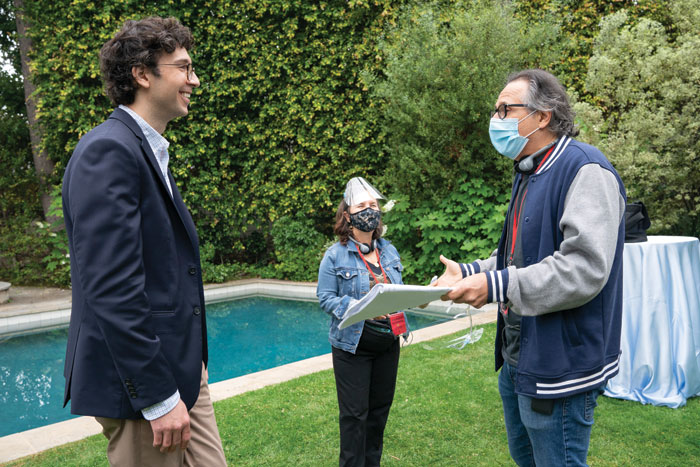
In the summer of 2019, “As We See It” creator Jason Katims, perhaps best known for “Friday Night Lights” and “Parenthood,” called Hall to see if she’d like to be their on-set advocate. They filmed the pilot that fall. It was very well-received, and the show was greenlit in early 2020. Then, after a COVID-forced break, they got the go-ahead to proceed in early 2021.

“I just really got to be myself and use all the same principles that I’ve created for The Miracle Project, which is creating a loving, nurturing, supportive environment,” Hall, who identifies as neurodiverse for her sensory sensitivities and different way of thinking, said. “What we focus on is the ability within the seemingly disability of being on the spectrum, looking at what a person can do, rather than what they can’t do.”

At first, there was a question about whether neurodiverse individuals would be okay on set all day. Would there be tantrums? Would they be hard to work with? Hall said the opposite is true. The real world is the challenge.

“Being on a set is our happy place,” she said. “Everything makes sense. Everybody has a role. We know what is expected of them. It’s a very predictable environment. And also, it’s a place where we get to really be creative and be ourselves and use our strengths.” 

But it’s even more than that. Hall said she and the creator of JDAAIM, Shelly Christensen, have changed from using the term “inclusion” to “belonging.”

“It’s not about being included in something,” she said. “I don’t want to be included in my synagogue, I want to belong to my synagogue. One of the most important things that we, as Jewish creators, innovators and employers, need to start remembering is that we all have an essential need to belong. The show really brings all of this to the forefront.”

Hall has nothing but praise for the team behind and in front of the camera.

“[Sue Ann, Rick and Albert] brought their authentic selves to the material,” Hall said. “And the material was so brilliantly written that [it] allowed them to effortlessly draw on their own past experiences and bring it to the roles.”

Hall lives in Santa Monica with her husband, Jeff Frymer. Her son, Neal Katz, lives independently with support and uses his iPad as a communication device. Hall and Katz have presented on neurodiversity multiple times to the United Nations.

“My dream is to change the way the world perceives ability and disability,” Hall said. “My driving force is to make this world a place where my son, all my students and all the actors I meet [can thrive].”

She continued, “If ‘As We See It’ can open doors to more appreciation, acceptance and curiosity, then we [have] really done our job.”

“As We See It” Shines a Light on Inclusion and Belonging Read More »

The Idolatry of Permanence

Like physicists in search of a unified field theory, the sages of old sought the Torah’s great unifying principle—that which encompasses and undergirds all of God’s teachings to the Jewish people. 

Rabbi Akiva proposed: “And you shall love your fellow man as yourself.”  (Leviticus 19:18)

Ben Azzai offered: “This is the book of the lineage of Adam.” (Genesis 5:1).

For both of these sages, the Torah’s unifying principle is love. For Rabbi Akiva, this is expressed explicitly in a divine commandment. For Ben Azzai, it is implied by the fact that we are all one human family, descendents of a shared ancestor, Adam. (Bereishit Rabbah 24:7).

Rabbi Ishmael, however, saw things differently. For him, the great principle of the Torah was the prohibition against idolatry. (Mekhilta de-Rabbi Ishmael 12:6)

There is something undeniably charming about Rabbi Akiva and Ben Azzai’s answers. That everything boils down to love is a pleasing idea. That said, it is a bit of a stretch. It’s not that the Torah is unconcerned with love. It isn’t. But it is hugely concerned with other matters as well—matters which, on the face of things, have no plausible connection to either Rabbi Akiva or Ben Azzai’s great principles. 

And so, Rabbi Ishmael’s great principle, despite its lack of pith or pathos, calls out to us for reexamination.

In Hebrew, idolatry is known as “avodah zarah” which means “strange worship.” One might also say, “estranged worship.” As with the charge of “estrangement of affection” in a divorce proceeding, the implication is that the idolator’s chief sin is comparable to the infidelity of a lover. 

In the words of scholar Moshe Halbertal, however, the Torah’s “prohibition against idolatry entails not only a ban on the worship of other gods but also a ban on certain ways of representing the right God,” i.e. with graven images.

Avodah zarah thus refers to two opposite sins. The first is the sin of taking a finite object and treating it as though it were the Infinite. The second is the sin of taking the Infinite and treating “it” as though it were finite.

Avodah zarah thus refers to two opposite sins. The first is the sin of taking a finite object and treating it as though it were the Infinite. The second is the sin of taking the Infinite and treating “it” as though it were finite.

Idolaters of the first variety are those who take the vain achievements of wealth, fame, and beauty—and make them into gods. 

Idolaters of the second variety take the infinite—God, religion, Torah—and make “things.” God becomes a star to be wished on or a weapon with which to bash others. Torah becomes a petty rule book. Religion becomes a social club. 

In the Torah, both idolatries are deeply connected to the practice of making images—hardened statues of stone or metal that are worshipped as deities, or else graven images that reduce God to god.

For the Torah, a polemic against statues and graven images is in truth a discourse about perception. To see the world rightly is to see that it is a living being. At every corner, it defies understanding and categorization. It is, in the words of mystic philosopher Martin Buber, an infinitely deep “Thou,” rather than an “it.” 

The world of idols is a world of illusion. In Hinduism, this concept is known as “maya.” Maya is the dazzling magic show that conceals the true, deeper nature of the universe. 

According to philosopher Alan Watts, the word “maya,” shares an etymology with the word “matter.” This is to say that the world of matter, of hardened forms, is in some way what we are talking about when we discuss “maya,” the world of illusion. 

This is not to say, as some religious teachers have it, that the material world is somehow less valuable or real than some imagined spiritual realm. The material world is deeply real. That said, we are deeply confused about its true nature. We like to imagine that the universe is a collection of discrete things—a space cluttered with junk. We imagine the world as a hardened place, when it is, in truth, ever changing—better represented by the flickering flame and the melting candle than the golden candelabra. 

“Maya,” then, is the delusion of permanence in a universe of impermanence. It is the delusion of essentialism in a universe of flux. Similarly, idolatry is the sin of taking this vast, shifting, electric, unnamable reality and casting it as a graven image.

In the book of Psalms, it is written of idols that “a mouth they have but they do not speak, eyes they have but they do not see. Ears…but they do not hear… hands… but they don’t not feel.” The Psalmist warns us, “those who make them” and “all who trust in them” will become “like them.” (115:5-8).

To worship a statue is thus to become a statue—to harden and be limited, to be insensate to the world in its fullness. This is the grave danger of the graven image.

To worship a statue is thus to become a statue—to harden and be limited, to be insensate to the world in its fullness. This is the grave danger of the graven image.

Mythologist Joseph Campbell famously said that what people are seeking is not the “meaning of life” but rather “an experience of being alive.” To the person who has become a statue, it is this experience that is lost.

Trapped by cosmic illusion—by maya and matter—our senses turn to stone. In this state, what use can Rabbi Akiva and Ben Azzai’s great principles be to us? What we need is Rabbi Ishmael to drag us from our statues and set fire to our idol trees. 

He is here to remind us that the Torah did not descend from heaven in order to inspire us with lovely words but rather to save us from spending our whole lives entranced by stone images as our eyes become dull.


Matthew Schultz is the author of the essay collection “What Came Before” (2020). He is a rabbinical student at Hebrew College in Newton, Massachusetts.

The Idolatry of Permanence Read More »

Table for Five: Ki Tisa

One verse, five voices. Edited by Salvador Litvak, the Accidental Talmudist

Remember Abraham, Isaac, and Israel, Your servants, to whom You swore by Your very Self, and to whom You said: ‘I will multiply your seed like the stars of the heavens, and all this land which I said that I would give to your seed, they shall keep it as their possession forever.’ ” The Lord [then] reconsidered the evil He had said He would do to His people.

-Ex. 32:13-14


Dr. Sheila Tuller Keiter
Judaic Studies Faculty, Shalhevet High School

Let’s hear it for nepotism! Several times throughout the exodus narrative, God invokes His promises to our forefathers to rescue their descendants from Egypt and bring them to the Promised Land. Now that Israel has sinned with the golden calf, and God has lost His patience with His people, Moshe throws those promises right back at God. This is the first time we see the invocation of zekhut avot, the merit of the fathers, but not the last. Every day, three times a day, we call to God in prayer, reminding Him of His love for Avraham, Yitzhak, and Yaakov. The Yom Kippur liturgy is filled with appeals to God to remember His promises to our patriarchs and to credit us with their virtues. Our very invocation of these merits tacitly admits that we do not always share them or measure up to the faith of our forebears. 

I often ponder, for how long can we keep playing the “merit of the fathers” card? Is it a “Get out of jail free” card with no expiration date? A magic incantation that absolves us of all wrong if recited correctly? That certainly cannot be. We expect God to remember His commitments to Avraham, Yitzhak, and Yaakov, but what about us? Whenever we ask God to remember the patriarchs, we should remember them as well and emulate their faith and commitment. “Remember Abraham, Isaac, and Israel” is equally relevant to us as it is to God. Perhaps more.


Rabbi Elchanan Shoff
Beis Knesses of Los Angeles

Moshe pleads, “God, you committed. You swore by your very Self!” Commitments are funny things. Why do we make commitments? Let’s really think this through. 

If you want to exercise more, why not just do it? If you love your significant other, why is there a need to “commit”? The reason, of course, is because inspiration is fleeting. We know that we will not always feel as motivated to do things. A wedding is essentially two people saying, “it may not always be as romantic and inspiring as it is now. But we still commit to being together even then.” 

Love, positivity and inspiration have their way of dwindling. They require constant infusions of fresh love and inspiration to maintain themselves and grow. Some bit of the fresh newness of even the most wonderful things will always diminish. That’s what a commitment is. Hashem promised to Abraham that he would make his descendants great. So He did. He will always accept us back even should we fall short. Hashem made that deal with Abraham. Remember – it was two-way covenant. The elegance of our final moments every Yom Kippur strikes me. We ask Hashem to forgive us. “Keep Your part of the deal.” As that occurs, we cry out the Shema, and say “Hashem Hu Haelokim.” We say: Hashem no matter what happens, You are our God. We have been kicked, spit upon, and beaten from one end of the earth to another. And never once did we forget You.


Rabbi Michael Berenbaum
Professor of Jewish Studies and Director of the Sigi Ziering Institute: Exploring the Ethical and Religious Implications of the Holocaust, American Jewish University

Selective Historical Memory. Moshe’s task is to descend – God’s command “lech raid, go down” and transmit what he has experienced to the people, who in the interim have sought a concrete god and built the Golden Calf. Moshe is shattered, God is enraged and vows to destroy these children of Israel and build anew from Moshe. 

Moshe forsakes his potential role as Patriarch, cajoles God, and invokes the covenant with the Patriarchs, the promise made to them. Honoring that commitment, God changes course, renouncing the threat made in anger. God understands that the journey from Egypt to the Sea and from the Sea to Sinai was just too intense for a slave people – too much, too soon. Time is needed to internalize the message of Sinai. A slave generation cannot enter the Promised Land. The portrait we have of God is of a Deity who can be persuaded by reason, who does not fear Divine inconsistency. It is a far more intimate portrayal than the medieval philosophers who write of Omniscience and Omnipotence. 

Who are we, the people Israel? Let us be candid. 

With pride we embrace the self-depiction that we Jews stood at Sinai. We forget that we are also the descendants of the people who built the Golden Calf immediately thereafter. Each generation must confront the choice between Sinai and the Golden Calf. And in each generation we must forsake the Golden Calf. Such is the challenge of this generation, which has come to worship many false gods. Sinai or the Golden Calf, the choice is ours to make, again and again.


Rabbi Patricia Fenton
American Jewish University

When Moses pleads with God to turn back from destroying the people, he says “zachor l’Avraham, l’Yitchak u’l’Yisrael,” which may be translated not as “remember Abraham, Isaac and Israel,” but “remember for Abraham, for Isaac and for Israel.” 

Moses intercedes with God on our behalf and asks that God save us for the sake of our Patriarchs. This scene is often described as the origin of Jewish prayer in the manner of zekhut avot, literally “the merits of the fathers,” when we try to sway God to act or not, based on the good deeds of our ancestors, if not of ourselves. 

When invoking the merit of the ancestors, why does Moses use the name Israel rather than Jacob? He uses Jacob in Deuteronomy 9:27, when retelling the incident of the calf, so why the name Israel here? 

Is it possible that by mentioning Israel, Moses is reminding God that, like our Patriarchs, the generation of the Exodus is both meritorious and flawed? Israel is the name Jacob received after he “struggled with beings divine and human” and prevailed (Gen. 32:29). Like the generation of the Exodus, and like us today, Israel is imperfect and bears the scars of his struggles. 

We often speak of the flawed nature of our biblical ancestors and find comfort in their stories. As God kept faith with them, may God keep faith with us. May we strive to live the kinds of lives that will allow our ancestors to recall our merits. 


Dini Coopersmith
Teacher, Coordinator reconnectiontrips.com

After it seemed God was “bailing out” on the Jewish People, He reconsiders after Moshe’s mention of our forefathers. 

In Michtav m’Eliyahu (1st volume, pg 13) Rav Dessler attempts to explain this reasoning known as zekhut avot (merit of the forefathers.) Is this Justice? Can a Judge let someone off the hook because of their lineage? If a Judge believes he is favoring someone because he knows his relatives or family, shouldn’t he remove himself from the case? 

He describes two thieves who were caught shoplifting. They were both found guilty. One, however, came from a good family, with parents who taught him good values, even sent him for therapy when needed. The Judge, who prefers to reconsider a jail sentence, after speaking to the family, realizes the young man had recently befriended a gang who compelled him to partake of the shoplifting. They take full responsibility for their son’s rehabilitation. 

The other young man did not have a supportive family or even a place to call home. He was shoplifting because this was what he always did because he did not have money to pay. The Judge had no choice but to place him in a correctional center for juvenile delinquents. 

Zchut Avot means we come from good stock. We went through a trauma in Egypt, we were swayed by the mixed multitudes in our midst and influenced to behave badly. But given the correct guidance and direction, we can be rehabilitated and re-established as the “Light unto the Nations” we are meant to be. 

Table for Five: Ki Tisa Read More »

SUNY New Paltz

Jewish Student Says She Was Dismissed from SUNY New Paltz Sexual Assault Survivors Group Over Pro-Israel Views

A Jewish student at the State University of New York (SUNY) New Paltz is alleging that she was thrown out of a sexual assaults survivors group over her support for Israel.

The Algemeiner and The New Paltz Oracle student newspaper reported that the student, Cassie Blotner, was a founding of the New Paltz Accountability (NPA) club. Blotner had shared an Instagram story in December arguing against allegations that Israel is a settler-colonial state, stating: “You cannot colonize the land your ancestors are from.” Various members in the NPA group chat on WhatsApp confronted Blotner on her post, saying that they needed to have a conversation about it to see if she supports “violence against the Palestinians.” Blotner initially declined, telling The Oracle that she would have been outnumbered four-to-one and that it’s “a form of antisemitism to corner Jews into a conversation about Israel and Palestine and forcing opinion out of us.” She later suggested that the NPA discuss the Israeli-Palestinian conflict with and the Jewish Student Union, which the NPA rebuffed. 

Blotner then found herself kicked out of the group. “They removed me from Instagram and then a few days after that they removed me from the shared Google Drive,” she told The Oracle.

NPA member Mia Altamuro told The Oracle that the group simply thought it was time to move past the issue because it would be “very time consuming” and “distract from our main goal of advocating for survivors.” Karl Velikonja, one of the NPA’s co-founders, elaborated further: “We want to support survivors by literally changing the rules to make it so that there are fewer survivors in the first place. And so when there’s a member with political beliefs that will kind of deter us from doing that, then you know, that’s something we can’t have in our group. I think defending Israel or supporting Israel in any way or any kind of imperialist capitalist nation that oppresses and kills people and exploits people and gives them diseases and any type of condoning or being okay with that is totally not accepted in our group.” 

Ofek Preis, another member of NPA, resigned from the group after learning about what happened to Blotner. “When I heard that NPA refused to meet with the Jewish Student Union, I felt like that was an official stance on their inclusion of Jewish voices,” he told The Oracle. “They said they refuse to talk to us about a conversation that they started. They started this conversation very aggressively by putting one Jewish person in this group chat, making them like making them give a statement on behalf of a foreign government … which they shouldn’t have to ever represent because they’re just one individual.”

The Algemeiner noted that the NPA issued a response to The Oracle in a Google Doc that responded to each paragraph in The Oracle’s report. “The very statements that were made in [Blotner’s] post reflect an indifference and denial of the genocide and terror the Israeli military has put the Palestinian population through,” they wrote. “We simply could not stand by and not address it with her. So no, we did not corner her into talking about it. She posted controversial views about the subject, and we responded with our views, asking to have a conversation about it. That is not antisemitic.” The NPA added that they only organize with those that “denounce all forms of oppression and exploitation,” and that “calling Israel a [non-colonial] state and justifying its occupation of the area, is being indifferent, condoning the oppression of Palestinians. Allowing these beliefs to permeate into our organization would exclude Palestinian students and survivors.” The NPA later added in the document that “neither Blotner nor Preis have fully acknowledged the actions of the Israeli government – instead painting the situation vaguely, calling for the emancipation of the Israeli and Palestinian population. Where is the denunciation of Israel’s actions? This is purposeful, to shift the focus away from the Israeli governments colonization of Palestinian land, and ignore the actual result of the Zionist movement.” They also disputed Preis as being a member, calling her more of a “prospective member” who only attended “a couple of virtual meetings.” Additionally, the NPA linked to a separate Google Doc of screenshots of their exchanges with Blotner.

Jewish groups denounced the NPA and urged SUNY New Paltz to address the matter.

“Putting Jewish students on trial for identifying with Israel and excluding them from the NPA for accurately describing the Jewish connection to Israel is blatant identity-based discrimination,” StandWithUs CEO and Co-Founder Roz Rothstein said in a statement to the Journal. “No student should face such treatment based on an aspect of their identity. It is also completely disingenuous that the NPA ignores the attacks against Israeli citizens by Hamas, the Islamist Palestinian terrorist group that governs Gaza, including thousands of rockets they launched against Israel in May. Focusing only on Israel’s response to the violence against it demonstrates a double standard, another clear form of anti-Jewish bigotry. Such biased and hypocritical treatment leaves Zionist Jewish students at SUNY New Paltz without important support resources, should they need them. This egregious act of bigotry must be addressed by the administration to ensure that all Jewish students receive equal access and support on campus.”

AMCHA Initiative Director Tammi Rossman-Benjamin similarly said in a statement to the Journal: “What started as boycotting Israel has quickly turned to boycotting people … For far too long university administrators have largely failed to recognize anti-Zionist targeting and harassment as forms of prohibited behavior, even though study after study demonstrates that it’s anti-Zionism that is the biggest contributor to a hostile environment for Jewish and pro-Israel students. While the answer is simple, so is the solution. University leaders must expand harassment policies to provide equal protections for all students. It shouldn’t matter if a student is kicked out of a group because they are Black, Jewish, Zionist, etc. The behavior is what is not okay and must be addressed fairly for all students. When that happens, Zionist students will finally have the bullseye removed from their backs.”

SUNY New Paltz spokesperson Chrissie Williams told The Algemeiner that the NPA is not an officially recognized university group, but the university still requires the organization to uphold “our values of inclusion, our sense of community, and our goal of creating a learning and working environment where every individual is welcomed and given the full opportunity to succeed and thrive. While we would like to prevent such acts, we respond to acts of bias by supporting the individual who has been impacted, and where possible educating members of our community to reduce the likelihood of similar experiences in the future.”

The NPA did not respond to the Journal’s request for comment.

A February 10 editorial in The Oracle stated that antisemitism “unfortunately hasn’t been a stranger to political movements in New Paltz. Last year, Black Hammer, a national organization (with ties to New Paltz) fighting to end oppression against all colonized people, was found to champion strongly hateful rhetoric against Jewish people, calling them oppressors and saying they enjoyed burning Anne Frank’s diary to keep warm, as previously reported in the Oracle. Leaders of the organization called Anne Frank a Becky, a colonizer and a Karen.” Additionally, the editorial noted that after the Colleyville terror attack in January, the university “failed to send an email to the student body on the matter, further allowing non-Jews to uphold their fantasy of living in a post-antisemitic town while simultaneously failing to unite in the ways they might’ve, had they known what was going on.” The editorial later stated: “Issues pertaining to anti-Semitism are not discussed widely enough on campus or in America at large. If you’re reading this, we encourage you to step out of your comfort zone this week. Lean into some intersectional conversations in your classrooms or at your dinner table where you explore how glaring religious persecution still is in America.”

Jewish Student Says She Was Dismissed from SUNY New Paltz Sexual Assault Survivors Group Over Pro-Israel Views Read More »

KY BLM Chapter and Bail Fund Post Bond for Suspect Who Allegedly Shot at Jewish Mayoral Candidate

Black Lives Matter (BLM) Louisville and the Louisville Community Fund posted the $100,000 bond to free the suspect behind the attempted shooting a Jewish mayoral candidate, Fox News reported.

The suspect, 21-year-old Quintez Brown, is alleged to have entered Louisville mayoral candidate Craig Greenberg’s campaign headquarters on February 14 and opened fire. No one was hurt, but a bullet did scrape Greenberg’s sweater. WHAS11 reported that the Louisville Community Fund, which is reportedly organized by BLM Louisville, officially posted the bond for Brown. Brown was reportedly involved with BLM Louisville and regularly participated in the George Floyd protests. Brown will be put under home incarceration in the interim.


BLM Louisville organizer Chanelle Helm told WHAS11 that the bail was posted for Brown because “they are calling for this individual, this young man who needs support and help, to be punished to the full extent. It is a resounding message that people are down for the torture that has taken place in our jails and prisons.” She also told The Courier Journal that they are seeking mental health counseling for Brown. “Jails and prisons do not rehabilitate people,” Helm said. “The community’s been doing that.” Brown’s attorney, Rob Eggert, had similarly told The Courier Journal that Brown suffered “a mental health breakdown” and needs “treatment, not prison.”

Greenberg told a local radio host that he is “concerned about my team and my family’s safety, and my safety, and we’ll be taking precautions for the duration of this campaign to ensure that everyone associated with us is safe,” according to the Courier Journal. The Courier Journal also highlighted a tweet from Republican Metro Councilman Anthony Piagentini saying: “Attempted murder on Monday, go home on Wednesday. This case is highlighting everything wrong with our criminal Justice system in Louisville.”

Jewish groups also criticized the bond being posted for Brown.

“BLM seems a bit confused––it’s not Quintez Brown who needs to ‘be safe’––he is the person who just missed murdering a candidate for mayor of the community,” Associate Dean and Director of Global Social Action Agenda Rabbi Abraham Cooper said in a statement to the Journal. “How does the [$100,000] protect the community? Who should Americans be defunding? The police?” Cooper also pointed to a tweet from Kentucky Chabad of Bluegrass Co-Director and Kentucky Jewish Council Chair Rabbi Shlomo Litvin, who tweeted that in the past couple weeks, Brown’s “social media has pictures accusing Jews of being plantation owners, accusing Jewish money of running politics, and trafficking Black Hebrew Israelite garbage.” “And BLM used [$100,000] to bail this man out? Beyond hypocritical,” Cooper added.

Zionist Organization of America National President Morton A. Klein also said in a statement to the Journal, “[BLM] posting bond for this man who attempted to murder a Jewish politician and who tweeted that Blacks who murdered police must be freed and falsely claimed those promoting Palestinian rights are censored, makes several issues more clear. It indicates that BLM’s recent nationwide riots were really about intentionally using violence to fulfill BLM’s goals to empty prisons of Black criminals, use a dangerously lenient and different standard for judging Black crime and raise money from frightened and intimidated White patrons and corporations. And it may further validate that BLM’s group’s previous written statements condemning Israel and some of their leaders’ public statements falsely blaming Israel for training US police to murder Blacks and lauding Jew- hater [Louis] Farrakhan, really may prove that [BLM] is an anti-White, antisemitic Israelophobic movement that must be carefully monitored.”

Stop Antisemitism Executive Director Liora Rez said in a statement to the Journal, “More and more troubling information is coming to light about BLM, and so we’re not surprised that they would help someone who attempted the targeted assassination of a Jewish man get out of prison.”

Brown faces charges of attempted murder and four counts of wanton endangerment. He has pleaded not guilty to the charges.

Previous reports found past comments from Brown saying that “defunding the police is our first step toward dismantling everything that was rooted in slavery” and that “our sick, manipulated brethren” say “that communism and collectivism has never and will never work and refuse to even explore these ‘childish’ (or inferior) ideas.” He has also previously called for “common sense gun reform.” The Courier Journal quoted Khalilah Collins, who met Brown at one of the George Floyd protests, as saying: “I think the idea that his attachment or his connection to (Black Lives Matter) is what motivated this is irresponsible. I feel like we’re trying to create this narrative of what happened, and we have no idea about nothing.”

KY BLM Chapter and Bail Fund Post Bond for Suspect Who Allegedly Shot at Jewish Mayoral Candidate Read More »