fbpx

January 28, 2022

Torah Portion Mishpatim and The Study of Law and Ethics


Torah Portion Mishpatim and The Study of Law and Ethics

The major part of our Torah portion, Mishpatim, raises important questions about Judaism, religion in general, ethics, and law.

First, the nature of Judaism. Many of our philosophers have divided Jewish law, halakha, into two areas: commandments that connect us to God, and commandments that connect us to other human beings.

Examples of commandments that connect us to God are keeping the Sabbath and devotional practice – prayer, meditation, and so forth. Commandments that connect us to other human beings are related to ethics and justice.

Our Torah portion contains commandments in both areas, but we find the study of ethics and justice especially prevalent. Many people define their Judaism through the lens of ethics and justice, hence the importance of this Torah portion. Here is the problem: both words are profoundly difficult to define.

Ethics is from the Greek term “ethos” – normally translated as society’s norms. Morality, by the way, is simply a Latin translation of ethics. Morality, like ethics, is etymologically connected to “mores,” also meaning societal customs or norms. Etymologically, there is no difference between ethics and morality; they are translations of each other.

Both terms eventually moved away from societal norms, what people do, to what people ought to do, rooted in what is truly right by its nature, not people’s opinions. Is theft really wrong, or wrong because most people think it is wrong? Judaism holds that there really are better and worse answers to question of ethics and justice.

Justice is also very difficult to define. Etymologically, it comes from something being according to a line or standard, as in wanting something to be “just so.” Justice, of course, is concerned with the line of what is fair and right.

There are no satisfactory definitions of these terms – ethics, justice, fair, and right, for example. When you study these terms, the definitions always end up using some of the other terms. What is fair, is just. What is just, is fair.

Through a lifetime of study of these ideas, I find that defining these terms is less important than studying cases where these terms play a decisive role.

In any well-functioning society, there is enough consensus on what is ethical and just to create a legal system, law being the attempt to consolidate ethics to an enforceable code of behavior. All well-functioning societies also understand the difference between law and ethics, in two ways.

One difference between law and ethics is the understanding that law will always lag behind ethics, that law won’t always line up with evolving understandings of what is right and fair. When enough people in a society recognize that the law in a given case is not fair, there is a way to change the law in well-functioning societies. The legislature or the courts step in. Crisis occurs when people in a society have radically different understandings of what is right and fair. Ideally, we work these things out at the ballot box.

Another difference between law and ethics is that ethics (what is truly right and fair) requires things of us that the law can’t. Ethics would require, for example, that we be civil to other people going about their business. Law could never delineate what it means for us to be civil to others – the law waits for a crime.

In our Torah portion, we see many examples of what is mostly case law, “if this happens, then this happens.” It seems clear that these legal problems presented in the Torah are the result of generations of questions of law and ethics, normative ways to settle disputes. It is also clear that the legal and ethical issues presented in our Torah portion are frozen in time, often expressed in ways that are foreign, or even objectionable to us.

Our work as faithful interpreters of Torah is to look behind any legal case and find the ethical dimension – what problems of fairness and justice are being addressed? Studying how the Torah addresses questions of fairness and justice in its time can teach us how to address problems in our own time.

In my view, every well-functioning religion (especially to the degree that religion and law intersect) and society are always working both to close the gap between law and ethics, and also to support ethical behavior that the law can’t cover.

From this point of view, there really is no such thing as “Jewish ethics.” Ethics, meaning the study of what is truly right, fair and just, is universal. I prefer a longer term: “Jewish ethics is the articulation of the Jewish tradition’s struggle with discovering what is right, fair, and just.”

Every religion, every society, struggles with the questions of ethics. Ethics is universal, but the understanding of ethics differs from place to place, from time to time.

Our goal in studying Jewish law and ethics is to sharpen our sensibilities regarding these issues. One example would be that traditional Jewish texts focus on duties much more than rights. Our rights-oriented discourse in American society can be enriched by the concept of duty – not what we deserve, but what we owe.

In our study of this week’s Torah portion, we will study different aspects of law and ethics that can enrich us as human beings, and that can even enrich our participation in our nation’s ongoing struggle with what is right, fair, just, and true.

Torah Portion Mishpatim and The Study of Law and Ethics Read More »
Dry Bones

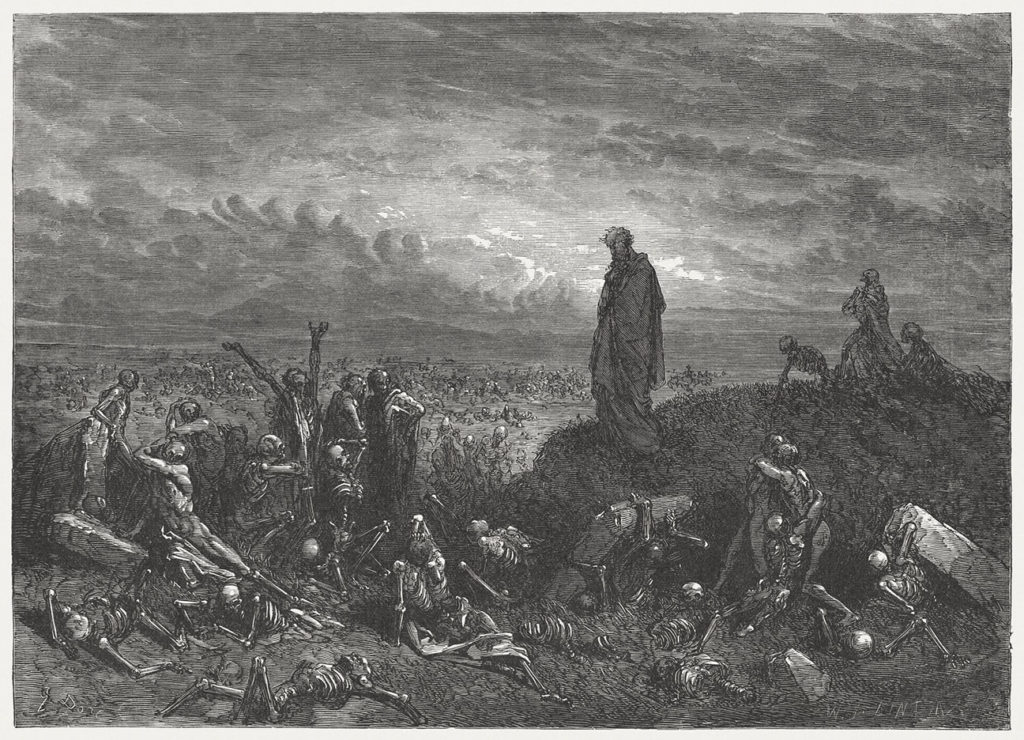
The dead who had been resurrected
in the Valley of Dry Bones
stood up and sang, till they, rejected,
died again, as dead as stones.

Ezekiel tells us of the first
event, the second he suppressed.
The dry bones had to face the worst,
though they’d once triumphed with the best,

as individuals unable to
survive, dependent on their nation,
whose revival helped them to renew
what they had lost in desiccation.

These scattered sinewed bones became
a helpless travesty, like Jews
whose sad extinction I here blame
on links with Jews they chose to  lose,

and thus despite their genes, not able
like dry bones ever to revive,
unlike Jews with the Israel label
who’ll sinew sinecured survive.

Jon D. Levenson, writing about Ezekiel’s prophecy concerning the dry bones (Ezek. 37:1–14) (Resurrection and the Restoration of Israel: The Ultimate Victory of the God of Life, New Haven: Yale University Press, 2006), cites bSanhedrin 92b , where Rabbi Eliezer states: “The dead whom Ezekiel resurrected stood up, uttered a song, and died.” Levenson points out that whereas Ezekiel’s vision focuses exclusively on the nation which he regarded as immortal, Rabbi Eliezer focuses on the individuals, whose mortality does not share the immortality of the nation.

It is curious that the Hebrew name of Lazarus, whose resurrection is reported only in John 11:1–44, and in none of the synoptic gospels, is the same as that of Rabbi Eliezer, who proclaimed that the dead whom Ezekiel revived “uttered a song, and died.” Is it possible that R. Eliezer was refuting the story told in John.

The last line alludes to the sinew of the thigh that an angel injured while wrestling with Jacob, an event that is the rationale of the ritual of circumcision. (Gen. 32:33), to which Ezek. 37:6 perhaps alludes after describing the revival of the bones in the Valley of Bones:

ו  וְנָתַתִּי עֲלֵיכֶם גִּידִים וְהַעֲלֵתִי עֲלֵיכֶם בָּשָׂר, וְקָרַמְתִּי עֲלֵיכֶם עוֹר, וְנָתַתִּי בָכֶם רוּחַ, וִחְיִיתֶם; וִידַעְתֶּם, כִּי-אֲנִי ה’. 6 And I will lay sinews upon you, and will bring up flesh upon you, and cover you with skin, and put breath in you, and ye shall live; and ye shall know that I am the LORD.’


Gershon Hepner is a poet who has written over 25,000 poems on subjects ranging from music to literature, politics to Torah. He grew up in England and moved to Los Angeles in 1976. Using his varied interests and experiences, he has authored dozens of papers in medical and academic journals, and authored “Legal Friction: Law, Narrative, and Identity Politics in Biblical Israel.” He can be reached at gershonhepner@gmail.com.

Dry Bones Read More »

TN School Board Removes Holocaust Graphic Novel “Maus” from Curriculum

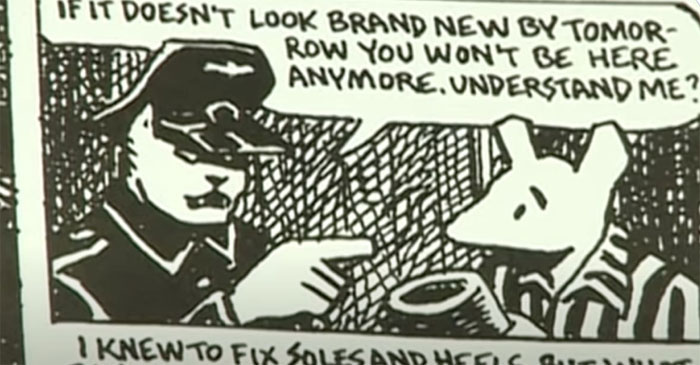
Tennessee school board voted to remove the Pulitzer-Prize winning Holocaust graphic novel “Maus” from their curriculum on January 26.

“Maus,” authored by cartoonist Art Spiegelman, tells the story of Spiegelman’s parents’ experience in Nazi-occupied Poland and in Auschwitz, depicting Jews as mice and the Nazis as cats. The McMinn County School Board voted 10-0 on the matter, arguing that the book contained eight cuss words and an image of female nudity. The board will decide on a different book to teach the Holocaust. “The wording in this book is in direct conflict of some of our policies,” School Board member Jonathan Pierce said during the meeting, according to National Public Radio (NPR).

Spiegelman told The Tennessean that the school board’s decision was “absurd” since the cuss words are “God d—” and “b—” and that the nudity scene involved “a dot for a nipple” to show that his mother, Anja, had committed suicide in a bathtub in 1968. He also told CNN that the school board is “so afraid of what’s implied and having to defend the decision to teach ‘Maus’ as part of the curriculum that it lead[s] to this kind of daffily myopic response.”

The United States Holocaust Museum defended the teaching of Maus in a couple of tweets. “Maus has played a vital role in educating about the Holocaust through sharing detailed and personal experiences of victims and survivors,” they wrote. “On the eve of International #HolocaustRemembranceDay, it is more important than ever for students to learn this history. Teaching about the Holocaust using books like Maus can inspire students to think critically about the past and their own roles and responsibilities today.”

Jewish groups also criticized the school board’s decision. “Banning #Maus, on the eve of International #HolocaustRemembranceDay, is shameful on every conceivable level,” Anti-Defamation League Southeast tweeted. “It serves no purpose other than to rob the next generation of knowledge. Awful.”

“School Board fails to understand the only pornography exposed in this powerful book is the pornography of hate, violence, and genocide,” the Simon Wiesenthal Center tweeted.

The American Jewish Committee tweeted that the school board’s decision was “shameful.” “It’s our collective responsibility to convey the lessons of the Holocaust to future generations,” they wrote. “The board must reverse its decision immediately.”

Conservative writer Christopher Rufo, known for his work on critical race theory, objected to those describing the school board vote as “banning” the book, pointing to a school board member saying in the meeting minutes that they could reinstate “Maus” into the curriculum if they can’t find a better alternative. “I personally wouldn’t have a problem with my child reading Maus in 8th grade, but I respect that other communities have different preferences,” he tweeted, noting that a school board in the Seattle area recently removed “To Kill a Mockingbird” from their curriculum. “It’s good to have a robust debate about what’s in school curricula, but it’s not ‘book banning’ to choose one text over another,” Rufo argued. “Curriculum space is finite. School boards should absolutely keep developing and refining their curricula to meet the preferences of their communities.”

George Mason University School of Law Professor David Bernstein tweeted, “The grounds for removal were dumb, though I’m not sure Maus is the book I’d choose for 8th graders if I were choosing. In any event… no ban on Holocaust books, not even a ban on Maus, just no longer required reading for students.”

https://twitter.com/ProfDBernstein/status/1486511785033314306?s=20&t=ZEISg9D7GtUZ61A1N_38sA

TN School Board Removes Holocaust Graphic Novel “Maus” from Curriculum Read More »