fbpx

January 25, 2022

‘We cannot hope to defeat it if we cannot define it,’ asserts those at conference on anti-Semitism

After a high-profile debate surrounding the role of anti-Semitism in the Jan. 15 synagogue hostage crisis in Colleyville, Texas, an Israel-education organization’s conference on cultivating greater understanding about anti-Semitism arguably could not have been timelier.

While the special agent in charge of the FBI’s Dallas field office, Matthew DeSarno, raised eyebrows by initially saying the Colleyville attack was “not specifically related to the Jewish community,” FBI director Christopher Wray later described the attack as “an act of terrorism targeting the Jewish community.”

The episode amplified the theme of the StandWithUs International Conference 2022, which was already set to focus on the importance of defining anti-Semitism, and specifically, adopting the International Holocaust Remembrance Alliance (IHRA) working definition of anti-Semitism.

“We cannot hope to defeat it if we cannot define it,” StandWithUs CEO Roz Rothstein told participants of the Jan. 23 virtual conference, sponsored by the Adam and Gila Milstein Family Foundation, which drew more than 200 college students and 200 high school students.

In a pre-conference interview with JNS, Rothstein said the FBI’s initial position on Colleyville “brings up the need for education and information—that every single one of us draws these red lines and has these conversations: ‘Wait a second, it was Jews who were targeted.’ ”

“We have to work hard to make sure people understand that anti-Semitism is anti-Jewish bigotry. We have to know it when we see it. Otherwise, we can’t address it if we have such confusion about what it is,” she said.

One day after the conference, StandWithUs on Monday launched Students 4 IHRA, a campaign to bring about wider adoption of the IHRA definition, which acknowledges that anti-Semitism can include “the targeting of the state of Israel, conceived as a Jewish collectivity.”

“There are people that are anti-Israel that want to separate Israel from the Jewish psyche, and we have to reinforce that Israel is a component of the identity of most Jewish people,” said Rothstein. “Half of the Jewish people in the world are living in Israel.”

Addressing the conference, U.S. Rep. Ritchie Torres (D-N.Y.) spoke of the danger of letting “anti-Semitic poison into the bloodstream” of American political discourse, warning that sentiments on the far-left could devolve into those promoted by former British Labour Party leader Jeremy Corbyn.

“We have to be willing to speak out against the anti-Semitism in our own backyard,” said Torres.

As a pro-Israel progressive, he spoke out against the BDS movement’s efforts to delegitimize Israel and ostracize progressive members of the pro-Israel community. He underscored the need “to drive home the message that there are people like me who are pro-Israel not despite our progressive values, but because of them. … There’s no country [in the Middle East] more protective of minority rights, women’s rights, LGBTQ rights [than Israel] … it’s a tableau of religious pluralism. By every metric, Israel is a profoundly progressive country and enterprise, and that’s a message that needs to be driven home here in American politics.”

Gil Troy, a distinguished scholar in North American history at McGill University and a leading Zionist activist, explained that understanding Judaism is a prerequisite to understanding Zionism. He said Judaism is not just a religion, but a mix of peoplehood and religion involving the Jewish people, the land of Israel and the State of Israel.

Troy said that today, traditional anti-Semitism is “transferred to the Jewish state.”

He raised the questions of why only Jews are asked to give up Zionism’s nationalism when there are 192 countries around the world built around nationalism, and why Jews are asked to give anti-Zionists a pass when members of other marginalized groups would never be asked to downplay racism and hate.

“Why do we Jews have to say, ‘Oh, my goodness, they [anti-Zionists] might be somehow nice. They’re not!” he said.

‘My business was hating people’

TM Garret, a neo-Nazi turned human-rights activist, provided another perspective on anti-Semitism by telling the story of his “step-by-step radicalization” and subsequent transformation.

“I’m not the usual speaker you would expect for a conference like this,” he acknowledged. “You could say that my business is for the love of people, but it hasn’t always been like that. Until 20 years ago, my business was hating people.”

Growing up in Germany, Garret picked up anti-Semitic jokes and started repeating them as a way to get the attention he was seeking. He later embraced hateful music and skinhead culture; joined the National Democratic Party of Germany (a neo-Nazi party) and the Ku Klux Klan; and read The Protocols of the Elders of Zion, an anti-Semitic propaganda pamphlet based on a hoax.

“It felt like I found the Holy Grail, and I had a chance to protect myself and my people against this enemy, like a superhero,” he said of the Protocols. “And let’s be honest, which kid doesn’t want to be a superhero, saving everyone?”
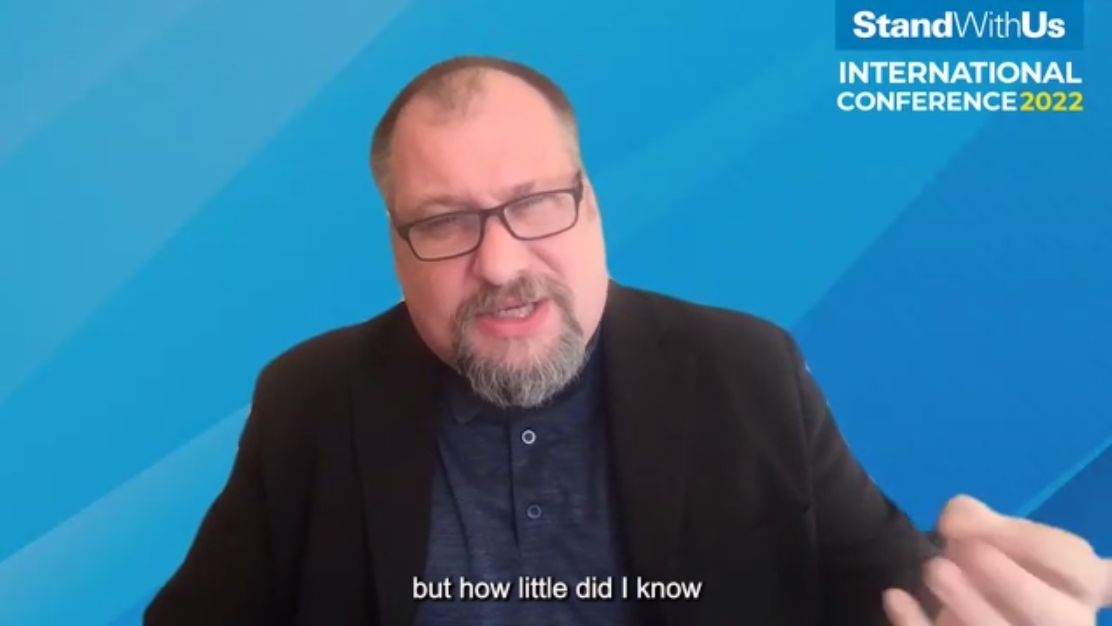
TM Garret, a neo-Nazi turned human-rights activist. Source: Screenshot.

But when Garret experienced kindness first from his Turkish-Muslim landlord, then from the Jewish community in Memphis when he moved there in 2012, he said his “hate started to crumble,” and he gradually abandoned anti-Semitic and racist stereotypes. Today, he is in the process of converting to Judaism.

‘A moral critique of Israeli Jews’

Former Associated Press reporter and editor Matt Friedman provided a wide selection of statistics on the media’s disproportionate focus on the Israeli-Palestinian conflict, including how during his time at the AP from 2006 to 2011, the news agency had more staffers covering Israel and the disputed territories than it had covering the world’s most populous country: China.

He said media outlets will treat the approval of 100 new apartments over the Green Line as a major story, but not 100 rockets fired from the Gaza Strip into Israel because they are trying to align the news with a narrative that always frames Israel as the stronger side.

“What if you zoomed out to the whole Middle East, the regional picture? Then Israel’s actions begin to make sense,” he said, describing such coverage as “an attempt to deliver a moral critique of Israeli Jews.”

Rothstein noted the importance of vigilance in reporting anti-Semitism on social media and the need to hold corporate giants accountable when Jew-hatred goes unchecked on their platforms.

“It’s going to be up to organizations like ours, up to everyday people, up to Congress. It’s dangerous. Are more people learning to hate as a result of an escalation of anti-Semitism on the Internet? The answer is yes,” she told JNS.

In the realm of combating anti-Semitism at colleges and universities, she said the next frontier for Jewish and pro-Israel organizations is working to ensure that campus administrations are implementing safeguards against anti-Semitism and more quickly condemning it when it arises.

“We see anti-Semitism on campus, whether it’s BDS or a social-media post by an anti-Semite who actually sounds dangerous, and we don’t see the kind of response from the administration that needs to happen or would happen if it were any other minority group,” she said. “We want the same level of respect and care and safety for Jewish students and Zionist students on campus.”
‘We cannot hope to defeat it if we cannot define it,’ asserts those at conference on anti-Semitism Read More »

COVID Winter of Discontent

Sometimes the world becomes a Rorschach test for life’s challenges. Like this week’s family hike in Topanga State Park.

Last May a fire swept through the Park, just west of the landmark Eagle Rock. It devastated much of Santa Ynez Canyon, leaving a moonscape of barren gray and black hills. This weekend’s family hike along the fire road revealed faint green meadows and rain-washed hills now cleared of the black char and sporting patches of green new growth. Vistas of nature’s rebalancing and renewing abounded.

At the peak of the last weeks’ COVID conflagration it has been worth remembering that all pandemics eventually end. The very raging of COVID may herald, finally, its end. Then we will begin our own rebalancing and renewing. The ghostly, charred trees of Topanga offer a symbol of those left behind.

At the peak of the last weeks’ COVID conflagration it has been worth remembering that all pandemics eventually end. The very raging of COVID may herald, finally, its end.

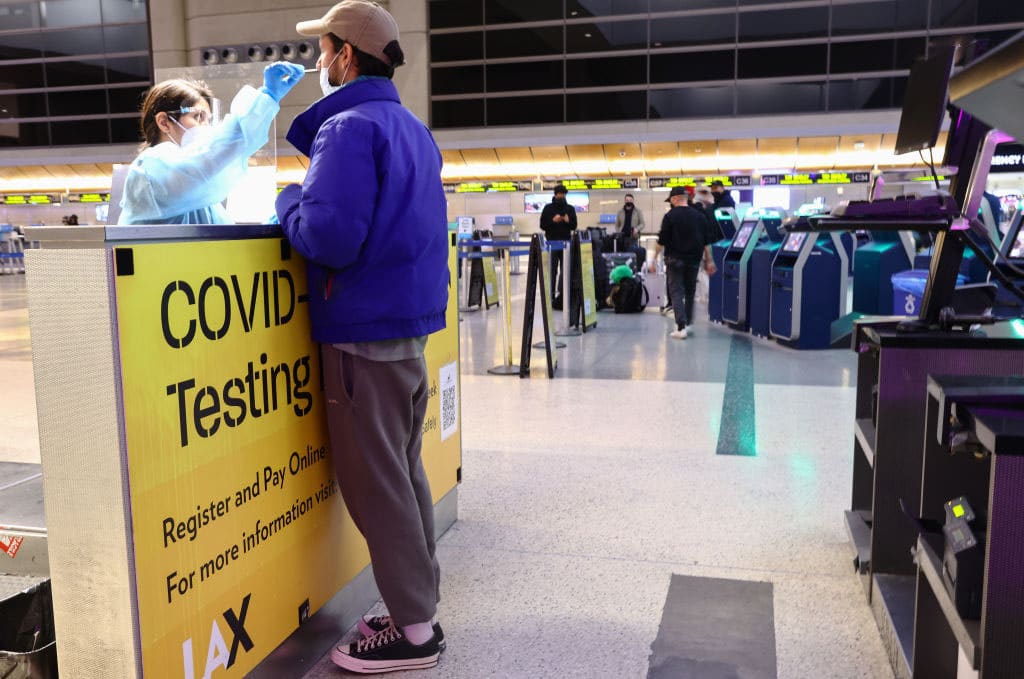
What a month it has been. The contagiousness of the omicron strain and the holiday parties held by those weary of COVID restrictions generated staggering numbers of new infections. Not since the brief shutdown of our offices two years ago have such disruptions occurred. Our Urgent Care (UC) offices, crippled by the staff’s own COVID illnesses, struggled to cope with patient volume that spiked, virtually overnight, to more than twice normal. Primary care doctors like me worked UC shifts where we treated COVID case after COVID case. The unrelenting energy and positivity of the UC staff will remain one of the few bright spots of the pandemic years.

Despite déjà vu to the first disruptions of the pandemic, the winter omicron spike differs markedly from that experience. The once common symptoms of unremitting cough and insidiously progressive breathlessness seem strangely absent. Vaccinated individuals generally have flu and cold symptoms that improve rapidly. At the Medical Center, almost half of those with COVID were admitted for other reasons with COVID discovered only incidentally. Only ten percent of those admitted were fully vaccinated and boosted. Although the unvaccinated and immune suppressed patients continue to develop life-threatening disease, omicron illness has been largely milder. Hospital cases, lagging UC, have gradually risen to about two thirds of last winter’s peak.

Caring for the sick is a privilege even in such hectic times. But that awareness fails to alleviate the frustration and weariness of hours spent failing to convince skeptics of the potentially life-saving value of vaccination. Tragically, the magnitude of the current spike is largely a problem we brought upon ourselves. Were we all vaccinated this might resemble a somewhat worse version of a typical flu season. Instead, the 25% of the population that were unvaccinated provided the fuel for the surge that affects everyone. When questioned, many cite their lack of trust in the CDC or Dr. Fauci. Some prefer discredited treatments like hydroxychloroquine and ivermectin to a vaccine that now protects hundreds of millions of people worldwide. Science, I try to explain, is not a faith that one accepts or rejects. It’s simply the application of an unbiased search for truth. It’s the same process that brought us the internal combustion engine or indoor lighting. I freely admit that recommendations based on science are not infallible. Yet, when guided by informed expert opinion they offer the most sensible approach. When skeptics are hospitalized, they seem to regain respect for scientific procedure, sometimes tragically in the form of intubation and artificial respiration.

Science, I try to explain, is not a faith that one accepts or rejects. It’s simply the application of an unbiased search for truth.

The appropriate advice remains simple and relatively unchanged: vaccinate and get boosted after six months. As vaccinated individuals can develop and spread disease without symptoms, continue masking, distancing and avoiding crowds when possible.

The possibility of additional variants makes the future of the pandemic uncertain. However, the recent raging of omicron seems likely to leave most with either natural immunity from illness, immunity from vaccination, or both. With a less susceptible population, the virus may settle into a more stable endemic phase that allows a return to normal life. Periodic vaccinations may continue to be needed as they are for flu. Unvaccinated individuals may still end up needing hospital care. Those that attend to the public health recommendations and remain vigilant can anticipate, probably before too long, the regeneration of spring and the waning of the long COVID winter of our discontent.


Daniel Stone is Regional Medical Director of Cedars-Sinai Valley Network and a practicing internist and geriatrician with Cedars Sinai Medical Group. The views expressed in this column do not necessarily reflect those of Cedars-Sinai.

COVID Winter of Discontent Read More »

Unilever to Put Ben & Jerry’s in Separate Unit Under Restructuring

Unilever announced a restructuring of their company on January 25, which will include putting Ben & Jerry’s in a separate standalone unit.

In a press release, the corporate giant announced they would be moving away from their “matrix structure” and will instead separate their businesses into five divisions: ice cream, nutrition, personal care, home care and beauty & well-being. Each division “will be fully responsible and accountable for their strategy, growth, and profit delivery globally,” per the press release. Unilever will also be cutting 1,500 jobs as part of the restructuring overhaul, although factory workers will not be impacted by the changes.

“Our new organizational model has been developed over the last year and is designed to continue the step-up we are seeing in the performance of our business,” Unilever CEO Alan Jope said in a statement. “Moving to five category-focused Business Groups will enable us to be more responsive to consumer and channel trends, with crystal-clear accountability for delivery. Growth remains our top priority and these changes will underpin our pursuit of this.”

In July, Ben & Jerry’s announced that they would be ending their relationship with their licensee in Israel because it operated in an Israeli settlement in the West Bank and will conduct business elsewhere in Israel. However, the head of Ben & Jerry’s Independent Board claimed that Unilever inserted in the statement about operating elsewhere in Israel and Ben & Jerry’s never signed off on it.

Since Ben & Jerry’s announced their boycott, Unilever’s stock declined by 20.7%, posting losses of around $26 billion, Jewish News Syndicate (JNS) reported on January 20. JNS noted that various state anti-Boycott, Divestment and Sanctions (BDS) laws have been enforced against Unilever over the Ben & Jerry’s, though the JNS article acknowledged that there were “numerous factors” behind Unilever’s losses.

Prior to the January 25 announcement, Unilever had announced they were looking “to offload low-growth brands and push further into the consumer health and hygiene market,” City A.M. reported. Various lawyers have told The Sunday Telegraph that it might be difficult for Unilever to sell Ben & Jerry’s because under their contract, Unilever cannot overrule any of Ben & Jerry’s political statements and any potential buyer would inherit that arrangement.

Unilever to Put Ben & Jerry’s in Separate Unit Under Restructuring Read More »

Travel Across Israel in Three Stripes South with Bex Band

Thank you to Tiffany Hawk, editorial director of Undomesticated, for introducing me to Bex Band. Read Tiffany’s interview here: “A Conversation with Bex Band, Women’s Adventure Leader.

Learn more about Bex at Love Her Wild website, The Ordinary Adventurer Blog, on her personal Instagram, Bex Band, Love Her Wild Instagram and Love Her Wild on Facebook.

Love Her Wild believe EVERY woman deserves an adventure!! But even more than that….we believe they also deserve to have a supporting team with them, cheering them along and celebrating their successes!Why? Because adventures improve our health, boost our wellbeing and connect us with the natural world. They enable us to discover what we are truly capable of while boosting our confidence.The Love Her Wild community has helped THOUSANDS of women go on adventures – many of those women from minority groups, facing hardship or additional barriers.”

Bex’s book, Three Stripes South: The 1,000km trek that inspired the Love Her Wild Women’s Adventure Movement, was published in Fall 2021. Please enjoy this excerpt below courtesy of Bex.

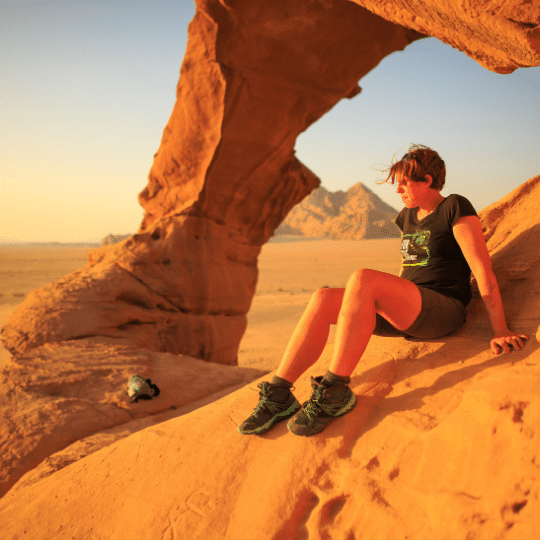
As the layers of dust thickened on my skin, the days in the desert passed by, my stripped-back, simple existence all merging into a strange passing of time. I finally had the thinking space I had always imagined the trail would give me. It didn’t come in calm moments of enlightenment or new-found wisdom, but stemmed from pure boredom. Although I was relishing the challenge and felt endless gratitude for the landscapes that rolled before me, there was no denying that hiking was monotonous. Plodding forward hour after hour, day after day, with loneliness and isolation becoming more constant, hiking swung from wonderfully exhilarating to tediously bland. I was grateful to have Gil with me, not for safety as most people assumed, but for companionship. Still, our conversations dried up and we found ourselves spending more time hiking apart, each of us at our own pace, looking for ways to occupy our minds. I yearned for the distraction of a busy coffee shop or the crowds of London, a peoplewatcher’s paradise.

Up to this point, much of my mind had been preoccupied with nothing but the loud demands of my most basic needs. There was no space for pondering when all I could think about was how hungry I was, how hot I felt, how much discomfort I was in. Hiking was still tough, that hadn’t gone away, but my body had adapted to the heat, my muscles strengthening by the day. I was getting comfortable with being uncomfortable and that freed my mind, which was now as vast as the space around me. I had infinite hours to think, or perhaps it was infinite hours to listen

As I walked, a montage of random memories would play out in my head. Sometimes these were significant moments from my life: my teacher telling me it was my fault I was getting teased because I had cut my hair short and ‘wasn’t acting like a normal girl’; opening my GCSE results to surprisingly good grades; my parents separating; the last conversation with a friend before she took her own life, those few words forever played on repeat like a broken record; laying eyes on Gil as he walked into Spanish Conversation Club; catching my grandad Stanley looking at me in a way I couldn’t make sense of until I heard he had passed a few days later; stopping by a tree in the New Forest and Gil producing a ring from his pocket.

Sometimes, though, the memories were so random it amazed me that my mind had made the effort to store them, like the excitement of finding a four-leaf clover in my junior school playground but having no-one around to show, or my Grandad Fred teaching me to draw a house in three dimensions and me noticing the colouring on his fingernails from decades of smoking. Often I’d return to the same point in time, a few years before doing the hike, when I had been my most unhappy, consumed with a cloud of hopelessness and depression brought on by the struggles of moving to an isolated city with Gil, bad jobs and financial strain. I had thought that being spat into the world of adulthood, no longer with a home and a bed that I could call my own, thanks to the breakdown of my family, was as lost as I would ever feel, but I was wrong. Nothing had been more disorientating and shattering than losing my way internally as I battled with poor mental health.

In the desert, though, I could feel old wounds being healed. For a short time, I stopped worrying about finding my way in life or questioning my every move; the path ahead clearly marked by three stripes, the only direction I needed for two months. It was a relief that calmed the turbulence as my compass gradually recentred. Each waymarker pointing south, another step in the right direction. We had been blessed with days of scenery that belonged on a postcard and, in between them, a rest day in a tiny desert town called Tzofar where we stayed in a Bedouin hut. The place was so slow I could well believe that if I saw a clock the seconds might be ticking backwards.

Tzofar was just four streets wide and three streets long, and surrounded by date farms with thousands of date palms lined in perfect rows. We walked through the town to reach the small convenience shop but didn’t see anybody along the way. I peered into the houses looking for signs of life but saw none. Perhaps they were all dozing, like the cats and dogs and camels that seemed to be occupying every available shady spot, all coming to the same conclusion that the only way to survive the sweltering days was to sleep through them.

The further we hiked south, away from the cities and villages of the north, the more I started to feel the vastness of the desert and our solitude. Our tiny insignificance had never been more obvious than when we reached the steep drop-off on the edge of the Ramon Crater. The Negev has five craters and the trail passes three: the Small Crater, the Big Crater and Ramon Crater, the largest. I stood on the edge, as close as I dared go, and felt a thrill as blood rushed through my veins, imagining joining the vultures above our heads as they dived into the expanse below.

Walking down to the crater floor, through thick fog that was clouding our vision, was a magical start to the days that followed as we weaved our way through wadis; but one of these wadis led me to a terrifying moment. Gil was ahead of me but just in sight and it was one of the few times in the desert we had been walking on sand that wasn’t just a thin layer of coating. Each step on the soft, fine sand swallowed my foot, necessitating double the effort and making for painfully slow progress.

Eventually, towards the wadi walls, stretches of gravel offered rocky relief underfoot. So focused was I on my stepping, though, that it took some time for me to look up and realise that I had not seen a trail marker for a while and I could no longer see Gil. I yelled out for him, hoping he might pop his head around one of the turnings ahead to show me the way, but there was no reply. I looked back, seeing that there had been three possible routes through the canyon to this point.

Which one had I come through? My instinct told me the furthest left so I backtracked and headed that way. After a while I passed a lone tree sitting in the middle of the canyon, the curve of its branches so distinct I was sure I hadn’t seen it before.

My chest tightened slightly knowing I was off the trail, so I quickly returned to the crossroads, now walking at a much faster pace. The walk back felt longer than the first time. Was this definitely the way I had come? I reached the crossroads but wasted no time deliberating, and instead took the middle turning. Again, the scenery around me didn’t look familiar but I was sure I hadn’t come from the turning furthest from the right. I pushed on a little further, feeling my heart race a little and sweat soaking the back of my shirt.

The walls around me suddenly seemed taller and the heat in the air just that bit more suffocating. I usually passed by my surroundings without paying a huge deal of attention but now I noticed every detail, each rock, each bare thorny bush. Had I passed that earlier? I stopped when I reached a sandy section and felt my shoulders drop slightly as I spotted footprints in the sand. To the side was the orange, blue and white striped marker I had missed, indicating that I should turn off and climb out of the wadi up the ten metres or so to the top. It was a reminder that a moment of lapsed concentration could have seriously ill effects.

Three Stripes South: The 1,000km trek that inspired the Love Her Wild Women’s Adventure Movement

Travel Across Israel in Three Stripes South with Bex Band Read More »