
fbpx

January 10, 2022

The Importance of a Diverse Forest Inventory

Imagine you aren’t sitting at your computer or looking down at your phone reading this article. Instead, try to picture yourself for a moment walking through the woods. What kinds of trees do you see around you? Are they tall? Are they short? Do they all look the same, or are there some clear differences distinguishing some trees from others? Depending on where you are from or where you live and the particular kinds of goals governing authorities prioritized throughout history, your visualization of a forest could very well be different from someone else’s.

Regionally, no two forests are the same, and this is especially true when it comes to their varying degrees of diversity. Some forests, and generally the most commonly thought of,  host a wide variety of tree species while others like the well-known pine forests in Israel mostly exhibit one dominant species above the rest. However, it turns out that this difference is important as evidenced by a new Israeli study which found a direct relationship between the diverse presence of tree species in forests and capturing carbon dioxide from the atmosphere. The more diverse a forest’s trees are, the more efficient and capable it is at absorbing and storing CO2.

Funded by the JNF and led by a doctoral student Ido Rog from Dr. Tamir Klein’s laboratory from the Department of Plant and Environmental Sciences at the Weizmann Institute of Science, researchers collected a wealth of ecological and physiological data from 25 trees belonging to five different species all within a 10 dunam (nearly 2.5 acre) area from the Yishai Forest near Beit Shemesh.

After inputting the data into a computer model, the researchers were able to determine the amount of water the wood of the trees utilize as well as the amount of carbon stored within. Compared to tree specimens belonging to a forest hosting one abundantly dominant species as a control group, trees from diverse-heavy forests were found to store about 130 grams (32 percent) more CO2 per square meter per year or 32 percent more CO2

Due to the current climate crisis, this ecosystem service has never before been more urgently crucial than it is now. Because they absorb almost a third of all CO2 emitted into the atmosphere, the ecological role forests play remains one of the most important tools for reducing the effects of modern-day global warming.

Trees Can Be Territorial Too

According to the researchers, diverse forests are more capable of capturing and storing CO2 due to the more effective way in which they utilize water resources. The researchers’ findings even show that diverse forests are able to utilize 40-80 millimeters more water per meter per year than non-diverse forests. Because of this, trees from diverse forests are better able to perform photosynthesis, an energy cultivation process key to any plant’s survival.

According to the study, one factor that allows trees from diversity-packed forests to make better use of water stems from “territorial division”—the range of depths different roots from different tree species typically occupy. Some trees’ roots naturally grow downward to exploit water present in deeper layers of soil and others have evolved to grow more horizontally to take advantage of water present in shallow layers of soil. Therefore, in a non-diverse forest, the dominant group of trees compete with each other for the same supply of water due to the similar depth-occupying space their roots all share. This means less water to go around, and thus less energy to perform photosynthesis effectively. However, when there is diversity amongst tree species, all their roots collectively occupy different depths of soil, thereby reducing competition for water, increasing water uptake, and enabling higher functioning photosynthesis throughout the forest.

Optimal water utilization is also in part due to the combined growth of shorter, shade-preferring trees, such as elm and oak, under tall trees like pine and cypress. Not only does this results in an even fuller coverage at the surface, but the combined presence of both shorter younger trees and taller mature trees reduces competition between trees of the same species as well.

“When trees thrive in a good water economy, they open their leaves’ stomata—the small nostril-like openings on the leaf, and they pull in CO2 into them which turns into sugar (glucose) during the process of photosynthesis,” Rog says. “When this happens, water vapor escapes from the stomata into the air and the plant loses water. Therefore, when the plant is experiencing a water shortage, it will prefer to close these openings.”

Different Priorities Back Then

Despite the advantages a diverse forest has over a non-diverse forest, some of Israel’s unfortunately are reminiscent of the latter because of the initial planting policy Israel established in its first decades of statehood.

“The purpose of planting in the forest was to maximize the productivity of the forest in order to yield as much wood material for construction as possible in the shortest possible time,” Rog explains. “They did not deal with the forest’s resistance to fires, or its efficiency in terms of carbon storage or any other ecological qualities.”

Dr. Gilad Ostrovsky, head of the JNF’s Forestry Division and its chief forester, confirms Rog’s remarks. “Speaking of the areas planted in the ’50s and ’60s, most of the forests were definitely made up of one dominant species,” he says.

However, Ostrovsky says that in 1990 there was a change in the KKL-JNF’s planting strategy.

“The composition of planting has shifted from relying on coniferous trees, such as the Jerusalem pine (Aleppo pine), to planting broad-leaf trees such as oak, elm, or carob,” he says. “In fact, there is a very large diversity.”

According to him, part of the diversity stems from natural processes and not solely from deliberate planting.

“After the establishment of the state, the massive deforestation carried out by villagers for the purposes of heating and cooking ceased, and recovery of the oppressed Mediterranean forest began. Even the single species pine forests naturally diversified.”

If It’s Good For the Environment, It’s Good For Us

It is important to emphasize that besides storing carbon, a diverse forest also has other benefits. According to new but yet-to-be-published studies, diversity in forest tree species can support a healthy variety of bacteria and fungi which effectively increase the chances of survival of insect populations. In addition, other studies conducted around the world have linked tree diversity in forests to better resistance to natural disturbances like fires.

“These findings must be taken into account, and we are already seeing how they affect decision making policies,” says Rog. “For example, the new forests planted on Mount Gilboa are much more diverse.”

Beyond that, a diverse forest offers a scenic advantage and recreational outlets for those enchanted by the outdoors as it enables someone to use and enjoy the forest regardless of the season—even when some of the species are shedding their leaves or are not blooming.

“The aim is to think about how the forest can contribute to human well-being, both as a highly ecologically functioning carbon sink and a place of leisure,” Rog concludes.

The article was made by ZAVIT – Science and the Environment News Agency

The Importance of a Diverse Forest Inventory Read More »
N.Y. Governor’s Term Limits Plan is Good for the Jews Too

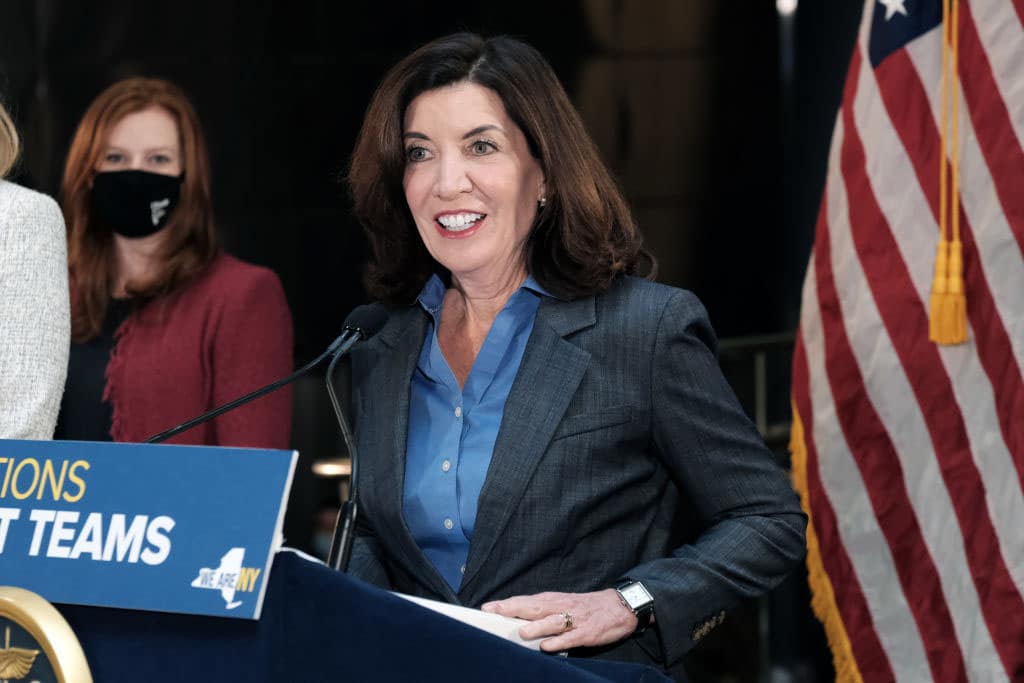
New York Governor Kathy Hochul is calling for term limits for statewide elected officials, following in the footsteps of California and many other states that have already adopted such limits. The American Jewish community, which has long suffered from its own crisis of entrenched leadership, should embrace the proposal, too.

Term limits are a safeguard against “the love of power and the love of money,” Benjamin Franklin wrote. He warned that without term limits, politicians would view elected office as “a place of profit, and they will move heaven and earth to obtain it.” Thomas Jefferson advocated term limits to curb what he called “office-hunters.”

Among the current leaders of American Jewish and Zionist non-profit organizations, there are at least nine who have held the same position for 32 or more years; at least seven more who have been in power for 21-29 years; and at least another six who have been in office for 15-19 years.

At least five other leaders of Jewish groups have in the past few years either passed away in office or retired after holding power for periods ranging from 35 to 40 years.

The president of one small American Zionist organization recently circulated a newspaper clipping from 28 years earlier, reporting how he first became head of the group. Is it really a source of pride for American Jewry if its leaders aspire to be presidents-for-life?

Term limits would improve the quality of Jewish leadership. Bringing in new faces would mean bringing in new ideas to keep Jewish organizations from growing stale and predictable. As younger women and men enter the Jewish organizational community, they will bring with them the technological skills and social media savvy needed to compete in today’s world.

Term limits would improve the quality of Jewish leadership. Bringing in new faces would mean bringing in new ideas to keep Jewish organizations from growing stale and predictable.

When a single individual holds the reigns of power for decades, some younger potential leaders are discouraged from becoming active. Why invest time and energy if power will always be concentrated in the hands of a privileged few? Programs to recruit potential leaders from diverse sectors of the Jewish community are badly needed—but how can they succeed if the road to leadership is obstructed by old-timers who want to preserve power for themselves?

Term limits would prevent self-interested individuals from viewing leadership positions as a way to enrich themselves or luxuriate in the other trappings of communal power—because there just wouldn’t be enough time to exploit their positions even if they were tempted to do so. Knowing the clock was ticking, they would have an incentive to keep their promises, do their jobs, and then step aside so others can have a chance.

In America today, there is a growing recognition that restricting political or civic leadership to a self-perpetuating old boys’ club is bad for democracy. Thirty-six states have term limits for governors. Fifteen state legislatures and numerous local municipalities have term limits, too. So do many non-profit organizations, including the American Red Cross, the American Civil Liberties Union, the Girl Scouts, and Habit for Humanity.

Gov. Hochul’s wise proposal would bring New York State in line with this enlightened movement. American Jewry should follow in her footsteps. 


Dr. Medoff and Prof. Magnus are historians and members of the steering committee of the Committee on Ethics in Jewish Leadership, www.jewishleadershipethics.org

N.Y. Governor’s Term Limits Plan is Good for the Jews Too Read More »

Hamas Reportedly Claims Israel is Using Spy Dolphins

Hamas is reportedly claiming that Israel has used dolphins to spy on them.

Israeli journalist Khaled Abu Toameh tweeted on January 10 that Hamas alleged that “Israel using dolphins to spy on us and chase our navy commandos off the coast of the Gaza Strip.” Toameh then linked to the Arabic newspaper Al Quds, which quoted a spokesperson from the Al-Qassam Brigades, Hamas’ military wing, stating that they found a dolphin with an unspecified device to use for “assassination.”

Joe Truzman, a research analyst for Long War Journal and the Foundation for Defense of Democracies (FDD) think tank, tweeted that “Killer Zionist dolphins exist, according to a Hamas publication.” He added that the spokesperson alleged that a Hamas member killed during the May conflict “found the killer dolphin.” Truzman’s tweet also contained a video of the Hamas spokesperson making the dolphin allegation.

Various people on Twitter mocked the allegation.

“In other news, the supposedly much vaunted Hamas heroes are scared by a few cute dolphins!” Human rights lawyer and International Legal Forum head Arsen Ostrovsky tweeted.

Siamak Kordestani, West Coast Director of the European Leadership Network, tweeted, “Killer Zionist Dolphin is a good name for a punk band, for what it’s worth.”

Shai DeLuca, retired Israel Defense Force Sergeant and TV personality tweeted, “2021 was the year of the Jewish space lasers. 2022 is the year of Mossad dolphins. Can’t wait to see what 2023 brings.” “Jewish space lasers” is a reference to 2018 social media posts from Representative Marjorie Taylor Greene (R-GA) blaming the California wildfires at the time on a space laser connected to a Rothschild banking firm.

https://twitter.com/ShaiDeLuca/status/1480604912379703298

Hamas has previously made a similar claim about Israel using killer dolphins in 2015; Foreign Policy’s Elias Groll wrote at the time that “though dolphins have been used by various militaries, including by both the United States and Russia, this report likely falls into what is a surprisingly fertile genre of conspiracy theories: the notion that Israeli intelligence routinely uses all manner of birds and other animals as tools of espionage.”

Hamas Reportedly Claims Israel is Using Spy Dolphins Read More »

Gene Simmons on Boycott of Australia Festival Over Israeli Sponsorship: “Leave Young Talented People Alone”

KISS bassist Gene Simmons criticized those boycotting an upcoming Australian festival over Israeli sponsorship, arguing that “young people in the arts” shouldn’t be punished over politics.

Simmons is one of more than 120 entertainment leaders to sign a Creative Community for Peace (CCFP) letter against a boycott of the Sydney Festival over the festival’s sponsorship deal with the Israeli Embassy of Australia for a dancing show. The festival, which takes place from January 6-30, is a cultural celebration of artists in music, dance and theater in Australia and worldwide. The Palestinian Justice Movement is among those believe that the sponsorship means that the festival is “complicit in [Israel’s] strategy to art-wash its crimes and contributes to the normalization of an apartheid state.” More than 30 acts and individuals have withdrawn from the festival over the matter, according to The Guardian.

Speaking with the Australian television program “Sunrise” on January 6, Simmons said that he respects people voicing their “political point of view.” “But don’t take it out on young people in the arts,” he said. “They have nothing to do with politics. When the Chinese send a dance troupe to Australia, you’re not gonna boycott them because you may have a point of view of how China treats certain people or the political stuff, leave that to the political pundits and let young talented people in the arts do what they do.” Simmons encouraged people to instead channel their political passions into writing “op-ed pieces … editorials, write letters of support to a certain political party and leave young talented people alone no matter where they come from.”

He added: “The arts should be free of political pressure. It’s a simple idea: I’m not curtailing your point of view, I just want you to stop bothering young people who are talented who have nothing to do with politics.”

The CCFP letter, which was published on January 6, was also signed by actress Noa Tishby, Disturbed frontman David Draiman and journalist Eve Barlow, among others. The letter stated, “This year, the spirit of the Festival is under attack by those calling for a boycott because the Israeli Embassy is sponsoring a world renowned Israeli dance ensemble. This call for a boycott turns the festival from an opportunity for unity into a weapon of division.” It later added that “art should never become subservient to politics and artists and cultural events should never be forced to be politicized. We believe the cultural boycott movement is an affront to both Palestinians and Israelis who are working to advance peace through compromise, exchange, and mutual recognition.” The letter concluded with a call for “the entertainment community to express their support for an exciting and successful Sydney Festival 2022 and to purchase a ticket and attend the festival itself to understand the power of arts to bring people together first-hand.”

CCFP Director Ari Ingel said in a statement, “The organizers of the Sydney Festival boycott intentionally misrepresent the truth about Israel and make provocative statements, to try and bully artists into backing out of the festival. Their messages deceptively involve an element of dishonesty and deny the truth of Jewish indigeneity to the land of Israel. Their actions only further hostility and dampen hope for peace, which all of us so urgently desire.”

The American Jewish Committee thanked the signatories of the CCFP letter in a tweet. “The BDS movement is rooted in antisemitism and openly seeks Israel’s destruction,” they wrote.


The Zionist Federation of Australia President Jeremy Leibler had sent his own letter as well, which stated, according to The Guardian: “The Sydney festival should be a safe space to celebrate the artistry and gifts of all peoples, including Israelis and Palestinians. Instead, the boycott organisers have attempted to make the festival culturally unsafe for anyone who believes in freedom of speech, and the freedom to have differences of opinion. It is appalling behaviour and the Jewish community condemns it outright.” He added that if the festival caves “into campaigns from these extremist groups, it will only encourage them to continue this behaviour. We have seen throughout history that while these campaigns start with Israel and the Jewish people, they very rarely end there.”

The festival’s board released a statement on January 4 stating that they decided to keep the Israeli-sponsored show because “all funding agreements for the current Festiva l… will be honored, and the performances will proceed. At the same time, the Board has also determined it will review its practices in relation to funding from foreign governments or related parties,” according to The Times of Israel.

Gene Simmons on Boycott of Australia Festival Over Israeli Sponsorship: “Leave Young Talented People Alone” Read More »