fbpx

October 26, 2021

In Israel’s Largest Global Jewish Celebration Since COVID, Masa Celebrates its 18th Anniversary

Thousands of young Jews from around the world gathered in Israel on Oct. 20 to celebrate the 18th anniversary of the founding of Masa Israel Journey in what was the first major international Jewish event in Israel since the COVID pandemic.

Dubbed Masa 18 Live, the celebration commemorated Masa’s nearly two decades of service, kicked off its upcoming programming year and featured addresses from a range of senior Israeli officials, including President Isaac Herzog.

“By choosing to immerse yourself in Israeli society and by sharing your unique stories and skills with us, you are contributing to Israel’s growth, and you are becoming partners in the critical mission of strengthening the ties between Israel and the Jewish people—especially the next generation,” Herzog said in his greeting at the event. “I am eager to see how our journey together, here, in your and my Israel, will make your lives so much richer.”

The event consisted of 3,000 Masa participants and featured community-building workshops, games and an art wall where Masa Fellows were encouraged to contribute in a way that represents their forthcoming journey. The Israeli band Hatikva 6 also performed for the crowd, driving home the overall theme of celebration and unification.

The event was packed with major leaders committed to connecting and strengthening the Jewish people, beginning with an address from Masa CEO Ofer Gutman and followed by live speeches from Minister of Diaspora Nachman Shai and Acting Chairman of the Executive of The Jewish Agency Yaakov Hagoel. Many of the speakers noted their appreciation for the thousands of diaspora Jews who have chosen to visit Israel through Masa’s programs, which facilitates long-term work and study abroad programs in Israel for young Jews from around the world.

“At a time of widening gaps between Jews in the diaspora and Israel, this event was the first major gathering of world Jewry—including fellows, alumni, and partners—since the beginning of the COVID-19 pandemic.” said Masa CEO Ofer Gutman. “As we welcome our newest cohort to Israel, the entire Jewish world will benefit from their efforts to educate, volunteer, work, and grow in the Jewish homeland.”

Since its founding in 2004, Masa Israel Journey has accompanied over 170,000 students from 60 countries on study abroad and professional development trips to Israel. Masa Israel Journey trips range from four to 12 months and place students in internships, Hebrew language programs and nonprofit roles across Israel.

While the COVID-19 pandemic caused significant disruptions to Masa’s mission—which is centered around international travel—Gutman noted that the organization has continued to grow over the last 18 months. Several Masa programs have grown over last year, including Masa Career, which has doubled in registrants. Masa Gap and Academic programs have seen similar growth, Gutman said.

The celebration of Masa at 18, or chai, references Masa’s unique role in empowering young Jews to shape their lives, aptly summarized by Chairman of the Executive of The Jewish Agency Yaakov Hagoel.

“You are young people from all over the world, who have come here, to this country, to study, to volunteer, to intern, to enjoy, to get excited, to photograph, to pray and to feel at home,” Hagoel said to Masa participants in his address at the event. “What other nation in the world can feel pride in having one event with so many people from all over the world?”

In Israel’s Largest Global Jewish Celebration Since COVID, Masa Celebrates its 18th Anniversary Read More »

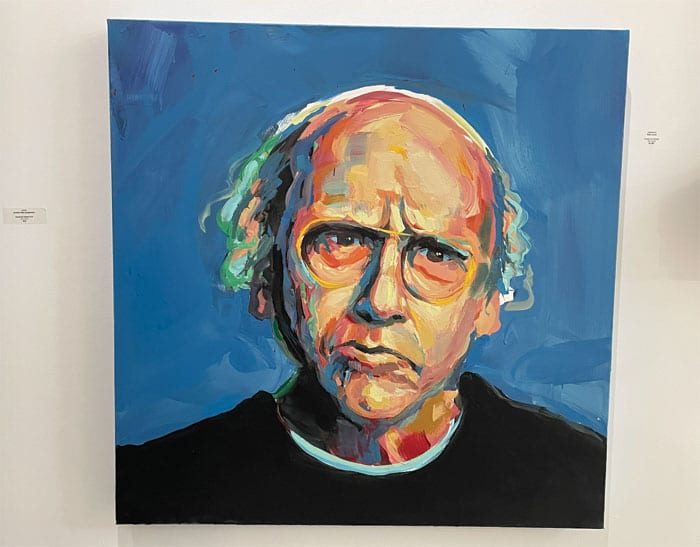
The “Art” of Larry David and “Curb Your Enthusiasm”

The eleventh season of HBO’s “Curb Your Enthusiasm” began this week to much anticipation from fans. “Curb” continues to offer slice-of-LA-life comedy surrounding the show’s curmudgeon-in-chief, Larry David. 

In celebration of the newest season of “Curb,” a Pacific Palisades art gallery is hosting a David-themed art show throughout the week of the season premiere (until October 31).

Titled “The Big Bald Art Show” and showcased at The Bruce Lurie Gallery, it features original works by artists from all over the world, including Australia, Costa Rica, Norway, Argentina, Ukraine, Belarus, Puerto Rico and Israel. 

The curator and producer of the art show, Steve Matoren, sourced the pieces mostly by searching Instagram and Twitter hashtags and contacting artists directly. 

“I’m a big pop culture art enthusiast,” Matoren told The Journal. “There’s a lot of Bill Murray [artwork] out there, a lot of Lebowski stuff, so any artist that I liked, even if they didn’t have a Larry [piece], I would reach out and ask if they would be interested in featuring something.”

Enthusiasm was indeed present as hundreds of “Curb” fans attended opening night.

“Every ‘Curb’ fan who has come through the art show so far has been blown away,” Matoren said, noting that a lot of “hardcore ‘Curb’ fans” showed up. It’s a very unique show, [and] people like the variety.” 

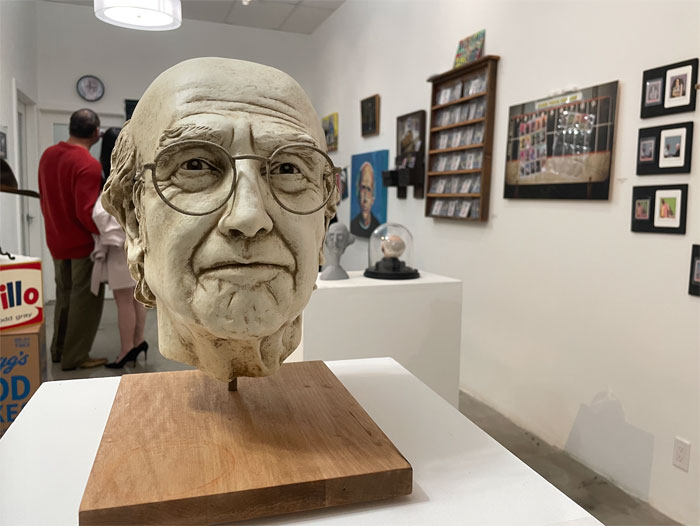
Artist Carl Lyon’s bust of Larry David

Local artist Carl Lyon created a Rodin-style bust of Larry David. Another local artist, Naz Harounian, featured several pieces in the art show, including spoof bottles of anxiety medication for David and recurring character Marty Funkhouser, played by the late Bob Einstein. There was a large crochet of David by artist London Kaye and a crochet of one of David’s catch phrases, “pretty, pretty, pretty good.” Matoren himself created early 1900’s-style baseball cards featuring “Curb” characters.

“[Larry David] has been a lifestyle brand, and the guy who says the things that people may be thinking but won’t say adds that cringe factor that ultimately becomes iconic.”
– Rick Lynch

“[Larry David] has been a lifestyle brand, and the guy who says the things that people may be thinking but won’t say adds that cringe factor that ultimately becomes iconic,” said Rick Lynch, a creative director in the entertainment advertising world. Lynch sold a painting of David standing on a diving board, which he says symbolizes the character once again walking the plank or pushing towards yet another uncomfortable situation.

After a busy weekend of visitors coming to the gallery, Matoren reflected on what draws people to love the show. He concluded that Larry David is unequivocally and unapologetically himself and very opinionated and passionate, and that is what people are drawn to. He said that he understands why some people find David’s character annoying, but he lacks any B.S. and always comes from a place of truth.

Much like David’s character on “Curb,” the best art comes from a place of raw honesty and vicious truth, even if it makes the viewers cringe.

The seven newest episodes, to be released weekly through December 5th, were filmed entirely during the COVID-19 pandemic. If the season premiere episode is any indication, the eleventh season will take place in a post-pandemic Los Angeles. 

Although the show’s first season began in 2000, there have been multiple hiatuses. And with season 10 having aired in 2020, this is the first time since the 2004 and 2005 seasons that “Curb” has had two consecutive calendar years with new seasons. 

Anyone at the opening night of the gallery who mentioned that they have met David said that he is in reality, quite a nice guy. So remember as season 11 of “Curb Your Enthusiasm” unfolds that the show is art, not a documentary.

The “Art” of Larry David and “Curb Your Enthusiasm” Read More »

New AJC Survey: Rise in Fear Among American Jews

Nearly a quarter of American Jews were targeted with antisemitism over the past year, according to two new surveys conducted by the American Jewish Committee (AJC), one surveying American Jews and another surveying the general public.

The AJC’s  State of Antisemitism in America 2021 report found that seventeen percent of American Jews said they were subjected to antisemitic comments in person, 12% said they were they subjected to antisemitic comments online and 3% said they were physically attacked for being Jewish.

The rise in fear has caused nearly one-third of American Jews to alter their daily lives. 

The rise in fear has caused nearly one-third of American Jews to alter their daily lives. Twenty-two percent said they avoided wearing Jewish paraphernalia in public out of fear of being subjected to antisemitism; 17% said they avoided certain public places and events out of fear of antisemitism while 25% said they kept quiet about their Jewishness or views on Jewish issues online to avoid antisemitism.

The report included four stories from American Jews who experienced antisemitism over the past 12 months. The first involved a 23-year-old Los Angeles-based woman named Aubrey who received an Instagram message in December 2020 that read, “Shut up, Jew.” The person who sent it was her brother’s friend, so she hasn’t reported it to the police; she now uses her Instagram to highlight  stories of Jews who also have experienced antisemitism.   

It was the antisemitic attack at a Melrose Avenue restaurant  last May that jolted Remi Franklin into action. The 37-year-old Brazilian Jiu Jitsu artist organized fellow martial arts artists and military veterans from across the country to escort observant Jews to school and shul. Dubbed “Shabbat Angels” by a local rabbi, they heard anti-Israel protesters shout “all Jews should die” and “Hitler was right” as they walked.  

“They thought twice when we yelled back, because I wasn’t silent,” Franklin said. “We did the best we could to make sure people were protected. We became a high-level version of deterrence.”

Ari Hoffman, a Seattle resident, told the AJC that he was subjected to antisemitic threats online when he ran for city council in 2019 and the  council was silent about it; additionally, he noted that “in September, the council narrowly defeated a bill that would have ended a training program.” Hoffman said he now brings a gun every time he goes to synagogue.

Overall, 90% of American Jews view antisemitism as a problem and 72% feel less safe in the United States.  

Overall, 90% of American Jews view antisemitism as a problem and 72% feel less safe in the United States. Ninety-one percent view the far-right as a threat and 71% view the far-left as a threat. Fifty-three percent approved of President Joe Biden’s handling of antisemitism while 28% disapproved; those numbers were more divided on the Democratic Party’s handling of antisemitism, as 45% approved while 40% disapproved. The majority of American Jews voiced disapproval of how the Republican Party has handled antisemitism, as 65% disapprove while  20% approve. Eighty-two percent view the Boycott, Divestment and Sanctions (BDS) movement as antisemitic and 50% think that antisemitism has increased on college campuses over the past five years.

“There remains a steady and consistent undercurrent of anxiety among American Jews when it comes to their sense of safety, security and well-being in America,” American Jewish Committee Los Angeles Regional Director Richard S. Hirschhaut told the Journal. “This is a direct consequence of the jarring and horrific tragedy of the Tree of Life synagogue massacre three years ago. That event represented the most egregious horrific single act of antisemitism in American Jewish history and we continue to feel its reverberations as reflected in [the] findings of this latest survey.”

The AJC’s survey on the general public showed that non-Jews are considerably less informed on the issue of antisemitism than American Jews, as 60% said that antisemitism was a problem. Only 44% said they thought antisemitism has increased in the country over the past five years and 59% said they hadn’t witnessed any antisemitic incidents in person or online. Additionally, 53% said they were unaware about the spike in antisemitic incidents during the Israel-Hamas conflict in May and 52% said they weren’t familiar with BDS, although 66% did say they view BDS as antisemitic.

Hirschhaut said he wasn’t surprised by the gap of knowledge about antisemitism. “American Jews are more attuned to the presence of antisemitism. Our collective antennae are raised to identify the signs and the signals of antisemitism. That is a sensibility that we have sadly had to hone and sharpen as a community … while the general public may not be as sharply attuned to expressions of antisemitism, we of course know there are other communities across America who have faced their own scourge of hate and bias in recent years.” He added that there was initially an “eerie quiet” from allies of the Jewish community during the spike in antisemitic incidents in May following Israel’s response to Hamas rockets. This is due to what Hirschhaut  described as a “certain fog” and “paralysis” resulting from media coverage of the conflict. 

“It required at that time some heart-to-heart conversations with traditional allies and friends to say, ‘We as a Jewish community are hurting and in pain. Where are you?’” Hirschhaut said, “and once we spoke out, those expressions of support were forthcoming and often with a tremendous sense of embarrassment for the initial silence.”

The surveys show that both American Jews and the general public “overwhelmingly” agree that anti-Zionism is antisemitism.

Hirschhaut did say there is “cause for genuine optimism.” The surveys show that both American Jews and the general public “overwhelmingly” agree that anti-Zionism is antisemitism. “More than eight in ten who were polled from both camps see anti-Zionism as equivalent to antisemitism. That is a very heartening statistic… perhaps we’ve been effective in making this point that legitimate criticism of Israeli policies is fair game… but that’s a completely different dynamic than calling into question the very legitimacy of the state of Israel.”

To help ameliorate the growing antisemitic climate in the U.S., Avi Mayer, AJC’s Managing Director of Public Affairs, suggested that American Jews become more connected to non-Jews, pointing to the fact that the survey showed that non-Jews were more likely to be aware about the issue if they were connected with Jews.

“Efforts to familiarize Americans of all backgrounds with Jewish life, with the different facets of contemporary Jewish identity, and with American Jews as individuals and as a community will help ensure that the positive trends of the past year continue and that negative trends are held at bay,” Mayer wrote. “This must be a true communal endeavor, showcasing American Jewry in all its diversity and telling our story in a way that is compelling and authentic. While such an ambitious undertaking may take some time to develop and implement, and even longer to show tangible results, it cannot and should not wait.”

“We should know our neighbors. We should find ways to share what hurts us, what causes us pain.” —Richard S. Hirschhaut

Hirschhaut called Mayer’s suggestions “an American ideal value. We should know our neighbors. We should find ways to share what hurts us, what causes us pain. Ultimately, being good citizens of this rich mosaic that is America is about building empathy.”

New AJC Survey: Rise in Fear Among American Jews Read More »

German Man Assaulted for Refusing to Shout “Free Palestine”

A 36-year-old man was assaulted in Berlin after he refused to shout “Free Palestine” on the evening of October 25.

The German newspaper Berliner Zeitung reported that three men approached the victim and pushed him to shout “Free Palestine”; the victim refused, prompting the three men to “kick and beat him brutally.” The victim was unconscious for a short period of time and has been hospitalized with life-threatening injuries. The whereabouts of the assailants are currently unknown.

The German-Israeli Society Youth Forum told The Algemeiner, “‘Free Palestine’ is not a peaceful slogan, but is used to call for the destruction of the only Jewish state and is therefore clearly antisemitic. The attack shows that Israel-related antisemitism is a violent reality in Germany.”

The American Jewish Committee tweeted that they were “horrified” by the assault and called on German police “to bring the perpetrators to justice and wish the victim a full recovery.”


Julie Lenarz, Director of Social Media for the AJC, tweeted that the attack shows that “anti-Zionism is just a modern manifestation of age-old Jew-hatred.”


German Man Assaulted for Refusing to Shout “Free Palestine” Read More »

Facebook Rejected OC Chabad Ad for Class Fighting Antisemitism

Facebook rejected Chabad Beth Meir HaCohen’s attempt to boost an advertisement for a course on how to fight antisemitism.

The Journal obtained Facebook’s October 24 rejection of the ad, simply stating that “it doesn’t comply with our advertising policies.” The ad featured the late Rabbi Jonathan Sacks explaining the varying manifestations on antisemitism and ending with text urging people to sign up for the four-part course, titled “Outsmarting Antisemitism.” The video itself remains on Facebook.


Rabbi David Elizrie, who is teaching the course, told the Journal that he had sent information verifying his identity to Facebook more than a year ago and that it was “illogical” for Facebook to reject the ad. “If Facebook is looking for hate speech… I would imagine that a human being would have looked at it and realized that this is the most absurd thing in the world: a Jewish organization running a course about antisemitism is told it doesn’t meet their guidelines,” he said and asked where Facebook’s “common sense” is.

Facebook did not respond to the Journal’s request for comment as to why the ad didn’t meet their guidelines.

The ad’s rejection comes as Facebook is under fire from a whistleblower alleging that the social media giant’s internal research showed that they’re not adequately regulating hate speech on their platform. Additionally, a recent Wall Street Journal report stated that Facebook employees have “consistently pushed to suppress or de-platform right-wing outlets such as Breitbart,” per The New York Post.

Facebook Rejected OC Chabad Ad for Class Fighting Antisemitism Read More »