fbpx

August 21, 2021

How to Help Women in Afghanistan

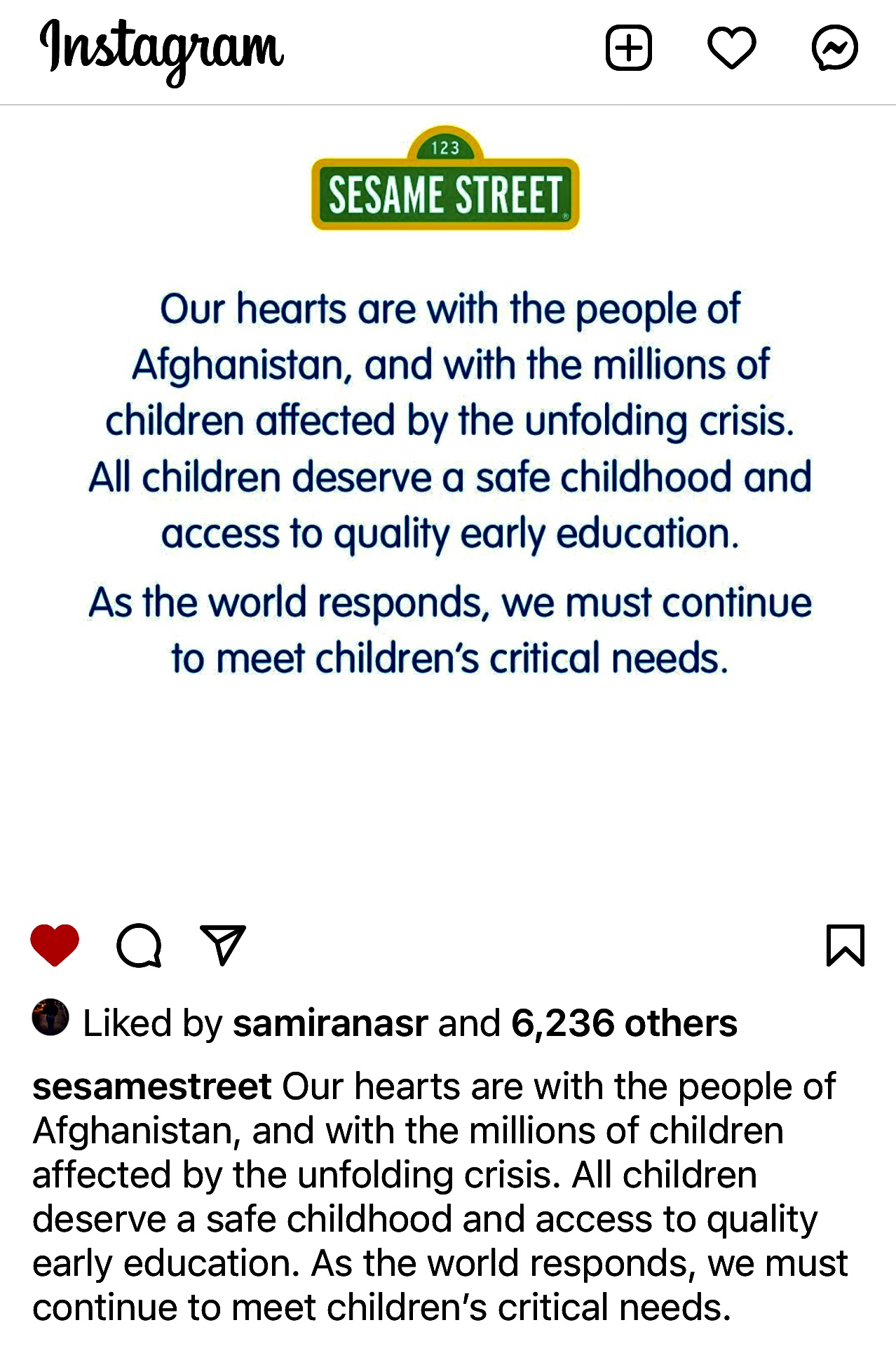
People have been calling, emailing and asking me how can we help the women of Afghanistan. I am sharing what the organizations I trust are recommending.

The Female Quotient

The FQ Foundation by The Female Quotient supports women and girls across the world. Join the FQ Foundation in supporting @WAWHumanRights, ensuring no woman is left behind. Women for Afghan Women (WAW) is dedicated to securing, protecting and advancing the rights of Afghan women and girls. We are #AfghanWomenStrong
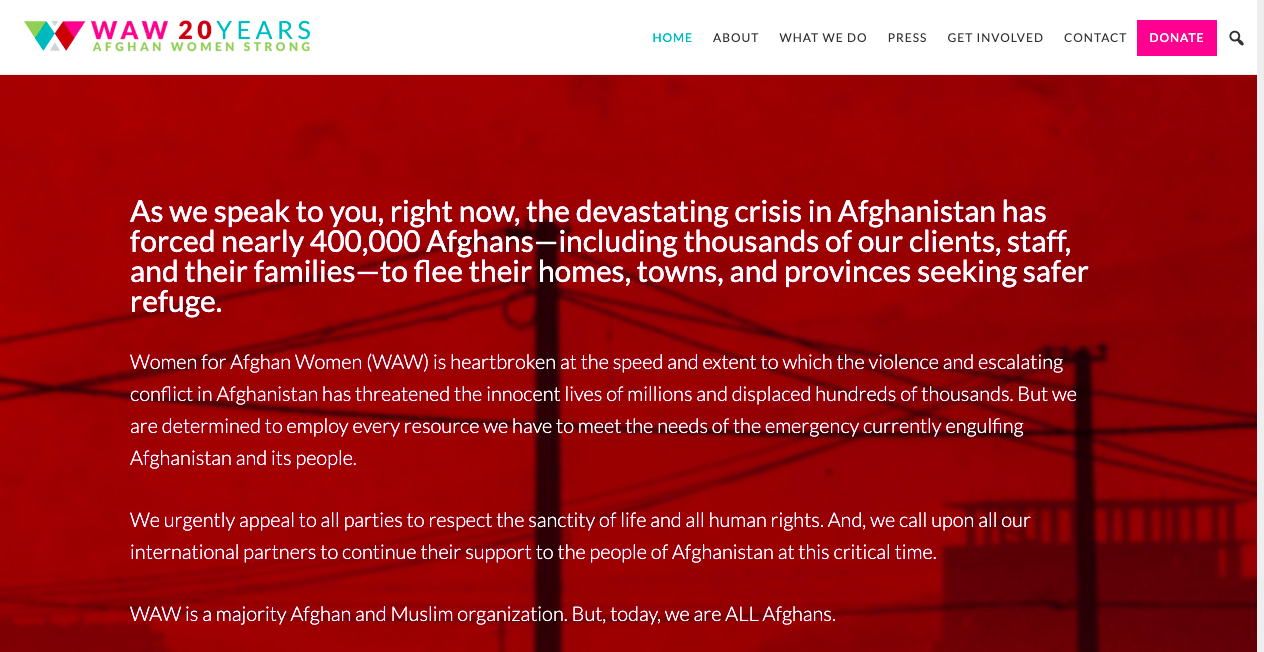
Together Rising is also working with Women for Afghan Women: “Thousands of women, children, and families in #Afghanistan are risking their lives in desperate attempts to evacuate.
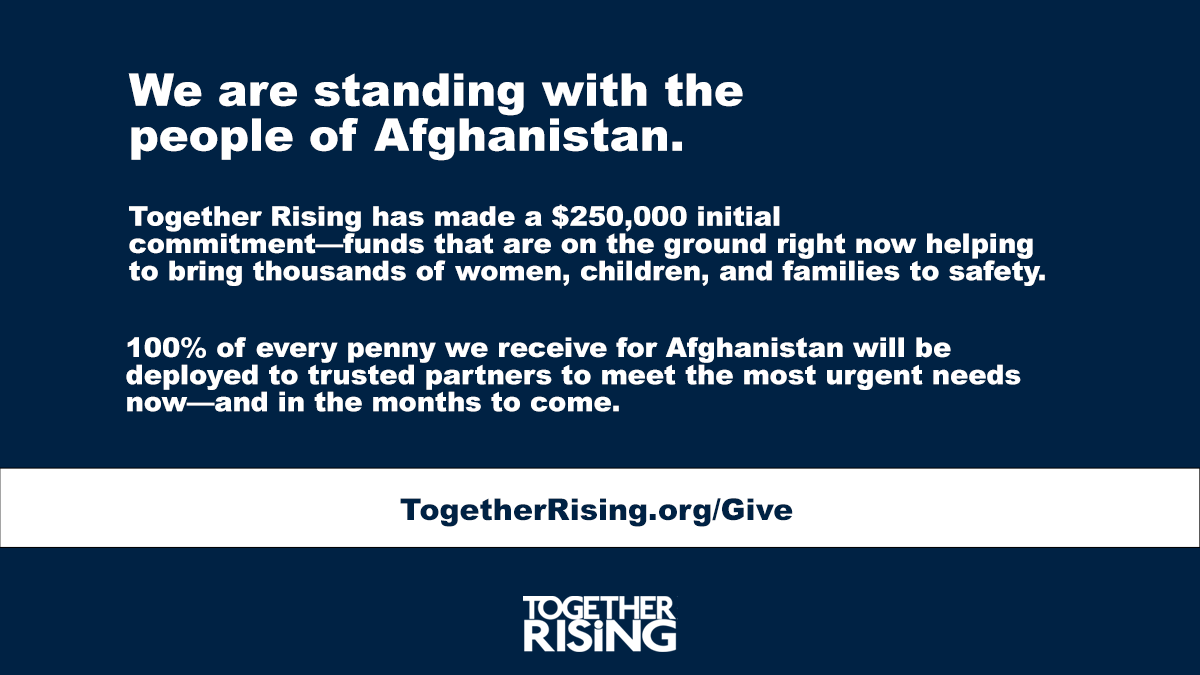
FROM TOGETHER RISING: “We watched in horror with the rest of the world as the Taliban took Afghanistan, knowing the unimaginable terror and persecution their control guarantees, especially for Afghan women. Immediately, we knew that we would not allow for those women—or their children or their families—to be abandoned. That you would not allow it, either. As we shared on Tuesday, our team has been working diligently to vet the most effective ways for us to invest given the volatile and complex nature of this devastating crisis.

Together Rising made a $250,000 initial commitment—funds that are on the ground helping to bring thousands of women, children, and families to safety. We’ve entrusted this investment to the Afghan women-led team of advocates at Women at Afghan Women, who are working 24/7 in Kabul. They told us that Together Rising’s investment “means Women for Afghan Women (WAW) can continue this critical effort on the ground to provide emergency services as well as to continue essential programs . . . because we must. Afghan women, children, and their families are depending on us.” 

The urgency of this crisis is undeniable—but we know that refugees and internally displaced people will need support far beyond the news cycle’s moving on. We will not allow them to be forgotten then, either. That’s why 100% of every penny we receive for Afghanistan will be directed to meet the most urgent needs now—and in the months to come.”

r

 
18 AUGUST 2021 Statement by UN Women on the situation in Afghanistan [New York, August 18, 2021]—In line with the statement by the UN Secretary-General, UN Women remains fully committed to support women and girls in Afghanistan. We will remain operational and engaged with our partners at this critical juncture for the country.Women’s and girls’rights in Afghanistan must have only one direction and that is forward. Afghan women and girls have played a pivotal role throughout the history of their country. It is essential that they continue to do so and that their hard-won rights are protected.We are following the recent events with graveconcern. We call on Afghanistan to secure the fundamental humanrights of all, including women and girls, and to meet their obligations to protect civilians and to provide humanitarians with unimpeded access to deliver timely and life-saving services and aid.Women’s and girls’rights must be at the core of the global response to the current crisis.


https://www.instagram.com/p/CSo8ElItPck/

https://www.instagram.com/p/CSsdkGdNJUT/


https://www.instagram.com/p/CSrahp9g67n/

DONATE TO WOMEN FOR AFGHAN WOMEN

FROM NAT GEO SPECIAL REPORT:

What Afghanistan’s post-2001 generation stands to lose
More than three in four Afghans today are under 25: too young to remember the Taliban’s reign of fear and, especially in cities, too accustomed to freedoms to be eager to relinquish them. These Afghans, shaped by the post-2001 reality, are unwilling to revert to a reactionary and repressive past. Now that the Taliban have seized the capital of Kabul, they must grapple with a future that only weeks ago seemed incomprehensible. How did we get here?
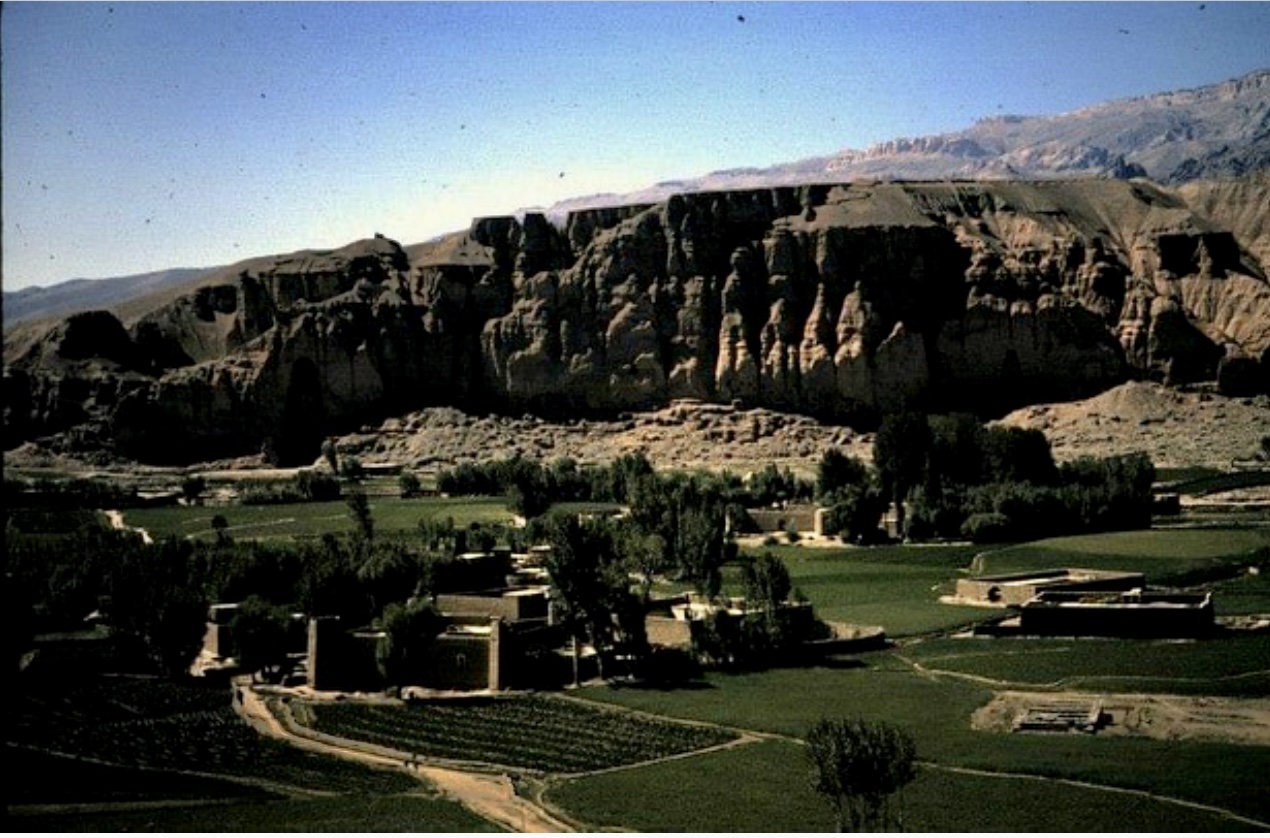
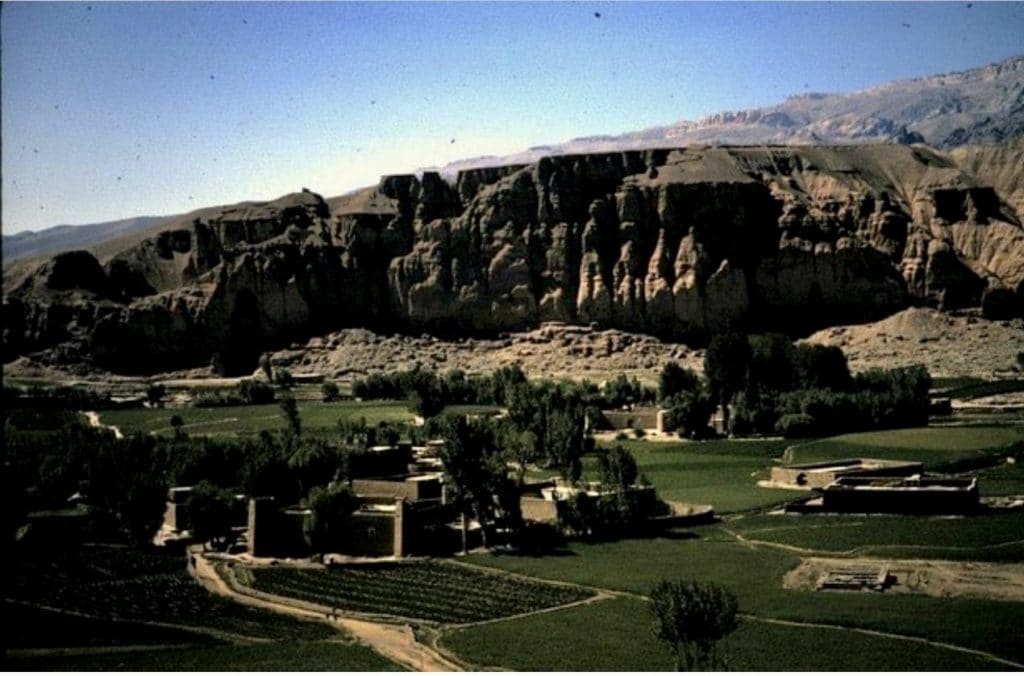
Photo from Susan Blumberg-Kason Family archives Afghanistan

For more information about how to help journalists in Afghanistan: click here

How to Help Women in Afghanistan Read More »

The Shadow Side – Thoughts on Torah Portion Ki Teitzei 2021


Preface to Shabbat Thought Friday 20 Aug 21: We went to very deep places this week in our wisdom classes on Wednesday night, experiences that lead us directly into the deep structures of the Days of Awe. In most disruptions of the unconscious ego self, we find grief, sadness and disappointment.  We discover memories of other people disappointing us, our disappointing others, and our not living a right and true path. A reflective person will always discover that they have patterns of disruptions, patterns that have existed probably since adolescence or even childhood.

Reflecting on the patterns of our inner disruptions is a part of a core practice of the month Elul – Cheshbon Ha-Nefesh, soul accounting.  We can all remember moments when we could have been more conscious, more understanding of ourselves and others, kinder, more courageous, wiser. In the reflections of the month of Elul, it is worth asking this:  what could I have known then that would have guided me?

The path to wisdom is oftentimes through grief, into sadness, into acceptance, and finally into wisdom.  In my understanding of things, there is no shortcut in this path.  I am not sure if a person who has not suffered can achieve the deep wisdom of the healing of the broken heart. In our studies this Shabbat, we will study these matters – the path from the shadow into the light.

The Shadow Side

Thoughts on Torah Portion Ki Teitzei 2021


Last week I gave a teaching on Torah portion Shoftim, focusing on the shadow of the law. By this term, I mean that in addition to looking at the contents of different teachings, commandments, statutes and laws, we ought to be inferring the background in which these statements are rooted.


For example, the great charge we are given in last week’s Torah portion, “Justice, justice shall you pursue!” is likely rooted in a time where injustice was rampant. Laws against bribing judges would only make sense in a time where bribery of judges was a concern. Each law is rooted in an unseen background, in a shadow.


My guiding theme is that the laws in these two Torah portions, Shoftim last week and Ki Tetzei this week, as righteous and even beautiful as many of these laws are, indicate a culture and a society in crisis. These laws range from establishing order against disorder all the way to fighting the entropy of things falling apart.


The idea that laws exist in background is finely articulated in Robert Cover’s 1982 essay, “Nomos and Narrative” (found in many places on the web). For the non-expert, this article can be daunting. His main point is that the world of law, “nomos,” exists within some social construction of reality, a “narrative.” The most well-known example of this idea is the statement in our Declaration of Independence, paraphrased thus:


It is an obvious truth that our Creator has endowed every human being with rights that are not granted by the state and cannot be taken away by the state. One of the main jobs of the state is to protect these rights, especially the rights to life, liberty and the pursuit of well-being.


Why might we call this paraphrasing of Jefferson a “narrative?” It is a narrative in the sense of a myth, not meaning a fable, but rather a narrative containing words as symbols, pointing to deep, inexhaustible meanings that orient our lives.


What do we mean by “truth?” What do we mean by “Creator?” What do we mean by “endowed?” Who counts as a “human being?” What do we mean by a “right?” What do we mean by each of these terms, “life,” “liberty” and “well-being?” None of these words can be satisfactorily defined. Yet these words, symbolizing the depths of our experiences and visions as human beings, orient some of the foundations of the moral reality in which we live.


The laws, norms and values expressed in our Torah portions indicate a moral reality in the background, but the meaning of that moral reality is always under dispute.


For example, a nation may proclaim that one of its visions is to establish “justice for all,” but if few believe that justice exists, or many think that the word is meaningless, there can be no moral commitment to achieve “justice for all.”


Put simply, when we study the idea of “nomos and narrative,” we are invited into the deep discussion of the meaning of law in the symbolic world in which the law exists.


This idea may be applied directly to each of our lives. We all live in a “nomos,” a world of values, norms and behavioral rules. We typically don’t reflect or philosophize about this very much. Our actions and expectations are usually unconsciously guided by our inner nomos. Unless we philosophize or reflect, we only become aware of this moral reality when we believe that someone else has violated our nomos – or when we become aware that we ourselves are in violation of our own values.


When we reflect deeply about the moral reality to which we are committed, we inevitably discover that we each have thoughts, feelings, emotions, drives, impulses and images that live contrary to our moral commitments.


Let me give an example that you probably have seen in a movie or TV show. The crooks perform a heist. They divide up the loot. The leader adjures the gang, “Now don’t go spending this money for at least a year. Don’t go buying things that will bring us to the attention of the cops.” The gang agrees – they’ve made a moral commitment to each other, “honor among thieves.”


Once we observe that the writer has cared to include this scene, we know what happens next. Somebody is going to break bad. Someone is going to go buy a car or a watch. Someone is going to get whacked. Reality is like an inattentive parent – they only pay attention when someone is not in compliance. Then reality can make its presence know, strongly.


What drove that thief not to keep the commitment to stay under the radar of the cops? The shadow knows.


Point being that we each live in a nomos, a world of values, norms and behaviors. We also all have within us an inner world, a shadow self, that exists in direct opposition to our nomos. Most of us can regulate that oppositional world, consciously or by habit. Until we can’t.


Hence our Torah portions – norms and moral crises, law and disorder, crime and punishment, entropy and the moral commitment to make the center hold.


Hence also Rosh Hashanah and Yom Kippur. Rosh Hashanah ought to be a deep meditation on our world of values, norms and behaviors and then a resulting moral commitment to uphold that world. We then spend 10 days meditating on that nomos and our own tendency to live contrary to it. Yom Kippur is the day when we squarely face the shadow, the contrary self.


Will we own up to the moments when we break bad from our values, and will we do whatever it takes to bring our destructiveness under control?


The shadow thinks it knows. We have to know better than the shadow.

The Shadow Side – Thoughts on Torah Portion Ki Teitzei 2021 Read More »