fbpx

August 20, 2021

Tevilat Keilim: A Mitzvah of Ethical Consumption

Toveling (immersing) dishes is one of the stranger things I find myself doing as a late-in-life observant Jew. This was made painfully clear last week as I stood on the banks of the Charles River in Boston, feet bare and pants rolled up to my knees, dunking flatware and stem glasses into the murky water while passersby stared in confusion, and picnickers, annoyed by the sounds, glared.

“I don’t know if the Charles is the right place to wash your dishes, son,” said an older man as he walked past with his dog.

“I’m actually not washing them,” I responded. “It’s a Jewish thing. Before we use a new dish, we sort of … baptize it.”

He shrugged, gave me a thumbs up, and hurried on his way.

The commandment of tevilat keilim (immersion of dishes) comes from the Book of Numbers in the Torah. After a bloody battle with the Midianites, the Israelites collect their vessels as spoils of war. Moses then commands the Israelites to pass the vessels through fire to make them kosher, and then to submerge them in waters of purification.

From this, we learn that kosher is not quite enough for dishes acquired from an outside nation. An added ritual of sanctification must be performed. Today, this can be done either at a community mikveh (an indoor pool of water used for this purpose) or in a natural mikveh (certain rivers and lakes, as well as oceans).

The idea that one must ritually cleanse dishes acquired from non-Jews was deeply troubling to me when I first encountered it. This was back when I was completing my halachic conversion to Judaism in Israel. My teacher was a friendly and soft-spoken rabbi from the liberal end of the Orthodox spectrum, but he was sick that day. His substitute was brusque and insulting, and took pleasure in shocking us with the most unpleasant aspects of Kashrut (kosher laws). If we took issue with any of it, he would kindly remind us that conversion to Judaism was not mandatory. In other words, if you don’t like it, get out.

While explaining Tevilat Keilim, he said that the issue was “Tumat Goy” (the impurity of the non-Jew). He spat out the words like a slur and I wondered how I would accept a law that seemed to imply something so ugly about the non-Jewish world.

This preoccupied me for days, but there was something else he said that stuck with me just as much. He told us that the dishes in our homes would not need to be toveled after we converted, despite the fact that we had used them when we were not yet halachically Jewish. Our dishes, he said, would convert with us. As we submerged in the mikveh (a full-body dunk in a mikveh is the final step of the conversion process), our dishes would undergo a parallel spiritual transformation, as if they were indeed connected to us by some invisible thread—an extension of our physical presence in the world.

When the time came for my mikveh, I stripped naked and dunked while three yeshiva students looked on disinterestedly from above. When I returned home, I took stock of the dishes in the sink. Like me, they looked the same as they ever had. But they were different. And so was I.

In my years as a practicing Jew, there have been moments when I have felt supremely in touch with my own religious practice, as if, to paraphrase Moses, it was very close to me, in my mouth and in my heart.

In my years as a practicing Jew, there have been moments when I have felt supremely in touch with my own religious practice, as if, to paraphrase Moses, it was very close to me, in my mouth and in my heart.

Then there have been other moments when Judaism has felt too demanding, too irrational, and too out-of-step with the modern world to be sustainable. Lugging a cast-iron pot to the shores of Walden Pond falls in the latter category.

That said, not all transformations are as instantaneous as the transformation of that which is submerged in waters of purification. It took time to get used to this commandment, and even more time to understand what it might mean in a world devoid of Midianites.

Despite what our substitute said that day, I do not think that this commandment’s purpose is to cleanse away the so-called impurity of non-Jews. In fact, since that day, I have never once heard the term “Tumat Goy.” A google search yields nothing but an article on how non-Jews are not susceptible to ritual impurity at all.

So, then, why do we tovel?

Two possibilities have been offered by the sages. The first is that tevilat keilim is a chok, a commandment without clear purpose.

The second possibility is that the purpose of tevilat keilim is to sanctify a vessel that may have been used by those known to classical Jewish literature as “worshippers of stars.” In other words, idolators.

There is no doubt in my mind as to the most dangerous idols of our day and age. They are not the stars or the moon, nor are they statues of gold or silver. Rather, they are profit, consumption, greed and waste. It is this kind of idol-worship that has contaminated so many of the vessels we take into our homes.

The delivery of a package to one’s front door is the last step of what is all-too-often a long and devastating supply chain of exploitation and extraction. The attempt to be an ethical consumer, in our economy, is not altogether possible. In the parts of the world where so many of our household products are manufactured, conditions akin to slavery are regularly practiced. This is to say nothing of the environmental impact of satisfying our society’s unending craving for more and cheaper stuff.

To tovel one’s dishes, then, is to ritually break this chain. It is to confront all that we know and all that we don’t know about the origins of the things in our lives, and then to release it to the waters, readying the vessels for a new life of sanctity.

This is not to absolve us of our participation in these unjust consumer systems. No ritual can exempt a person from the obligations of Tikkun Olam (repairing the world). But this mitzvah creates space to confront the problem mindfully, and to redeem the spark of holiness contained in an object whose material history may have been wasteful or exploitative.

But this mitzvah creates space to confront the problem mindfully, and to redeem the spark of holiness contained in an object whose material history may have been wasteful or exploitative.

Rituals slow us down. They generate mindfulness. To tovel one’s dishes is to create a speedbump in the process of acquisition. To tovel all the kitchenware needed for my new apartment, for instance, took a solid five hours. The boxes had to be loaded into my car, transferred to the beach, and then unloaded. One by one, the items had to be submerged, then let to dry, and then repacked. At home, I unpacked them again and washed them.

One-click purchasing might seem easy and convenient, but for those who tovel, it is just the beginning of a longer and more intensive process. This, in and of itself, is a reminder to purchase carefully, purchase infrequently, and purchase to keep.

I don’t believe that my interpretation of this mitzvah is necessarily a 21st-century interpolation. I would make the case that this is the true meaning of the commandment. Cooking and eating are sacred activities in Judaism, with the table likened to an altar. What Moses feared, I believe, was placing vessels on this altar that had once been used to serve wicked causes.

When I shop and when I bring new items into my home, I share in this fear. The truth is that the story of our things is often an unseemly one, and this is what makes this mitzvah more vital today than ever. Until the idols have been smashed, and the wicked practices of modern manufacturing reformed, it is truly the least we can do.


Matthew Schultz is the author of the essay collection “What Came Before” (2020). He is a rabbinical student at Hebrew College in Newton, Massachusetts.


Tevilat Keilim: A Mitzvah of Ethical Consumption Read More »

Want to Know What Will Become of Afghanistan? Ask Iranian Women.

For days, I didn’t know why I did it. I bought a scarf, put it in my purse, and took it everywhere. I even folded it and put it on my table at a restaurant this week, next to a glass of water.

Come to think of it, I bought the scarf on the day America abandoned ship in Afghanistan.

As a little girl in post-revolutionary Tehran, I always kept a backup scarf in my backpack in case the mandatory one on my head fell off or became dirty with sweat or debris. My mother always kept a second scarf in her purse, too, as did my aunts, my grandmothers, and nearly all of my female relatives.

Last month, I ran into one of my aunts at a Persian market in Los Angeles. “Write about what will happen to the women in Afghanistan if the Taliban comes back,” she instructed, adding, “Because we all know what will happen.” Then she pointed to a group of Iranian women who were congregating around boxes of cucumbers and lemons.

As an Iranian woman, I’ve been obsessively thinking about Afghan women lately. But the Islamic revolution that tore through Iran four decades ago and the Taliban’s nightmarish rise to power in Afghanistan today don’t add up to a linear comparison.

Iranian women knew only of a Westernizing, secularist government before the 1979 revolution. In a nutshell, they went from freedom to oppression, which continues today.

Afghan women, however, have known oppression, then freedom, and now, the horrifying return of oppression. For the past two decades, many of them tasted freedom by enrolling at universities and working, becoming entrepreneurs, journalists and even mayors, before the Taliban took control again. They were able to do things that we in the West view as ridiculously self-evident rights, such as leaving their homes without a male escort, attending school, working, laughing out loud or speaking loudly in public. They were able to wear nail polish and cosmetics, and stand on balconies. The Taliban forbids women from all of these actions, and more.

Afghan women, however, have known oppression, then freedom, and now, the horrifying return of oppression.

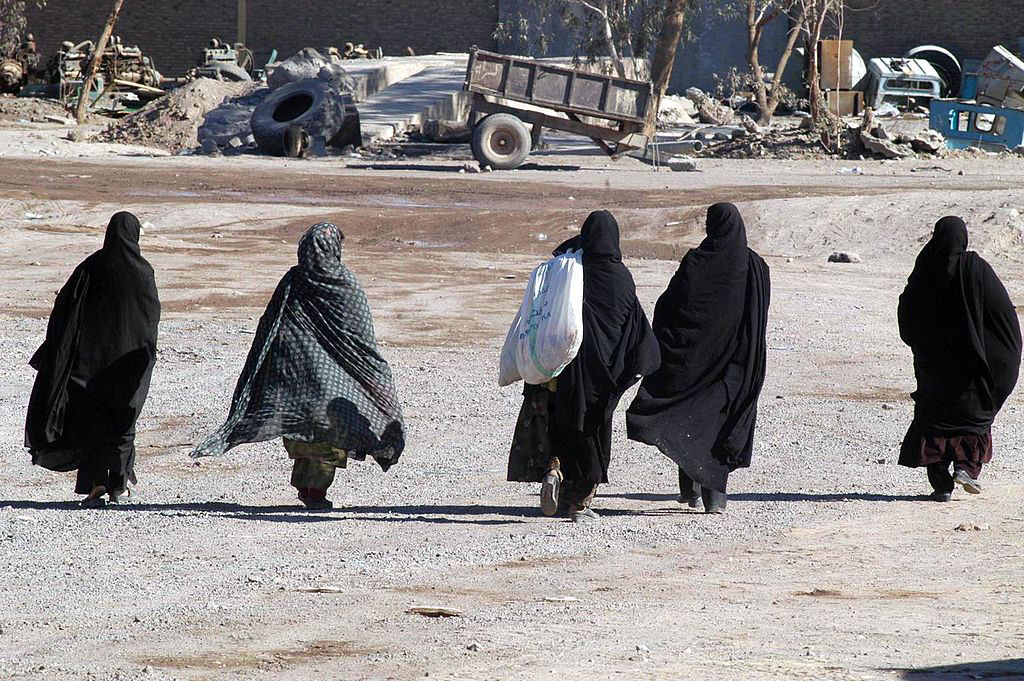
This week, city by city, when confronted with news that the Taliban was minutes away, Afghan women ran in search of burkas. Not headscarves, like Iranian women 42 years ago after the Iranian revolution, but actual burkas.

As I write, the murderous barbarians of the Taliban are going door-to-door, looking for various targets, including women (and young girls, whom they “gift” to their leaders), Americans, Christians, LGBT Afghans and anyone who worked with American forces. For the 19 million women of Afghanistan to return to such a nightmare after having tasted freedom is, I believe, harder than anything Iranian women faced. In fact, the Taliban is now calling Afghanistan a name it designated for the country over 20 years ago: The Islamic Emirate of Afghanistan.

And then, there is a generation of Iranian women whose lives were upturned at the hands of merciless fanatics, after Ayatollah Ruhollah Khomeini and his cronies turned Iran into a theocracy in the wake of the 1979 revolution. They even changed the name of the country to the “Islamic Republic of Iran.” Initially, Khomeini assured citizens that women would have equality. Then, he announced that all women, regardless of faith, must wear the hijab, or Islamic head covering, in the workplace and at government offices so as not to appear “naked.” In March 1979, tens of thousands of Iranians, most of them women, took to the streets on International Women’s Day to protest the shocking new laws. Eventually, by the early 1980s, the hijab became mandatory for females everywhere (except in the home), including little girls. Thugs who enforced new “morality” laws beat women in the streets, shouting “Head scarf or head smack!”

Having been born after the revolution, I don’t belong to a generation of Iranian women that enjoyed basic rights such as free-flowing hair, access to education, or even miniskirts and mixed gender parties. Like millions of other little girls in the country, I was born into the mandatory hijab, not forced to learn how to live with it (like my mother, my grandmothers or my aunts). Overnight, Iranian women raided their closets or quickly stood in lines at stores, in search of headscarves. The price of being seen without a head covering was simply too high. But for me, life didn’t become oppressive overnight because I was born into oppression itself. In fact, the system, with its brutalization of women, was already in place.

But for me, life didn’t become oppressive overnight because I was born into oppression itself.

And just as Khomeini assured Iranians over four decades ago, the Taliban announced this week that women would be safe under theocratic rule. “We assure that there will be no violence against women,” said Taliban spokesman Zabihullah Mujahid. The bold-faced lies of these men are only matched by their medieval cruelty.

This isn’t a contest over who is more miserable or endangered. As I mentioned, the comparison between Iranian and Afghan women isn’t even linear. But ask an average Iranian-American woman about what’s transpiring in Afghanistan today and she will reveal a humble, empathetic understanding of some of the plights of Afghan women. Many of these Iranian women, whether in Los Angeles, Orange County or New York, still suffer from untreated trauma related to living through the revolution (and escaping Iran). Their voices can offer one of the most powerful and damning indictments of fanatic Islam. Sadly, I can’t say the same for some American leaders; whereas Rep. Ilhan Omar (D-MN), who hails from Somalia, sees freedom in wearing the hijab, Iranian women know firsthand the misery of the hijab when it’s mandatory (and non-adherence is punishable by arrest, torture and imprisonment.)

Yes, like Afghan women today, Iranian women have lived under the brutalization of fanaticized men. And for those of us who escaped Iran, we’ve truly come out on the other side.

Do we believe that America could ever be overturned into an Islamic theocracy? Not exactly. Not in this decade, anyway. And probably not in this century. But most Middle Eastern women have one thing in common with fanatic Islamists (hopefully, the only thing): our ancient heritages enable us to think about the future in terms of centuries, rather than mere years.

But even in America, some of us are still looking over our shoulders. And we can’t let go of our scars, or our scarves.


Tabby Refael is a Los Angeles-based writer, speaker and civic action activist. Follow her on Twitter @RefaelTabby


Want to Know What Will Become of Afghanistan? Ask Iranian Women. Read More »

Our Obligation to the Women of Afghanistan

The events of the past few weeks in Afghanistan are horrifying on so many levels. But the true magnitude of the horror dates back decades, centuries even.

The human toll of the United States’ longest war is devastating. Thousands of American soldiers and contractors have been killed and many more have been maimed and injured. Tens of thousands of Afghan civilians have died and millions more have suffered. Our chaotic and hurried withdrawal has created additional tumult and pain, tarnishes our global reputation, and might very well lead to an international refugee crisis.

In time, we will learn valuable lessons from this painful chapter of American presence in Afghanistan, which, to be sure, is not without its successes. A variety of public health indicators have seen overall improvements. We have also seen the suppression of terrorist activities and opium trafficking. One of the most significant positive outcomes has been the benefits experienced by Afghan girls and women. This is perhaps the greatest tragedy of the Taliban’s return to power: their track record regarding the treatment of women is truly nauseating including denying girls and women educational and employment opportunities, dictating precisely how women may dress, and punishing behaviors deemed to be immodest with public floggings and executions.

We should care deeply about this as human beings and, particularly, as Jews who are committed to creating a world in which the fundamental kavod (dignity) of both women and men is universally acknowledged, a world where pay inequities, sexual harassment, sexual violence, and human trafficking are no more.

This week’s Torah portion, coincidentally, touches on some of these issues. To be sure, our Biblical ancestors were not feminists: the stories and teachings of our Torah emerge from a deeply patriarchal world. And yet, in this week’s Torah portion, Ki Teitzei, we are taught that there are limits to how we may treat those we take captive in war, including women. In the context of the ancient Near East (and the contemporary Near East as well in most places other than Israel), such a limit on patriarchal power, particularly vis-à-vis the enemy, was unique. It points to a larger concern of the Torah: the obligation of those with power to care for the most vulnerable among us. Again and again we are reminded of our responsibilities to the stranger, orphan and widow.

While we can debate many things about America’s longest war, including how it was initiated, how it was managed, and how, ultimately, it ended, what is impossible to deny is that the American presence in Afghanistan these past two decades has been incredibly beneficial to Afghan girls and women. Nobel peace prize winner Malala Yousafzai, herself a survivor of Taliban misogyny and violence, shared these thoughts on Tuesday: “We will have time to debate what went wrong in the war in Afghanistan, but in this critical moment we must listen to the voices of Afghan women and girls. They are asking for protection, for education, for the freedom and the future they were promised. We cannot continue to fail them. We have no time to spare.”

It points to a larger concern of the Torah: the obligation of those with power to care for the most vulnerable among us.

As Americans and as Jews, no matter how exhausted we are from this painful conflict, we have an obligation to continue to care for the lives of the most vulnerable and to find appropriate ways to advocate for their well-being going forward.

To fail to do so would be another tragedy.


Rabbi Yoshi Zweiback is the Senior Rabbi of Stephen Wise Temple in Los Angeles, California.

Our Obligation to the Women of Afghanistan Read More »

Allies and Activists in the Disability Rights Movement

Can non-disabled allies serve in leadership positions of organizations advocating for and serving individuals with disabilities? If so, can this be done without overshadowing or subverting the voices of people with disabilities as leaders of their own movement?

It depends.

If leadership comes from a top-down, “we know what’s best” approach, then the answer is no. The ableist sensibility of “we’re just trying to help you” operates from a blind spot rather than a place of true service.

If, however, it comes from a place of collaboration, inclusiveness and the intention to raise the voices of individuals with lived disability experience, then the answer is yes. In fact, perhaps this is exactly what society should look like: individuals with disabilities and non-disabled individuals working together for a common cause. One might argue that real inclusion is the ultimate goal for every community.

If the disabled community were to say only people with lived disability experience can advocate for individuals with disabilities, wouldn’t that be the opposite of inclusion?

When we say “nothing about us without us” it doesn’t mean only us. It means all of us, as long as we remember that the voices of people with lived disabilities must be heard and included at the tables of power and influence. They must be part of all conversations that impact the disabled community. And if a non-disabled activist is truly an ally, then “nothing about us without us” will always be at the forefront of all conversations, all activism and all policies and decisions. A true ally will always advocate for disabled representation, accessibility and inclusion wherever and whenever disability issues present—which, in truth, is always and everywhere.  

When we say “nothing about us without us” it doesn’t mean only us.

But the word “ally” has taken on a negative connotation. A non-disabled person can be empathetic enough to the cause and advocate alongside individuals with disabilities. So why do many feel that non-disabled advocates are not credible advocates? Without allies where would we be? To dismiss their expertise, empathy and knowledge does a disservice to the entire community. On the other hand, we must never dismiss the voices of people with disabilities who have the lived experience.

While suggesting that non-disabled advocates can have a seat at the leadership table may sound like heresy to some, we believe that there is strength in numbers. We believe that the more people who work toward greater rights for people with disabilities, the stronger we all will be.

We are two women in the disability field. One of us is a blind woman with 55 years of lived experience as a disabled person and as a disability advocate. The other is a woman with 28 years of experience in advocating for the inclusion of people with disabilities in all aspects of life and creating and ensuring opportunities for people with disabilities (the disparity of years reflects the disparity in our ages, not our commitment to disability rights).

Both of us see the world from a lens of inclusion, both of us see society’s prejudices and misconceptions, both of us see the lack of accessibility, and we both fight for inclusion, accessibility and the rights of people with disabilities.

We are in fact both advocates. One of us happens to be blind and the other does not have a disability, but we both want the same thing: a world where people with disabilities are valued, included, have opportunities and belong. From our own unique perspectives, we each understand what that means. From our different vantage points, we each have different opportunities to be advocates: one of us understand, from deep in her soul, the challenges people with disabilities face; the other understands, from her lived experience, what it means to face those challenges. This collaboration is quintessential strength in numbers and the true definition of symbiosis—two things that support each other.

One of us happens to be blind and the other does not have a disability, but we both want the same thing: a world where people with disabilities are valued, included, have opportunities and belong.

Finally, we question the distinction of a disabled person being labeled an advocate while a non-disabled person is labeled an ally. Is the distinction necessary? Is it not possible for us both to be advocates, one of us is blind while the other is not?

Neither of us feels superior or that we are a greater expert or more committed to the cause. No, we recognize each other’s strengths, we support each other and ultimately we want the same thing: a world in which disability is just a part of the human experience. An accessible world in which people with disabilities have the same rights and opportunities as non-disabled people. A world in which we welcome, value and include people with disabilities as a matter of course. We both want a world where people of all abilities learn play, work, live and grow together—a community of belonging.

We are both allies and we are both advocates and neither of us is giving up our membership in the disability rights movement.


Michelle Friedman has been a disability advocate for 40 years and is a speaker, children’s book author and is currently the Board Chair of Keshet.

Jennifer Phillips is an accomplished special education and inclusion  professional with more than 28 years of experience in classroom, camp, recreational and residential settings. She is currently the President and Chief Executive Officer of Keshet.

Allies and Activists in the Disability Rights Movement Read More »