fbpx

August 12, 2021

As the World Turns

There’s no place in this world where I’ll belong when I’m gone

And I won’t know the right from the wrong when I’m gone

And you won’t find me singin’ on this song when I’m gone

So, I guess I’ll have to do it while I’m here.

—“When I’m Gone” (Lyrics by Phil Ochs)


It is not your duty to finish the work, but neither are you at liberty to neglect it.—Rabbi Tarfon


As the world turns dark, my job is to shine a light as best as I can, and to try, if only a little, to brighten this ailing world back up. I have no illusions that I can fix the world. I am only one person. So perhaps the scope of that light won’t shine much farther than on my family, some of my neighbors, a few friends, and my audiences that come to laugh and forget. But that’s OK. That’s a start. At least I am doing something.

Because as Rosh Hashanah and Yom Kippur gallop toward me, hopefully I’ll be given another chance and more time to fix the twisted and broken branches of this world. Then I will use the broom of wisdom to sweep clean the debris from this past year.

Because as Rosh Hashanah and Yom Kippur gallop toward me, hopefully I’ll be given another chance and more time to fix the twisted and broken branches of this world.

Because the alternative of doing nothing is a paralyzing thought. To do nothing is to give up my citizenship as a person. To do nothing is to be barely human. To not correct is incorrect. We have seen the direction the world takes when people either do or say nothing, either consciously or unconsciously. It’s too late to do nothing. The clock will not tick backward. We are now within its grip.

As hatred grows like unpulled weeds, it chokes the roots of a fragile civilization. As we are now witnessing, it’s much easier to destroy than it is to build. Since I have become aware of these changes, my soul has been ignited. I have always cared about people, goodness and fair play.

I haven’t always acted like I cared, though. I spent many years silently riding the merry-go-round, feeling proud just to pay my bills on time. I worried about my credit rating. But what about that ultimate rating: the one for your soul. The rabbis might say I was asleep, and that saddens me. I lost precious time. I personally feel somewhat responsible for the decay. But thank God, caring was always in me and, to whatever degree, I now recognize it. I finally hear an echo from the mountain. The supreme voice is angry when I sit still, as if I have not earned idle time. The voice asks that I do something. Something to show I care. Something that proves I am not just words. Something that shows I believe in him and his children.

As the curtain falls on my 60s and I realize I have little time left, my eyes have snapped open. I feel the need to protect my family now more than ever. A day does not pass where I don’t worry about their safety. I care more about being a good husband, father, grandfather and friend. I care more about being helpful. I care more about helping to stop the madness. And it is madness. I care more about being a good Jew. I have never been prouder than I am today of my Jewish soul. I have never been more grateful for the gift I was given when I entered this world. It makes me think that, because of the depth of my love for being a Jew, the roots of these feelings, coupled with my anxieties for my people, are connected to the long, arduous and treacherous roads my people have had to march down—many times, to their deaths. These feelings are so strong it makes me think that this is not the first time my neshamah (soul) has entered the Jewish maze. It all feels so eerily familiar.

So, while the roots of our lives are being torn away, prayer, kindness and especially our time is more important than ever. A hello, a smile, or a phone call asking how a person is has more power than ever before. People are scared. People are angry. People need assistance. A simple hello can reach the heart as quickly as any bullet.

The rabbis have told us that we can’t solve this. We can’t fix this. But we still must do our part.

Mother Teresa never finished the job she was put on earth to do. The streets of Calcutta remain full of the sick and the dying. But she did what she could.

The Chofetz Chaim, the famous work on guarding one’s tongue, did not end lashon hara (negative speech), but Rabbi Yisrael Meir Kagan, its author, did what he could.

The Jewish souls that walked their last steps, shoeless and into stone buildings, still believed with the Shema on their dying lips.

So now, God forbid, before the dark turns permanent and the door is sealed behind us, on this Yom Kippur I choose to light the few candles I have left. A little light is better than none. I believe that each flicker of a candle is a wink from God to keep going.


Mark Schiff is a comedian, actor and writer.

As the World Turns Read More »

Human Rights Watch: Hamas Committed War Crimes During Most Recent Conflict

Human Rights Watch (HRW) released a report on August 12 concluding that Hamas may have committed war crimes during the recent escalation in May between the terror group and Israel.

HRW blamed Hamas and other armed Palestinian groups for launching rockets at Israeli civilians, killing 13 Israelis––12 of whom were citizens––and hundreds of others. HRW also concluded that Palestinian terror groups launched a rocket that misfired and landed in the Gaza Strip, killing seven people. HRW also noted that according to the Israeli military, 680 Palestinian rockets misfired.

HRW Acting Middle East and North Africa Director Eric Goldstein said in a statement, “Palestinian armed groups during the May fighting flagrantly violated the laws-of-war prohibition on indiscriminate attacks by launching thousands of unguided rockets towards Israeli cities. The failure of both Hamas authorities and the Israeli government to provide accountability for alleged war crimes by their forces highlights the essential role of the International Criminal Court.”

He added: “Hamas authorities should stop trying to justify unlawful rocket attacks that indiscriminately kill and injure civilians by pointing to Israel’s violations. The laws of war are meant to protect all civilians from harm.” The report referenced a statement from Palestinian terror groups saying that they were launching rockets “in response to the barbaric aggression against our people.”

HRW Executive Director Kenneth Roth tweeted, “Given Hamas’s long history of ignoring war crimes committed by its forces — most recently the indiscriminate rocket attacks fired toward Israeli cities — the International Criminal Court is needed.“

Jewish groups were not impressed.

“Finally @hrw condemns #Hamas for killing Gazan and Israeli civilians,” the Simon Wiesenthal Center tweeted. “Unfortunately HRW continuously demonizes Israel.”

UN Watch tweeted, “Ken Roth wants you to think he is fair and balanced by accusing both Hamas and Israel of crimes. But his goal is perversely to equate a terrorist organization that deliberately targets civilians with a democracy that aims to stop those attacks while avoiding harm to civilians.” They added in a subsequent tweet that Hamas and Israel are not morally equivalent and challenged Roth “to name an example of any army in the history of warfare that did more than the IDF in the recent conflict in Gaza to avoid harming civilians in a combat zone.”

Bar Ilan University Professor Gerald Steinberg, Founder of NGO Monitor, tweeted, “Every few years (from 2002), @kenroth’s @hrw propaganda machine produces a token ‘report’ on Palestinian terror etc, to be filed and immediately forgotten. No ongoing campaign, no sanctions, no impact — it’s all for gullible media.”

The blogger known as “Elder of Ziyon” argued in a post that the report shows HRW’s anti-Israel bias because it didn’t mention Hamas’ use of human shields or child soldiers. Elder of Ziyon also noted that the report stated that Hamas started launching rockets after Israeli authorities cracked down on protests in East Jerusalem over the potential eviction of Palestinian families in the Sheikh Jarrah neighborhood.

“The war started with Hamas rockets at Israeli civilians. But for HRW, Israel always starts the war, and the facts must be twisted until they fit that narrative,” the blogger wrote. “Note also that HRW doesn’t mention any violence by the Palestinian protesters in Jerusalem – and elsewhere in Israel – before the war. Only Israelis are violent.”

The Centre for Israel and Jewish Affairs tweeted, “Those who choose to use HRW reports to demonize Israel but fail to recognize this report are guilty of hypocrisy.”

Human Rights Watch: Hamas Committed War Crimes During Most Recent Conflict Read More »

ADL CEO Urges UC President to Condemn UCLA’s Asian American Studies Department for Accusing Israel of “Yellow-Washing”

Anti-Defamation League (ADL) CEO Jonathan Greenblatt urged University of California President Michael Drake in an August 9 letter to condemn UCLA’s Asian American Studies Department’s anti-Israel statement in May that, among other things, accused Israel of “yellow-washing.”

The department’s statement, titled “Statement of Solidarity with Palestine,” denounced “the exchange of military tactics and financial support between the United States and Israel, noting how U.S. counterinsurgency techniques and military equipment used during the Vietnam War were then extrapolated to the Occupied Territories; how the Israeli military’s policing of the apartheid wall dividing Jerusalem and isolating the West Bank has influenced the U.S.’s own brutal border security policies along the U.S.-Mexico border; and how Israel has too often upheld its support of Asian and Asian American individuals as proof of multicultural democracy, over and against the ethnic cleansing of Palestine via a process of ‘yellow-washing.’” It also stated that the violence that occurred during the May escalation between Israel and Hamas “are but the latest manifestation of seventy-three years of settler colonialism, racial apartheid, and occupation.”

“The statement makes many problematic claims and biased assumptions, including blaming the outbreak of violence in May solely on Israel and questioning Israel’s right to exist,” Greenblatt wrote to Drake, adding that while the ADL supports free speech, “we are concerned that the Asian American Studies Department statement isolates Jewish and non-Jewish students and faculty who are supportive of the state of Israel, and for whom a connection to Israel is part of their Jewish identity and will have a devastating impact on campus climate.”

He argued that it was important for UC officials “to issue a public statement distancing itself from the Asian American Studies Department statement” given that antisemitism is on the rise. “Now is the time for the University of California leadership to use your voice to speak out and offer support to all students who may be affected by the recent conflict in Israel and Gaza. It is long overdue for universities to send a clear message: they will prioritize the needs of their entire student body ahead of politics.”

Judea Pearl, Chancellor Professor of Computer Science at UCLA, National Academy of Sciences member and Daniel Pearl Foundation President, thanked the ADL in a tweet for supporting “UCLA professors who protested the politicization of academia and the criminalization of Israel and its supporters.”


Several university professors, including Pearl, signed onto a July 20 letter that similarly called on Drake to condemn the statement for creating “an unwelcoming, even toxic, atmosphere for students who disagree with them.”

At the time, a spokesperson from Drake’s office told the Journal that Drake “appreciates the concerns raised by the authors of the letter. The University will continue to ensure that its campuses are welcoming, inclusive spaces for all students as UC continues its rich tradition of free speech and diversity of thought.” Drake’s office similarly said in a statement to the Journal on August 12 that Drake “appreciates the concerns raised by Mr. Greenblatt on behalf of the Anti-Defamation League (ADL). The University will continue to ensure that its campuses are welcoming, inclusive spaces for all students as UC continues its rich tradition of free speech and diversity of thought.”

A spokesperson for the university said in a statement to the Journal, “These are important issues facing campuses across the UC system. Given their complexity and the importance of faculty input, we are grateful that the systemwide University Committee on Academic Freedom (UCAF), as well as the UC Academic Council, are conducting reviews on this matter for the University of California and its campuses. It is our understanding that this matter was discussed by the council in July and that the council plans to take it up again in partnership with UCAF in early fall, when new members are seated. We look forward to the outcome of this review.”

The department did not respond to the Journal’s request for comment regarding Greenblatt’s letter at publication time.

Other university faculty departments that have issued statements of solidarity with Palestinians include UC Davis and USC. StandWithUs’ Saidoff Legal Department and Center for Combating Antisemitism issued an August 10 letter to various universities demanding that they take action against the use of university resources to issue statements “that marginalize students based on their Jewish ethnicity, Zionist identity, and Israeli national origin.”

“Academic departments and student governments should not champion and disseminate one-sided political viewpoints on behalf of a university,” the letter read. “This is especially true of rhetoric and actions that marginalize students based on protected components of their identity, such as the Jewish religion, Jewish ethnicity or ancestry, and Israeli national origin. Universities should not be safe harbors for those who disseminate anti-Jewish hate by calling it another name and then dressing it with the university’s imprimatur through the use of the university’s channels.” The letter concluded with a call for universities to adopt guidelines regarding the “inappropriate use of official electronic communications resources, such as university listservs and official university social media channels, including a prohibition against the use of these resources to advance politicized viewpoints that could marginalize students and contribute to a pervasively hostile campus climate” and ensuring “that there are consequences for” violating these guidelines.

ADL CEO Urges UC President to Condemn UCLA’s Asian American Studies Department for Accusing Israel of “Yellow-Washing” Read More »

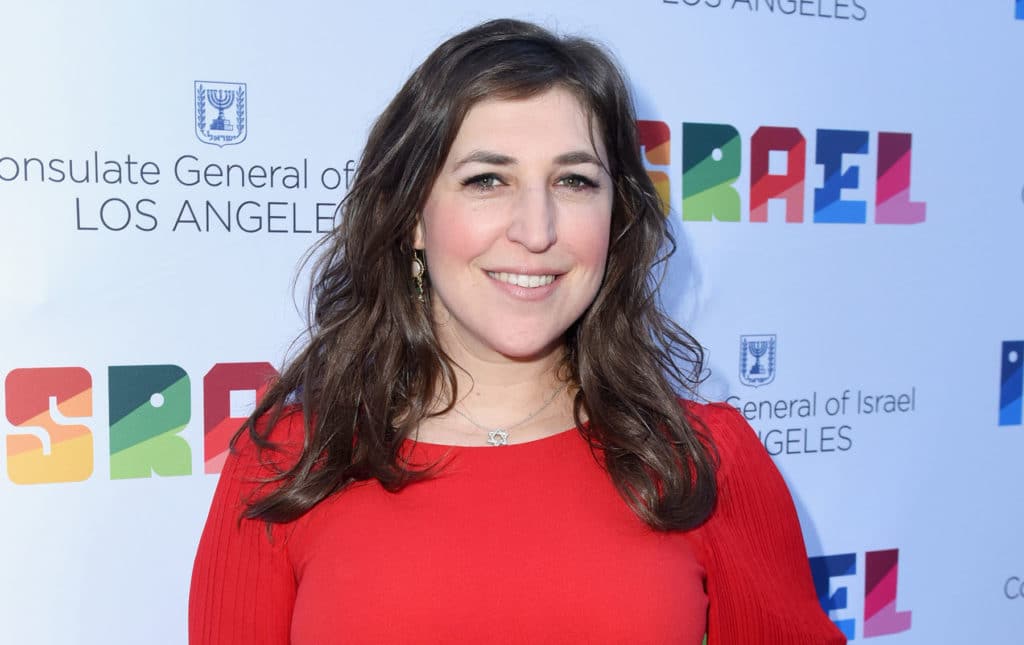
Mayim Bialik on Her “Jeopardy!” Hosting Announcement: “I Wore a Jewish Star in Every Episode”

“Jeopardy!” executive producer Mike Richards and actress Mayim Bialik are going to be taking over hosting duties for the game show following Alex Trebek’s death last fall. While Richards will be hosting the syndicated version of the show, Bialik is hosting the primetime and spinoff series, including “Jeopardy! National College Championship.”

Bialik, star of “The Big Bang Theory,” “Call Me Kat” and “Blossom,” and writer/director of the upcoming feature “As Sick As They Made Us,” with Dustin Hoffman and Candice Bergen, recalled her family’s history when the announcement was made.

“My grandparents fled the pogroms of Eastern Europe with barely anything to their name and started a new life here with no certainty, no support and no idea where their lives would lead,” she told the Journal. “My parents were born during WWII and scraped by and fought for every cause they came in contact with as they navigated a new culture and language. They raised me to believe in my Jewish faith and culture. They taught me to have a personal relationship with a complicated Gd who holds me close when I’m scared or uncertain or alone. I carry these struggles, this history and my family’s bravery and moxie as I embark on this new chapter of my career.”

“My parents were born during WWII and scraped by and fought for every cause they came in contact with as they navigated a new culture and language.”

During the search for Trebek’s replacement, Bialik stepped in as a guest host along with 15 others including Richards, former champion Ken Jennings, Packers quarterback Aaron Rodgers, LeVar Burton from “Reading Rainbow,” Fox Sports’ Joe Buck and Dr. Mehmet Oz.

Bialik, who is a lifelong “Jeopardy!” fan as well as a neuroscientist, was a fan favorite. This season, “Jeopardy!” was the most-watched show in syndication, with 8.7 million viewers on average.

The actress and host of the podcast “Mayim Bialik’s Breakdown” is outspoken about her passion for Judaism, explaining to the media why she wears modest clothing on the red carpet, showing her support for Israel on social media and appearing on the Partners in Torah website, which connects Jews who want to learn Torah together.

“Here’s a fun secret: I wore a Jewish star in every episode of ‘Jeopardy!’ that I guest hosted,” Bialik said. “Sometimes a pin, sometimes a ring and most often, one of two ‘hidden’ Mogen Dovids. One of my outfits featured earrings from The City of David in Jerusalem, which were unearthed in a dig in recent years. I find ways to maintain my sense of ‘Jewishness’ wherever I go. And it’s especially important to me to do that on such a public stage.”

She continued, “I look forward to finding more ways to honor my family and my people and the legacy of Alex Trebek as I begin my High Holiday season with planning filming for ‘Jeopardy!’”


Kylie Ora Lobell is a writer for the Jewish Journal of Los Angeles, The Forward, Tablet Magazine, Aish, and Chabad.org and the author of the first children’s book for the children of Jewish converts, “Jewish Just Like You.”

Mayim Bialik on Her “Jeopardy!” Hosting Announcement: “I Wore a Jewish Star in Every Episode” Read More »

The Elusive Fire — A poem for Torah Portion Shoftim

The Levitic kohanim…shall have no portion or inheritance with Israel;
the Lord’s fire offerings and His inheritance they shall eat.
-Deuteronomy 18:1

Nothing but the best for the workers –
except for cash, of course, but bring them
an ox or a sheep, or the best parts if
you know how to disassemble them.

Nothing but the best for the workers –
I mean not property, of course, but bring them
the best of your crops, the wine you were
saving for yourself, the oil which you
were going to do God-knows-what with.

Nothing but the best for the workers –
except for anything that requires legal documentation,
of course, but the fleece you took off your sheep
(if you didn’t give the whole sheep) Not the
leftovers from your special night out
but the whole meal!

Nothing but the best for the workers –
They don’t need you to take taxes out.
This is all under the table, and they’re
already getting Fire – the kind of Fire we
don’t get and distract ourselves from
not getting with our sheep and our
possessions and our land.

Nothing but the best for the workers –
And would you mind learning their names?
They have them, you know, although, at this point
it’s all the same last name, or last names
hadn’t been invented yet.

But know the faces of the workers –
Develop an appreciation for their
unique mannerisms
Look into their eyes
This may be the only glimpse of
that Fire you’ll get.


God Wrestler: a poem for every Torah Portion by Rick LupertLos Angeles poet Rick Lupert created the Poetry Super Highway (an online publication and resource for poets), and hosted the Cobalt Cafe weekly poetry reading for almost 21 years. He’s authored 25 collections of poetry, including “God Wrestler: A Poem for Every Torah Portion“, “I’m a Jew, Are You” (Jewish themed poems) and “Feeding Holy Cats” (Poetry written while a staff member on the first Birthright Israel trip), and most recently “The Tokyo-Van Nuys Express” (Poems written in Japan – Ain’t Got No Press, August 2020) and edited the anthologies “Ekphrastia Gone Wild”, “A Poet’s Haggadah”, and “The Night Goes on All Night.” He writes the daily web comic “Cat and Banana” with fellow Los Angeles poet Brendan Constantine. He’s widely published and reads his poetry wherever they let him.

The Elusive Fire — A poem for Torah Portion Shoftim Read More »

Bewildered in the Wilderness

Black is the night
when bewilderment brightens
the soul in the light
with the sight that enlightens.

Bewildered in “wilderness,”
mid-barred Israelites
lacked lightness to progress,
against Moses’ insights,

grousing with great grief,
while they, wailing, wallowed,
disdaining their belief
in him whom they’d followed.

Not heading toward
any goal, they felt lost,
completely ignored,
twelve tribes tribal trash-tossed,

which made it important
to find leaders who
would help them trans-Jordan,
as Joshua would do.

Post-Pentateuch, Book Six
tells how they dry-crossed
the Jordan, but not Styx,
no more feeling lost.

Yet though Jews’ survival
continues still fraught,
of hope, grief’s great rival,
we’ll never be short.

 “Bewilderment” is an eighteenth-century coinage, meaning “thorough lostness”; to “wilder” is to go astray, to lose one’s path.


Gershon Hepner is a poet who has written over 25,000 poems on subjects ranging from music to literature, politics to Torah. He grew up in England and moved to Los Angeles in 1976. Using his varied interests and experiences, he has authored dozens of papers in medical and academic journals, and authored “Legal Friction: Law, Narrative, and Identity Politics in Biblical Israel.” He can be reached at gershonhepner@gmail.com.

Bewildered in the Wilderness Read More »

The Abraham Accords One Year Later: Shaping a Common Future

(The Media Line) Two weeks ago, at the end of a fairly standard meeting in City Hall with a group of east Jerusalem businessmen, Mahmoud, a local entrepreneur, pulled me aside. He told me that as the result of his attendance at one of the webinars organized by the UAE-Israel Business Council, an organization I co-founded over one year ago, he now has a promising new business with an Emirati investor which utilizes Israeli technology and Moroccan raw materials.

At that very moment I truly understood the power of people-to-people peace. This is the new model of peace and co-existence we are building every day. Up until now, Israel was a lone player in the region and we were not part of any regional cultural, sporting or business alliances. Our network faced west rather than to our own neighborhood, where we share much in common.

This past year has changed everything. In June 2020, my co-founder Dorian Barak and I saw that a shift was taking place, but we did not know just how quickly it would boom. The minute the Abraham Accords normalization agreement was announced, we created an online platform for people to connect, the first of its kind for the accords. Within weeks thousands of Israelis and Emiratis had joined in order to interact with each other, to talk, to do business and to become friends. I cannot overestimate the enthusiasm on all sides of those early days. At the time, I was quoted as saying that it felt like we were dating. The initial curiosity about each other, our religions, cultures, and even how we raise our kids, helped us realize how similar we actually are.

Despite this past year being a pandemic year with lockdowns and essentially a closed airport, nearly a billion dollars in trade between Israel and the UAE will have taken place by the end of the calendar year. Nearly a quarter of a million Israeli tourists visited the UAE this past year and, by my estimation, that number will continue to grow in year two.

The prognosis is bright but not without its challenges. One concern is that the new US administration is not as invested in the Abraham Accords as the previous one. There were even rumors that the term “Abraham Accords” should be changed to simply “normalization.” The new Israeli administration is potentially about to cancel an oil agreement between Israel and the UAE, citing environmental reasons. Instead of saying how the arrangement could work and still remain environmentally conscious, the environment minister is bent on throwing out the baby with the bath water.

The latest round of the Israeli-Palestinian conflict in May was the biggest test of the budding new relationship. I am a firm believer that the conflict happened as a result of the Abraham Accords, as a sort of revenge of the Muslim Brotherhood to remind us that they are still around and to try and create divisions and bad blood between Israelis and Arabs, and between Jews and Muslims. The press in the Gulf demonized Israel as is tradition, but something else was happening. During this time period, I received dozens of phone calls from my new friends in the UAE and Bahrain asking how my family and I were doing, how we were holding up, and asking us for our side of the story. They instinctively knew that there was another side, that we are decent people so there had to be, and mainly they wanted to know how we felt and what we thought. We got through the first major test of this new relationship and a short week after the end of hostilities we were back in Dubai seeing our friends and continuing to build this warm and sustainable peace.

These challenges are real. There is still much work to do. However, I am convinced that the Abraham Accords will continue to march on and build further momentum. The Abraham Accords are building a sustainable peace in our region. We must each do our part to help propel this forward.


Fleur Hassan-Nahoum is the deputy mayor of Jerusalem and the co-founder of the UAE-Israel Business Council and the Gulf-Israel Women’s Forum

The author of this blog or other opinion piece is a third-party contributor who is independent of The Media Line Ltd and its partners or supporters. All assertions, opinions, facts, and information presented in this article are the sole responsibility of the author and are not necessarily those of The Media Line and/or all parties related thereto, none of whom assumes any responsibility for its content.

The Abraham Accords One Year Later: Shaping a Common Future Read More »

The Museum of Tolerance Reopening Today

While the Museum of Tolerance has been closed throughout the pandemic, it is set to reopen to visitors on August 12.

“We have been planning for a while how to provide the valuable experience of the MOT to our public visitors, as soon as it is safe to reopen,” said Michele E. Alkin, Director of Global Communications for the museum. “As other museums were opening to the public, with MOT staff grateful to return to work and increasing inquiries from eager visitors, a limited schedule of museum operations was welcome at this time.”

When COVID-19 hit, the MOT went online. People could experience the public programs virtually, and according to Alkin, they will remain virtual for the time being.

Admission includes access to the Social Lab and Holocaust Exhibit, the Anne Frank Exhibit, and Para Todos Los Niños, live personal testimonies and temporary exhibitions. The museum also plans to hold several film screenings and discussions, weekly testimonies by Holocaust survivors followed by Q&As, and distinguished author presentations.

“During the pandemic, MOT exhibits have been updated to remain current, relevant and meaningful,” said Alkin.

To keep everyone safe, the MOT will require guests to wear masks indoors, regardless of vaccination status, which is in accordance with Los Angeles County Department of Public Health guidelines. Additionally, the museum has improved central air filtration and enhanced cleaning protocols, as well as installed touchless restroom faucets.

To keep everyone safe, the MOT will require guests to wear masks indoors, regardless of vaccination status, which is in accordance with Los Angeles County Department of Public Health guidelines.

“The mission and work of the MOT are even more crucial as we emerge from an intense period of unprecedented challenges,” said Alkin. “The MOT provides [a] stimulating and safe space to have the difficult conversations around the serious issues with which we are grappling, including the alarming increase in antisemitism and hate.”

Since the museum opened in 1993, 7.5 million visitors have experienced it, and the institution has left an indelible mark on LA, said Alkin. With its reopening, the MOT can continue its work of educating both Jewish and non-Jewish communities about the Holocaust while tackling the discrimination and prejudice that are still prevalent in our society.

“The Museum of Tolerance has impacted millions of people around the world and visitors have discovered that the museum is a life-changing experience unmatched by any other museum in the world today,” said Alkin. “The powerful exhibits and immersive experience of the MOT challenge us to reflect, from an historic and contemporary perspective, on what is happening in our world and our role in it. We are better informed and empowered to assume responsibility and make a positive difference.”

The Museum of Tolerance opens August 12 and will have limited hours: open from 10 a.m. to 5 p.m. on Sundays and 10 a.m. to 3 p.m. on Thursdays and Fridays.


Kylie Ora Lobell is a writer for the Jewish Journal of Los Angeles, The Forward, Tablet Magazine, Aish, and Chabad.org and the author of the first children’s book for the children of Jewish converts, “Jewish Just Like You.”

The Museum of Tolerance Reopening Today Read More »

An Everyday Guide to Being an Olympian

In the third grade, I stood at the edge of the mat, ran with all of my force, and sprang into a powerful roundoff.

I did not stick the landing.

Instead, I broke my radius and my ulna (the two bones in your lower arm) at the same time.

I later broke my ankle playing basketball, and broke both my wrist and my growth plate in two separate, but equally fun, relay races.

All this to say, I’m not exactly the world’s most athletic (or, apparently, coordinated) person. While I’m never going to compete in the Olympics Games I really enjoy watching them. As I’ve enjoyed Tokyo from the comfort of my couch, with a glass of wine in my hand instead of a cast around it, here’s my take on three things we can all do to show up as Olympians every day at work.

Saying yes to saying no.

The world went bananas (and nearly broke the internet) when Simone Biles pulled out of the team event in Tokyo, and here’s why: so many of us desperately crave that same courage to say no.

So how do we do it? It’s actually this simple: If Simone Biles can withdraw from the Olympic team finals, you can say yes to taking a vacation, taking a sick or mental health day, declining a meeting, project, or a Zoom, asking for help, or just saying no.

Seriously, one more time: If Simone Biles can withdraw, are you going to tell me you cannot decline a single obligation?

If you’re still not convinced, consider this: We often look at saying “no” as a sign of weakness, when it’s actually a sign of strength. What Simone revealed in that moment of immense scrutiny and pressure is that we always have permission to make a choice, and that the right choices actually enhance both our reputation and the longevity of our career.

What Simone revealed in that moment of immense scrutiny and pressure is that we always have permission to make a choice, and that the right choices actually enhance both our reputation and the longevity of our career.

Basking in bronze.

Okay, did you see Simone win that bronze? Great, so I’m not the only person who teared up. What a powerful statement for a woman known as the G.O.A.T (the greatest of all time) to bask in her bronze, accepting her medal with such pure and absolute joy.

Basking in bronze is really hard for a lot of us. Especially if you’re a (recovering) perfectionist like me. As Claire Wasserman writes in her book, “Ladies Get Paid,” when it comes to perfectionism we typically believe that:

“Anything less than flawless is a failure; and failing at a task really means that we’re the failure … But by convincing ourselves that having unreasonable standards is in our best interest, we risk getting stuck in the never-ending cycle where we’re pushing ourselves too hard and then being too hard on ourselves for every misstep.

“To be clear,” Wasserman reminds us, “letting go of perfectionism doesn’t mean lowering our standards. It means operating from a desire to do well, not so we can escape judgement but so we can grow.

In Tokyo, Simone reminded us of what can change in our lives and outlooks when we give ourselves permission to bask in bronze instead of beating ourselves up.

The one percent strategy.

For many of us, getting comfortable saying “no” or conquering our perfectionism can feel incredibly liberating in theory, but impossibly daunting or downright radical in practice. That’s why one of my favorite Olympic stories comes from Great Britain’s cycling team.

After winning a gold in Sydney in 2000 and scooping up another two in the ’04 games in Athens, the team got a new coach, Sir David Braillsford, who had a theory. He believed that the team could make a huge performance leap—not by making a massive stride in a single area, but by making incremental changes, one percent at a time, across everythingin their training routine.

So the team started making a large number of small changes to their helmets, their diet, and their training routine, even seeking out the best pillows, and taking them everywhere they went as they competed around the globe. And with one percent changes here and one percent changes there, they went from two golds in Athens, quadrupling to eight golds in the next games in Beijing and holding down eight golds again in their home-town games in London in the Olympics that followed.

Meet me on the podium.

This is the practice of being an everyday Olympian: saying “yes” to saying “no” happens one percent at a time. Letting go of our perfectionism so we can bask in bronze happens one percent at a time. It’s one day at a time one decision at a time.


Randi Braun is an executive coach, consultant, speaker and the founder of Something Major

An Everyday Guide to Being an Olympian Read More »

A Moment in Time: Coming Full “Cycle”

Dear all,

While in the park this week, I saw a fellow on a unicycle. I then looked at my Hebrew calendar and noticed that it happened to be the 1st day of the month of Elul.

Elul is a significant month in Judaism. It is our time of spiritual preparation before the Holy Days. We have come a full cycle as individuals and as a people, and we are all trying to find our collective balance in this life-journey. It’s so easy to fall! And it takes strength to get back up. Thus we consider:

How have we held one another up this year?
How did we keep forward momentum for the betterment of society?
When we fell, who was there to motivate us?
And …. What is it that truly unites us?

Let’s use this month as our moment in time to reflect, to recharge, and to renew.

With love and shalom,

Rabbi Zach Shapiro

A Moment in Time: Coming Full “Cycle” Read More »