fbpx

August 4, 2021

On Aging

Is aging as positive as some claim or as terrible as others perceive?

The Book of Job states that “with the ancient is wisdom; and in length of days understanding.” The American writer Edith Wharton, on the other hand, complained that “there is no such thing as old age, there is only sorrow.”

There are clearly very different opinions as to whether old age brings benefits or confers only losses. The great World War II hero, General Douglas MacArthur, said:

“Nobody grows old by merely living a number of years. People grow old by deserting their ideals … You are as young as your faith, as old as your doubt; as young as your self-confidence, as old as your fear; as young as your hope, as old as your despair.”

Perspective changes our sense of what is trivial and what is significant in life.

For General MacArthur, age is not as much a number as it is an attitude toward life. For him, ideals, faith, self-confidence and hope are ageless and belong to all people in all stages of life.

In that spirit, I offer my own Eight Truths on Aging:

  1. In Hebrew, if you wish someone a long life, you wish him or her yerichus yomim, length of days. Why not length of years? Why days? Judaism puts the emphasis on each day. Yom Yom. Take it day by day. If the days are good, the years will be good. We hope the years will be long, but it is quality over quantity that matters. So the first Truth is that our lives are made up of days and we should focus on making each of those days count.
  2. With age comes experience, which should confer perspective. The older person realizes that what seems important to the young is less so with the passage of time. Perspective changes our sense of what is trivial and what is significant in life. Material acquisition yields to relationships, and ambition gives way to the search for meaning. The second Truth is that the journey of life moves us from a focus on the superficial and the transitory, to one on the profound and the lasting.
  3. Older people realize, as the joke goes, that, except for one trifling exception, the world is made of others. In time, they become less self-centred, less striving, more satisfied and appreciative. Along with the understanding that there’s a wide world out there beyond the self—with much to offer and many people in need of care, along with many opportunities for expanding one’s horizons—older people often engage with others more frequently, and often find great satisfaction. The third Truth is that, as time passes, much of one’s former life gets left behind, but there is also plenty of life ahead.
  4. It is undeniable that seniors do not have the energy of youth and often suffer from more than one ailment or disability. But that loss of youthful dynamism can strangely affect the mood in a positive way. Life seems more settled, less frantic, and we feel more at peace. We are free in a way that young people are not. Youthful ebullience is traded for a sense of accomplishment, memories, understanding, insight and even a touch of wisdom. The fourth Truth is that there is a lot to be said for the serenity that old age can bring.
  5. Thinking that “things were better in the good old days” is neither productive nor necessarily true. Boomers often talk about how great things used to be back in the 1950s and 1960s, forgetting that civil rights for minorities were restricted, opportunities for women limited and the Vietnam war and the Cold War loomed large. As the saying goes, nostalgia ain’t what it used to be. The fifth Truth is that seniors need to look back honestly at the past, and look to the future with hope.
  6. Just as young people grow professionally, intellectually and in other ways by taking on challenges, so should older people. Young professionals learn on the job, take on responsibilities at work, and often assume leadership positions in charitable organisations or synagogues. Old age need not be a time to withdraw but can be a time to take on new challenges. After a career in the university, teaching and publishing research in academic journals, I was invited to write for a Jewish newspaper. I have done that since retirement and found writing for a different audience in a different medium to be exciting and energizing. The sixth Truth about aging is that change is an opportunity at any age and should be undertaken with enthusiasm.
  7. Do not accept decline as a given. Everyone experiences difficulties at some point, especially as we age, but we do have some agency in our own state of health. We can always make improvements, and resignation should not govern our feelings when good decisions can have positive outcomes. The seventh Truth about aging is that we should do what is within our power to enhance the “Golden Years” physically, mentally and spiritually.
  8. In keeping with the seventh Truth, I conclude with an idea from psychiatrist and Holocaust survivor Viktor Frankl. He taught that we cannot control what happens to us but we can determine our reaction. When truly difficult situations arise, we always have the choice to become disillusioned and defeated or act with grace and dignity. The eighth Truth on aging is that we should never stop believing in our ability to exert agency over our lives.

The American poet Henry Wadsworth Longfellow wrote:

“Age is opportunity no less
Than youth itself, though in another dress,
And as the evening twilight fades away
The sky is filled with stars, invisible by day.”

The poet’s words are aspirational. Not everything about aging resembles bright stars in the night, but we also must not lose sight of the possibilities, as long as we are blessed with life.


Dr. Paul Socken is Distinguished  Professor Emeritus and founder of the Jewish Studies program at the University of Waterloo.

On Aging Read More »

Can Plant-Covered Buildings Cool Things Down?

You don’t realize how small you are until you find yourself walking on a sidewalk in the middle of a city surrounded by hundreds, thousands, and often millions of people, and it’s hard to conceptually fathom the amount of people living, breathing, and working in that city, isn’t it? But everything you do whether its cleaning dishes in your apartment, throwing away less than a week’s worth of garbage, turning on the air conditioner, or driving to and from work, there are hundreds of thousands––even millions––of others doing the exact same thing, thereby generating an enormous cumulative, concentrated impact to the environment.

Currently, the world’s population stands at a staggering 7.8 billion people, and more than half of those people, approximately 55%, are living in concentrated urban centers, or cities. The global population is even projected to grow by an additional 2 billion or so persons by 2050, and by that time, experts predict 68% of the population will take up residence in cities. Israel already exemplifies this trend to the extreme as 92% of Israelis presently live throughout the country’s many cities and towns.

With the climate crisis looming over us, the vast majority of scientists conclude that our anthropogenic activities have undoubtedly accelerated the rate of climate change and that our nonstop population growth only intensifies this trend. Solving this existential crisis therefore requires well-placed restorative actions and initiatives to reverse course, and what better place to start implementing change than the areas that host the most people and generate the most pollution? Cities.

This has given credence to the idea to transform cities into sustainable ones to combat the effects of climate change more effectively, particularly the urban heat island effect in which cities become many degrees hotter than their rural outskirts because of the lack of green spaces and the abundance of heat-absorbing concrete and asphalt that are used in virtually all aspects of urban infrastructure. As a result, this spawns greater energy costs for cooling, compounds concentrated urban air pollution, and prompts greater amounts of heat-related illnesses and mortality.

Integrating green buildings adorned with various vegetation into the urban landscape is one such strategy put forth by architects and city planners to deal with this intensifying phenomenon as they are said to provide natural cooling benefits among other things like improving local air quality and bringing a green-lush aesthetic to an otherwise concrete-grey urban landscape. But their eye-catching features begs the question: is it all for show, or is it a truly worthwhile investment? Luckily, a new Israeli study has set out to determine the answer.

The Real Deal

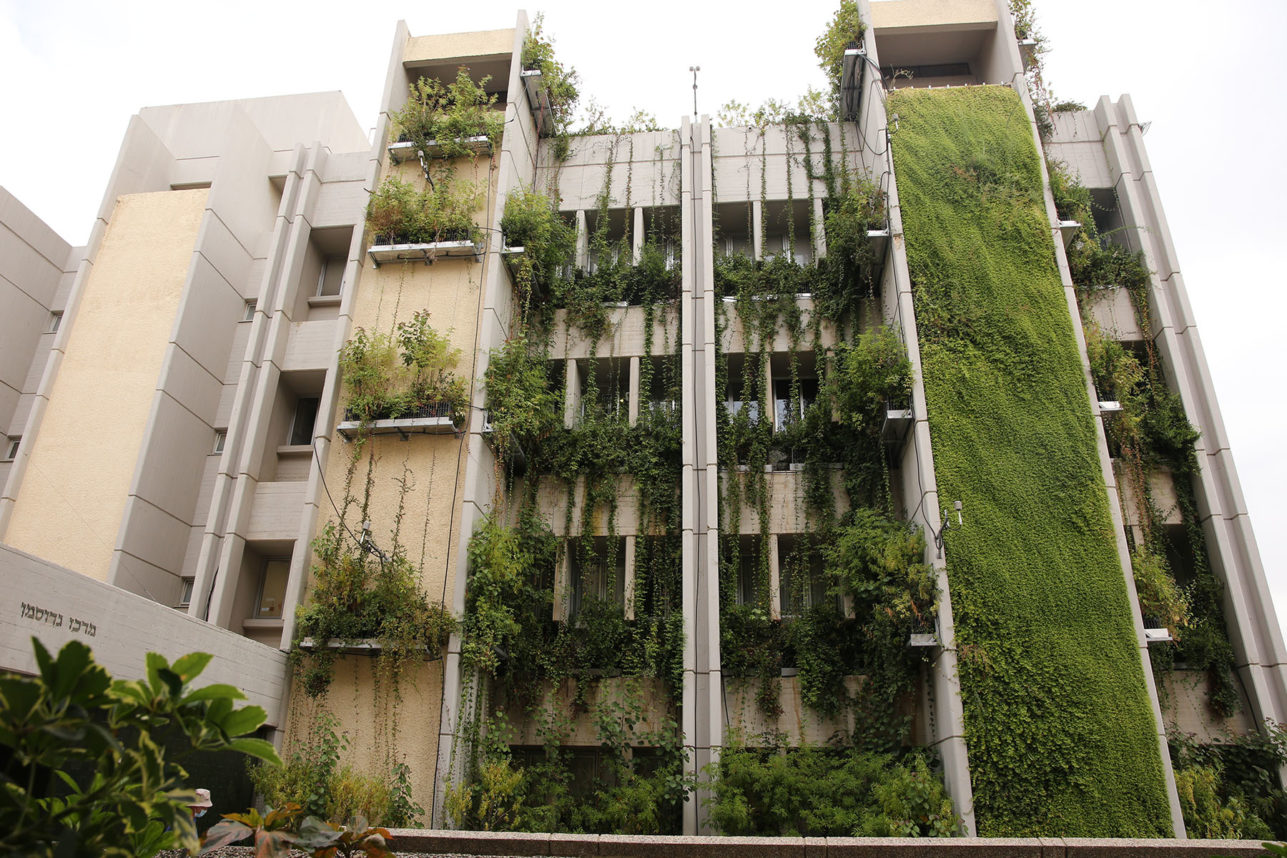
In recent months, the students and lecturers of Bar-Ilan University have been surprised to discover green walls covering the facades of two main buildings on campus, which include an assortment of plants alongside advanced irrigation systems. Although pleasing to look at, the move was not meant to enhance campus aesthetics, but rather to quantitatively assess whether these kinds of green buildings actually improve surrounding local environmental conditions.

Led by Professor Itamar Lansky and doctoral student Noa Zuckerman, this groundbreaking study marks the first time large-scale green walls have been erected for the specific purposes of academic research, which seeks to examine their impacts on the urban environment in terms of thermal microclimate comfort.

Photo by Noa Zuckerman

“This practice is considered very trendy today, but no studies of this magnitude have yet been conducted,” says Zuckerman. While prior studies have indicated the environmental value and thermal comfort of green walls as they significantly reduce short and long-wave radiation emanating from them to their immediate environment, their results are often based on theoretical models or small samples. By contrast, Zuckerman puts it best, “the experiment at Bar-Ilan is the largest controlled experiment in the world, and this is the first time that live research has been done on real structures.” In other words, it’s the real deal.

The study was presented at the Israel Society for Ecology and Environmental Science’s 49th Annual Conference, and it sought to answer the following research questions: what are the potential impacts for public health and environmental conditions within cities, are they a significant strategy for dealing with the climate crisis, and are buildings covered with vegetation the future of the urban environment?

To answer these questions, Lansky and Zuckerman decided to utilize three identical buildings on Bar-Ilan’s campus where they applied a vertical forest to one building covered in upright bushes and climbers, a green wall to the second building covered in smaller plants packed densely together in small modules, and nothing to the third building to act as a control subject for the experiment.

“Our walls are designed in a sophisticated way with smart irrigation systems and sensors to monitor vegetation. The aim is to control the wall in the most effective way for the needs of the research,” Zuckerman elaborates.

The data collected by the researchers show an improvement in thermal comfort in the vicinity of the green walls, with the effect on air temperature being the most noticeable, especially during the summer months in the sun-exposed southern slope.

After 18 months of recording temperatures and humidity both inside and outside of the buildings,

indoor air temperature during the summer closest to the vertical forest was 1.9°C (3.4°F) cooler than the control building. Indoor air temperature nearest to the green wall, on the other hand, was 2.41°C (4.3°F) cooler than the control. But in the winter months, both the vertical forest and the green wall naturally warmed indoor air temperatures by 2°C (3.6°F). On the path between the green buildings, outdoor air temperatures were about 1°C (1.8°F) cooler than the path nearest to the control building, and in the winter, the researchers found that the green-adjacent path offered one degree of warmth over the path closest to the control building.

Although cooling a space with the help of plants could lessen a building’s energy cost, the cost of special maintenance could plausibly become more expensive. However, this potential drawback is on Zuckerman’s radar.

“We understand that hanging vegetation is difficult to reach, so we examined the best way to maintain a green wall because maintenance should be simple and efficient through the use of technology,” she says. “Therefore, a significant part of the research is to understand how the maintenance of the walls can be streamlined.”

Next Step: Scale Up 

Green buildings adorned with vegetation and trees on their walls have been growing in recent years and have become an architectural trend throughout the world, representing the green building movement, which sees the need to add and promote vegetation on the facades and roofs of buildings to cut on energy consumption and air pollution.

Designed and completed in 2014 by Italian architect Stefano Boeri, the iconic Bosco Verticale in Milan is one of the first tower projects to display a vertical forest on every balcony floor, and it is without a doubt one of the most talked about buildings in the last decade. The towers host about 800 trees of various sizes, 15,000 perennials, and 5,000 kinds of various shrubs. The greenery surrounding all the facades of the building filters some of the sun’s radiation and thus allows a reduction in energy consumption for indoor heating and cooling. Meanwhile it raises oxygen and reduces carbon dioxide levels in its immediate environment, thereby improving air quality by filtering pollutants and fine particulate matter.

In the next phase of Lansky and Zuckerman’s study, they plan to escalate their size of their samples from the level of neighborhood to one of greater urban scale.

“Our goal is to test the impact of green walls not just on a single building, but on an entire neighborhood. The intention is to look at a number of buildings that are surrounded by green walls to understand their impact at the neighborhood level,” Zuckerman explains.

“The study also includes a psychological side, which has not been studied at all so far. We examine how the addition of green walls affects people’s moods living in the area. There is an opportunity here to explore the environmental aspect and all that it implies. In the end, it will give us a broader picture of the impact of green walls on the environment and humans.”

With human population on the rise, the cumulative climate effects of continued anthropogenic activities alongside current infrastructure are expected to worsen. Erecting green buildings of this kind, however, could very well decelerate those effects, and it is an option well worth exploring further.

ZAVIT – Science and the Environment News Agency

Can Plant-Covered Buildings Cool Things Down? Read More »

A Bisl Torah: The Trail of Time

On our family road trip to the Grand Canyon, we decided to take a leisurely shuttle to see the various viewpoints. Our driver was surprisingly convincing, encouraging us to get off at the first overlook. We spent ample time looking at the splash of colors painted across the canyon and watched mules make their way towards the Colorado River. But then we realized we missed some important information from our bus driver. The only option for getting back to the visitor center was to keep walking to the next overlook.

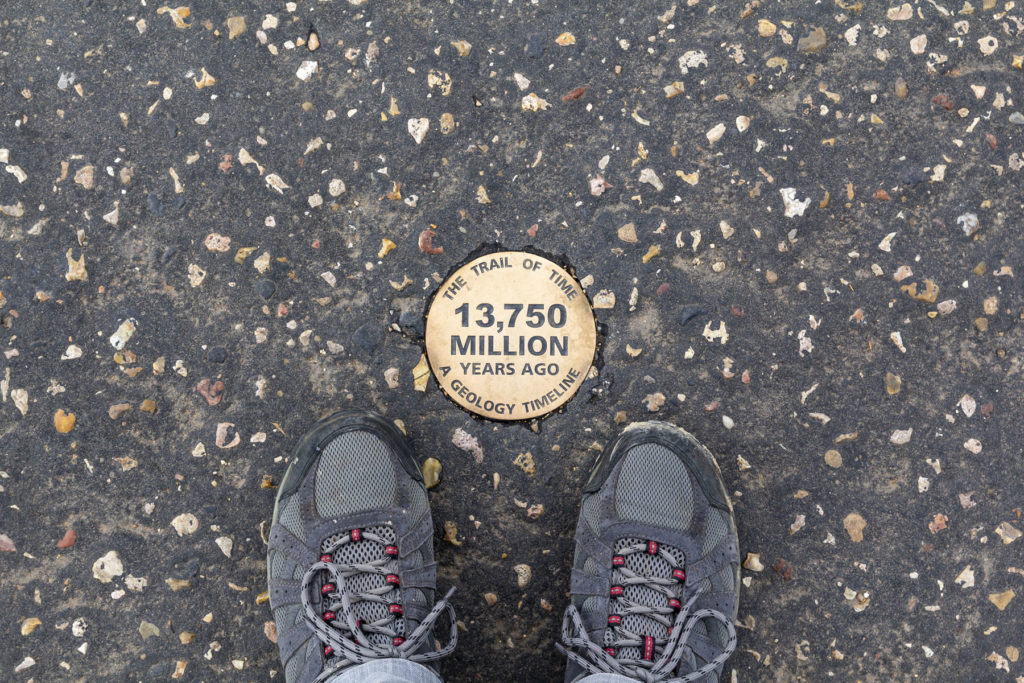
A mile isn’t that far. A mile with anxious parents and a narrow row of rocks that serves as the barrier between pathway and canyon is pretty nerve wracking. The pathway from the first overlook to the second was called, “The Trail of Time.” With every few steps we took, a marker informed us upon how many millions of years in history we were walking. And the years traversed backwards…further into a time impossible to imagine.

My husband said, “Look down at the history markers!” And with me concentrating on our balance, I replied, “I’m just going to look forward.” But upon reflection, it’s clear that relationship to historical memory is exactly that: standing firmly upon the shoulders of those that came before us. Appreciating messages of faith, stories infused with spirit that shape our own personalities, and a connection to a heritage that enriches our sense of resilience and strength. Each human is connected by a “trail of time.” A constant traveling that allows us to honor the past and encourages us to keep moving, walking towards dreams inspired by long-ago.


Rabbi Nicole Guzik is a rabbi at Sinai Temple. She can be reached at her Facebook page at Rabbi Nicole Guzik. For more writings, visit Rabbi Guzik’s blog section from Sinai Temple’s website.

A Bisl Torah: The Trail of Time Read More »

Ben & Jerry’s US Franchisees Call for Company to Rescind Israel Decision

Several Ben & Jerry’s franchisees in the United States sent a letter to the company calling on them to rescind their July 19 decision to stop doing business in the “Occupied Palestinian Territory.”

The letter was signed by franchisees located in Seattle, Boston, San Francisco and St. Louis, among other major cities, that operate 30 stores and generate $23.3 million in revenue combined. They stated: “There is a danger in the pursuit of social justice will descend into political correctness or result in the adoption of overly simplistic solutions by people who share a single view of the world that misconstrue complex problems in which multiple claims of justice are implicated.” They cited the Israeli-Palestinian conflict as an example, arguing that there are “multiple and conflicting claims of justice made” and that any solution to the conflict should address those claims.

“The decision that has been made to terminate the contract with Ben & Jerry’s licensee in Israel not only distorts the situation on the ground—it has imposed and will to continue to impose, substantial financial costs on all of us,” the letter stated. “More importantly, the controversy your recent actions have brought upon our local businesses has had an adverse effect on the value of our independently owned franchises and investments.” The franchisees added that their respective families and communities “have shamed us personally for doing business not just with a company that draws controversy, but with one that continues to consider the calculated negative affect on its franchisees as acceptable collateral damage.”

They concluded the letter by stating: “Those who feel strongly about Israel that they want to boycott it or some part of the territory it administers are free to do so. They cannot, however, do that at our expense. We believe this decision needs to be re-examined and withdrawn.”

The American Jewish Committee (AJC) lauded the letter, noting that they aided the franchisees in drafting the letter. AJC Chief Legal Officer Marc D. Stern wrote in a letter to The New York Times responding to the Ben & Jerry’s co-founders’ Times op-ed defending the company’s decision that the op-ed “wholly ignores, for example, several peace plans put on the table by Israel, endorsed by the United States and rejected by the Palestinian leadership. Tagging one side with all responsibility for the Israeli-Palestinian conflict may make self-described social justice advocates proud, but it advances neither peace nor justice.”

Stern added that the co-founders argued that the company isn’t doing business in the West Bank, not with Israel as a whole; however, Stern noted that “The chair of the company’s board of directors has publicly said it wanted to boycott Israel but was overruled (wrongly she believed) by its parent company, Unilever, and now may do so only under unspecified arrangements. The failure of Ben and Jerry to address that reality fatally undercuts their argument.”

Jake Novak, the Broadcast Media Director for the Israeli Consulate General of New York, tweeted that the letter is “very, very important” because “franchisees often take their franchise owners to court over stuff like this. There are lawyers who specialize in these kinds of cases and win. This is a red flag for #Benandjerrys parent company.”

Sussex of Friends of Israel tweeted, “@benandjerrys threw the own partners under the bus with their discriminate boycott of Israel. Safe to say they aren’t happy….”


Ben & Jerry’s US Franchisees Call for Company to Rescind Israel Decision Read More »

“Squad” Member Says US Aid to Israel Should Go to Homelessness

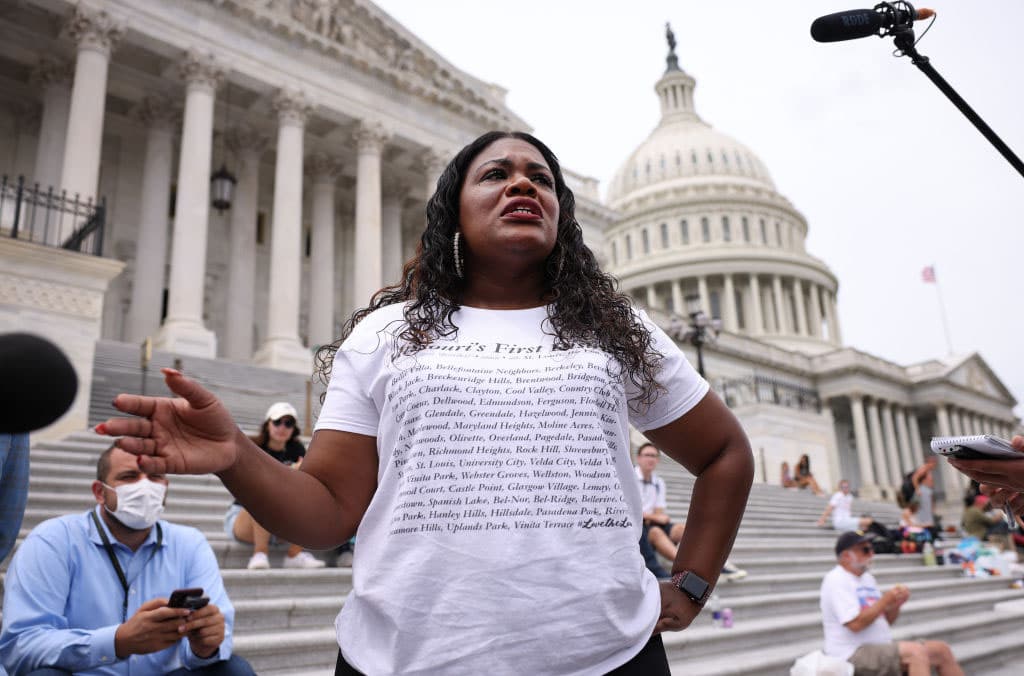
A clip of Representative Cori Bush (D-MO), a member of “The Squad,” giving a speech on the floor of the House of Representatives suggesting that United States aid to Israel should be redirected toward combating homelessness went viral on Twitter on August 4.

Bush was paying homage to Bassem Masri, a Palestinian activist who died in 2018. Bush said that Masri was among those protesting the “state-sanctioned murder” of Michael Brown in 2014 and that she learned that “the same equipment that they used to brutalize us is the same equipment that we send to the Israeli military to police and brutalize Palestinians.” She later added that the “St. Louis community sent me here to save lives,” meaning that “we oppose our money going to fund militarized policing, occupation, systems of violent oppression and trauma. We are anti-war, we are anti-occupation, and we are anti-apartheid, period.

“If this body is looking for something productive to do with $3 million instead of funding a military that polices and kills Palestinians, I have some communities in St. Louis city and in St. Louis County where that money can go, where we desperately need investment, where we are hurting, where we need help. Let us prioritize funding there, prioritize funding life, not destruction.”

Writer Emily Schrader shared a clip of Bush’s May speech in an August 4 tweet, arguing that Bush blamed “the Jews for homelessness in St. Louis… And we wonder why antisemitism is rising. Elected officials are openly scapegoating Jews.”

Writer and activist Yoni Michanie similarly tweeted, “A politician blames poverty and economic despair in the United States on the world’s only Jewish state. We’ve seen this before. We know where it leads.”


Associate Dean and Director of Global Social Action Agenda at the Simon Wiesenthal Center Rabbi Abraham Cooper told the Journal that Bush’s remarks as well as Tlaib’s “behind the curtain” comments on August 1 show that “the talking points are clear: they use the nonexistent points of intersectionality to create nonexistent connections between different events. The goal is to demonize Israel, is to demonize any politician or public figure who’s ever been to Israel, it’s to imply that ‘Jewish money’ is in control and look who made all the big bucks off the coronavirus while you lost your job, etc. This is quintessentially the 21st century update of Scapegoating the Jews 101, and we know what that scapegoating led to in the 20th century.”

He added that Tlaib and Bush “have no business being on committees. They should be called out for the hatred that they have for their pernicious bias against our communities and against Israel, the ally of the United States. They need to be called out from the top of the Democratic Party.”

Stop Antisemitism noted in a tweet that Bush supports the Boycott, Divestment and Sanctions (BDS) movement and aligns herself with former Women’s March, Inc. leader Linda Sarsour.

Zionist Organization of America National President Morton Klein called Bush an “ignorant bigot” in May. “You support $300 million going to Palestinian Authority which pays Arabs to murder Jews, names schools, streets and sports teams after Jew killers [and] refuses to have elections.”

Bush’s office did not respond to the Journal’s request for comment.


“Squad” Member Says US Aid to Israel Should Go to Homelessness Read More »

Table for Five: Re’eh

One verse, five voices. Edited by Salvador Litvak, the Accidental Talmudist

Behold, I set before you today a blessing and a curse. The blessing if you will heed the commandments of the Lord your God, which I command you today; and the curse, if you will not heed the commandments of the Lord your God, but turn away from the way I command you this day, to follow other gods, which you did not know.
-Deut.11:26-28


Bracha Goetz
Author of 39 spiritual children’s books

LOOK, the Source of Everything is giving your inner self divine gifts right this very moment! A clear and never-ending wellspring of goodness is yours – if you absorb all the ways in which the Creator of the entire Universe loves you as an individual here and now. There will only be disguised blessings if you turn away and go looking for love outside of our pure relationship, following those who have never demonstrated their genuine care and concern for you.

We can take things for granted by thinking “Of course!” Or recognize goodness comes from a Source!

Although we were created simply to experience the joy of gratitude, so often we forget to do just that. The pandemic has been a global spiritual lesson in developing appreciation for many things we may have taken for granted before.

We can turn away and try to seek sources of pleasure that are disguised as appearing to be separate from Source, but that only makes it take that much longer to experience the deep and nourishing joy of gratitude that our souls need to thrive. Or we can choose to focus, for instance, on all the body parts we have that are currently working and the beautiful nature around us.

LOOK, we get to enjoy the abundance of revealed blessings from the Source of Everything – filling and surrounding us right this very moment!


Nili Isenberg
Pressman Academy Judaics Faculty

There is a debate in the Talmud (Kiddushin 39b) over whether one is rewarded for mitzvot in this world or in the world to come. The Malbim (1809 – 1879) pointed out that in our verse the Torah specifies that we will see the blessing and the curse with our own eyes, with clarity, in this world, as “Behold” may even more directly be translated as the imperative, “See!”

Taking a different approach, his contemporary, Mei HaShiloach (1801 – 1854), enigmatically stated that, “When God gives goodness he dresses it in a way that makes it appear the opposite so that a person can clarify the good and bring it to light.”

This conceptual debate recalls the sad story of righteous Job’s suffering, and the anguished challenge raised by Kohelet (Ecclesiastes 7:15) that, “sometimes a good man perishes in spite of his goodness, and sometimes a wicked one endures in spite of his wickedness.”

Today, it would be reasonable for us to wonder why a pandemic has turned our lives upside down, with curses akin to those later elaborated in Deuteronomy 28, where we are threatened with terrible repercussions for sin, such as pestilence, consumption, and fever. With the start of the introspective month of Elul, whatever our beliefs about reward and punishment, this is a time to take the debate to heart, and conclude with the prayer, as they did in some communities after reading the Torah curses: “May God change the curse into a blessing, and let us say, Amen.”


Rabbi Ilana Grinblat
VP of Community Engagement, Board of Rabbis of Southern California

The La Times recently interviewed a woman in Missouri who decided against receiving the Covid vaccine. She explained why she and her friends decided against vaccination, saying: “the stronger someone’s trust is in the Lord, the least likely they are to want the vaccine or feel that it’s necessary.”

When I read this quote, I realized that inaccurate theology can be fatal. If she contracts Covid, the underlying cause of her illness would be a misunderstanding of how God operates in the world.

“Behold I set before today a blessing and a curse…” This verse teaches that God presents options for us, between life and death, blessings and curses. We can’t merely sit back passively and assume that everything will be fine. We must actively choose between these options.

This idea is echoed in an old story, recounted by Rabbi Edward Feinstein in Tough Questions Jews Ask: “A man who goes up to heaven at the end of his life. He stands before the throne of God. The man looks up at God and says, “You know, I’ve very angry at You! Can’t You see that the world You created is filled with suffering and ugliness and destruction? Why don’t You do something to fix the world’s mess?

God looks down at the man, and in a gentle voice says, “I did do something. I sent you.”

In this time of uncertainty, may we do everything in our power to “choose life,” so that we and our descendants may live.


Rabbi Michael Barclay
Spiritual Leader of Temple Ner Simcha (www.NerSimcha.org)

There is an old saying in sports that there is a huge difference between watching the bullfight and being in the ring.  A person walking by a swimming pool and hearing a man yelling at a teenager might think the adult is acting abusively.  But if he knew that the youth is committed to becoming a champion athlete, the spectator’s perspective changes to appreciation of the coach’s discipline.

Every competitive athlete understands the concept of short-term pain in order to achieve long term success.  We must follow the rigors of training if we want to achieve our goals, and the quickest path to failure is to ignore the requirements necessary.  Parents teach their children this same value, and in this verse we see that God is the ultimate “coach” for our souls.

God is not bribing or threatening us.  Like any good coach he is making it clear that one path leads to success and joy while the other leads to failure and sadness.  He reminds us here that living a mitzvah-observant life manifests untold blessings, and those blessings are absent without the observance.  We are to remember that mitzvot are the training practices that will lead to our success and happiness.

“Am Yisrael Chai”, the people of Israel will always live.  But for us to thrive, we must each take on more mitzvot and heed the guidance of the ultimate coach.  May we all find the blessings of success by passionately embracing the spiritual training we have been given.


Rabbi Avraham Greenstein
AJRCA Professor of Hebrew

The second of these verses presents a striking detail that is often elided in translations. Although the verse is often translated with the phrase “the blessing if you heed the commandments,” the relative particle “asher” that appears in this verse suggests a reading more like “the blessing is that you heed the commandments.” The Nation of Israel is asked to see that the commandments themselves are a blessing. The commandments are not merely tasks to perform and regulations governing Jewish life. They are much more than this: they are a guide to living well, and each mitzvah is suffused with blessing.

It is noteworthy that the Nation of Israel is asked here to “behold” or “see” the great value of the commandments. In contradistinction to understanding something or knowing about it, seeing something is more experiential; seeing concretizes a fact and makes it intuitively relatable. We are asked to experience the mitzvot first-hand, to personalize this experience, and to relate to mitzvot as if their worth were visible to our own eyes.

The mitzvah of Tsitsit (ritual fringes) is a commandment that encapsulates this concept. We are commanded to “see” the Tsitsit and thereby remember and cherish all of the mitzvot in such a fashion that we come to “do them” (Num 15:39). Each act of a mitzvah, no matter how small, is an opportunity to make the abstract Divine more real to us, to personally experience the substance of a mitzvah through its performance. Let us do mitzvot and see the Divine!

Table for Five: Re’eh Read More »

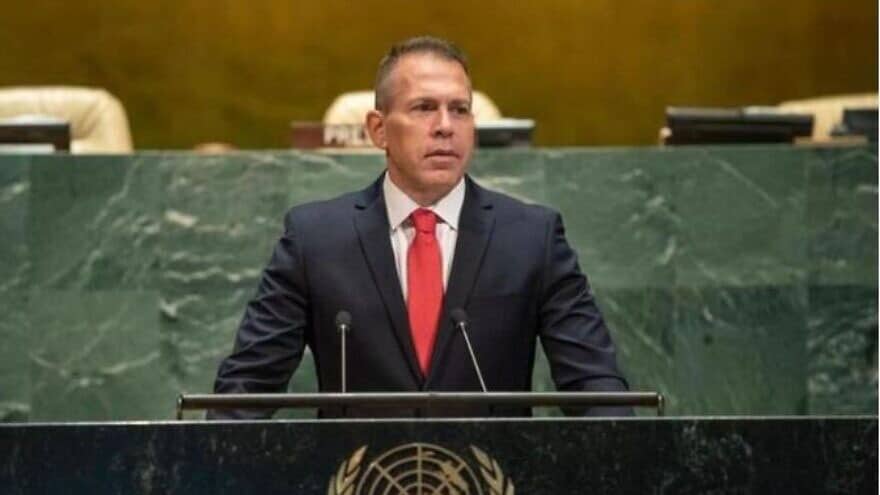
Israel’s UN Envoy Demands Security Council Sanction Iran for Maritime Attack

Israel’s Ambassador to the United Nations Gilad Erdan called on Tuesday for the U.N. Security Council to “condemn and sanction” Iran over an attack on an Israeli-managed oil tanker in the Arabian Sea on July 29.

“Iran’s repeated brazen and murderous actions … serve not only to threaten the safety of international shipping and navigation … but further destabilize a highly volatile region. The Security Council should not sit idly by in the face of such violations by Iran or by the terrorist organizations throughout the region that serve as its proxies,” Erdan wrote in a letter to the incoming president of the U.N. Security Council T.S. Tirumurti.

The July 29 attack on the Mercer Street killed two crewmen, one British and one Romanian. Israel, the United States, the United Kingdom and Romania have all said that the evidence points to an armed drone attack carried out by Iran. U.S. Secretary of State Antony Blinken on Monday said there would be a “joint response” to the incident, which he called a “direct threat to freedom of navigation and commerce.”

Erdan wrote: “It is imperative to underline the pivotal role the Iranian Revolutionary Guard Corps has played in sowing violence and destruction in the Middle East and elsewhere in the world. The IRGC is the main sponsor of terrorist groups and militias throughout the region.”

Referring to strikes against Israeli-owned ships, including the Helios Rayand Hyperion Ray, earlier this year, Erdan said the Security Council must address the “string of attacks” with “great urgency” and “take all necessary measures to hold the Iranian regime fully accountable for its repeated and unrestrained gross violations of international law.”

Erdan’s letter was sent as another event involving oil tankers unfolded in the Gulf of Oman.

On Tuesday, six oil tankers off the coast of Fujairah in the United Arab Emirates reported that they were “not under command,” AP reported. That number was reduced to one by Tuesday evening, with The Times of London reporting that the Asphalt Princess had been hijacked around 5 p.m. London time.

On Wednesday, the British military’s United Kingdom Maritime Trade Operations announced that the vessel was safe and that the hijackers had left the ship, according to AP.

Iran has denied any involvement in the incident.

Israel’s UN Envoy Demands Security Council Sanction Iran for Maritime Attack Read More »

The Stuff We’re Made From

Human beings were formed from the dust of the earth. But do you know where that dust came from? The Torah gives two fascinating answers, and each reveals something amazing about human nature.

The first answer is that G-d made us from earth that He gathered from the four corners of the world. But why not make us out of earth from the Garden of Eden? After all, that’s where He breathed life into us.

To answer that, first we need to know something about vaccines.

You’d think if a person wanted to avoid a virus, the last thing they’d do is expose themselves to the virus itself. And yet, that’s exactly how traditional (non-mRNA) vaccines work. First a tiny amount of the disease is injected into a person. This enables our immune systems to learn how to recognize the virus. After that, the body learns how to develop anti-bodies to fight it.

G-d used that same wisdom when He created us. G-d knew that we were destined to leave the Garden of Eden and to go into exile. For us, this posed a great danger. How would we spiritually survive? Wouldn’t the exile kill us? We had no defenses against it!

Or, to put it more strongly, human beings are literally made out of forgiveness.

Therefore, G-d inoculated us against the exile before we encountered it. How?

By taking earth from the furthest reaches of the exile itself and placing it within us, so that our souls wouldn’t be overwhelmed by the darkness, and we’d learn to overcome it with light.

According to the second opinion, G-d formed us from earth taken from where the altar of the Holy Temple in Jerusalem would stand. This is the spot where we brought offerings to be granted forgiveness.

Do you understand?

That means we’re made from earth taken from the headquarters of forgiveness. Or, to put it more strongly, human beings are literally made out of forgiveness.

So, if you ever wonder about how compassionate G-d is, or how much He understands our humanity, just look to the stuff we’re made from.


Check out David Sacks’ Weekly Podcast, Spiritual Tools for An Outrageous World, at Torahonitunes.com

The Stuff We’re Made From Read More »

Social Media Companies Receive “Mediocre Grades” in ADL Report Card on Handling Antisemitism

Social media companies received overall “mediocre grades” in the Anti-Defamation League’s (ADL) report card on handling antisemitism.

Twitter and YouTube received the highest grades on the report card, each earning a “B-.” Twitch and Reddit each received “C” grades; TikTok, Facebook/Instagram and Discord all earned “C-” grades; and the gaming platform Roblox received a “D-,” the lowest grade.

The ADL praised Twitter for their “broad anti-hate policies” and for responding “quickly to content flagging,” but criticized Twitter for not providing “information on why it took action,” although no other platform did either. Similarly, YouTube has “robust hate policies” and generally took action against reported content, but usually took more than 72 hours to do so. YouTube also doesn’t provide the same level of access to their data that Twitter and Reddit do.

Reddit and Twitch both “have strong policies around hate that include explicit protections for protected groups”; Reddit’s “community moderation” helped eradicate the antisemitism on its platform, although the site did not act against the content reported by the ADL. Twitch responded to reported content faster than Reddit did, but their “trusted flagger program” isn’t up to the ADL’s standards.

Facebook/Instagram, TikTok and Discord all “have robust hate policies yet did not provide any information behind their enforcement decisions when responding to reported content. Nor did any of these four platforms take any action against the content ADL reported through ordinary user flagging,” according to the report. The report also stated that “TikTok is at the very bottom of the platforms reviewed in terms of data access.” Roblox received the worst grade because of “data accessibility” and because they failed to respond and take action against reported content.

The ADL recommended that these platforms better enforce their policies, provide more transparency and allow experts to review their training manuals for content moderation.

“These companies keep corrosive content on their platforms because it’s good for their bottom line, even if it contributes to antisemitism, disinformation, hate, racism, and harassment,” ADL CEO Jonathan Greenblatt said in a statement. “It’s past time for tech companies to step up and invest more of their millions in profit to protect the vulnerable communities harmed on their platforms. Platforms have to start putting people over profit.”

The ADL report comes around the same time as a report from the Center for Countering Digital Hate NGO report finding that Facebook, Instagram, TikTok, Twitter and YouTube failed to act on 84% of reported antisemitic content from May 28-June 29. Spokespeople for Facebook, Twitter, YouTube and TikTok all said in separate statements to The Guardian that they denounce antisemitism and have made progress in removing antisemitic posts from their platforms, but are continuing to improve their efforts to do so.

Social Media Companies Receive “Mediocre Grades” in ADL Report Card on Handling Antisemitism Read More »