fbpx

July 15, 2021

A Bisl Torah: More Fun Than You Can Handle

In New Jersey, it is a seasonal tradition to go “fruit-picking”. In our past visits, we picked apples and pumpkins. This occasion we enjoyed picking blueberries, sunflowers, zucchini, and sweet corn. As we walked into the farm, a decorated sign caught my eye: “More fun than you can handle.”

I found the statement odd. Why can’t we handle the fun? Going on a tractor ride, watching our children scrutinize the different sizes of berries, comparing the growth of one flower to another…this fun seemed perfectly manageable. Just as my cynicism over the sign turned into smugness, I was surprised to see random sunflowers growing within vast fields of corn. Drops of beauty hidden within rows of yellow and green. If you slightly turned your head, you would have entirely overlooked the scene. And as we drove away from those sun-kissed fields, I thought over and over again, “I almost missed that.”

Perhaps the sign wasn’t implying that there is an overabundance of fun, too much to hold or experience. Perhaps the sign was challenging its students: don’t let the outside world drown your ability to soak up a moment. Joy isn’t a rare spice to be savored. Put down the phone. Clear the cobwebs. Get rid of the clutter your mind refuses to give up. Instead, open your eyes to the possibilities that sit right before you. Sunflowers concealed within fields upon fields. My children running through beds of wildflowers. Laughter over the various ways to use up hundreds of blueberries. Fun…that I almost missed.

Tehillim reminds us, “This is the day God has made. Let us rejoice and be glad in it.” Today. This day. A day filled with endless opportunities to smile, gladden one’s heart, listen and find joy. Don’t turn away. This is your moment to grasp. Don’t miss a single second.

Shabbat Shalom


Rabbi Nicole Guzik is a rabbi at Sinai Temple. She can be reached at her Facebook page at Rabbi Nicole Guzik. For more writings, visit Rabbi Guzik’s blog section from Sinai Temple’s website.

A Bisl Torah: More Fun Than You Can Handle Read More »

GW Students Against Sexual Assault Say “Palestinian Liberation Is Synonymous With Survivor Justice”

George Washington University’s (GWU) Students Against Sexual Assault (SASA) Intersectionality Council posted a statement calling “Palestinian liberation” synonymous “with survivor justice”; the statement appears to have been removed.

Blake Flayton, a student at GWU and Co-Founder of New Zionist Congress, posted the statement to Twitter. The statement read: “We stand in solidarity with our Palestinian siblings undergoing apartheid and settler colonialism. Palestinian liberation is synonymous with survivor justice.” It goes onto accuses of Zionists of engaging in a “violent pursuit of territorial gain” and “ethnically cleansing indigenous Palestinians.”

The statement also claimed that a 2015 study found that Israeli authorities engage in “sexual torture” of Palestinian males and that it’s “systematic.” Additionally, the statement alleged that Israeli soldiers threaten Palestinian female “with rape and subjected them to sexual humiliating practices” and that the Israelis “train with the same discriminatory and violent tactics as the U.S. police and military apparatus.”

The statement later promoted a “healing circle” on July 14. “Israeli human rights violations are not being treated as what they are: apartheid ethnic cleansing, genocide, sexual violence, racism and oppression. We understand this is only the start of our support and dedication for our Palestinian brothers and sisters. We hold vehement beliefs in disseminating and openly discussing the impacts and ramifications of the horrors of being from and on occupied land.”

Flayton tweeted that the “Palestinian liberation is synonymous with survivor justice” line “asserts that the fight to end sexual violence is tethered to the fight to end the Jewish state. You can’t make this s— up, folks.” He added in a subsequent tweet: “It’s also worth noting how incredulously libelous and fraudulent these demonizing claims are. My favorite being that somehow Israel is responsible for police violence in the United States. Ah yes, the Jews did it. The Jews did all of it.”

Jewish groups also denounced the SASA Intersectionality Council statement.

“If there are no consequence[s] for #Antisemitism masquerading as social justice the demonization and violence against Jews will only increase,” the Simon Wiesenthal Center tweeted. “This is anti-Semitism unchecked and getting uglier and uglier. Disgusting! Shame on @GWSASA!”

StandWithUs Co-Founder and CEO Roz Rothstein also tweeted that the GW SASA Intersectionality Council’s statement was “crazy cra*.” “So are the GW students pretending to be unaware of abuses like honor killings, lack of [women’s] rights and LGBTQ rights under Hamas and under the Palestinian authority? Why are they so unconcerned about those very real issues? Hmmmm…..”

Melissa Weiss, Managing Editor for Jewish Insider, noted in a tweet that GW SASA appeared to remove the statement from their Instagram page but did hold their “Palestinian Healing Circle” event.

On July 15, GW SASA issued an Instagram post stating that their “mission is to stand in solidarity and provide support for all survivors, no matter their background. We are interested in having conversations to help us learn and grow, if your organization is interested please reach out and we’ll schedule something for our campus return in the fall. We welcome discourse and empathic dialogue seeking mutual understanding, but we do not tolerate harassment or discriminatory language in any SASA spaces.” It was not immediately clear if the post was referencing the GW SASA Intersectionality Council statement.


View this post on Instagram


A post shared by GW SASA (@gwsasa)

 GW SASA did not respond to the Journal’s requests for comment.

GW Students Against Sexual Assault Say “Palestinian Liberation Is Synonymous With Survivor Justice” Read More »

Shylock Gets Even in Revised ‘Merchant of Venice’

A cartoon in a New Yorker magazine issue of the late 1930s showed Adolf Hitler pinning a Nazi medal on William Shakespeare for his perceived anti-Semitic slant in his play “The Merchant of Venice.”

In recent years, various directors and actors have tried to portray a more sympathetic and humane persona in Shylock, the Jewish money lender. Still, it is the rare Jewish theater goer who can avoid a certain discomfort or resentment at the portrayal of a Jew who mourns the loss of his daughter in the same tone as a financial setback and demands a pound of flesh from the body of a defaulting borrower.

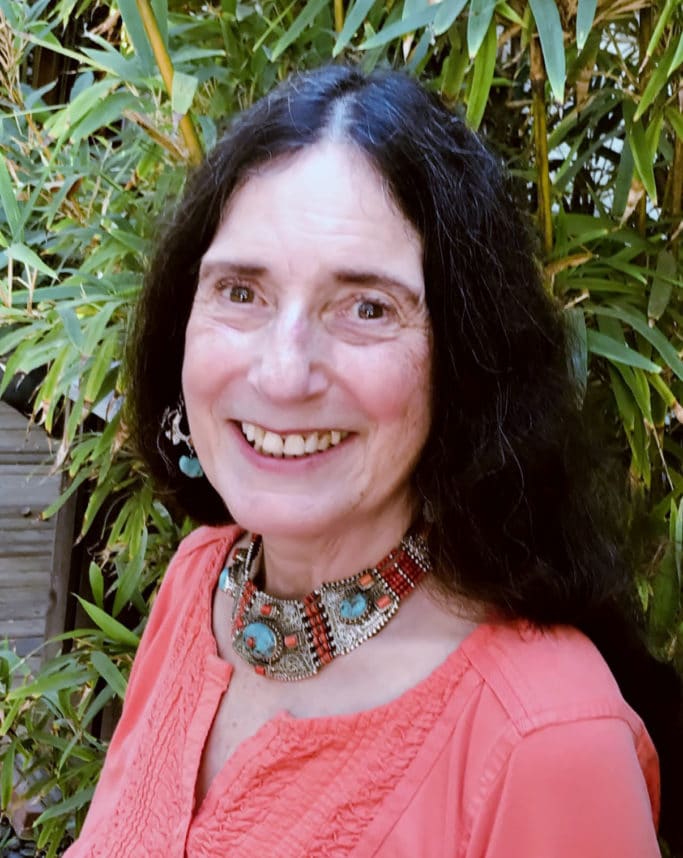
Carol Fisher Sorgenfrei

Also annoyed was Carol Fisher Sorgenfrei, a professor emerita at the UCLA Theater Arts department, and she decided to do something about it. Drawing on her own dramatic skills, Sorgenfrei set about creating a counter play, in which the tormentors of the Jew are hoisted on their own petard.

Shakespeare wrote the play in the 16th century, when England was rife with anti-Semitic rumors, even though all Jews had been expelled from the country by royal decree two centuries earlier.

Nevertheless, in Shakespeare’s time the personal physician to Queen Elizabeth was a Portuguese Jew, who, it was rumored, was plotting to kill the monarch. Other widespread accusations feeding into the strong anti-Catholic feeling of the time, accused the Vatican of infiltrating spies masquerading as Jews, who were also plotting to restore the power of the Catholic church after the break of Henry VIII with the Vatican.

While Shakespeare was too astute a writer to turn Shylock into a Nazi-style caricature, Sorgenfrei objected to other aspects of “The Merchant of Venice.”

In her version, titled “A Wilderness of Monkeys,” Shylock and Jessica are a loving father and daughter duo and it would be most unlikely that she would convert to Christianity without compunction, Sorgenfrei noted.

Among Shakespeare’s other main characters, the Christian Lorenzo woos Jessica through his beautiful poetry, but once they are “married” she discovers that he is basically a casual seducer and that the wedding was a sham.

While Portia, disguised as a lawyer whose clever pleading saves Antonio’s    neck (and the rest of his body), is generally considered the heroine of Shakespeare’s play, in Sorgenfrei’s interpretation, a less sympathetic Portia has clearly perverted the course of justice.

From this point on, Jessica and Shylock hatch a convoluted scheme to rectify the injustice.

Without spoiling all their tricks in advance, the new plot rests on the fact that a tulip craze pervaded England at the time, with tulip bulbs worth their weight in gold.

To advance the action of what Sorgenfrei describes as “a comedy sequel and reversal,” there is a lot of cross-dressing, with Jessica disguised as a Dutch tulip bulb seller.

Julia Stier as Shylock’s daughter Jessica – Photo courtesy of Ophelia’s Jump

In the final scene, in which the principals plead their cases at court, the Duchess, who has been following the action in various disguises, has a more sympathetic attitude than Shakespeare’s Duke toward Jessica’s side of the story.

As punishment, the Duchess reverses the first trial, finding Portia and Lorenzo guilty and Shylock innocent. She decrees that Antonio must drop his pants and he is outed as the despised Jew of Malta (Shylock’s literary forerunner).

Sorgenfrei’s professorial focus has been largely on the Japanese theater and among her works is the Japanese-Israeli fusion play “The Dybbuk/Between Two Worlds.”

Sorgenfrei acknowledges that her own Jewishness was a motivating factor in penning “A Wilderness of Monkeys.”

Shakespeare’s “Merchant of Venice,” in which Jews are forced to wear yellow stars, has all kinds of racist messages, which must be addressed, Sorgenfrei told the Journal. “For a while, I tried to ignore that, but at some point I decided I was not going to take it anymore. So I wrote a ‘Merchant of Venice’ in which everybody gets what he or she deserves.”

“A Wilderness of Monkeys” had its premiere last March, performed by the theater group “Ophelia’s Jump” in Claremont and Upland. The author expects that in the future, her play will be performed in other locales and before other audiences.

Shylock Gets Even in Revised ‘Merchant of Venice’ Read More »

Perfectly Imperfect — A poem for Torah Portion Devarim

Do not be broken or afraid of them
-Deuteronomy 1:29

I recently crossed my own river
or, that’s a metaphor really – it was a mountain.
It landed me in a hidden valley.

When I have to leave to get provisions
a canyon takes me to another valley
and drives me by a house of worship

favored by people who weren’t
at the bottom of the mountain with
the rest of us (though who knows

what happened there before and after?)
They put up a sign that says
The perfect place for imperfect people.

This resonates with me so much
every time I’m off to get a refill of
Triscuits or whatever it may be

I think man, if this whole Judaism thing
doesn’t work out, this may be the place.
We come into this world broken

and imperfect, and that is perfect.
When we fix one thing, there’s always another.
This is what we all have in common.

So when we find ourselves on one side of a river,
scouting the promised unknown on the other –
Wade across without fear.

Take a boat if you don’t want to get your feet wet.
and don’t be embarrassed by that. You may find
the seats fill up around you by others who

are appreciative you made the call. And the people
you’ll find on the other side of the river. It turns out
They are as perfectly flawed as you.

Do not be broken or afraid of them.
Or be just as broken as you are.
Oh, so beautiful, oh, so broken.


God Wrestler: a poem for every Torah Portion by Rick LupertLos Angeles poet Rick Lupert created the Poetry Super Highway (an online publication and resource for poets), and hosted the Cobalt Cafe weekly poetry reading for almost 21 years. He’s authored 25 collections of poetry, including “God Wrestler: A Poem for Every Torah Portion“, “I’m a Jew, Are You” (Jewish themed poems) and “Feeding Holy Cats” (Poetry written while a staff member on the first Birthright Israel trip), and most recently “The Tokyo-Van Nuys Express” (Poems written in Japan – Ain’t Got No Press, August 2020) and edited the anthologies “Ekphrastia Gone Wild”, “A Poet’s Haggadah”, and “The Night Goes on All Night.” He writes the daily web comic “Cat and Banana” with fellow Los Angeles poet Brendan Constantine. He’s widely published and reads his poetry wherever they let him.

Perfectly Imperfect — A poem for Torah Portion Devarim Read More »

Walking with God in the World

Like brothers that have fallen out, or sides of a family that no longer speak, religion and everyday life are often seen to be at odds. It’s not hard to find the worldliest among us calling believers cranks, or the more pious seeing life in the secular world as the source of every evil and temptation.

I once spent four years working customer service in downtown Manhattan, and I can’t think of a worse outlook on life than the one where getting ahead is all there is. At the same time, though, if there is a God, the world and life in it cannot merely be some trick or test we are meant to resist and deny. And it’s just as destructive to allow a sense of otherworldliness to become world-hatred. Religion and the world are both destroyed when one is used as an escape from the other.

It’s also too easy to say that worldly life is so chaotic and meaningless that only religion can swoop in and give us certainty and safety. While this is true in a way—recall, how, in the opening chapter of Genesis, God literally creates the necessary boundaries between things—Donald Akenson suggests that the greatest strength of Judaism isn’t in the certainty or structure it offers, but in how it reveals that religion and God are actually a reflection of the world, rather than an excuse to condemn it:

“The reason the god of the ancient Israelites is so convincing is that, as he is limned in the covenant, he is the perfect embodiment of what is: reality. Whatever controls the lives of individual human beings (and there is an infinity of philosophical debate about such matters), it is not consistently nice, benevolent, predictable, or even understandable. Yahweh personifies that ultimate reality exactly. Life is bounteous, so too is Yahweh; life is unfair, so too is Yahweh (just ask Job). Yahweh is the name for reality invented by Hebrew religious geniuses who paid attention to the way the world works.”

“The world as it is,” then, is the best and most difficult definition we have of God. Religion in general, and Judaism especially, is not a collection of certainties that eradicate the difficulties of life; it’s a way of giving those difficulties meaning. Rather than a reason to deny that morality or meaning exist, the uncertain and sometimes incoherent experience of life is best expressed in the sometimes incomprehensible nature of religion. All the permutations and versions of itself that Judaism has been forced into finding thanks to its endless diaspora is an illustration of this. Perhaps Judaism only became itself in the making of these adaptations, whether during the Babylonian Exile or just in Brooklyn.

That beauty and meaning and decency should exist in a world upheld by an unswerving tradition that hovers above historical circumstance and change, isn’t much of a miracle; but that beauty and meaning and decency should exist in a world where even our hallowed traditions are upheld by uncertainty and conflict—that is a miracle, and every day we are called to contribute to it is equally miraculous. We are called to be good and to love—and to debate what that means—not because we can safely claim we know everything, but precisely because we don’t.

We are called to be good and to love—and to debate what that means—not because we can safely claim we know everything, but precisely because we don’t.

The mathematician and historian Jacob Bronowski put it this way: “There is no absolute knowledge. And those who claim it, whether they are scientists or dogmatists, open the door to tragedy. All information is imperfect. We have to treat it with humility. That is the human condition.” The human condition, in other words—which is synonymous with the religious condition—is not one of power or dominance or certainty, but of humility; and if of humility, then of uncertainty; and if of uncertainty, then of empathy. Only in a condition of uncertainty, diaspora, and unsettledness can we recognize others in ourselves and ourselves in others—and this is only possible when the world itself is seen as the stage on which we work out what God means for us to do.

And don’t the narratives of the Tanakh bear this out? What simple takeaways and life lessons can we glean from the lives of the patriarchs, matriarchs and prophets, from David, from Nadab and Abihu or Phineas, and especially from the life of Moses? Are there any psalms that don’t assume that struggle and suffering must preclude peace and happiness? And where does the presence of God in these stories simplify anyone’s life? In fact, the presence of God always complicates life, always appears wrapped in and around the details of daily life. God’s presence always makes life more difficult—but also more meaningful.

In fact, the presence of God always complicates life, always appears wrapped in and around the details of daily life. God’s presence always makes life more difficult—but also more meaningful.

When Bronowski was making his documentary series “The Ascent of Man” in the early 1970s, one unforgettable scene was filmed at Auschwitz. There, standing up to his ankles in a pond, he said:

“This is where people were turned into numbers. Into this pond were flushed the ashes of some four million people. And that was not done by gas. It was done by arrogance. It was done by dogma. It was done by ignorance. When people believe that they have absolute knowledge, with no test in reality, this is how they behave. This is what men do when they aspire to the knowledge of gods … I owe it as a human being to the many members of my family who died at Auschwitz, to stand here by the pond as a survivor and a witness. We have to cure ourselves of the itch for absolute knowledge and power. We have to close the distance between the push-button order and the human act. We have to touch people.”

We lose the ability to “touch people” when we separate religion from everyday life, when we yearn for some illusory perfection we associate with God, and conclude that worldly life—and the people associated with it—are just scum on the bottom of somebody’s shoe.

While Judaism has had its share of ascetic movements, and continues to have its isolated enclaves, for me its greatest achievement is its refusal to deny the world. Even the laws of the Torah, and their excruciating explication in the Talmud, point to a sanctification of daily life, down to every gesture; and even the wildest mystical flights of the Kabbalah are made only for the purpose of tikkun olam, repairing the world, not for escaping it. Judaism shows how it is possible for religion not to raise us above the world but to settle us down in it.

After all, when my wife says the blessing over our daughter on Friday nights, asking that she be like “Sarah, Rebecca, Rachel and Leah,” what are we hoping for but that her life be filled with meaningful and difficult choices, that she be given the opportunity to walk with God by living in the world?


Tim Miller‘s poetry and essays have appeared in Parabola, The Wisdom Daily, Jewish Literary Journal, Crannog, Southword, Londongrip, Poethead, and others across the US and UK. Two recent books include Bone Antler Stone (poetry, The High Window Press) and the long narrative poem To the House of the Sun (S4N Books). 

Walking with God in the World Read More »

A Moment in Time: It’s the Journey, not the Destination

Dear all,

Over the weekend I went on a wonderful walk with Ron and our friend, Philippe, along the “Park to Playa” trail. I checked my watch a few times, realizing that our goal was ambitious for the time we allocated. But Philippe reminded me, “It’s about the journey, not the destination.” Just then, we were met with the sign pictured here.

”Stop, Breathe Relax.”

While Judaism has great emphasis on hope, aspirations, and vision, we keep in mind that the greatest lessons of Torah occur while the Israelites are in the desert, on their way to the Promised Land.

And for us – we often need reminders to stop and capture the blessings along the way. What treasures will you discover today when you take that moment in time?

With love and shalom,

Rabbi Zach Shapiro

A Moment in Time: It’s the Journey, not the Destination Read More »

“Nazi Pride” Graffiti Found on Beverly Hills Street Corner

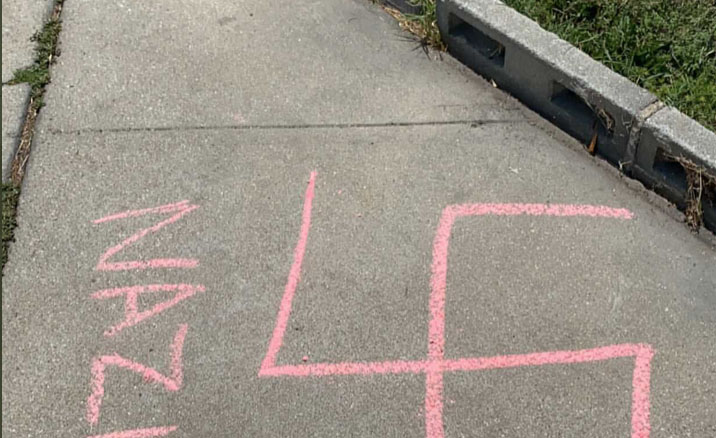
Graffiti of a swastika and the words “Nazi Pride” in all capital letters was found on a Beverly Hills street corner on July 14.

Stop Antisemitism posted a photo of the graffiti to Twitter; the graffiti was found on the corner of Gregory Way and S Bedford Street.

Anti-Defamation League Los Angeles tweeted, “We condemn the antisemitic graffiti found on a street corner in Los Angeles, which has now been removed. At a time in which we are tracking a sharp rise in antisemitism, much work remains in front of us to rid our communities of all forms of hate and bigotry.”

American Jewish Committee Los Angeles Regional Director Richard S. Hirschhaut said in a statement to the Journal, “Beyond the sheer vulgarity of such vile graffiti, there is a fundamental cowardice to those who would scrawl a swastika on a sidewalk. Fortunately, just like their impact in Los Angeles, this too is easily erased.”

Stop Antisemitism Executive Director Liora Rez also said in a statement to the Journal, “Just 80 years since the onset of the Holocaust we are forced to see daily reminders of how many still hate us. Until harsher prison sentencing starts happening for offenders of these types of acts, they’re not going to stop.”


“Nazi Pride” Graffiti Found on Beverly Hills Street Corner Read More »

Do They Even Know What “Genocide” Means?

A new poll claims that 22% of American Jews believe “Israel is committing genocide against the Palestinians.” That would be alarming—if they actually know what genocide is. But do they?

There is reason to suspect that as the word has become common place in public discourse, its meaning has been diluted and compromised. The unexpected ways in which the term “genocide” often is used today suggest it is no longer necessarily understood the way its originator intended.

The word “genocide” was coined by the legal scholar Raphael Lemkin in 1944. Lemkin was haunted by the failure of the international community to act against Turkish officials involved in the slaughter of more than one million Armenians in 1914-1918. He believed that to galvanize a more effective response to future atrocities, a new word was needed to label such a unique type of crime. Lemkin took his inspiration from George Eastman, who invented the word “Kodak” because he needed a short, unique, and easy-to-pronounce name for his camera.

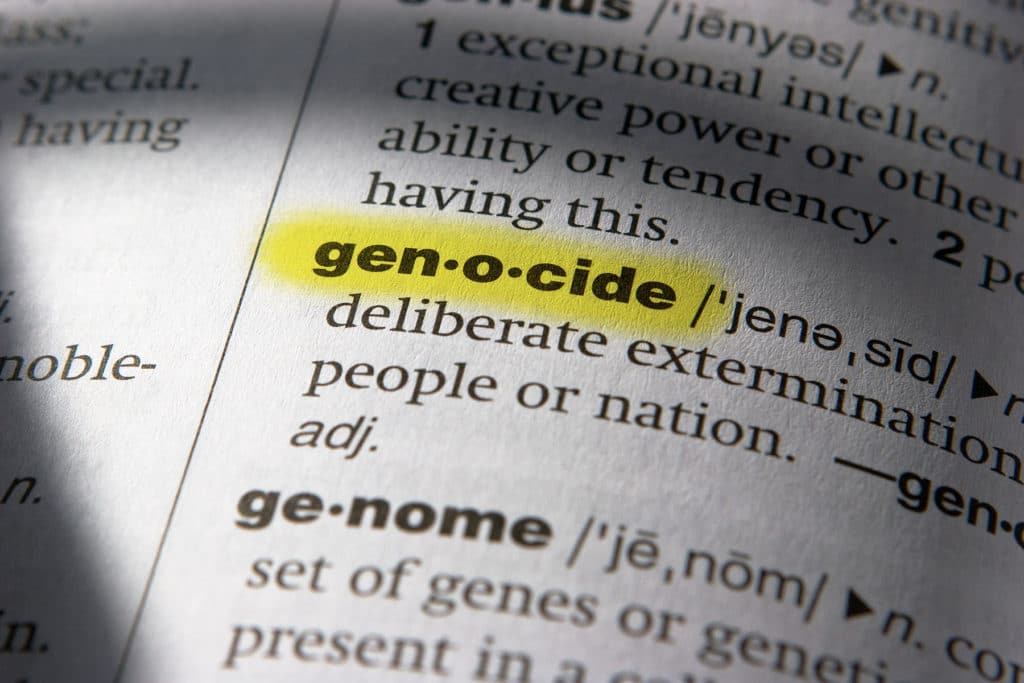
Lemkin’s efforts to popularize the term “genocide” were crowned with success in December 1948, when the United Nations adopted its Genocide Convention, an international treaty criminalizing genocide. It defines genocide as “acts committed with intent to destroy, in whole or in part, a national, ethnical [sic], racial or religious group, as such.”

Over the years, pundits and even some scholars have occasionally used the term “genocide” rather loosely, as if it’s interchangeable with “war crimes” or “ethnic cleansing.” It’s not.

For example, the war crimes committed by the Syrian government, such as its use of chemical weapons against its civilian opponents, do not constitute an attempt to destroy a particular national, ethnic, racial or religious group. This fact does not make those crimes any less heinous, or any less worthy of a forceful international response. But that is not what Lemkin intended the word “genocide” to mean.

U.S. government officials have made matters worse by sometimes refusing, for political reasons, to apply the genocide label when they should. Recall the almost comic lengths to which some leaders went to avoid acknowledging the Armenian genocide, as when President Barack Obama invoked the Armenian term for the slaughter, “Meds Yeghern,” but would not say it in English. (President Joe Biden finally acknowledged it earlier this year.)

As the genocide in Rwanda unfolded in 1994, Clinton administration officials debated how best to respond. Susan Rice, who was director of African Affairs for the National Security Council, argued against calling it “genocide” on the grounds that, as she put it, “If we use the word ‘genocide’ and are seen as doing nothing, what will be the effect on the November [congressional] elections?”

In the spring of 2003, human rights groups began using the term “genocide” to characterize the mass slaughter of non-Arab blacks in Darfur by Sudanese government-sponsored Arab militias. It took the George W. Bush administration until September 2004 to publicly concur. According to the New York Times, the 16-month delay was due in part to the fact that the administration was “concerned that threats and punishments against Sudan would antagonize the Arab world.”

Consider, too, how the word has been distorted in recent popular discourse.

Anti-abortion activists frequently cry “genocide.” Ben Crump, the attorney in some of the recent police shooting cases, is the author of a book called “Open Season: Legalized Genocide of Colored People.” Oklahoma Native American activist Casey Camp Horinek says pollution of wells in her tribe’s territory is “environmental genocide.”

Congressman Matt Gaetz (R-Fla) recently claimed America is threatened by “cultural genocide,” while his colleague Rob Bishop (R-Ut) has charged that “the ideas behind the Green New Deal are tantamount to genocide.” And a Minnesota professor has claimed that black-on-black shootings constitute “genocide from within.”

This freewheeling use of the term “genocide” in situations that do not meet the definition undermines the public’s understanding of what the term really means. It would not be surprising if the word has become little more than a casual synonym for injustice in the minds of a part of the public.

This freewheeling use of the term “genocide” in situations that do not meet the definition undermines the public’s understanding of what the term really means.

The younger generation is particularly susceptible to such rhetorical excesses. Social media have been flooded in recent weeks by wild anti-Israel accusations from cultural celebrities, including the invocation of “genocide” by Roger Waters of the rock group Pink Floyd, social media star Mia Khalifa, and the actor Mark Ruffalo (although he later backpedaled). Others, including popular singer Dua Lipa and Canadian musician The Weekend, used the only slightly less incendiary term “ethnic cleansing.”

Impressionable young people pay attention to what their cultural icons are saying. It may not be a coincidence that in the new poll about Israel, the percentage of respondents who were aged 18 to 34 was 24%—almost identical to the number who said Israel is guilty of genocide.

Ultimately, then, the problem with the poll may be that the “genocide” question assumed that all the respondents understand what “genocide” means. Imagine if, instead, the question had briefly explained what it was talking about—something like: “Genocide means ‘acts committed with intent to destroy, in whole or in part, a national, ethnic racial or religious group’—do you think Israel is doing that to the Palestinians?”

It is highly unlikely that 22% of American Jews would have answered “yes” to such an obviously false allegation. Even many of those who are not well educated on the subject understand that “destroying” means wiping out, or at least significantly reducing, the targeted population, while the Palestinian Arab population has increased dramatically since Israel’s creation in 1948.

It may well be that a small number of American Jews are becoming more extreme in their criticism of Israel. But a casual embrace of poorly-understood language is not necessarily evidence of a serious trend in Jewish public opinion.


Dr. Rafael Medoff is founding director of The David S. Wyman Institute for Holocaust Studies and author of more than 20 books about Jewish history and the Holocaust.

Do They Even Know What “Genocide” Means? Read More »

What You Need to Say Before You Die

The Jewish ethical will is a forgotten genre of literature. Like an ordinary will, the ethical will offers a set of instructions to be followed after death; but instead of monetary directives, it offers moral advice. It is the parent’s last lecture about the right way to live life. The will’s instructions will often include exhortations about religious practice, ethics, character and marriage, mixed in with personal anecdotes, rebukes and blessings. Many of the authors go so far as to leave instructions about how often the ethical will should be reread by the children because it is also the rough equivalent of a family mission statement.

The earliest examples of formal Jewish ethical wills go back to the middle of the 11th century, but the practice is rooted in both the Talmud and Midrash. In the 19th and 20th centuries, several scholars brought attention to this genre; the great trailblazing scholar of Jewish literature, Leopold Zunz, wrote a study of Jewish ethical wills, and an in-depth study was done by Israel Abrahams of Jews College in 1891. Abrahams later published a two-volume anthology entitled “Hebrew Ethical Wills.” In recent years, Rabbi Jack Riemer has written extensively about ethical wills, in hope of reviving this practice.

The Book of Deuteronomy, Sefer Devarim, is actually an ethical will. In the final five weeks of his life, Moshe offers a series of speeches and lectures that become the final book of the Torah. Sefer Devarim contains all of the elements of a traditional ethical will, with rebuke, autobiography, advice, commands and blessings. In a series of extraordinary speeches, Moshe offers a paradigm of what a person needs to say before they die.

We are obligated to pass our wisdom onto the next generation; life’s lessons carry profound insights, even divine insights. Don Isaac Abravanel writes that the contents of Sefer Devarim were originally Moshe’s words, and only later were these speeches chosen by God to be written down and incorporated into the Torah. Abravanel’s assertion is radical in terms of traditional views of Biblical authorship. But it also offers a very different perspective of religious knowledge, and asserts that human experience and interpretations can teach divine lessons. Later, this idea becomes the foundation of the rabbinic tradition; and even though there is a received tradition, rabbis from successive generations would still offer their own insights. Ethical wills have the same rationale; they recognize that each person has unique lessons that they alone can offer their children. As the 16th-century Polish rabbi Abraham Horowitz writes in his own ethical will, a true bequest goes beyond the financial. When a parent opens their heart and shares their final thoughts, they offer their children a spiritual bequest that is invaluable.

We are obligated to pass our wisdom onto the next generation; life’s lessons carry profound insights, even divine insights.

Moshe’s determination to share his ethical will is evident from the very beginning of the Torah reading. The verse reads “these are the words that Moshe spoke to the entire people of Israel.” The Hebrew words are “eleh hadevarim“; as the Midrash notes, these words are reminiscent of the exact words Moshe says when he initially refuses God’s mission over forty years earlier. At that point, he tells God he is not ready to go to Egypt because of his stutter, and explains that “lo ish devarim anochi,” “I am not a man of words.”

The similarity of phrasing in the two verses points us to a fascinating question: How did Moshe, who stutters and is not a “man of words,” give the speeches of Sefer Devarim at the end of his life? Perhaps, as one Midrash proposes, Moshe was transformed by teaching Torah, which healed his speech impediment. But there is another possibility: Moshe might have given this speech with the same stutter and stammer he always had. The speeches would have been painstakingly slow, and required great strength and determination. Yet Moshe perseveres; and in his final days of life, he teaches day in and day out, to ensure that these lessons won’t die with him.

Ethical wills reflect this same desire and dedication. Parents open their hearts and speak honestly to their children about what is important to them. Sometimes the advice is very personal. Rabbi Yaakov Dovid Wilovsky, a Lithuanian Rabbi, (who, among other stops in his career, presided over the 1904 High Holidays at my current synagogue, Kehilath Jeshurun), exhorted his descendants not to follow in his footsteps and to avoid the rabbinate. But much of the advice is timeless. Make certain to visit shiva houses. Take your prayers and Torah study seriously. Treat your spouses with respect. Avoid losing your temper, and above all, avoid disputes. In his ethical will, Judah ibn Tibbon, the 12th-century philosopher who lived in Provence, wrote “Make thy books thy companions. Let thy cases and shelves be thy pleasure grounds and gardens.” Nachmanides, the 13th-century Spanish rabbi, writes: “accustom yourself to speak in gentleness to all men.”

Some of the most moving ethical wills are written as letters to family and friends during times of crisis. Yosef Hagar of Lesko wrote in his final letter to his children, before Rosh Hashanah in 1942: “don’t lose your temper from so much sorrow … be well and strong. I bless and kiss you. Keep this letter and remember that you once had a father in this world. I wish for you to be inscribed and sealed in the book of life, and have a blessed and good New Year.”

Eldad Pan, a soldier for the Palmach who died at age 20 in 1948, wrote the following reflections when considering he might fall in battle: “At best a man’s life is short … the years of life do not satisfy the hunger for life. What then shall we do during this time? We can reach either one of  two conclusions. The first is that life is so short, we should enjoy it as much as possible. The second is that because life is short and no one can completely enjoy it, therefore we should dedicate life to a sacred and worthy goal … it seems that I am slowly coming to the conclusion that life by itself is worth little unless it serves something greater than itself.” These words jump off the page, and leap from one world to the next. Every ethical will aspires to do the same.

I have tried to write an ethical will several times, and each time stopped before writing anything. Considering my profession, I might be called a “man of words”; but here words fail me. The task is intimidating, and it feels like there is plenty of time. It is also discomfiting to wrestle with mortality, even for a few minutes. I hope that when the time comes, Moshe’s example will help me through the hesitations and stumbles, and remind me that there are some things you need to say before you die.


Rabbi Chaim Steinmetz is the Senior Rabbi of Congregation Kehilath Jeshurun in New York.

What You Need to Say Before You Die Read More »