fbpx

June 29, 2021

Former Dem Congresswoman Cynthia McKinney Tweets That Zionists Were Behind 9/11

Former Democratic Congresswoman and Green Party presidential candidate Cynthia McKinney tweeted that Zionists were behind the 9/11 terror attacks.

The tweet featured McKinney stating “The Final Piece of the Puzzle…” with a photo of a puzzle depicting the attacks on the World Trade Center. The photo showed a puzzle piece with the word “Zionists” on it being placed as the last piece of the puzzle on top of the words “did it.” As of this writing, the tweet is currently her pinned tweet.

Several Twitter users criticized McKinney’s tweet as antisemitic.

“Former US Rep. Cynthia McKinney continues to repeat an offensive #antisemitic trope falsely blaming Jews/Zionists for the terrorist attacks on 9/11,” the Anti-Defamation League (ADL) tweeted, “This isn’t the first time she’s propagated hate and conspiracy theories, but it should be the last.”

Representative Ritchie Torres (D-NY) also tweeted, “Why is Twitter turning a blind eye to Antisemitism? Conspiratorial crackpots like Cynthia McKinney have no business being on any social media platform.”

StandWithUs CEO and Co-Founder Roz Rothstein tweeted, “What is this woman’s problem? Does anyone know why she promotes anti-Jewish racism?”

Israeli Ambassador to the United Nations Danny Danon tweeted, “I strongly condemn the antisemitic and false tweet of former Congresswoman Cynthia McKinney. She is promoting a vicious blood libel. I expect an immediate and clear apology.”

The Journal’s request for comment through the contact form on McKinney’s website was not returned by publication time.

According to the ADL, “McKinney has a history of using anti-Israel rhetoric, including accusing the pro-Israel lobby of sabotaging her political career and alleging that Israel [commits] genocide, apartheid and war crimes.” McKinney also posed for a picture with a Holocaust denier and met with Hamas and Hezbollah representatives in 2009, per the ADL.

This article been updated.

Former Dem Congresswoman Cynthia McKinney Tweets That Zionists Were Behind 9/11 Read More »

Antisemitism, Jew-hatred, Anti-Jewish Bigotry: Say Its Name

“One of the streams under the floorboards of Western culture is antisemitism. When people need it, they just dig it up. We don’t want to repeat it. And we do, over and over again.”—Henry Louis Gates, Jr.

When Jews are targeted by racists, how is trying to whitewash that racism by decrying prejudice against all “non-Christian religious faiths” not a form of erasure of Jews? Why is it so hard for some people to say the word “Jew” or “Jewish”? In 2021, can’t we at least all agree that if you hate Jews, you’re an antisemite, or even more accurately, a Jew-hater?

It’s hard to understand what would motivate someone to trivialize or whitewash Jew-hatred, also commonly referred to as “antisemitism,” which is a misnomer given that the term technically refers to discrimination of those with Semitic characteristics and hearkens back to the “scientific racism” of the 19th century. But there’s nothing scientific about Jew-hatred: it is an ancient, ongoing, virulent and mutating form of bigotry.

But there’s nothing scientific about Jew-hatred: it is an ancient, ongoing, virulent and mutating form of bigotry.

The virus of Jew-hatred is strong. Jews are Communists, they say. They are money-grubbing capitalists. They are tribal. They are globalists. They are the beneficiaries of “white privilege.” They pollute the bloodlines of “white Caucasians.”

The very first step of any attempt at curing and inoculating people against this pathological disease is to call out Jew-hatred by name. Pointing out the existence and presence of Jew-hatred is not, of course, in and of itself a remedy for the bigotry and persecution associated with antisemitism.

But it’s really the only place to start.

This June the Culver City City Council passed a resolution “acknowledging the racial history of Culver City.”

The resolution mentions the Ku Klux Klan and white supremacist organizations that met in Culver City. It calls out the discrimination suffered by “African Americans” and “other people of color.”

It talks about teaching “the United States’ white supremacist origins” in Culver City schools.

It talks about racially restrictive covenants and deed restrictions that “restricted African Americans, other people of color and those of non-Christian religious faiths from housing and land ownership within Culver City.”

While the Culver City council is to be commended for trying to tackle the thorny subject of the City’s racial history, not mentioning Jew-hatred by name effectively whitewashes the history of Jew-hatred in Culver City and erases the lived experiences of Jewish people, as I pointed out before the resolution was adopted in a letter to the Council.

The fix would have been a relatively simple one. Leaving aside the fact that Jews are a people (sui generis, constituting a class in itself, I would suggest) not just members of a “religious faith,” the Culver City Council majority could have directly acknowledged and called out the city’s history of anti-Jewish racism by inserting two words. When listing those impacted by racism in Culver City, it could have and should have talked about “African Americans, other people of color, Jews and those of other non-Christian religious faiths.”

Culver City has a history of bigotry, including specifically toward Jews, from a cross-burning on the lawn of Jewish resident in the 1950s after Jews resolved to build a synagogue, to antisemitic vandalism last month.

Culver City has a history of bigotry, including specifically toward Jews, from a cross-burning on the lawn of Jewish resident in the 1950s after Jews resolved to build a synagogue, to antisemitic vandalism last month.

Perhaps the reluctance of the Culver City Council majority to specifically acknowledge the city’s unwelcoming history when it comes to Jews has to do with the fact that some don’t consider light-skinned Jews to be “people of color” or an oppressed people.

Many Jews, even those who may have lighter skin and could “pass” (if we remove our kippot), do not consider ourselves to be “white.” We know history all too well. We remember the “Jews won’t replace us” chants of white supremacists. We are aware of anti-religious prejudice that has hounded Jews through the millennia because we were not willing to give up our faith or Peoplehood, and we know the history of the race-based prejudice toward Jews that gained traction in the 19th century.

The skin color of Jews didn’t help us in Germany. The skin color of Jews offered us no privileges wherever and however we were subjected to anti-Jewish violence and pogroms around the world.

After my letter was published in the Jewish Journal, I received a note from an individual who shared his own experience in Culver City. He wrote that in 1947 he was a five-year-old child and his parents were looking to buy their first home. They found a house in Culver City and were playing outside with some children on the block, when the father of the children came out and grabbed his two sons where were playing with the Jewish five-year-old and his older brother. As they walked away, his brother heard the father say “Don’t ever play with those Jews again.”  The nine-year-old brother told his parents and the parents did not buy the house, but instead built one in Beverlywood, where the family made a home and thrived.

Just as other groups experiencing housing discrimination were pushed into certain neighborhoods, many Jewish people congregated in Beverlywood, which was more welcoming to Jews than Culver City. The community they formed in Beverlywood, in which they could live together as Jews, exists to this day, as does the Jewish character of the neighboring Pico-Robertson area, which is also adjacent to the part of Beverly Hills where I live.

Interestingly, the same Culver City Council majority that could not bring themselves to call out anti-Jewish discrimination by name is in the process of outlawing single-family neighborhoods in Culver City because of the city’s “history and legacy of racism.”

Yet their refusal to acknowledge anti-Jewish discrimination and call out Jew-hatred by name in their resolution simply perpetuates the hurt felt by many Jewish people at the ongoing trivialization of antisemitism within our society. Not calling it out by name only increases the sense of insecurity felt by many Jews throughout the world because our unique history of discrimination, persecution and suffering has not been acknowledged.

Within Jewish culture, the traditional greeting of “Shalom aleichem” (“peace be upon you”) is answered by “Aleichem shalom” (“to you, peace”). Not responding intentionally to the greeting is considered to be a fairly grievous insult within Jewish culture. Sadly—though perhaps not unsurprisingly in this day and age—it feels like the Culver City Council majority has made a conscious decision to snub the Jewish community in its unwillingness to call Jew-hatred out by name and not to answer, as it were, “Aleichem shalom.”

Instead, in response to bigotry toward Jewish people, we’re left with a whitewashing version of “All lives matter.”

And that’s just not good enough. Jew-hatred. Antisemitism. Anti-Jewish racism. Say its name.


John Mirisch has served on the Beverly Hills City Council since 2009, including three terms as mayor.  He is currently a garden-variety councilmember.

Antisemitism, Jew-hatred, Anti-Jewish Bigotry: Say Its Name Read More »

Unscrolled: Pinchas: Releasing the Bound

In Parashat Pinchas, the orphaned daughters of Zelophehad approach Moses at the tent of meeting, distressed that they will be excluded from inheriting a portion of the land of Canaan on account of their sex. Moses takes their case to God who rules that the daughters may inherit. He then issues a decree changing the Israelite laws of inheritance on the basis of the daughters’ claim. “Speak to the Israelite people as follows: ‘If a man dies without leaving a son, you shall transfer his property to his daughter” (Numbers 27:8).

This isn’t the first time that we’ve seen God amend the Law based on the unique circumstances of a claimant. In Parashat Behaalotcha, when a number of men approach Moses concerned that ritual impurity will prevent them from offering the Pesach sacrifice, God amends the laws of Pesach. From there on out, those who are ritually unclean on Pesach or who are away on a long journey will have a second chance to sacrifice their offering on “Pesach Sheni,” or Second Pesach, a month later.

The Torah is a blend of story and law, and the way in which the two are interwoven has profound implications for our understanding of both. It would have been easy enough for the Torah to present God’s Law as an unchanging edifice, gathering its many statutes together in one section and excluding scenes of arbitration and legislation.

The Torah is a blend of story and law, and the way in which the two are interwoven has profound implications for our understanding of both.

Instead, the Torah presents Law as process, teaching us that even divine statutes must sometimes change to meet the needs of the moment.

This alone is not a terribly controversial statement. Contrary to popular belief, the denominational divide in Judaism is not about whether the Law can be changed, but rather about how, when, and for whom.

On these questions, the two above stories provide some guidance.

In both cases, the claimants are asking to be included. Their petitions for change are not challenges to the authority of God or Moses. Just the opposite: the daughters are eager to settle the promised land according to God’s will. The men are eager to remember the Exodus as commanded. Ironically, they both find themselves in the predicament of being prevented from fulfilling the Torah by the Torah itself. Their hands are tied, so to speak.

In the blessings recited by observant Jews each morning, we thank the God who “releases the bound” (“Matir Asurim”). Vocalized differently, this can be read as “Matir Isurim,” the God who permits the forbidden. In the 18th and 19th centuries, a false Jewish Messiah in Poland named Jacob Frank built a following around the radical implications of this pun. The Frankists believed that the highest Jewish value was to be found in the active transgression of the Law. Pork-eating, Shabbat bonfires, Yom Kippur feasting, and ritual orgies ensued.

Those who are more circumspect about altering the Law seem to fear that any small change will lead to Frankist mayhem, forgetting that Frank’s holy pun was also taken up by the brilliant Hassidic master, Rabbi Tzadok HaKohen of Lublin, who believed that students of Torah are emboldened by God to overturn prohibitions through novel readings of the text, going so far as to suggest that insects could someday be kosher to eat. To illustrate his point, he recalls how the sages wrote down the Talmud in order to save it from being forgotten, abrogating a prohibition against writing down the oral law.

Unlike Frank, however, Rabbi Tzadok HaKohen was a pious, Torah-observing Jew. No ritual orgies. No Shabbat bonfires. No insects in the cholent.

This is because Rabbi Tzadok (along with the daughters of Zelophehad) didn’t see the overturning of prohibitions as a virtue in and of itself, but rather as a means to end – abrogation of Torah for the sake of Torah.

Perhaps, then, “Matir Asurim” and “Matir Isurim” are not two alternative readings as Frank believed, but are rather two simultaneous readings, each deriving its force from the other, and lacking coherency without its counterpart.

Occasionally the Law will wind its way around us like a chain – keeping us from our sacred inheritance, barring us from holy participation, distancing us from God, and locking the gates of the palace of Torah. When this happens, we are permitted (and perhaps even obligated) to act as Moses did before the daughters of Zelophehad, permitting the forbidden in order to release the bound.


Matthew Schultz is the author of the essay collection “What Came Before” (2020). He is a rabbinical student at Hebrew College in Newton, Massachusetts.

Unscrolled: Pinchas: Releasing the Bound Read More »

Israeli Basketball Coach Achieves Winning Record With Training and Torah

It was 2018 when Daniel Tamir, the assistant coach for the Yeshiva University (YU) basketball team, found himself facing a dismal start to the season. His YU team was plagued with injuries and low morale. Tamir, former Israeli professional basketball player turned assistant coach, wasn’t accustomed to losing, but that was where his YU team was headed.

During winter break, one of Tamir’s rabbis, who was helping guide his journey toward religious observance, suggested he include Torah study in the team’s routine to help overcome mental obstacles that players might be facing.

“I took his advice and while preparing for the next game, a group of players started studying Torah with several rabbis,” Tamir explained. “As it turned out, we started winning again. From then on, we made Torah study a regular part of our routine and we won the next eight games in a row. Before the ninth game, we were delayed and had to skip the learning. We lost. From then on we never skipped Torah study and ended the season with a historical championship.”

Tamir, 30, who stands 6 feet 10 inches tall, was born into a basketball family. Over a seven-year professional basketball career, he played power forward and center for teams in Israel and Hungry, including the renowned Hapoel Jerusalem. His older brother, Amit Tamir, also played professionally on Hapoel Jerusalem as well as other teams in Israel and Europe. Like father like son, it is no surprise that their father played professional basketball in Israel’s early leagues.

“Growing up, basketball was all around me,” Tamir said. “If I wasn’t playing, I was watching other players and learning.  It was a large part of my upbringing.”

Upon his retirement from professional sports in Israel, Tamir moved to the States where he landed a job as the assistant basketball coach at The Frisch School, a yeshiva high school, in New Jersey.  At the same time, he enrolled in YU for a degree in business administration where he was also tapped to be the assistant coach for the YU basketball team.  After completing his studies, he moved to Los Angeles to start his own basketball coaching program that he is launching in August.

“When I was deciding what kind of basketball program to create, I knew it had to include Torah study,” Tamir said.   “What the players gain from learning Torah finds its way on the court and supports their success.”

As examples, Tamir cited times while at Frisch and YU when players would lose their tempers or become complacent. “To counter these negative attitudes, rabbis would teach students Jewish perspectives on how to control their anger and act more humble,” he said. “Learning Jewish values helped put the players on track and made them better athletes.”

Tamir will be launching the Daniel Tamir Basketball Program starting August 9 through August 20 at Emek Hebrew Academy in Sherman Oaks. The all-day program is open to boys ages six to 14. The morning hours will be devoted to basketball skills and other training protocols such as Pilates, meditation, strength and conditioning. The afternoon sessions will consist of Torah study with local rabbis as well as motivational guest speakers. Cost is $350 per week or $100 a day.

Additional information can be obtained by contacting Daniel Tamir at byeger@emek.org or calling (818) 961-7599.  Tamir can also be found on Instagram @hatamir.

Israeli Basketball Coach Achieves Winning Record With Training and Torah Read More »

The US-Israel Relations: Should We Manage Disputes “Like Friends”?

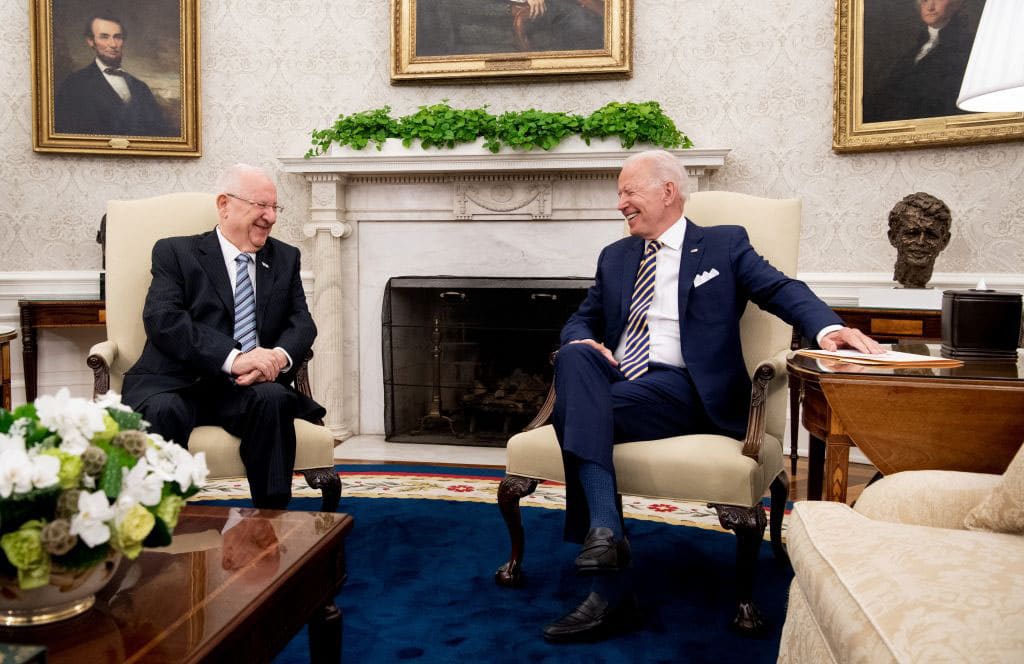
Today, Monday, President Reuven Rivlin of Israel is meeting with President Joe Biden. One president is an outgoing politician, the other just began his first term. One president has no power, and very little say, the other is a commander in chief. One is the president of a small, if not insignificant country, the other is the leader of the world’s number one superpower.

In sum, this is a meeting between “friends,” but not one between equals. Rivlin is here to say goodbye, mostly to his role as the first citizen of Israel. Biden is here because that’s his job, and because he has a mission to accomplish.

Biden’s mission is to have a nuclear deal with Iran. Preferably, without seeming weak and duped and without causing uproar.

Rivlin is one tool that Biden uses to calm the waters before the stormy days of the deal. By hosting him, he proves that he is, indeed, friendly to Israel and cares about its security, that there is a way to work with Israel without a need to sweet-talk former Prime Minister Netanyahu. Of course, Rivlin was invited to the White House when Bibi was still the prime minister, and the invitation was a clear snub of him. Now, with the former PM no longer in his position the taste of the Rivlin-Biden meeting became somewhat bland. And yet, it happens. To the benefit of both.

Landing in New York, to a meeting with Jewish leaders, Rivlin said the following about Iran: “I know we may have disagreements but as always, we will manage them as friends do when they have disagreements.” This statement is also a stab at Netanyahu’s expense. He is the one who supposedly didn’t manage disagreements “as friends do.” When President Obama decided to cut a deal with Iran, Netanyahu decided to break the rules of friendship. He traveled to Washington, invited by the president’s Republican rivals, and made a speech for the ages against the agreement.

What should he have done instead? His political rivals, and many Americans observers, agree that he should have managed the disagreements “as friends do.” But if you ask Bibi about this idea, he’d probably laugh at you. Friends? If the U.S. was a friend, it wouldn’t sign such deal to begin with. Friends? What is the less friendly move—to make a speech in Congress or to make a deal with your friend’s mortal enemy?

That’s the problem with Rivlin’s suggestion to act “as a friend.” That’s the problem with similar suggestions made by Israel’s Foreign Minister Yair Lapid. Of course, Israel would like to be able to talk about Iran like friends, and coordinate with the U.S. But what the U.S. seems to want from its friend is to keep its worry under wraps and let Biden and Blinken cut a deal without making a fuss. If Israel behaves in such convivial manner, it will be entitled to call itself a friend. This would be its small reward for not raising hell over a deal that puts people in mortal danger.

Israel has two strategic goals: one is to be America’s friend, the other is to keep Iran from getting a nuclear weapon.

And yet, the question remains: what to do about Iran. What would Israel do when the deal is cut? What would it gain by being such a “friend” and by managing the disagreements behind closed doors? What would it do if behind closed doors all it gets is not much more than sympathy and a shrug? Israel has two strategic goals: one is to be America’s friend, the other is to keep Iran from getting a nuclear weapon. The only change from Bibi to Rivlin (or Lapid), is that the former chose to risk the first (U.S.) to hopefully get the second (Iran) while the latter chooses to hopefully gain the first (U.S.) by risking the second (Iran).

Losing the U.S. as a friend would be highly problematic. Having a nuclear Iran would also be highly problematic. Promising the Americans to handle disputes like friends merely shifts the priority from problem A to problem B, without quite acknowledging that this is what happens.

Just remember that this isn’t a disagreement about manners. This is a disagreement about the most dramatic strategic challenge Israel faces.

Should the priority really be A and not B? Maybe. Maybe not. Just remember that this isn’t a disagreement about manners. This is a disagreement about the most dramatic strategic challenge Israel faces.


Shmuel Rosner is an Israeli columnist, editor, and researcher. He is the editor of the research and data-journalism website themadad.com, and is the political editor of the Jewish Journal.

The US-Israel Relations: Should We Manage Disputes “Like Friends”? Read More »