fbpx

June 23, 2021

The Leaky Boat

In the aftermath of the American Civil War, the Confederate Grace Brown Elmore wrote, “I find no consolation in religion. I cannot be resigned. Hard thoughts against my God will arise, questions of His justice and mercy refuse to be silenced. … Sometimes I feel so wicked, so rebellious against God, so doubtful of His mercy.”

Elmore believed religion to be a source of consolation, mercy and justice, but seeing very little of this herself, she began to doubt God, and then felt guilty for doing so. Considering the side she was on it might be easy to judge her, but Elmore’s struggle is the struggle of anyone whose religious faith, when tested by the experience of actual life, begins to slip.

Yet I don’t think that Elmore was doubting God or rebelling against God, only her idea of God. And so it seems that when we struggle with God today it might be more fruitful not to question or argue with God, but rather to question and argue with our idea or version of God, and question and rebel against the certainties and conclusions we find within ourselves.

Another way to look at it: The religions of the world are sharing a leaky boat, and each one has a forefinger plugging up a hole. Each time any religion raises that finger to say they are the best or only one, the boat begins to sink. And it is the same with every other preference—cultural, political, and otherwise—that can only be clung to by pretending it is actually an unassailable truth. Despite what the loudest voices continue to say, the enemy of faith is certainty, and certainty can’t help but fail when faced with everyday life on the ground.

The religions of the world are sharing a leaky boat, and each one has a forefinger plugging up a hole.

It has become a cliché to quote Hillel the Elder’s most famous remark, but that’s only because it is as fertile a statement now as it was more than two thousand years ago. When asked by a pagan to sum up the Torah while his questioner stood on one foot, Hillel responded, “What is hateful to yourself, do not do to your fellow-man. That is the whole of the Torah, and the remainder is but commentary. Go, learn it.”

To reduce an entire ethical system—the Ten Commandments, the 613 laws of the Torah that expand on them, and the expansions of those that eventually filled the Talmud—to a statement of fewer than fifteen words is quite an achievement, and to call the vast religious literature of Judaism “commentary” is even better. But what can this mean to us today?

What Hillel seems to be saying is that the rules for a good life are fairly simple, and indeed his statement is Judaism’s formation of the Golden Rule: “What is hateful to yourself, do not do to your fellow-man.” But people don’t live simple lives, and the times are always changing: so what did it mean to not do to another what you yourself would hate, around the year 50 BCE? How about further back, in the Ice Age? How about in Medieval Europe, or modern America? What will it mean tomorrow?

To approach the semblance of understanding, we need the commentary, and in Judaism this means the talk and discussion of the prophets, priests, rabbis, intellectuals, poets, mothers, grandmothers, teachers and family members that fill our books and memories. Just as a decent meal depends upon who is cooking and who is eating, ethical and spiritual sanity cannot rest (despite the image adorning synagogues, churches and courthouses all over the world) simply on rules carved into stone.

As the grandson of the Baal Shem Tov said of each new generation of interpreters: “They make the Torah complete. Torah is interpreted in each generation according to what that generation needs. God enlightens the eyes of each generation’s sages [to interpret] His holy Torah in accord with the soul-root of that generation. One who denies this is like one who denies Torah, God forbid.”

While there is, in the end, no way to fully avoid either the slipperiness of relativism or the brutality of fundamentalism, looking at scripture and faith in this way can help find a middle road. Only by learning the flavor of each generation, and of each historical moment and place, can anything like eternal verity be approached. Understood in this way, all the details of daily life—all the things that fundamentalists would identify as temptations, and what all those with no need for religion see as all that life has to offer—are actually the things that lead to truth, and to God, but only if they are taken together.

If Torah is truly to be understood anew each generation, only those in touch with that generation—and in touch with the worldly life of that generation—can ever approach it.

If Torah is truly to be understood anew each generation, only those in touch with that generation—and in touch with the worldly life of that generation—can ever approach it. We need every argument surrounding religion just as we need every ephemeral allegiance—to Mac or Windows, “Star Trek” or “Star Wars,” the Yankees or (God forbid) the Phillies. Our preferences, our opinions, our traditions and rituals can all rise to the level of sacredness, and our adherence to them can literally support our lives, but there is nothing sacred about a hammer that pretends to clear every other option away.

By sanctifying study and interpretation as much as prayer, Judaism sanctifies the question over and above any possible answer. The perceived goal is not, as Grace Brown Elmore saw it, consolation and mercy, but the unending intensity of living, thinking, and praying. The questions that make Elmore so uncomfortable—“questions of His justice and mercy that refuse to be silenced”—are, for Jews, just what happens on a Tuesday. What to Elmore felt like a plummet towards some terrible end, is just the beginning for any thinking, wrestling Jew.


Tim Miller‘s poetry and essays have appeared in Parabola, The Wisdom Daily, Jewish Literary Journal, Crannog, Southword, Londongrip, Poethead, and others across the US and UK. Two recent books include Bone Antler Stone (poetry, The High Window Press) and the long narrative poem To the House of the Sun (S4N Books). 

The Leaky Boat Read More »

The Magical Images of Israeli Political Cartoonist Shay Charka

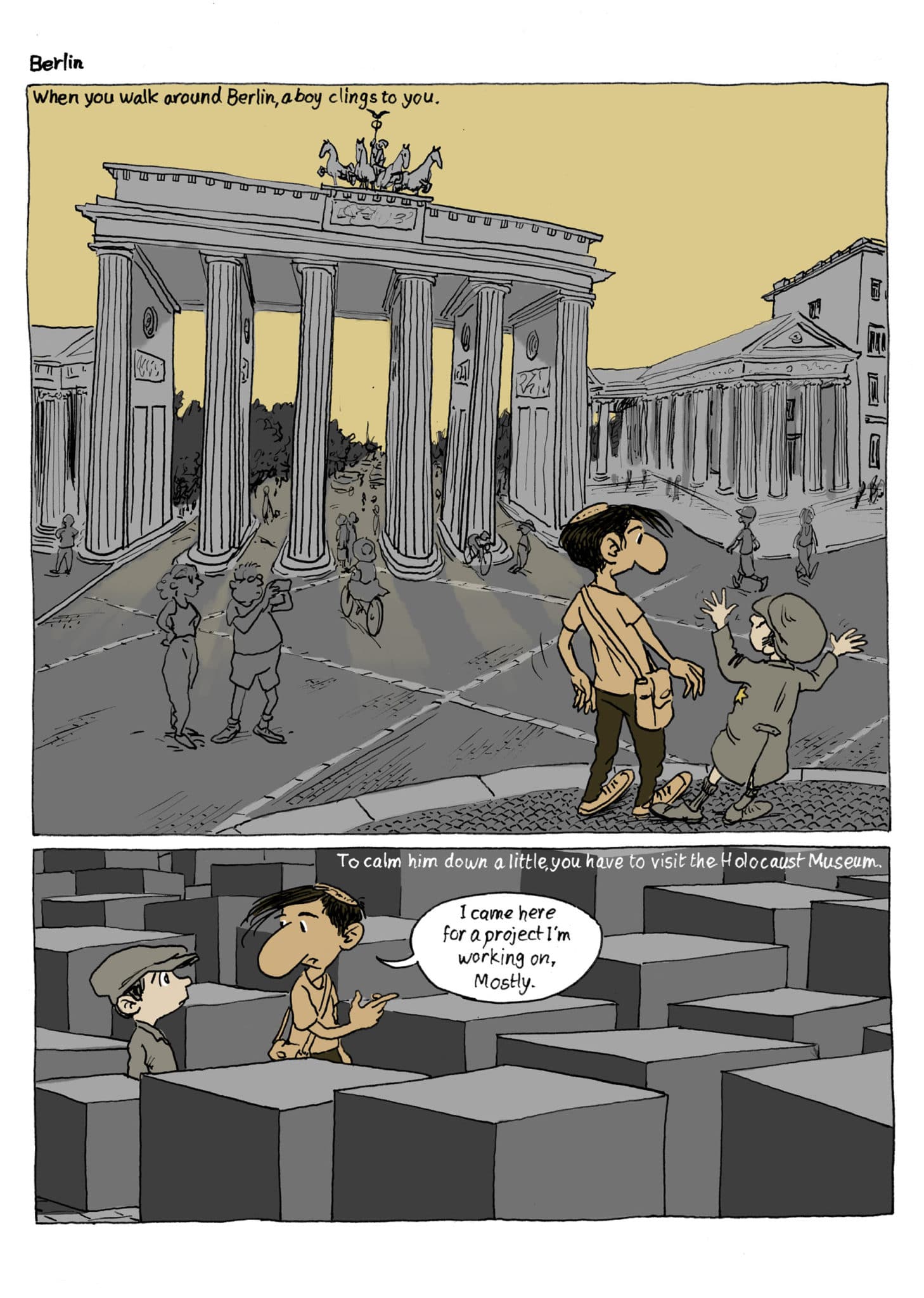
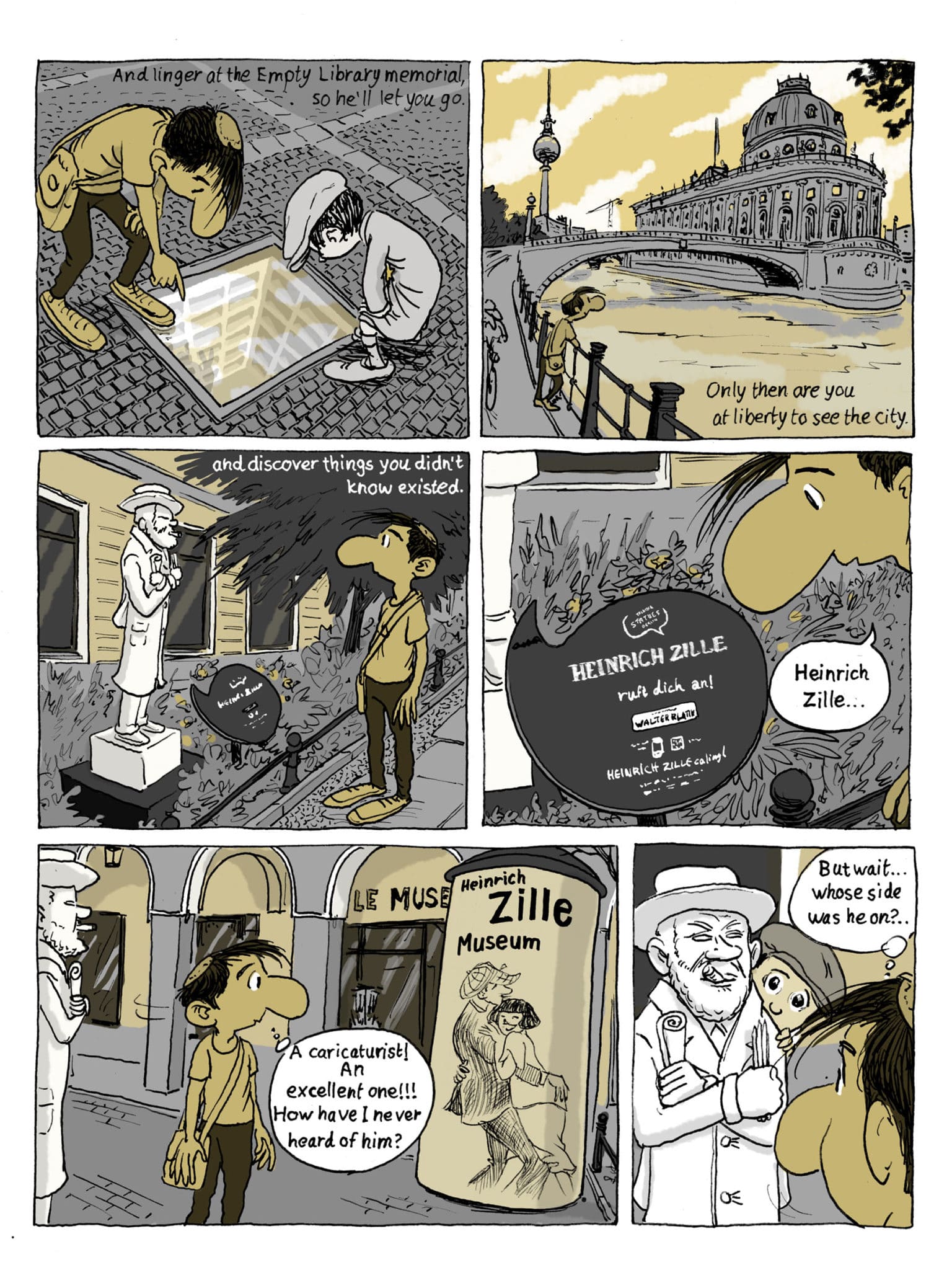
Shay Charka is one of Israel’s most talented comic book artists and political cartoonists. Dara Horn, writing in TabletMagazine, called “From Foe to Friend,” Charka’s pictorial versions of stories by the Nobel prizewinning author S. Y. Agnon, “miraculous” and “so breathtaking that I almost thought I dreamed it.” Born in 1967, Charka has published twenty graphic novels and cartoon collections, his work drawing playfully and profoundly on Jewish sources such as the Bible and Talmud. His “Jewdyssey,” a graphic-novel retelling of Homer’s “Odyssey” as a Holocaust story, has recently been prepared in English translation. He is the political cartoonist for the Israeli paper Makor Rishon, where his deft and brilliant visual commentary on current events is relished by thousands.

In these three recent “shorts,” Charka meditates on Europe—the “old world.” The first, “Berlin,” captures the haunting experience of the Jewish visitor to that city, figured as the boy from the Warsaw Ghetto photograph. The second, “Nehemia,” mischievously retells the Hasidic tale of the Baal Shem Tov and the boy who played flute on Yom Kippur, making a place for the cartoonist in a story Agnon included in his “Days of Awe.” The third story is an acerbic, affecting reflection on family memories and the impulse to look for our “Roots” in the landscape of post-Holocaust Europe.


Michael Weingrad is a professor of Jewish Studies and lives in Oregon. 

The Magical Images of Israeli Political Cartoonist Shay Charka Read More »

Bilaam and the Boy with the Flute

Where did Bilaam go wrong? One early rabbinic tradition asserts that Bilaam was the greatest prophet to ever live, even greater than Moshe. Yet Bilaam is an exceptional failure. He is described in the Book of Joshua as a mere magician, and is put to death during the Israelites’ battle with Midian. How can a man with a direct connection to God lose his soul?

The authors of Pirkei Avot offer a fascinating comparison between Bilaam and Avraham. The Mishnah says:

“Whoever possesses these three things is of the students of Avraham, our father; and [whoever possesses] three other things is of the students of Bilaam, the wicked. One who possesses a good eye, a humble spirit and a moderate appetite is of the students of Avraham, our father.  One who possesses an evil eye, a haughty spirit and a limitless appetite is of the students of Bilaam, the wicked.”

This comparison is not random. Bilaam and Avraham have similar beginnings; they share the same birthplace, Aram Naharaim (Deuteronomy 23:5). Both have abundant gifts of prophecy, and the Bible describes both as people whose blessing is a blessing and curse is a curse. The Mishnah explains that what separates Bilaam and Avraham is their character. Bilaam is arrogant, nasty, and selfish, and because of this, his remarkable spiritual gifts go to waste. A person can have the most profound experience of God, but without a well-developed character, that revelation is lost. The Mishnah’s explanation is straightforward, yet elegant: if you fail to be a good person, you will fail to be a godly person.

The Mishnah’s explanation is straightforward, yet elegant: if you fail to be a good person, you will fail to be a godly person.

A further look at this comparison offers a second perspective. Jonathan D. Safren notes several textual similarities between Bilaam in this narrative and Avraham in the narrative of Akeidat Yitzchak, the binding of Isaac, in Genesis chapter 22. Bilaam and Avraham both wake up early and saddle their donkeys by themselves; both have two servants, and both confront angels. The verb “raah,” “to see,” appears five times in both narratives. These parallels imply another reason for Bilaam’s failure: unlike Avraham, Bilaam is not a faithful servant of God. In contrast to the self-sacrifice of the Akeidah, Bilaam pursues his self-interest.

I would argue that there is a third way of looking at this comparison. The most significant comparison between Avraham and Bilaam is found in a set of parallel narratives. In our Torah reading, Bilaam is requested to curse a nation; and Bilaam runs out the door in the morning to do so, hoping to destroy a multitude of complete strangers. Bilaam pushes forward despite divine warnings, and builds one altar after another, in hopes of convincing God to destroy the Jews.

Avraham responds in a very different manner when told about the impending destruction of Sodom. Avraham also pushes forward in his mission even after it is rejected, and argues with God to spare Sodom. Avraham uses his connection to God to save lives; Bilaam uses his connection to God to destroy lives.

Avraham uses his connection to God to save lives; Bilaam uses his connection to God to destroy lives.

Bilaam may speak to God, but his paradigm of divine power is a pagan one. Joshua Berman in his book “Created Equal” writes that “in the Mesopotamian, Ugaritic, and Egyptian conceptions … it is not the common man who is the central focus of the gods but the king.” In Egypt, this went so far as to have the King worshiped as a demigod. In paganism, divine power belonged to the elite, and served their needs; the common man was ignored by God and can be oppressed by man. Bilaam wants God to provide him with wealth and prestige, while trampling on the backs of the Israelites. His God is the God of autocrats, serving the powerful while oppressing the weak.

Avraham’s vision of God is very different; he understands that God has a direct relationship with all of mankind. The reason Avraham has the chutzpah to argue with God about Sodom is because God is the God of all humanity, and would not want any innocent life to be lost. Avraham is an advocate of his fellow human beings; and the “students of Avraham” are advocates for humanity as well.

This understanding of God was revolutionary for the ancient world, and it remains revolutionary today. We may try to imagine a divine connection to each human being; but too often, our imagination fails us. An excellent example of this is the story about the Baal Shem Tov and the shepherd boy. This is the version offered by Shmuel Yosef Agnon in “Days of Awe”:

A certain villager used to pray on the Days of Awe in the House of Study of the Baal Shem Tov. He had a child whose wits were dull and who could not even read the letters in the prayer book, much less recite a holy word … when the boy became Bar Mitzvah, his father took him with him to the city for Yom Kippur, so as to be able to watch him and keep him from eating from simple ignorance.

Now the boy had a little flute on which he used to play all the time when he sat in the field tending his flock. He took the flute with him from home and put it in his coat, and his father did not know about it.

The boy sat in The House of Prayer all Yom Kippur without praying, because he did not know how.

During the Additional Prayer he said to his father. “Father, I want to play the flute.” His father became terrified and spoke sharply to the boy. The boy had to restrain himself.

During the Afternoon Prayer the boy repeated again: “Father let me play on my flute.”

Seeing that the boy wanted badly to play on his flute, his father said to him “Where is the flute? The child pointed to the pocket of his coat. The father therefore held the child’s pocket in his hand, to keep the boy from taking out the flute and playing on it.

Holding the pocket with the flute in this way, the man stood and prayed the Closing Prayer. In the middle of the prayer, the boy forced the flute out of his pocket and blew a blast so loud that all who heard it were taken aback.

When the Baal Shem Tov heard the sound, he shortened his prayer. After the prayer the Baal Shem Tov said: “With the sound of this flute the child lifted up all the prayers and eased my burden.”

We have heard this story so often that we forget how revolutionary it actually is. Yes, the Baal Shem Tov is a “student of Avraham.” But what would happen if a young man pulled out his flute during Neilah today: would people react like the father, or the Baal Shem Tov? Many of us subconsciously carry an elitist view of God, and lose our appreciation for God’s connection to the homeless and hopeless. The challenge of this Parsha is to learn how to be true “students of Avraham,” and see God’s love for every human being. Then, we will be able to appreciate the divine symphony of the boy with the flute.


Rabbi Chaim Steinmetz is the Senior Rabbi of Congregation Kehilath Jeshurun in New York.

Bilaam and the Boy with the Flute Read More »

Break-in and Burglary at PSY ON PICO Kosher Restaurant

PSY ON PICO, a kosher restaurant on west Pico Boulevard, just east of Beverly Drive, was burglarized at approximately 2 am Tuesday, June 22.  The suspect smashed the glass front door, entered the restaurant and took $1,500 from the cash register, according to Mike Loeben, restaurant manager.

The incident was caught on video inside the restaurant which showed a masked person going straight to the register, taking the money and leaving. The front door has since been replaced.

The burglary comes in the wake of two incidents on May 28 just one block east at Young Israel of Century City, and Pat’s restaurant on the adjacent block.  Jon Knight Prince, 26, was arrested on June 3 on suspicion of felony vandalism in those incidents.

“It appears this was a professional robbery,” Loeben said.  “We are very aware of recent antisemitic attacks in the neighborhood, but we will have to wait and see if there is any connection.”

Calls to West Los Angeles Police were not immediately returned.

This is a developing story.

Break-in and Burglary at PSY ON PICO Kosher Restaurant Read More »

Table for Five: Balak

One verse, five voices. Edited by Salvador Litvak, the Accidental Talmudist

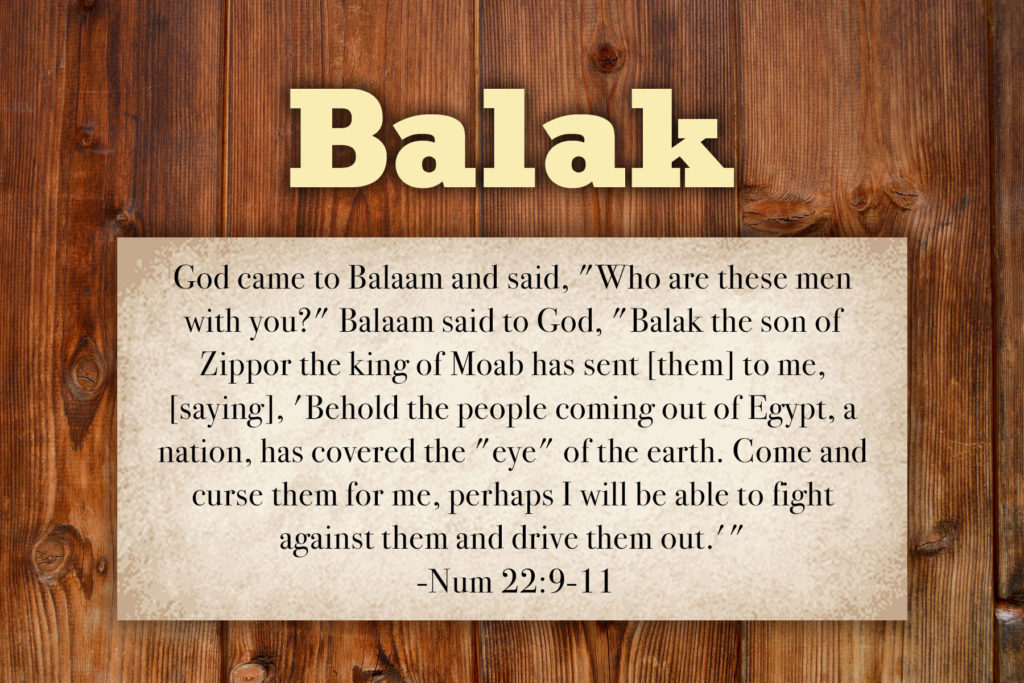
God came to Balaam and said, “Who are these men with you?” Balaam said to God, “Balak the son of Zippor the king of Moab has sent [them] to me, [saying], ‘Behold the people coming out of Egypt, a nation, has covered the “eye” of the earth. Come and curse them for me, perhaps I will be able to fight against them and drive them out.'”
 -Num 22:9-11


Rabbi Peretz Rodman
Jerusalem-based writer, translator & teacher

Balaam is careful. He is far more reliable in conveying to God Balak’s request than the king’s messengers will be in reporting Balaam’s answer to the king. Balaam quotes, nearly verbatim, almost all of the messengers’ offer. One verb, though, he carefully edits out: Balak had not concluded with “perhaps I will be able to fight against them…,” as Balaam reports, but rather “perhaps I will be able to whack them…,” using a verb, nakkeh, that means “whack” in both the literal and Mafia senses: “strike at” and “strike down,” meaning “kill.”

Balaam does not want the Lord to hear that Balak might adopt more than a defensive posture. The thought of Balak clobbering the Lord’s chosen people, thwarting their march to Canaan, would surely be a deal-breaker. And this story is all about the art of the deal. So Balaam portrays the Moabite king as wanting merely to push Israel away.

Balaam has already undertaken the game of maneuvering that he is to continue to the end of the tale, when Balak’s temper finally overcomes his patience and he wails at Balaam: “Don’t you utter another word!” Our prophet-for-hire, offered the commission of a lifetime—he hints at earning a “house full of silver and gold”—is caught between his avarice and his professionalism, for he knows he must not curse Israel. If we read as carefully as Balaam speaks, we see that he plays for time, manipulating everyone until his plan collapses in tragicomic failure.


Rivkah Slonim
Rohr Chabad Center, Binghamton University

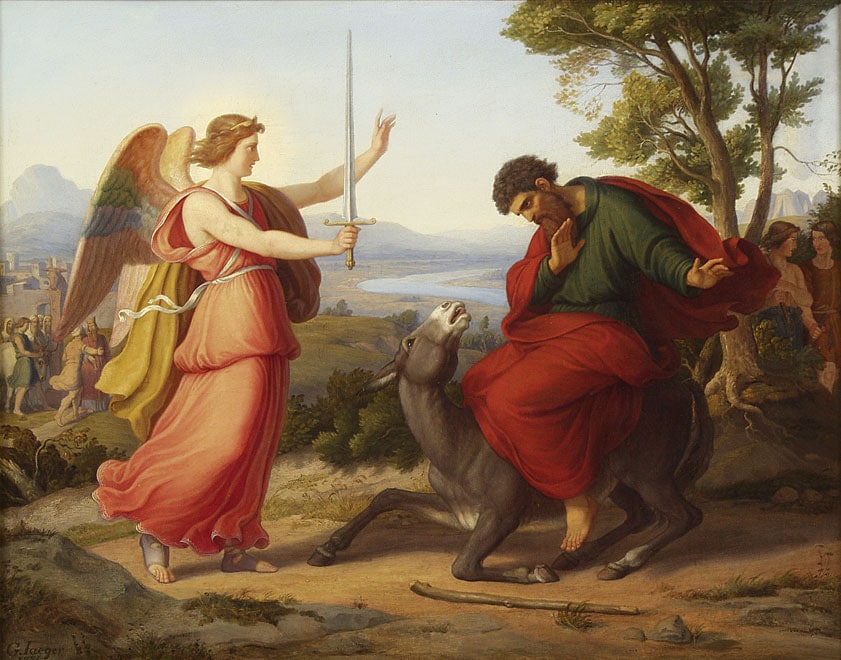
It’s easy to be distracted by the zaniness of the narrative and miss the profundity in this week’s Parasha. Bnai Yisroel are just about to enter the Promised Land. Balak, king of the Moabites who inhabited Canaan is fearful. He hires Balaam, a powerful, gentile prophet and sorcerer to curse the Jews and diminish their power. And while God appears to Balaam and warns him against taking this contract, he cannot overcome his desire to harm the Jews. Even after his donkey speaks to him and makes clear that he is walking into a quagmire, Balaam persists.

Ironically, Balaam ends up being used as an instrument for blessing. Additionally, his words contain the most explicit reference to the Messianic era in the Torah!

Chassidus teaches that before entering the Land of Israel the Jews needed to learn of the end of days, the messianic era, that would come as a result of their service in exile. Am Yisrael is not a pedestrian people entering an ordinary parcel of land. This was the Holy Land, bequeathed to Jews for the purpose of irradiating light and sanctity unto the entire world. Entering the land was just the first step in a millennia long project: that of transforming the world into a place that reflects its Creator in manifest fashion. The parasha, named curiously for Balak, teaches us that this sweeping transformation must include every aspect of the universe, and all of its inhabitants. Even the ones most resistant to hearing God’s message.


Rabbi Natan Halevy
Kahal Joseph Congregation

The Midrash equates these verses to the tragic story of Cain and Abel. Hashem asks Cain “Where is your brother?” Cain answers arrogantly, “Am I my brother’s keeper?” He thought that Hashem was not fully cognizant of happenings in this realm and that he could succeed in fooling Hashem.

Likewise, Balaam had falsely inferred limitations within G-d and had misperceptions about his communication with Hashem. These men had divine revelations of G-d, yet they were scheming how to outsmart Him. Both knew right from wrong since it had been expressed by a present deity. Yet they chose to go against Hashem’s will, spilling innocent blood with wanton cruelty.

Sadly, this illogical spiritual path continues to plague the world. Mankind has been blessed with a wealth of knowledge, from the function of the most minute cells to the infinite depth and grandeur of the universe. We have reached the pinnacle of human innovation and technical advancement, yet humankind is no closer to the truth that comes with the intimate knowledge of Hashem. Men have strayed from the revelation and moral clarity of the Ten Commandments.

Just as Cain spilled his brother’s blood, human suffering has been inflicted by corrupt men with power and weapons. Just as Balaam tried to curse the Israelites out of pure evil, mankind has been cursed with man-made evils.

Every one of us has the power to make the choice for goodness and kindness, to improve our spiritual service, and to proclaim Hashem’s greatness. May it be His will!


Eva Robbins
Rabbi/Cantor N’vay Shalom, Faculty AJRCA

How bizarre that G-d should ask Balaam, “Who are these men?” Are we to believe that G-d does not know? The High Holy Day liturgy teaches that G-d sees and hears everything, “There is nothing hidden from You…” and it is all recorded in the great Book we confront on Rosh Hashanah.

Our Sages pondered this idea and Midrash Raba points out Balaam should have responded, “Master of the world, ‘Everything is revealed in front of You and there is not anything hidden from you, and You ask me?’” This response would have reflected some semblance of humility, what one would expect from someone standing before the awe of the Divine. Even more ironic is that this foreign prophet has the ability to converse with our Deity.

Ibn Ezra points out that G-d wants to engage in a conversation with Balaam. Perhaps this is to test him. What G-d hears is an arrogant prophet, bragging that he has the ability to curse the people, G-d’s people. To the One, whose reputation surely spread throughout the land that S/He had destroyed the Egyptian army, Balaam had the chutzpah to boast of his abilities to make it possible for Balak to defeat the Israelite nation whom he clearly feared. G-d teaches them both there is only One power in the Universe.

And G-d teaches us, as well, that curses can become blessings, that evil can be met with good, and that darkness can be transformed into light.


Miriam Mill-Kreisman
Tzaddik Foundation

When I was in college I used to wear a pin showing the map of Israel stating “Because G-d gave it to the Jews”. I could never understand how anyone could argue it didn’t. After all, we won it. War after war.

It was only years later after I started to properly learn Torah that I began to understand what my pin meant. Every victory was miraculous. The pasuk, “Behold the people coming out of Egypt, a nation, has covered the ‘eye’ of the earth”, describes how the Israelites have divested the Canaanite and Moav kings of its sentinels, Sichon and Og, the Kings of the Amorites, who were paid to protect them from invaders. At this point, Balak recognizes that if giants in battle like Sichon and Og can’t conquer the Israelites, then he had to use a different tactic.

So he hires Balaam, a powerful sorcerer and prophet, to curse the Jews. The cursing tactic didn’t succeed; G-d just won’t let it. In fact, Balaam is forced to bless the Jews and it is from his prophecy that we get much of what we know about the coming of the Moshiach. But evil is hard to overcome and we see later how these evil ones chose a different tactic that did work – reducing the Jewish men to sin with the Moabite women. May we always have faith that G-d is with us and have control over our own low desires to receive all blessings.

Table for Five: Balak Read More »

Local Comedian Crowdfunding for a Podcast Bus

Orthodox-Jewish comedian Danny Lobell, 38, has spent nearly four decades on this planet, and during that time, he has learned a few things.

Lessons learned include but are not limited to: “Don’t work with people who are fond of taking acid”; fatherhood is an opportunity for an adult man to experience activities he’d be shunned for doing if done without a child, like visiting a playground; and “When you have an idea, run with it.”

It is this last point that makes the greatest impression when meeting with Lobell at Star Juice in Pico-Robertson on a Friday afternoon to discuss the entertainer’s latest initiative, a crowd-funding campaign to support the purchase of a mobile podcast studio, a bus that will come equipped with video and audio equipment—a top-of-the-line recording environment, Lobell says, “that comes to you.”

“I want to build up a podcast business, it is basically all I am doing these days, and I want to be the best at it. I am looking at a bus to convert into a podcast studio with the best sound and video and the best Danny Lobell behind it all,” he says on his campaign’s GoFundMe page, which as of press time, had raised more than $3,200 of a $50,000 goal.

While he may have long a way to go in terms of fundraising dollars, in a post-pandemic age where people have increasingly become accustomed to groceries and Amazon packages arriving at their doors, is it that much of a stretch to imagine a bus pulling up and parking outside your door, you stepping outside and onto the bus and recording the podcast you have always wanted to record on the bus?

Lobell is hoping it isn’t. Married to Journal contributor Kylie Ora Lobell and based in Pico-Robertson, Lobell said the idea for the bus came directly from his imagination, which has also birthed “Fair Enough,” an autobiographical comic book series chronicling his upbringing in an Orthodox yeshiva. In 2017, he performed the one-man show, “Broke as a Joke,” as part of the Hollywood Fringe Festival. And he has released two comedy albums, including 2017’s “The Nicest Boy in Barcelona,” which revisits Lobell’s Sephardic family’s roots.

While it seems like everyone has a podcast now, Lobell was doing it before it was big business. In 2004, he created “Comical Radio,” credited as one of the very first podcasts focused on stand-up comedy. He later became the host of the long-running “Modern Day Philosophers,” featuring interviews with guest comedians, both popular and obscure, about different philosophers. Along the way, he has also helped a variety of professionals from various fields launch shows on topics as wide-ranging as Torah, medical issues and law.

While it seems like everyone has a podcast now, Lobell was doing it before it was big business.

“I have an extensive knowledge of all these random things,” Lobell, wearing a yarmulke and tzitzit during the recent interview, said. “I like getting to step into different worlds and learning.”

In the promotional video on his campaign’s GoFundMe page, he promises ten percent of all income earned from the endeavor will go to charity in perpetuity.

“Have you ever been to perpetuity?” he asks in the video. “It’s a long time. It’s longer than purgatory.”

While he has a studio in his home, he said distractions, including a crying baby, a barking dog and leaf-blowing gardeners, are aplenty, and the studio-on-wheels will allow him to record podcasts in a quieter, more focused space. For anyone who has worked from home during the pandemic, this is certainly relatable.

Furthermore, the bus will allow him to potentially expand his podcast business to those who want to record a podcast but do not want the inconvenience of driving to his home studio in Pico-Robertson to do it.

As for what has made him successful in the podcasting world, Lobell said, “I have a real curiosity about people, which I think makes me a good host—people and subject matters.”

To support Lobell’s GoFundMe campaign, visit gofundme.com/f/help-daniel-lobell-build-a-mobile-recording-studio.

Local Comedian Crowdfunding for a Podcast Bus Read More »

The Jewish Stake in the Battle Against Critical Race Theory

What’s the latest racist threat to American democracy? According to a host of liberal publications, it’s the nationwide push to prevent the imposition of critical race theory doctrines on public education. Articles in publications like The New York Times, NBC and Axios claim grassroots efforts to stop local school boards from adopting curricula heavily influenced by radical ideas depicting America as an irredeemably racist nation are both racist in spirit and largely the work of right-wing conspiracy theorists who are being organized and funded by national conservative groups.

Outlets like the Times, where support for critical race theory is a constant theme for writers like Michelle Goldberg and Charles Blow, claim that this growing activist movement is a noxious form of Trumpism whose aim is to demonize an important idea and the righteous educators seeking to shed light on American racism. Critical race theory opponents are being likened to book burners, censorship advocates and McCarthyite witch-hunters persecuting free thinkers.

If that wasn’t bad enough, coverage of the issue is tilted so as to describe the controversy as a case of “astroturfing,” a term used to describe an orchestrated effort financed by “dark money” to fake grassroots activism.

In this way, public opinion is being mobilized not only to support race-training education but to regard those fighting it as either racists or fools being manipulated by forces opposed to democracy.

However, this spin on the controversy is not only false but a case of gaslighting. Which is to say that rather than being persecuted innocent free thinkers, the defenders of critical race theory themselves are advocates of censorship, cancel culture and opponents of free inquiry.

What’s more, this is an issue in which the interests of the Jewish community are very much at risk from those who wish to label both the Jewish people and Israel as linked to “white privilege” and the effort to oppress “people of color.” But rather than joining in opposition to those trying to make critical race theory and the associated intersectional ideas that delegitimize the Jewish state, the organized Jewish community and its leading groups are either absent from the fight or, as in the case of the Anti-Defamation League and the Jewish Council on Public Affairs, on the wrong side of it.

As we have seen in the last year since the death of George Floyd created a moral panic about race, the champions of this ideology are not seeking to make Americans less race-conscious, and willing to treat and judge each other as individuals rather than members of racial groups as traditional civil rights efforts sought to do. Their purpose is just the opposite. The point of these educational and training programs, such as those championed by White Fragility author Robin D’Angelo or the work of Boston University professor and open anti-Semite Ibram X. Kendi, is to make race the organizing concept of every aspect of American society.

As with the fallacious work of the Times’ “1619 Project” and its author Nikole Hannah-Jones, these efforts are not only focused on making the objects of its pedagogy—both those in school and adults who are being dragooned into mandatory corporate or government training sessions—but to think of the United States as a racist nation in need of re-education. The organizing principle of this theory is that all people are categorized by their race, and labeled either as victims or beneficiaries of “white privilege” who must acknowledge their complicity in the crimes of the past and the alleged injustices of the present. It seeks “equity” rather than equality so as to justify the indefensible and illogical notion that racial discrimination is required to eradicate racism.

As with other radical ideas associated with the Black Lives Matter movement that migrated from the margins of society to the mainstream, these programs demand not just a hearing but unquestioned obedience. Those who question the premises of the programs are automatically deemed racists who must be forced to acknowledge fault in the manner of the “struggle sessions” of the Chinese Cultural Revolution and/or purged.

That’s why it’s so vital to resist their imposition. Once put in place, they are totalitarian in nature and work to change not just the nature of the conversation about race but also who may speak about it.

It is unfortunate that this issue quickly became politicized but in a country where politics has infiltrated every sector of society perhaps that was inevitable. By the end of last summer, it became one in which Republicans and conservatives were lining up behind Trump’s executive order against imposing critical race training in government agencies, and Democrats and liberals immediately and wrongly assumed they should defend these programs.

As the country became even more polarized by the presidential election and its aftermath, it also became apparent that the spread of critical race theory in school curricula was not some marginal phenomena but happening across the nation without debate or proper vetting. Parents saw their children were being subjected to fundamentally illiberal ideas about race and liberty, and being told that to question them was to risk being falsely labeled as a white supremacist. While they are told by the talking heads that they don’t understand the issue, there is no mistake about what is up for grabs in this controversy.

Jews, like other Americans, have an interest in opposing these toxic ideologies—let alone their imposition on our educational system. The Jewish community ought to be particularly alarmed not only by the spread of such curricula, but also the effort to demonize those citizens with the temerity to stand up to the intellectual thugs who are behind them.

As we have seen in recent weeks in the wake of the latest fighting between Israel and Hamas, there is a direct connection between the acceptance of intersectional and critical race theory ideas and anti-Semitism. Those in Congress, the media and in the academy who are championing notions of white privilege and seeing race as the defining element of society are the same people who claim that Israel is an “apartheid state,” and that the Palestinian war to destroy the one Jewish state on the planet is a struggle against racist oppression. The distance between those lies and Jew-hatred is short; it is not surprising that acts of intimidation and violence, first on college campuses and now on the streets, have followed.

That ought to mean that those tasked with opposing anti-Semitism ought to be at the forefront of the effort against critical race theory education. Sadly, not only is that not the case, those agencies most vocal about the issue are lining up with the racial ideologues allied to the Black Lives Matter movement, not the parents, both Jewish (such as Elana Yaron Fishbein, who organized the No Left Turn in Education group) and non-Jewish in school districts around the country. The ADL opposed Trump’s executive order against race training and has continued to help demonize those opposed to such efforts. The same is true of the JCPA, the umbrella group of Jewish community relations agencies.

If there is anything we have learned in the last year, it is that critical race theory is an all-purpose permission slip for Jew-hatred. Since the divide on this issue has become one largely characterized by partisan affiliation, the ADL, the JCPA and many other liberal Jewish groups have lined up in favor of it and, more importantly, against those who oppose it.

This is madness. It is imperative that Jews join the movement to stop the twisting of American education in such a way as to undermine the cause of liberty, as well as endanger Israel and the Jewish community. That those who are supposed to be defending the Jews feel more comfortable accepting the partisan conventional wisdom about race theory is both a scandal and a tragedy.


Jonathan S. Tobin is editor in chief of JNS—Jewish News Syndicate. Follow him on Twitter at: @jonathans_tobin.

The Jewish Stake in the Battle Against Critical Race Theory Read More »

Big Shot LA

Laker fans recognize only one “Big Shot,” Robert Horry, AKA “Big Shot Rob,” seven-time NBA champ and famed member of the Kobe-Shaq championship teams. But now we need a new crop of LA Sports “Big Shots.” This time the moniker won’t reward clutch 4th-quarter jump shots, walk-off homeruns, or game-ending strikeouts. Instead, LA needs help with its biggest shot ever: the COVID-19 vaccination.

Despite California’s recent opening and our relative success against the virus, sports stars should know that fans are still dying. About 1000 Californians still are diagnosed with COVID-19 every day. Because many remain asymptomatic and others are never formally diagnosed, the true rate is probably closer to 4,000. The mortality rate of about 0.5% means that about 20 Californians will die of the COVID-19 infection they catch today. To end the pandemic, we must push vaccination rates to the 70-80% that produces herd immunity and eliminates ongoing infections.

Despite California’s recent opening and our relative success against the virus, sports stars should know that fans are still dying.

So, why sports stars?  Simply because they deliver the message better than anyone else.  Sports figures’ unique ability to break through to the public dates back to Babe Ruth, who revolutionized both sports and marketing in the 1920s. Advertisers discovered early on that an association with the Babe guaranteed commercial success. Ruth’s advertising income eventually more than doubled his substantial baseball salary. In commenting on Ruth’s hold on the public, The New Yorker noted that in 1934 the Associated Press ranked him as the world’s most photographed individual, surpassing FDR, and the Prince of Wales.

Although epic figures like Ruth are rare, Los Angeles boasts six players that meet the best litmus test of sports stardom: their league’s Most Valuable Player (MVP) award. The Lakers’ Lebron James stands out even among these remarkable sports heroes. In seventeen pro seasons the 36-year-old won four NBA championships, two Olympic Gold Medals and four NBA MVP awards. His efforts on behalf of his non-profit organization and his willingness to speak out on social justice issues enhance his credibility. In recognition of Lebron’s unique status, Time Magazine placed him on its annual list of the World’s 100 most influential people four times, more than Joe Biden, Warren Buffet, or the Dalai Lama. Just imagine how much his enthusiastic endorsement would mean for a vaccination appeal.

The Angels’ Mike Trout and the Dodgers’ Albert Pujols nearly match Lebron as standouts. Each won three MVP awards. In baseball history only Barry Bonds won more. The Dodgers’ Clayton Kershaw, Mookie Betts, and Cody Bellinger also all won MVP awards and offer the additional distinction of their leadership in the Dodgers’ 2020 championship effort. Finally, the Rams’ Aaron Donald, though never a league MVP, deserves a place among the LA sports elite as a three-time NFL defensive player of the year.

The ”LA Seven” can reach many that fall beyond the reach of traditional public health advisories. Four of the seven belong to the minority groups whose vaccination rates are lagging. While 64% of the white community has been vaccinated, only 43% of the Black community and 52% of Latinos in LA County have taken the shot. The sports heroes would also likely connect with the young. Only 54% of those between 18 and 29 have been vaccinated. Among the youngest eligible, 12-15-year-olds, the rate is an abysmal 34%.

The ”LA Seven” can reach many that fall beyond the reach of traditional public health advisories.

Several prominent sports stars have made public service announcements (PSAs) to encourage vaccination including Milwaukee Bucks Star Jrue Holiday and the Golden State Warriors’ Klay Thompson. However, none of the current crop of PSA players offers the superstar status needed to attract sufficient  attention to motivate the public.

Although California’s downturn in cases reflects progress, our LA sports stars know that a lead in the 9th inning doesn’t mean “game over.”  Continued small numbers of infections in unvaccinated individuals may preserve the embers of the epidemic. As the immunity of those previously infected wanes, these embers of persistent virus, by rekindling re-infections, could allow the virus to continue to circulate indefinitely. Each vaccination offers a step toward herd immunity and to a future without the need for repeated periodic booster vaccinations.

America has safe vaccines that can end the pandemic but it’s not enough. We need all hands-on deck for this effort. Superstars like the LA Seven should recognize this need and step up, as they would during game time. It’s late in the fourth quarter with the future health of our city and country in the balance.  LA sports celebrities should join with local sports teams, media, and the government’s public health organizations in a new program to lift our life-saving efforts to a new level: Big Shot LA.


Daniel Stone is Regional Medical Director of Cedars-Sinai Valley Network and a practicing internist and geriatrician with Cedars Sinai Medical Group. The views expressed in this column do not necessarily reflect those of Cedars-Sinai.

Big Shot LA Read More »

Unscrolled Balak: This Against That

“In the beginning God created the heavens and the earth” (Genesis 1:1).

The Torah opens with a wide establishing shot of the universe. In it, we behold all of creation—the waters above and the waters below; the celestial bodies in their orbits; the flora and the fauna of the earth.

We then zoom in, narrowing the frame until the earth is all we can see.

What begins as a history of the universe becomes a history of the earth and of mankind. We are introduced to Adam and Eve, Cain and Abel. We are told the story of Noah and the great flood. We learn of the Tower of Babel. And then comes Parashat Lech Lecha, and our narrative scope narrows once again.

“When Terach had lived 70 years, he begot Abram, Nachor, and Haran (Genesis 11:26).

From here on out, this is no longer the story of the universe, nor the story of the earth, nor the story of the human race. It is now the sacred history of one people and their relationship with God, who redeems them from slavery and brings them to a promised land that He has designated for them as an inheritance.

For the most part, this is how it will be for the rest of Torah. Only in rare moments will the frame again widen—reminding us that God is indeed God of the world, and not merely the protector of one small tribe.

In Deuteronomy, for instance, God warns the Israelites not to set so much as a toe into the hill country of Seir, for God has “given the hill country of Seir as a possession to Esau” (Deuteronomy 2:5). God then makes a similar pronouncement about the Moabites. “I have assigned [the land of] Ar as a possession to the descendants of Lot” (Ibid 2:9).

From this, we can learn that there are other promised lands, which are apparently promised to different peoples.

Another such instance of frame-widening takes place in this week’s Torah portion, Parashat Balak, in which we meet Bilaam, a gentile prophet who is hired by the Moabite king, Balak, to curse the Israelites, who he believes have become too numerous.

According to a simple reading of the text, Bilaam seems like a good enough fellow. He refuses to curse the Israelites despite King Balak’s insistence, instead blessing them.

The sages, however, remember him more ambivalently, charging him with cursing the Israelites on the sly, by way of blessings that could be plausibly read as curses. Still, the sages give credit where credit is due, contending that Bilaam was equal to Moses in terms of prophetic ability.

This an example of what the Hasidic master Rabbi Tzadok Hakohen of Lublin called “Zeh Leumat Zeh,” or “this against that.” According to this theory, the world of the Jews and the world of non-Jews are held together by a kind of symmetry and parallel development. At its worst, this can become a source of enmity between the Jews and the non-Jews. At its best, it can become a flowering of mutual inspiration and cooperation.

At its worst, this can become a source of enmity between the Jews and the non-Jews. At its best, it can become a flowering of mutual inspiration and cooperation.

In the story of Bilaam, the narrative frame is wide enough for us to see the workings of “zeh leumat zeh.” Just as the Jews have a great prophet, so do the nations of the world. That said, this is still very much the Israelites’ story. Bilaam is thus primarily defined for us through his relationship to the Israelites.

But even if the frame has only widened a little, falling short of its Genesis 1:1 expansiveness, we would be remiss if we didn’t take such moments to gaze out and soak in as much of the view as we can, for hidden in its details are the unarticulated tenets of the Torah’s cosmology.

Doing so, what do we see?

A landscape checkered by promised lands. A world populated by chosen peoples. A God who speaks to those who listen.


Matthew Schultz is the author of the essay collection “What Came Before” (2020). He is a rabbinical student at Hebrew College in Newton, Massachusetts.

Unscrolled Balak: This Against That Read More »