fbpx

June 10, 2021

Gentrified Chocolate Cupcakes

It takes a cold-hearted woman, one in complete control of her appetites, to resist the allure of a well-frosted cupcake. Though they didn’t play a large part in my Bronx childhood, once I became a mother, providing cupcakes for my children’s bake sales and birthdays felt as important as teaching them how to swim. I wanted my kids to have it all—a carefree childhood complete with birthday parties, summer camps, and sleepovers. Homemade cupcakes were deeply baked into that fantasy for reasons unavailable to me.

Becoming a grandmother in my sixties tapped that nurturing instinct again. Perhaps it was a reaction to my own grandparenting experiences. Both of my grandmothers were the scary, stocky, foreign type known as “European.” Practical women who had fled the Russian pogroms as little girls, they never really adapted to American ways. My favorite, my mother’s mom Yetta, was a slave to the home. Forget about baking together or having a conversation with her grandchildren. This balabusta didn’t even have the time to learn English.

Providing two weekly Shabbat meals for about fourteen, including hand-rolled lokshen for her homemade chicken soup, several boiled meats, and a brick-hard honey cake that terrified me and my cousins, meant that Yetta rarely left the house, except to do the marketing, where bargaining was conducted in Yiddish. Dressed in a simple dress, support hose and sensible black shoes, Grandma rested her elbow on the windowsill and looked out the window if she needed a getaway. Travel back to Europe, or anywhere, was not on the agenda.

When I had my own family, we were more frivolous. We shared many happy cupcake moments together when my sons Joe and Andrew were growing up. Andrew, my youngest, even went semi-professional in his last two years of high school. From 2006 to 2008, he and his friend Sophie would meet at our house on Saturday mornings to bake two dozen perfect cupcakes and make a mess. After baking for a few hours and wrecking my newly remodeled kitchen, they would set up a card table in our Los Feliz driveway and get to work selling cupcakes and lemonade to passersby on their way to brunch.

After baking for a few hours and wrecking my newly remodeled kitchen, they would set up a card table in our Los Feliz driveway and get to work selling cupcakes and lemonade to passersby on their way to brunch.

At the time, our neighborhood was completing its transition from a quiet, old-school residential neighborhood close enough to downtown and the movie studios in the Valley, to a hipster enclave where lattes sold for five dollars. As urban pioneers, our 100-year-old house was now worth more than we had ever dreamed possible, meaning we would be forced to stay forever, transitioning from an adventurous young couple to the stubborn oldies who just won’t leave.

Cupcakes were enjoying a renaissance in the early 2000s, thanks to the enormously popular TV show “Sex and the City.” Grown-ups were standing in line at cute specialty shops like Magnolia and Sprinkles; brides were giving up wedding cakes for cupcake towers; and gimmicky flavors like piña colada were being baked into what had previously been a child’s food.

Cupcake mania hit its apex at our house one hot summer night when a twenty-something couple out on a date rang our doorbell at about 8pm. “Is this the house that sells cupcakes,” they ingenuously asked. With Andrew out at the movies, I did what I had to do. I sold them six cupcakes. Then I turned off the porch lights and hid in a back bedroom with the hubby.

A generation later, upscale cupcakes are just another menu item like chai tea or frappuccino. It’s not unusual for my grandchildren, Piper and Finn, to receive deliveries of a dozen perfect cupcakes at their Austin home. Piper attends cupcake decorating birthday parties, complete with monogrammed aprons and take-home kits. And the kids know exactly where to go in London for the very best cupcakes. Primrose Hill Bakery, please!

I’d be lying if I didn’t say I had concerns regarding their expectations when I suggested we make our own cupcakes from scratch one Sunday morning. They had only known perfectly engineered and frosted cupcakes from upscale bakeries; I knew ours would be different.

They had only known perfectly engineered and frosted cupcakes from upscale bakeries; I knew ours would be different.

“Children don’t really care whether a snack cake is hand-crafted or machine made,” I worried. “It’s all about the sugar to these uncomplicated little humans, isn’t it?”

To be honest, our little homespun cupcakes looked nothing like the perfectly symmetrical fluffy darlings topped with swirls of sugary buttercream frosting that they know. Ours were short, dense and flat. But the rich chocolate flavor was gob-smacking good.

To celebrate our success, I broke the house rules regarding dessert and suggested we do a taste test right then, at 3pm, before dinner. The kids agreed. We all grabbed our favorite accompaniment—an ice-cold glass of milk for Finn, Topo Chico bubbly water for Piper and a strong hot coffee for grandma. Four generations after Yetta’s trip to America, I must admit that dining with family on the weekend is still the best.

RECIPE

Gentrified Chocolate Cupcakes

1 stick butter
4 ounces semisweet chocolate, chopped
2 eggs
3/4 cup sugar
1 tsp vanilla extract
1/2 cup flour
2 tsps. baking powder
pinch of salt

Preheat oven to 325F. Spray muffin cups or line with paper cups.

Combine the butter and chocolate in a saucepan and place over low heat. Stir frequently, just till melted. Set aside to cool.

In the bowl of a mixer, beat together eggs and sugar until light and fluffy. Pour in the melted chocolate mixture and vanilla. Stir to combine.

In another bowl, combine flour, baking powder, and salt. Mix with a fork. Add to the beaten chocolate mixture and mix on low speed less than a minute. Then remove bowl and fold with a rubber spatula until combined. Spoon into prepared cups until half full.

Bake about 25 minutes, until a toothpick inserted in the center comes out dry. Remove from oven and turn out on rack to cool. Then chill about 1 hour.

Glossy Chocolate Frosting

4 ounces semi-sweet chocolate, roughly chopped or broken in squares
½ cup heavy cream
tube of white decorating frosting with fine tip

Make the frosting about 30 minutes before removing the cakes. Place the chopped chocolate in a medium mixing bowl. Pour the cream into a small pot. Bring to a boil. Pour the hot cream over the chocolate, stirring with a rubber spatula until chocolate is smooth. Cool on the counter about 30 minutes, until thick and cooler than body temperature, 80 to 85F on a thermometer.

Remove cold cupcakes and place on a rack over paper towels. Pour a few spoonfuls of frosting over the center of each and quickly spread with a small spatula or butter knife for a smooth, flat surface. Drips over the sides are fine. When the frosting sets, decorate as desired. Makes 12.

Store in a single layer at room temperature.


Los Angeles food writer Helene Siegel is the author of 40 cookbooks, including the “Totally Cookbook” series and “Pure Chocolate.” She runs the Pastry Session blog. During COVID-19, she shared Sunday morning baking lessons over Zoom with her granddaughter, eight-year-old Piper of Austin, Texas.

Gentrified Chocolate Cupcakes Read More »

A Bisl Torah: Making Time

For many, summertime connotes endless swimming, trips to the beach, cold lemonade and dripping ice cream cones. But for Jews, summer also means longer Shabbat afternoons, vacant hours ready to be filled. Traditionally, the time is spent studying Pirke Avot, passages of mishnah that offer life advice: how to be a leader, cultivate a righteous life, rise as a student and become a contributing human being. Passages that are often skipped because of the common refrain, “there’s never any time.”

“Making time” is a somewhat egotistical human concept. We inherited a calendrical construct. A single day has 24 hours. 60 minutes within each hour. We cannot escape the day or night but do hold the privilege of rearranging our priorities. What gets first billing when you rearrange your day? Quality time spent with loved ones? Improvement of your soul? Learning for the sake of building, wondering, loving? Or do all these things grow dust…because we haven’t figured out how to “make the time?” Are you one that counts down their days or chooses to make each day count?

Hillel reminds us, “Do not say when I have leisure, I will study, for you may never have leisure.” (Pirke Avot 2:5) Stephen Covey teaches, “The key is in not spending time, but investing in it.” Grasp this very moment, right now, and declare what you will do to invest in yourself. To invest in that which always seems to take a backseat.

Trust me; in doing so, it will be time well-spent.

Shabbat Shalom


Rabbi Nicole Guzik is a rabbi at Sinai Temple. She can be reached at her Facebook page at Rabbi Nicole Guzik. For more writings, visit Rabbi Guzik’s blog section from Sinai Temple’s website.

A Bisl Torah: Making Time Read More »

Comedians in Shelters Eating Hummus

Being able to find humor in the worst of situations has been key to Jewish survival. No matter where we settled, the Jewish people have been persecuted. Now we have our homeland back, but it’s in a pretty bad neighborhood. When you’re used to a life of terror, you can either become hardened and cynical or you can find comedy in everything.

The latest conflict with Hamas was the first war in Israel since I made aliyah from Los Angeles six years ago. I’ve found that the Israeli persona is truthful, forthright, and direct. Nothing is sacred. There is no running away from political incorrectness. What you see is what you get. While sometimes brutal, it’s also refreshing. This most recent conflict in particular revealed the mettle and elasticity of Israelis and brought some of the country’s funniest citizens to the forefront.

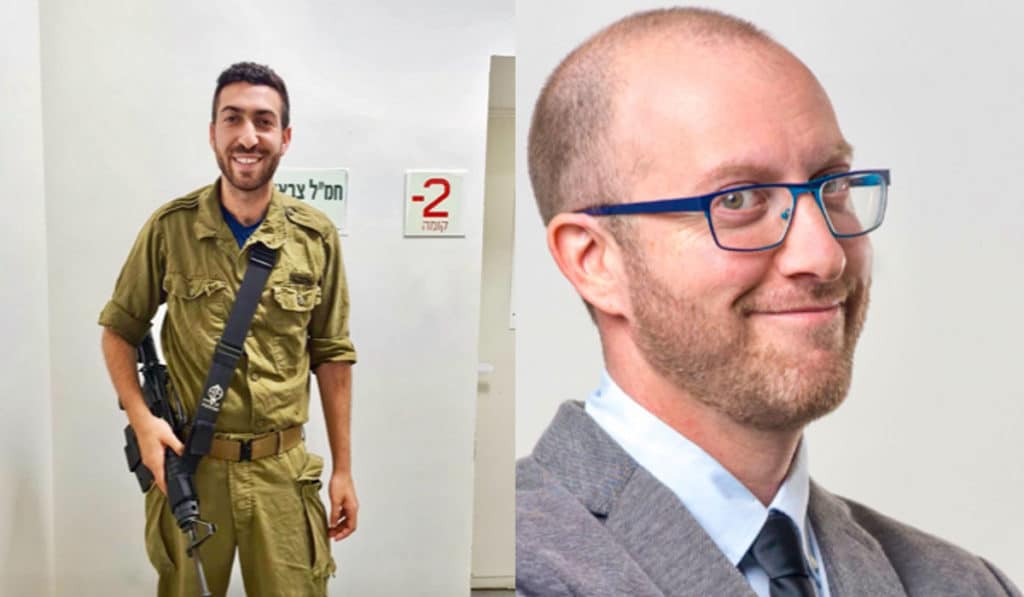
I first ran across Uri Cohen on Instagram as I scrolled through my feed. I saw an Israeli guy in an IDF uniform ranting about being called up for reserve duty for the fourth time this year, and I thought it was hilarious. We were leaving behind our pandemic lockdowns and facing yet another political election, but his posts about his life in Israel were uproarious. I had to get to know Uri.

Uri is a rising comedian and online social influencer. This 28-year old gever is sometimes brash, totally authentic, and has a huge heart. When not working as a security guard for Birthright visitors, tour groups and school groups, or doing reserve duty, Uri is posting on Instagram and TikTok and increasing his fan base with his unique style of comedy.

Who would have thought a young guy could also become a shadchen, or matchmaker? In response to the meetup, dating and hookup app, Tinder, Uri created his own dating site on Instagram: Jewuri (aka Tinduri), where young Jewish singles from all over the world can post photos and brief descriptions of themselves in hopes of finding a match. What started as a joke soon became a way of meeting one’s soulmate. Uri sees this as a way of perpetuating the Jewish people. Nothing pleases him more than “getting people together: sometimes they get married and that leads to making more and more Jewish babies. That’s just wonderful!” He hosts social events once a month in locations throughout Israel—and, yes, it’s all legal and done in a spirit of fun.

This past May, things got real as Hamas started their massive rocket barrage into the heart of Israel. It’s said that there are no atheists in foxholes, but what about comedians in bomb shelters?

It’s said that there are no atheists in foxholes, but what about comedians in bomb shelters?

Uri was called up yet again for reserve duty as a medic. But he also became a kind of lead sapper for the IDF. A real sapper goes to the site of an unexploded bomb, something that has incredibly lethal potential, and bravely diffuses it. But instead of taking apart physical bombs in the field, Uri worked from stairwells and bomb shelters, bravely fighting antisemites and anti-Zionists who call for the destruction of Israel with his unique brand of online humor.

He responded nightly to Hamas’s threats of incessant bombs with his signature swagger: “Yo! Jihadists! You know you promised to send rockets tonight at 9 pm. But listen. I have a date with hot IDF girl. Believe me. She is bigger bomb than all the rockets you send. So please. Make it 12 tonight.”

“Yo! Jihadists! You know you promised to send rockets tonight at 9 pm. But listen. I have date with a hot IDF girl. Believe me. She is bigger bomb than all the rockets you send. So please. Make it 12 tonight.”

When the missiles did not let up for days and it was Uri’s birthday, he created a post thanking Hamas for sending up fireworks in his honor. “Hey. It’s a celebration! They are celebrating me! Gee thanks for the fireworks, guys!!” He took the footage of bombs exploding over the Tel Aviv skyline and choreographed it to the “Star Wars” theme.

His fan base began to grow exponentially, along with his haters. Humor turned into hasbara, diffusing hate bombs with education, explanation, and reproachment, Uri Cohen-style.

Underneath one of his video clips, we see an Instagram comment calling Uri a colonizer and a baby-killer, telling him to get the f–k out of Palestine. In the video, there are tears streaming down Uri’s face. “Wow,” he says. “That hit me so hard.” He continues, as he wipes the tears from his cheeks, “I don’t think I can take it.” Then the camera pans down to the knife in his hand, cutting an onion. “That’s a huge piece of onion. Wow.”

Uri knows that he has haters, but he never shows anger. “That’s what they want. They want to expand the fight. And most of the times these people are not even from Gaza or Palestinian, and they don’t know the facts. So you have to find a way to turn it around. I make them laugh. I make the best of a difficult situation.”

One commenter wrote, “Go back to your countries and leave the rest of Palestine immediately, you thieves. We will liberate Palestine soon,” to which Uri posted a video response. “Yo, bro. I’m truly sorry,” he says in the video. “It was misunderstanding.” He throws up his hands. “I’m immediately leaving. Just please. I only need 5 minutes. To pack a suitcase—and have sex with my girlfriend. And I’m leaving.” He walks out the door, muttering, “And they say Israelis have no patience.”

The bomb is once again diffused, with even the original commenter admitting that Uri is actually funny and suggesting that perhaps Israelis are cool after all. So Uri invited him to his next social event.

Of course, Uri couldn’t pass up the opportunity to make fun of the army rations he was served for Shabbat dinner. Cold schnitzel, limp chips, and a dollop of hummus. He invented the saying that went viral: “More Hummus. Less Hamas.” Within a week, the words could be seen on posters as far away as Paris, New York and Los Angeles.

Uri’s humor is a mixture of seriousness and sarcasm. He became outspoken about the anti-Israel posts by his former fantasy girls, pop icons Bella and Gigi Hadid, Dua Lipa and Mia Khalifa. It was truly a sad day for Uri when he deleted Dua Lipa from his playlist.

What makes his videos and posts so much fun is that they are interactive. Offering quizzes, ways to respond to his posts, and opportunities to ask him questions makes his site personal—and he responds to all of his messages. He pokes fun at himself: “My IDF service is 1% protecting the country; 99% Instagram pictures.”

Uri was not the only one diffusing bombs with humor during the most recent conflict. Countless memes, all darkly humorous, were posted on social media platforms. There were charts on what to do when you hear the Red Alert siren going off, signifying an incoming volley. The conflict also saw the emergence of drinking games for every time you hear a rocket or every time you have to unfollow a former friend for posting an antisemitic comment.

After a year in isolation, meet-ups with strangers in the bomb shelters were a good reason to laugh. Some played games in which each person had to guess what others had been doing prior to arriving at the shelter by noting their attire. Others created online gambling pools to speculate on how long the conflict would last and what the terms of ceasefire would be. Being able to laugh in the heat of an intense conflict was helpful. We laughed at ourselves, our situation, and our enemies. And as a result, we came out of it stronger and more resilient.

Liel Eli, another Instagram and TikTok influencer, made a humorous video of young California socialites trying to be trendy. It was filmed poolside against the backdrop of a Beverly Hills villa, where Liel played the roles of multiple silly, American Israel-haters who had absolutely no idea about any of the facts behind the propaganda. It was so funny that it landed her spots on the local news stations.

“The Daily Freier” is an online Tel Aviv publication that showcases biting satire. There is absolutely nothing off limits to these Anglo-Israeli jokesters. In Hebrew, a frier is a naïve shlemiel who constantly gets taken advantage of. Sample headlines include: “Three of Ilhan Omar’s Ex-Husbands/Brothers Feared Missing in Gaza Tunnel Collapse,”  “Victory: IDF Weaponizes its Inability to Write a Proper English Sentence,” and “Anything Happen in Israel This Week?” All of these headlines suggest that there is no political correctness in Israel, and that’s part of what makes it so funny.

Benji Lovitt is an American-Israeli author, comedian and hasbara expert who tours the U.S. regularly to educate groups with his unique blend of humor and encourage aliyah. In 2006, Benji made aliyah from Dallas, Texas during the Second War with Lebanon, so he has racked up points as a conflict survivor. He’s written for Times of Israel and The Jerusalem Post among others. Reading his annual “Things I Love About Israel” column helped us make the decision to move to Israel, so when we heard he’d be performing in Tel Aviv recently, we just had to go.I was able to speak to Benji after the show.

“There’s so much happening all the time here,” he said, “that there’s never a shortage of material. And the great thing about this country is that there are no taboos. And during wartime, that’s when the country is most in need of laughter. It dispels the stress everyone is under.” As a result, he created a chart on what to do when the emergency siren sounds—poking fun at Israelis who put their cars in cruise control and start filming the sky on Facebook Live.

Benji kept us in stitches with his latest news updates on the conflict. “A rocket just fell next to the IKEA in Rishon L’Tzion. At least the furniture is already in parts – KÄSSÁM Kitchen Storage Unit….hmmm I wonder if Sweden will retaliate?” And a day later: “Rockets and Iron Dome shrapnel are said to strike several Israeli cities. Just what the economy needs, another strike!” And toward the end of the conflict: “85 year-old Mahmoud Abbas and 78-year-old Joe Biden spoke on the phone this weekend for the first time since Biden took office. Topics discussed include a ceasefire, diplomacy and prune juice.”

One of the greatest experiences we’ve had during our time in Israel has been witnessing the strength and determination of the Jewish people. We have fallen even more deeply in love with this country. Still, I’ve asked everyone—do we get a special pin or at least a certificate to say we’ve survived our first official conflict? And the answer I’ve gotten from everyone: No. Not this time. But the third time: ice cream!


Tamar Dunbar made aliyah from Los Angeles to northern Israel six years ago where she works as a freelance journalist and blogger at israeldreams.com.

Comedians in Shelters Eating Hummus Read More »

Is German Chancellor Angela Merkel Endangering Jewish Life?

Vicious, often Muslim-animated antisemitism—including violence—has engulfed German cities, from metropolises such as Berlin, Cologne, Essen, Leipzig, Munich and Stuttgart, to regional centers such as Bochum, Freiburg, Gelsenkirchen and Osnabrück. The protesters say they are demonstrating for human rights and against alleged Israeli abuses, yet their targets suggest otherwise.

The protesters say they are demonstrating for human rights and against alleged Israeli abuses, yet their targets suggest otherwise.

In Gelsenkirchen, a mob of 180 people waving Turkish and Palestinians flags marched on a synagogue, where they shouted, “Scheiss Juden” (“Shit Jews”). There was no similar mobilization against Syrian President Bashar al-Assad’s war on his own people that left half a million dead—including over 4,000 Palestinians. There were also no demonstrators protesting the Chinese Communist Party’s genocidal targeting of its minority Muslim community, the Uyghurs, not to mention the Tibetans.

Pro-Hamas supporters also attacked an Israeli journalist with firecrackers during an interview in Berlin. The event prompted the Committee to Protect Journalists to urge the German authorities to swiftly investigate the attack (and others) and hold those responsible to account.

This kind of overt intimidation has exposed the emptiness of German politicians’ platitudes such as that “antisemitism has no place” in the federal republic.

Julian Reichelt, the Co-Editor-in-Chief of Bild, Germany’s highest-circulation daily paper, addressed how Chancellor Angela Merkel’s government is limping along in its effort to manage, rather than to properly address, outbreaks of antisemitism:

“In almost 16 years in the Chancellery, and also after the refugee crisis, which fueled Arab-Muslim antisemitism in Germany, Chancellor Angela Merkel and her government have done next to nothing to combat this danger, or even clearly to name it.”

Widespread indifference within German civil society—and part of the political and media establishment—to the outbreaks of contemporary antisemitism targeting Israel is evident.

One possible explanation for these attitudes can be encapsulated by a highly sarcastic quote attributed to the Israeli psychoanalyst Zvi Rex, who said, “The Germans will never forgive the Jews for Auschwitz.”

The German-Jewish philosophers Theodor W. Adorno and Max Horkheimer termed this pathological response to the Holocaust “guilt-defensive antisemitism.”

Today, many Germans, and many Western Europeans, still will not forgive Israel for the Holocaust—possibly to try to rationalize a feeling of guilt: If the Jews and Israel can be portrayed as evil, then perhaps the Holocaust was not such a terrible thing after all, right?

A 2017 German federal government study found that 40 percent of Germans are infected with modern antisemitism. According to the study, 40 percent of Germans approved of this statement: “Based on Israel’s policies, I can understand people having something against the Jews.”

A Christian Social Union party think tank study published in 2017 revealed that over 50 percent of Muslim refugees hold antisemitic attitudes.

A dangerous interplay of this “guilt-defensive antisemitism” combined with an antisemitism seemingly animated by new Muslim arrivals and German Muslims who have lived for decades in the Federal Republic, appears to be  unfolding in Germany. Only 500 people turned out at a pro-Israel rally last month, compared to 3,500 who turned out to support a terrorist group, Hamas, in Berlin.

The German newspaper Süddeutsche Zeitung reported on the Berlin demonstration in solidarity for Israel that “almost all of those who came had to come. What is going on there?”—meaning that those who attended were most likely staff of the politicians who spoke or members of the Jewish community.

Merkel and other German politicians have shown a far greater readiness to confront antisemitism—whether left- or right-wing—if it is integral to the Boycott, Divestment, Sanctions campaign targeting Israel. In 2019, the Bundestag passed a non-binding resolution that declared BDS an antisemitic campaign comparable to the Nazi movement’s boycott of German Jewish business during the 1930s.

Merkel’s government and the Bundestag seem paralyzed, however, when faced with Muslim antisemitism, ubiquitous “guilt-defensive antisemitism” and the Iranian regime’s genocidal targeting of Israel.

Merkel’s government and the Bundestag seem paralyzed, however, when faced with Muslim antisemitism, ubiquitous “guilt-defensive antisemitism” and the Iranian regime’s genocidal targeting of Israel.

Felix Klein, Germany’s commissioner for Jewish life and the fight against antisemitism, has blamed the previous US government under President Donald Trump for outbreaks of antisemitism. Yet Klein has refused to condemn 40 years of Iranian demands to obliterate Israel. Klein’s silence raises the possibility that his employer, Merkel, advised him not to comment to avoid jeopardizing diplomacy with Iran’s regime over its illicit nuclear weapons program, presumably to ensure the continued flow of business with Tehran.

To Klein’s credit, he delivered a strong statement against Prof. Achille Mbembe’s slated appearance at a publicly financed cultural event, triggering a 2020 nationwide debate about Mbembe’s antisemitism. Mbembe, Klein said, had “relativized the Holocaust and denied Israel’s right to exist.”

Mbembe, a post-colonial studies academic, is on staff at the Wits Institute for Social and Economic Research at the University of the Witwatersrand in Johannesburg and has an annual visiting appointment at the Franklin Humanities Institute at Duke University.

Additionally, the quality of some of Germany’s commissioners leaves rather a lot to be desired. The Simon Wiesenthal Center has urged the southern German state of Baden-Württemberg to dismiss its commissioner, Michael Blume, who liked a Facebook post comparing Zionists to Nazis. Blume also sought to draw a parallel between a pro-Israel German Jew and Nazi mass murderer Adolf Eichmann.

A small number of courageous German journalists, such as Reichelt, have tried to bring Islamic-animated Jew-hatred to the fore of public discourse.

That would entail addressing the antisemitism of many in Germany, both Christians and Muslims, as well as the state-sponsored Islamic Republic of Iran, for which Merkel’s government has shown largely continual toleration.


Benjamin Weinthal is a fellow at the Foundation for Defense of Democracies. Follow Benjamin on Twitter @BenWeinthal

Is German Chancellor Angela Merkel Endangering Jewish Life? Read More »

Reminders – A poem for Torah Portion Korach

…the censers of these who sinned…and they shall make them
into flattened out plates as an overlay for the altar…and they
shall be as a reminder for the children of Israel.
Numbers 17:3

In the back yard of my old house
a stone Buddha with a smile like dinnertime
and a belly like many dinnertimes gone by
sits on a small, rectangular plot of land
surrounded by brick, stucco, and sidewalk.
Deep under his feet, commingled with soil,
a box, and a veterinary towel, lay the
remains of my first three cats.

Buddha’s never-ending joviality reminds us
of the joy those three gave us – their nighttime
purrs and pounces, their bodies on our chests
when our morning eyes first opened.
Buddha keeps their souls safe in that space
while we’ve moved on to another one.

On my computer, every Wednesday
words pop up to remind me what I once did
and to never do that again. I could turn it off
but I wouldn’t dare.

Millennia ago, even though I was there,
after the ground swallowed up the heretics
we took their frying pans, melted them down
and decorated our holiest space.
Not for the aesthetic, but so whenever we
went there we’d be reminded of what they did
and never do it again.

I think that’s why we hoard the objects of our past
the useless memoirs that only take up space
to remind us of what was, good and bad.
We make museums of our lives. I’m already
laying out the admission fees for those yet to come.
What we do here matters, good and bad.
Our knickknacks, our statues…all that is left
when the ground swallows us up.


God Wrestler: a poem for every Torah Portion by Rick LupertLos Angeles poet Rick Lupert created the Poetry Super Highway (an online publication and resource for poets), and hosted the Cobalt Cafe weekly poetry reading for almost 21 years. He’s authored 25 collections of poetry, including “God Wrestler: A Poem for Every Torah Portion“, “I’m a Jew, Are You” (Jewish themed poems) and “Feeding Holy Cats” (Poetry written while a staff member on the first Birthright Israel trip), and most recently “The Tokyo-Van Nuys Express” (Poems written in Japan – Ain’t Got No Press, August 2020) and edited the anthologies “Ekphrastia Gone Wild”, “A Poet’s Haggadah”, and “The Night Goes on All Night.” He writes the daily web comic “Cat and Banana” with fellow Los Angeles poet Brendan Constantine. He’s widely published and reads his poetry wherever they let him.

Reminders – A poem for Torah Portion Korach Read More »

A Message for Non-Jewish Friends on the Israel-Palestine Violence over Sheikh Jarrah

Imagine, wherever you live, there exists just beyond the border to your province an armed group of militants called H. Every so often, H gets upset because your nation’s government (which you may not have even voted for and may sorely want out of the picture) has built a couple of houses on some land beyond your nation’s opposite border where some folks culturally related to H live. In response, H starts shooting rockets all over the southern half of your nation.

Now, luckily, your nation has some helpful tech that can usually block these rockets. But they keep coming. Following a barrage of more than 4,000 rockets over the course of a week and deployment of explosive drone technology to evade your defense tech, your nation’s military goes after H militants, using intelligence to track the fighters to their hiding spots, which typically include (hopefully) empty schools, hospitals and PR houses. However, because these spots are commonly civilian, your nation’s army issues a one-hour warning before exploding the building in question.

When shrapnel from the explosion injures or tragically kills civilians, it is unarguably wrong. H realizes this, and so they house their weapons and fighters in these locations, knowing that, to the outside world, it will appear as though your nation invades their territory for no reason. Why? Because often, international news headlines and sometimes even entire articles don’t tend to mention H—instead making it appear as though your nation struck first.

Obviously, territorial encroachment is always difficult on those affected, even in the case of legal evictions. That said, H rarely attacks due only to territory encroachment. Commonly, they await the next opportunity to launch unprovoked attacks, sending innocents running through the streets to hide all night in bomb shelters. It’s a squabble between two governments that ropes in civilians on both sides.

It’s a squabble between two governments that ropes in civilians on both sides.

H clearly stands for Hamas, the entity in charge of the Gaza Strip that not only fires unprovoked on Israeli civilians but also uses much of its foreign aid to construct terror tunnels for further siege. Furthermore, when their rockets miss Israel, it’s typically because they misfire and instead endanger resident Gazans.

Hamas’s charter does not recognize any Jewish entity in the region that is now Palestine/Israel, including Israel proper. Their goal to “Free Palestine” calls to free Palestine of Jews under the guise of ousting Zionists. This means that all Jews not wishing to live in an Islamic state will be essentially cleansed from the region, including Jews whose families have been living there for centuries.

If you’re still with me, we move now to the ever-loaded topic of Zionism. By definition, Zionism just means a secure homeland in the region that comprises historical Judea. That does not mean Jews in this land cannot live alongside Palestinian Arabs, nor does that proposed homeland even have to include the West Bank or disputed Jerusalem territory. Indeed, Israel forcibly evicted all Jewish residents from the Gaza Strip back in 2005, showing that, in the face of pushback from neighboring Arab nations and multiple rejected peace deals following the British Mandate jumping ship to let us all battle it out, Zionism didn’t even have to include that land either. Therefore, the blanket statement circulating these days—that at its core, Zionism equals racism—doesn’t hold up perfectly. Not when such an entity can feasibly exist as any other nation, including as a home to many diverse peoples.

Okay, let’s take a breath. To clarify, unilateral settlements as well as air raids can cause significant destruction. An alternative might be solo sniper ground warfare to target militants with more discrimination in order to avoid civilian casualties. What’s more, we can all hope for a more progressive center-left administration to replace Likud in the Knesset this year, a goal of which would be enhanced Palestinian rights in Gaza and the Disputed Territories.

So, if you have read this far, once more, please do continue to mourn the innocents killed in this conflict. At the end of the day, no matter who shot first, people are still people. But please try to consider that, unlike any conflicts in the U.S. for the past two centuries and most in Europe for nearly the past century, humans on both sides of the Palestine/Israel war recognize and face the frequent threat of bomb sirens that come from a war on home turf.

But please try to consider that, unlike any conflicts in the U.S. for the past two centuries and most in Europe for nearly the past century, humans on both sides of the Palestine/Israel war recognize and face the frequent threat of bomb sirens that come from a war on home turf.

The main reason this nuance matters to diaspora Jews is that regardless of plenty of Jews worldwide having no connection to Israel, the number of attacks against Jews around the globe has dramatically surged since the latest Palestine/Israel violence spike began. The running narrative of Jews as oppressors has even reached tech giants, with one high-profile employee claiming that Jews have an insatiable appetite for war—not Israel, Jews—in a blog statement that wasn’t called into question until 14 years after its release.

Many of us are starting to worry, because while those living in Diaspora have next to no say in Israeli politics, plenty of diaspora Jews are taking the fall for this. It is, quite frankly, frightening. So, believe us when we say that you can decry the loss of innocent Palestinian lives, and at the same time, allow us to express fear over the mounting narrative that ties our very identity to violence and the next great conspiracy.


Sarah Katz is an author, UC Berkeley alumna in Middle Eastern Studies, and cyber security analyst. 

A Message for Non-Jewish Friends on the Israel-Palestine Violence over Sheikh Jarrah Read More »

Unscrolled Korach: A Series of Misunderstandings

“You have gone too far!” shouts the rebel Korach at Moses. “All the community are holy, all of them, and the Lord is in their midst. Why then do you raise yourselves above the Lord’s congregation?” (Numbers 16:3).

Speaking to the old man at the synagogue, I admitted that I didn’t understand. Why was Korach condemned to be swallowed whole by the earth? What was his crime? Was it that he challenged authority? Was it his radical egalitarianism? Was it that he dared to speak aloud what any decent person should believe: that all of God’s children are holy?

Why did Moses fall on his face as if this were an affront? Why did the fire of God burn and the earth split open?

Did not God Himself say, “You shall be to Me a kingdom of priests and a holy nation” (Exodus 19:6)?

Did not Moses himself say “Would that all the LORD’s people were prophets” (Numbers 11:29)?

The old man tutted and shook his head. “You have misunderstood,” he said. He then explained it to me: Korach was not anti-authoritarian, nor egalitarian, nor a believer in the holiness of the people. He was a populist and a rabblerouser who used the language of equality in an attempt to raise himself above others. His quibble was not with the hierarchy of power, but rather his position in it.

His quibble was not with the hierarchy of power, but rather his position in it.

I nodded, but I wasn’t convinced. Something yet troubled me—a fear that we had buried a righteous man alive in the sand and were now engaged in some sort of cover-up, rewriting the story in our minds to make it appear that he deserved his fate.

A year later when Parashat Korach came back around, I went back to the old man and told him that I had listened to what he said and had at last come around to his position. I had looked closely at the text. I had tried to suppress my twenty-first-century views and imagine things as they were in their own context. I could now see that Korach was a deceiver, and that Moses had seen through his deception and called him out for what he really was, saying, “Is it not enough for you that the God of Israel has set you apart from the community…He has advanced you and all your fellow Levites with you, do you seek the priesthood too?” (Numbers 16:9-10).

The old man tutted and shook his head. “You have misunderstood,” he said. He then explained: Korach was not a deceiver but a prophet bearing a radical truth that the world was not yet ready to hear. This would be made explicit by the Kabbalists, but it was hinted at by a single line in the psalms in which the last letters of each word spell Korach’s name. “A righteous man will flourish like a date palm.” Or, in Hebrew, “TzadiK KatamaR YifraCh” (Psalms 92:13).

The old man then looked at me with a look in his eyes such as I had never seen, and he told me how he had been to the Sinai Desert after the war when he was still a young man. He had traversed its sands and sought out its holy mountain, and at some point in his sojourn he had been startled in his solitude by the plaintive cries of a human voice, though no one was in sight.

He had traversed its sands and sought out its holy mountain, and at some point in his sojourn he had been startled in his solitude by the plaintive cries of a human voice, though no one was in sight.

Sun-addled, he wondered if it was a mirage, or a sign of oncoming madness. He stood still and held his breath. The voice, he realized, was coming from beneath the ground. He dropped to his knees and prostrated himself in the sand, laying his ear upon the ground in order to better hear.

The voice was faint—almost impossible to make out. It was hoarse, parched for water and raspy from centuries of ceaseless muttering.

“What did it say?” I asked.

“One thing and one thing only,” the old man said. “All the community is holy! All the community is holy!”


Matthew Schultz is the author of the essay collection “What Came Before” (2020). He is a rabbinical student at Hebrew College in Newton, Massachusetts.

Unscrolled Korach: A Series of Misunderstandings Read More »

The Future of Jeff’s Gourmet

In the old days, before coronavirus struck, even if you were a stranger to the Pico-Robertson neighborhood you easily could identify Jeff’s Gourmet Sausage Factory. There always seemed to be a crowd, both inside and outside, even as late as 11 p.m.

When the pandemic struck 16 months ago, however, owner Jeff Rohatiner asked his inner circle—his wife Linda and his manager Elan Adivi—whether it was worthwhile staying in business.

The answer was complicated, sun mixed with clouds of uncertainty.

“The pandemic transformed so much,” said Rohatiner, who opened Jeff’s Gourmet Sausage Factory in 1999. “Lots of issues had to be looked at in a different way,”

“When we closed for five weeks in April and May last year, I was not sure if we were going to reopen.”

Shutting down seemed the lone option. “It was impossible to operate under the circumstances,” he said, “impossible to have faith. Everybody was so unclear about safety. We have been through so much that I almost can’t remember some details. I just knew we had to close.”

Rohatiner said that “we considered not reopening because of health concerns for our employees. You don’t want to lose employees dedicated to you, and you also don’t want to lose your own health.”

Rohatiner is a father of three, and his family had concerns about his health as well. He is asthmatic. “They worried, but I told them not to worry,” he said.

“This pandemic experience is a roller-coaster. Reopening was a roller-coaster. The whole thing was a roller coaster. And it continues.”

While the business was dark, Linda Rohatiner asked her husband, “Is this really worth it?”

It was a serious question, but both of them knew it was his life’s work. His passion is cooking and creating foods.

The pandemic shrank the menu.

“We used to make 40 meat products, now it’s seven,” said Rohatiner, for many years the main face of the Happy Minyan shul, currently looking for a home base. “I made a lot of product—15 different sausages, eight different deli meats, sticks, salamis.”

He is especially proud that “we make every sauce, every topping, every meat. We buy the bread, but almost everything, we make here.”

Rohatiner and manager Elan Adivi agreed a new business model was required. “We had to cut a lot from the menu and from production, move into a more ready takeout-and-delivery function.”

This demanded massive reorganization. The dining room of the 1600-foot layout vanished. The menu changed sharply, down 50 percent.

This demanded massive reorganization. The dining room of the 1600-foot layout vanished. The menu changed sharply, down 50 percent.

“I had to simplify,” said Rohatiner, “stop making so many products, stop putting so much on the menu. We needed to keep a good, fast flow going from the kitchen out to the customer (whether by delivery or takeout). We basically pulled a lot of stuff we were doing behind the line out into the dining room. We had to have fewer staff per shift, too,” although most of his 23 employees have been retained.

Jeff’s Gourmet’s current (but not necessarily permanent) hours are 11 a.m. to 9 p.m., Sunday through Thursday. While there was a measure of indoor dining earlier in the pandemic, now on-site meals are limited to four tables outside.

Easy-going Rohatiner grins as he reflects on what was, what is and what may be. “We have a lot of ‘used-tos’,” he said. “We used to be open Saturday nights after Shabbos. We may go back to it.”

Because of the pandemic adjustments that eliminated the dining room, a potential return to indoor dining is months away, requiring significant construction.

While Rohatiner concedes that he is “seeing some light,” he quickly adds, “even now I don’t feel [the pandemic] is over. I am worried about the next shoe that’s going to drop. All the variants, the booster shots. Seems promising. But I feel more is to come, maybe because I am skittish.”

Regardless of what the future holds, Jeff’s Gourmet remains a staple of the Pico-Robertson neighborhood. The menu may be limited for now, but the quality of the food and the spirit behind it is never in short supply.

The Future of Jeff’s Gourmet Read More »

The Sliding Doors of Bibi Netanyahu’s Legacy

(Israel Policy Forum) — Barring him pulling an unforeseen and unprecedented political rabbit out of a hat, the next time I write this column Binyamin Netanyahu will no longer be the prime minister of Israel. Netanyahu has dominated Israeli politics and policy like no other figure since David Ben Gurion, and it is not only a function of his longevity in office.

He has overseen, and in some cases explicitly driven, significant shifts in Israel’s standing within its region, its perception in different quarters of the U.S., and its policies toward the Palestinians in the West Bank and Gaza. He has implemented real changes in Israel’s economy, presided over a period of increasing polarization in Israeli society, cemented right-wing dominance in Israel’s politics, kept Israel out of any large-scale conflicts beyond the confines of Gaza, and whether purposely or not opened the door to the inclusion of an independent Arab party in an Israeli governing coalition for the first time. He has overcome the Israeli-Palestinian conflict in an unprecedented way, and also ensured that the Israeli-Palestinian conflict will remain with Israel in an unprecedented way. Entire books could, and no doubt will, be written on Netanyahu’s legacy, the ups and downs and everything in between, and this may only be the end of the second act rather than the curtain closing. Trying to do it justice in 1,500 words is a fool’s errand.

Entire books could, and no doubt will, be written on Netanyahu’s legacy, the ups and downs and everything in between, and this may only be the end of the second act rather than the curtain closing.

In considering Netanyahu and what he is leaving behind though, what jumps out at me is just how dependent any ultimate assessment of him is on what happens next. This is obviously true of any world leader, as the impact of their policies and decisions do not expire with their terms in office, but with Netanyahu this dynamic is heightened. Throughout the past twelve years, the common view of Netanyahu has been that he is largely cautious and risk-averse, notwithstanding his increasingly desperate recklessness of the past few years as his legal troubles boxed him into a corner and his political fortunes dictated pushing for seemingly endless and irresolvable elections. But Netanyahu has actually made some big bets, the status of which is yet to be determined, and he has also put changes in place that will be monumental–some for good, some for ill–if they outlast him. How we ultimately view Netanyahu rests on the decisions that others are going to make next.

There is one big achievement that Netanyahu pushed for and successfully oversaw that is likely safe from any intervening developments, which is the normalization process embodied by the Abraham Accords. Whether the agreements expand is an open question, but the recent fighting between Israel and Hamas and the ongoing tensions in East Jerusalem demonstrated the Accords’ relative imperviousness to complicating external events. The agreements were built primarily on the foundation of shared economic interests, with shared security interests playing a role as well, and as the gains from these relationships become realized to a greater extent, the countervailing pressure created by the Israeli-Palestinian conflict will hold even less sway. Much as the peace treaty with Egypt is part of Begin’s legacy irrespective of anything else, this will be a big part of Netanyahu’s legacy no matter what.

But there are at least three other issues that will just as significantly impact how we view Netanyahu, and while he set them in motion, they are all now entirely out of his hands. The first is the U.S.-Israel relationship, where Netanyahu was responsible for both unprecedented highs and unprecedented lows. Because of the relationship that Netanyahu forged with President Trump, Israel benefited during the latter’s tenure in ways that seemed unimaginable  before January 2017. But the way that relationship played on the other side of the aisle along with the more tense relationship that Netanyahu crafted with President Obama and other Democrats has led to rockier periods in U.S.-Israel relations, ultimately manifesting in challenges to U.S. security assistance to Israel while Hamas rockets were falling on Israeli cities. There are two ways in which this might go; when Netanyahu is off the scene, the difficulties for which he was partially responsible could largely dissipate beyond a fringe of elected Democrats, or the new way in which some Democrats view Israel and Israeli behavior after over a decade of Netanyahu could be cemented irrespective of who is prime minister. If ten years from now Israel’s status in the U.S. has eroded in a significant way, it will be an inseparable part of Netanyahu’s legacy.

If ten years from now Israel’s status in the U.S. has eroded in a significant way, it will be an inseparable part of Netanyahu’s legacy.

Similarly variable pathways exist for Netanyahu’s legacy when considering Israeli polarization and domestic cohesion. There is no questioning the fact that Netanyahu has now spent years casting doubt on Israeli state institutions, and more recently on Israeli electoral integrity and democratic legitimacy, as a result of the police investigations into his conduct, the state attorney’s recommendation to indict him, the attorney-general’s acceptance of that recommendation, and his current trial before the Jerusalem District Court. Whether you believe that Netanyahu is justified in doing this because he is the victim of a deep state conspiracy or you believe that it is his effort to leverage mob rule in order to thwart justice for his actions, it is a fact that Netanyahu has done more to cast doubt on the legitimacy of fundamental underpinnings of the Israeli state than anyone before him.

We in the U.S. are familiar with this particular movie. The question is what happens next. If the new Israeli government–which does not include anyone who has demonstrated inclinations similar to Netanyahu’s–turns down the temperature, goes out of its way not to incite against the justice system in particular despite Yamina and Tikva Hadasha’s belief that the Knesset has ceded too much power to the courts, and Israeli politics goes back to normal negative campaigning as opposed to claiming that the other side is fundamentally illegitimate or trying to undermine Zionism, then Netanyahu’s actions and rhetoric will still be notable but not revolutionary. But that outcome is not at all preordained or guaranteed. For all that Trump did during his tumultuous four years, January 6 is going to be in the first paragraph of his obituary. If Netanyahu behaves out of power as he has in power, he will increase the chances of the current level of Israeli polarization being a waystation on the journey down rather than a nadir, and that will ultimately factor in at the beginning of his obituary too.

If Netanyahu behaves out of power as he has in power, he will increase the chances of the current level of Israeli polarization being a waystation on the journey down rather than a nadir, and that will ultimately factor in at the beginning of his obituary too.

Finally, there is the Israeli-Palestinian conflict. Netanyahu has institutionalized the position that the conflict will not and should not be solved, and that it should instead be managed. He has elevated the idea of the status quo as a doctrine while not actually abiding by the status quo, and turned it from a temporary fix born out of necessity into a permanent solution representing the ideal scenario. For a majority of Israelis, this fits with their thinking on the conflict precisely; they do not believe there is a partner on the other side, they do not believe that two states is currently achievable or even currently advisable, and they also do not want to absorb the costs of de jure annexation or permanent occupation. Thus, Israel under Netanyahu has adopted a policy of de jure ambiguity with de facto creeping annexation, moving the status quo to the right day by day, hilltop outpost by hilltop outpost, demolition order by demolition order, all while maintaining what increasingly looks like a legal fiction that Israel is committed to a two-state outcome should conditions on the Palestinian side allow it.

If Israel is able to somehow manage this for another fifty years, this may eclipse the Abraham Accords as Netanyahu’s most enduringly successful foreign policy and security legacy. At the moment, this formula has allowed for unprecedented Israeli security in the West Bank without having to make any hard choices on settlements or Israel’s long-term presence; has allowed Arab states to normalize relations with Israel or inch slowly forward on non-official public relations; and has created a way for the overwhelming majority of Israelis to not have to deal with, absorb, or even see the military occupation of the West Bank.

But things can also turn on a dime in any number of ways, from Mahmoud Abbas being replaced by a Palestinian leader without a similar commitment to non-violence, to a third intifada, to a Palestinian Authority collapse and Hamas takeover, to an increasing international acceptance of charges that Israel engages in apartheid. Should any of these things happen, Netanyahu’s legacy of not making a decision in either direction while also ensuring that the PA remains weak will backfire enormously, as Israel finds itself more territorially intertwined with the West Bank and its Palestinians than it ever has been and without any workable exit strategy. Netanyahu has never wanted to bring about two states and has also never wanted to oversee the paradigm’s ultimate collapse. If the latter ever occurs, he will own that outcome and its consequences more thoroughly than anyone else.


Michael Koplow is Israel Policy Forum’s policy director, based in Washington, DC. To contact Michael, please email him at mkoplow@ipforum.org.

The Sliding Doors of Bibi Netanyahu’s Legacy Read More »

Omar Denies Equating US, Israel With Hamas, Taliban

Representative Ilhan Omar (D-MN) released a statement on June 10 denying that she equated the United States and Israel with Hamas and the Taliban.

Omar tweeted on June 7, “We must have the same level of accountability and justice for all victims of crimes against humanity. We have seen unthinkable atrocities committed by the U.S., Hamas, Israel, Afghanistan, and the Taliban.”

Omar’s June 10 statement said that she was asking Secretary of State Antony Blinken about current International Criminal Court (ICC) cases. “The conversation was about accountability for specific incidents, not a moral comparison between Hamas and the Taliban and the United States and Israel.

“I was in no way equating terrorist organizations with democratic countries with well-established judicial systems.”

Speaker of the House Nancy Pelosi (D-CA) and the rest of the House Democratic leadership said that they welcomed Omar’s clarification that “that there is no moral equivalency between the U.S. and Israel and Hamas and the Taliban.”

In a June 9 statement, 12 House Democrats called on Omar to “clarify” her remarks, calling them “offensive” and “misguided.” “Ignoring the differences between democracies governed by the rule of law and contemptible organizations that engage in terrorism at best discredits one’s intended argument and at worst reflects deep-seated prejudice.”

They added that “false equivalencies give cover to terrorist groups. We urge Congresswoman Omar to clarify her words placing the US and Israel in the same category as Hamas and the Taliban.”

Omar responded later that evening in a tweet that read, “It’s shameful for colleagues who call me when they need my support to now put out a statement asking for ‘clarification’ and not just call.

“The islamophobic tropes in this statement are offensive. The constant harassment & silencing from the signers of this letter is unbearable.”

She added in a subsequent tweet, “Citing an open case against Israel, US, Hamas & Taliban in the ICC [International Criminal Court] isn’t comparison or from ‘deeply seated prejudice’. You might try to undermine these investigations or deny justice to their victims but history has thought us that the truth can’t be hidden or silenced forever.”

Democratic Majority for Israel praised the 12 House Democrats who spoke out against Omar. “Her comparison of the US & Israel, on the one hand, to Hamas & the Taliban on the other, reflects either the lack of a moral compass, the failure to understand the facts, or both,” they tweeted.


The Jewish Democratic Council of America tweeted that they “will be meeting with Rep. Omar during our Week of Action to discuss her recent comments on Israel, as well as other priorities of Jewish Dems in Minnesota. There is no equivalence between Israel and terrorist organizations such as Hamas.”


American Jewish Committee CEO David Harris tweeted that Omar’s spokesperson said, “As usual, the far right is ginning up hate against [her].” But “what unites” the 12 Democrats who spoke out against her is that they’re “all Democrats,” Harris noted. “Far right? Hardly.”

House Minority Leader Kevin McCarthy (R-CA) tweeted that Omar’s remarks were “abhorrent.” “Speaker Pelosi’s continued failure to address the issues in her caucus sends a message to the world that Democrats are tolerant of anti-Semitism and sympathizing with terrorists. It’s time for the Speaker to act.”


Representatives Rashida Tlaib (D-MI) and Alexandria Ocasio-Cortez (D-NY) have both defended Omar on Twitter.

“Pretty sick & tired of the constant vilification, intentional mischaracterization, and public targeting of @IlhanMN coming from our caucus,” Ocasio-Cortez wrote. “They have no concept for the danger they put her in by skipping private conversations & leaping to fueling targeted news cycles around her.”


Tlaib similarly tweeted that House colleagues’ “obsession with policing [Omar] is sick. She has the courage to call out human rights abuses no matter who is responsible. That’s better than colleagues who look away if it serves their politics.”

Omar Denies Equating US, Israel With Hamas, Taliban Read More »