fbpx

June 9, 2021

UCSD BDS Resolution Fails

A Boycott, Divestment and Sanctions (BDS) resolution at UC San Diego’s (UCSD) Graduate & Professional Student Association (GPSA) failed on June 7.

According to StandWithUs, the resolution called for UCSD to end their partnership with the University of Haifa, including a joint project investigating “how humans have adapted to climate and environmental change over the past 11,000 years.” The resolution also contained “misleading and hateful rhetoric,” per StandWithUs. The resolution was ultimately amended to form a committee tasked with developing a resolution that will be palatable to both Israeli and Palestinian students.

“We are so proud of the Jewish and Israeli students who spoke out against this malicious resolution and succeeded,” StandWithUs Executive Director of Campus Affairs Rena Nasar First said in a statement. “Because of their efforts, the GPSA chose cooperation, dialogue, and academic freedom over harmful and discriminatory boycotts.”

AMCHA Initiative Director Tammi Rossman-Benjamin similarly said in a statement to the Journal, “We applaud the Graduate Student Government for recognizing how deeply harmful academic BDS is to all UCSD students and faculty.  If implemented, it would directly subvert the educational opportunities and academic freedom of students and faculty wanting to study about or in Israel, as well as those in the UCSD community engaged in collaborative research with Israeli scholars.

“We urge the Chancellor to issue a campus-wide statement condemning academic BDS and reminding the community that in 2018 all 10 UC Chancellors stated unequivocally that an academic boycott of Israel ‘poses a direct and serious threat to the academic freedom of our students and faculty, as well as the unfettered exchange of ideas and perspectives on our campuses, including debate and discourse regarding conflicts in the Middle East.’”

On the other hand, Jack Saltzberg, president and founder of The Israel Group, said in a statement to the Journal, “The BDS resolution did not fail. The students were only targeting Israel for human rights violations; therefore, BDS spent months poisoning students against Israel while the pro-Israel community reacted, as always. Now BDS will submit another resolution with another opportunity to influence more students negatively about Israel.”

UCSD BDS Resolution Fails Read More »

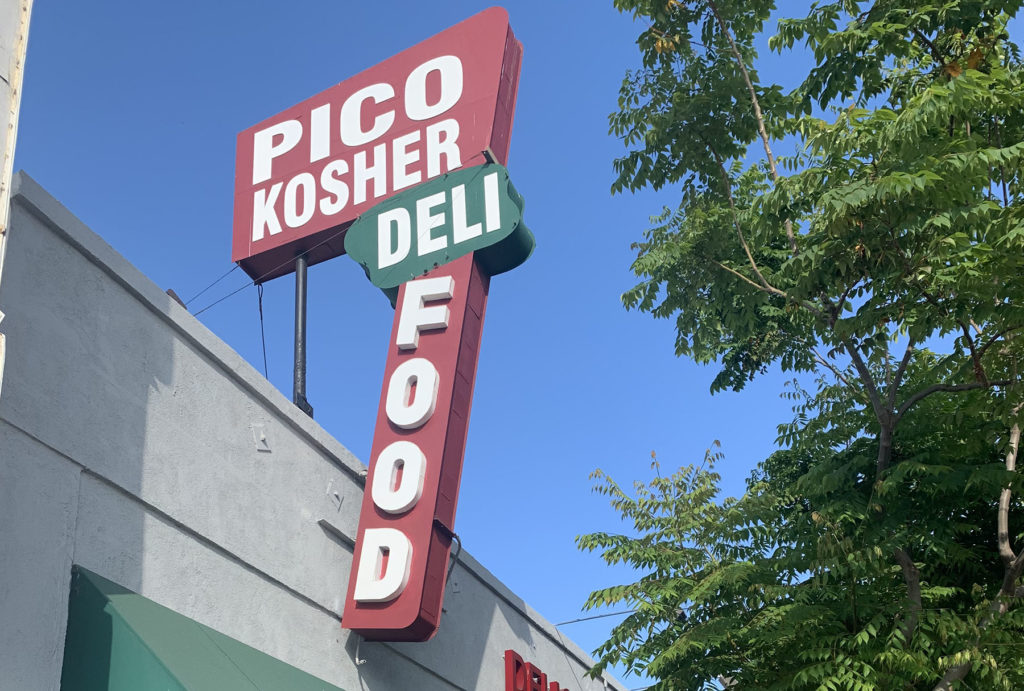
What’s the Scoop on Pico Kosher Deli? It’s as Unclear as a Bowl of Chicken Noodle Soup

During the past 15 months of COVID-related uncertainties, the one thing the Pico-Robertson community could always count on was the home-style comfort food prepared by Pico Kosher Deli, even if it had to be picked up, delivered or served in outdoor seating.

But that was so last week.

Today, patrons who stop by hoping to pick up or enjoy PKD’s iconic chicken soup with matzo balls, a corned beef sandwich, PKD’s “triple-decker on toast” or one of a myriad other menu items, are met with a small window sign that reads:  “We are closed.  If you have any questions please email us at info@picokosherdeli.  Thank you!”

Photo by Harvey Farr

The PKD website is operational, but several calls to the restaurant went to voice mail, and an email went unanswered.

The restaurant, on Pico Blvd. just west of Robertson Blvd. has been a mainstay of the neighborhood since 1968.   It was started by a father and son team who sold it to the Hecht family in the late 1980s.  The new owners did a major renovation, updating the kitchen, counters and seating areas which made it a popular gathering place for kosher-observant families and business meetings.

After the husband and wife owners died, the business was taken over by their sons Jacob and David Hecht who kept the business thriving mainly by expanding its catering operations.

In 2019, for reasons that are unclear, the restaurant was sold to Mendel Goldman, owner of MGM Caterers.  Now it stands shuttered with few details regarding whether the closing is permanent or temporary.

A call by this reporter to Goldman didn’t yield much light on what the future holds for the eatery.

Journal: “Why Is PKD closed?”

Goldman: “It is right now.”

Journal: “Can you clarify?”

Goldman: “We are making some changes and will re-open.”

Journal: “When?”

Goldman: “I don’t know.  I have to go.”

Whether the closing is temporary or permanent, the mere thought of losing the landmark kosher deli is hard for some to swallow.

“PDK is an institution,” a disappointed patron said when told of the window sign. “I especially loved their cobb salad.  It was the best.”

One life-long Pico-Robertson resident said she recalls going through a phase of being addicted to the kasha varnishkas.  “In the old days they were the only game in town, or one of the few,” she said.  “You would bump into everyone from shul there.”

A fellow Pico-Robertson kosher restaurateur who asked to remain anonymous, believes there simply may be too many kosher restaurants lining Pico Blvd.  “With PPP (Payroll Protection Program) funds running out, and with restaurants starting to feel the pressure of having to pay rent again, it’s going to be tough for many to survive.” he said.  “People have become accustomed to ordering in and unfortunately I think we’re going to see some fallout.”

If the closing is indeed permanent, one long-time PKD customer summed up her feelings in a few choice words. “Pico-Robertson just won’t be the same without them.”


Harvey Farr is a local community reporter for the Jewish Journal.

What’s the Scoop on Pico Kosher Deli? It’s as Unclear as a Bowl of Chicken Noodle Soup Read More »

When UTLA Educators Decided to Go After a Foreign Country, Guess Which One They Picked?

My father is a retired surgeon. Whenever he would hear about a fellow doctor opening a restaurant or other non health-care related business, he’d offer up these words of caution: “Son,” he’d tell me, “it’s important in life to ‘stay in your lane,’ to focus on your area of expertise and experience.”

I thought of my dad‘s wise advice when I read that the United Teachers Los Angeles (UTLA) will be voting on a resolution in September calling for the suspension of home evictions in the Sheikh Jarrah neighborhood of Jerusalem, the cessation of United States aid to Israel, and an endorsement of “the international campaign for boycotts, divestment, and sanctions against apartheid in Israel.”

The resolution includes a “rationale” that is riddled with inaccuracies and logical fallacies. It claims that the IDF initiated the violence this past May in Gaza, ignoring the fact that the most recent conflict was begun by the Hamas terror regime as a cynical ploy following tensions in Jerusalem. The authors do not address how they would suggest Israel respond to thousands of indiscriminate attacks on its citizens, attacks that killed a dozen people among them two children, injured many more, and traumatized an entire nation, including Israel’s Arab citizens and visitors from all over the world.

The resolution includes a “rationale” that is riddled with inaccuracies and logical fallacies.

The resolution attempts to demonstrate that Israel is an apartheid state by cherry-picking two human rights organizations that support this claim, without bringing in the analysis of any one of the many legal experts, historians, and political scientists who demonstrate why this comparison is so flawed. While the possibility of the eviction of some families in Sheikh Jarrah might be troubling to many (the case is still in the Israeli court system), myself included, to label such potential actions as apartheid or “a regime of legalized racial discrimination,” as the resolution claims, is simply ludicrous.

Israel’s new government, which is slated to be sworn in this coming Sunday, includes an Arab Islamist party, Ra’am, as well as Arab representatives from other parties. Every Knesset since the founding of the State in 1948 has had Arab members among its 120 elected officials. The resolution also mis-characterizes the recent altercations at the Temple Mount, ignoring the often violent protests by Palestinians that are in fact designed to precipitate a police response.

While criticism of Israeli police, military, and government policies and actions is fair game and sometimes warranted, this resolution crosses red lines that must be noted and called out.

First, one can’t help but wonder why, given the myriad challenges facing public school education in Los Angeles, the teachers’ union is spending social capital and time addressing international issues that are far beyond its purview or expertise.

Second, one would expect a group of educators to do its homework. It is shocking that a resolution so biased and inaccurate would be drafted by a local chapter, approved, and then sent to the general membership for a vote. Disturbingly, several other teachers’ organizations across the state have passed similar resolutions in recent weeks.

Third, actions such as these from a California-based teachers union beg the question: why is Israel, among all the nations in the world—including known human rights abusers like China, Syria, Saudi Arabia, and Iran—being singled out for repudiation? Holding Israel to standards to which one doesn’t hold other nations is a form of antisemitism.

The closing line of the resolution notes that as public-school educators in America, these teachers feel a special responsibility to stand in solidarity with the Palestinian people because of the $3.8 billion given annually by the US government to Israel, “thus directly using our tax dollars to fund apartheid and war crimes.” The resolution fails to note that billions of dollars in aid are sent by the United States to Egypt, the Palestinian Authority and Gaza each year. It also fails to indicate the considerable corruption that is endemic to the Palestinian Authority or the terrorist activities of Hamas. It seems that the UTLA’s concern around these issues stops at the Green Line.

I would also note as a taxpayer who helps to fund the Los Angeles Unified School District, that the LAUSD budget for 2020-2021 was $8.55 billion dollars. LAUSD administrators and UTLA educators have tragically failed their students over the past 15 months of the pandemic. The LAUSD budget increased 75% in the five years preceding the pandemic. Despite this enormous influx of dollars, only 23% of 4th graders, as an example, tested proficient in math last year. Studies indicate that LAUSD is failing students of color even more dramatically.

LAUSD administrators and UTLA educators have tragically failed their students over the past 15 months of the pandemic.

Here is my plea to the UTLA: focus on educating our children, focus on getting the facts right, and focus on modelling how to craft arguments around sensitive matters with care and a sense of proportionality, balance, and nuance. You owe this to your students who look to you for guidance as they attempt to navigate a complex, dynamic world. Dear teachers, more than anything else, your students need you in the classroom modeling an objective, analytical approach to complicated situations. As a former classroom teacher and Head of School, I know first-hand how deeply enriching such work is and I know how time consuming it can be as well, leaving precious few moments for matters that are far, far outside of one’s area of expertise. UTLA, kindly heed my father’s wise advice and please stay in your lane.


Rabbi Yoshi Zweiback is the Senior Rabbi of Stephen Wise Temple in Los Angeles, California.

When UTLA Educators Decided to Go After a Foreign Country, Guess Which One They Picked? Read More »

Remote Learning and the Potential Effects on Future Leadership

The shift to remote learning due to the COVID-19 pandemic has been detrimental to the psychological and social-emotional development of high school students. In an effort to research and report on high school students’ mental well-being and self-efficacy following widespread lockdowns and transitions to remote learning, I conducted a qualitative study.

As part of this study, I created an online survey to determine the effects of this abrupt transition. I found that the majority of participants—all of whom are high school students from various parts of the country—reported increased levels of anxiety, thus resulting in inferior academic performance, poor work ethic, disordered behaviors, emotional volatility and social disinterest.

The effects of this psychological transition from face-to-face, cooperative learning to remote learning may pose further mental health concerns with regard to building a healthy sense of self-efficacy. I, therefore, insist that this problematic shift for the sake of public safety has come at a price, and high school students are experiencing its consequences, the likes of which may have major implications for the future of education, American leadership, and individual character development.

The effects of this psychological transition from face-to-face, cooperative learning to remote learning may pose further mental health concerns with regard to building a healthy sense of self-efficacy.

In conjunction with this discussion, I will address substantive issues that must be confronted in adolescent research and summarize evidence on the utility of self-efficacy as an important quality with which to undertake leadership positions as well as for predicting motivational outcomes.

As part of the online survey responses, students have confessed to compromising their academic integrity in order to satisfy deadlines, exigencies, and standards.

“I have probably cheated on every test, and it is going to be very difficult to study,” said one student.

“[I have] lost motivation to work hard in all aspects in life,” said another.

The source of high school students’ emotional distress leading to a decrease in self-efficacy is both generic and personal, academic and social-emotional. The generic causes—a wide range of ongoing stressors associated with academic demands and a collective uncertainty of the future—have been the most prevalent. Based on the inferences of my research, that self-efficacy has been shown to play an important role in achievement contexts and underpins the outcomes of achievement-related actions. Results have indicated that self-efficacy is an accurate predictor for affective-motivational variables and academic success.

Therefore, it is paramount that mental health services train their clinicians to address such issues of academic, social, and psychological relevance by first understanding a potential causative factor: the shift to remote learning. When analyzing their adolescent patients, practitioners should note the significance of these negative effects, as well as the role they may play in the long run. Whether this remains a “catch-22 scenario” depends on the rate at which professionals address this problem without escalation. A catch-22 scenario would imply an irreversibility to these issues, brought upon by a problem whose solution is denied by a circumstance inherent in the problem. Clinicians should use more curative mechanisms, geared toward helping students develop healthy psychological self-constructs by which to raise their mental health status.

Test participants also provided me with a lengthy list of mental health concerns due to social inactivity. Many students have experienced stunts or shifts in social-emotional development. For some students, this has manifested in medical and psychological diagnoses.

“I got diagnosed with bipolar disorder and anorexia,” said one student.

Another student describes the impact of being disconnected from social peers: “During the beginning of lockdown, it was hard to maintain a normal sleeping schedule. It was also extremely difficult to maintain a normal consistent diet. My mental health has always been rocky, but during the lockdowns, I finally met a breaking point [at which point I] was forced to enter emergency mental health services.”

“I never exercise,” said another. “I’ve lost friends…my life is falling apart, I got diagnosed with depression, anxiety, and ADHD.”

Further, students are becoming both more desensitized to sociopolitical issues, as well as more compartmentalized. These two issues can be traced back to the same root problem: a higher volume of social media usage and internalization of conflicting views and beliefs. Respondents directly admitted to feeling more “detached” from their personal lives, substituting family time for time spent “wastefully” on social media. If this problem continues without conscious validation (accepting the truth of lockdown-related mental health declines as self-evident), it may escalate into a societal issue that manifests later in students’ personal and professional lives in more tangible forms.

Combined with these apparent effects of excessive social media usage is the circulation of misinformation across several platforms. This leaves adolescents exposed to the associated vulnerabilities of false information, meanwhile subjecting the pandemic to disregard and trivialization. Poor decision-making regarding health and safety precautions are fueled by false narratives on the severity of the pandemic.

Finally, excessive screen-time has risen in correlation with decreases in academic achievement, which, in turn, has been detrimental to many students’ sleep schedules and exercise habits.

Finally, excessive screen-time has risen in correlation with decreases in academic achievement, which, in turn, has been detrimental to many students’ sleep schedules and exercise habits. Some comments on the impact of increased screen time on sleep and exercise include:

“Less sleep because of increased screen time. More depressed because of less real interaction with people. More irritable and frustrated.”

“Computers and screens make me feel drained, by the end of my classes I don’t want to do anything on technology, and I don’t get things done.”

“Because of the pandemic, I deleted most of my social media apps because I was spending too much time on them at home.”

“Can’t focus in class. Don’t complete homework at all. Increased anxiety and depression. No motivation for exercise, complete schoolwork, or go to social events.”

The negative impact of remote learning may be unaccounted for by elected officials and, therefore, by the national education system. But the increased incidences of mental health problems in high school aged individuals, including stress-related disorders, may have a causal relationship with remote learning. Until this possibility is addressed, high school students will continue to lack qualities of self-efficacy, initiative, and leadership—all of which are major determinants of the future of student behavior and the education system itself.


Maya Kaarina Wertheim is a sophomore at YULA Girls High School in Los Angeles, California and the Principal Investigator of a research project that analyzes the impact of remote learning on Jewish high school students’ mental well-being and self-efficacy.

Remote Learning and the Potential Effects on Future Leadership Read More »

Social Media, Infographics, and the Spread of Anti-Jewish Racism

I have always considered myself a proud Jew and Zionist. Having grown up in a primarily Jewish community, I didn’t realize just how deeply antisemitism is ingrained in North American culture until I got to university. The true horrors of anti-Jewish racism fully revealed themselves to me in my first year, after a Teaching Assistant showed the class a neo-Nazi video that displayed white supremacists justifying their hatred for Jews as they quoted Hitler. While learning about Cabaret and the atrocities of the 1930s and 1940s, we were shown a video in which people expressed contemporary solidarity with the Nazi party.

While the majority of my classmates laughed, I sat in fear, shoving my Hebrew-engraved necklace underneath my shirt, just in case someone noticed and made a connection. Although one classmate spoke up to tell our TA the video was full of propaganda, the comment was dismissed and the TA blamed the course director who had, allegedly, directed the TAs to share the video with the class. The intent behind sharing the video was never clarified.

While the majority of my classmates laughed, I sat in fear, shoving my Hebrew-engraved necklace underneath my shirt, just in case someone noticed and made a connection.

I don’t know the student who spoke up. But I think of that person to this day because as clubs at my university continue to disseminate antisemitic propaganda online, I thank students who are brave enough to speak up and amplify Jewish voices. The question is whether students are also able to speak up on social media, where antisemitism has infected our feeds.

People have outwardly compared Jews and Israelis to Nazis on social media. And #HitlerWasRight was trending on Twitter for several days, with thousands of users justifying the genocide of 6 million Jews in Europe.

Historically, non-Jews are very vocal when spreading propaganda and antisemitic rhetoric, but are very quiet when Jews are being attacked, discriminated against and vilified. From allegations that Jews sacrifice a Christian child each year during Passover to blaming Jews for the Bubonic plague, erroneously holding Jews responsible for real or imagined problems has historically put Jews in danger. The recent resurgence of antisemitism in the diaspora has brought with it the complexity of voicing our utmost fears and experiences on social media.

Given that Jews are 0.2% of the total population, whenever we voice our fears we are outnumbered by voices perpetuating antisemitic ideas. After posting an open letter to my university about antisemitism on campus, I was met with a wave of antisemitic comments and messages. It was so overwhelming that for the sake of my mental health I deleted numerous comments. While the Jewish community was there to amplify my voice, it was made clear that calling me a terrorist and a pig while wishing death to me had nothing to do with what was happening in the Middle East. Rather, it was the effects of anti-Jewish propaganda in the guise of social justice activism.

Social media has allowed us to use our voices more than ever before. It has connected us to others, introduced us to new ideas, and expanded our knowledge of many topics. It is central to who we are: who we follow, what we post, what we like and share with others. Users have since become accustomed to sharing anything and everything, including an extensive amount of misinformation and antisemitism.

There are 14.7 million Jews worldwide. Bella Hadid has 43 million followers on Instagram, her sister Gigi Hadid has 66 million followers. Pop stars Dua Lipa and Halsey have 66 million and 24 million Instagram followers respectively. Instagram activist accounts such as Impact and “so you want to talk about” have 1.6 and 2.7 million followers. That’s 203.3 million followers. Presumably, there is some overlap of followers so it is probably fewer than 203.3 million people. Nonetheless, there are about 13.8 times more people following these Instagram pages than there are Jews in the world.

Nonetheless, there are about 13.8 times more people following these Instagram pages than there are Jews in the world.

One can easily understand how quickly misinformation can spread. If Bella Hadid just posted one photo full of propaganda, 66 million people would potentially see it, and because of the nature of scrolling quickly through social media many may not realize the dangers within the post. But because it was posted by someone with an incredibly large following, someone whose face we see in countless ads, many people believe the post must be truthful—especially when it is in collaboration with a so-called activist account. However, Hadid did not just post one harmful infographic, but several. And so did her friends.

On social media, we often take things at face value. Infographics that use bright colors and cute cartoons tell us that Israel is an apartheid country, ethnically cleansing Palestinians, committing genocide, illegally creating settlements and colonizing the land. They tell us we must not be complicit in the violence that Israel perpetrates, and  so rather than doing our own research to determine the validity of the claims, we hit the share button.

They tell us we must not be complicit in the violence that Israel perpetrates, and so rather than doing our own research to determine the validity of the claims, we hit the share button.

What infographics don’t tell us are the real definitions of phrases like “ethnic cleansing,” and how sharing them can lead to more racist ideologies. Apartheid refers to systems of legislation that segregate people based on race; it does not apply to Israel as all citizens (Jewish, Arab, Druze, etc.) have the same basic rights under Israeli law. Similarly, ethnically cleansing a population leads to a decrease in that group of people, but the Palestinian population has increased. Jews are indigenous to the land of Israel, and have returned to their homeland after being forcibly ejected from nearly every other nation. It is not possible to colonize one’s ancestral land.

Within the past two weeks, antisemitism has increased by more than 500% in the UK and 63% in the US. One wonders how much social media infographics are to blame for this. We have seen this show before. The same horrors of the past continue to rebrand themselves and shapeshift in order to fit modern day sensibilities. But the story is still the same: propaganda sells.

It is clear that anti-Jewish attacks occurring in the diaspora have nothing to do with the Middle East. Otherwise, David Beckham wouldn’t get comments on a post telling him that he is a murderer or to “Free Palestine” when he is simply wearing a Star of David, journalist Eve Barlow would not face antisemitic comments with every one of her courageous posts, and I would not receive comments suggesting that I am a terrorist, a murderer, or a pig for voicing my fears about antisemitism on my campus.

Speaking out about antisemitism online has made Jews and non-Jews alike the victims of further antisemitic rhetoric. When we speak out, we find that our words, concerns, fears, and experiences do not matter. We are often told that now is not the time to speak about antisemitism, that we are being dramatic. Conversely, it is always the “right time” to be antisemitic.

It seems that Jewish voices don’t matter. But if we don’t speak about it, who will? And if not now, then when is the right time to speak out about antisemitism?


Taylor Levy is a writer based out of Toronto. She is currently completing her undergraduate degree in Psychology at York University and is looking to pursue an M.A. in History.

Social Media, Infographics, and the Spread of Anti-Jewish Racism Read More »

Table for Five: Korach

One verse, five voices. Edited by Salvador Litvak, the Accidental Talmudist

They assembled against Moses and Aaron, and said to them, “You take too much upon yourselves, for the entire congregation are all holy, and the Lord is in their midst. So why do you raise yourselves above the Lord’s assembly?” Moses heard and fell on his face.
-Num. 16:3-4


Rabbi Gershon Schusterman
Rabbi, mashpia, writer, businessman

Korach, Moses’ influential cousin, mounted an insurrection against Moses’ leadership. He teamed up with rabble rousers and leaders with grievances, 250 men strong, and besieged Moses and Aaron.

The Jewish people were susceptible to Korach’s manipulation. They had been informed that they would remain in the desert for 40 years and only their children would come to Israel. The priesthood, previously assigned to the firstborn of each family, was now assigned to Levites only. An undercurrent of alienation and disenfranchisement was setting in.

As for Korach, he felt he deserved a more prominent role in the priesthood. The 250+ men were judges of the individual tribes, who nursed complaints. Dasan and Avirom were known troublemakers. Korach, shrewd and powerful, driven by his own perceived slight, harnessed the mobs’ intersectionality for mayhem.

Moses, God’s faithful servant, who had earned God’s assurance “and also in you they will believe forever,” was now being challenged. Moses fell on his face. The previous ten tests were against God; Moses stood strong. This one was directed against him. Being the humblest of all men, all Moses could do was to turn to God to defend his authority, and thereby God’s.

The integrity of Moses’s leadership was fundamental to the entirety of God’s authority. If Moses couldn’t be trusted, anarchy was next. The union between God and his people was threatened. The insurgency had to be dealt with — immediately and uncompromisingly. And so it was. Faith in God and in Moses was restored, and tranquility returned.


Rabbi Benjamin Blech
Professor of Talmud, Yeshiva University

Korach, as many others since, misunderstood what Thomas Jefferson would much later proclaim as the fundamental pillar of American democracy.

The Declaration of Independence inspires us to this day with the premise that “all men are created equal.” Korach took the words literally. All of us are the same. None of us can lay claim to special traits or talents. “The entire congregation are all holy – so why do you raise yourselves above the Lord’s assembly?”

Democracy, in this horrifying miscalculation, is the enemy of meritocracy. No one dare to stand out, to excel, to surpass the achievements of others by dint of extraordinary effort or unique genetic blessing.

And yet the Talmud tells us “Jerusalem was destroyed because the small and the great were made equal.” (Shabbos 119b, B. Talmud). I acknowledge that I am not as smart as Albert Einstein, as wise as Maimonides, as gifted as Michelangelo, or as holy as many of our ancestors.

Yet all of us, no matter our advantages of heredity or environment, need to know that we are beloved by God who created us as unique and special in order for us to fulfill our roles in helping to make this a better world. Yes, we are all equal in our human dignity, created in the image of God with the same rights to similar legal standing for justice and opportunity – but as Sir Herbert Samuel so beautifully put it, “Equality of opportunity is an equal opportunity to prove unequal talents.”


Atara Segal
Shalhevet High School

Moshe and Aharon, brothers born only three years apart but raised radically differently, reacted to Korach’s challenge in unique ways. Moshe, falling on his face, expressed his dismay at Korach’s insurrection. Aharon, reprising his “stillness” in the wake of his sons’ deaths, does and says nothing.

Ramban interprets this silence as an expression of Aaron’s modesty, acknowledging the value of Korach’s claim that the entire congregation is sanctified with no need for additional leadership. Not knowing how – or if – to respond, he chooses not to. But what about Moshe? His faceplant conveys profound dismay. However, if it were only a reaction to the content of Korach’s claim, Aaron would have joined his brother on the ground – as he did a few parshiyot ago.

I believe Moshe was disturbed by more than Korach’s claims. He hurt for his brother. Before Moshe returned from Midian as the prophetic redeemer, Aaron’s leadership was natural and appreciated. It is only in the context of Moshe’s radical leadership that Aaron’s place is challenged. Moshe expressed not only his pain at the national crisis provoked by Korach, but his profound loss at Aaron’s bewilderment in the face of Korach’s rejection of Aaron’s sacrifice and skill as High Priest. What an expression of fraternal devotion! At the very moment of a crisis of confidence in the government, I see Moshe’s political concerns rivaled by his love and concern for his brother. Pundits routinely claim that family distractions diminish our leaders. For us, Moshe’s humanity marks him as our greatest ever.


Rabbi Dr Janet Madden
Fountainview at Gonda Westside

In the parlance of our day, Korach’s truth-twisting is classic gaslighting. He begins his attack with a true statement: the congregation has been named holy and the Divine Presence has come to dwell in the midst of the people. But then Korach moves to the reveal. His accusation shows his real motive: he wants the status of leadership and perhaps also the unique status—and the unique relationship—that Aaron and, especially Moses, have with the Living Presence.

Aaron’s response is not recorded, but Moses, who has consistently demonstrated his acute sense of hearing, accurately perceives Korach’s animus. Presumably, Moses knows his first cousin’s nature and also understands the nuances and dangers of Korach’s challenge. When Moses prostrates himself, he is, in fact, providing a most eloquent embodied response to Korach. Assuming this submissive posture does not simply express Moses’s humility, his physicality speaks volumes, a full-bodied articulation of reverence, despair, helplessness, petition, dread.

Rashi imagined that Moses fell on his face as a way of desperately seeking Divine forgiveness for this perpetually rebellious people. Saadia Gaon imagined that Moses fell on his face awaiting Divine instructions about what to do next.  We might also imagine that Moses, seeking a moment’s solace in embracing the solidity of the earth in this space between words, is already grieving for what has been and what will be.


Rabbi Miriam E. Hamrell
MHL, MAEd ahavattorahla.org

Rabbinic interpreters suggest that Korach’s public attack on Moses and Aaron comes not only from jealousy of unfulfilled goals, but also from his claim that Moses showed favoritism to his brother Aaron for the priesthood, and that Korach and his highly deserving family were bypassed for this honor.

On one hand I can understand Korach’s jealousy, on the other hand how dare Korach publicly question and accuse Moses, the humblest man of God, and Aaron his brother, of raising themselves above all the people of Israel because all the people are a congregation of holy priests. Is Korach not aware that God is the one that has chosen Aaron, and not Moses?

In The Ethics of Our Fathers 5:17 we read, “Every dispute that is for the sake of heaven, will in the end endure; But one that is not for the sake of heaven, will not endure. Which is the controversy for the sake of heaven? The controversy of Hillel and Shammai; and which is the controversy not for the sake of heaven? The controversy of Korach and his congregation.” Nehama Leibowitz writes that each of Korach’s gang was filled with jealousy and criticism against Moses and Aaron. What do we learn from this classic rebellion?

Jealousy is a destructive power! We learn that, “Jealousy, lust and ambition drive a man out of this world,” Ethics of our Fathers, 4:21. Please remember that looks can be very misleading, therefore, before we make any assumptions, we should check our facts. May it be so. Amen.

Table for Five: Korach Read More »

Israel’s Top Film Comes to L.A. — Finally

Admirers of Shira Haas, who has wowed American viewers in the Israeli television dramas “Unorthodox” and “Shtisel” on Netflix, will finally be able to see her on the big screen in the movie “Asia.”

Last year’s original release date for the film was cancelled by the Corona-19 pandemic, which shuttered movie houses across the world. “Asia” is now scheduled for its Los Angeles premiere on June 25.

The movie’s title, however, has nothing to do with the continent of the same name. Rather, it is the given name of the Russian-born mother (actress Alena Yiv), who immigrates to Israel with her 17-year old daughter Vika (portrayed by Haas) who suffers from an apparently incurable motor disease.

But Vika is a fighter and rebel, often pushing the boundaries of Asia’s maternal love. The daughter clings to life (“I don’t want to die a virgin”) and hangs out with pot-smoking skater punks – more akin to juvenile delinquents in American movies than our old-time image of clean-cut Israelis toiling away on a kibbutz.

For a single mother with a teenage daughter, trying to adjust and make a living in a new country is a tough enough challenge, but it is the mother-daughter relationship that is the focus of director-writer Ruthy Pribar.

In an extended phone interview, Pribar displayed some of the same mettle as the Asia character of the film.

About to embark on the pre-production of “Asia,” her first feature film, Pribar learned that she was pregnant. Contrary to the advice of the producers and actors, she refused to postpone the project and credits her husband, himself a movie director and writer, for backing her up all the way.

Although the movie’s plotline is not based on her own life, Pribar said, she recalled the emotional impact some 14 years past, when her then 32-year old sister died of a lung infection.

“That was very personal for me and I drew on that for the film, though it is not autobiographical,” she added. “There is a lot of hope in this film for me…a lot of beauty in the ugliness. I made the film as a life lesson for people who have been in this kind of situation…but I am not the daughter of a single mother or a single mother myself.”

It speaks to this reviewer’s male chauvinism that he ventured to suggest that “Asia” would appeal more to women than to men, but Pribar would have none of it.

“The film appeals to both males and females and that’s something I am very happy about,” she said. “I’m trying to look at the beauty in the characters’ lives, not the ugliness… about what cards they have been dealt with and how to make the best of it.”

The view is backed by the predominantly male Israeli film industry, which picked “Asia” as the best movie of the year and as topping the field in almost every other category.

American reviews have been similarly enthusiastic. Typical is one by David Rooney of the Hollywood Reporter, who described the film as “An assured feature debut, balancing sobriety with emotional intensity. Actually a twin character study… (with) two superbly matched leads. This perceptively observed small-scale drama…continues to yield surprising nuances that keep you gripped.  There’s a delicate understatement also in the consideration of each woman’s sexuality…seldom depicted on screen.”

Unfortunately, Oscar judges, after viewing entries from 93 countries, took a less enthusiastic view and failed to nominate the Israel entry for Academy Award honors.
“Asia” is scheduled to open June 25 at Laemmle’s Royal Theatre in West Los Angeles, Town Center 5 in Encino and Playhouse 7 in Pasadena, as well as through Laemmle’s Virtual Cinema (www.watchlaemmle.com).
Tickets will go on sale no later than June 22 at 7 p.m. For possible changes, phone (310) 478-1041.

Israel’s Top Film Comes to L.A. — Finally Read More »

In Brooklyn’s Hipster Williamsburg Neighborhood, Hasidic Jews are the Real Counterculture

(New York Jewish Week via JTA) — Brooklyn’s Williamsburg neighborhood is known as a center of gentrification and a gathering place for the cool young hipsters of New York City. A short walk from the Lower East Side over the Williamsburg Bridge, it’s also home to one of the most concentrated Hasidic Jewish communities in New York.

In their new book, “A Fortress in Brooklyn: Race, Real Estate, and the Making of Hasidic Williamsburg” (Yale University Press), Nathaniel Deutsch and Michael Casper unpack the history of Jewish Williamsburg and the collision of its pious Jewish community with the forces of commerce and urban development.

They show how the Satmar and other Hasidic movements represented an alternative version of the “New York Jew” — the assimilated cohort that was already heading to the suburbs when Williamsburg began to fill with strictly Orthodox refugees from Hitler’s Europe. Moreover, while their fellow Jews were largely joining the professional class, the Hasidim had more in common with their Puerto Rican and African-American residents as proponents for and beneficiaries of federal and state aid to the poor.

“Rather than an Eastern European shtetl miraculously transported to Brooklyn, the Hasidic enclave in Williamsburg is a distinctly American creation, and its journey from the 1940s to the present is a classic New York City story,” they write.

We spoke to Deutsch, professor of history at the University of California, Santa Cruz, and Caspar, a writer with a doctorate in history from UCLA, about their book in an event at the American Jewish Historical Society on May 23. This conversation has been edited and condensed from a transcript of that discussion.

Jewish Week: How did you decide to write this book?

Casper: Nathaniel and I were both living in or near Williamsburg over 10 years ago, and separately had been spending time in the Hasidic community. We had made contacts there. I really loved to walk around there and buy Yiddish newspapers and speak a little Yiddish. When Nathaniel and I met, it was at the time of the [economic] crash and huge wave of foreclosures in and around Williamsburg. Some of those Zip codes had the highest rate of foreclosures in the city. That whole neighborhood went through a massive transformation, which we watched in real time. I think we both had sort of separate interests in various aspects of the neighborhood, religious aspects, social dynamics, and gentrification. And how the Hasidim themselves were expanding into other neighborhoods like Bed-Stuy really interested us.

Deutsch: I had lived in Williamsburg since the 1990s, but in the hipster part of Williamsburg, a few blocks away from the Hasidic part. I became friends with a Hasidic community member, and he and I would learn together in a shtiebel, a small synagogue, that actually became part of the epicenter for those Hasidim who really ended up opposing gentrification. He used to take me around to different places in the neighborhood and introduce me to people.

And the second thing was that when my wife was pregnant with our second daughter, she had a midwife who was in the Hasidic part of the neighborhood who had delivered 3,000 babies to Hasidic women, including one woman who had 17 babies. And so that was another entree and made me curious about a totally different aspect of the community

Getting access into Hasidic communities can be very difficult. How did you build those relationships and get people to trust you and to speak candidly, especially with women?

Casper: Some people were willing to answer, some not. Some women answered, some didn’t. We also interviewed some major Hasidic real estate developers, and we came to them in different ways. Some through contacts, in one case through a Hasidic contact. In another case, my friend’s brother happened to live in a building that was developed by someone we were already writing about and interested in. I found that people spoke candidly to us.

Deutsch: In the case of a number of the women that I interviewed, some of them I met through male relatives and others I just met independently. There were some differences in terms of where the interviews would take place. Learning was a way that I can gain entree into the male [community]. It’s a very gender-segregated community. When it came to women, most of the interviews I conducted were in people’s homes or in a coffee shop outside of Hasidic Williamsburg, or even more typically in lower Manhattan. But people actually were very willing to talk in general. They were kind of curious about us. People would often ask, what’s your family name? Where do they come from? And what’s your family status? Like, are you married, do you have kids, those kinds of things. It’s interesting always when you interview people to also see how they’re situating you.
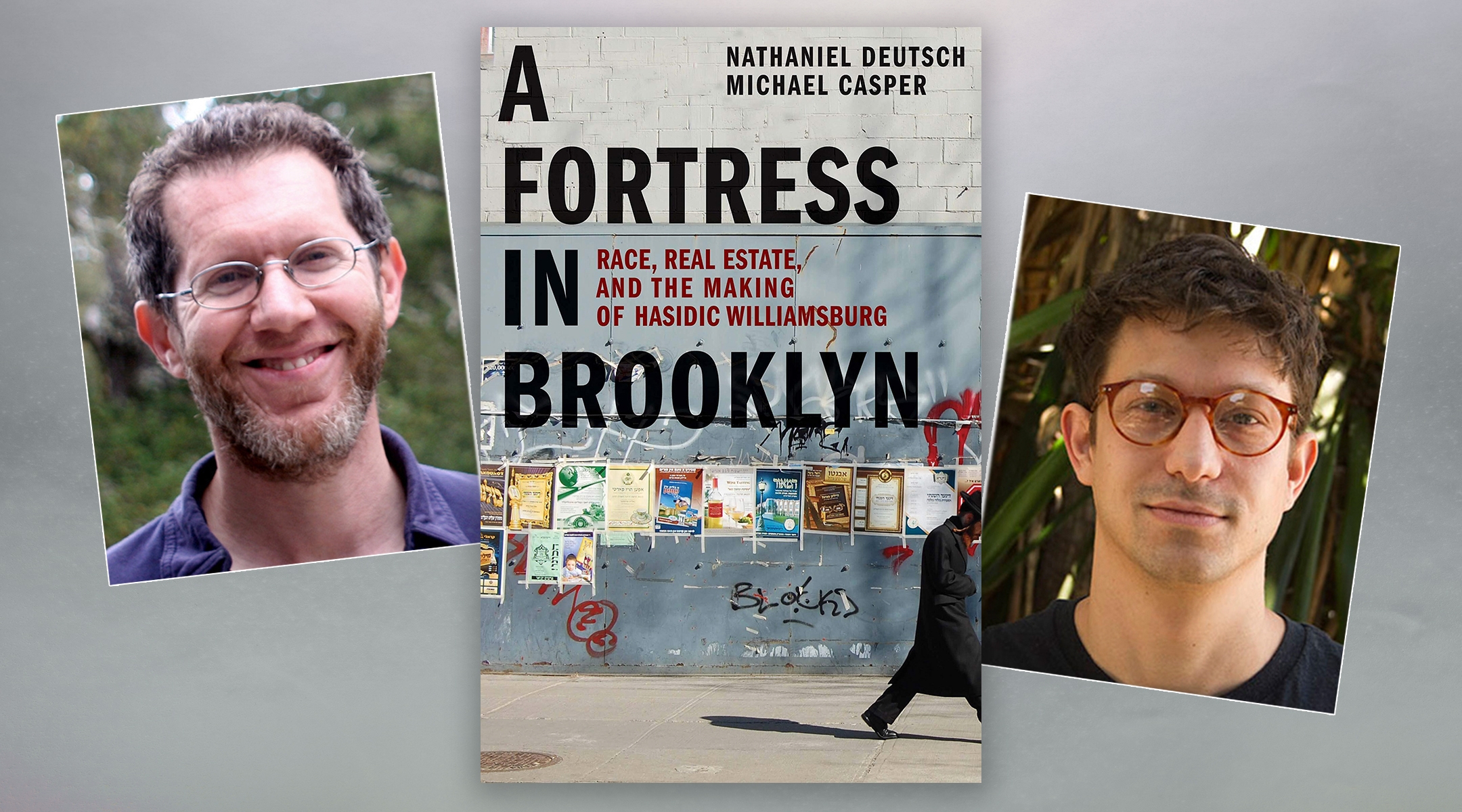
Nathaniel Deutsch, left, and Michael Casper, right, wrote about Williamsburg’s Hasidic community and its relationship to real estate while living in the area. (Photos courtesy of authors)

 The relationships between the Hasidic community in Williamsburg and non-Jewish community leaders or politicians were often better than relationships with Jewish but non-Hasidic elected officials. Can you say a little more about that and why that is?

Deutsch: There was an earlier Jewish community in Williamsburg, it was one of the largest Jewish communities in New York City, and it was known as the most Orthodox Jewish community already in the 1920s and 1930s. That was one of the reasons that the Hasidim were initially attracted to it. And yet there was tension. The Hasidic groups were very concerned that their followers would be influenced by the local Jews, even more than non-Jews, because the other Jews represented a different Jewish path. You would see accounts where children would call other Jews, including Orthodox Jews, “shkutzim,” which is a pejorative term for non-Jews. And these were other Jews!

At the same time, the Satmar [Hasidim] became very notorious for being profoundly anti-Zionist at a time when Zionism was increasing in popularity among American Jews. So they were distanced from other Jews in the U.S. in that regard, too. So there’s a variety of reasons why they end up becoming distanced, and they see it as a way of protecting themselves and their community from negative influences. And ironically or not, the most negative influences arguably were from other Jews, in their mind, not from non-Jews.

You write about how that sense of external danger to the community shifts over time, eventually shifting to artists, hipsters and gentrification, which brought rising housing costs and spiritual dangers. What’s the outsider threat in Williamsburg today?

Casper: I think that the hipster threat is kind of in the past, too, interestingly. But yes, for many decades Hasidim lived mostly with Latino and African-American neighbors. And when the artists and later college graduates and young gentrifiers started to move to the area, the Hasidim, similarly to the way they saw other non-Orthodox Jews in an earlier period, saw these tattooed people with dogs who laugh loudly in the street as a potential threat for their children in particular. … It was a question of modesty, too, in a lot of cases, and they would write about how women would dress in the neighborhood, which was a kind of a threat to to the general, modest character that they tried to keep.

Deutsch: The gentrification of Williamsburg occurred at the same time as other changes that were impacting the Hasidic community in the neighborhood as well as haredim [in general.] That was things like the internet and the exposure to all sorts of different influences and luxury goods and things that previously were not available to Hasidim — the general embourgeoisement of the community. So a certain segment of the community in particular became wealthier. If you look at Hasidic media, you start to see ads for things like vacations in Switzerland, or spend Pesach in Miami, or foods that are photographed in these really food magazine ways.

Michael especially has studied this phenomenon from the 1950s and on. The Satmar in particular had this ideology of being opposed to luksus, luxury. They’re very ascetic as a kind of ideal, and the Satmar rebbe [Rabbi Yoel Teitelbaum], their leader, tried to live out that ideal. And yet you see over time this weakening of that opposition, at least in some camps within Hasidic Williamsburg, and then you also see a resistance to it.

For the last several years, there’s been a conversation in the Jewish community about whether Jews count as white given their history of being a minority and being persecuted. Did you ask people if they considered themselves white? 

Deutsch: Hasidim in Williamsburg, their experience especially in the ’50s until gentrification, is much more similar to their African-American and Puerto Rican neighbors than it is to, let’s say, Ashkenazi or Eastern European or German Jews, or for that matter Sephardi Jews living in the suburbs in that same period.

They live in public housing projects at a time when whites are leaving public housing projects in New York City and elsewhere in droves. And that’s exactly when they move into these high-rise public housing projects and almost all of their other neighbors in those projects are African-Americans and Latinos. During the Great Society programs of Lyndon Johnson in the 1960s, Hasidim distinguished themselves [from other Jews] for tapping into those government anti-poverty programs. They even at a certain point, under Reagan, are officially designated as a “disadvantaged minority” group by a government agency, and therefore gain benefits for that. And during the same period, they experienced the divestment of city services that happen to neighborhoods like Williamsburg, they also suffer from environmental pollution that has a strong racial and racist dimension in areas like Williamsburg in terms of putting things like incinerators there and so on.

So in those ways, are they or are they not white? They experienced a lot of the things that these definitely nonwhite groups experience now whether they see themselves as white or not.

I did ask that very explicitly recently to a Hasidic guy I know. And he kind of said that’s not exactly the right question in the sense that for him, it’s much more important, the Jewish versus non-Jewish distinction, and the Hasidic versus non-Hasidic distinction. I think that the answer is probably “both, and.” Does he see himself as white in the same way that white people [might]? I would say no, but in recent years one of the things that I find interesting about the rightward shift politically among a lot of Hasidim is to what extent that will also ultimately involve a kind of greater identification with a kind of white identity than previously existed. I’ll leave that as kind of an open question. But I wonder whether that may even be happening now as a result of supporting Trump in great numbers and so on.

You wrote about how the Hasidic community really spans the gamut of income, of dependence on welfare, dependence on public housing. You’ve got the developers with a lot of wealth on one end and people who are searching for affordable housing and often failing on the other. So how do you make sense of how this community falls under this umbrella of support for Trump?

Casper: I think there’s always been wealth inequality within the Hasidic community. And that was certainly exacerbated by the economic crash in 2008 and the subsequent rise of a class of extremely wealthy Hasidic real estate developers. So there have always been wealthy Hasidim and many more working-class Hasidim, many of whom use the Section 8 housing voucher or live in public housing. I don’t know how much cognitive dissonance there is among Hasidim who, let’s say, use Section 8 and also vote for Republicans who would be ideologically opposed to welfare. I think that Hasidim vote really pragmatically, especially in local elections, and so they’ll vote for Republicans or Democrats. And even though there was a large swing towards Trump, there were some prominent Hasidic community members who supported Clinton [in 2016].

Deutsch: I wonder whether now though, in this current moment, we’re seeing a shift, among some at least, away from that pragmatism which has typically characterized Hasidic voting in Brooklyn. It’s been profoundly pragmatic, especially on bread-and-butter issues, like when it comes to education, when it comes to housing and so on. To some extent, you could see that in the support for Trump insofar as he made gestures towards support for private schools and that sort of thing, but there’s also to me a stronger ideological component, as well as an almost personal affinity. One thing that I heard from a number of people is this idea that Trump is the first candidate, at least at that level, “who sees us as a community.” I don’t think that it’s negating the pragmatic. And you see, for example, in the current mayoral race in New York City, the pragmatic concerns are coming up a lot.

But at the same time, the Hasidic communities in New York City have largely coalesced around Andrew Yang in the mayoral race rather than one of the more progressive candidates who might have been more interested in increasing public housing. I wonder if that surprised either of you?

Deutsch: I talked to a bunch of people in recent days about this and in different specific communities, and everyone I talked to says it’s between Yang and [Brooklyn Borough President Eric] Adams in terms of their support. Adams has a long-standing relationship with different Hasidic communities in Williamsburg, in Borough Park, in Crown Heights, and has cultivated it for a long time. There’s also a long history going back at least to Shirley Chisholm of African-American politicians in North Brooklyn having support from Hasidim. The Hasidim in Crown Heights supported her different candidacies very strongly, for example.

And then Yang came in as a kind of wild card and he distinguished himself by basically saying more or less unequivocally that he was going to take a hands-off attitude towards [yeshiva] education. And there’s a big controversy right now as to whether Hasidic schools will be compelled to comply with state standards regarding the curriculum and secular subjects. In fact, if you took all the students in the Hasidic schools, it would be the second largest public school district in the state of New York, bigger than Buffalo, the second largest after New York City. So it’s a lot of students, and it also provides a lot of jobs for people teaching in the schools. And of course, educating Hasidic children is maybe the key to continuing the traditions and reconstituting the community, and then recreating it with every generation. So I think that that’s why Yang’s gotten so much traction.

Why aren’t they supporting somebody who would be more progressive when it comes to public housing? It’s a good question in certain ways, and might be somewhat similar to  the whole “What’s the matter with Kansas?” argument, that certain people appear to vote against their interests. But then I think we should also expand the notion of what interests are. They might feel that the threat to education is more immediate and the likelihood that a New York City mayor will be able to deliver affordable housing, when that’s really done at the federal level, is much slimmer and more distant, and so it’s better to focus on the more immediate threat.

In Brooklyn’s Hipster Williamsburg Neighborhood, Hasidic Jews are the Real Counterculture Read More »