fbpx

May 11, 2021

Israel’s Presidential Election Set for June 2

Knesset Speaker Yariv Levin on Monday set June 2 as the date for Israel’s presidential election.

Israeli President Reuven Rivlin’s term expires in July, and by law, the vote must take place no later than one month prior to the end of his tenure.

The Israeli president is elected by the members of the Knesset for a single seven-year term. The vote is confidential.

Current hopefuls include former Knesset members Yehudah Glick, Michael Bar-Zohar and Shimon Sheetrit.

It is unclear at this time whether Jewish Agency chairman Isaac Herzog, the son of Israel’s sixth president, Chaim Herzog, will enter the race, although it is predicted he would be the leading candidate.

Refuting rumors, former Labor Party leader Amir Peretz made it clear last week that he would not make a bid for the role.

Other names that have been suggested as potential candidates include iconic Israeli performer and 2004 Israel Prize laureate Yehoram Gaon and Miriam Peretz, an Israeli educator and public speaker, the 2018 laureate of the Israel Prize for lifetime achievement.

Candidates must present the speaker with the signatures of at least 10 Knesset members supporting their presidential bid by May 19.

This article first appeared in Israel Hayom.

Israel’s Presidential Election Set for June 2 Read More »

The Pursuit of Cheesecake

When Lawrence of Arabia visited the Tomb of Ezra the Scribe in 1916, he remarked that “the blue-tiled dome and courtyard of yellow brick and beautiful glazed brick of a dark green color built into the walls….is the most elaborate building between Basra and Ctesiphon.”

Located in the Southern part of Iraq, on the western bank of the Tigris River and shaded by lush palm trees, the Tomb is a symbol of the centuries long coexistence between the Moslem and Jewish faiths. In the Twelfth Century, Benjamin of Tudela visited the Tomb and wrote of the special observances of Jews and Muslims at the site, because behind it’s battlement walls, on either side of the prophet’s grave, are a Shiite mosque and a synagogue. In the early 13th Century, the Andalusian poet Judah al-Harizi wrote about witnessing the illumination that lights up the night sky over Ezra’s grave, causing “many people to make pilgrimage to him.” Middle Eastern Jewish merchants who travelled to India stopped in Al-Azair to pay respects on their journeys home.

When Ezra returned from the Babylonian exile to rebuild the Second Temple in Jerusalem, he reinforced the observance of the Torah laws amongst the Jews living there. To honor Ezra’s legacy, over the centuries, hordes of Jews from Baghdad and Basra made pilgrimages to the Tomb to celebrate the holiday of Shavuot, Z’man Matan Torateinu, the time of the giving of our Torah.

For centuries, Sharon’s family were the Shamashim, the keepers of the Tomb of Ezra Ha’Sofer, Ezra the Scribe. The Iraqi Jewish diaspora expanded to Calcutta, Mumbai, New Delhi and Shanghai. Some of the cousins of Sharon’s grandmother were born in Shanghai and landed up in Los Angeles. They never forgot that they came from Al-Azair and were thrilled to reconnect with the family, becoming good friends over the years. One was the incredible matriarch Moselle Hendeles. The other was Abe Abraham, a stalwart member of Kahal Joseph Congregation, who had a wealth of information about Iraqi Jewish laws and customs.

In the way that history coils and twists, Rachel and Neil Sheff became “family” with Abe. He would invite them and their children for amazing Chinese feasts and they shared many Shabbat and holiday meals together. Every Shavuot, Abe would bake a dozen cheesecakes for friends in the community.

Rachel would get a phone call from Abe. “Darling, which cheesecake can I make for the children?” Rachel always requested the special mango cheesecake because her kids loved it so much. And she would be blown away by his amazing generosity.

We searched and searched for the recipe, asking everyone who knew him for the recipe to no avail. It seemed that the recipe was lost. And then last week Rachel found it in a file. Just in time to share it with you, our dear reader.

The cheesecake itself is the typical graham crusted, cream cheese and sour cream version, but what takes it to heavenly heights is the garnish of delightfully citrusy bright orange sauce and sweet mango. In our version, we added coconut to make it even more tropical.

However you make your cheesecake, we wish you a happy Shavuot!

Tradewinds Cheesecake Recipe

Crust
2 cups Graham cracker crumbs
1 stick butter, melted
1/3 cup sugar

Preheat oven to 325°F.
Grease a 9 inch springform pan.
Combine Graham cracker crumbs, melted butter and sugar, until it has the texture of sand.
Press mixture into the bottom of the cake pan and about 1 inch up the sides.
Bake for 10 minutes, until lightly browned.

Cheesecake mixture
2 8 ounce packages of cream cheese
1/2 cup sugar
4 large eggs
1 cup sour cream
2 tablespoons orange liqueur
1 teaspoon vanilla
2 ripe mangoes, peeled and sectioned

In a large bowl, beat cream cheese and sugar until softened and creamy
Add eggs, one at a time, beating well after each addition.
Add sour cream, liqueur and vanilla until well blended.
Pour batter into cake tin.
Bake for 45 to 50 minutes, until the center jiggles slightly when shaken.

Orange Sauce
3 tablespoons sugar
4 teaspoons cornstarch
2/3 cup orange juice
3 tablespoons orange liqueur

In a small pan, mix sugar and cornstarch.
Add orange juice and orange liqueur and stir well over high heat, until mixture begins to bubble.
Remove from heat and let cool to lukewarm temperature.
Pour half the lukewarm sauce over cheesecake, making sure to leave a one inch border around the sides.
Layer mango sections in an overlapping pattern.
Pour remaining sauce over the mango.
Refrigerate cake until serving.


Rachel Sheff and Sharon Gomperts have been friends since high school. They love cooking and sharing recipes. They have collaborated on Sephardic Educational Center projects and community cooking classes. Follow them on Instagram @sephardicspicegirlsofficial and on Facebook at Sephardic Spice SEC Food.

The Pursuit of Cheesecake Read More »

Sephardic Rabbis Stand in Solidarity with Israel

As Israeli civilians are once again under rocket attacks from the Hamas and Islamic Jihad terror groups, we the undersigned, Sephardic rabbis representing communities all over the world, stand in solidarity with our brothers and sisters in Israel.

We support Israel’s right to defend her cities and civilians, and to assert her sovereignty over Jerusalem, the historic and eternal capital of Israel.

We offer our love and prayers to the brave men and women of the Israel Defense Forces, the Israeli Police, Israel’s Home Front Command and Medical First Response units. May God strengthen and protect them as they protect Israel.

We condemn the violent ways of all terror groups attacking Israel, whose hypocrisy recalls the Biblical verse: “I am all peace, but when I speak, they are for war” (Psalms 120:7).

In the words of our great Sephardic sage Rabbi Bension Meir Hai Uziel, “we desire peace, but we will not go as sheep to the slaughter, rather we will defend ourselves with strength and courage in our historic homeland.”

Today and every day, we are proud to stand with Israel.

Rabbi Elie Abadie, Senior Rabbi, Jewish Council of the Emirates (United Arab Emirates)
Rabbi Ilan Acoca, Sephardic Congregation of Fort Lee (New Jersey)
Rabbi Marc Angel, Institute of Jewish Ideas and Ideals (New York)
Rabbi Haim Amsalem, Am Shalem/Zera Yisrael Foundation (Jerusalem, Israel)
Rabbi Yaakob Levy Aserraf, Communidad Israelita de Cueta (Spain)
Rabbi Eitan Bendavid, Kehillat Shivtei Yisrael (Ra’anana, Israel)
Rabbi Moshe Benzaquen, West Coast Torah Center (Los Angeles)
Rabbi Simon Benzaquen, Congregation Ezra Bessaroth (Seattle, Washington)
Rabbi Daniel Bouskila, Sephardic Educational Center (Los Angeles/Jerusalem)
Rabbi Nissim Elnecavé, Sephardic Jewish Brotherhood of America (New York)
Rabbi Albert Gabbai, Congregation Mikveh Israel (Philadelphia)
Rabbi Baruj Garzon, Kehillat Yagdil Torah (Ra’anana, Israel)
Rabbi Yonatan Halevy, Shiviti/Kehillat Shaar HaShamayim (San Diego)
Rabbi Yaacov Betzalel Harrar, Kehillat Shuva (Ra’anana)
Rabbi Ben Hassan, Sephardic Bikur Holim Congregation (Seattle, Washington)
Rabbi Daniel Kahana, (Brooklyn, New York)
Rabbi Dr. Abraham Levy, Spanish & Portuguese Community (London)
Rabbi Mordejai Maarabi, Kehillat Torah ve’Jaim (Ra’anana, Israel)
Rabbi Mimon Mamane, Congregation Magen David of Manhattan (New York)
Rabbi Raif Melhado, Americans4Israel (Los Angeles)
Rabbi Moshe Nahon, Kahal Kadosh Abudarham Synagogue (Gibraltar)
Rabbi Abraham Tobal, Monte Sinai Community (Mexico City)
Rabbi Devin Maimon Villareal, Kehillat Sha’ar Tsafon (Pocatello, Idaho)
Rabbi Ariel Yeshurun, Skylake Synagogue (Miami)

Sephardic Rabbis Stand in Solidarity with Israel Read More »

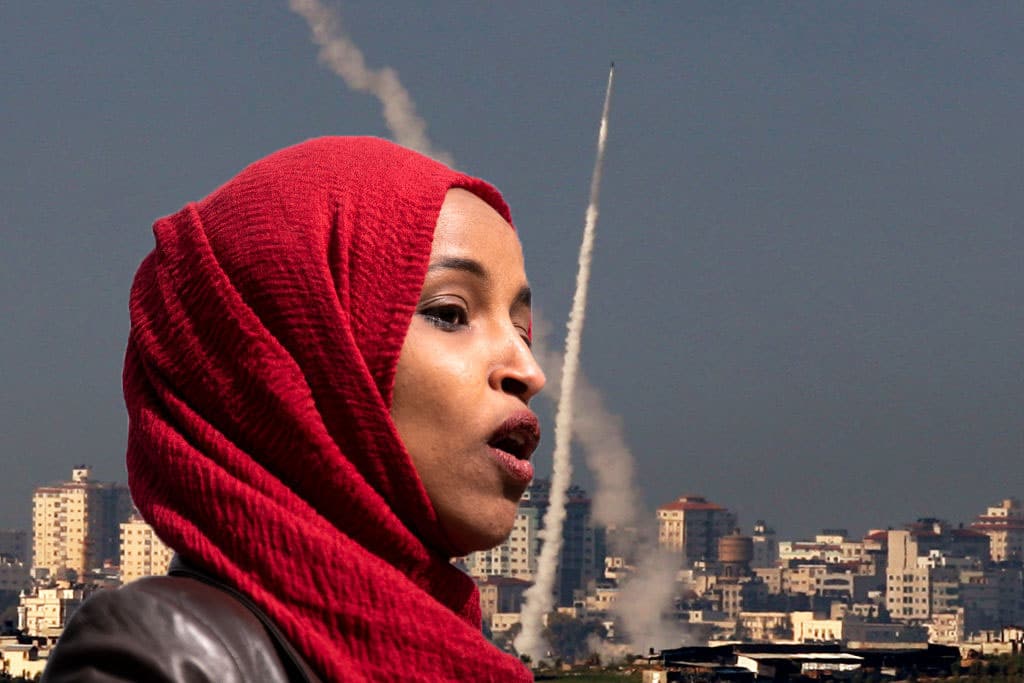
While Terrorists Try to Murder Jews, Rep. Ilhan Omar Flips the Script

Palestinian terror groups such as Hamas have a surefire strategy to win over the world’s sympathy: fire rockets into Israeli territory, trigger an Israeli response and wait for the global outrage against Israel’s response.

The strategy is effective because Israel is so darn good at protecting its citizens from missile attacks, thanks to ubiquitous bomb shelters and a sophisticated Iron Dome missile defense. So, if the terror rockets don’t kill any Jews, but the forced retaliations kill Palestinians, anyone biased against Israel will have a field day.

Consider, for example, Representative Ilhan Omar (D-MN), who flipped the script and accused Israel of committing an “act of terrorism” with its airstrikes on the Gaza Strip on May 10, which resulted in the deaths of 20 Palestinians.

“Israeli air strikes killing civilians in Gaza is an act of terrorism,” Omar tweeted. “Palestinians deserve protection.”

Indeed, they do. They deserve protection from their murderous, corrupt and Jew-hating leaders who deliberately provoke Israel into retaliatory strikes that they know endangers the lives of their people.

Provoking Israel into killing Palestinians is the perfect diversion from the blatant failures of Palestinian leadership to improve the welfare of its people. Abbas canceling the PA elections? Israel’s fault. Trouble on Temple Mount? Israel’s fault. Chronic poverty and misery? Israel’s fault. A legal dispute over houses in East Jerusalem? Let’s fire rockets into Israeli cities and blame Israel for the reprisals.

Meanwhile, these cowardly leaders sit comfortably in their villas and bunkers basking in the world’s endorsement that, yes, it must be Israel’s fault.

If only more Jews would die during these rocket attacks, maybe the world would have more sympathy for the Jewish state. Does anybody doubt Hamas would love nothing better than to see thousands of Jews die from their rocket attacks? That’s their mission. They admit it. But because relatively so few Jews die from these rocket attacks, a pathetic international community simply sides with those with more casualties.

Does anybody doubt Hamas would love nothing better than to see thousands of Jews die from their rocket attacks? That’s their mission. They admit it.

Now, however, despite all the bomb shelters and Iron Domes, Jews are dying.

As of late Tuesday, three Israeli women were killed in rocket attacks, with 46 injured. Of those injured, two are in serious condition: an 81-year-old woman and 30-year-old woman who caught shrapnel in her upper body.

More than 700 terror rockets have been fired at Israel since Monday, including rockets launched at Tel Aviv, one of them striking a bus in Holon, injuring some 18 people, including the bus driver, who was in critical condition.

So, now that Israelis are dying at the hands of these terror rockets, will Ilhan Omar walk back her shameful accusation against Israel? Or will she wait for more Palestinians to die in Israel’s response attacks so she can keep her focus on the big, bad Jewish state?

We’ll see.

In the meantime, her fellow Democrats, including Jewish groups, need to unequivocally condemn her accusation and set her straight on the difference between murder and self-defense.

While Terrorists Try to Murder Jews, Rep. Ilhan Omar Flips the Script Read More »

New Pew Study shows 75% of Orthodox Jews Identify as Republicans

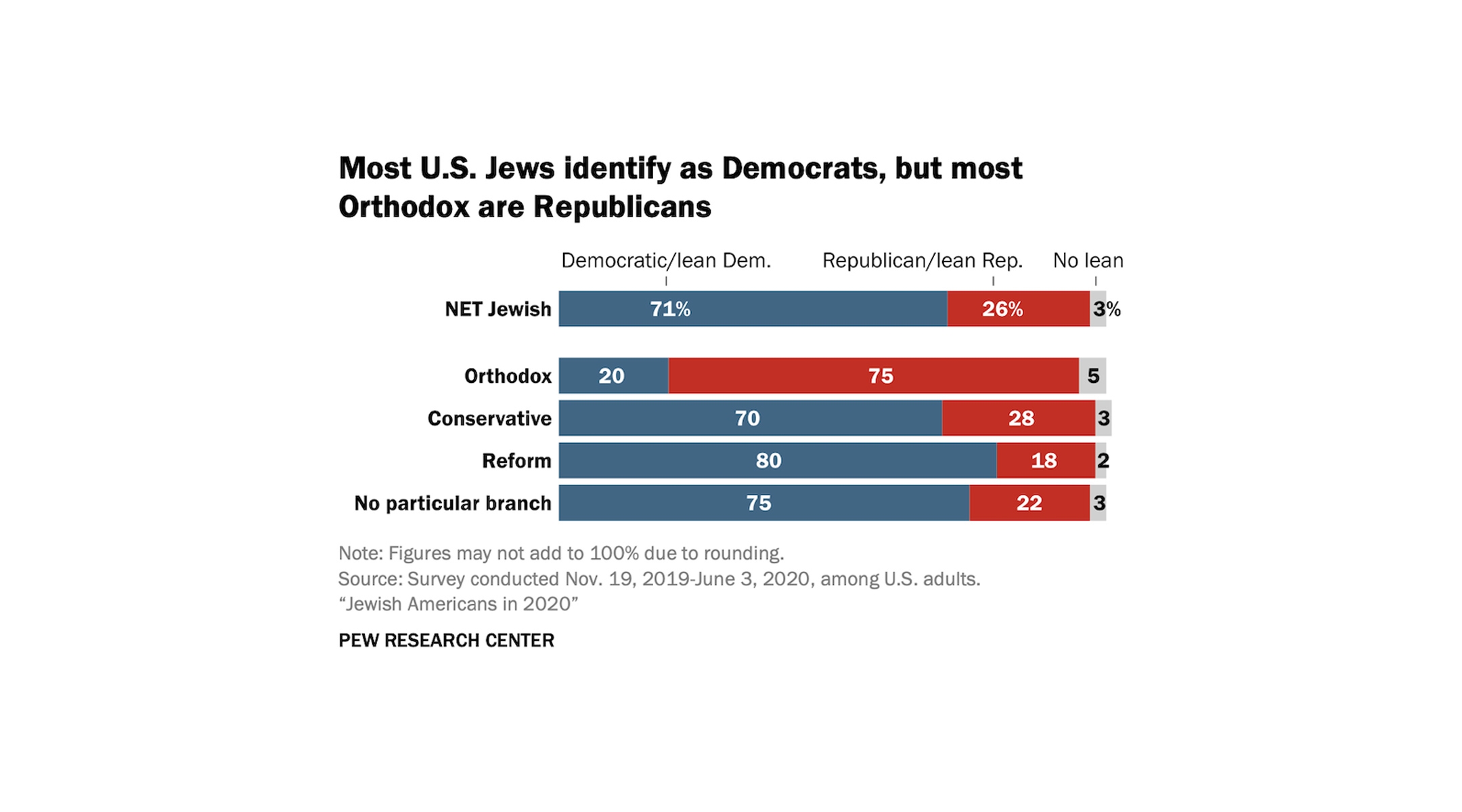
(JTA) — Among the findings of the Pew Research Center’s new survey of American Jews is one that has become increasingly self-evident in recent years: Orthodox Jews in the U.S. overwhelmingly affiliate with the Republican Party.

According to the newest study, 75% of Orthodox Jews surveyed said they were Republicans or leaned Republican. In 2013, the last year in which Pew conducted a survey of American Jews, 57% of Orthodox Jews said they were Republicans or leaned Republican.

The Pew survey was conducted between Nov. 19, 2019 and June 3, 2020, a period of dramatic polarization across America in the leadup to the 2020 presidential election. It found a large political polarization by denomination in American Jewry: Among all Jews, 71% are or lean Democratic, and 26% identify more with Republicans.

(Pew Research Center)

While Orthodox Jews have been moving rightward politically for years, the data from Pew suggest that politically progressive Orthodox Jews are not just outnumbered but are a shrinking minority within their communities. And it demonstrates the strikingly different ways that Orthodox and non-Orthodox Jews viewed Donald Trump’s presidency.

Read more about what the 2020 Pew study reveals about American Jews.

While non-Orthodox Jews largely disapproved of Trump’s handling of nearly every aspect of the role, Orthodox Jews were the only ones to overwhelmingly approve of his job performance, particularly on Israel. Among Orthodox Jews, 86% rated Trump’s handling of policy on Israel as “excellent” or “good,” compared to 40% overall of respondents who rated his handling of Israel policy as good or excellent.

Matt Williams, director of the Orthodox Union’s Center for Communal Research and an adviser on the new Pew study, said that Orthodox Jewish affinity with the Republican Party should not be attributed entirely to the party’s stance on Israel.

“If you look at the Pew lines on things like same-sex marriage, you see significantly strong alignment between the Orthodox community and what we think of as the Republican platform or conservative value or ethos on that score,” Williams said.

The new Pew numbers come with a giant asterisk, as the researchers worked from a small sample size of 430 Orthodox Jews nationwide out of 4,718 American Jews surveyed overall. Due to the sample size, the margin of error among Orthodox Jews is 8.8 points — nearly three times as large as the margin of error for the data on all American Jews. The new study also was conducted using a different methodology than the 2013 study, making it harder to draw direct comparisons between the two data sets.

But, according to Williams, the data showing the jump in Republican affiliation among Orthodox Jews from the 2013 study to this year’s survey are large enough to rely on.

“It definitely overcomes the methodological difference between the two reports,” Williams said, calling the 18-point increase “huge.”

The Trump administration embraced the Orthodox Jewish community with an unusual warmth. From its start, Orthodox Jews such as U.S. Ambassador to Israel David Friedman, special envoy to the Middle East Jason Greenblatt and Trump’s son-in-law Jared Kushner held important roles.

There was even a minyan on the White House lawn at the signing of the Abraham Accords, deals of cooperation between Israel and several Arab nations, in September.

And Orthodox Jews were among Trump’s most ardent supporters as the incumbent falsely claimed he won the 2020 election and called on his supporters to take back the presidency. On Jan. 6, a number of Orthodox Jews were among his supporters who stormed the U.S. Capitol while Congress voted to certify the election results — some even traveled to Washington, D.C., on specially chartered buses. Some of those Orthodox backers were arrested, including the son of a Brooklyn judge and former president of the National Council of Young Israel, a synagogue organization that took a sharply pro-Trump turn during his administration.

New Pew Study shows 75% of Orthodox Jews Identify as Republicans Read More »

Israeli Civilians Under Rocket Fire as Palestinians Launch More Than 500 Missiles

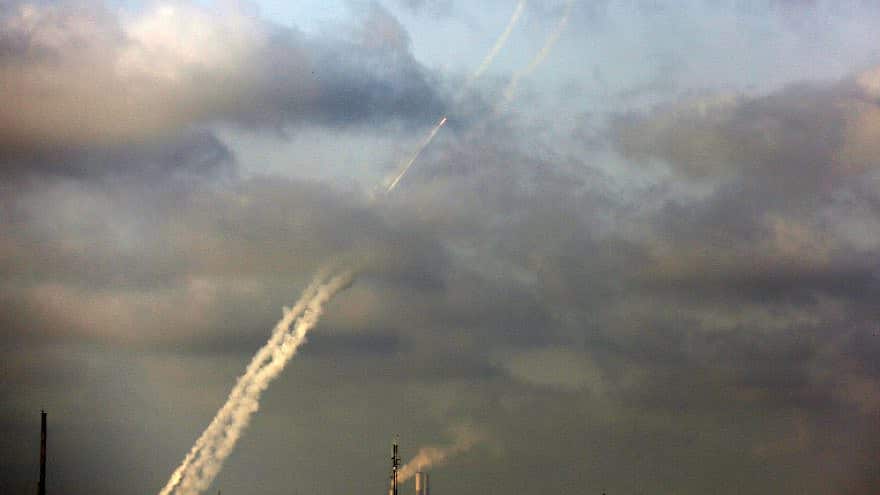
(The Media Line) Two civilians were killed and more than 80 wounded by Gazan rockets raining down on Israeli cities and towns on Monday and Tuesday, with no end in sight.

The Israel Defense Forces estimated that Palestinian organizations in Gaza had fired more than 500 projectiles. The vast majority were directed at Israel’s southwest − the area adjacent to the Strip as well as the cities of Ashkelon and Ashdod − but Hamas fired seven long-range rockets toward Jerusalem on Monday evening and warning sirens were sounded in Israel’s capital and the nearby city of Beit Shemesh.

Thousands of mostly young Orthodox Israelis were in the capital’s streets, marking Jerusalem Day in celebration of its reunification under Israeli rule in 1967.

Islamic Jihad, the second-largest armed organization in Gaza, fired an anti-tank missile at an Israeli civilian vehicle parked just outside the Strip on Monday. A video later released by the organization shows that its operatives saw that the driver was not wearing a uniform before they targeted the car. The driver, who had exited the vehicle and was a few yards away, was lightly wounded.

Israel responded to the rocket fire with a long series of airstrikes against “targets belonging to the Hamas terror organization in Gaza.” The IDF spokesperson said that more than 130 attacks have been carried out, targeting ammunition storage and manufacturing sites, Hamas attack tunnels intended for infiltration into Israel, and Hamas and Islamic Jihad operatives. Palestinian sources reported 26 casualties, including nine children.

Attacks against Hamas and Islamic Jihad targets in the Strip will continue, the IDF spokesperson said.

On Tuesday, Defense Minister Benny Gantz approved the call-up of 5,000 army reservists.

Prof. Gabriel Ben-Dor, head of the National Security Studies Program at the University of Haifa, said Israel would likely continue its aerial response but avoid a ground attack. “I think that the likelihood of a ground operation is very low,” he told The Media Line.

Israel has to decide whether its goal is to exact a price from Hamas for its aggression using aerial strikes that will hurt its military infrastructure and target its operatives, or that its interests would best be served by putting an end to the organization’s control of the Gaza Strip, he explained.

Both Hamas and the Israeli government of recent years were satisfied with the status quo, Ben-Dor explained, “and within that, there are rules to the game – you hit them, they hit you…, but yesterday they violated the rules of the game by firing at Jerusalem on Jerusalem Day. … Now the question is, what can Israel do in response to a blow that is a game-changer, without toppling the regime there?”

The professor believes that despite the attack on Israel’s capital on a day of national celebration, Israel’s government “doesn’t want the chaos” that toppling Hamas would create. Because of this, he predicts that “once again, they will hit them strongly from the air, targeting missile depots, ammo factories, weapons’ development sites, [the organizations’] headquarters, training facilities and so on.”

Brig. Gen. (res.) Dr. Meir Elran, head of the Homeland Security Program at the Institute for National Security Studies at Tel Aviv University, agrees it is highly unlikely that infantry and armored battalions will take part in the operation.

“Israel doesn’t want to be pushed into a military operation that on the one hand won’t solve its problems, and will only create others. … Israel wants to contain the situation by attacking from afar, mainly using airstrikes. Israel doesn’t want to enter Gaza,” Elran told The Media Line.

Both men agree that at present, Israel has no desire to rule Gaza or topple Hamas, and so, entering the Strip is an unappetizing option for the country’s decision-makers.

It should be noted that Israeli ground forces on the Gaza border are being reinforced. However, this has occurred in the past without developing into an incursion.

The escalation between Israel and Gaza comes as Ramadan nears its close, a month of increased tensions and violent clashes between Israeli police and Arabs in Jerusalem, and between Arabs and Jews across the country. The confrontations in the city reached a peak on Monday, when rioters and police forces met on the Temple Mount/Al-Aqsa Mosque compound. Some 300 Arabs were injured, according to Palestinian sources, as were 21 police officers.

Hamas issued an ultimatum to Israel, demanding that its security personnel retreat from Al-Aqsa compound and the Sheikh Jarrah neighborhood (where several Palestinian families face eviction from homes that an Israeli court ruled belonged to Jews before the 1948 war) and all those arrested in the riots be freed by 6 pm, or else they would retaliate. Hamas punctually fired the seven long-range rockets toward Jerusalem, whose streets were then full of Jerusalem Day celebrants.

In tandem with the rocket barrage, violence erupted in several places across the country on Monday night, when Arab Israeli rioters took to the streets. In Lod and Ramle, two cities with mixed Jewish and Arab populations, synagogues and a Jewish school were targets of arson attacks and desecration, compelling residents to save sacred Torah scrolls from burning. In Israel’s South, a woman was reportedly dragged from her car, which was then lit on fire. An ultra-Orthodox man was surrounded in his car in the Galilee village of Kafr Kanna; the vehicle was vandalized and he was severely beaten.

An Arab Israeli was killed during the events in Lod. The police arrested a Jewish man on charges of murder for shooting Mousa Hasouna, 25. The suspect claims he acted in self-defense.

This latest round of violence comes as coalition talks were close to bringing the Islamist United Arab List party to support a new government. If realized, the move would be a historic development toward the integration of Arab citizens into Israeli society and politics.

Elran explains that the protests of recent weeks, which culminated in Monday’s riots, were in response to an insult and threat felt by Israel’s Arab population against their religious sentiments, and in particular, their devotion to Al-Aqsa Mosque. A video circling since Saturday night shows Israeli border police entering a mosque and throwing stun grenades. While the context is unclear, these actions being seen as a gross insult to Muslim sensitivities is easily understandable. The fact that this occurred during Ramadan only added to the impact.

In the last two decades, says Elran, the Arab Israeli community has been integrating into Israeli society. This current bout of friction and violence would be extremely significant, he explained, if it turns the tide on this phenomenon. “As a first step, peace must be restored,” he says.

Israeli Civilians Under Rocket Fire as Palestinians Launch More Than 500 Missiles Read More »

Gaza terror factions fire more than 200 rockets at Israel; six injured in Ashkelon

Gaza terror factions have fired more than 200 rockets at Israel in the past 24 hours, the Israel Defense Forces said on Tuesday.

The IDF struck more than 130 targets in Gaza in response, including strikes on 15 terror operatives, in what the military is calling “Operation Guardian of the Wall,” the IDF said in a statement.

Ashkelon came under heavy fire on Tuesday morning, with tens of rockets being fired at the city within 30 minutes. A 40-year-old man suffered serious to moderate injuries, his wife, 39, moderate injuries and their two children light injuries when two residential buildings sustained direct hits, according to Ynet. Two additional civilians in Ashkelon, ages 63 and 82, were lightly injured in the attacks.

Many of the projectile attacks have targeted Sderot and its surrounding area near the Gazan border, according to the IDF.

International IDF spokesman Lt. Col. Jonathan Conricus said on Tuesday that the rockets were launched from densely populated urban areas in Gaza. The Iron Dome air-defense system has intercepted “slightly above 90 percent” of the projectiles heading to populated areas, he added. The Iron Dome air-defense system “is saving Israeli lives every minute, and under significant strain,” said Conricus.

Addressing the strike on Ashkelon, the IDF spokesman said, “We are doing everything possible to limit harm to Israeli civilians. We have enhanced Iron Dome batteries in the south, both in terms of radars and interceptors.”

Conricus reported that one-third of the rockets fired by Hamas and Palestinian Islamic Jihad have fallen short, exploding inside Gaza, describing the figure as “abnormally high” compared to past escalations.

“Perhaps it is indicating poor quality. The rockets falling short are causing casualties and damage inside the Gaza Strip,” he said. “We are aware of Hamas and Palestinian Islamic Jihad efforts to nurture a narrative of damage to noncombatants, done by Israel. This is not true. We take every effort to limit harm to non-combatants.”

Hamas began its assault on Israel with a rocket attack on the Jerusalem area and on southern Israel on Monday. The last time that Jerusalem came under rocket fire was during “Operation Protective Edge” in the summer of 2014.

Gazan terror groups have “a substantial arsenal capable of reaching large parts of Israel, including Jerusalem and Tel Aviv,” said Conricus. “The fact that they decided to fire [at Jerusalem] is a very grave event.”

Conricus said the IDF is prepared for a further escalation, adding that troops have been ordered to be ready for “various scenarios.”

Gaza terror factions fire more than 200 rockets at Israel; six injured in Ashkelon Read More »

What The New Pew Study Tells Us About The 7.5 Million American Jews

It is impossible to summarize all the details contained in a 250-page report within a short article. It is also impossible to summarize the state of American Jews within a short article. So this article will try to do neither; it will merely touch upon the most worthy and urgent headlines from the latest Pew report on American Jewry. Like its predecessor, the 2013 Pew report on American Jewry, the 2020 study will be the basis for every discussion about this community for the next decade. So, headlines today, but more to come in weeks and months.

According to the Pew report, there are 7.5 million Jews in America. This is slightly more than the 2013 survey, but considering methodology differences and other factors — such as the never-ending debate concerning who should be counted as Jews — this number is pretty much in line with what we know.

Three out of four of these Jews are Jews “by religion.” This means that when asked, they say their religion is Jewish. About a quarter (27%) do not identify with Judaism as a religion; they consider themselves to be Jewish “ethnically, culturally or by family background and have a Jewish parent or were raised Jewish.” This group of Jews without religion is growing. Among the youngest cohort of Jews (age 18-29), 40% identify as having no religion.

Looking at nonreligious Jews is meaningful not only because it is a growing demographic, but also because nonreligious Jews present different values. For example, roughly six in ten Jews say it would be very important (34%) or somewhat important (28%) for their grandchildren to be Jewish. But when we focus on the two groups, Jews by religion are fairly likely to say it is very important to them for their grandchildren to be Jewish (45%), but for Jews of no religion, it is not likely at all (4%).

But looking at Jews of no religion is just one pole of the Jewish spectrum. On the opposite pole is a growing Orthodox demographic. Seventeen percent of Jews under the age of 30 are Orthodox. So younger group are more polarized, and the so called “Jewish middle” is gradually shrinking. As the Pew team says, “Meanwhile, the two branches of Judaism that long predominated in the U.S.,” that is, Reform and Conservative Judaism, “have less of a hold on young Jews than on their elders.” Although these denominations are still around — the Reform more so than the Conservative — they are losing ground.

The Pew report reveals polarization on more than one front. Jews behave in different ways, believe in different things and do not feel that they share much in common. Surely, most Jews of no religion feel they have little or nothing at all in common with Orthodox Jews. But Reform Jews also report that they share little with Orthodox Jews, and many Orthodox Jews do not feel that they share much with Reform Jews.

Indeed, their experiences as Jews in America seem quite different. Orthodox Jews feel less safe because of anti-Semitism than Reform Jews do. Conservative Jews had been to Israel almost twice the rate of Reform Jews, and Reform Jews had been to Israel three times the rate of Jews of no religion. More Orthodox are poor, with just a quarter saying they live “comfortably.”  Two-thirds of Reform Jews and half of Jews of no religion, by contrast, believe they live “comfortably.” Religion itself is very important to most Orthodox Jews, a third of Conservative Jews and 5% Jews of “no particular branch.” For a seven of ten Conservative Jews, being Jewish is very important. For Reform Jews, this number declines to forty percent. For 55% of Jews of no religion, being Jewish is not important.

Does any of these findings surprise you? I posed this question last week to the scholars of the Pew Research Center. Alan Cooperman, the director of religion research at Pew, responded in a a slightly disappointing but apt way: When one studies a community one knows, surprises are more often a sign that something is wrong with the survey than a sign that the community is not what we thought it is. Eight years had passed since Pew 2013, and grand changes should not be expected. The new study is mostly a way for us to track the slow moving trends and look for nuance.

But nuance is everywhere because, as the Pew study puts it, “U.S. Jews do not have a single, uniform answer to what being Jewish means.” Some things most of them do, such as having a Seder (62%). Some things very few of them do, such as keeping Kosher (17%). Jews agree that some things are essential, such as remembering the Holocaust (76%). But there are other things on which there is no such broad agreement, such as caring for Israel (45%). Four out of ten Jews “regularly mark Shabbat in a way that is meaningful to them.” But eight out of ten have a Menorah at home (81%).  

Nuance is everywhere because, as the Pew study puts it, “U.S. Jews do not have a single, uniform answer to what being Jewish means.”

What can we learn from this grand pile of new data? We can learn that American Jews are who we think they are. We can learn that American Jews are not a monolith but rather a mosaic of many shades. We can learn that the Jews of America did not yet find the key for long term cultural survival — but also that predictions of inevitable doom are probably premature or false.

We can learn that there is still much to debate: Is a group with such high rate of interfaith marriage culturally sustainable? You will get more than one answer to this question, even if the data is undisputed (seven of ten marriages of Jews in the last decade). Can a group for which members share an ancient religion but have little else in common still consider itself a group? Maybe yes — the proof is that they all still call themselves Jews. Maybe no — the proof is that many of them say there is no shared culture. Is a group that is politically polarized — in an era in which politics is in many ways the dominant American religion — still viable as a group? Consider that Orthodox Jews, the group that is most Jewishly engaged, stand out as a small subgroup (one in ten) whose political profile is “virtually the reverse of Jews as a whole.”

That’s the benefit and disappointment inherent to all baches of new data. Oftentimes new data is not a tool to close important debates and settle old questions. It is a tool to better argue for one’s previous position and address the positions of the other side with more acuity. What is the state of American Jewry? Suffice it to say there are still enough of them to be counted, and there is still enough interest in them to conduct a study. The rest, as the Elder Hillel said, is interpretation. Go study!


Shmuel Rosner is an Israeli columnist, editor, and researcher. He is the editor of the research and data-journalism website themadad.com and is the political editor of the Jewish Journal.

What The New Pew Study Tells Us About The 7.5 Million American Jews Read More »