UC Merced Engineering Professor Abbas Ghassemi will not be teaching at the university during the upcoming spring semester following a controversy over his anti-Semitic tweets.
Ghassemi’s tweets in question include a tweet of “The Zionist Brain” and another tweet stating that “the Zionists and IsraHell interest have embedded themselves in every component of the American system.” The university announced on December 29 that they would be investigating Ghassemi over the matter.
End Jew Hatred, a grassroots organization promoting the civil rights of Jews, announced on January 18 that UC Merced told them that Ghassemi will not be teaching during the spring semester. The Journal can confirm that this is the case and that the investigation is still ongoing.
“Blocking Professor Ghassemi from infecting impressionable young minds with his hateful propaganda this semester is an admirable first step,” Lawfare Project Executive Director and End Jew Hatred partner Brooke Goldstein said in a statement. “The university must be transparent throughout his disciplinary process and provide further details about the training workshops they intend to hold this spring. We demand that End Jew Hatred partner organizations be brought into the process to ensure that the training on anti-Jewish discrimination is done properly.”
Micha Danzig, another End Jew Hatred partner, also said in a statement, “Questions still remain about whether Ghassemi is receiving a salary throughout his suspension and whether he will return to teaching at some later date. The dangers of allowing him to spread Jew hatred on campus without proper repercussions cannot be overstated.”
Other Jewish groups also weighed in.
“We applaud UC Merced in this initial step in remedying the stain Abbas Ghassemi has placed on their University,” Liora Rez, director of the Stop Antisemitism.org watchdog, said in a statement to the Journal. “Ghassemi is a blatant Jew hater, fan of the Iranian Ayatollahs, and cheerleader of Hezbollah. He needs to be kept as far away from college campuses as possible.”
Stop Antisemitism launched a petition on January 5 calling on the university to fire Ghassemi; the petition has garnered thousands of signatures worldwide.
StandWithUs CEO and co-founder Roz Rothstein said in a statement to the Journal, “This is a very positive step, indicating that UC Merced is continuing to follow through on its pledge to stand against antisemitism. We look forward to hearing further details about how the university will ensure that Jewish students will not suffer at the hands of a professor who has expressed so much hate towards their community.”
Ghassemi did not respond to the Journal’s request for comment.
Contracts benefit, but covenants transform,
the former mere transactions but
relationships the latter, pulpit and platform
where minds are open, never shut.
Cooperating, fauna which have selfish genes
survive because they are a team,
their hidden covenants providing them the means
to thrive, as if they have a dream
like Martin Luther King’s, so that they all can see
beyond their petty selves to where,
cooperating with the so-called enemy,
they triumph, since they dare to share.
Inspired by a speech Rabbi Lord Jonathan Sacks, gave to an assembly of Anglican Bishops at Lambeth Palace on July 29, 2008. He used the concept of what Richard Dawkins has called the selfish gene to illustrate the difference between contracts and covenants.
His response to this poem on September 8, 2008 was:
Dear Gershon:
Thank you very much for your very, very moving letter. I loved the poetry and the prose. May G-d continue to bless all you do.
בשלום וברכה
Jonathan Sacks
Gershon Hepner, MLK Day 1/18/21
Gershon Hepner is a poet who has written over 25,000 poems on subjects ranging from music to literature, politics to Torah. He grew up in England and moved to Los Angeles in 1976. Using his varied interests and experiences, he has authored dozens of papers in medical and academic journals, and authored “Legal Friction: Law, Narrative, and Identity Politics in Biblical Israel.” He can be reached at gershonhepner@gmail.com.
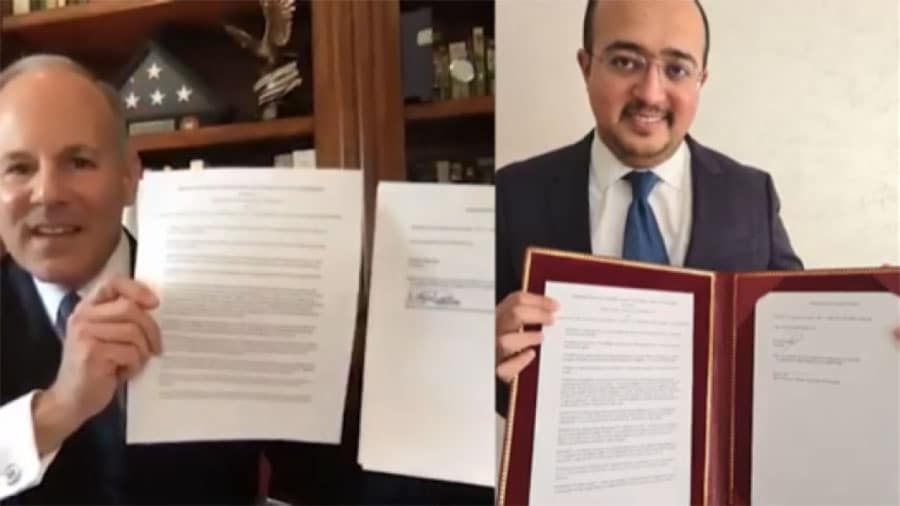
(JNS) The United States and a Moroccan NGO signed a memorandum of understanding (MOU) on Friday to combat all forms of anti-Semitism.
The MOU was signed by Elan Carr, who leads the U.S. State Department’s Office of the Special Envoy to Monitor and Combat Anti-Semitism, and El Mehdi Boudra, president of the Morocco-based Association Mimouna, which has never received financial assistance from the Moroccan government.
The Memorandum of Understanding states the United States and Mimouna “intend to work together to share and promote best practices for combating all forms of anti-Semitism, including anti-Zionism and the delegitimization of the State of Israel” and “for combating other kinds of intolerance and hatred, including Islamophobia.”
The agreement came a month after Morocco agreed to normalize ties with Israel, joining the U.S.-brokered Abraham Accords that currently includes the United Arab Emirates, Bahrain and Sudan.
The agreement “reinforces the deep and longstanding partnership between our two countries in the fight against all forms of intolerance and the promotion of peace and mutual coexistence,” said Morocco’s ambassador to the United States, Princess Lalla Joumala, in a statement. “It is an unwavering engagement spearheaded by His Majesty King Mohammed VI who leads by example and upholds the proud heritage of tolerance perpetuated by His Forefathers.”
The Jan. 15 MOU was similar to the one signed in October by the United States and Bahrain—one month after Israel, Bahrain and the UAE signed the Abraham Accords at the White House.
According to the Los Angeles Police Department (LAPD), surveillance footage shows that a male in a hooded sweatshirt committed the vandalism at 2:30 A.M. The matter is being investigated as a hate crime.
Richard S. Hirschhaut, regional director of American Jewish Committee Los Angeles, said in a statement to the Journal, “We are saddened and dismayed to learn of the incident of antisemitic graffiti early this morning outside Wilshire Boulevard Temple’s Koreatown campus. That this hateful act was committed on a day when we celebrate the life and legacy of Dr. Martin Luther King, Jr. is a reminder that our work of building a more just and respectful society is far from done. We trust that LAPD will bring its full investigative power to identifying and charging the perpetrator of this hate crime.”
Don Levy, director of Communications and Marketing for Wilshire Boulevard Temple, also said in a statement to the Journal, “On this day when we celebrate the life and legacy of Dr. Martin Luther King Jr., who chose courage over fear in the face of oppression, ignorance, and violence, we stand strong in our resolve and condemn this hateful act of antisemitic vandalism that defaced our historic sanctuary building. There is no place for hate in a civil society.”
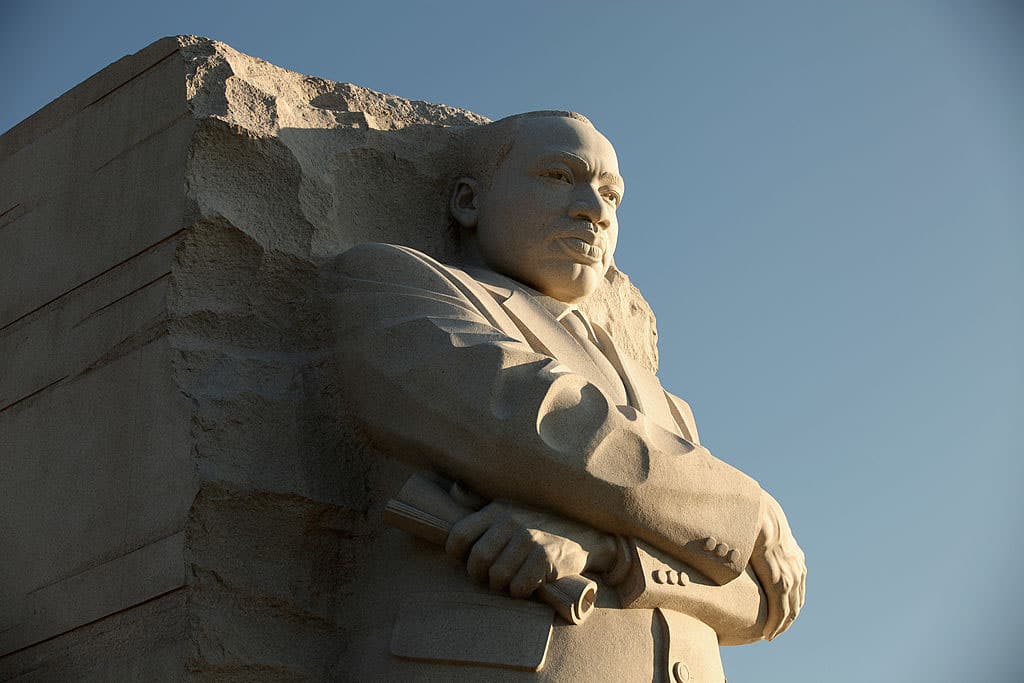
Two days before President-elect Joe Biden delivers his inaugural address, we honor a man today, Dr. Martin Luther King Jr, whose message should inform any leader interested in national unity.
Dr. King may be the most unifying figure in American history. He had the unique ability to move the oppressed as well as the oppressor. He fought fiercely against racism and discrimination and for freedom and civil rights. But he fought equally fiercely in favor of non-violent resistance. He knew the power of violence to undermine his cause, and the power of non-violence to advance it.
But he was also impatient. “We know through painful experience that freedom is never given voluntarily by the oppressor; it must be demanded by the oppressed,” he wrote in April, 1963, in a letter from a Birmingham jail. “Frankly, I have never yet engaged in a direct action that was ‘well timed,’ according to the timetable of those who have not suffered unduly from the disease of segregation.”
He didn’t just fight for freedom and civil rights. He knew the value of employment in achieving human dignity. His famous “I Have a Dream” speech was billed as a rally for “jobs and freedom.”
He didn’t just fight for freedom and civil rights. He knew the value of employment in achieving human dignity.
While he fought for the rights and freedoms and equal opportunities for African-Americans, he dreamed for the whole country.
He wanted freedom to ring “from the hilltops of New Hampshire… the mighty mountains of New York…the heightening Alleghenies of Pennsylvania… the snow-capped Rockies of Colorado… the curvaceous slopes of California… from Stone Mountain of Georgia… from every hill and molehill of Mississippi and every mountainside.”
He was a man of faith who preached confidence in America’s ability to accomplish the most difficult tasks: “With this faith,” he said, “we will be able to hew out of the mountain of despair a stone of hope. With this faith we will be able to transform the jangling discords of our nation into a beautiful symphony of brotherhood.”
He called on the nation “to work together, to pray together, to struggle together,” and yearned for the day “when all of God’s children will be able to sing with new meaning ‘My country ’tis of thee, sweet land of liberty, of thee I sing.”
Above all, Dr King was a unifying force because he believed in America.
Yes, he was outraged that a hundred years after the Emancipation Proclamation, “the colored American lives on a lonely island of poverty in the midst of a vast ocean of material prosperity… is still languishing in the corners of American society and finds himself an exile in his own land.”
But he saw the solution in America itself: “When the architects of our great republic wrote the magnificent words of the Constitution and the Declaration of Independence, they were signing a promissory note to which every American was to fall heir.”
He criticized America’s failures, but believed in America’s promise. His approach was to bring out the best in our nation.
He criticized America’s failures, but believed in America’s promise. His approach was to bring out the best in our nation.
“In a sense we have come to our Nation’s Capital to cash a check,” he said in his “Dream” speech. This promissory note “was a promise that all men, yes, black men as well as white men, would be guaranteed the inalienable rights of life, liberty and the pursuit of happiness.”
While he was pained that “America has given its colored people a bad check, a check that has come back marked ‘insufficient funds,’” he refused to believe that “the bank of justice is bankrupt. We refuse to believe that there are insufficient funds in the great vaults of opportunity of this nation.”
Whatever your political, racial or ethnic affiliation, when you hear a Black activist talk about “the great vaults of opportunity of this nation,” it’s hard not be moved.
It’s unfortunate that King’s unifying message has dissipated in recent years. Movements like the 1619 Project seem more interested in reframing American history around slavery than in inspiring a divided nation to move forward.
It’s unfortunate that King’s unifying message has dissipated in recent years.
King’s guiding light was 1776, not 1619. By rallying the country around our founding ideals, he brought us together. He used America’s sins not to demoralize us, but to spur us to new heights. He gave our nation hope.
Our new president can honor King’s memory by uniting us around that hope.
On Sunday The Guardian reported the depressing fact that “almost half of British Jews avoid showing visible signs of their Judaism in public, such as a Star of David or a kippah (skullcap), because of antisemitism,” according to a new study. The Guardian reported that “The Campaign Against Antisemitism and King’s College London gave 12 statements that participants in the survey were asked to agree or disagree with… Twelve percent showed “entrenched antisemitic views” by agreeing with four or more of the statements. The one that had most backing was “Israel treats the Palestinians like the Nazis treated the Jews”, affirmed by almost a quarter (23%) of respondents.”
That’s pretty sobering. But it gets worse. “Among the general public, a similar proportion agreed with one or more antisemitic statements put to them, pointing to a “deeply troubling normalization of antisemitism.”
Is anyone surprised? The question is what to do about growing European anti-Semitism. Should Jews in Britain give up and move to Israel? Or is making Europe judenrein exactly what the Nazis sought through the annihilation of European Jewry, and we should never give Hitler that posthumous victory?
Two of the greatest Jewish leaders of the 20th century had opposing views on this question. Theodor Herzl concluded that anti-Semitism was unmovable, and the only hope for Jewish survival was the establishment of an independent Jewish State. He insisted on the necessity of using diplomacy to persuade the world that Jews have a right to self-determination in their historical homeland—Israel—and helped turn the centuries-old dream of returning to Zion into a reality.
Rabbi Menachem Mendel Schneerson, the Rebbe, believed that Jews should have no fear, and communities should be expanded to all parts of the globe. Judaism was a global religion with global influence. To assist in this goal, the rebbe sent emissaries around the world to establish and strengthen Jewish communities, and spread the light of Jewish values and faith.
As an American Jews who spent 11 years in Western Europe, I believe that both Herzl and the rebbe were correct. We need a Jewish State in the eternal Jewish homeland of Israel, that is the axis and pivot of world Jewry, while maintaining a global Jewish community that both spreads the light of the Jewish people and supports the Jewish State.
How can I say this? Doesn’t the fact that six million Jews were killed while the world watched prove Herzl’s point? After all, no Jew was spared. Even the most assimilated Jew, and non-Jew with only a distant Jewish relative, was sentenced to death. The world’s leaders shut the gates to their countries, offering few Jews an opportunity to escape.
If Israel had existed at that time, Jews would have had a haven, and a government that would have done everything in its power to save them. In fact, even without a state, Jews in Palestine did what they could to rescue their brethren. The Mossad was first created to organize illegal immigration to Palestine, bringing Jews to their homeland, despite the objections of the British mandatory government. Heroic figures, like Hannah Senesh put their lives on the line to fight the Nazis.
In countless cities and towns of Europe, Hitler eradicated whole Jewish communities. If synagogues survive, they were often museums rather than places of worship because often no one was left to pray in them. Is this what we really want?For Jews to be historical oddities like the dinosaurs?
No. Amid the central importance of Israel to every aspect of the Jewish future, we need a global Jewish community where our people thrive and flourish in every part of the world.
Amid the central importance of Israel to every aspect of the Jewish future, we need a global Jewish community where our people thrive and flourish in every part of the world.
Then there are the Israeli tourists who flock to cities such as Venice, Rome, Warsaw, Munich, and Berlin. Do we want Israelis, especially former IDF soldiers, doing a travel year abroad, to arrive in a continent bereft of Jews, and find no place to feel at home? No Chabad houses? No shuls to pray in? No kosher restaurants? No mikvehs? No Jewish communities to visit and feel part of?
An Israel friend of mine with whom I discussed this disagrees with me. He argues that, “When we’re not together, we’re weak and we’re exposed. Our enemies murder us. When we’re strong, as one, they can’t. In Israel, we have an army. And if we are all there, it will be harder to defeat us.”
I told him that the genocidal Iranian Mullahs make the same case, but for the opposite effect. “Israel is a one-bomb state,” one of the murderers said. Because the Jews are all together, it’s easier to annihilate the whole of the nation.
I was playing devil’s advocate. But my Israeli friend would have none of it. He agreed with Israeli leaders that all the European Jews should move to Israel, where they would be safe.
I of course believe that every Jew who wants to live in Israel should go there and be encouraged to do so. Three of our children already have and two have served in the IDF while the third is about to join, God willing. Israel is our eternal homeland. Despite terrorism and the threats of radical Islam in the region, Israel is strong and safe. The population is defended by a powerful military, a true people’s army, composed mostly of courageous Jews with a fighting spirit. The government and the people are a flourishing democracy, and all citizens enjoy the freedoms we often take for granted in the United States, but which are a miracle in the Middle East.
On the other hand, the Jewish philosopher Emil Fackenheim formulated a 614th commandment that we should not give Hitler a posthumous victory. No Jew should be lost to his or her people or tradition. Abandoning the Jews of Europe, especially those who survived Hitler’s genocidal war, is unacceptable. Allowing or encouraging Europe to become judenrein would violate that commandment and betray the ideals of both Herzl and the rebbe.
But Israel has something else. Governed by Jewish values, it has an army that celebrates no victories or military glory, but only defense of human life. Judaism has no victory arches. You will find many things in Israel—the ruins of the ancient temple, ancient synagogues, and mikvehs. The Maccabees and King David had great military victories. But Jews don’t celebrate them, because we do not believe in the glory of war. We do not believe societies are enhanced or ennobled by war. Precisely the opposite is true. We are a people who celebrate peace, and our God’s name is Shalom, peace.
Jews believe the purpose of war is to protect life. We fight only because we are forced to fight. There is no glory in it. Even in modern Israel, which has seen the electrifying victories of the Six-Day War, when Israel conquered land three times its size. Or the more sobering Yom Kippur War, when Israel was almost annihilated, but rallied to threaten Cairo and Damascus and encircle the Egyptian Third Army. Even then, Israel made no celebratory military arches. Israel has no celebrations for its wars, only monuments to the fallen soldiers, and countless victims of terror, who gave their lives to defend their people.
Europe, of course, is different. Going back to ancient Greek and Roman times, rulers were celebrated not for peacemaking, but for war and conquest. Caesar and Augustus, Trajan and Constantine earned their places in the annals of history by dominating the enemy. Even in benign modern democracies, like Britain, the rulers—like King Charles and his two sons—get married in military garb.
Which just goes to show you, how much the Jews can contribute to Europe in the field of values, faith, charity, and community, if only Europeans would forego the long history of anti-Jewish antipathy and decide that fighting anti-Semitism is a European, rather than a Jewish, priority.
Rabbi Shmuley Boteach, “America’s Rabbi,” whom the Washington Post calls “the most famous Rabbi in America,” is the founder of the World Values Network and the international best-selling author of more than 30 books, including “The Israel Warrior.” Follow him on Instagram and Twitter @RabbiShmuley.
As a matchmaker, I tell others, don’t date seriously until you’ve healed from your divorce. You can’t dive into one hole while you’re still climbing out of another one.
But I recently broke my own rules — and broke someone else’s heart while doing it.
Out of the blue, an amazing Jewish guy in another state sent me an email saying, “my wife of 30 years just left me, I always thought of you as someone I’d go out with (if I wasn’t married), I’d love the chance to re-connect.”
We started chatting and imagined an incredible, traditional Jewish life together in the United States and Israel. I was already dancing at our wedding!
In the past I would have jumped on a plane and landed in his bed. This time, I knew I would crash and burn, so I asked to slow it down. I told him I wasn’t ready — I was going through my own journey to self-love. I had put off the work to heal after a traumatic divorce for far too long.
To ask for time in the most authentic, romantic way, I sent him a love letter. I cried and shook as I wrote it. I worried I would lose him.
Here’s the “Time to Love” note I gave him 19 days after he first reached out:
It’s time.
It’s time to love.
Not time to seek love outside ourselves in each other’s arms to blunt the love we lost, or never had.
Before we bond in love, it’s time to fall in love with ourselves.
I believe the reason why I’ve never allowed my heart to be so vulnerable is I’ve never turned inward and taken the time to see my own beauty. I’ve relied on the external validation of others telling me I’m wonderful and believing them. Anyone who’s not me must know myself better than me.
After I got married, I was a good wife and raised three menchy boys in a Jewish home for 18 years — but the divorce scattered my identity into a million pieces.
For the last six years, I’ve been chasing after the sparkly, shining pieces of myself reflecting back through other’s eyes. I’ve been in constant motion. Doing, moving, serving, learning. Changing careers, changing homes, trying to find my worth by helping others find theirs.
But as I’ve uprooted myself and my children for the sixth time in six years to another home, I finally want to stop chasing to find peace and make time to love myself. I want to trust and believe I’m loveable. Especially when I’m alone.
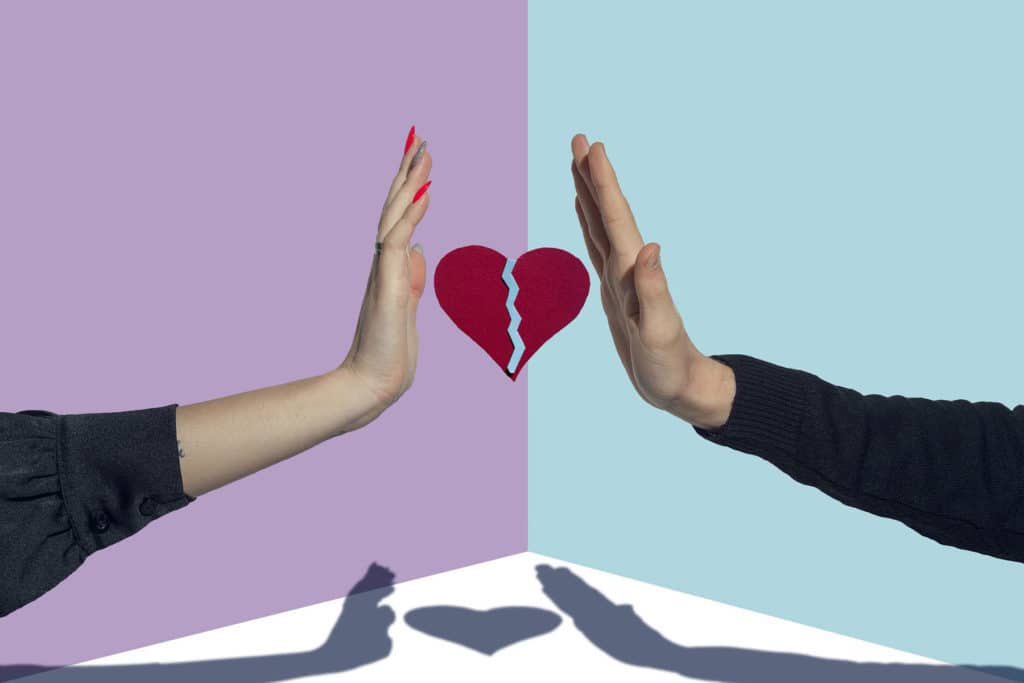
I feel as if I’ve begun to collect all the scattered pieces of my soul, and finally I can stop, ground myself and fuse the pieces back together. Like the glass a Jewish man steps on under the marital Chuppah — think of all the hundreds of pieces fused back together to now form the shape of a heart. The heart is made of hundreds of shards, but its beauty lies in its imperfect shape.
How will I create my own fused heart that will be ready to love? To love you?
First, I need to stop moving, ground myself and allow myself time to heal.
So, before you reached out to me, I started to heal my heart. I started therapy. I filled my home with the life force of plants. I kept my bed intentionally empty.
I feel like the pieces of my heart and soul are gathered again, but the glue of time needs more time to set.
The pieces of my heart and soul are gathered again, but the glue of time needs more time to set.
(ChuppahGlassArt — Etsy — Heart Beat in Blue by Eva Edery)
I’m drawn to you, to know you, to laugh with you, to learn with you, to cook with you, to travel with you, to give tzedakah with you, to entertain guests with you, to observe Shabbat with you and to get lost in each other’s bodies, exploring and learning how to pleasure each other. To live a life of loving each other.
But right now, my yearning for you, to discover us, is a distraction that will scatter my sticky but not strong pieces of my heart.
After my divorce, I never gave myself this time to slow down, pause and learn to love myself in loneliness.
These past six months of being single are the first time in six years I have not sought comfort in the wrong person’s arms. Every night, as I lie alone in my King bed without my King, I talk to G-d. I pray he brings me my beshert. I forgot to say, “G-d — bring him when I’m ready.”
You got here early! I’m still getting ready!
My friend, we’re both not ready. For the last six years, I’ve been running from my pain. You have only begun to know yours.
Divorce is like the death of a loved one, death of the idea of forever, dancing together at our children’s and our grandchildren’s wedding.
You must mourn that death.
So must I.
We can mourn together at the same time — but physically apart.
Right now, I want to be your friend and your love, but I know if we don’t allow ourselves time to mourn and love ourselves, our union will be created on the scattered shards of our souls.
But sweetheart, you and I are so damn lucky. We know that at the end of our journey of pain and discovery of self-love, we are there waiting for each other.
It’s almost not fair. Most people mourn the loss of divorce and begin the journey of self-love not knowing if they’ll ever find love again.
We are so aligned in all our values of family, friends, Torah and Israel, and we’re playful and adventurous. I’m so excited to fall in love with you.
You reaching out to me gives me faith that that love is possible. You exist. “We” are possible.
But I am willing to wait to manifest “us” into reality.
I want to be there for you as you journey through time, but in order to protect myself and my fragile soul, I have a few requests…
Let’s not discuss your “dating” adventures. If you need to be pleasured, I understand, but I won’t be able to hear about it. Already, I belong to you. I cannot imagine anyone touching me but you.
Again, I want to express that we not be together until you’ve given your wife a Get, filed for divorce and experienced a cycle of holidays with your children without a partner. It’s so hard and sad, my love, but you must know that pain, and your children must see how hard it is for you in order for them to accept your desire to remarry.
When we come together, I know I won’t want to be apart. So my first gift to you is time to mourn and heal.
Once we become an “us,” I want to be a loving presence and partner in your life. We’ll support our kids, take care of our parents and family, encourage each other in our business and together create our own home of “Love and Prayer,” open to all hungry souls.
It’s time to love, but to get there first, we need time.
For you, my love, I have all the time in the world.
– – – – –
Gosh, how we all pray to find the perfect love at the perfect time.
What I wrote projected on him that he needs time to heal in order to love.
Maybe he doesn’t. But I do.
I led him on, thinking I’d be ready soon and I could be his friend during his divorce. I thought I could keep the dream alive while shielding him from his pain.
But I couldn’t. His pain triggered mine.
I tried to be an impartial divorce coach, but when I listened and gave advice, my shoulders tightened, my neck seized up, my head throbbed and my heart raced. I couldn’t sleep; I had nightmares about my marriage ending. I realized I couldn’t be his divorce coach first and his beshert later.
I shut down. I went dark. My silence killed his trust in “us” and crushed our dream.
Sadly, this love affair ended before it ever began.
So, three months later, we parted ways and continued on different paths. He continues to look for the next wife to live a Jewish life. And I’ll continue on my solo journey to self-love.
Maybe our paths will cross again. Or maybe not.
Hopefully, we both end up finding love.
Audrey Jacobs is a financial adviser and has three sons.
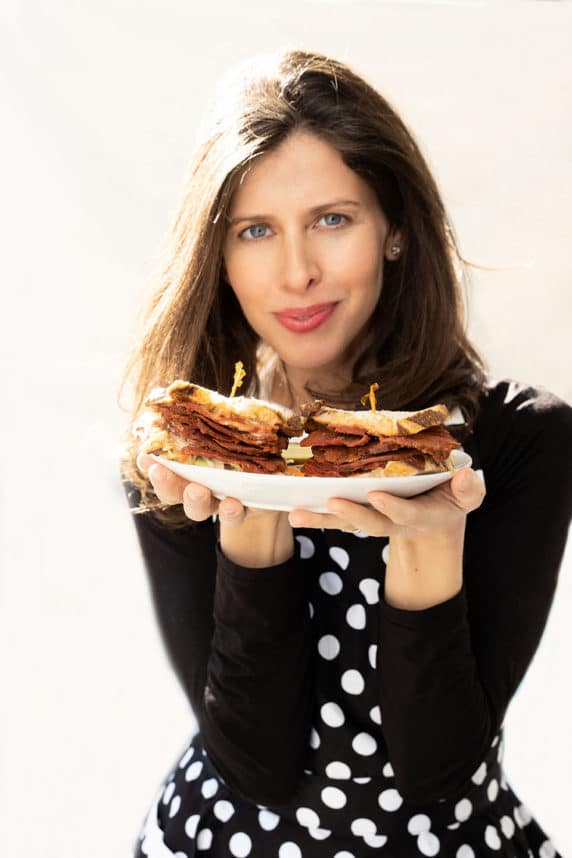
When Jenny Goldfarb pitched her vegan corned beef on ABC’s reality show “Shark Tank”, her revenues topped only $10,000. This great-granddaughter of New York delicatessen owners nevertheless scored a deal with Mark Cuban, the entrepreneurial owner of the Dallas Mavericks. The billionaire invested $250,000 for a 20 percent stake in Mrs. Goldfarb’s Unreal Deli.
That was back in November 2019. Within six months, Goldfarb’s pushed sales to $300,000 at almost 200 locations, including Veggie Grill, Mendocino Farms and Whole Foods Markets. But in March 2020, with the onslaught of Covid-19, Goldfarb’s momentum hit the skids. Her father, part of her management team, contracted the virus, surviving 28 days on a ventilator. Miraculously, two months after a plasma donation, he finally left the hospital to recover at home.
Meanwhile, Goldfarb created a parallel recovery plan, following Cuban’s advice to focus on retail. As Beyond Meat and Impossible Burger have been gaining traction, Unreal, too, has expanded. Goldfarb’s roster now counts 300 grocery stores with another 300 retail locations in the works, including Ralphs, H-E-B, Giant Food Stores, New York’s Wegmans and Canada’s Loblaw chain.
“Unreal has a chance to be the leading provider of plant-based deli counter meats in the country,” Goldfarb’s Shark investor, Mark Cuban, told the Journal. “Every great company starts with a great entrepreneur, but needs great products to really grow into a powerhouse. Unreal has both.”
A married mother of three girls ages 18 months to eight years, Goldfarb’s transition from home cook to entrepreneur dates to 2015 when she started limiting her meat intake. Still, she craved corned beef. The classic fare was not only a mainstay of her diet. It was a way of life. “I was born in New York and knew my way around the Jewish deli: pastrami, corned beef, fresh rye, spicy mustard, Dr. Brown’s, sour pickles. That’s home to me,” Goldfarb says. “When I became vegan, I missed classic Jewish deli, so I sought to recreate it.”
“When I became vegan, I missed classic Jewish deli, so I sought to recreate it.”
— Jenny Goldfarb
After landing accounts at Canter’s Deli and elsewhere, Goldfarb marketed her moxie on primetime. In the year since her winning “Shark Tank” segment aired, her certified kosher faux meats have achieved unreal corona-era success. In addition to a nationwide entry into another 1,000 grocery stores this winter, Goldfarb plans for “ghost kitchens” serving vegan “Unreal Subs” at five Quiznos LA locations and other deals are ahead. To learn more about Goldfarb’s recipe for success, and what Cuban estimates as $50 million potential in an “exploding marketplace,” the Jewish Journal invited Goldfarb for a shmooze.
Jewish Journal: How has your life changed since “Shark Tank”?
Jenny Goldfarb: I’m literally living my dreams running this business. I love the products we make, our small but mighty team and introducing Jewish deli to my vegan compadres and vegan food to my Jewish people.
JJ: What is your secret sauce to making UnReal a real success?
JG: Literally “mazal,” symbolized by the acrostic Makom, Zman and La’asot [Hebrew for place, time and effort]… doing the work, loving the work, wanting to help the world, having the chutzpah to call up the CEOs of the biggest establishments, being good for animals, earth and health and being mouthwateringly delicious…
Shabbat is also part of the equation. Hustling hard for six days and then taking a step away creates a beautiful harmony.
JJ: How did you, your children and your husband transition to a plant-based diet and how has it impacted you?
JG: I ate meat my whole life, and for the last 10 years, only kosher meat. I started learning what happens to animals on “happy” farms, kosher farms, grass fed farms… It was totally heartbreaking and completely unacceptable. I became vegan “for the animals” about six years ago.
I later learned how beneficial this diet would also be for my children, our immunity, vitality, etcetera… Before going vegan, they might get sick like once every five to seven weeks. Now, it could be eight months in between a cold and less severe—no longer requiring trips to the doctor and antibiotics. I am also much more equipped to fight inflammation, common colds, even serious viruses with a diet devoid of fatty animal products and heavy in vitamins, fiber and healthy fats!
My husband was very “meat and potatoes” when I met him. He thought I was taking the family on a hippie crusade when I started introducing vegan fare. But when he tried my corned beef, I knew I could convert him.
JJ: What motivated you to launch commercially?
JG: Enough friends and family telling me how delicious my corned beef finally prompted me to email some friends asking if they knew anyone in the food world.
JJ: How is your father managing?
JG: Dad is doing so well now. We came so close to losing him… Many times, doctors told our family he wouldn’t make it. It is a total miracle we have him back. He is involved in the daily operations… our COO/CFO and sounding board.
JJ: How did the pandemic impact your business?
JG: We were [prospering] in food service in the first quarter of 2020, selling to delis, restaurants, stadiums, movie studios, getting loads of press when Covid hit. Sales started flat-lining in April and May… We kept busy in R&D to come up with Unreal Roasted Turk’y. We’ve got our third meat coming soon, Unreal Roast Beef. Like very fine lean steak slices with a char-broiled exterior. Extremely meaty!
JJ: What kind of in-roads have you made?
JG: We’re at many individual delis across America. One notable is Sarge’s Deli on 3rd Avenue in New York City. Other venues include Quiznos in Seattle and Denver. Several universities will be serving Unreal when they reopen. So will the arenas for the Dallas Mavericks, Golden State Warriors and New York City Tennis League.
Martin Luther King, Jr. once said that “A riot is the language of the unheard.”
Let me be clear: I have no sympathy for those who stormed the U.S. Capitol on January 6 — another day that should live in infamy. The rioters not only destroyed property and threatened the symbolic and structural center of our democracy, but evidence shows that at least some of them were intent not only on vandalism and destruction but on kidnapping and assassination. They deserve the harshest punishment that our criminal justice system can muster for seditionists, insurrectionists and traitors. And make no mistake: Donald Trump should be convicted by the U.S. Senate and forbidden from ever holding elective office again.
But let’s draw a line between those misguided souls who attended Trump’s rally on the morning of the 6th and then went home peacefully, and those malicious zealots who then went on to tear apart the Capitol, murder at least one police officer and threaten the lives of those working to do the people’s business inside. We need to think about those protestors who had been fooled into believing that Trump had won the election and raised their voices – but not their fists – in support of that delusional goal in an entirely different way than those who turned to violence. Finding a way to talk to those fellow Americans may be the key to moving forward as a diverse but unified nation.
Let’s draw a line between those misguided souls who attended Trump’s rally on the morning of the 6th and then went home peacefully, and those malicious zealots who then went on to tear apart the Capitol.
On September 11, 2001, we learned that the threat of international terrorism was no longer something we could ignore. In addition to necessary security enhancements, we quickly came to understand that not everyone with a similar demographic or ideological profile was intent on causing harm and most of us moved quickly to differentiate the large majorities of Muslims who shared the nation’s goals of life, liberty and the pursuit of happiness from a very small minority with more dangerous aspirations.
Almost twenty years later, we are now beginning to realize something that U.S. intelligence agencies have known for some time that domestic terrorism is now the gravest threat to our safety. While the death toll on 9/11 was obviously much greater, there is a case to be made that the Capitol riots of January 6 will have a similar impact on our collective consciousness as we recalibrate to protect ourselves against this very different type of menace.
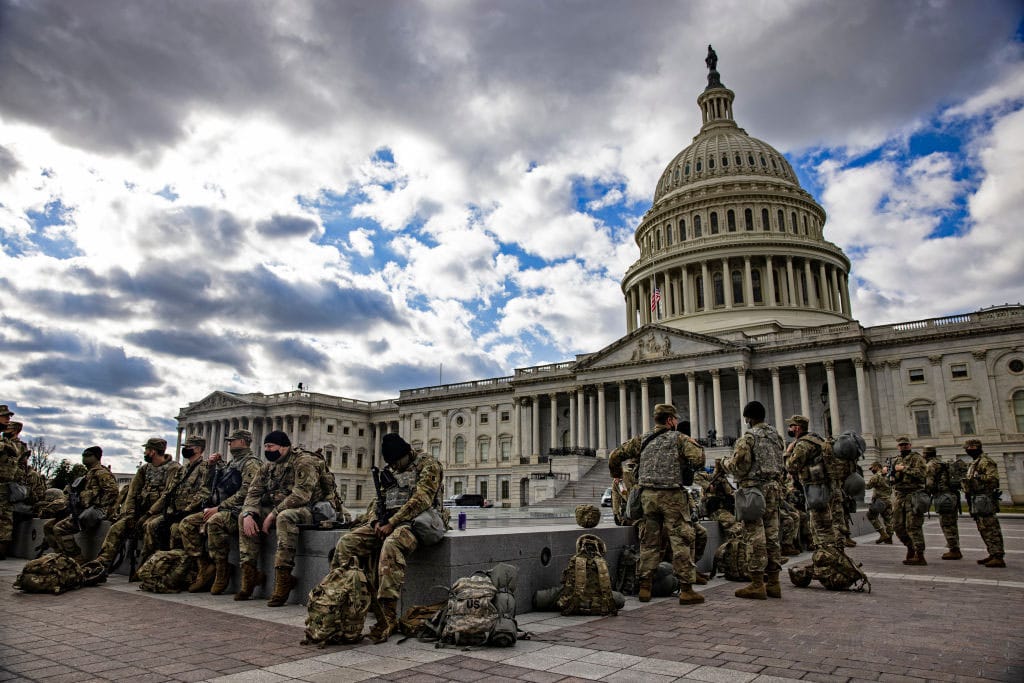
The federal government is already mobilizing against the immediate danger of further violence on and around the day of the new president’s inauguration. More than 25,000 National Guard troops have been deployed to Washington, DC, and scores of other local and state authorities are preparing for potential disruptions at government buildings across the country.
Virginia National Guard soldiers on the east front of the U.S. Capitol on January 17, 2021 in Washington, DC. (Photo by Samuel Corum/Getty Images)
But we learned in 2001 that there is not enough law enforcement or military presence to protect every potential soft target in our communities. Even during the age of social distancing, it’s impossible to provide enough fortification to guarantee security for every shopping mall, sports event or other public gathering place. So as is the case when preparing for foreign intruders, security is only part of the solution when the potential instigators are from the homeland.
We now know that the most important protection against terrorist violence comes not from building walls or fences, but winning hearts and minds. The criminals who defiled the Capitol – like the assassins who flew airplanes into the World Trade Center and the Pentagon — must be penalized to the full extent of the law. But if the key to winning the war against foreign terror is to isolate radical and dangerous fanatics from the broader population, the same approach will be necessary to knit our own country back together. That means separating out the violent hate-mongers bent on destruction and death from those Americans who turned to Donald Trump out of fear rather than cruelty.
Uniting our country will require at least some of the 51 percent of the voters who supported Biden talking to at least some of the 48 percent who were for Trump. If we’re serious about healing, it will require reaching out to those with whom we disagree on public policy but who are willing to settle their arguments with words rather than clubs or guns.
Uniting our country will require at least some of the 51 percent of the voters who supported Biden talking to at least some of the 48 percent who were for Trump.
Some of those policy differences are profound, and many of the conversations about those differences will be exceedingly difficult. But to take Dr. King’s quotation one step further, listening now may be the best way to avoid more rioting in the future.
Dan Schnur teaches political communications at UC Berkeley, USC and Pepperdine. He hosts the weekly webinar “Politics in the Time of Coronavirus” for the Los Angeles World Affairs Council & Town Hall.
In January 1991, when I finished my Israel Defense Forces (IDF) basic training and received my service assignment as a military journalist, my family and friends showered me with sarcasm.
“Thank you so much for coming all the way from America to save us,” deadpanned one of my childhood buddies, an Israeli Air Force fighter pilot. “How did we ever survive without you?” fired another, an IDF Armored Corps major.
At that point, all I could do was smile and half nod, half shrug. My buddies saw my military journalist role as so nonessential that they dubbed me a “chocolate soldier.” It made no difference that my bachelor’s degree and industry experience allowed me to hit the ground running as the IDF Spokesperson’s Unit’s professional first lieutenant. Stationed in the heart of Tel Aviv by IDF Headquarters and lunching in the officers’ dining hall (I recommend the chicken schnitzel and mashed potatoes), I had it ostentatiously easy.
Then everything changed.
In the predawn hours of January 17, my grandfather, whom I stayed with at the time, woke me up and said the unit sent a vehicle to pick me up. The U.S.-led coalition had just launched Operation Desert Storm to push Saddam Hussein’s troops out of Kuwait.
Having slept in my uniform in anticipation of such a development, I jumped out of bed, rushed out and hopped into the vehicle, which sped away as I closed the door. I spent the workday and much of the night conducting research, writing reports and drawing up communication plans. We received briefings, facilitated media requests and contemplated various scenarios.
After work, at around 11 pm, I joined one of my buddies at our favorite bar for a couple of Goldstars. A usually packed hole-in-the-wall, Zig Zag stood eerily empty. As De La Soul and Leonard Cohen were piped in through the wall speakers, we placed bets on Operation Desert Storm’s length and reach. I wagered the Americans would complete their mission in a month and “say no go” to invading Iraq. My friend predicted two weeks and said, “first they’ll take Kuwait, then they’ll take Baghdad.”
A couple of hours later, I arrived home and turned on the radio, only to hear the code words “nachash tzefa” (viper). Knowing what this message signified, I woke up my grandparents and led them into the “sealed room,” which we had prepared by covering its windows with plastic sheets and filling its closet with food, water and other supplies, such as a first-aid kit. Shutting the door behind us, I taped a loose sheet over it. I helped my grandparents put on their gas masks and strapped on mine.
The whole time, my commander, Brig. Gen. Nachman Shai, guided and informed us through the airwaves. The Iraqis, Shai said, fired Scuds at greater Tel Aviv and Haifa. He ordered us to stay in the “safe rooms” until the IDF could determine if any of the Russian-made missiles carried chemical or biological warheads. He spoke in a cool, clear voice. He was authoritative yet warm, informative yet honest about knowledge gaps, factual yet folksy. He urged us to remain calm and breathe steadily.
Shai unsealed the rooms, so to speak, after an hour, informing us that none of the eight Scuds that struck Israel were packed with chemical or biological agents. He encouraged us to drink water. Although this attack caused little damage — destroying several buildings but only slightly injuring seven people — it stressed everyone out, increasing the country’s mortality rate by 58 percent that day, according to a 1995 study published in the Journal of the American Medical Association.
Thirty hours later, Hussein fired a couple more Scuds at Israel. This time, I was on duty, helping provide the information my commander needed to instruct the nation. The mortality rate, according to the 1995 study, returned to pre-Desert Storm levels and stayed there through the war’s final five weeks. I believe several factors contributed to that, including humanity’s natural agility and resiliency, but I have no doubt that Shai’s comforting guidance helped.
By the time the first Iraq War concluded on February 28, 1991, Iraq had launched more than 40 Scuds at Israel. They all carried conventional warheads, killed two people, and indirectly caused four fatal heart attacks and seven asphyxiations. They also injured more than 200 people and destroyed thousands of buildings. The “Butcher of Bagdad” attacked Israel to try to break up America’s 35-country coalition, which included several sworn enemies of the Jewish state. He knew that an IDF retaliation would force Syria, Saudi Arabia and others out of the coalition.
But Israel resisted the bait, heeding the United States’ request to remain on the sidelines. The IDF officially activated only two units: the one tasked with checking the Scuds for chemical or biological agents and the spokesperson’s. I went from chocolate soldier to essential officer. In the process, I picked up a few life lessons.
I went from chocolate soldier to essential officer.
Now, as I reflect on the 30-year anniversary of the Scud attacks, I sense that some of those lessons could apply to the current crisis ravaging the United States — the coronavirus pandemic. I propose that America:
Appoint someone like Nachman Shai as the national COVID-19 spokesperson. We need someone who’s authoritative yet warm, informative yet honest about knowledge gaps, and factual yet folksy to provide daily public updates. With all due respect to Dr. Anthony Fauci and New York Governor Andrew Cuomo, we should avoid picking a doctor or a politician, who would always be suspect to partisan segments of the country. Instead, we should turn to a bipartisan, respected, professional communicator who can synthesize relevant, complex, ever-changing info and guidelines in real time. This would simplify and amplify the messages that we should all be hearing and heeding.
Operate off facts. During the first Iraq War, Israelis disagreed on many issues, such as whether to strike back, but they rarely, if ever, disputed the cold, hard truth. No one labeled the Scud reports “fake news.” Silicon Valley and other parts of the private sector should create a program to award grants to independent, neutral news operations around the county and to nonprofit, nonpartisan fact-checking and fact-generating efforts. A consistent stream of reliable, accurate information through popular channels such as websites, the airwaves and, yes, even social media is crucial to combatting COVID-19.
Have the U.S. military or major companies provide meaningful assistance to the government. The IDF has helped the Jewish state manage COVID-19 from the start, and the county has already vaccinated more than 20% of its population — the fastest pace on the planet. Since the pandemic hit, the Israeli military’s Alon Coronavirus Task Force has conducted tens of thousands of daily tests and contact-traced thousands of people on a weekly basis. It recently assigned 700 reserve paramedics to boost the inoculation effort. Let’s task America’s soldiers with distributing and helping to administer the vaccines and supporting the maxed-out health care system. The governors of California, Oregon and Arkansas have already activated some of their National Guard troops. We should also tap the innovative and logistical prowess of companies such as Amazon and Honeywell, the latter of which has stepped up to assist North Carolina vaccinate its residents.
Revise best practices based on the latest research. Thirty years ago, upon hearing the “viper” alarm, Israelis should have sprinted to bomb shelters instead of sealed rooms. In the United States, we should have been wearing masks when the crisis started. It’s not too late to make this and future adjustments as we learn more and more about COVID-19. We should express gratitude, not frustration, that almost every day we hear something new about this pesky virus.
Formulate and implement a multidisciplinary medical effort to research and address COVID-19’s long-term effects. The virus’ elevation of our overall mortality rate may last decades, according to Duke, Harvard and Johns Hopkins researchers. In the next 15 years, they foresee a 3% increase in diseases such as hypertension, causing the death of 890,000 Americans. The multidisciplinary effort should aim to reduce the virus’ collateral damage by preventing and treating the expected health fallout.
During the first Iraq War, I learned that, if given the opportunity, almost every soldier (i.e., worker) can become essential. Let’s keep this in mind as we enter the next, crucial stage of our COVID-19 response. We all can do our part to save lives.
An award-winning nonfiction storyteller, Boaz Dvir is the author of “Saving Israel: The Unknown Story of Smuggling Weapons and Winning a Nation’s Independence” (Rowman & Littlefield, 2020) and an assistant professor of journalism at Penn State University.