fbpx

January 17, 2021

Martin Luther King Jr.’s Legacy Alive in Israel

The Media Line — On Monday, the US marks Reverend Dr. Martin Luther King Jr.’s birthday with a national holiday. Celebrated this year on January 18, the event comes less than two weeks after historic violence on Capitol Hill, the symbol of American democracy.

King was only 39 years old in 1968 when an assassin’s bullet ended his life in Memphis, Tennessee, but his legacy as a proponent of nonviolent conflict resolution lives on.

This year, though, a different spirit – one directly affected by the attack on the home of the US legislative bodies – adds a variant to King’s heritage.

“I have also been thinking a lot this past week about Rev. Martin Luther King’s famous ‘I Have a Dream’ speech in Washington, DC, at the [National] Mall, in front of hundreds of thousands of Americans in August 1963, in which he envisioned freedom for all Americans and called for an end to racism,” Rabbi Ron Kronish, the founding director of the Interreligious Coordinating Council in Israel, told The Media Line.

“How relevant this is today when racism is once again tearing America apart, as we witnessed so dramatically during the insurrection incited by US President Donald Trump last week on January 6, at the same place, in America’s capital city,” stated Kronish.

What are the ramifications of these events for Israel and the Middle East?

Davka (despite expectations to the contrary) when America is having problems, we need to look back not only to King’s words but also to his actions, according to Rabbi Dr. Daniel Roth, director of the Mosaica Center’s Religious Peace Initiative, a program that seeks to use the language of religion and tradition to build trust with people whose political motivation is religious and find a way out of the Israeli-Palestinian conflict.

“How do we move forward?” Roth asks.

“The big question is, can we still use him as a beacon of social justice and democracy? How to connect to his work? He created inspirational social change via the system and now it looks like the system is kind of broken,” Roth told The Media Line, reflecting on the violent assault on the US Capitol by right-wing American elements.

Echoing this is Rabbi Dr. Meesh Hammer-Kossoy, director of the social justice track at the Pardes Institute of Jewish Studies in Jerusalem.

“What is happening in the US today sends waves across the entire world and could easily happen here in Israel tomorrow. Hopefully, this tragic event sounds a major shofar blast for all of us to recommit ourselves to shared civil discourse and mutual respect,” she stated to The Media Line.

Roth pointed to the Islamic Movement in Israel as a model for reflecting on King’s legacy.

The Islamic Movement, founded in 1971 by Sheikh Abdullah Nimar Darwish, focused on providing services to Muslim communities around Israel. He also founded Usrat al-Jihad (“The Family of Jihad”), a paramilitary group dedicated to creating an Islamic state.

In 1979, following a terrorist attack in central Israel by the latter group’s adherents, Sheikh Abdullah and dozens of the movement’s leaders were arrested.

While in prison, the sheikh and his associates decided to work within the Israeli system. After release, they sought to run for positions in local councils and in the Knesset, Israel’s parliament. At this point, notes Roth, the movement split into two major sections: a more moderate Southern Branch, based in Kafr Qasim and led by Abdullah, and a more strident Northern Branch, based in Umm el-Fahm.

This split, he said, was akin to the schism in Black American leadership in the late 1960s between Malcolm X and Martin Luther King Jr. over the best methodology to move forward. The central gulf between the two sides was whether to take an antagonistic, self-sufficient path or to work within the system.

Both sides believed theirs to be the best way to achieve results for the community.

Whereas the Southern Branch works nonviolently, the Northern Branch is far more militant, having been banned by Israeli authorities in 2015 and having its leadership, primarily Sheikh Raed Salah, arrested and jailed numerous times over accusations of incitement to violence and funding the Hamas terrorist group.

Sheikh Abdullah co-founded the Religious Peace Initiative in 2005 with former Israeli Minister of Social and Diaspora Affairs Rabbi Michael Melchior and Sheikh Imad Faluji.

Sheikh Eyad Amer, imam of the Al Shohada Mosque and principal of a high school in Kafr Qasim, was mentored by Sheikh Abdullah and is now director of the Religious Peace Initiative’s Sheikhs as Mediators Program.

Abdullah’s sojourn in prison afforded him time to think more deeply and changed him, according to Amer.

“He left the world of jihad to join the world of peace. He asked all his followers to understand that death from jihad was only a moment in time. But Allah expects us to live for him. Death is but for a moment, but life is longer so live for Allah,” Amer told The Media Line.

King influenced Darwish and thus Amer.

“He [Darwish] quoted King about living life rather than moving toward violence. In his life, he prevented a great deal of violence – between Arabs and Jews, Arabs and Arabs, Fatah and Hamas. He condemned all terror and because he was a man of Allah, people listened to him,” said Amer.

Sheikh Darwish died in 2017.

Despite the recent events at the US Capitol, no one is giving up on the underlying messages generated and amplified by Dr. King.

Fr. John M. Paul, SJ, the new rector of the Tantur Ecumenical Institute in Jerusalem, noted that many places in the world celebrate the life of Martin Luther King Jr., telling The Media Line, “He pursued justice and equal rights for all with a commitment to do so nonviolently and without hatred.”

For Paul, the following King quote captures part of his mission at Tantur, which creates programming to introduce people to the geography, history and complex religious life of the local people and the Bible.

“People fail to get along because they fear each other. They fear each other because they don’t know each other; they don’t know each other because they have not communicated with each other,” King said.

Paul said, “We seek to live out that desire to dialogue and get to know each other in all that we are about here, especially through our programs and our work with each other.”

For Prof. Muhammed Dajani, director of the Wasatia Academic Institute in Jerusalem, the message from America is loud and clear: Democracy is not dead. The solution to its ills does not lie in laws and legal wrangling; rather, education is the key to the future.

Stressing the need to educate for democracy, Dajani brought the story of Socrates’ death and its aftermath. He told The Media Line that following the great philosopher’s death forced by the leadership of Athens, his disciple Plato did not go around denouncing democracy; rather he started educating for a better democracy.

“We need to stress the need for democracy and education. In the early part of the last century, the famous educator John Dewey wrote about educating the young in democratic values, those that would stay with them for life. We need to focus on our children and cannot take their support for democracy for granted,” Dajani argued.

“We need to continue this mission and promote education. We need to rejuvenate democracy in the minds of our children,” he said.

David Blumenfeld, an independent filmmaker currently in Jerusalem whose short film The Legacy of Martin Luther King, Jr. was released in 2020, called the minister’s legacy “riveting.”

King means so many different things for so many communities. For Ethiopian Jews, he is the force for keeping protests nonviolent; for a Palestinian rapper he is the inspiration for words that make a difference; and for bereaved families on both sides of the Palestinian-Israeli conflict, his is the presence that enables them to meet each other with fortitude and quietness, the filmmaker said.

“Just talking and meeting is what it is all about. It is the first step toward a better future,” Blumenfeld told The Media Line.

Martin Luther King Jr.’s Legacy Alive in Israel Read More »

Shira Haas & Israeli Filmmakers Appear at Virtual Film Festival

“Shtisel” and “Unorthodox” star Shira Haas discussed her latest film, the Ophir-winning (and potentially Oscar-nominated) drama “Asia” at the InFocus: Israeli Cinema film festival, appearing virtually via Zoom at a panel that also featured writer-producer Ron Leshem (“Valley of Tears,” “No Man’s Land,” “Euphoria”) and producer Alon Aranya (“Tehran,” “Your Honor”).

Presented by New Filmmakers Los Angeles and the Academy of Motion Picture Arts and Sciences in partnership with the Consulate Generals of Israel in Los Angeles and New York, the virtual festival also featured a program of five award-winning Israeli short films and a panel discussion with their directors.

Haas, who won of the nine Ophirs awarded to “Asia,” a heart-wrenching drama about a Russian immigrant mother and her ailing daughter, talked about her skyrocketing career and most memorable roles.

“I was a very shy child. I never thought I’d be an actress. I thought I’d be a writer or graphic designer, not the center of attention,” she said. “‘Princess’ was my first project. I was 16½. I fell in love with acting in this movie. It got into the Sundance Film Festival and I got representation, and then ‘The Zookeeper’s Wife’ happened. That was my first interaction with a global audience, it opened the door for me to continue telling stories and playing complex and interesting characters.”

Haas recalled reading “Shtisel” for the first time. “I come from a secular background and thought, ‘How can I relate to that?’ But reading it opened my mind to telling this story and to this world. It made me see the bigger picture and have more empathy.” She also shared her challenging experiences making “Unorthodox,” which earned her an Emmy nomination last year.

“The head-shaving scene was very challenging but also very empowering. It was on the first shooting day. I had such long hair then. One heck of a welcome,” she recalled but Esty’s audition scene was even more daunting. “It’s such an important scene and a very symbolic one,” she said. “It’s a story about a woman who’s finding her voice, and in that scene, she’s literally finding it. It was [filmed] live and there were a lot of people and cameras. I was really nervous about singing in front of everyone and messing up. I felt a lot of responsibility to do it right.”

When it comes to choosing projects, “It was always important for me to do roles that were different from one another, like ‘Asia’ and ‘Unorthodox’ are—different languages, different everything,” Haas noted. “For me, acting is not only the result, but the process, the research. That’s what I’m looking for in a project, and different stories and collaborating with directors and creators that inspire me.”

On the subject of the success of film and TV shows from Israel on the global market, Haas, remarked, “I think people in America are tired of only seeing people like themselves and want to see something different but still be able to relate to it. I think people are way more open to it and looking to see that kind of material from amazing creators, writers and directors.”

Leshem opined that in Israel, “We take risks, maybe because of the urgency of life. We’re good at collaborating, working together. We think outside the box.” Aranya, whose spy series Tehran” is a big hit for Apple TV+ and English-language remake of his drama “Your Honor” is now airing on Showtime, pointed out, “Success on global television can come from anywhere today if it’s done right.”

The shorts program featured screenings and conversation with the filmmakers behind “Birth Right,” about a Russian girl pondering her future on a Birthright trip to Israel; “White Eye,” in which a bicycle theft prompts a crisis of conscience; “Image of Victory,” a documentary about a wounded IDF soldier’s recovery from an injury sustained in the 2014 offensive in Gaza;

“Anna,” about a lonely older Ukrainian woman with dwindling romantic prospects; and “Touch,” a very different kind of teenage romance: it’s totally silent. The dialog is entirely in the form of text messages.

“I’ve always wanted to do a rom-com but I knew it had to be weird and kind of grotesque for me to enjoy making it,” said Nir Berger, “Touch’s” director, and recent Ophir winner for “Here We Are.” “I have this fascination with digital communication, which I find so sad and so hilarious at the same time. It was terrifying to shoot a film with no dialogue. We had to make up a lot of ways to deal with that. I love the idea that the way in which the medium in which you communicate confines and creates this lovely irony.”

His teenage protagonist alternates between trolling, catfishing and obsessing over a boy. “I wanted it to be cringeworthy in the way you see this teen writing the most horrible things to people. You want her to stop and be better than that,” he said. “That was the experience we were trying to create with the film.”

In “Birth Right,” Inbar Horesh wanted to evoke the feeling of alienation that being between two cultures can produce. “I was interested in breaking this image of what it means to be an Israeli,” she said. “In telling these characters’ stories I wanted to show that not everyone fits in completely. The group looks very united from the outside but when you focus on each one of them you see that they don’t quite belong completely. Maybe this united community that we’re trying to create in Israel is only in our minds and doesn’t really exist.”

For “Image of Victory” director Adi Mishnayot, the film was “a very personal experience”—it documents the long recovery of her brother, Uri, after he was injured in battle in July 2014. “All Israelis have this fear of someone close to them being injured or worse. You constantly see on the news representation of what that is. When it happened, it was overwhelming and my first instinct was to start filming everything, but I didn’t touch the material until a year after, when I realized this was my story to tell,” she said.

A steady stream of dignitaries and celebrities visit Uri in the hospital including model Bar Rafaeli, part of the IDF’s publicity machine. “They are recruited to keep the positive view of the army going, [which is necessary] in order for the system to work. It’s idealized into this very positive thing when in reality it’s constant war,” Mishnayot said. “This film is not about Uri’s recovery process but what it means to be an Israeli hero,” she continued, noting that Uri is now a student and doing well. “People that fought in earlier wars tell me they identify so much with Uri’s experience.”

“White Eye” filmmaker Tomer Shushan revealed that the story, about a man whose efforts to retrieve his stolen bicycle causes him to lose sight of his humanity, was based on an incident in his life. “My instincts were to get my property, and I couldn’t see this person in front of me. It happened so fast that I didn’t have the time to think or breathe or understand if what I’m doing was right or wrong. In the end, it doesn’t matter what happens with the bike. The harm has already been done.”

Dekel Berenson’s film “Anna” was inspired by a trip to Ukraine, where one of his grandparents was born. “I got to know the country and that’s how I learned about these parties” where American men seek brides,” he said, but he didn’t speak the language and had a translator in order to work with the local cast and crew. His next project is “Aliya,” about a young Ukrainian woman who discovers she’s Jewish, moves to Israel and joins the IDF, but a violent off-base assault causes her to reevaluate her choices, values and beliefs.

The short films are currently playing the festival circuit and

“Asia” will be released theatrically this year.

Shira Haas & Israeli Filmmakers Appear at Virtual Film Festival Read More »

Biden’s Israel-Palestine Policy: The Devil is in the Details

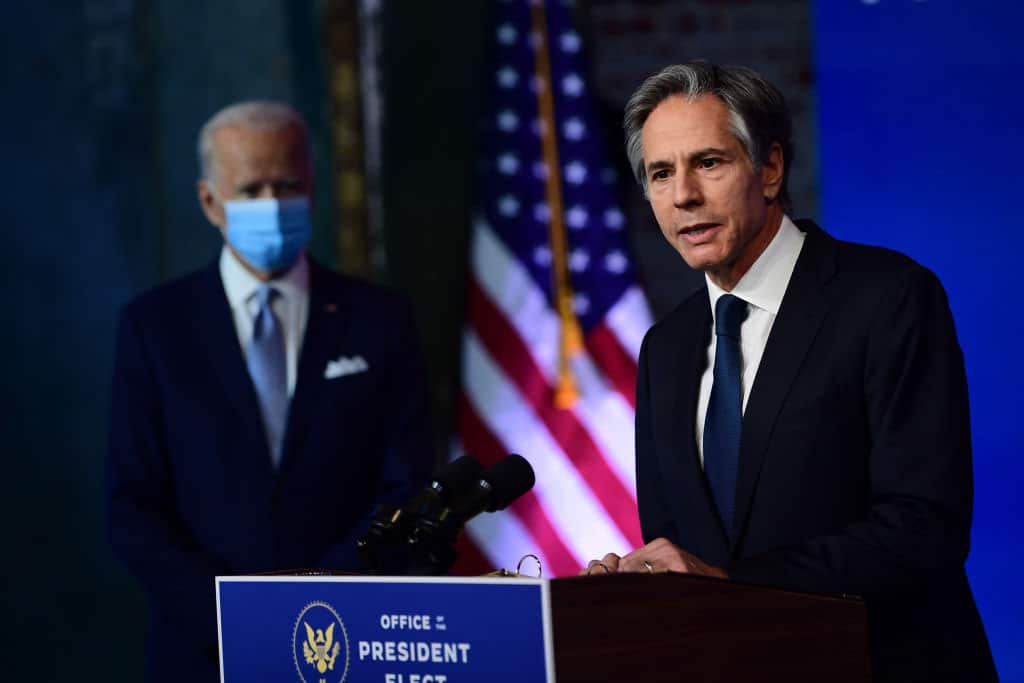
The new administration under President-elect Joe Biden and his Secretary of State, Tony Blinken, will be required to appoint a new ambassador to Israel during their first term in office. They will therefore need to revisit quickly some of the working assumptions of U.S. policies vis-à-vis Israel and the Palestinians, in light of the dramatic changes initiated under the Trump administration.

The diplomatic agenda of the new administration will be driven by the vision of a permanent settlement based on the model of a two-state solution. Yet, Biden and Blinken may soon realize that a return to the Obama strategic framework will lead to a dead end. The Obama administration’s diplomatic agenda adopted the “package approach” to the Israeli-Palestinian conflict, namely, the pursuit of one comprehensive agreement between Israel and the Palestinians, which settles all historical issues and defines Israeli-Palestinian relations in a permanent status. This approach had virtually no chance of success. It will fail again if put forth, due to the Palestinians’ internal political crisis and the internal disagreements in Israel regarding the permanent status, as well as the significant gaps between Israelis and Palestinians concerning numerous issues, such as the status of refugees and Hamas’ ongoing control of the Gaza Strip.

Biden and Blinken may soon realize that a return to the Obama strategic framework will lead to a dead end.

A seemingly inevitable and realistic conclusion will focus on the need to support Palestinian statehood in the West Bank, as well as improve Palestinian quality of life through economic and humanitarian assistance, while bypassing several “unresolvable” historical issues, first and foremost the status of Palestinian refugees.  This conclusion was one of the main reasons that brought the United Arab Emirates, Bahrain, Sudan and Morocco, to normalize their relations with Israel before a permanent settlement of the Israeli-Palestinian conflict is reached.

The new administration is expected to adopt policies on a number of issues opposite to Trump’s approach, including reversing Trump’s decisions to close the Palestinian office in Washington and the American consulate for the Palestinians, as well as to renew humanitarian aid. If the new administration will indeed adopt the aforementioned working assumptions – embracing a two-state vision, while focusing on Palestinian state-building – these seemingly technical matters could have significant implications on America’s ability to promote an effective policy.

President Trump moved the American embassy to Jerusalem, and ended the unacceptable reality to most Israelis that Israel’s closest ally would not accord full diplomatic recognition to Israel’s capital. At the same time, perhaps unwittingly, Trump has changed the mandate of the US Embassy in Jerusalem to de-facto reflect the notion of a ‘One-State Solution’. This is because the US Consulate in Jerusalem, which used to be designated to the Palestinian Authority, was downgraded into ‘The Palestinian Affairs Unit’ in the Embassy to Israel. Namely, the US diplomatic mission in Israel currently expresses the viewpoint that Israel and the PA are one, unified political unit. Clearly, this structure is at odds with the new administration’s agenda driven by a vision of a two-state solution.

The Palestinian diplomatic mission in Washington will likely also be reopened by the new administration. Biden and Blinken should take the opportunity to grant the keys of this office to the Palestinian Authority, and not the PLO, as was the case when it was closed by Trump. The Palestinian Authority was established by agreements signed between Israel and the PLO, and was intended to represent the Palestinian residents of the West Bank and Gaza Strip during an interim period that was supposed to end more than a decade ago. Allowing the Palestinian Authority to run the Washington office will reflect that it is the platform for Palestinian statehood and represents the residents of the West Bank and Gaza, while the PLO is the platform for the entire Palestinian people, including Palestinian refugees and citizens of other countries throughout the Middle East.  The distinction between the PLO and PA has practical, symbolic, and legal meanings, which may constitute the difference between the likely continuation of the political gridlock and the possibility of reaching at least an interim or partial agreement that focuses on Palestinian statehood.

The Palestinian diplomatic mission in Washington will likely also be reopened by the new administration. Biden and Blinken should take the opportunity to grant the keys of this office to the Palestinian Authority, and not the PLO, as was the case when it was closed by Trump.

It is likely that the new administration will renew the financial support for UNRWA, the UN agency that is supposed to support Palestinian refugees, after the Trump administration ceased supporting it financially. However, the renewal of aid to UNWRA will be a major step backwards in efforts to resolve the refugee issue. In addition to the humanitarian assistance that the agency provides, it also assumes responsibility for dealing with Palestinian refugees in Jordan, Lebanon, and Syria, as well as those under the PA’s authority. The agency preserves the unique status of refugees even after the first generation, a unique phenomenon in international law. Moreover, UNWRA’s textbooks demonstrate incitement against Israel and even include anti-Semitic content. Instead, the US should consider funneling its resources into a comprehensive plan for the gradual and orderly transfer of power from the UNWRA to the PA, towards the end of its presence in the West Bank and Gaza. This step could be accompanied by an economic development program to improve the quality of life under the PA’s authority and by calling on host countries to grant citizenship to Palestinian refugees.

It seems that the Biden administration’s willingness to be involved in the Middle East and the Israel-Palestinian conflict will be limited in light of America’s domestic struggles with COVID-19 and its economic repercussions. However, crucial decisions will be required early on regarding these aforementioned issues, and the administration must be prepared for them.


Eran Shayshon is CEO of the Reut Group

Biden’s Israel-Palestine Policy: The Devil is in the Details Read More »

Celebrating Quitters Day

Happy Quitters Day! Today is January 17, the day most Americans will quit their resolutions — and I’m really excited about it. Not because I hate quitting (I don’t), but because I hate resolutions. Let me introduce you to somebody in my life who is anything but a quitter — to tell you why.

That person is my husband, Benjy. Back in January 2020, it felt like my heart was exploding when I watched him give a guest lecture at UCLA’s Anderson School of Management. For a kid who grew up just a few miles away from Anderson with a coding and sequencing learning disability, it was extraordinary to watch him address a group of Masters in Business Analytics students at this top-20 business school.

Playing it cool, I sat in the back row with a poker face and a notebook (taking notes he’d later ask me for, as I predicted — even though he had told me he absolutely wasn’t going to ask). When the room clapped at the end of his lecture and the line formed around him, I teared up a little: It was just amazing to watch knowing what he had overcome.

Who would think that a kid who couldn’t even write a single sentence in the third grade could grow up to write in English, Hebrew and Arabic? Let alone code in three computer languages?

This isn’t a fairy tale story about his resilience in overcoming his obstacles. It’s more about the fact that his story doesn’t have a fairy tale ending. Yes, his accomplishments are remarkable, but the effects of his learning disability linger: He is still a horrible speller and long-form proofreader, even when using spell-check. He will tell you himself that he can build you an analytics dashboard, but he is incapable of spelling the word “broccoli” correctly.

In fact, according to Benjy, part of the reason he has excelled at coding is because, unlike checking for spelling in a long-form document, when you get something wrong while coding, you literally can’t miss it because “the whole product is just broken.”

At his old jobs at places like large consulting and tech firms or government agencies, attention to detail mattered, but his proof-reading abilities never mattered too much. Teams were big, so there were always lots of eyes on everything. One of the things that attracted him to starting as the first hire at a start-up this past February was how small and senior the team would be. So when his boss asked him to proofread a slide deck they had all been working on and Benjy gave the thumbs up, his boss was reasonably miffed that there were a few errors he had missed.

Nobody likes to mess up at work, especially when you’re still relatively new. In fact, if you’re like any of the high-potential and high-performing people I work with, a mistake can easily be confused for failure, and failure can quickly feel existential.

a mistake can easily be confused for failure, and failure can quickly feel existential.

Odds are that, like Benjy, you are good at 99% of the things you do at work. The truth is that we’re all bad at something in our job. That exact something that you might be tempted to make your New Year’s resolution, and that same something you are probably quitting by today. This is the year, you swore, you’d be more organized or manage your time better.

So, as you quit your resolution, take a page from Benjy’s book. Instead of convincing himself and others that he’d fix that bad habit of missing typos, he simply owned it: “I just explained to him that this is something I’m terrible at because of my coding and sequencing issues, so I should still play a role in building the deck and presenting it to the clients, but I should never be the final set of eyeballs on it.”

His boss’s answer? “No problem.”

That moment of open communication saved Benjy from a series of future bad slide decks and tough conversations. Instead of spending all his energy on remediation, Benjy had pivoted and focused on optimization.

For all the talk about “vulnerability” at work and the millions upon millions of Brené Brown books sold, it’s still really hard to talk about our weaknesses at work. Earlier in our careers, we worry that any admission of weakness might derail the next promotion. Later, in positions of leadership, we worry about how our team will perceive our flaws.

While the rush to remediation can be tempting, it can actually distract us from optimizing our overall performance. To put it like leadership expert Marcus Buckingham, “We live in a remedial world [and] you don’t remediate your way to excellence.” As Buckingham explained in an interview with Adam Grant, “In fact, if you’re not really careful, you get people’s minds thinking much more about failure prevention than about soaring.” As though he had heard Benjy’s very story, Buckingham continued, “no one has ever excelled because they stopped making grammatical errors in their writing.”

So as you quit your resolution, quit the temptation to focus your energy on remediation and focus on doubling down on your strengths. As we celebrate quitters day, let’s celebrate what makes you soar.


Randi Braun is an executive coach, consultant, speaker and the founder of Something Major

Celebrating Quitters Day Read More »