fbpx

December 31, 2020

Final Arrangements – A poem for Torah Portion Vayechi

And Israel said to Joseph, “Behold, I am going to die…
…And I have given you one portion over your brothers…”
Genesis 48:21-22

Someone I know once called to make
funeral arrangements for his mother who
hadn’t died yet.

The doctors made it clear the outcome
was inevitable, but, maybe let the eyes close
one last time before you make the call.

You never know how busy they’re going to be
he told me forecasting a rush of burials
over the weekend.

I suggested it may not be the first time
the funeral home had dealt with people dying
and perhaps one of their prerequisites

may be the deceased be actually dead.
He was kind enough not to say I told you so
when she did pass away and now

she is safely in the ground where
these arrangements are not spoken of.
Who among us, after we get past

the impossibility of our own deaths, hasn’t
already planned our own funeral and screened
landscape architects for our burial spots?

There should be a nice tree, of course,
ideally a view of the city, and, as far as the
ceremony goes, I’ve already pre-recorded

the whole thing. You’ll let me know if they
laugh at the right times, and who feels
bold enough in that space to say

what they really think of me?
Jacob took care of his last needs
to make it easier for Joseph.

Something we’ll all do.
Something that will be done
for all of us.


God Wrestler: a poem for every Torah Portion by Rick LupertLos Angeles poet Rick Lupert created the Poetry Super Highway (an online publication and resource for poets), and hosted the Cobalt Cafe weekly poetry reading for almost 21 years. He’s authored 25 collections of poetry, including “God Wrestler: A Poem for Every Torah Portion“, “I’m a Jew, Are You” (Jewish themed poems) and “Feeding Holy Cats” (Poetry written while a staff member on the first Birthright Israel trip), and most recently “The Tokyo-Van Nuys Express” (Poems written in Japan – Ain’t Got No Press, August 2020) and edited the anthologies “Ekphrastia Gone Wild”, “A Poet’s Haggadah”, and “The Night Goes on All Night.” He writes the daily web comic “Cat and Banana” with fellow Los Angeles poet Brendan Constantine. He’s widely published and reads his poetry wherever they let him.

Final Arrangements – A poem for Torah Portion Vayechi Read More »

How Can We Make Progress After Floyd’s Death?

Since George Floyd’s death, the United States has launched into a national reckoning with race. Combined with other recent deaths of unarmed Black men by police and compounded by the COVID-19 lockdown, Floyd’s death was met with an explosion of emotion that expressed the growing tension between the police and African Americans.

Although Floyd’s death sparked many important discussions on policy and racial progress, some of the protesters channeled their anger into riots. High emotions swayed political discourse from constructive to destructive.

As Americans consider how to move forward as a nation, we must ask how we can use this reckoning to generate real progress in race relations — without letting our emotions destroy the very tools that make some solutions possible.

Releasing Our Emotions

As important and justified as our emotions were in response to Floyd’s death, we must not allow fear, anger and mistrust to drive our policies. Although it is important to acknowledge our emotions and let them inspire us to act, studies have shown that if our emotions are too exacerbated, our autonomic nervous system gets deregulated and part of our brain shuts off, causing us to become polarized and lose our ability to be in control of our actions — all of which affects our thinking process and drives us into impulsive behavior.

We must not allow fear, anger and mistrust to drive our policies.

In a topic as important as racial justice in America, we all need to take time to process and release, allowing our emotions to empower our actions without overriding them. There are many tools that help release emotions, allowing us to discharge the excess but retain their power to drive constructive actions. For example, when you feel overly agitated, tap your knees 25 times and take deep breaths until you feel calmer. You can also pay attention to your feet planted firmly on the ground, imagining you are sending roots into the earth, and then look around you and count 10 different shapes around you, or 10 different textures or 10 objects of the same color. Notice how your breath deepens and you feel more grounded and present, less in your emotions and more in control.

Leaders must have a role in diffusing our emotions, too. Those who validate these strong emotions — but do not decry the destructive actions they sometimes inspire — will unwittingly inflame them instead of calming them. Leaders must call for calm, reflection and assessment for the best interventions. The capacity to demand changes based on thoughtful interventions is what will transform the exposure of the suffering into the steps that will put an end to it.

The media can also play a part in quelling emotions. The media should immediately release all available information, including full videos of events, to prevent misinformation. The media can also de-escalate further unrest by reporting how emotions that fuel destruction can cause not only tremendous economic and psychological damage to allies but also can create backlash that harms the justness of the cause.

But perhaps the biggest change we can make to allow us to seize this opportunity to make progress is to listen to the suffering of some in our communities, speak to our desire to heal it, and choose words that make them feel accepted, honored, loved and cherished. We need to ask these communities what their needs are and how best we can reach out for healing, apology and empathy.

A movement for redress and justice will gain much ascendance if it moves towards recognition and reconciliation, acknowledging all parties involved and requesting the changes needed without ostracizing any element of our society.

The opportunity is here to push racial equality forward and heal the country from its past, hopefully once and for all. For that, we must validate the depth of collective trauma, offer healing, reparative words and actions and make sure that we do not create other collective traumas in the process. By regulating our own emotions and then listening to one another, we can channel our emotions into healing policies. We have an opportunity to make unquestionable and durable change. It must not be missed.


Gina Ross, MFCT, is Founder/President of the International Trauma-Healing Institute USA and (ITI-Israel. Her latest book is “Breaking News! The Media and the Trauma Vortex: Understanding News Reporting, Journalists and Audiences.” You can reach her at Gina@GinaRoss.com

How Can We Make Progress After Floyd’s Death? Read More »

Search for Missing Jewish Man Continues

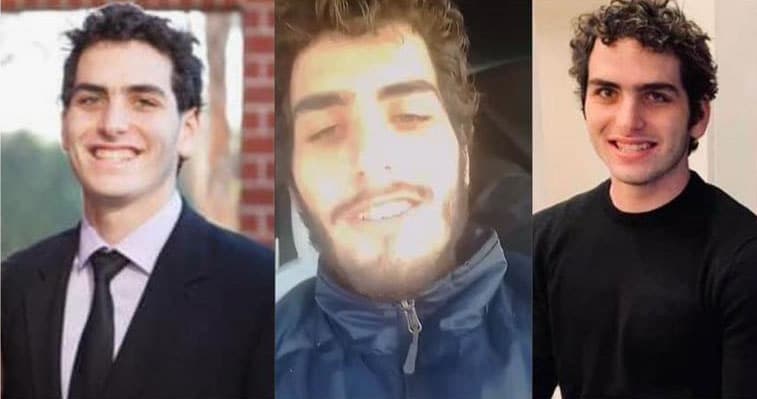
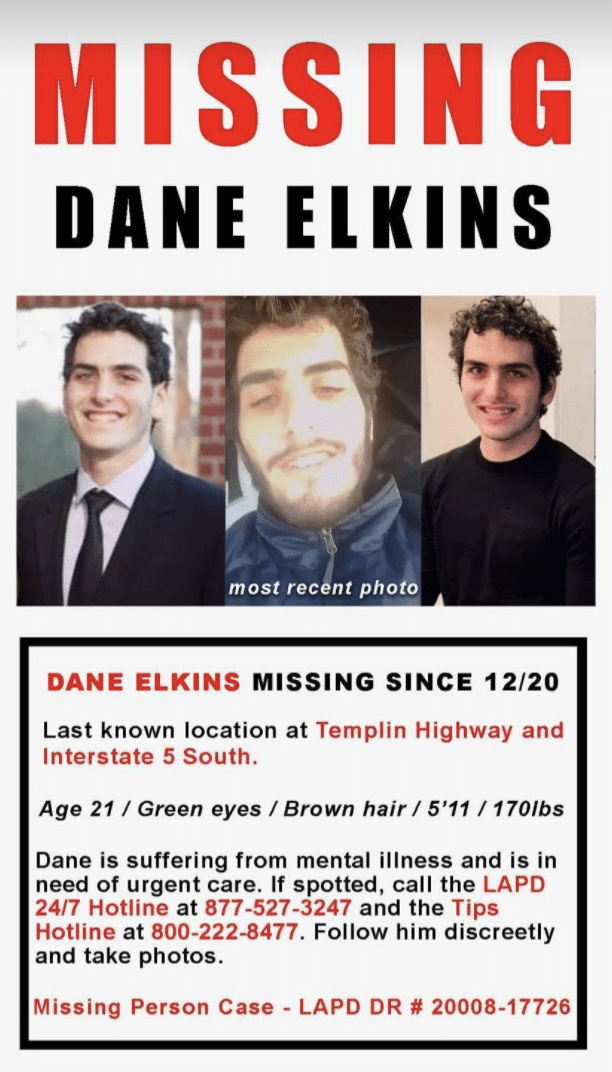
The search for Dane Elkins, a 21-year-old UC Santa Cruz student and champion racquetball player, continues.

According to KTLA, a car belonging to Elkins was found abandoned near the I-5 freeway and Templin Highway in the Castaic area on December 20. His wallet and cell phone were found inside.

Elkins’ mother, Brentwood resident Deborah Elkins, told KTLA that she thought the COVID-19 pandemic and stress from school was causing her son’s mental health to deteriorate.

“It’s every mom’s worst nightmare,” she told KTLA.

The mother told the Journal on Dec. 31 that according to their personal investigator, Elkins “is hiding because he is in a paranoid state” and that he was taking a break from his “hard classes in engineering at Santa Cruz so… he stayed with us for awhile at home” before he went missing. She added that the family has received “an outpouring of concern and everyone is out searching [for him].”

According to VC Reporter, Elkins’ family is urging anyone who sees him not to approach him out of concern that he could be easily spooked and flee. Instead, anyone who sees him should instead cautiously follow him and call the police. A Facebook group has been formed to help find Elkins.

This article was updated on December 31 and January 1.

Search for Missing Jewish Man Continues Read More »

Regaining Our Liberty: Why 2021 Has to Be Better than 2020

I’m a liberty junkie. You can try to persuade me to do anything, even change my life or beliefs. Just don’t force me.

2020 was the year we were forced to change our lives.

It doesn’t matter if we made the best of it and turned lemons into lemonade. What matters is that we had no choice.

And for good reason. A lethal and contagious virus forced our hand. Suddenly, we were no longer free to do stuff we took for granted. We had to get used to wearing masks. We had to restrict our activities and destinations. We had to pay attention!

One of the deepest expressions of liberty is the freedom to not pay attention. You are free to be oblivious to anything and everything. As long as you don’t hurt anyone or break any laws, you can lead your life as you wish, even if it’s a life of self-absorption. That is the contract of a free nation.

I’ve always admired people who could create beautiful lives by being oblivious to the madness of the outside world. If this outside world does not impact them directly, why worry?

Of course, it is virtuous to be engaged with the world, to volunteer and help others, to aspire to altruism. But these are matters of choice. We are free to promote those values and encourage others to pursue them, but in a free society, individual liberty comes first.

What is extraordinary about 2020 is that it made perfect sense to lose many of our liberties. Something more fundamental was at stake—the preservation of human life.

“Live free or die,” the official motto of the state of New Hampshire, may have been an appropriate toast for a general of the American Revolutionary War, but in 2020, a better motto might be, “Live a little less free and live.”

The miraculous arrival of a vaccine at the end of 2020 will save countless lives. We should be deeply grateful for that. But let’s not forget what the vaccine also means. As more and more people get inoculated and lose the fear of getting infected, the vaccine will give us back, slowly and gradually, our liberty.

As more and more people get inoculated and lose the fear of getting infected, the vaccine will give us back, slowly and gradually, our liberty.

If I want to continue to not have guests at our Friday night Shabbat table, it will be my choice. But don’t bet on it.

Happy new year.

Regaining Our Liberty: Why 2021 Has to Be Better than 2020 Read More »

Colorado University Investigating Allegation Student Received Anti-Semitic Note, Rat Poison

The University of Northern Colorado is reportedly investigating an allegation that a student received a note blaming Jews for the COVID-19 pandemic and that the note had rat poison attached to it.

The Greeley Tribune reported that on December 15, an Instagram account called Jewish on Campus – an account that highlights anti-Semitism on college campuses – posted an allegation from an anonymous student stating, “Someone left a note on my door that said, ‘Jews created COVID-19 to subvert the white race.’ This note was covered with stickers of various Jewish caricatures. A bag of rat poison was taped to the bag.”


View this post on Instagram


A post shared by Jewish on Campus (@jewishoncampus)

University Associate Vice President of Student Affairs and Chief Diversity Officer Tobias Guzman responded in the comments section that the university is “very concerned” about the alleged incident and urged the student “to reach out to us so we can do a proper investigation.”

Guzman told the Tribune on December 29 that the student still hasn’t contacted the university over the matter and the Jewish on Campus account hasn’t responded to their inquiries. He acknowledged that it could be tough for the student to come forward because “when marginalized populations are impacted and … if they have this threatening feeling to it, there’s this feeling of being a target and … of ‘I don’t want to disclose who I am because more action can take place.’ But if we want to eradicate, eliminate and destroy these kinds of behaviors, then obviously we need to take the next step.”

Liora Rez, director of the Stop Antisemitism.org watchdog, said in a statement to the Journal, “This is a demonic attempt to physically harm a Jewish student. We hope the individual(s) who are responsible are quickly identified and prosecuted to the fullest extent of the law.”

Guzman also told the Tribune that a swastika was found on a campus bathroom earlier in 2020, and the university was quick to remove the swastika and replace it with a notice stating that such symbols have no place on campus.

“Our goal is to always let the campus know that we denounce these types of actions,” he said.

The Simon Wiesenthal Center listed the pandemic as the worst anti-Semitic incident of 2020, noting that the pandemic has been “weaponized” against Jews and Asians. There have been several examples in 2020 scapegoating Jews for the pandemic.

This is a developing story.

Colorado University Investigating Allegation Student Received Anti-Semitic Note, Rat Poison Read More »

What’s It Like to be Vaccinated?

(JTA) — When Christie Moore rolled up her sleeve to get her COVID-19 vaccine earlier this week, many thoughts went through her mind. Among them: a set of Jewish blessings that rabbis suggested for the occasion.

I knew this because Moore shared the Jewish Telegraphic Agency’s roundup of rabbinic suggested blessings when she tweeted her vaccine selfie. So I reached out to Moore, a medical oncologist in Portland, Oregon, to learn more about her experience getting vaccinated.

We talked about the blessing she ended up making, how COVID-19 changed her relationship with her Judaism and what she would tell people who might be concerned about getting the vaccine.

This interview has been edited for length and clarity. A bracha is a Hebrew word that means blessing.

JTA: Can you take me through what getting the vaccine was like?

Moore: In my organization, we filled out an online tool to determine our eligibility for the vaccination and our interest in getting it. It is not mandatory for our health system, but obviously they would like for everyone to do it. I don’t know anyone who’s not excited about getting it.

All of our major hospitals are doing vaccinations in-house, so I just showed up at our conference room, which was like a well-oiled machine. I think they’re starting at 6 a.m. and going until like 10 p.m. or so to catch people on multiple different shifts. I filled out some preliminary paperwork about medical history, in terms of whether I had any prior severe allergic reactions to other vaccines. And then the whole thing happened so fast.

They had this entire auditorium full of people administering vaccines, so I walked over to the next person, rolled up my sleeve and 60 seconds later it was done. It was very quick and easy. Then they had seats in the auditorium, spaced in a socially distanced fashion, so that we could sit for 15 minutes being observed to make sure there was no reaction.

Was it painful?

It was exactly like getting a flu shot, except in my opinion, it was less painful than a flu shot. It’s a very tiny needle, and it’s just a quick intramuscular injection.

Did you feel any aftereffects in the hours later?

I actually didn’t. I got the Moderna vaccine and I have colleagues who have gotten the Pfizer vaccine. The side effects I’ve heard of from my friends who have been vaccinated have all been really quite mild.

The only side effect I have a day later is really mild tenderness in my upper arm, where the injection was administered. I find this to have been less problematic than the annual flu shot that I get every year and encourage everyone else to get.

Did you make a bracha?

Rabbi [David] Wolpe had suggested three different brachot, but the experience was so fast that I had the opportunity to say shehecheyanu and that was it.

Do you have any ideas about why so many people are connecting to this vaccination on a more spiritual level than a flu shot?

I have a lot of feelings about it! To think that this particular variant of a coronavirus was identified a year ago, and I’m getting vaccinated now, is an absolute marvel. It is a total testament to the researchers and the scientists and, in my opinion, most importantly the clinical trial participants who were brave enough to sign up to make this possible.

I’m an oncologist, I take care of cancer patients, I’m kind of a feelings-type person, but I just think if something like this doesn’t make you pause and and want to say a bracha, I’m not sure really what would.

What would you say to people who are concerned about getting the vaccine?

I think the trial data is robust and I think that the vaccines have been thoroughly vetted and they are safe. And I think this is absolutely the best thing that we can do to try to regain some sense of normalcy.

Prior to vaccination, you know what was COVID-19 like for you?

I didn’t get COVID, which I’m so grateful for. I have 8-year-old twins, and my partner is also an oncologist, so we are in and out of the hospital all the time. It’s been highly anxiety-provoking. I am extremely grateful to be getting this vaccination and to be able to continue working with less fear about potentially bringing this home to my children.

My parents live in Colorado, and we haven’t been able to see them at all. We are completely on lockdown because my patients are all immunocompromised. I just can’t think of anything worse than becoming a vector for giving this to my children or my patients, so there is just this overwhelming sense of relief I think that we all feel about being able to get vaccinated.

How would you say the Jewish community in Portland has weathered this pandemic?

I would actually say extremely well. Our Jewish Federation raised a lot of money for people affected, and I think there was a lot of community investment and buy-in in supporting the community. I’m a member of Congregation Beth Israel and I think the rapid pivot to online has been totally amazing. The sense of community that has been able to be maintained has been really pretty, pretty incredible.

Honestly, the one thing that I am taking away, more than anything from the pandemic, is I’m just so grateful for online Judaism because I couldn’t participate in morning minyan [prayer service] before the pandemic because of my work schedule. I could never go to a morning minyan here, because I always had to be at work by then. But now I do morning minyan at five o’clock in the morning here at B’nai Jeshurun in New York. It’s opened up this opportunity for me to have this incredible daily prayer practice that I would not have had if it hadn’t been for the pandemic so it’s the one bright, bright part of it for me.

How has the pandemic changed your relationship with Jewishness?

Minyan is just such a grounding thing that has made this so much more tolerable for me. Normally we’re out traveling and doing a million things all the time and this has saved my sanity in many ways. We were super involved in our synagogue here before this happened, but the accessibility of online Judaism is sort of taking it to another level for me, to just realize how much more I can participate in.

Is there anything fun that you’re looking forward to doing when all this is over?

I’m taking my kids to see their grandparents. My dad is also a practicing physician and just knowing that we’re all safe and able to actually be together in each other’s homes again, that’s what I’m most excited about.

What’s It Like to be Vaccinated? Read More »

Guarded Optimism for Business in the Middle East in 2021

The Media Line — 2020 was a vicious year for businesses of all sizes.

No region was spared disruption from the coronavirus pandemic and every business sector found itself pulled in new directions to meet a new and different reality.

With the end of 2020 and the beginning of vaccination operations around the region, The Media Line asked businesspeople and experts from the Middle East to look back on the challenges of the past year and to look ahead to the possibilities for the coming year.

Tourism around the globe changed during the pandemic with entire industries such as air travel, accommodations and cruises losing massive amounts of revenue. Only during the last third of the year has limited air travel picked up again.

In the Middle East, companies and countries adjusted to the new realities for both travel and travelers.

“The Middle East, specifically the Gulf region, was very pro-active. Initiatives by Emirates, Qatar and Etihad airways to make COVID tests possible before departure – a first in the world,” Juergen Steinmetz, CEO of Travel News Group and publisher of eTurbo News, told The Media Line.

In the United Arab Emirates, “the opening of the market to Israeli travelers was a game changer. A no-market became the prime market within days. It will change tourism to the UAE for a long time to come. It will help in maintaining higher numbers compared with many other destinations,” Steinmetz said.

“COVID-19, however, remains unpredictable,” he added. “It’s all in who wins the race of getting everyone vaccinated. The possibilities seem to be very different depending on the country.”

“Video interviews have become the norm and there is a growth in demand for remote workers.”

International recruiters serving the Middle East also are adapting to the new normal.

The pandemic changed our clients’ hiring needs, Ziad Ghorayeb, managing partner at Expertise Recruitment in Baabda, a town overlooking Beirut in Lebanon, told The Media Line.

“Video interviews have become the norm and there is a growth in demand for remote workers,” he said. “The recruitment process is almost the same but to protect the health of our recruiters and candidates, we are no longer conducting face-to-face interviews.”

Ghorayeb, whose firm works in all business sectors with clients mainly in the Middle East and Africa region, does not see many, if any, changes coming for the near future, conceding there will be “a further rise of remote work and the job market will become truly globalized.”

He is also thinking ahead. “We’re currently expanding to Europe,” he told The Media Line.

Energy markets in the region also were under pressure in 2020. With a supply war between two major powers – Saudi Arabia and Russia – causing a surfeit of oil in local markets coupled with a steep drop in demand due to the pandemic, the price of US crude was pushed into the negative range in April, for the first time ever.

Despite OPEC basket prices falling off by close to 30% for the year and WTI [West Texas Intermediate] spot prices down 20% since January, Dr. John Sfakianakis, chief economist and head of research at the Gulf Research Center in Riyadh, Saudi Arabia, remains upbeat.

“OPEC found a way to address a rather unique crisis which the global economy has never encountered before, at least during the history of the last few decades,” he said.

“The views on peak oil demand and oil price destruction have gone from an exaggerated destruction to an auspicious upside despite the negative results around the pandemic news,” he told The Media Line.

“We have witnessed an increase in the discourse of de-carbonization, renewables, electric vehicles and peak oil demand in 2020,” he said.

“2021 will bring more balanced views about demand for energy which should improve over 2020 although the discourse of peak oil will keep on resurfacing. Despite the pandemic, oil prices will rise based on demand which will continue its recovery path into 2022,” he said.

“The global pandemic altered many aspects of life for organizations and individuals in unprecedented ways, including the way we work, live and do business in the Middle East.”

Technology was forced to self-reflect in 2020. Since this is a sector based on innovation and knowledge, such self-study will continue in 2021, experts say.

“The global pandemic altered many aspects of life for organizations and individuals in unprecedented ways, including the way we work, live and do business in the Middle East,” according to Haider Pasha, chief security officer, Middle East and Africa, at Palo Alto Networks, a leading cybersecurity company.

For cybersecurity in 2021, said Pasha: “Technological advances including the growth of 5G networks, cloud, edge computing and touchless interfaces will give rise to new types of security vulnerabilities and threats.”

Dr. Dorit Dor, vice president of products at Check Point Software Technologies, another leading cybersecurity player, said that: “The COVID-19 pandemic derailed business-as-usual for virtually every organization, forcing them to set aside their existing business and strategic plans, and quickly pivot to delivering secure remote connectivity at massive scale for their workforces.”

Dor stressed that organizations need to protect their networks.

“One of the few predictable things about cybersecurity is that threat actors will always seek to take advantage of major events or changes – such as COVID-19, or the introduction of 5G – for their own gain. To stay ahead of threats, organizations must be proactive and leave no part of their attack surface unprotected or unmonitored, or they risk becoming the next victim of sophisticated, targeted attacks,” she said.

Despite the pandemic, technology in Israeli had a banner 2020.

According to Jon Medved, founder of the crowdfunding global venture investment platform, OurCrowd, over $10 billion was invested in startups, representing an almost 25% growth year over the previous year.

“The fact that Israel had a record year in funding while the rest of the venture capital world was flat to down is a testament to the strength of the Israeli tech ecosystem and the willingness of overseas investors to invest over Zoom without physically meeting mask to mask,” Medved told The Media Line.

For 2021, he said he hopes that “the coming year will be a year of steady recovery for the Israeli economy, as Israel’s global leadership in vaccination percentages powers the country back to something close to normal in the spring, restoring broad economic activity and employment.”

The coronavirus pandemic changed the world in 2020. Though humanity, particularly the less affluent and those without access to healthcare, is continuing to suffer, most people are learning to live alongside the pandemic.

Today, the outlook appears far less gloomy than eight months ago and, say the experts, 2021 will be an improvement over 2020.

Felice Friedson contributed to this article.

Guarded Optimism for Business in the Middle East in 2021 Read More »

A Bisl Torah for the New Year

How do you begin

After heartbreak and breakdown

Vanished dreams, hurried goodbyes, exhaustion, disappointment, remnants of hope feeling very far away.

How do you start over in a world that looks so very upside down?

How do you begin

After division and dissention

Fractured country, civil discontent, racism, misunderstanding, deep seeded fear pulling us further apart.

How do you start over in a world that feels so angry and misguided?

How do you begin

After loneliness and anguish

Troubled minds, souls unsettled, dejection, depression, purpose lost somewhere in this isolation.

How do you start over in a world where my mind won’t stop screaming?

How do you begin?

In the beginning, there was chaos. Darkness and separation. Confusion and madness, nothingness spinning out of control.

How do you begin?

“Let there be light.” With one divine breath came the ripening of possibility, ingenuity, potential, and growth.

Within bleakness comes a spark. One glowing ember. A flickering candle instilling faith, rooting assurances of better tomorrows.

The promise of a sunrise. The promise of a rainbow. The promise of an ocean breeze. The promise of a smile. The promise of an outstretched hand. The promise of a lingering embrace. The promise of journeys untraveled.

How do you begin?

Let there be light. Let there be laughter. Let there be longing. Let there be love.

We begin again. Standing firm on the chaos that snarls as our feet. Reaching, stretching, wondering, yearning, believing…

That we will… that we must…that we can…begin again.


Rabbi Nicole Guzik is a rabbi at Sinai Temple. She can be reached at her Facebook page at Rabbi Nicole Guzik.

A Bisl Torah for the New Year Read More »

Rosner’s Torah Talk: Parshat Vayechi with Willemina Davidson

Willemina Davidson is a first year rabbinical student at Hebrew College. Her love of Jewish text study and a desire to create space for queer Jews in the Jewish community

Parashat Vayechi (Genesis 47:28-50:26) is the final portion of the book of Genesis. The portion describes the final days of Jacob, the blessing given to his sons, Jacob’s death and burial, and the death of Joseph. Our discussion focuses on why the Israelites decide to stay in Egypt even after famine is over.


Previous Torah Talks on Vayechi

Rabbi Denise Eger

Rabbi Josh Yuter

Rabbi Joanne Heiligman

Rabbi Chaim Strauchler

Rabbi Shlomo Zarchi

Rabbi Samantha Frank and Rena Singer


Rosner’s Torah Talk: Parshat Vayechi with Willemina Davidson Read More »

Good-bye 2020: We Said Go Travel News Dec 2020

Dec News 2020 with We Said Go Travel:

As the ten years of 2020 begins to end, this quote from the movie, The Martian, seems very apt: “At some point, everything’s gonna go south on you… everything’s going to go south and you’re going to say, this is it. This is how I end. Now you can either accept that, or you can get to work. That’s all it is. You just begin. You do the math. You solve one problem… and you solve the next one… and then the next. And If you solve enough problems, you get to come home.” Mark Whatney, The Martian

I hope we have solved enough problems together! I put together a post of all my articles, posts and interviews from 2020 and another one which is a decade of my content 2010-2020!

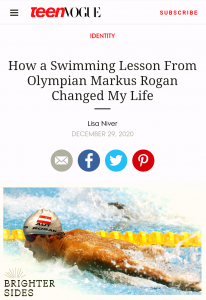
Thank you to Teen Vogue for publishing my article, “How a Swimming Lesson From Olympian Markus Rogan Changed My Life” I am thrilled to be published in TEEN VOGUE especially since I wrote for AARP first! Oh 2020!!!

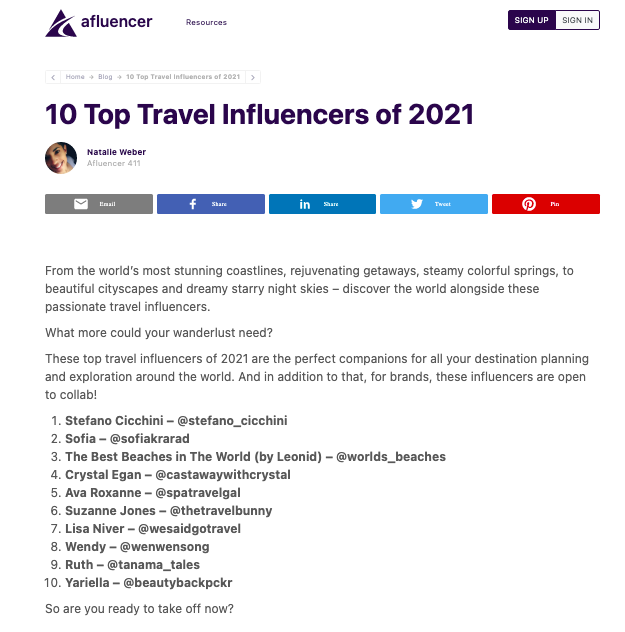
Thank you to Afluencer for including me in your 10 Top Travel Influencers of 2021

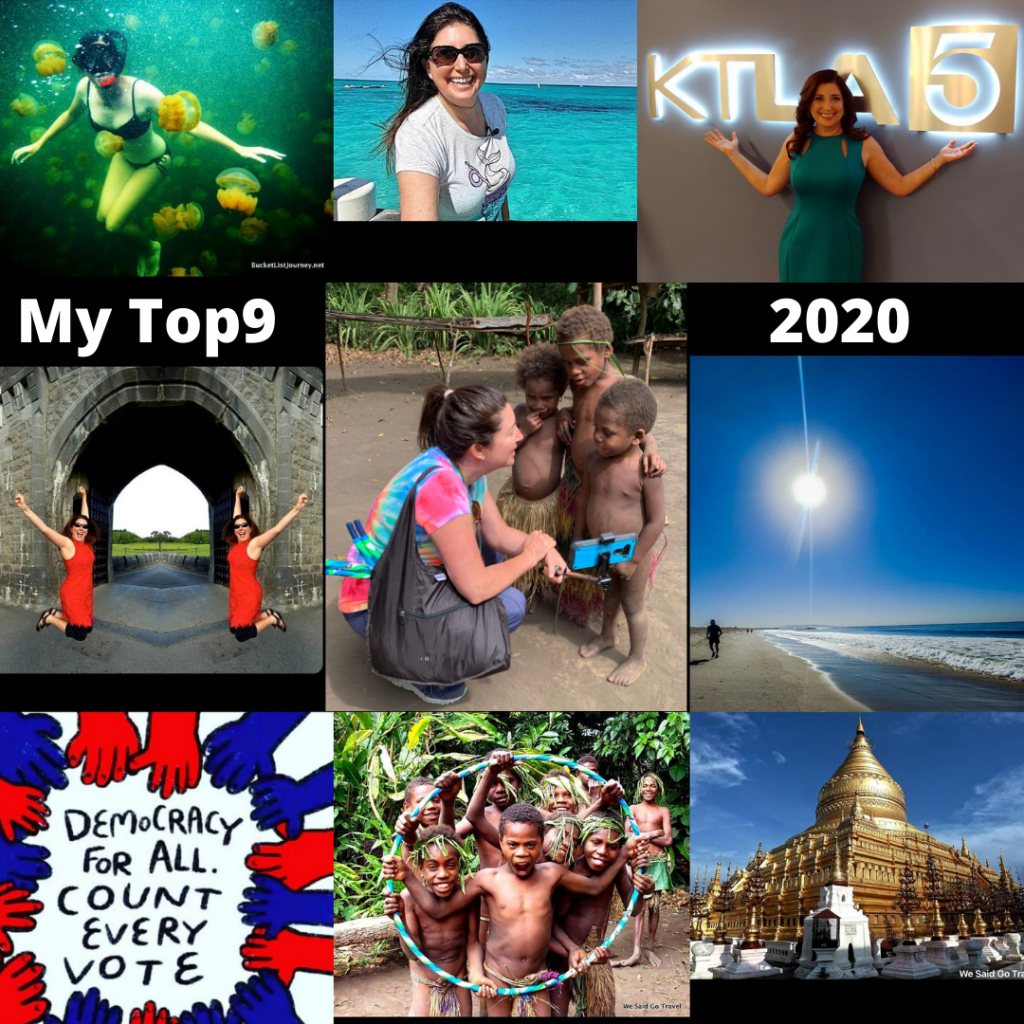
This is my #TOP9 posts from 2020 instagram: full of past travels, TV segments and #COUNTeveryVOTE!

2020 has been a year filled uncertainty and changes. Michael Jordan said: “I’ve missed more than 9,000 shots in my career. I’ve lost almost 300 games. Twenty-six times I’ve been trusted to take the game-winning shot and missed. I’ve failed over and over and over again in my life. And that is why I succeed.” We have to keep practicing, keep going, keep taking chances and making things HAPPEN!

Taken on one of my neighborhood COVID19 walks around the block with my #LGV60ThinQ

Thank you to Thrive Global for publishing my articles!

Thank you to all of the scientists who created the COVID 19 Vaccine and to all of the medical teams who have been treating people with this disease. Please see information below from UCLA Health.


View this post on Instagram


A post shared by UCLA Health (@uclahealth)

During COVID19, I have been honored to publish diverse voices on many topics! Please enjoy Cherice Taylor’s poem, WOW 2020, Elwood Hopkins’ Will Santa Love Me if I am Gay? and an excerpt from DreamCatchers, the new anthology from POPS club for children who are impacted by a family member’s incarceration.

Let’s say GOOD-BYE to 2020’s uncertainty and HELLO to a 2021 with 12 months of success, 52 weeks of laughter, 365 days of fun, 8,760 hours of joy, 525,600 minutes of good luck, and 31,536,000 seconds of happiness. I hope that 2021 brings you peace, joy, and happiness!

Thank you to Amy and Hotel Erwin for my birthday staycation in Venice Beach! I learned to use Adobe Premiere Pro during COVID:

WHERE CAN YOU FIND MY TRAVEL VIDEOS?

Here is the link to my video channel on YouTube where I have over one and a quarter million views on YouTube! (Exact count: 1,287,338   views) Thank you for your support! Are you one of my 2,960 subscribers? I hope you will join me and subscribe!

For more We Said Go Travel articles, TV segments, videos and social media: CLICK HERE

Find me on social media: InstagramFacebookTwitterPinterestYouTube, and at LisaNiver.com.  My social media following is now over 160,000 and I am verified on Twitter.

My fortune cookies said:

“From now on, your kindness will lead you to success.”

“Your Independence shall lead you to bold adventures.”

Stay safe and healthy! We will travel again….

Lisa

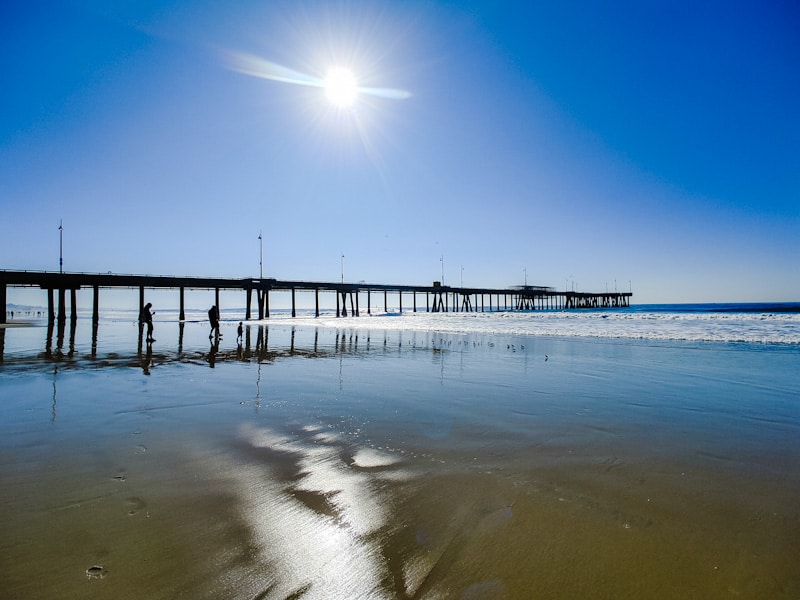
Venice Beach Pier, December 26, 2020 by Lisa Niver #LGV60ThinQ

Good-bye 2020: We Said Go Travel News Dec 2020 Read More »