I can imagine Jacob justifiably bemoaning his fate as he trudges toward Paddam Aram. Jacob was the one, the Bible tells us, who was the dweller in tents. The Midrash explains that this does not mean that he dwelt in tents at the campsite, but rather studied in the tents of “Shem and Eber,” the mythical founders of the wisdom academy that paralleled the lives of the ancestors. The rabbis of the Talmudic era interpreted this to mean that he was the studious type, not a recluse, but certainly not a man of action.
Remember, he had learned from his mother (who, according to the Talmudic rabbis, received her oracle in that same study house of Shem and Eber) that “the older will serve the younger.” This rather opaque statement was taken to mean that the birthright from his father Isaac belongs to him, Jacob, not his fraternal twin, Esau. Mother Rebecca, the sister of Laban, devised a plan in last week’s Torah portion to trick father Isaac to get the birthright away from Esau, to where it is supposed to be, with Jacob.
Jacob perhaps assumed that he would get the birthright and then go back to his studies. Perhaps he thought that once he assumed the mantle of leadership when his father died that he would then just delegate most of his duties. Life did not turn out that way. Instead of going back to his studies and delegating the work, he found that he had to hit the road to escape his brother’s murderous wrath. Back to the ancestral homeland in Paddam Aram he goes, to save his life – and find a wife.
In this week’s Torah portion, Jacob finds himself on the road, a bit like his ancestor Cain, a “na-ve-nad” – a wanderer, a man on the trail, in exile. Cain was exiled because he had murdered his brother, Abel. Perhaps the similarity was not lost on Jacob – in some symbolic way, he did kill his brother. The future that Esau imagined for himself was annihilated.
Jacob’s future, too. No more studying in tents. I think of Jacob on the road saying to himself, “I did not see this coming.”
I can imagine Jacob ruing this fate, the blessing of his father and the blessing of God notwithstanding. Instead of enjoying the blessings of the birthright, he will now have to struggle under the oppressive hand of that swindler, his uncle Laban. He falls in love but does not get to marry his beloved Rachel – he is tricked into marrying Leah. He does finally get to marry Rachel, who some years later tragically died, birthing Benjamin as Jacob returned to Canaan.
Jacob’s life does not go as planned. He thought he was a dweller in tents. It did not turn out that way. He found himself in the vale of thorns.
While on the road leaving Canaan, Jacob had a dream of a ladder rooted in the earth, the top reaching to the heavens, angels ascending and descending. God promises to be with Jacob. God, it seems, had not appeared to him in his dreams all those years he studied in the study house of Shem and Eber. Only on the road, in exile, does God appear to him. Jacob’s miserable fate broke him and then the light came in. He had planned for tents, but instead, while heading into exile, the ladder found him. He was forced to trade tents for a ladder to heaven. Maybe somebody’s life goes as planned, but I have not met that somebody yet.
What do we do when life does not go as planned? We can ruminate on the oft-repeated maxim, “Life is what happens to us while we are making other plans.” It is true – “life” cares very little about our plans. But now what?
What many people do when life happens not according to plan, at least initially, is complain, grieve poorly, deny, fight the truth, anger at someone (or God), and eventually depress. Many people become bitter and check out. If life is a battle (as Psalms 144:1 seems to imply), then it seems we have lost. Another adage comes to mind; when some doors close, others open. More accurately, when some doors close, we become aware of other doors, maybe obscured by our being fixated on the doors now locked.
As a counselor, I often time find myself guiding people through the “now what?” One thing seems to be required: we have to go deeper than the pain, deeper than the loss, deeper than the grief. The way through loss is depth. We live in a society that does not teach much about that depth, nor about the life of virtue that helps us retain our dignity when we suffer. Much of what I see is a “culture of complaint.” When things don’t go our way, we have to blame someone, typically insuring that life doesn’t go their way, either. We need to punish. We take our loss out on them. It is a zero-sum game – loss is multiplied.
The need to blame, to punish, to complain is, for me, the indication of immaturity, a state of character that has little to do with chronological age. The complaining character has decided that they do not have the capacity for resilience, to hold the line. Blaming instead of growing, instead of making a plan, maybe even only one day at a time, as an answer to the “now what?” The despairing person might exhibit addictive behavior, medicating the pain instead of going deeper than the pain. Despair seems to say, “Anything but dignity and depth.”
“Life is what happens while we are making other plans.” Eventually, it seems, you have to make a new plan or that unruly force we euphemistically call “life” will make a plan for us. Understanding that life might intrude again as well, one must come out of the blaming, complaining, unproductive grief, despair, and loss into a life of depth and wisdom, perhaps even find occasional great bliss and joy. This is hard, sometimes bitterly hard work. You can plan a life, but more deeply, we have to plan who we will be no matter what life delivers to us.
(JNS) I have never criticized former U.S. President Barack Obama publicly—neither during my time in the Knesset nor anywhere else—despite my having disagreed with many of his policies. I am of the strong opinion that Israelis should not engage in or interfere with American politics, and I regularly offer a blanket thank you to all American presidents, including Obama, for their economic and military support for Israel.
However, his memoir, A Promised Land, is filled with historical inaccuracies that I feel the need to address. His telling of Israel’s story (at the beginning of Chapter 25) not only exhibits a flawed understanding of the region—which clearly impacted his policies as president—but misleads readers in a way that will forever shape their negative perspective of the Jewish state.
Obama relates, for example, how the British were “occupying Palestine” when they issued the Balfour Declaration calling for a Jewish state. But labeling Great Britain as an “occupier” clearly casts doubt on its legitimacy to determine anything about the future of the Holy Land, and that wasn’t the situation.
While it is true that England had no legal rights in Palestine when the Balfour Declaration was issued in 1917, that changed just five years later. The League of Nations, the precursor to the United Nations, gave the British legal rights over Palestine in its 1922 “Mandate for Palestine,” which specifically mentions “the establishment in Palestine of a national home for the Jewish people.”
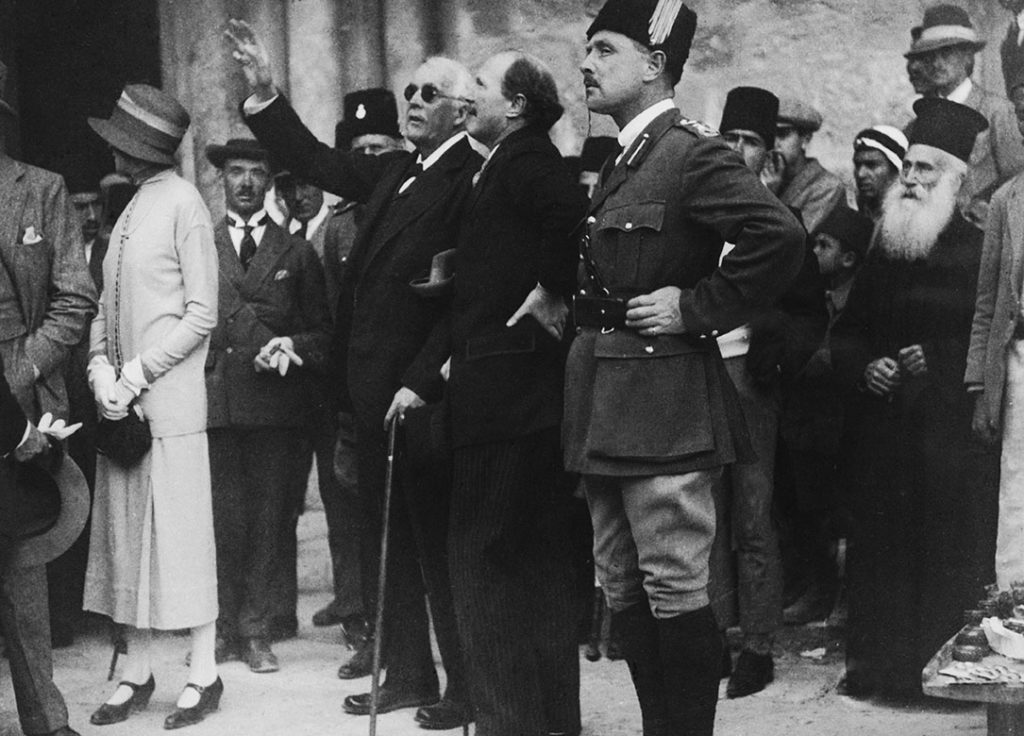
British politician Lord Arthur Balfour during a visit to Jerusalem, 9th April 1925. (Photo by Topical Press Agency/Hulton Archive/Getty Images)
The League also said that “recognition has thereby been given to the historical connection of the Jewish people with Palestine and to the grounds for reconstituting their national home in that country.”
The former president’s noted omission of the internationally agreed-upon mandate for the British to establish a home for the Jews in Palestine misinforms the reader, who will conclude that the movement for a Jewish state in Palestine had no legitimacy or international consent.
“Over the next 20 years, Zionist leaders mobilized a surge of Jewish migration to Palestine,” Obama writes, creating the image that once the British illegally began the process of forming a Jewish state in Palestine, Jews suddenly started flocking there.
The truth is that Jews, who maintained a continual presence throughout the 2,000 years that most were exiled from the land, had already been moving to Palestine in large numbers way before then; considerably more than 100,000 immigrants arrived in the late 19th century and beginning of the 20th century. Then, in the 1920s, high numbers fleeing anti-Semitism in Europe could only find safe haven in Palestine due to the United States having instituted quotas in 1924 on the number of Jews who could enter America.
The number of immigrants rose even more in the 1930s when Adolf Hitler rose to power and began his conquest of Europe while the world remained silent.
Historical Context is Important
Historical context is important, and once Obama chose to write about the history, he should have provided the full context and portrayed the Jews as they were: a persecuted and desperate people searching for safety, and not, as he implies, strong conquerors flooding into Palestine.
His claim that the new immigrants “organized highly trained armed forces to defend their settlements” is also misleading. A more accurate way to describe it would have been: “Because the Arabs in the region mercilessly attacked the Jewish areas, the Jewish refugees had no choice but to take up arms to defend themselves.”
Acknowledging that the Arabs were attacking Jews before there was even a State of Israel is important historical context for understanding the Israeli-Arab conflict.
Acknowledging that the Arabs were attacking Jews before there was even a State of Israel is important historical context for understanding the Israeli-Arab conflict.
A Promised Land recounts, as well, how the United Nations passed a partition plan for Palestine in November 1947, by dividing the country into a Jewish and Arab state, which the “Zionist leaders,” as he calls them, accepted, but to which the “Arab Palestinians, as well as surrounding Arab nations that were just emerging from colonial rule, strenuously objected.”
Obama’s use of “Zionist leaders” instead of “Jewish leaders” plays right into the current international climate, in which it is politically correct to be “anti-Zionist,” while unacceptable to be anti-Jewish. (In reality, Zionism is the movement for Jews to live in their biblical and historic homeland, so being against that actually is anti-Semitism, but that’s for another discussion.)
The description of “Arab nations that were just emerging from colonial rule” is a clear attempt to justify the Arab refusal of the U.N. Partition Plan. Those poor “Arab nations” that have been suffering due to outsiders colonizing their “nations” simply could not accept another “colonial” entity, the Jews, entering the region.
Simply False
But the truth is that with the exception of Egypt, which was not colonized, none of the neighboring countries that rejected the partition plan had been established states before World War I. Yes, the post-war mandates of the League of Nations gave control in the region to the British and the French for a few decades, but this was in place of the Ottoman Empire that had controlled the region for centuries. Thus, the image of countries emerging from long-standing colonial rule as a subtle attempt to justify their objection to the Partition Plan is simply false.
Obama tells the story of the establishment of the State of Israel in two sentences, which are nothing short of outright revisionist history: “As Britain withdrew, the two sides quickly fell into war. And with Jewish militias claiming victory in 1948, the state of Israel was officially born.”
Wow. I don’t even know where to begin. The two sides didn’t “fall into war” when Britain withdrew; the two sides had been fighting for decades, with the Arabs—who rejected more than half-a-century of efforts to establish a Jewish state in the region—attacking the Jews, and the Jews defending themselves. When the British then left the area in May 1948, the Jews made a very difficult decision to declare their independence based on the U.N. Partition Plan, which gave the right for a Jewish state alongside an Arab state.
There were no “Jewish militias claiming victory.” There was a unified Jewish army that formed the Israel Defense Forces, which knew that the surrounding Arab countries would begin an all-out assault to destroy Israel the moment its Jewish leadership declared an independent fledgling Jewish state. And that is exactly what the Arab armies did. The new State of Israel fought off that assault for months, emerging in 1949 both weakened and fragile.
Obama’s perspective on the formation of the State of Israel no doubt affected his foreign policy regarding the Jewish state. If one sees Israel as a colonial force occupying the land as a result of its armed militias, then it will be treated as an outsider that wronged others to establish itself as a state. The former president misleads others into believing this, as well.
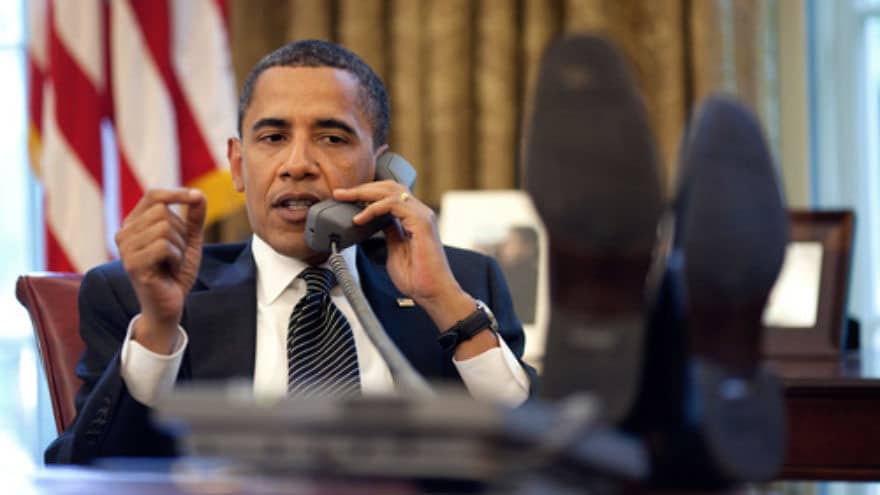
Prime Minister of Israel Benjamin Netanyahu speaks to U.S. President Barack Obama during a bilateral meeting at the Lotte New York Palace Hotel, September 21, 2016 in New York City. (Photo by Drew Angerer/Getty Images)
Misleading, Deceptive and Damaging
The most disingenuous sentence of Obama’s history of Israel is in his description of what happened during the 30 years following Israel’s establishment: “For the next three decades, Israel would engage in a succession of conflicts with its Arab neighbors … .”
What? I had to read that sentence many times because I could not believe that a president of the United States could write such misleading, deceptive and damaging words about his country’s close ally.
Israel did not “engage” in any conflict with the surrounding Arab countries. The Arab armies and their terrorists attacked Israel again and again, and Israelis fought to defend themselves.
A straightforward history of Middle East wars involving Israel yields this basic truth. Facts are facts, and the former president’s misrepresentation of Israel as a country that sought conflict instead of peace—one that willingly engaged in wars with the Arabs—does an injustice to peace-seeking Israel and riles up anti-Israel sentiment.
Obama’s description of the 1967 Six-Day Way continues this revisionism: “A greatly outnumbered Israeli military routed the combined armies of Egypt, Jordan and Syria. In the process, Israel seized control of the West Bank and East Jerusalem from Jordan, the Gaza Strip and the Sinai Peninsula from Egypt, and the Golan Heights from Syria.”
Here he fails to address what led up to the war, when all those Arab armies gathered along Israel’s borders and declared their intention to wipe it off the map. He doesn’t describe Israel’s pleading with Jordan not to enter the war, nor that Jordan altogether had no legal rights to the West Bank, which it occupied in 1948 and annexed against international law in 1950.
Most significantly, Obama fails to mention Israel’s willingness, immediately after the war, to withdraw from all the areas that it won in its defensive battle in exchange for peace; and by extension, he also fails to tell of the Arab League’s “Three No’s” in response to that offer: no peace with Israel, no recognition of Israel and no negotiations with Israel.
This omission serves once again to portray Israel as the aggressive occupier that seeks conflict and not peace.
The former president continues with another outright falsehood, which helps give insight into his policies regarding Israeli settlements in the West Bank.
The “rise of the PLO (the Palestinian Liberation Organization)” was a “result” of the Six-Day War he writes. That makes it seem like the Palestinian liberation movement, including its violent and murderous attacks against Israelis, was only a result of Israel’s taking control over the West Bank, eastern Jerusalem and the Gaza Strip.
It strengthens the message that if only Israel would vacate these areas, there would be peace between Israel and the Palestinians. This is what spurs leaders around the world to suggest that Israeli settlements in these areas are the obstacle to peace in the region.
But there is one flaw with this story and logic. It’s not true. The PLO was established in 1964—three years before Israel was in control of any of those “occupied” areas and three years before there were any settlements.
“From the River to the Sea”
What exactly was this Palestinian organization liberating at that time? Is there any conclusion other than the liberation of the Jewish state in its entirety? What other option could there be?
This is why the “Free Palestine” movement chants, “From the river to the sea, Palestine will be free.” They are against the existence of Israel anywhere between the Jordan River and the Mediterranean Sea. They see such a state as a colonial enterprise with armed militias grabbing the land of others, just as Obama leads readers to believe when describing the formation of the state.
The false description of the PLO rising after 1967 serves the narrative that the “occupation” and the settlements are the cause of the conflict, and this, no doubt, had a direct impact on Obama’s “not one brick” policy, including freezing settlement construction, in an effort to bring about peace between Israel and the Palestinians.
Obama describes the failed Camp David accords of 2000, in which former Israeli Prime Minister Ehud Barak offered the Palestinians more than 90 percent of what they were asking for. “Arafat demanded more concessions, however, and talks collapsed in recrimination,” he writes. But the talks didn’t simply “collapse.” Sixty-six days later, Arafat unleashed the Second Intifada, in which 1,137 Israeli civilians were murdered and 8,341 were maimed by Yasser Arafat-funded terrorists who blew themselves up in Israeli buses and cafes.
U.S. President Bill Clinton, center, speaks during a morning meeting with Israeli Prime Minister Ehud Barak, left, and Palestinian Chairman Yasser Arafat July 25, 2000 at Camp David in Maryland. (Photo by Ralph Alswang/Newsmakers)
Don’t trust my word on this. Mamduh Nofal, former military commander of the Democratic Front for the Liberation of Palestine, revealed that following Camp David, “Arafat told us, ‘Now we are going to fight so we must be ready.’”
In addition, Hamas leader Mahmoud al-Zahar said in September 2010 that in the summer of 2000, as soon as Arafat understood that all of his demands would not be met, he instructed Hamas, Fatah and the Al-Aqsa Martyrs Brigades to begin attacking Israel. And Mosab Hassan Yousef, son of Hamas founder Sheikh Hassan Yousef, has verified that the Second Intifada was pre-planned by Arafat.
Not only does Obama fail to accurately connect the Second Intifada to Arafat’s not receiving everything the Palestinians asked for at Camp David—demands that would have prevented Israel from being able to defend itself against Palestinian terrorism—but he seems to place the blame for the intifada on Israel.
He describes the September 2000 visit of Israel’s opposition leader and subsequent prime minister, Ariel Sharon, to the Temple Mount in Jerusalem as “provocative” and a “stunt” that “enraged Arabs near and far.”
But Obama neglects to mention that Sharon only visited there after Israel’s Interior Ministry received assurances from the security chief of the Palestinian Authority that no uproar would arise as a result of the visit.
In fact, Jibril Rajoub, head of Preventive Security in the West Bank, confirmed that Sharon could visit the sensitive area as long as he did not enter a mosque or pray publicly, rules to which Sharon adhered.
Even more incredibly, Obama describes the Temple Mount as “one of Islam’s holiest sites,” making no mention that it is the holiest site in Judaism.
Obama describes the Temple Mount as “one of Islam’s holiest sites,” making no mention that it is the holiest site in Judaism.
An innocent reader who is unfamiliar with the region and its history reads this and concludes that it was simply wrong for a Jewish leader to walk onto a Muslim religious site. On the other hand, if he or she knew that it is the holiest site for Jews, then they would more likely wonder why there was anything wrong with Sharon’s having gone there—except Obama omits that part, leading anyone to conclude that Sharon was in the wrong.
That omission, together with the exclusion of Arafat’s plans for the intifada right after negotiations at Camp David failed, can only lead one to conclude that Israel was responsible for the five years of bloodshed during the Second Intifada.
Gaza Conflict: Zero Mention of Israeli Withdrawal
Obama’s history lesson continues with the tension between Israel and Gaza. Remarkably, he makes zero mention of the Israeli disengagement from Gaza in 2005, when Israel pulled out all of its troops from the strip while forcing 9,000 Jewish citizens to leave their homes.
Anyone reading the president’s description of the wars between Israel and Hamas would never know that Israel no longer “occupies” Gaza, and that the Palestinians have been free to build a wondrous “Israeli-free” Palestinian state there for the last 15 years. That omission is glaring.
Finally, Obama’s misleading words describing Israel’s response to Hamas rocket fire on its civilian population only serves to inflame and incite anti-Israel sentiment worldwide. That response, he writes, included “Israeli Apache helicopters leveling entire neighborhoods” in Gaza—Apache helicopters that he identifies as coming from the United States, a subtle or not-too-subtle questioning of whether the United States should be providing Israel with military aid if it is used in this manner.
More importantly, what does he mean by “leveling entire neighborhoods,” other than to imply that Israel indiscriminately bombs Gazan neighborhoods, willfully murdering innocent people? And what human being on Earth wouldn’t be riled up to condemn Israel for such inhumane activity?
The problem is that it’s false. Israel targets terrorist leaders and the rockets that they fire into Israeli cities. Tragically, Hamas leaders use innocent Palestinians as human shields by hiding behind them in civilian neighborhoods, and by launching rockets into Israel from there and from hospitals and mosques.
Israel does its best not to kill innocent people, even airdropping leaflets announcing an imminent airstrike, and calls off missions to destroy rocket launchers or kill terrorist leaders when there are too many civilians in the area. Israel most certainly does not launch retaliatory attacks that aimlessly “level” entire neighborhoods.
I have no problem with criticism of Israel. We can debate the issues in intellectually honest discussions, and in the end, we may have to agree to disagree about Israel’s policies. But no one should accept a book that is filled with historical inaccuracies that invariably lead innocent and unknowing readers to reach false conclusions. Such a devastating book has real-life ramifications and consequences.
It is terribly disappointing. I surely would have expected truth, accuracy and fairness from Barack Obama, America’s 44th president. But the falsehoods and inaccuracies in this memoir only feed the theory that Obama was, in fact, anti-Israel. Now, through A Promised Land, he seeks to convince others to join him.
Dov Lipman served as a member of the 19th Knesset.
The Media Line — The world is turning the page on the Trump Administration and getting ready for the Joe Biden presidency.
While many world leaders are breathing a sigh of relief that Donald Trump will soon exit the White House, a few like Turkish President Recep Tayyip Erdoğan are bracing for a stormy four years.
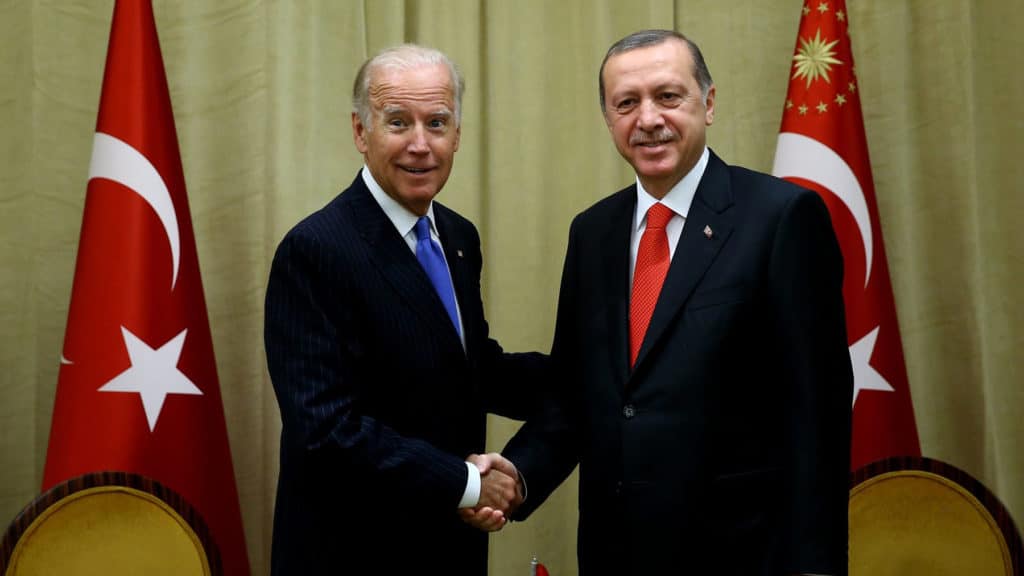
Erdoğan has had a cozy relationship with the outgoing American president, with their relationship something of a “bromance” and the two men constantly showering each other with praise.
Trump bragged that world leaders have come to him for help with Erdoğan, saying Turkey’s leader will listen only to him.
During an Oval Office meeting between them last November, Trump said of his Turkish counterpart, “The president and I have been very good friends, for a long time, almost from day one.”
Former Ambassador Ahmet Ünal Çeviköz, the foreign policy adviser to Republican People’s Party (CHP) head Kemal Kılıçdaroğlu, the leader of the main Turkish opposition party, told The Media Line that with a Biden presidency, relations between the two principals will change.
“The authoritarian rule in Turkey enjoyed the Trump type of governance. With the new US administration, a stronger emphasis on the rule of law, fundamental rights and freedoms from the US side will create discomfort on the Turkish side,” Çeviköz says.
The continued tensions are due in part to the Trump Administration having neglected many of the issues under dispute between the two countries, he says, adding that relations between Ankara and Washington are “lukewarm” at best.
The continued tensions are due in part to the Trump Administration having neglected many of the issues under dispute between the two countries.
“The next four years will be a period to address all these issues, but nobody should be under the illusion that things will get back to normal easily and rapidly,” he says.
“It is a fact that Turkey will go to elections, both parliamentary and presidential, at the latest in June 2023,” Çeviköz adds. This means “there is a possibility of change in the Turkish administration, too. The new US administration will probably not look at relations with Turkey as an urgent agenda item.
“The best-case scenario would be to maintain, at least, the status quo, or not to worsen the relations if they cannot be repaired,” says Çeviköz.
In late 2016, Erdoğan went on CBS’s 60 Minutes news magazine to talk about how disappointed he had been with the outgoing Obama-Biden Administration. He said the Obama Administration had a failed policy on Syria.
Some four years later, Biden had tough words for Erdoğan. He told The New York Times earlier this year that Washington should support the Turkish opposition, “to be able to take on Erdoğan at the ballot box.”
That may be why Ankara was slow to congratulate President-elect Biden on his election victory. Erdoğan’s office issued a statement expressing Turkey’s determination to work closely with the new administration. “I believe that the strong cooperation and the bond of alliance between our countries will continue to make vital contributions to world peace in the future, as it has done so far,” Erdoğan said on November 10.
Despite all these differences, analysts say it is too early to know how the former vice president will deal with Turkey.
Egemen Bağış, ambassador of Turkey to the Czech Republic, downplays the friction with the US.
Bağış told The Media Line he likens it to the relationship between married couples. Even couples who have been married for a long time do not agree on everything, he says.
“It’s natural to have differences. I’m married for almost 30 years and I don’t see eye to eye on every issue with my wife, but we have a successful marriage. We have and continue to have each other’s support. In every relationship there are good days, and there are better days. Turkish-American relations have a long history of almost 70 years, so naturally we have ups and downs. As in every relationship, there are sometimes sharp differences, but we have a long tradition of cooperation and dialogue,” he says.
Bağış, a former member of the Turkish parliament and a former minister for EU affairs and chief negotiator of Turkey in accession talks with the European Union, says politicians say things during election campaigns that do not necessarily reflect their agenda once in office.
“There is a very popular Turkish saying: ‘The head that wears the crown grows wiser.’ So, when politicians get elected to office, they then realize their responsibilities because they are briefed and understand the need to recognize that neither the US nor Turkey can afford to lose each other,” he says.
“Experience has taught us that US politicians should not be evaluated based on their statements during campaigns. Look at the actions more than the words. Mr. President-elect is not a newcomer to the world of politics and international relations. He has relationships with Turkey, and with President Erdoğan,” Bağış adds.
With a new US administration entering office on January 20, the two capitals will have to sort through an assortment of issues in the following months.
Some analysts think the strains between Ankara and Washington could worsen under Biden, as the two leaders differ on several issues, ranging from Turkey’s seemingly close relations with Russia, its military interventions in Syria, Libya and the Kurdish issue, and what the West views as Erdoğan’s increasingly authoritarian rule.
Michael Doran, an American analyst of the international politics of the Middle East and a senior fellow at the Hudson Institute, told The Media Line there are also other sticking points the US should not ignore.
“The Americans are also increasingly alarmed by the assertive Turkish foreign policy as well as by the Erdoğan government’s support for the Muslim Brotherhood in the Arab world and its support for Hamas,” he says.
A forceful and decisive policy by the new administration will yield results, Doran says.
“I think the assertive foreign policy [of Turkey] works, on balance, much more to the advantage of the United States than many people think, but in the absence of a common view of the world, a common understanding of the purposes of the alliance, and an effective mechanism for coordination, the assertive policy appears threatening to Washington. Great powers don’t like surprises,” he says.
Ankara’s 2019 decision to purchase S-400 surface-to-air missile defense systems from Russia is subject to sanctions mandated by Congress, putting the two NATO allies at odds.
Matthew Bryza, an Istanbul-based nonresident senior fellow with the Atlantic Council’s Eurasia Center and Global Energy Center and a former US ambassador to Azerbaijan, told The Media Line that under US law, the president is required to counter that purchase with sanctions.
“He [Trump] is required to choose five of 12 [possible] sanctions against Turkey. He’s been obligated to do this since last year, and he simply refused,” Bryza notes.
Turkey’s fear of Biden stems from comments he made during the Second Gulf War, when he hinted he would be okay with breaking up Iraq into three countries, thus empowering Iraqi Kurdistan.
“Back in 2004, then-Senator Biden made some statements suggesting he might be in favor of breaking up Iraq into three separate cantons: a Shi’ite one, a Sunni one and a Kurdish one. That plays into Turkey’s huge fears of also dividing up Turkey,” Bryza says.
Bryza, an expert on US-Turkey relations with four years in the George W. Bush White House and another four at the State Department, says a more recent comment by the former vice president “about President Erdoğan, saying that he should be removed from office by democratic means, by election,” further irritated Ankara.
Doran says despite the optics that Ankara and Moscow are getting closer, this is not the case.
“I don’t actually believe that Turkey is getting closer to Russia. There is great friction in the Turkish-Russian relationship: in Libya, Syria, and add the South Caucasus, the Black Sea and Ukraine to the list as well.”
The future of the relationship between Ankara and Moscow depends on how Ankara and Washington resolve their differences, Doran says.
“The Erdoğan government has purposely given itself the option to move closer to Russia if necessary, meaning if it does not get satisfaction from the United States on its core security challenges, fighting the PKK [the Kurdistan Workers Party] being No. 1 among them,” he says.
“Washington feels Ankara developing options for itself outside of the traditional framework of US-Turkish relations, and it is resentful. But it does not spend enough time asking itself why Turkey felt the need for this. Ideally, the Turks prefer to be closer to the US than to Russia,” Doran adds.
Another major headache awaiting Erdoğan is the court case against Turkey’s state-owned Turkiye Halk Bankasi A.Ş. (Halkbank), which was indicted in Manhattan federal court last year for alleged fraud and money laundering while helping Iran sidestep US sanctions.
Turkey’s maritime claims in the Mediterranean are also a source of tension between the two nations. Expecting the worst, Erdoğan seems to be taking precautionary measures.
Last week, Turkey’s parliament approved legislation to repatriate Turkish energy and mining companies established abroad. Turkish officials said the move aimed to guard against the impact of potential sanctions.
Doran says that the West is underestimating the depth of Erdoğan’s domestic support.
“Biden is not going to find Erdoğan easier to deal with than Trump did. The Turks are much more supportive of Erdoğan’s foreign policy than the United States realizes. Even Erdoğan’s domestic enemies support his major foreign policy moves.”
Yusuf Erim, chief political analyst and editor-at-large for the Turkish public broadcaster TRT, told The Media Line that both leaders would “look to increase bilateral trade to give the relationship more depth.”
The Biden Administration will likely have a more stable and less unpredictable foreign policy than under Trump, Erim adds.
The Biden Administration will likely have a more stable and less unpredictable foreign policy than under Trump.
“Despite the negative aura surrounding US-Turkey relations that has increased with the election of Joe Biden, I don’t expect the new administration to take any steps that would seriously hurt the relationship. Washington knows Ankara has alternatives in Moscow and Beijing, and Turkey is too important to the security architecture of the MENA [Middle East and North Africa] region. Biden will want to rebuild alliances, and completely alienating Turkey would be a major blow to NATO,” Erim says.
Erim concedes that friction exists between the two countries, but adds that this shouldn’t overshadow the possibility of bridging the gap.
“While Biden will pose new challenges for Turkey, there will also be new opportunities as well. If the US goes back to the JCPOA with Iran, this will change regional dynamics,” he says, referring to the Joint Comprehensive Plan of Action or Iran nuclear deal. “Turkey may find it has new shared interests with rivals like Saudi Arabia, Israel and Egypt, creating a diplomatic space for a thawing of relations.”
Ali Cinar, a senior foreign policy expert and a 2019 Ellis Island Medal of Honor recipient, told The Media Line tension with Turkey would have been “unavoidable even if Trump had won, and it seems that it will continue with President-elect Biden as well.
“The reality is President-elect Biden’s priority will not be on Turkey. Biden Administration priorities are more domestic and fighting against COVID-19. I think that Turkey will have a better diplomatic relationship during the Biden Administration, especially with the incoming Secretary of State Antony Blinken. He knows Turkey well and he acknowledges the importance of Turkey in the region,” Cinar says.
He adds that Biden is very familiar with Turkey.
“He was in Turkey four times during his vice presidency. He has made his first visit in December 2011, during the Arab Spring, and his second visit took place just after the US air bombardments against the [ISIS] organization [in Syria and Iraq] in November 2014. Following his third visit in January 2016 for the meetings against ISIS, he visited Turkey for a fourth time after the [Turkish] coup attempt in August 2016,” Cinar notes.
“I don’t think that the ties will break completely during Biden Administration. I am more optimistic on the Turkey-US relationship,” he says.
He argues that the two leaders should work together on confidence-building measures, and “open a fresh page starting in January 2021.
“There is no solution in the Middle East without Turkey, so I think that Biden Administration will be careful not to push Turkey toward Russia and Iran. The US and Turkey will have a better relationship under the NATO alliance despite the current issues,” he adds.
However, “the problem for Turkey will be in the US Congress since there is a very negative perception by both parties,” Cinar says.
As a former yeshiva student, it’s challenging balancing higher education, a high-tech career and a significant emphasis on Torah study. But it can be done.
There’s a common idea in secular society that religious studies and academic life are mutually exclusive. This perception may stem from the idea that religious beliefs and critical thinking are at odds with each other or from a notion that religious studies are less rigorous than college courses.
Yet having been through years of both yeshiva and a traditional education, I can say that nothing could be further from the truth.
I made Aliyah from Los Angeles to Jerusalem at age seven, joined yeshiva at 18 and the army at 20, then returned to yeshiva. I had set aside a few years to study in yeshiva as a preparation for life, but I was pleasantly surprised to discover that yeshiva also prepared me for academic studies at the Jerusalem College of Technology’s (JCT) International Program in English.
Unlike the modern education system — which tends to be memorization-oriented, with tremendous value placed on grades and testing — yeshiva encourages engaging directly with the material to uncover hidden meanings. Unencumbered by deadlines and grades and motivated by a strong sense of purpose, yeshiva students have creative freedom to learn in a manner that’s suitable for their style and temperament. A yeshiva education provides the information and then the independence to apply that knowledge on your own.
In my six years in an Israeli Hesder program — which combines yeshiva study with IDF service — I sharpened my reasoning skills and learned to think carefully and critically about nuanced topics within the realm of Halacha and Jewish thought.
At the end of those six years, I decided against devoting myself full-time to Torah study and religious affairs. Instead, I set out to identify the most meaningful path I could take in the absence of being a rabbi or spiritual leader. This led me to pursue computer science, which opens quite a few potential career paths. I set my sights on JCT, largely because the institution provides a religious-friendly environment while its students study technical subjects.
But getting to higher education from yeshiva wasn’t an obvious path. I signed up last minute for the psychometric exam (Israel’s standard university admission test), leaving me with little time to prepare. With the semester set to begin in just a couple of months, I needed to cram for the math component of the exam, which I had to pass to get accepted into college. But what use was my Talmud analysis in a math test?
After taking a few deep breaths, I channeled the discipline and determination I learned in yeshiva and for three weeks, immersed myself in my studies. In that time, I essentially taught myself the entire curriculum. It was probably the most difficult task I’ve tackled in my life. But I passed and even scored relatively well.
I attribute my success on that test — and my current success as a JCT student — to my religious studies. Studying Talmud, where I spent hours analyzing several different texts and their various interpretations to determine if there’s sufficient evidence to arrive at a particular conclusion, promoted superb critical thinking skills.
Yeshiva also instilled in me a level of focus that has demonstrably helped me in my academic career. In today’s wired world, it’s easy to get distracted by YouTube, a ping from your phone, a call from someone in the next room. The yeshiva world found a solution to this problem many centuries ago: leave any distractions at the door and pay attention to what matters. My years in yeshiva have allowed me to push those distractions aside for a higher purpose.
My years in yeshiva have allowed me to push distractions aside for a higher purpose.
Now, I’m completely enthralled by computer science, especially the ability to create something from scratch. The career options in this field are limitless, and I’m excited to be at the forefront of discovering new ways to make a positive impact in the world.
Choosing this career, of course, has its challenges. Although technology is highly beneficial, it trains us to expect and crave instant rewards and to shy away from things which take mental effort to achieve — principles that are in tension with what I learned at yeshiva.
In the end, my combination of Jewish and academic studies have taught me that both worlds are vital to push for success. And, more importantly, this balance also brings a much-needed humanity and ethical touch to my chosen career. Modern life comes with great advantages and conveniences, but it also needs inspiration from our sages, who teach us to step back and pay attention to what’s meaningful.
Jonah Hess made Aliyah to Israel from Los Angeles and is currently enrolled in the Jerusalem College of Technology’s International Program in English.
Studying the history of Thanksgiving is like digging a narrow mine shaft into the complexities of the history of the English settlement and the United States.
For years, various days of Thanksgiving had been pronounced at different levels of government, almost all in response to bountiful harvests or military victories, often at the same time. Public thanksgiving feasts were constantly organized, the most emblematic being the one organized by the Puritan separatists (or “Pilgrims”) in the Plymouth colony in 1621, after a catastrophic first year on the continent. As anyone who went to elementary school in the United States up to a certain time can attest, a large number of Native Americans were invited. (The bonhomie between the European settlers and the Native Americans deteriorated drastically over time.)
Since that Puritan feast and for many thereafter, the Thanksgiving holiday has become fundamentally theological, promoting the idea that God provides our bountiful harvests and our victories in war. What we don’t notice, of course, is the years of shortages, famine and military failures. If it is God who provides the bounty, it seems that God withholds the bounty, too.
I know that the theology of Thanksgiving is typically not the grist for discussion at most Thanksgiving dinners, but there might be a few people — between the turkey and pumpkin pie — who would like to take the theology of Thanksgiving seriously, for just a moment.
Take our presidents’ Thanksgiving statements, for example. Presidential proclamations give an overall picture of the conventional Thanksgiving theology on God — one who provides for bounty and national success. Lincoln and FDR, our greatest war-time presidents, shared a view of an all-powerful and gracious God who kept the crops growing and ensured success in war. Their proclamations played a large role in making Thanksgiving a national holiday. (And their theologies of Thanksgiving are certainly in line with traditional Jewish theology.)
President Jefferson, on the other hand, never made a Thanksgiving declaration. As a Deist, he did not believe in Divine Providence (“God provides”). Deists believe, in general, that a divine creator set up the physical and moral laws of the universe and what comes next is up to us. Some call this the theology of the “watchmaker God” — a divine being made the watch, wound it up, and walked away.
As I think about the theology of Thanksgiving, I find myself more on the Jeffersonian side of things, as I consider the divine dispensing goodness according to some criterion that I cannot comprehend. If the divine dispenses the good, so the thinking goes, then the divine withholds the good, as well.
Give and Take
Thanksgiving brings up for me more theological ambivalence than gratitude to God. Like many of you, I recall innocents (including a vast number of Jews 80 years ago) being swept up in horrific, brutal and heartless wars. I recall catastrophic droughts (some looming) and failed harvests, causing human starvation and misery.
If God were all knowing, all powerful and good, I am often asked, why would God permit these natural catastrophes? Why would God permit evil people to take charge?
That question is at the crux of Thanksgiving and traditional Western theology. Traditional theologians believe that God is good and all powerful. God, according to them, could provide good harvests everywhere and every year, but chooses not to for some reason that we mere humans cannot understand.
But this conception of God poses a real and painful reality. When my son Kayitz served two tours in the Iraq war between 2003 and 2005, I became an informal chaplain to many families whose children served in either Iraq or Afghanistan. One family’s son was grievously wounded. They came to meet with me, and the mother cried, “I am a good and pious woman. I prayed and prayed and prayed. God was supposed to have protected my son. How could (an all-powerful and good) God do this to us?”
My answer is that all our theological calculations require that we give up either Divine power or Divine goodness.
From a traditional perspective, if we believe that God exists, then we must believe in God’s goodness. Whatever God is, God is the author of the universe and of the moral law — the law of conscience that requires that we be good to each other — by which we ought to live. Free choice is a requirement of this moral law: nearly every culture believes that there really are better and worse answers to moral questions and that human beings have some degree of freedom in choosing to live in alignment with the moral law or not.
But the freedom of choice in moral law means that God is not all powerful, nor all knowing. God does not have the power to make us choose one action or another, nor does God have the knowledge of what we will do. How can God be good, then, if God cannot enforce moral law?
Based on my theological standpoints, experience working with hundreds of suffering families and my study and knowledge of history (especially the Holocaust), I believe that God is the source and inspiration for the good but does not have the power to enforce it. We human beings must choose to be good and create goodness. The power of creating good lies not with God, but in the power of human will.
The Goodness of People
I, like you, feel grateful for so many things. But I am not sure whom to thank. The idea that some divine mind is behind all that for which I am grateful is theoretically plausible, but I can’t make sense of it all, given all the misery in the world. Instead of focusing on the unseen causes of that for which I am grateful, I focus on my gratitude for the people who choose to do good things.
We see this focus on the good, and not so much the cause of the good, in how we celebrate Thanksgiving. Nowadays, in one of the unique events that can be described as “American culture,” many of us get a day off, eat turkey dinners together, watch football or hang out in the kitchen and in usual years, maybe watch or go to a parade.
Some of these dinners start off with a beautiful ritual of people stating, “what I’m grateful for this year.” Most often, this gratitude extends to family and close friends, many sitting at the table. If we are truly grateful, it is because of what they do and what they bring out in us. The bonds of love and friendship, the feeling that we belong somewhere, we long for and belong to others, and they to us. Essentially, but maybe not consciously, we thank them for their goodness.
If people truly are good in a sustained way, their goodness comes from reflection and will. Being good — that is, bringing goodness to others and to the world — requires focus and choice. Yes, we should practice random acts of kindness. We should plan to be kind.
I don’t understand the theological cause of natural disasters, including a pandemic. I doubt there is one. I do know, however, that in the face of human suffering, legions of human beings work and risk their lives to alleviate the suffering of others. I am thankful for those good people taking care of us.
History abounds with the actions of the evil, the cruel and merciless. History also abounds with those who seek and fight for justice, who work to protect the innocent and fight against that evil. I am very distressed that we don’t do enough or even know exactly what is to be done in the face of evil and human suffering. I don’t blame God for human perfidy and ignorance. I am, simply, profoundly grateful for those who struggle against the worst effects of the human condition.
I am, simply, profoundly grateful for those who struggle against the worst effects of the human condition.
I think that whatever good that happens in the world is due either to good fortune or the intentional efforts of human beings. I am grateful for good fortune, in an instinctive sort of way, but I am consciously grateful for good people in a reflective, intentional way.
Where is God in this gratitude for good people, those who make a difference in my life and in human history? In my way of thinking, the Divine will for goodness operates in and through those who do the good, but they have to be receptive to it. God, in my mind, cannot command the harvest, but can guide in its tithing for the benefit of, as our tradition phrases it, the “widow, orphan and stranger in our midst.” We are commanded; you can choose to follow his commandment or not.
God cannot make us be good and moral people, but nearly all of us are created with a conscience. Through the conscience we can metaphorically hear and assent to the divine call for love, justice and truth. We are not puppets or robots, doing the bidding of God. We can, however, consciously or not, know God in the soul and know of God’s will to the good, even if we don’t believe in a Divine being. Humans are the nexus between God willing the good and our broken, fragmented world that yearns for the good. We can choose.
As I thank people for being in my life at our Thanksgiving dinner and the good they bring to me, I think more deeply about all those working for justice, truth and peace. We make sure to talk about these ideas — the good people in our lives, and the good people in the world and our gratitude to them.
I don’t really know what moves people to such extraordinary lives of goodness, or what the ultimate cause of this great, painful and grand mystery is, but this unique American holiday binds us all, at one moment or another, in giving thanks to those who will and do the good.
Rabbi Mordecai Finley is the spiritual leader of Ohr HaTorah and professor of Jewish Thought at the Academy of Jewish Religion, California.
As we experience an unprecedented global pandemic, more Jews than at any other time in history are being exposed to Jewish platforms of culture, religious practice and education. According to several reports, COVID-19’s forced digital emphasis has generated a rebirth in Jewish spirituality, learning and religious engagement.
In many ways, American Judaism is undergoing a structural revolution. I am convinced that “Virtual Judaism” will emerge as a central feature in the twenty-first-century model of practice and participation. But the revolution extends beyond the pandemic, as synagogues, communal institutions, and national organizations all pivot in response to this pandemic and in reaction to the social and financial forces that were already in play before 2020.
Jews should not fear these changes; in fact, they are a reminder that our communal story has been an evolving experiment, as we have continuously accommodated to the cultural and economic trends that have defined and shaped our society. Throughout our American Jewish journey, Jews have witnessed a series of operational “revolutions.”
The Jewish Experiment
The first American Jewish Revolution occurred from 1880 to 1920, as a response to the great influx of Eastern European Jews. This rapid demographic change created the need for institutions that would help immigrants to accommodate the social and economic demands of being Americans. Religious denominations and the federation system of social services were the solutions. This federation and denomination model dominated the Jewish landscape until the mid-1980s, although many of these organizations continue to serve as the core institutions of American Jewish life.
The second American Jewish Revolution occurred from 1985 to 2005, in response to the changing status of Jews in America. The Jewish community had witnessed a rise in communal and family organizations, a new generation of activism, and alternative models of religious and social engagement.
Guided by the purpose to transform American Jews into Jewish Americans, whose Judaism informed and framed their national identity, leaders launched hundreds of organizations that offered single-issue constituencies and innovative approaches to learning, activism and spirituality. Such organizations included the American Jewish World Service, Mazon: the Jewish Response to Hunger, J Street, the Republican Jewish Coalition, Moishe House and Jewish World Watch. Each provided a distinctive agenda, served a defined population and generated targeted outcomes.
(L-R) Janice Kamenir-Reznik, Steve Zimmer, Paul Koretz, Amy Friedman Cecil, Chris Richter and Karen Getelman attend Jewish World Watch’s 11th Annual Los Angeles 5k/10k Run and Walk to end Genocide on April 30, 2017 in Los Angeles, California. (Photo by Maury Phillips/Getty Images for Jewish World Watch)
As these first two revolutions demonstrated, most institutional change occurs in response to the populace’s needs, tastes and trends. And, as the Jewish community’s needs began to change in 2008, a third revolution appeared on the horizon.
The Third Jewish Revolution
Around 2008, the Jewish community witnessed two emerging trends that would distinctly alter existing forms of practice. The first was the rise of the “Just Jewish” population (nearly one-third of young Jews), individuals who resist denominational Judaism and other forms of organized Jewish life. The second trend was the high rate of intermarriage.
To many in this new generation, Judaism has become a choice, no longer a requirement or obligation. Witness, for instance, a 2010 Pew study, where only 15% of surveyed millennials said that “living a very religious life is one of their most important goals,” but “a quarter (26%) say this is not important to them.” A 2020 study of Jewish millennials by Hakhel found that “only 30 percent of respondents said they had any interest in joining a synagogue, and only 7.5 percent were interested in the work of Jewish federations and community centers.”
These younger generations present an existential challenge to existing Jewish institutions. Millennials and Gen-Zers, for instance, prefer to selectively connect with Judaism around a specific cause or interest area, such as social justice, the environment, culture or the arts. They are, as a result, uncomfortable with the idea of memberships and dues structures — the very basis of synagogues, federations and schools. It is no coincidence that as this demographic has grown, synagogue affiliation has declined and further downsizing, mergers and closures have occurred.
Younger generations present an existential challenge to existing Jewish institutions.
One effect of this emphasis away from the synagogue is the rise of privatized Judaism, where more Jews are dropping membership and instead are enlisting Jewish professionals to perform private family life cycle events. These personalized versions of practice point to a growing pattern of individualized Jewish engagement outside of the synagogue.
Another result of this decentralization is the growth of online Jewish resources, programs and speakers, which allow younger generations, among others, to access an array of content never before accessible. The number of virtual publications, educational, religious and cultural websites and study materials attests to this expansion of Jewish learning and connectivity outside of the synagogue.
The pandemic has only accelerated this digital, decentralized Judaism, just as it has challenged and upended the financial and structural viability of many of our institutions. 2020 proves that the third revolution is here to stay.
Adapting to the Times
In an effort to adapt to this revolution, many Jews have sought to identify what ideologies are driving younger generations’ needs. One study by Stanford University, for example, argues that “The millennial generation is on the leading edge of changes in racial and gender identities.” This finding carries immense implications for Jewish organizations, as younger Jews consciously distinguish who they are and how they want to affiliate by employing racial, cultural, and gender identity terms to demarcate their personal and group stories.
But other factors contribute to the particular features of this new Jewish generation. As severalstudies have illustrated, younger Jews tend to be urban-based, leaving them at times disconnected from the Jewish suburban institutions of their youth. This generation binds together their personal and work behaviors, as they seek meaning and congruence in all aspects of their lives. Health consciousness represents another generational indicator, as we find younger Jews experimenting with different forms and definitions of Kashrut.
Guidelines for the Third Revolution
In addition to conducting research, the American Jewish establishment is actively seeking to construct strategies and programs designed to be responsive to these emerging needs. The Jewish Federations of North America, along with other communal and religious entities, are developing guidelines for addressing this new audience, such as:
Know the audience. Target programs. Design initiatives for specific niche audiences within the larger younger adult market.
Help younger adults build Jewish life for themselves with support and resources that we provide to them.
Make place matter. Intertwine the culture and initiatives of a larger NextGen project in the narrative of the community.
Emphasize blended identity. Engage and educate. Content can be engaging.
Be memorable. Work with excellence. Rise above the noise and competition by being outstanding.
These guidelines are not unique to the federations, as other communal institutions have moved to create similar millennial operating protocols when assisting member agencies and synagogue affiliates.
Being attentive to the revolution, however, does not ensure success. Some institutions may be able to evolve, but others may fade away. Yet these developments represent a natural progression of how institutions perform and how communities grow and change. The American Jewish experiment continues.
Steven Windmueller is the Rabbi Alfred Gottschalk Emeritus Professor of Jewish Communal Studies at the Jack H. Skirball Campus of HUC-JIR, Los Angeles. In future pieces, he will explore reforms that can help organizations manage the structural and programmatic changes essential for the pandemic revolution.