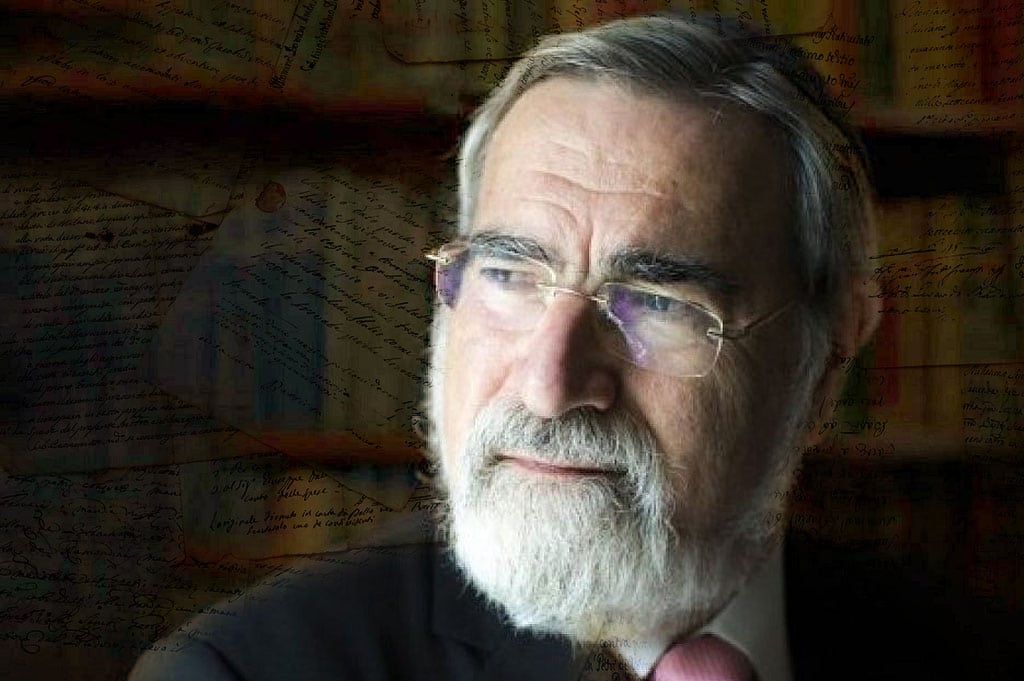
Poetry Inspired By Rabbi Jonathan Sacks
The 13 poems in this collection were inspired by the teachings and books of Rabbi Lord Jonathan Sacks. In the flood of appreciation for this great personality, may the following poetic echoes of some of his thoughts serve as one further testimony to the great wealth that he has brought to the Jewish people and to the world at large.
Each of the following poems is a reflection on a particular work or teaching. The context is evident from the title of the poem, and as needed, a brief explanation follows.
FORGIVENESS AND REPENTANCE
Playing up forgiveness,
playing down repentance,
ignores with lily liverness
the seriousness of sentence.
Playing up repentance,
forgiveness downplayed,
appeals to no defendants
whose sentences aren’t stayed.
Forgiveness of sin
when it is quite sincere,
transforms the greatest chagrin
it causes into cheer.
Rabbi Lord Jonathan Sacks said that repentance is a core factor in Judaism, invented by Jews. Greeks have the concept of appeasement but not of repentance. He added that he once heard Hannah Arendt say that Christians invented repentance. “I cannot forgive her for saying this,” he added, laughing. He added, concluding his remarks: “I call Judaism the choice of hope in the conversation of mankind.”

A DREAM LIKE KING’S
Contracts benefit, but covenants transform,
the former mere transactions but
relationships the latter, pulpit and platform
where minds are open, never shut.
Cooperating, fauna which have selfish genes
survive because they are a team,
their hidden covenants providing them the means
to thrive, as if they have a dream
like Martin Luther King’s, so that they all can see
beyond their petty selves to where,
cooperating with the so-called enemy,
they triumph since they dare to share.
Inspired by a speech Rabbi Sir Jonathan Sacks gave to an assembly of Anglican Bishops at Lambeth Palace on July 29, 2008. He used the concept of what Richard Dawkins has called the selfish gene to illustrate the difference between contracts and covenants.
COMPLEXITY IN FOURTEEN LINES
Though some look with perplexity
at nuances, complexity
is beautiful and irredu-
cible, all points view
made far more meaningful when syn-
thesis reveals the truth within
the many parts that make the whole,
which nobody should pigeonhole
without remembering that pigeons
are as diverse as all religions
that fools to feeble faith reduce
because they can’t make proper use
of those complexities that rule
what faith should never ridicule.
Inspired by Rabbi Sir Jonathan Sacks’s use, in his contribution to the new Koren-Sacks siddur, of the ideas of the atheistic philosopher Sir Bernard Williams (1929–2003), an analytic philosopher with the soul of a humanist who according to Sacks tells had “the most brilliant mind in Britain” and is generally regarded as the most important moral philosopher of his time.

DIGNITY OF DIFFERENCE
From those who don’t accept the dignity of difference,
give, we all must pray to God, complete deliverance.
These people all have left the universal God behind,
inhabiting instead the ghastly ghetto of the mind.
A people who the prophet Balaam said all dwell alone
will, if they dwell apart, shrink faster than they’ve ever grown.
A fellowship of knowledge in a Jewish conversation
is what is needed most now to preserve the Jewish nation
from itself, and looking outward, not stay inward bound,
while by the prophets, rabbis and enlightenment made sound.
In his obituary of Jonathan Sacks in in the 11/8/20 NYT Ari Goldman writes:
His universalism sometimes got him in hot water with more fundamentalist elements of the Jewish community. When he was chief rabbi, Rabbi Sacks published “The Dignity of Difference: How to Avoid the Clash of Civilizations” (2002), a book whose central message was that religious communities had parity in their attempts to find God.
“God has spoken to mankind in many languages: through Judaism to Jews, Christianity to Christians, Islam to Muslims,” he wrote. “No one creed has a monopoly on spiritual truth; no one civilization encompasses all the spiritual, ethical and artistic expressions of mankind.”
He added: “God is greater than religion. He is only partially comprehended by any faith.”

NOT A DOCTRINE BUT A SHAPER OF MORALITY
Religion should not be a doctrine, once declared Lord Sacks,
but a shaper of behavior and a tutor
in morality. You have no problems if you’re lax
in doctrine, being of its tenets a disputer,
but do have if your conduct isn’t in good shape and your
morality is questionable. It would be
to everyone’s advantage if they felt a lot less sure
of doctrines than of conduct and morality.
When violence reminiscent of the sixties and the novel “A Clockwork Orange” raged in London Lord Jonathan Sacks, who visited Los Angeles on the weekend of February 3-5, 2012, laid the blame on moral decline, as indicated in an Op-Ed he wrote for the WSJ, 8/20-21/11.
CREATIVE MINORITIES
Creativity comes from minorities
who do not follow – slavishly – authorities,
and establishes by influence, not power
like that of kings before whom people cower
and whose power dies when these kings die,
but that of prophets who with rulers vie
for influence, which is the engine driving
all progress that minorities who’re thriving
with creativity ensure. The Jews,
creative, a minority whose views
shaped western culture some call Judaeo-
Christian, have not just swum with flow,
but have affected its direction for
the whole world, their curriculum the core
of culture in the west that’s now attacked
by people who its values have not backed,
worshiping their bodies inside gyms
instead of God whom they once praised in hymns.
Spiritually steeped in soulless error
they tremble, tried and terrified by terror,
optimism helping some to cope,
though, lacking creativity, no hope
will come to them from optimism, cure
that’s bound to fail them, though they may feel sure
that it is justified, as politicians
may promise them, while making bad decisions.
The right solution is to be creative,
although it’s a solution they all hate if
they’re told that they must make their love more real
than so-called truths they think are universal,
but actually can lead to a reversal
of peace and the civility all lives
depend on. A minority that thrives
to be creative is what we must quickly all
now emulate, or we will surely fall.
Inspired by a lecture that Rabbi Jonathan Sacks gave on Monday 21st October 2013, delivering the twenty-sixth Erasmus Lecture at the Union League Club in New York. Hosted by First Things (http://rabbisacks.us7.list-manage.com/track/click?u=2a91b54e856e0e4ee78b585d2&id=866a0135e4&e=a33a939e79), the topic of the lecture was “On Creative Minorities” in which Rabbi Sacks outlined a vision for how religious communities – Jewish and Christian – can function, and indeed thrive, as creative minorities.

CHRISTIAN AND JEWISH ATHEISTS
A Christian atheist does not believe in God,
but Jewish ones will argue with the Lord,
God’s paradoxical reaction to them odd,
His faith in man by arguments restored.
In an epigraph to “The Great Partnership: God, Science and the Search for Meaning,” Rabbi Lord Jonathan Sacks offers four quotes about faith, God and the meaning of life – from Albert Einstein, Sigmund Freud, Ludwig Wittgenstein and Tom Stoppard. It just so happens that all of them were or are secular or assimilated Jews – or in Wittgenstein’s case, the descendant of three Jewish grandparents, which was Jewish enough for the Nazis.
When questioned about this, Sacks acknowledges it’s no coincidence that they’re his conversation starters. “A Christian atheist doesn’t believe in God. A Jewish atheist doesn’t believe in God, but keeps arguing with Him,” he quips.
THE TENTH COMMANDMENT
Violence, Girard declares, comes from a mimetic version of desire,
that’s why in the Commandment that is number ten, ve-
toing the root of violence, of social harmony the nullifier,
lurks the greeneyed monster that’s entitled “Envy.”
Jonathan Sacks discusses the importance of the Tenth Commandment in “To Thank Before We Think: Yitro – Covenant & Conversation 5776 on Spirituality,” 1/30/16

WHY A JEW IS TYPICALLY A PHILOSOPHER
When Theosophists suggested that a Jew is typically a philosopher,
they may have been thinking of Job, who despite his loss of a
debate with God accepted His authority. Even when they’re losers,
Jews carry on, of God and all accusers the excusers.
Rabbi Lord Jonathan Sacks writes in the Koren Sacks Yom Kippur mahzor, quote on his website on 10/6/16 (“Yom Kippur—How It Changes Us”):
The sages said that Abraham was called ha-ivri, “the Hebrew,” because all the world was on one side (ever echad) and Abraham on the other. To be a Jew is to swim against the current, challenging the idols of the age whatever the idol, whatever the age.
So, as our ancestors used to say, “’Zis schver zu zein a Yid,” It is not easy to be a Jew. But if Jews have contributed to the human heritage out of all proportion to our numbers, the explanation lies here. Those of whom great things are asked, become great – not because they are inherently better or more gifted than others but because they feel themselves challenged, summoned, to greatness.
Few religions have asked more of their followers. There are 613 commandments in the Torah. Jewish law applies to every aspect of our being, from the highest aspirations to the most prosaic details of quotidian life. Our library of sacred texts – Tanakh, Mishnah, Gemarra, Midrash, codes and commentaries – is so vast that no lifetime is long enough to master it. Theophrastus, a pupil of Aristotle, sought for a description that would explain to his fellow Greeks what Jews are. The answer he came up with was, “a nation of philosophers.”
INFLUENCE AND POWER
Influence is more enduring than is power,
for unlike power it, when most significant, endures,
and even sometimes blooms just like a virtual flower
when posthumously its producer’s influence matures.
Inspired by an essay by Rabbi Jonathan Lord Sacks (“Influence and Power,” Pinchas 5777)
WHAT YOU MAY FEEL BUT SHOULD NOT SHOW
Anger is a feeling you may feel, but should not show,
for if you do it’s very possible that you will sow
the anger in another person’s heart, and sadly reap
what should – just like an animal that’s sick – be put to sleep.
It only comes when you are thinking fast instead of slow,
with all discussions while you feel it made pianissimo.
Rabbi Lord Jonathan Sacks wrote:
Maimonides on Moses teaches us that we should try to conquer our feelings of anger. But when we see someone or a group acting wrongly, we may have to show anger even if we don’t feel it. People sometimes need that shock to help them change their lives.

SHAME AND GUILT, ATONEMENT AND ALONEMENT
No one can be vulgar all alone,
which strangely also leads
me to conclude that nobody can feel ashamed
if his world is, pace Donne, an island,
but belief that there’s a heavenly highland
that’s ruled by God, enables people to feel blamed
for all their wicked deeds,
which they hope He will forgive if they atone.
Even if they think they’re on an island, they
need to feel guilt instead
of shame, and only if they feel this are they able
to atone for all bad deeds they have performed.
By atonement they’re allegedly reformed
without the guilt that had made them unstable,
but unlike guilt that they have shed,
shame won’t, if they’re not on an island, go away.
If you believe in God you may think guilt can be removed by means of your atonement,
but there’s no cure for shame, except for living in an island, solitary alonement.
Since nobody on planet earth is ever able to live all his life quite blamelessly,
no one who concurs with Donne believes that it is possible to live all life quite shamelessly.
Rabbi Lord Jonathan. Sacks, discussing the contrast between shame, as described by his teacher, Bernard Williams, and guilt, said that we are currently living in a society where shame rather than guilt rules.
CONFIDENCE
Confidence is conceptual stuff
that transforms into action thought.
If of it you don’t have enough
“can’t do” will thwart all thought of ought.
Rabbi Lord Sacks wrote that the mission of the ten spies described in Numbers 13-14 was “perhaps the single greatest collective failure of leadership in the Torah. Ten of the spies whom Moses had sent to spy out the land came back with a report calculated to demoralize the nation. “
He added:
The truth is that in no small measure a law of self-fulfilling prophecy applies in the human arena. Those who say, “We cannot do it” are probably right, as are those who say, “We can.” If you lack confidence you will lose. If you have it – solid, justified confidence based on preparation and past performance – you will win. Not always, but often enough to triumph over setbacks and failures. That, as mentioned in a previous Covenant and Conversation, is what the story of Moses’ hands is about, during the battle against the Amalekites. When the Israelites look up, they win. When they look down they start to lose.
Gershon Hepner is a poet who has written over 25,000 poems on subjects ranging from music to literature, politics to Torah. He grew up in England and moved to Los Angeles in 1976. Using his varied interests and experiences, he has authored dozens of papers in medical and academic journals, and authored “Legal Friction: Law, Narrative, and Identity Politics in Biblical Israel.” He can be reached at gershonhepner@gmail.com.
Poetry Inspired By Rabbi Jonathan Sacks Read More »