fbpx

November 9, 2020

An American Rabbi Says Thank You to President Trump

By now, many Americans are piling up on Donald Trump. They’re calling him a loser. They’re reveling in his defeat. They’re saying America is saved from the ogre.

But I, for one, will not join this criticism. Although I accept the results of the election, in bowing to the majesty of the American democratic tradition, I also submit to the Jewish values that tell me to show gratitude toward a true friend of our people.

Donald Trump was always a controversial figure. He could, at times, be deeply divisive, and he reveled in being a counter-puncher. But I will remember him as a staunch friend of the world’s most persecuted nation.

To be a Jew is to expect bigotry, double-standards, and prejudice. To be a Jew is to accept the unbelievable fact that in the lifetime of my parents, six million Jews were murdered by firing squads and poison gas. To be a Jew is to live with the almost daily vilification of Israel, the world’s only Jewish state.

On to this stage of tragic history rose President Trump, with an unfailing defense of our people at every turn. President Trump proved himself to be the greatest friend of Israel ever to occupy the Oval Office.

Trump fundamentally changed the tenor toward Israel at the disgustingly unfair United Nations, where the demonization of Israel was a seventy-year tradition. He hired the most pro-Israel people ever to serve in an American administration. From Nikki Haley to David Friedman to Jason Greenblatt to Jared Kushner to Avi Berkowitz to Mike Pompeo, and, of course, Mike Pence, Trump’s subordinates had Israel’s back at every turn.

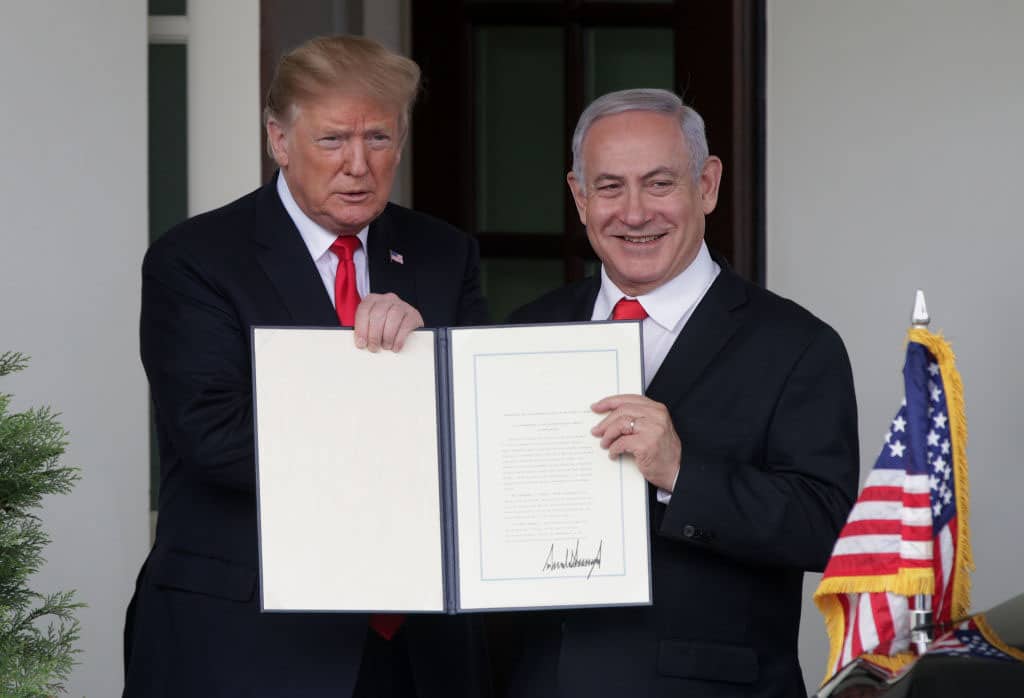
They shut down the corrupt Palestinian Authority’s quasi-embassy in Washington because of Mahmoud Abbas’ constant incitement against Israel. They held Hamas accountable for their genocidal ambitions and actions against Jews, and they defunded UNWRA. They recognized Jerusalem as Israel’s eternal capital. And they recognized the Golan Heights as being forever sovereign Israeli territory.

Israel has had many friends in the White House, from John F. Kennedy to Lyndon Johnson to Richard Nixon to Ronald Reagan to George W. Bush. But Trump easily outdid them all.

Israel has had many friends in the White House. But Trump easily outdid them all.

But Trump was also a protector of Muslim lives, as he demonstrated in Syria when he fired American missiles at Bashar Assad, who gassed Arab children and was given a pass by Barack Obama. Trump did this even as he was vilified by his opponents as a hater of Muslims.
If he was has hated by the Arabs and Muslims, as his American opponents would have you believe, how is it that only Trump was able to forge peace between Israel and the UAE, Bahrain, and Sudan? Obama could not pull it off. To the contrary. The Arab nations despised Obama’s negotiations with Iran. Due to Trump’s policies, they began to see Israel as a kindred spirit rather than as an enemy.

Trump deserved the Nobel Peace Prize for possibly ending the Arab-Israeli conflict, but his critics gave him scant praise for this incredible achievement.

Most notably, Trump took America out of the execrable Iran deal, which legitimized a regime that hangs gays from cranes and stones women to death. He stopped immoral payments to a regime that is the foremost purveyor of terrorism around the world.

It is fashionable to attack Trump, now that he has lost the election, even though he garnered more than 70 million votes. But I will not be one who joins the demonization of a true friend of my people.

Rather, I will thank him and ask his successor, Joe Biden, who has a long history of friendship with the Jewish people and Israel, to embrace his predecessor’s approach and continue to champion the Middle East’s only democracy.

Gratitude is a dying virtue in our world, which puts partisan loyalty before basic decency and values. To be sure, Trump, like the rest of us, is a flawed man. And Trump, like all presidents who preceded him, made many mistakes. This is the price we all pay for human leadership.

But on the subject of Israel and the Middle East, he was exceptional and deserves to be recognized as such.

President Trump, I thank you, from the bottom of my heart, for your protection of a vulnerable people who have been massacred throughout the ages.

May God bless you and keep you, and may the country that you served for the last four years be fair and thankful in their assessment of your legacy. And may President-elect Biden follow in your trailblazing footsteps of friendship to Israel and the Jewish people.


Shmuley Boteach, “America’s Rabbi,” whom the Washington Post calls “the most famous Rabbi in America,” is the international best-selling author of more than 30 books and is the founder of The World Values Network. Follow him on Twitter and Instagram @RabbiShmuley.

An American Rabbi Says Thank You to President Trump Read More »

‘Oslo’ Drama Underway from Steven Spielberg, Marc Platt

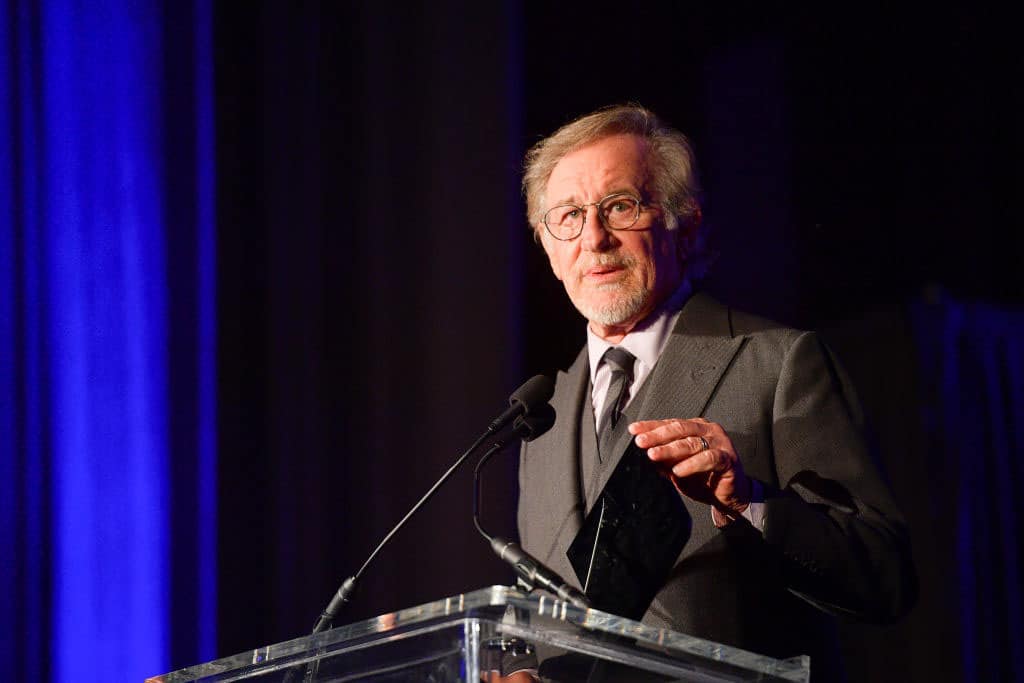
Steven Spielberg, Mark Platt and David Litvak are bringing the J.T. Rogers’ Tony Award-winning play “Oslo,” about the 1993 Israeli-Palestinian Peace Accords, to HBO. Now shooting in Prague, Czech Republic from Rogers’ screenplay and directed by Tony winner Bartlett Sher, the film stars Ruth Wilson and Andrew Scott as the Norwegian foreign minister and her sociologist husband who were involved in the negotiations.

The cast also includes Israeli actors Jeff Wilbusch (“Unorthodox”) as Uri Savir, Director General of the Israeli Foreign Ministry; Igal Naor (“Fauda”) as Joel Singer, Legal adviser to the Israeli Foreign Ministry; Dov Glickman (“Shtisel,” “Stockholm”) as Yair Hirschfield, Israeli Professor of Economics; Rotem Keinan (“Fauda”) as Ron Pundak, Hirschfield’s associate and fellow Israeli professor; Itzik Cohen (“Fauda”) as Yossi Beilin, Israeli Deputy Foreign Minister; and Sasson Gabai (“Sirens,” “Stockholm”) as Shimon Peres, Foreign Minister of the State of Israel.

“My memory of seeing ‘Oslo’ on the stage for the first time is still so vivid,” executive producer Kristie Macosko Krieger said in a statement. “I felt then what I feel now – this is a powerful and necessary story for our times. I’m excited to be working with Steven, Marc, HBO and Bold Films, along with our incredible cast and creatives, to bring this story to an expanded global audience.”

“In collaboration with Steven, Kristie, Marc, and Bold Films, we’re delighted to work with J.T. and Bartlett to adapt their inspiring Tony Award-winning story for the screen,” Tara Grace, Senior Vice President, HBO Programming and Films, added. “Recounting the remarkable feat of two diametrically opposed sides coming together to find common ground, ‘Oslo’s’ themes are especially pertinent, and we couldn’t be more pleased to have so many revered artisans on both sides of the camera working together to bring this to life.”

“Oslo” will air on HBO and stream on HBO Max next year.

‘Oslo’ Drama Underway from Steven Spielberg, Marc Platt Read More »

Home Shalom Monday Message #30

Home Shalom promotes healthy relationships and facilitates the creation of judgement free, safe spaces in the Jewish community. Home Shalom is a program of The Advot Project.

Please contact us if you are interested in a workshop and presentation about healthy relationships, self-worth or communication tools.

“The crown of a good name surpasses them all.”
~Mishnah Avot 4:17

One of the most frequently quoted sages in the Talmud is Rabbi Shimon bar Yohai. He was a disciple of the famed Rabbi Akiva and said to be the author of the famous Jewish mystical book The Zohar. According to rabbinic legend, when Rabbi Shimon spoke out against the Roman emperor Hadrian, he was condemned to death and hid in a cave in the north of Israel with his son Eleazer for 13 years until Hadrian died and he felt it safe to emerge. The Talmud in Shabbat 33b recounts that they survived on dates and carob fruit from a carob tree that miraculously sprung up to hide the entrance of the cave along with a spring of water and that they studied Torah the entire time. When they emerged and Shimon saw the people busy with agricultural pursuits and not studying Torah, the power of his angry glances alone started killing people and a voice from heaven (bat kol) told him to return to the cave. He did so for another twelve months until another heavenly voice said it was time to reenter society again.

One of his better known sayings is from the Mishnah Avot 4:17, where he taught, “There are three crowns: the crown of Torah, the crown of Priesthood and the crown of Kingship – but the crown of a good name surpasses them all.”

The image of a “crown” is a symbol of authority and respect. Kingship and the priesthood are hereditary passed down from father to son from the House of David, or the descendants of Aaron. Even though the “crown of Torah” is earned by individual study and effort, Rabbi Shimon recognized that the most important symbol of authority and respect in the world is the one that comes with having a shem tov, a “good name.”

The reputation that you earn in the world is not simply the result of inherited status or intellectual acumen but rather the result of who you are as measured by what you say, what you do, and how you treat others every day. The real lesson is that having a shem tov, earning the greatest level of honor and respect from your peers, is totally in your hands and that power is one no one can ever take away.

Rabbi Steven Carr Reuben, Home Shalom
Naomi Ackerman, The Advot Project

Home Shalom Monday Message #30 Read More »

Israelis React to Biden Win in US Election

The Media Line — Israelis have voiced mixed feelings about US President-elect Joe Biden’s hard-fought election win, with some welcoming the change and others questioning its impact on the balance of power in the Middle East.

After Biden defeated incumbent President Donald Trump, many in Israel wondered how US foreign policy in the region will shift and how the result will affect negotiations with Iran, Israel’s longtime foe.

The Media Line took to the streets of the central Israeli city of Modi’in-Maccabim-Re’ut to hear their initial reactions.

Israelis React to Biden Win in US Election Read More »

Bahrain, Israel, UAE Hold Historic Virtual ‘Tourism Meet’

For the first time since the signing of the Abraham Accords agreements, Israel, the United Arab Emirates and Bahrain’s top tourism officials came together virtually to discuss new travel and business opportunities between the three countries.

Orit Farkash-Hacohen, Israel’s minister of tourism; Dr. Ahmad bin Abdullah Belhoul Al Falasi, the UAE’s minister of state for entrepreneurship and small and medium enterprises; and H.E. Mr. Zayed R. Alzayani, Bahrain’s minister of industry, commerce and tourism, met online at virtual session titled “Tourism: The Path to Peace in the Middle East.” The panel was part of WTM (World Travel Market) Virtual, the second-largest international tourism fair, which is being held from November 9 to 11.

“People moving between countries is the expression of true peace,” Farkash-Hacohen said at the opening of the session. “I think that governments sign contracts and agreements, but people are the true expression of peace.”

Farkash-Hacohen’s Emirati counterpart, Al Falasi, agreed and also pointed to emerging business opportunities as being a major motivator for newly blossoming ties.

“Israel has been very well-known to be a hub for startups, specifically in hi-tech technologies,” Al Falasi said. “I think the Abraham Accords will really help both the UAE, being a hub for the Middle East and North Africa … and Israel to have a slew of entrepreneurs and investments [that will] enrich the ecosystems of both sides.”

He added that Emiratis are very excited to be able to travel to Israel and that he expects both incoming and outgoing tourism between the two countries to boom in the near future. For this reason, the UAE’s travel industry has already begun ramping up the production of kosher food for Israeli tourists.

“People moving between countries is the expression of true peace. I think that governments sign contracts and agreements, but people are the true expression of peace.”

Alzayani, Bahrain’s minister, also stressed that Bahrain’s business sector is particularly keen to begin working with their Israeli colleagues.

“There are a lot of commonalities with Israel and Bahrain: the sense of entrepreneurship, the pride in creating, and being small nations,” Alzayani said. “For years we have been isolated from each other. I think we have a golden opportunity now to explore new ventures with each other.”

While visa requirements are still being ironed out, on Monday Israeli airline Israir announced that it would begin offering weekly flights to Bahrain beginning on January 31.

“We are excited on every level and looking forward for the skies to open so that we can have guests from the UAE and Bahrain,” Farkash-Hacohen stressed.

Foreign nationals are still forbidden from entering Israel due to COVID-19 restrictions. Nevertheless, Israel’s Tourism Ministry is already preparing for an expected surge in incoming Muslim tourism and has begun training tour guides to develop their Arabic language speaking skills.

The ministers’ statements come less than two months after the signing of historic bilateral normalization agreements, which have accelerated a wide range of business and intergovernmental initiatives in the region. The tourism sector has also been at the forefront of these efforts despite the ongoing pandemic.

“When people travel, they form friendships, engage in dialogue and are able to see things from a different perspective,” WTM Senior Director Simon Press said ahead of Monday’s virtual session. “When flight paths open up, the prospect for new business becomes a reality, which creates wealth and opportunity for destinations and their citizens. The post-COVID possibilities are endless for this region and we’re excited that WTM Virtual has been able to facilitate such an important meeting and play a part in history.”

Bahrain, Israel, UAE Hold Historic Virtual ‘Tourism Meet’ Read More »

Is Saving Art Worth Lives?

When we think of the heroes in World War II, we usually think of individuals who saved others’ lives. But what about the heroes who risked their lives to save culture?

More than 20% of the art in Europe was looted by the Nazis during World War II, including 600,000 paintings belonging to Jewish owners. At least 100,000 works of art are still missing today. The Nazis’ goal was to destroy the history of cultures that they deemed inferior and make sure there was no trace left from them. They burned and destroyed many Surrealist, Expressionist, and Cubist pieces (which they categorized as degenerate), sold works such as Impressionist pieces in order to buy other pieces they liked, and kept all the pieces pleasing to Hitler to be exhibited in his Linz collection.

In June 1943, at the request of General Eisenhower, the Civil Affairs and Military Government Sections of the Allied Armies formed the Monuments, Fine Arts, and Archives (MFAA) section. A group of men and women from thirteen nations, who came to be known as the Monuments Men, volunteered to be part of the MFAA. Many were architects, museum directors, librarians, artists, and educators. “Their job description was simple: to save as much of the culture of Europe as they could during combat,” Robert M. Edsel describes in his book “The Monuments Men” (which was the basis of the 2014 movie of the same name). The Monuments Men considered all art to be equally significant and worth saving for preservation of culture. George Stout, an art conservator and one of the Monuments Men, stated, “Our job isn’t to judge; our job is to save the art.”

On a hot Friday afternoon this summer, I had the honor to interview both the last surviving Monuments Man, Richard M. Barancik, and Ruth Adler Schnee, a Holocaust survivor with a lifelong passion for art. I spent much of my quarantine summer researching the MFAA, so I jumped at the chance to hear the firsthand account of these older figures, and glean the significance of the MFAA section in their eyes.

Richard Barancik

The last surviving member of the Monuments Men, Richard M. Barancik was born in Chicago, Illinois and in December 1942, at the age of 17, enlisted in the Army Enlisted Reserve Corps,, against his father’s will. He joined a special training program and studied basic engineering as a cadet in 1943 at the University of Nebraska.

Richard’s first combat experience was during the Battle of the Bulge. On Christmas Eve, as part of the 66th Infantry Division, he crossed the English Channel to France, and he witnessed part of his unit torpedoed by enemy submarines. He recalled seeing bodies washing up upon the beach from the S.S. Leopoldville. “It was a terrible tragedy that occurred through a screwup of the British, Belgians and Americans. It was described for many years as the best kept secret of the Second World War, to avoid embarrassment.” Approximately 800 men lost their lives in that tragedy.

After the war ended, Richard was sent to Bagdestein, Austria, where the 66th Division prepared the town’s hotels for the arrival of camp survivors. While in Badgestein, he noticed on a bulletin board that the Army was looking for men with an art background to join the MFAA. He applied for duty and was selected. For three months, Richard served as a guard and assisted in moving stolen art to the Wiesbaden Central Collecting Point. “The art was wonderful,” Richard said, unlike anything he’d ever seen.

After the war, Richard studied architecture at Cambridge University in England and the Ecole des Beaux Arts at Fontainebleau in France and became a successful architect with his own firm in Chicago.

Ruth Adler Schnee

A textile designer and interior designer, Ruth Adler Schnee is familiar with another side of Richard’s story — those who had art stolen from them. Ruth attended  the Degenerate Art Exhibition in Düsseldorf in t 1938. The teenager was in awe of the exhibit, which included examples of  Impressionism, Dadaism, Cubism, Surrealism and Expressionism, displayed by the Nazis as examples of art that degraded German culture.

At the time, Ruth was friends with the family of Adele Bloch-Bauer’. Adele was most famously known as the model in the painting “Woman in Gold” by Gustav Klimt, stolen by the Nazis in 1941. Ruth would often go to Adele’s house to play with her niece and see the painting in their living roomwas. She was also close family friends with the modern artist Paul Klee. As a child, Ruth went to Klee’s apartment, which was right below hers, and playing with the colorful shapes that he had designed. Ruth’s family, who had been in the publishing and rare book business for 500 years, lost everything. Her mother’s modern art collection was stolen and destroyed by the Nazis. Ruth remembered dreaming with her family about life in a peaceful place.

Ruth and her family endured the insufferable persecution of the Jewish people in Germany. Her father was imprisoned at Dachau but, miraculously, her mother was able to free him. Though it was difficult, her family acquired the necessary papers to leave Germany and immigrate to the United States, where they re-established their lives in Detroit. Ruth continued her studies and was granted a full scholarship to the Rhode Island School of Design for fashion. “Design was my passion,” she said. After the war, Ruth became one of the founding figures of textile design in the United States.

Her family’s art and treasures were never retrieved.

The Legacy of the Monuments Men

The Monuments Men rescued five million stolen art pieces and artifacts and restored them to their rightful owners whenever possible. However, tens of thousands of looted pieces are still missing today. In December 1998, forty-four countries agreed  to the Washington Principles on Nazi-Confiscated Art, and set a goal to identify, locate, and restore all looted artwork. During the last twenty years, many museums and art galleries have begun researching paintings that had passed through Europe and had suspicious origins or ownership roots. Almost 30,000 stolen works have been posted and identified on a collaborative portal since then. France, Germany, Austria, the Netherlands, and Britain created advisory commissions and have returned thousands of looted art and personal belongings.

In 2009, forty-six countries extended the Washington Principles by signing on to the Terezin Declaration. This Declaration included a wider range of institutions beyond museums and art galleries, and extended the definition of confiscated art to include art that was sold by Jewish families who were trying to flee Nazi Germany and needed the money to do so. Unfortunately, many other European nations, including Russia, have not cooperated with or supported any of these declarations, and still have many stolen pieces on display in public and private museums, and traded in markets.

Is Art Worth Lives?

Often, people think art is meant to be displayed in museums and shown to the public only for the sake of its visual appeal. However, Richard Barancik and Ruth Adler Schnee demonstrate that art is a representation of our history, our culture, and our past.

Art never ages and will never die.

The Nazis understood this power, and tried to demolish the memory of certain civilizations by taking away their art. It is important that we remember their unjust actions and never forget those who helped preserve our history.

At the end of the movie “The Monuments Men,” the captain of the MFAA section is asked the poignant question: “Is saving art worth lives?” I ended both of my interviews with this same question. Ruth enthusiastically said “absolutely!” But Richard gave me an unexpected answer: “If I were [one of] the ones that died, I would say no. The art that was saved was wonderful, and the Monuments Men did wonderful things, but it’s not worth someone’s life.” Their contrasting responses likely stem from their very different lives. For Ruth, art and artifacts were a testament of her family’s existence and her heritage. But Richard was a soldier, who witnessed the horrors and damages to human life that the war caused with his own eyes.

I once would have agreed with Richard if I was asked this question. But after doing each interview, I couldn’t help but think of the MFAA soldiers that were killed for the sake of art during the war. Their deaths conveyed a powerful message: Saving art is worth a human life because it means saving our ability to document our history, maintain our identity, and preserve our culture through time. Art provides a personal and emotional perspective on history that allows us to understand others’ experiences as humans. In an age in which technology can be manipulative and any version of history spread online, art is like a primary source that serves as proof of the humanity of others across time and cultures. What is more valuable than that?


Amalia Abecassis is a tenth-grade student at Shalhevet High School.

Is Saving Art Worth Lives? Read More »

A Prayer for Our Country After the Election

Our nation has chosen a new leader
To guide us forward in this challenging time.
Help us, God, to unite our great country
In the wake of a contentious election.
Teach us to listen to one another,
To heal our divisions and to restore hope.
The days that lie before us will not be easy,
But they are ours to shape.
Let them be days of repair,
Days when we will stem the tide of this horrific pandemic,
Days when we will join together
To build a new future.
For some of us the results of this election are a cause for great celebration,
For others the results are a deep disappointment.
Our charge today must be to rise above conflict,
To rise above our differences,
And welcome in a new time of understanding,
A new time of caring and empathy,
Decency and support.
Bless us God, with ears to hear,
Hearts to love,
And hands to reach across party lines,
So that we can ensure liberty and dignity for all.

Land of opportunity and dreams
We vow to protect our blessed democracy
And to safeguard the freedom that is our birthright.
We pledge our allegiance
To every soul in need
And every child praying for a better tomorrow.
Bless America, God,
With peace, prosperity, and with justice for all, Amen.

A Prayer for Our Country After the Election Read More »

More than 40,000 People Send Flowers for Shabbat to COVID Heroes

Thousands of flower bouquets were delivered in time for Shabbat last Friday through the Shabbat Project as part of their COVID-19 Shabbat initiative.

More than 40,000 people sent flowers to coronavirus patients, doctors, frontline healthcare workers, volunteer first responders, Lone Soldiers and elderly people who are isolated and at high risk during the pandemic, Holocaust survivors, new immigrants to Israel, community leaders, people with disabilities, residents in old-age homes and farmers.

“It’s been a really difficult year. We’ve been torn apart in many ways.  So, at the Shabbat Project we decided to come up with a campaign that could bring people together – something to remind one another that we are always here for each other,” South African Chief Rabbi and founder of the Shabbat Project, Rabbi Dr. Warren Goldstein said. “Shabbat is always an opportunity for all of us to come together, put aside our differences and  build a kinder, gentler, more empathetic world.”

Many participated in the virtual festivities and sent flowers, including Israel’s former president Reuven Rivlin. In a statement provided to the Journal, he said it was a privilege to take part in the project.

“Shabbat brings so much joy and we must do all we can to bring light and happiness,” Rivlin said. “My flowers were sent to the residents of the Naamat refuge shelter for women in Jerusalem, with my wishes for strength and happiness.”

President Rivlin sends “Flowers for Shabbat”

The “Flowers for Shabbat” initiative was a new addition to this year’s annual international Shabbat Project. More than 1,600 cities and 106 countries around the world took part in the Shabbat and Kabbalat Shabbat programs. Because of coronavirus restrictions, organizers brought together Jews of all ages, backgrounds and nationalities virtually. The year’s theme was to “Bring Shabbat Home.”

More than 1,600 cities and 106 countries around the world took part in the Shabbat and Kabbalat Shabbat programs.

This year’s Shabbat Project included a virtual challah bake in Arizona involving participants from New York, Canada, New Jersey, Australia, South America and Israel. A special challah bake took place in Mexico City for 135 bat mitzvah girls from across Latin America and Spain, which helped to alleviate some of the disappointment of not being able to celebrate their bat mitzvah with their friends and extended family.

In Kfar Yona, Israel, the Ministry of Education in association with the local municipality, sent thousands of “Shabbat kits” – with candles, a songbook, challah ingredients and other items – to every single resident in the town, and encouraged neighbors to exchange challahs with each other. Shabbat packs were also distributed to 1000 families around Eilat, as well as to soldiers, Magen David Adom workers and police officers.

In South Africa, high school students ran their own challah bake, encouraging participants to bake four challahs and donate two of them to those in need, while also raising money for local welfare organizations that have done such vital work during the coronavirus crisis.

In the United Kingdom a 24-hour challah bake featured 19 different cities and a “Shabbaton at Home” initiative that reached 30,000 Jewish households and 75 shuls across the country.

Locally, renowned psychologist and Holocaust survivor Dr. Edith Eger took part in a webcast hosted in Orange County, followed by a live broadcast performance from the Shalva band in Jerusalem. In the build-up to Shabbat, special Shabbat boxes with education materials were distributed to Jewish families across Orange County. In Los Angeles Jews participated in a Jewish vegan Shabbat cooking class.

“Against all odds, this was actually the most vibrant Shabbat Project in recent memory, even amid all of the COVID-19 challenges and restrictions,” Goldstein said. “Jewish communities around the world joined together, virtually, defying geographical barriers, in a beautiful display of Jewish unity. I believe the Jewish world is realizing – now more than ever – that Shabbat is our anchor, no matter how stormy the sea.”

More than 40,000 People Send Flowers for Shabbat to COVID Heroes Read More »

Have You Heard the Big News About the Vaccine?

In a stunning development, Pfizer announced today that its early data shows that its COVID-19 vaccine is more than 90 percent effective.

“This is really a spectacular number,” Akiko Iwasaki, an immunologist at Yale University, said to The New York Times. “I wasn’t expecting it to be this high. I was preparing myself for something like 55 percent.”

Dr. Saad B. Omer, the director of the Yale Institute for Global Health, said to the Times that if the final vaccine is 90% effective, it “would be higher than your regular flu vaccine, and this vaccine could have a serious impact on bending the curve of this outbreak.”

This is big news, very big news. Considering the historic devastation COVID-19 pandemic has brought to our planet in 2020, one would think that major news outlets would go all-in with this remarkable development.

And yet, when I checked The New York Times, CNN, Fox and MSNBC websites, none gave it major prominence. The Washington Post included the item in its major headline of the day, connecting it to the stock market: “Biden Takes Steps to Fight Pandemic; Markets Soar on Vaccine News.”

I’m not sure if the Post editors caught the irony in that headline: After all, what better way to fight the pandemic than with a promising vaccine?

Whether one loves or hate President Trump, we must give him credit for his Operation Warp Speed initiative, which has supported a massive effort to develop, produce and distribute an effective vaccine and treatment.

Whether one loves or hate President Trump, we must give him credit for his Operation Warp Speed initiative.

According to the Times, “On Monday, a spokeswoman for Pfizer clarified that the company is part of Operation Warp Speed as a supplier of a potential coronavirus vaccine.”

In other words, Trump’s zeal to get a vaccine that can save lives and restart our broken economy seems to be paying off.

President-elect Biden congratulated the “brilliant women and men who helped produce this breakthrough” but cautioned that “for the foreseeable future, a mask remains a more potent weapon against the virus.” That may well be true, but if I were Biden, I would also announce that my top priority will be to build on Trump’s success and accelerate the arrival of a safe and effective vaccine– which would represent a huge global accomplishment. I would even express gratitude for the initiative.

If that’s not a statement of “national unity,” I don’t know what is.

Have You Heard the Big News About the Vaccine? Read More »

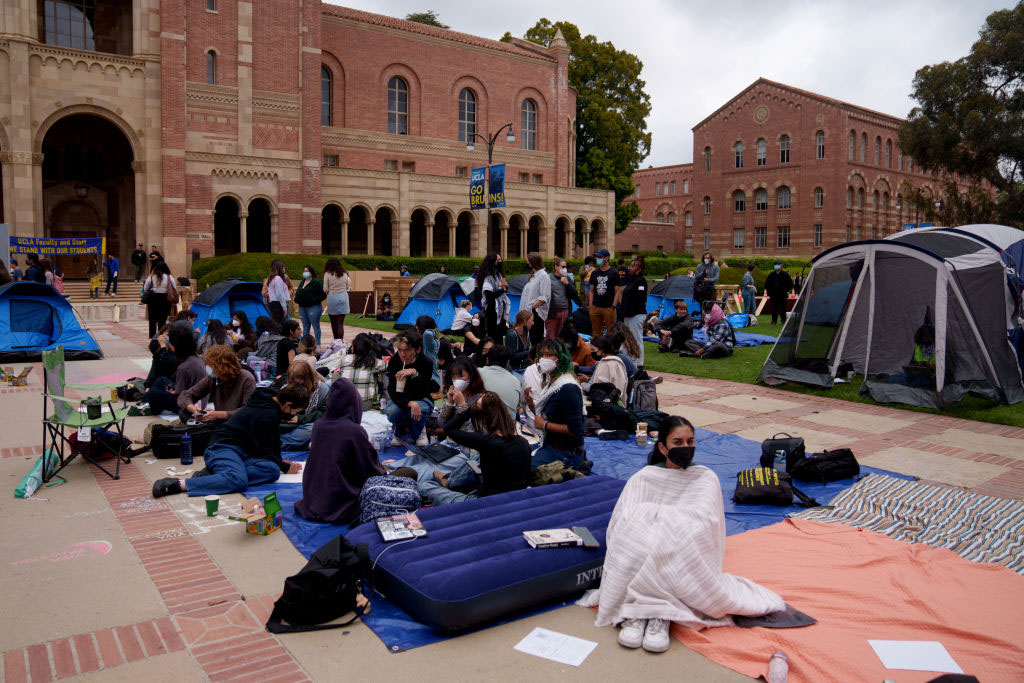
SFSU Faces Possible Federal Investigation for Leila Khaled Event

The federal government could potentially investigate San Francisco State University (SFSU) for attempting to host Popular Front for the Liberation of Palestine (PFLP) member Leila Khaled in September, the New York Post reported.

The November 5 article stated that The Lawfare Project — an organization dedicated to fighting for the civil rights of the Jewish people in court  — argued to the Department of Education that by attempting to give Khaled a platform, the university violated federal law stating that one can’t provide “material support” to terrorists. The State Department has designated the PFLP as a terror organization.

In response, the Department of Education referred the matter to the Treasury and Justice Departments to determine if the university violated anti-terror laws. The Education Department’s civil rights division in San Francisco will also determine in the next 30 days if they will investigate the university.

An SFSU spokesperson told the Jewish News of Northern California that the university has not been contacted about a possible investigation.

SFSU’s Arab and Muslim Ethnicities Diaspora Studies Department (AMED) had planned to host the Zoom webinar on September 23; the day before, Zoom announced that they would not allow their platform to be used for the webinar. The day of the webinar, Facebook also deplatformed the event and YouTube cut off the live stream at around 23 minutes in.

University President Lynn Mahoney wrote in a September 23 email to the campus that the university did not believe the webinar violated federal law because “Ms. Khaled is not speaking as a member, representative, spokesperson, or surrogate for the Popular Front for the Liberation of Palestine; and Ms. Khaled is not receiving compensation from the University of any kind for her participation in this event.”

SFSU Professor Rabab Abdulhadi, who was slated to co-moderate the webinar, blamed the university for the webinar’s deplatforming, arguing on her Facebook page that the university didn’t provide AMED with other platforms to hold the webinar.

Khaled, now 76, was among the terrorists who hijacked commercial jetliners in 1969 and 1970. Her attempt to detonate grenades on the 1970 flight was thwarted and no one was injured or killed in either incident.

SFSU Faces Possible Federal Investigation for Leila Khaled Event Read More »