fbpx

November 5, 2020

March of the Living Remembers Kristallnacht in Illuminated Campaign

Nov. 9 marks the anniversary of of Kristallnacht, the night of broken glass. It was Nov. 9, 1938, where Nazis instigated a two-day pogrom where more than 1,400 synagogues and Jewish institutions in Germany and Austria were destroyed. Kristallnacht marked one of the key events which lead to the Holocaust.

Over the last four years alone, there has been a global increase in racism, anti-Semitism and extremism. In a new international and interfaith campaign titled, #LetThereBeLight, Holocaust education organization, March of the Living (MOTL) is inviting people of all religions and backgrounds worldwide to symbolically illuminate homes, institutions and places of worship.

This Monday, across the world, mosques, churches, synagogues, temples and private homes are invited to share a symbol of hope in the face of hatred. At the center of this effort will stand the main synagogue in Frankfurt, one of the synagogues in Germany to survive Kristallnacht.

This Monday, across the world, mosques, churches, synagogues, temples and private homes are invited to share a symbol of hope in the face of hatred.

Phyllis Heideman, President of International March of the Living, encourages everyone to send personal prayers and messages for peace, tolerance and respect virtually (you can send yours here.) They will then be projected onto the walls of the Old City of Jerusalem.

“March of the Living is determined to mark the importance of Kristallnacht for several reasons. Firstly, to remind people of the dangers of leaving anti-Semitism unchecked and secondly to unite the world against anti-Semitism and all forms of hatred, bigotry and intolerance,” Heideman told the Journal in an email. “In just the past several weeks, we have seen the shocking attacks in churches in France and in Vienna, we witnessed the murderous consequences of extremism once again. It is clear that the message of Kristallnacht, to warn and act against extremism is more important than ever.”

So far hundreds of messages of light have already been submitted from 40 countries including Brazil, Japan, United States, Germany, Israel, Mexico, Argentina and Hungary. Hundreds of institutions, Jewish leaders, celebrities and organizations have already committed to participate and dozens of organizations have also chosen to be partners in the initiative.
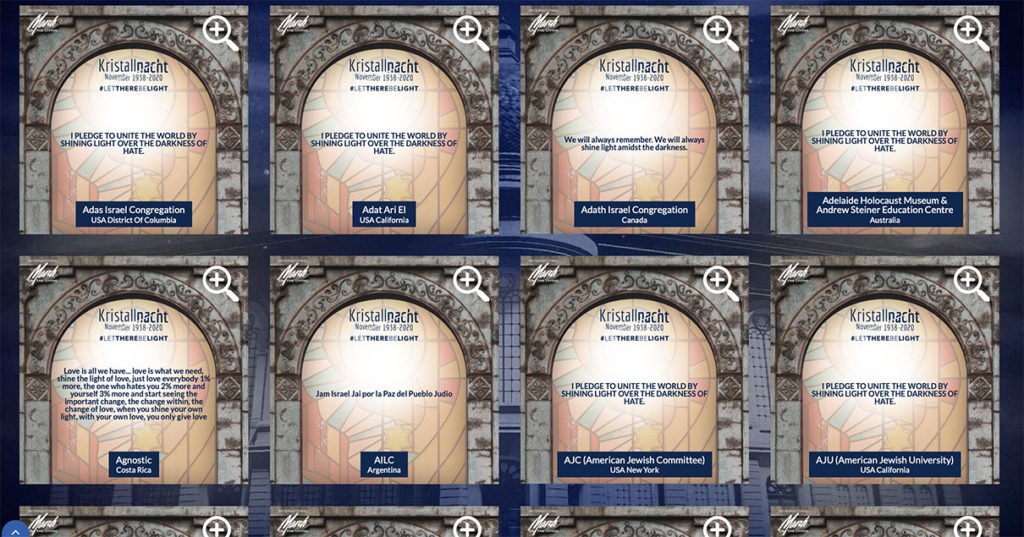
Screenshot from kristallnacht.motl.org

Local Los Angeles organizations are also participating including the USC Shoah Foundation, Holocaust Museum LA, Israeli American Council, The Los Angeles Jewish Home for the Aging, Abraham Joshua Heschel Day School, American Jewish University, Builders of Jewish Education L.A. (BJE), deToledo High School, Milken Community High School, Pico Union Project, Shomrei Torah Synagogue, Valley Beth Shalom, Sinai Temple and Stephen Wise Temple, among others.

While the number of Kristallnacht survivors are dwindling, some are still alive today and continue to share their powerful and painful stories. Senta Graff, 96, was 14 years old when she witnessed Kristallnacht. She has not shared her experience with her community in Los Angeles but told the Journal that, “it was a nightmare.”

“Our synagogue [was] in flames. SS people stormed into our house, broke furniture and windows and threw massive valuables into the street below,” she wrote via email. “They commanded my parents and myself to walk up to the next floor. As I walked, I said the Sh’ma. I was overheard by one of the SS officers and he said to me, ‘Your GOD does not hear you!’”

After Germany invaded Poland in September 1939, Graff said Germany closed all borders and many were left stranded. Among them was a couple who promised her parents they’d do everything to get her out of Germany once they left for Sweden. With their help, Graff escaped to Sweden on March 20, 1940 with two suitcases and 10 German Marks. She went on to live with a Quaker host family.

She notes while her parents did not survive the Holocaust, she was able to reunite with her brother in 1945, who left to study in Holland before Kristallnacht. Now, 82 years after the night of broken glass, Graff said she is blessed to have a husband, five healthy children, 15 grandchildren and 30 great-grandchildren. She said remembering the Holocaust is important because, “we owe [those who have died] so much. It is imperative to never to be silent again and it is our responsibility to educate [and] never to be silent or indifferent to evil.”

Graff’s daughter, Naomi Chernin, told the Journal also by email that her mother’s experience taught her the importance of Jewish religion and culture, the significance of Israel, and the power of family, welcoming the stranger and friendships.

“Hitler has failed because she has raised a committed Jewish family,” Chernin said noting she is most proud of her mom’s “inner strength integrating into a new life, new language, [and] new culture alone, without her parents’ support. [Also for] being able to feel the pain of the past but able to live in the present and raise a family committed to Jewish values.”

She said her #LetThereBeLight message is one she learned from her family, “Jewish people will survive even though there will be persecution.”

Since 1988, March of the Living has continued to be the largest annual international Holocaust education program of its kind in the world. To date, more than 300,000 March of the Living participants from 52 countries have walked the annual 3.2-kilometer-long route from Auschwitz to Birkenau concentration camps.

Heideman said that due to the pandemic, this year’s MOTL was canceled, yet it hasn’t stopped the organization from turning to virtual education and social media to reach millions of people around the world. Even if they can’t meet in-person, she said the organization is committed to sharing the history of the Holocaust and examining the roots of prejudice, intolerance and hatred.

due to the pandemic, this year’s MOTL was canceled, yet it hasn’t stopped the organization from turning to virtual education and social media to reach millions of people around the world.

“We have no choice but to continue remembering the Holocaust, whatever the circumstances” Heideman said. “We cannot stand silent when we see anti-Semitism and when hatred and intolerance raise their ugly head against people of all backgrounds and religions. The message of this campaign is a message of hope, that together we can shine a light towards a brighter future.”

Individuals can upload their messages of hope in their own words at the campaign website. To learn more about March of the Living, visit their website. The anniversary of Kristallnacht is Nov. 9, 2020.

March of the Living Remembers Kristallnacht in Illuminated Campaign Read More »

The Electoral Collage – a poem for Torah Portion Vayera

Arise, go forth from this place, for the Lord
is destroying the city

It is election night and I don’t want to
go to sleep without knowing if my city
is being destroyed.

If all of my friends behind all the
red and blue borders are becoming
pillars of salt because they couldn’t

help but look back. I’d like to take
more responsibility but I cast my Lot
weeks ago. I’d like to tell you

I know how this happened but
I dropped out of electoral college
and now I just look wistfully

at the electoral collages on the TV. It is
election night and I think the chief fornicator
just excused himself from the process.

I’m having a couple of angels over
for breakfast to discuss. The ancient
wisdom says one should get out of Dodge.

The ancient wisdom says there are
fewer people on our side than we thought.
The ancient wisdom says

we should take Canada more seriously.
The appeal of a small city, the healthcare
on every corner, the human beings in charge.

I may come off like a comedian, but
I’m just paraphrasing the oldest book we’ve got.
I’m just telling it like it was. I’m just exhausted

from having to talk about this at all.
I may go to sleep, anyway, before
all the buildings go away.


God Wrestler: a poem for every Torah Portion by Rick LupertLos Angeles poet Rick Lupert created the Poetry Super Highway (an online publication and resource for poets), and hosted the Cobalt Cafe weekly poetry reading for almost 21 years. He’s authored 23 collections of poetry, including “God Wrestler: A Poem for Every Torah Portion“, “I’m a Jew, Are You” (Jewish themed poems) and “Feeding Holy Cats” (Poetry written while a staff member on the first Birthright Israel trip), and most recently “The Tokyo-Van Nuys Express” (Poems written in Japan – Ain’t Got No Press, August 2020) and edited the anthologies “Ekphrastia Gone Wild”, “A Poet’s Haggadah”, and “The Night Goes on All Night.” He writes the daily web comic “Cat and Banana” with fellow Los Angeles poet Brendan Constantine. He’s widely published and reads his poetry wherever they let him.
The Electoral Collage – a poem for Torah Portion Vayera Read More »

Senior Coalition Member: Biden Presidency Means Early Israeli Election

THE MEDIA LINE — If former vice president Joe Biden is declared the victor in the US presidential vote, “it will hasten new elections in Israel,” a senior member of Prime Minister Binyamin Netanyahu’s parliamentary coalition tells The Media Line.

“It would be easier for Netanyahu to [hold an election and then] deal with a Biden White House while leading an ultra-right-wing coalition rather than today’s centrist coalition.”

“Netanyahu has an open door to the [Donald Trump] White House. He may no longer have such strong ties with a Biden White House,” the Knesset member elaborated. “It would be easier for Netanyahu to [hold an election and then] deal with a Biden White House while leading an ultra-right-wing coalition rather than today’s centrist coalition.

“With a Democratic presidency, things will be different regarding the Palestinians in the West Bank. With an ultra-right-wing government, it will be easier for Netanyahu to deal with a Democratic president by protesting to the Americans: ‘I am the most moderate person in my coalition. I can’t do what you ask,’” the senior parliamentarian said.

Under a President Biden, the Middle East would likely face a different type of US leadership.

Biden brings the right pro-Israel credentials, confides Prof. Jonathan Rynhold of the Political Studies Department at Bar-Ilan University in Ramat Gan, near Tel Aviv.

“He has the longest pro-Israel record of any US politician. He met with [prime minister] Golda Meir [in Jerusalem, shortly before the 1973 Yom Kippur War] and loves to tell the story of his father’s support for the creation of Israel. He has an underlying commitment to Israel’s security.”

“He has the longest pro-Israel record of any US politician. He met with [prime minister] Golda Meir [in Jerusalem, shortly before the 1973 Yom Kippur War] and loves to tell the story of his father’s support for the creation of Israel,” Rynhold told The Media Line. “He has an underlying commitment to Israel’s security.

“As vice president, Biden was responsible for the 10-year MoU [Memorandum of Understanding for US Fiscal Years 2019-2028] agreement that provided a boost in military aid to Israel,” Marc Schulman, a spokesperson for Democrats Abroad Israel, stated to The Media Line. “It is clear that the military arrangements will continue.”

“Biden and Prime Minister Binyamin Netanyahu have a good personal relationship from their long years of working together,” commented Dr. Einat Wilf, a former Labor Party member of Knesset and foreign policy adviser to then-vice prime minister Shimon Peres.

Still, one of the biggest differences between the Trump Administration and one led by Biden concerns Tehran and its race to obtain nuclear weapons.

“Iran is a strategic threat to Israel and to the entire region,” former deputy minister in the Israeli Prime Minister’s OfficeMichael Oren, who was ambassador to Washington in 2009-2013, under Netanyahu, told The Media Line.

“Biden has said he is ready to talk with Iran.”

Any new deal negotiated by the United States with Iran will be difficult for Israel, in Oren’s opinion. “And Biden has said he is ready to talk with Iran.”

Rynhold agrees. “An Iran deal is a major national security issue for Israel,” he said.

The 2015 Iran nuclear accord negotiated by then-president Barack Obama “was a total betrayal,” Oren said. “He negotiated the deal behind our backs and those of other US allies in the region.”

Trump, on the other hand, withdrew the US from the accord in 2018, against the vigorous objections of America’s European allies, saying, “Not only does the deal fail to halt Iran’s nuclear ambitions, but it also fails to address the regime’s development of ballistic missiles that could deliver nuclear warheads.”

“It is unclear what Biden means regarding a [revised] deal with Iran,” said Rynhold. “Biden and his people are deliberately being vague. There are significant differences among Biden’s advisers. Will missile development issues be addressed in a new deal? Will concessions be narrowly linked to the nuclear issue? Will US sanctions be cut back? We don’t know what will happen.”

Of one thing, though, Rynhold is certain: “Even if Israel is not sure where negotiations with Iran will go, it does know that Iran will be closer to a nuclear bomb. Things are ratcheting up.”

Regarding a Biden administration negotiating with Tehran, Oren is clear: “Israel needs to move swiftly to engage a new administration on an Iran deal. We need to publish our interests, our vision of what a good deal will look like for Israel. We need to be clear on what a good deal looks like,” he told The Media Line. “We couldn’t do this the first time.”

Despite the genuine personal friendship between Biden and Netanyahu, indications point toward the Democrat pursuing policies regarding the Palestinians and Israel different than those expounded by Trump.

Trump correctly identified the root of Palestinian intransigence, argues Wilf, co-author of The War of Return: How Western Indulgence of the Palestinian Dream Has Obstructed the Path to Peace.

She noted to The Media Line, “Before, there was no real pressure for the Palestinians to come to terms with the legitimate sovereignty of the Jewish people in the Land of Israel. Trump stopped this by defunding UNRWA [the UN Relief and Works Agency for Palestine Refugees] and taking issue with the Palestinian Authority’s payments to terrorists’ families, among other actions.”

“He will likely go back to the Obama-Clinton peace process, with a two-state solution and east Jerusalem as the Palestinian capital.”

Oren notes that Biden differs from Trump in a few significant areas regarding the peace process with the Palestinians. “He will likely go back to the Obama-Clinton peace process, with a two-state solution and East Jerusalem as the Palestinian capital.

“It is likely that a Biden administration will oppose building by Israel in the West Bank and in eastern neighborhoods of Jerusalem,” Oren said, seeing this as a continuation of previous Democratic administrations’ policies.

The United States’ new embassy in Jerusalem will not be moved, he said. However, he suspects that the former US Consulate in east Jerusalem, which was merged into the embassy in 2019, will return to being the de facto embassy to the Palestinians.

Regarding aid to the PA, Wilf noted that Biden has declared that his administration will reinstate much of the US assistance to the Palestinians.

“It is definitely a mistake to give funds to the Palestinians without strings attached,” she maintained.

Oren noted that all aid from the US to the Palestinian Authority and other bodies serving the Palestinians such as UNRWA will have to conform to the Taylor Force Act of 2018, which prohibits US aid to organizations paying salaries to families of Palestinian terrorists imprisoned in Israeli prisons and to families of Palestinian “martyrs” killed in acts of terrorism against Israel and other targets.

A new administration will present Israel’s government with the need to figure out how to continue working together with US officials and how to maintain the special relationship between the two countries.

Wilf remarked that Netanyahu knows how to work Congress. This will be an advantage as he endeavors to ensure that support for Israel is maintained in both houses of Congress and on both sides of the aisle. “Netanyahu,” she said, “will work with Congress to lean on the president for the betterment of Israel.”

There are concerns about the anti-Israel elements within the Democratic Party and that Netanyahu has become too close to Trump and the Republican side.

According to Rynhold, polls over the past five years show that Democrats still support Israel as a country by a two-to-one margin when compared to the Palestinian Authority. However, Democrats support the Israeli and Palestinian people in nearly equal measure.

“We have also seen Netanyahu’s popularity among Democrats ‘hit the boards,’ being heavily negative,” Rynhold noted.

“The way Netanyahu approached the Obama Iran deal by tying himself so closely to the Republicans and then to President Trump, combined with a growing hatred of Democrats for Republicans, and vice versa, puts Netanyahu in a difficult position,” the professor said.

Said Rynhold, “Netanyahu needs to stay on good terms with the Americans and he has to stay on good terms with his core base in Israel. If he is too accommodating to Biden, he will lose votes to the right. If he is too accommodating to the Israeli right, he will be challenged by others.”

Netanyahu, it appears, will have a great deal to think about if the Democrats take the White House.

Senior Coalition Member: Biden Presidency Means Early Israeli Election Read More »

Jewish Democrat Who Heads Fox News Decision Desk Stands By AZ Call

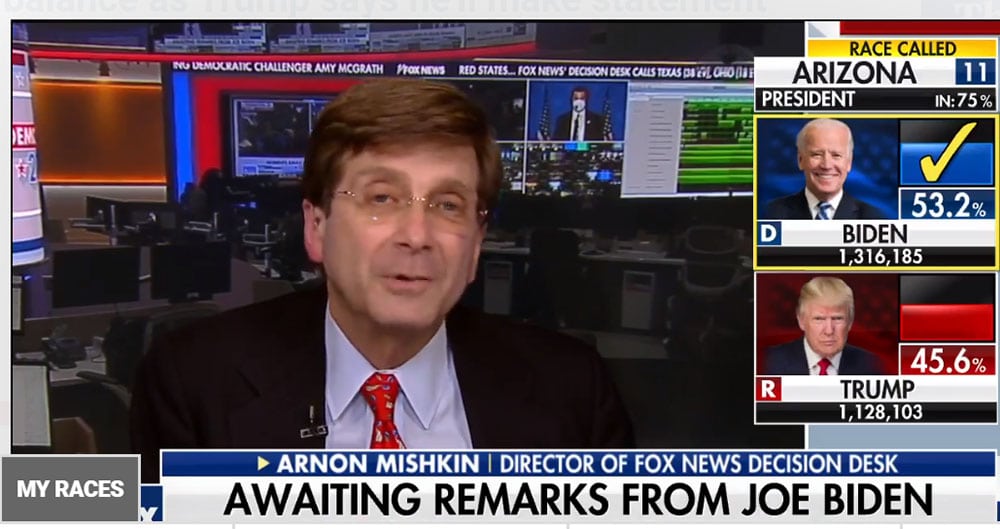
Arnon Mishkin, a Jewish Democrat who heads Fox News’ decision desk team, is defending his decision to call Arizona for former Vice President Joe Biden on November 3, despite the Trump campaign’s insistence that the call was too early.

Mishkin told Fox News anchor Bret Baier about an hour after he made the call for Biden that he was “100% certain” about the call, according to Jewish Telegraphic Agency (JTA).

“The president is not going to be able to take over and win enough votes to eliminate that seven-point lead that the former vice president has,” Mishkin said. “We’re not wrong in this particular case.”

The decision to call Arizona has resulted in fury from the Trump campaign, prompting Jared Kushner, President Donald Trump’s son-in-law, to reportedly contact Rupert Murdoch, who owns the Fox News’ parent company. Murdoch didn’t interfere with the network’s call.

The Trump campaign has called Mishkin a “Democrat operative,” noting his donations to Democrats. According to The Washington Post, Mishkin has publicly disclosed his political donations.

Jason Miller, a senior adviser to the Trump campaign, has insisted that Trump will win Arizona, pointing to how prognosticators like Nate Silver have said that Arizona was called too early.


Fox News anchor Chris Wallace said on November 4 that the network is sticking to its call.

So far, the only other news outlet to call Arizona is the Associated Press, which uses the same polling data firm as Fox, according to the Post.

Mishkin had previously caused controversy when he called Ohio for then-President Barack Obama in 2012; GOP political strategist Karl Rove at the time said the call was too early. Mishkin defended the call on-air and was proven to be correct.

Jewish Democrat Who Heads Fox News Decision Desk Stands By AZ Call Read More »

A Palestinian Peace of the Pie

Despite the difficulties wrought by COVID-19, Charles Wiesel, an oleh (immigrant to Israel) from Los Angeles since November 2019, said his first year in Israel has been one of the best of his life.

Wiesel, the Vice President of Business Development for a start-up called “Shahar Solutions” — which developed technology at Ariel University to convert carbon dioxide emissions into natural gas — feels energized by the Abraham Accords and its opportunities for the company as well as for Israelis and Arabs.

Out of both idealism and practical considerations, the partners of Shahar Solutions dream of setting up a manufacturing plant in the Ariel Industrial Park, which is located in the heart of Samaria and already employs some 3,000 Palestinians. To make it a reality, the company is looking towards the Abraham Fund — a three-billion-dollar investment fund set up by the United States, Israel, and the United Arab Emirates to support economic cooperation among them.

By setting up shop in Ariel, Wiesel envisions Palestinians will become an integral part of Shahar Solution’s workforce.

“We, in our hearts and in our actions, are trying to break down some walls,” said Wiesel from his Jerusalem home office. “Now that’s very, very tough. Our Palestinian partner didn’t want to have equity in the company. There are still barriers, political pressure that exist which, in my mind, the Abraham Accords and Abraham Fund will help tear down.”

Among some Palestinians, those barriers have been broken down, at least behind the scenes. Since 2010, the Palestinian Authority has taken a militant anti-normalization stance and forbids Palestinians from doing business with “settlers” in Judea and Samaria. In that spirit, it also boycotted the Abraham Accords, which it accuses of selling out the Palestinian cause. But this ban is difficult to enforce. Some 45,000 Palestinians work in the settlements, mostly in construction and manufacturing. Palestinians rely on their Jewish neighbors for subsistence.

“Ninety-percent of the Palestinian people want peace. No doubt about that,” said Ashraf Jabari, a Palestinian businessman based in Hebron, in a telephone interview conducted in Hebrew. Jabari founded, along with Avi Zimmerman of Ariel, the Judea and Samaria Chamber of Commerce, an NGO designed to develop economic and business ties between Israelis and Palestinians living in the region. “The problem is with the politicians. But many business people and merchants and regular Palestinians prefer peace through the economy more than anything else.”

Jabari led a delegation of Palestinian businessmen to the American-led “Peace Through Prosperity” workshop held in Bahrain in June 2019, despite the Palestinian Authority’s refusal to participate.

“We had to do it if we wanted to be in the picture,” Jabari said. “They [the P.A. leaders] don’t want anyone to make peace except through their door, and that’s a big mistake.”

On October 20, the Judea and Samaria Chamber of Commerce held, virtually, the second annual “Israeli Palestinian Economic Forum,” a “safe space” for Palestinians and Israelis entrepreneurs and business people to come together. It featured a panel on the Abraham Accords and showcased start-ups with an integrated Israeli-Palestinian business model.

Zimmerman considers the Abraham Fund a major opportunity for regional economic development since, unlike past American-sponsored development funds, it does not explicitly discriminate against Israeli institutions and businesses located in the West Bank and Golan Heights. This inclusive approach was reflected in the Trump administration’s policy decision, signed at Ariel University on October 27, to extend funding for scientific research to the area.

Still, the major obstacle to Palestinian-Israeli regional cooperation is the Palestinian Authority, whose political stance has not evolved with that of the Arab states eyeing joint ventures with an economically attractive Israel.

“The Emirates or the Gulf States are much more interested in doing business with Israelis than in creating a Palestinian state,” Zimmerman said.

Jabari said that most Palestinians resent what they consider a self-serving, corrupt Palestinian leadership. For them, the paradigm of the Oslo Accords is no longer relevant.

“Why do we need to go to the end of the world to speak with Israelis, our neighbors?” Jabari said. “We could speak with them directly.”

It’s up to the Palestinians to take the initiative, despite the risks, he said, to leverage the Abraham Accords, whether in the fields of high tech, imports and exports, and incoming Arab-speaking tourism.

“Israel won’t wait for the Palestinians to bring them investors from Arab countries or to sign peace deals,” Jabari said. “If we continue on a true path for peace, we’ll help ourselves. Or we’ll help the Israelis the right way, not through politics.”

Jabari thinks that a peace deal with the Saudis, whom the Palestinian leadership fears, would be the real game-changer.

“If Saudi Arabia will sign a peace agreement for normalization with Israel, no one in the Palestinian Authority will say anything,” he said.

A Saudi deal might also pose a windfall for Shahar Solutions. “Saudi Arabia and the United Arab Emirates have some of the highest CO2 emissions per capita in the world. They need our technology.”

As a social entrepreneur and wide-eyed oleh, Wiesel also hopes that the mini-idyll of peace that Shahar Solutions intends to create will add to the company’s appeal, no matter what the American election brings.

“I really feel strongly,” he said, “no matter who the U.S. president is, that the momentum towards peace has already started and needs to continue.”


Orit Arfa is a journalist and author based in Berlin. 

A Palestinian Peace of the Pie Read More »

Five Values to Unite America

By the time you read this column, the American presidential election may be over. We might not yet know who is President –— and I hope that process doesn’t drag on endlessly, as it did in 2000 with Bush versus Gore — but at least we’ll have put this ugly election behind us in a way, which I hope, will unite the nation.

Sounds crazy, right? Unite the nation?

Are you kidding? you might ask. We Americans hate each other. We’re divided on every level, from blue states to red states, from liberals to conservatives, from Only-Trumpers to Never-Trumpers, from those who think Joe Biden is a good soul to those who think he’s senile.

So it’s time to ask whether there is anything that can unite us, aside from the geography of all living in the United States.

Here are five values that I believe can unite us and which I hope, whoever is the president, will embrace.

  1. A hatred of evil.

From the founding of our country, Americans have hated tyrants. We called George III a tyrant for taxing our tea. Even that was too much for us. Who the hell did he think he is, living across an ocean and thinking he could control us? So we rebelled, kicked his redcoats out of the British colonies, and created our own nation.

We call those Americans who fought Hitler “the greatest generation.” There were boys from Kansas and Nebraska who died and are buried in France and Luxembourg because they fought the Nazi tyranny, even though it did not directly affect them and their families.

That’s even why we fought — however ineffectively — in Vietnam. Because we hated the community tyranny and we were going to stop it.

It’s also why, ultimately, we removed Saddam Hussein from power. Yes, many of us thought he had weapons of mass destruction. And yes, the war was messy and most Americans today probably question it. But one reason the war enjoyed support at the time is because Americans hate tyrants, and Saddam Hussein killed countless civilians.

  1. A love for communal service.

I have lived in Australia, the United Kingdom, and Israel. The one thing that distinguishes the United States is a passion for giving. We are the most charitable nation on earth. Yet, some of our youth are becoming self-centered and narcissistic because they are told that they should live to share their every moment on social media and work tirelessly in order to get into a great university and thereby obtain a well-paying job.

The one thing that distinguishes the United States is a passion for giving.

That’s great. But where is the service? I fervently hope that the next American administration will institute a year of national service for all High School graduates as a gap year. We should emulate Israel in this regard. Not all Israelis go to the army. Many do Sheirut Le’Umi. American youth should be asked to give a year of their lives to working in hospitals, homeless shelters, charities, libraries, and homes for the aged.

  1. A love of family.

America revolves around beautiful national holidays like Thanksgiving and Christmas,where we travel from every corner of the nation to be with our loved ones. But two days a year are not enough. It is time to institute a national weekly family dinner program for all Americans. I believe that the Jewish community should spearhead a national Friday night dinner campaign, where familiescan turn off the TVs, laptops, and cell phones for two hours and focus on each other. We should have our children — once the coronavirus has passed, God willing, invite two guests so that we inculcate within our offspring an appreciation for hospitality, making the American home into the tent of Abraham.

  1. A love of learning.

America is the most prosperous nation on earth, and this is mostly due to American industriousness and innovation. But both of these traits are predicated on a mastery of information. We take learning and ideas and transform them into companies and industries. American science put a man on the moon, invented the internet, and helped map the human genome. But now, that flow of information is being corrupted by politics. We don’t even know what is true when we read the news. If it comes from CNN, it has a liberal slant. From Fox, a conservative one. Some universities are embracing a cancel culture, where “wrong” ideas are slowly muted. And we’re also not reading as much as we did. Add to that the terrible disruptions to schooling that havecome with the coronavirus, and what emerges is a true crisis in education. The solution is a renewed respect for learning. We need to promote public intellectuals again, making philosophers, historians, and scientists into national celebrities. We have to elevate the public discourse, making it one of ideas and not just opinions, intelligent insights and not just partisan political babble. Our national soul depends on it.

We have to elevate the public discourse, making it one of ideas and not just opinions, intelligent insights and not just partisan political babble.

  1. A love for God and religion.

No country on earth is as religious as the United States. Even countries that purport to be religious almost always leverage God and religion for political purposes. And while this also happens in America, the average U.S. citizen has a natural spiritual disposition, where it’sexpected that every presidential speech end “God bless America” and where public holidays like Thanksgiving have a spiritual dimension of divine gratitude. No Western country,save America, has God even printed on our money. We have to nurture this innate American spiritual disposition by cultivating it and not fearing it. A moment of silence should be instituted as part of the curriculum of every American school, allowing students to reflect daily on a higher cause of their choosing. We need to affirm more spiritual values in American life that transcend the traditional religious debates on abortion, gay marriage, and contraception. There is more to American religion than the values that have come to define American spirituality. A new emphasis on charity, national prayer, synagogue and church attendance, or civic conferences for the agnostics will return us to a time when we didn’t only seek a vaccine for pandemics like the coronavirus but also turned our eyes toward divine grace and national redemption.

Americans are capable of coming together, even as we affirm our political and social differences. It will take more than just empty rhetoric about an increasingly elusive national unity. Rather, it demands national purpose through shared and cherished values.


Rabbi Shmuley Boteach is the author of “Judaism for Everyone” and “Renewal: The Seven Central Values of the Jewish Faith.” Follow him on Twitter and Instagram @RabbiShmuley.

Five Values to Unite America Read More »

To Bypass Israel’s Sanctions on Banks, Former Security Prisoners to Become PA Employees

THE MEDIA LINE — To circumvent Israeli sanctions on the Palestinian banking system, the Palestinian Authority decided this week to permanently cease paying monthly stipends to about 7,000 former prisoners, in order to transfer them to work within security, military or civilian institutions, so they can receive salaries as government employees.

A questionnaire was distributed in the past few days to all Palestine Liberation Organization followers who spent time in Israeli prisons, to identify their qualifications and allow them to choose into which field they prefer to integrate.

“The move is providing these former prisoners job security and social stability.”

Hasan Abd Rabbo, the spokesperson of the PLO’s Commission of Detainee Affairs, explained to The Media Line that recently the commission worked to fill out the questionnaires for those prisoners who spent more than five years in Israeli prisons, “in order to transfer them to become PA employees, based on their wishes and the information they provide us.”

Abd Rabbo clarified that payments to the families of “current prisoners [in Israel] and martyrs” will remain unchanged, “including their salaries, legal expenses and everything they need, which come as part of the greatest Palestinian national interest.”

He stressed that the change is intended to protect the former prisoners’ income, amid Israeli and American pressure to deal with them as terrorists. “The move is providing these former prisoners job security and social stability.”

Many banks in the West Bank closed accounts of relatives of “prisoners and martyrs,” after the Israeli army threatened the financial institutions, accused them of serving terrorists, said such stipends encouraged terrorism, and set a deadline to close the accounts, Abd Rabbo said. “And the most recent deadline given to the banks expires at the end of next month [December 31],” he added.

“But the PA has made a decision to establish a national bank, to serve the prisoners and the families of martyrs,” Abd Rabbo continued.

“The PA pays them salaries when they are in prison, and then outside as employees. Unbelievable!”

Moshe Marzouk, an Israeli analyst and research fellow at the International Institute for Counter-Terrorism at the Interdisciplinary Center Herzliya, told The Media Line the PA’s decision was very dangerous, as it encouraged people to commit terrorism attacks. “The PA pays them salaries when they are in prison, and then outside as employees. Unbelievable!”

Mazouk said none of the countries supporting the Palestinian leadership will accept this step, and that he believes the Israeli sanctions on the West Bank banks will continue. “The decision won’t help the PA, but on the contrary,” he added.

The Palestinian leadership pays the prisoners and families what it calls “salaries” – and what many on the Palestinian street call “martyr payments” – totaling an estimated 1.5 billion shekels ($444 million) annually.

Last May, the Israel Defense Forces Central Command issued an order prohibiting banks in the West Bank to transfer stipends that the PA pays to prisoners in Israeli jails and to the families of those slain in clashes with Israelis.

The Central Command is responsible for overall security in the West Bank, and issues directives enforcing many policies. It sees these payments as a security threat.

As such, it warned Palestinian and non-Palestinian banks not to carry out transactions related to what it called “terrorism funds,” saying that doing so would expose them to lawsuits. Bank managers and employees would be considered “accomplices to the crime” and be subject to imprisonment and fines.

Adel Mohammed Abed from Bethlehem, who was imprisoned by Israel twice, in 1994-2007 and in 2014-2016, told The Media Line that the questionnaire he filled out for the Commission of Detainee Affairs concerned information about him as a person, in addition to his professional qualifications.

“We were asked about our hobbies, experience and preferred work field. Now regarding the salary, it remains the same, but instead of receiving our salary from the commission, we now receive it from the Palestinian Finance Ministry’s Staff Affairs Office,” Abed said.

He said that his bank did not close his account, but his brother faced an issue with Cairo Amman Bank. His brother’s son was recently imprisoned, and his salary was being transferred to his father’s account. “The bank froze my brother’s account and that caused him a lot of problems,” Abed said.

“The prisoners and martyrs’ case is a national one and a priority, but I’m not sure if the PA move will help the situation.”

Nasr Abd al-Kareem, a professor of finance and banking science at the American University in Ramallah, told The Media Line the PA decision addressed a small part of the issue but would not solve it, “especially since Israel has several tools to pressure and blackmail the PA.

“The prisoners and martyrs’ case is a national one and a priority, but I’m not sure if the PA move will help the situation,” he said.

Israel aims to “criminalize the Palestinian struggle,” Abd al-Kareem said, and therefore it does not want prisoners and former prisoners to receive any payments from the PA or to be able to open bank accounts. “If Israel wants to punish them, the PA decision will not really protect them; they [the Israelis] have lists with their names and information.”

He added, “The name of the payment is not a problem for Israel, as long as the PA pays these former prisoners.”

Abd al-Kareem added that the decision might not protect the banks from Israel, “and regarding the fact that the PA is establishing a bank, that takes time, and the steps to get it working are very slow.”

He opined that Israel was not targeting these prisoners personally, but rather “their history,” and therefore what one calls the prisoners or the payments does not really matter. “However, Israel might just look at things differently, for security and political reasons, or for whatever strategic aim it has. It already postponed the deadline for the banks before, but at some point Israel might just implement its decision.”

To Bypass Israel’s Sanctions on Banks, Former Security Prisoners to Become PA Employees Read More »

UN Committee Passes Resolution Downplaying Jewish Connection to Temple Mount

The United Nations General Assembly’s Special Political and Decolonization Committee passed a resolution on November 4 that downplayed the Jewish connection to the Temple Mount.

U.N. Watch reported that the resolution, titled “Israeli practices affecting the human rights of the Palestinian people in the Occupied Palestinian Territory, including East Jerusalem,” refers to the Temple Mount entirely as Haram al-Sharif, its Muslim name. The resolution expressed concern over “the tensions and violence in the recent period throughout the Occupied Palestinian Territory, including East Jerusalem and including with regard to the holy places of Jerusalem, including the Haram al-Sharif, and deploring the loss of innocent civilian life.”

One-hundred and thirty-eight countries, including Britain, Cuba, France, Qatar, Venezuela and the United Arab Emirates, voted for the resolution.

“The UN today showed contempt for both Judaism and Christianity by passing a resolution that makes no mention of the name Temple Mount, which is Judaism’s holiest site, and which is sacred to all who venerate the Bible, in which the ancient Temple was of central importance,” U.N. Watch Executive Director Hillel Neuer said in a statement.

Jewish groups also weighed in.

“UN pushing itself into irrelevancy by continuing to promote a pernicious lie,” the Simon Wiesenthal Center tweeted. “No nation or international org will ever succeed in erasing Jewish people’s connection to their heart – the undivided capital of the Jewish state.”

StandWithUs similarly tweeted, “Once again, the UN is trying to rewrite history, ignoring the ancient & historic connection to #Judaism’s holiest site.”

Gabriel Grosman, the mayor of Bal Harbour, Fla., also tweeted, “Nothing to see here. Just the @UN trying to erase Jewish history while no one is looking.”

Neuer also noted in U.N. Watch’s press release that the Temple Mount resolution was one of seven anti-Israel resolutions that the U.N. passed; for instance, one of the resolutions denounced Israel for “repressive measures” against Syria in the Golan Heights. Three other resolutions addressed the United Nations Relief and Works Agency for Palestinian Refugees (UNRWA) but failed to mention the “sexual misconduct, nepotism, retaliation, discrimination and other abuses of authority, for personal gain” that a U.N. investigation found in the agency, according to Neuer.

“Just two weeks after the Palestinian Islamic Jihad terrorist group assaulted Israeli civilians with a barrage of rockets from Gaza — while the UN’s General Assembly and Human Rights Council stayed silent — the world body now adds insult to injury by adopting seven lopsided resolutions, whose only purpose is to demonize the Jewish state,” Neuer said. “While France, Germany, Sweden and other EU states are expected to support most of the estimated 20 resolutions to be adopted against Israel by December, the same European nations have failed to introduce a single UNGA resolution on the human rights situation in China, Venezuela, Saudi Arabia, Cuba, Turkey, Pakistan, Vietnam, Algeria, or on 175 other countries. Where’s their supposed concern for international law and human rights?”

UN Committee Passes Resolution Downplaying Jewish Connection to Temple Mount Read More »

A Moment in Time: A Prayer for our Country

Dear all,
On Wednesday evening, as our country continued counting votes, and as political differences exposed the great divide in our nation, our congregation came together to reflect, comfort one another, and provide opportunity to share.
Even though it was a mid-week gathering, we ended with Havdalah – a ceremony usually observed Saturday evening when Shabbat ends, marking the division between the holy (Shabbat) and the ordinary (the rest of the week). We observe Havdalah with a candle made from multiple wicks.
Why Havdalah on a Wednesday? Because this unique moment in time required that we harness the intertwining light that connects us. We want to move from rancor to righteousness and from darkness to discovery. We all need to heal.
I shared a prayer written by Rabbi Mordechai Kaplan (of blessed memory), a Conservative Rabbi who founded the Reconstructionist Jewish Movement. I share the prayer here for all of us to consider.
With love and shalom,
Rabbi Zach Shapiro
————————————-
That America Fulfil the Promise of Its Founding
O God, who is Liberator and Redeemer, Lawgiver and Judge,
who rules over all mankind
and presides over the destinies of nations,
we invoke your continued blessing on our Republic,
which your grace called into being,
and your love has sustained to this day.
May America remain loyal
to the principles of the Declaration of Independence,
and extend their application
to ever widening areas of life.
Keep out of our life all manner of oppression,
persecution,
and unjust discrimination;
save us from religious,
racial and class conflicts;
may our country be a haven of refuge
to the victims of injustice and misrule.
Instruct us in the art of living together,
of reconciling differences of opinion
and averting clashes of interest,
of helping one another
to achieve a harmonious and abundant life.
Give us the wisdom to elect to leadership capable,
conscientious men, men of integrity
who will govern our people
according to your law of righteousness.
Bless the enterprise of the American people,
that they may utilize the natural resources of the land
for the highest good of all men.[1]
May America be ever hospitable
to new revelations of truth in science and philosophy,
ever sensitive to the appeal of beauty in nature and art,
ever responsive to the call of duty
and the spirit of religious consecration and worship;
And may Americans so love their country
that they shall withhold no sacrifice required
to safeguard its life and to fulfil its promise;
the symbol of our American democracy,
may ever wave o’er the land of the free
and the home of the brave.
(Rabbi Mordechai Kaplan, 1945, taken from the Open Siddur Project)

A Moment in Time: A Prayer for our Country Read More »

david suissa podcast curious times

Pandemic Times Episode 102: Political Expert Dan Schnur on our Uncertain Elections

New David Suissa Podcast Every Tuesday and Friday.

What do the results mean and what can we expect going forward? Dan Schnur weighs in.

How do we manage our lives during the coronavirus crisis? How do we keep our sanity? How do we use this quarantine to bring out the best in ourselves? Tune in and share your stories with podcast@jewishjournal.com.

Pandemic Times Episode 102: Political Expert Dan Schnur on our Uncertain Elections Read More »