fbpx

October 14, 2020

Why the Peace Process Needs More Women Now

On Friday, September 18, the first night of Rosh Hashanah, two consequential events occurred: the world lost the feminist icon in Justice Ruth Bader Ginsburg, and women took to social media in droves to issue a rallying cry: “she would want us to grieve by fighting.” This call to action mobilized gender equality advocates and led to record-breaking fundraising efforts.

As for me, I recommitted to uphold Ginsburg’s mission to eradicate gender inequity, and began contemplating my role as a contemporary American Jewish woman. And, in this moment, I realized that I wished this same sense of urgency existed in promoting the role of women within the diasporic Zionist community and in the broader pursuit of Israeli-Palestinian peace.

Jewish people have a long, proud tradition of teshuva (the act of returning from our sins to the highest version of ourselves) and, more broadly, of correcting inequities. However, these efforts have yet to translate into meaningful representation of women in the Israeli-Palestinian peace process or in ongoing Arab-Israeli normalization efforts. Furthermore, there’s mounting evidence suggesting that these initiatives are less likely to succeed in the long term without women’s participation. If Jewish women want to uphold Justice Ginsburg’s legacy, we must join our communities in demanding a seat at the negotiating table — and all leadership forums. Progress has never been linear, but Jewish leaders can start to catalyze women’s political representation through the five below steps:

  1. Increase Awareness Among Institutions

Throughout much of my Jewish or Israel-centered education, I was unaware of women’s historical exclusion from negotiations and the benefits of their participation. Until our community acknowledges the extent of this representation problem, we cannot start to fix it. A study from the Council on Foreign Relations highlights the discrepancy: in major peace processes from 1992-2018, only 4% of signatories and 13% of negotiators were women. But when women participated, resulting agreements were 64% less likely to fail and 35% more likely to last 15 years. If statistics are too esoteric, look no further than the images in the media coverage from the recent normalization deals between Israel and the United Arab Emirates and Bahrain: not a single woman appeared to be present at the negotiating tables. Not only is this harmful as a precedent for women optically, it is dishonest representation of the constituencies within both negotiating societies.

Throughout much of my Jewish or Israel-centered education, I was unaware of women’s historical exclusion from negotiations and the benefits of their participation.

  1. Embrace Diverse Leadership Styles

To allow women to envision themselves at the negotiating tables, we have to create a new narrative about leadership, one that celebrates the unique characteristics that women bring to the political stage. For instance, those involved in major negotiations believe women canwork effectively across partisan lines. We can also elevate the profiles of women who have successfully guided peace talks to learn from their tactics: In 2013–2014 negotiations between Israelis and Palestinians, Tzipi Livni reportedly advocated for parties to ignore political distractions and continue to discuss concrete agenda items—even though other members of her team appeared ready to filibuster talks.

  1. Avoid Politicization

The consequences of vicious hyperpolarization hurt the Diaspora community and the progress of women’s rights and representation. Equal participation of women in negotiations should not be controversial. It should be a welcome opportunity for liberals and conservatives to coalesce and start to work together again—not only in the service of equity but also in the service of problem-solving. Time and time again, history suggests that the prioritization of country over party pays off; more women at the table can help with that. Witness, for instance, Secretary of State Condolezza Rice’s evolution from “passive participant to activist diplomat” in the 2007 Annapolis Peace Process. Rice’s willingness to break with conservatives to achieve near-success in negotiations exemplifies the benefits of disregarding shortsighted political pressure and prioritizing peace over party.

  1. Implement Achievable Objectives

Jewish communal coalitions need to translate abstract support for women’s representation into tangible planning. We can begin by promoting existing initiatives that deserve our attention and support. For example, the nonprofit Gender Avenger, whose mission is to ensure women are represented in the public dialogue, created a pledge that asks signatories to confirm that they will not serve as a panelist at a public conference when there are no women on its panels. Additionally, Israel Policy Forum, a nonprofit policy organization mobilizing support for a viable two-state solution (where I’m involved with as a lay leader), recently launched the Women Peace and Security effort, committing to “advancing women’s involvement, expertise, and leadership in Israeli-Palestinian peacebuilding and Jewish communal affairs.”

  1. Speak Up, Show Up.

Everyone has a critical part to play in helping achieve equality, and it starts from the ground up. Insist a woman asks the first question at your Q&A, encourage women to join your board, and translate your voice into meaningful action. It really is that simple.

In his recently published memoir, Friendly Fire, Ami Ayalon, former head of the Shin Bet, envisioned that a female leader of Israel will be the one who legislates and enacts a two-state solution. I love imagining the woman in Ayalon’s dream and hope I get to meet her — and I hope you do too — because until we all attain equality, we cannot attain a perfect America or a perfect Israel. In the words of Justice Ginsburg, “when I’m sometimes asked, ‘when will there be enough [women on the Supreme Court]?’ and I say ‘when there are nine,’ people are shocked. But there’d been nine men, and nobody’s ever raised a question about that.”


Alexandra Stabler is the Founding Chair of IPF Atid’s Los Angeles chapter, Israel Policy Forum’s young professionals community. Currently, Alex works as a strategic marketing and communications consultant, specializing in ideating and executing entertainment and public affairs initiatives.

Why the Peace Process Needs More Women Now Read More »

WATCH: NYC Jewish Man Berated for Not Wearing Mask on Empty Street

A video has gone viral on social media of a man shouting at a Hasidic Jewish man for not wearing a mask on an empty New York City street.

The video, which appeared to be taken from someone driving a car, features a man shouting at the Hasidic Jewish man, “Put your f—ing mask on! Put your mask on! There’s COVID cases! Hurry up! Put it on!” The Jewish man, who was talking on the phone, puts his mask on. Nobody was around him.

Tablet senior writer Yair Rosenberg tweeted that the video originated from a Facebook account called Sonny Luciano, who posted it with the caption, “Riding though boro park be like ……they have a spike in COVID cases so I’m trying to help the neighborhood.”

https://www.facebook.com/norman.vado.1/videos/3254409214784734

“This is basically anti-Semitic intimidation of a random Jew done for sport and applause from peers under the guise of righteousness,” Rosenberg tweeted. “So basically, the same sort of anti-Semitism we Jews have been dealing with for centuries.”

Rosenberg added in a subsequent tweet, “That young Hasidic guy wasn’t within 6 feet of anyone, and he *had* a mask he just wasn’t wearing in order to talk on the phone. The guy making this video openly bragged on his Facebook page about stalking him so that he could jump him, then posted the video of it for likes.”

https://twitter.com/Yair_Rosenberg/status/1316165474464534528?s=20

https://twitter.com/Yair_Rosenberg/status/1316166785809502211?s=20

https://twitter.com/Yair_Rosenberg/status/1316168554530701314?s=20


Metro UK reporter Jacob Henry reported that he tracked down the man who took the video, and that the man told him that he thinks Orthodox Jews commit “‘disgusting’ practices including incest, child abuse by circumcision and even murder with the full tirade too offensive to reproduce.”

Others on Twitter condemned the video.

“This is #antisemitism, plain & simple,” Anti-Defamation League CEO Jonathan Greenblatt tweeted. “This man had no one near him & had a mask at the ready. The only reason he is being harassed is because he is an Orthodox Jew.”

Greenblatt then linked to an op-ed he co-authored in the New York Daily News urging people not to scapegoat Orthodox Jews for the spread of COVID-19.

In a tweet, The Orthodox Jewish Public Affairs Committee (OJPAC) blamed the Democratic Governor of New York, Andrew Cuomo, for the anti-Semitic attack.

“The verbal abuse seen in this video against an Orthodox Jew is on @NYGovCuomo
for making Orthodox Jews the target of the rise in COVID-19 across New York,” OJPAC tweeted. “As for the bigot in the video, you don’t need a mask on an empty sidewalk.”

On October 14, Cuomo said in a press conference there are “issues in the Orthodox Jewish community in New York, where because of their religious practices, etc., we’re seeing a spread.” Cuomo had announced a series of restrictions on October 6 in nine primarily Hasidic zip codes, which closed some schools and restricted the number of people who could attend houses of worship to 10 people.

The restrictions resulted in a series of protests from the Orthodox Jewish community, which featured masks burned and a couple of assaults. Jewish Insider reporter Jacob Kornbluh, himself an Orthodox Jew, was assaulted during one of these protests. One of the protesters, Harold “Heschy” Tischler, was arrested on October 11 for allegedly inciting the assault against Kornbluh and is facing charges of inciting a riot.

WATCH: NYC Jewish Man Berated for Not Wearing Mask on Empty Street Read More »

Pandemic Summer Vacation: Air Birds

Summer vacation plans usually don’t require in-depth risk analysis. But 2020 is no normal year.

Sylvia, my wife, likes nature vacations: beaches, mountains, and communing with wildlife. She claims I only want the “4 Cs:” cathedrals, carvings, crypts, and cafés. The first issue for a 4C vacation this year is air travel safety. Like much of COVID-19 lore, uncertainty reigns. We know from the CDC what’s unsafe: ten minutes within six feet of a contagious person not wearing a mask. The farther from that scenario, the safer it gets.

It probably takes a certain “load” of virus, inhaled over a short period, to reach the possible infection threshold. Face masks and physical distancing provide the best protection. Unfortunately, surgical and cloth masks—the kind most individuals use—reduce viral particle release but probably don’t eliminate it. If you’re near someone “leaking” particles but the exposure is transient, the odds are in your favor. In a COVID-era supermarket, for example, if everyone wears a mask and interactions within six feet are brief, the risk should be very low.

Of course, airlines try to mitigate these risks. They now screen passengers for fevers. Although that procedure eliminates some COVID-infected passengers, others can be asymptomatic spreaders. Traveling in first class or business provides some distancing and is a good idea, albeit expensive. If the airline doesn’t fill middle seats, that helps too. But what if you’re seated near an infected person leaking particles? Are airline ventilation systems good enough to keep the load of viral particles below that likely to transmit? It’s hard to say. If it’s an hour flight, you might be fine. With five hours of exposure, perhaps not.

Family time and a dose of nature are worth some risk.

As we pondered these risk factors, we reached our result: no airline flight and no 4C vacation. Instead, we booked a couple of Airbnbs for a trip to Oregon. We’d see the coastal redwoods, the Oregon Caves, and hunker down at beautiful, if chilly, Cannon Beach. We’d also visit my friend Barry in nearby Portland. 2020, it seemed, had chosen the nature vacation.

As we prepared to leave, however, Barry texted me, “Oregon is on fire.” A quick Google search confirmed horrendous air quality throughout the state. Instead of infectious disease expertise, our vacation plans suddenly required a pulmonary medicine perspective. An unhealthy Air Quality Index (AQI) is over 100. AQIs in Oregon were registering in the 300s and 400s. Again, it was nasty particles, but this time, from the smoke. Exposure to such levels can damage even the lungs of healthy people. The horrors of a two-week staycation loomed.

As I prepared a cancellation e-mail for our Airbnb host, I checked Cannon Beach’s air quality to pass along the bad news. Surprisingly, it was better than most of the state and was expected to improve. The vacation wouldn’t be what we hoped. No Oregon Caves—closed due to COVID. No redwood groves—closed due to smoke and fire risk. We brought N-95 filtering masks to use when we exited our car during brief stops in smoky Ashland and Eugene.

Cannon Beach worked well. Although it lacks the “Cs,” we welcomed the intermittent rain that cleansed the air and allowed for safe walks and hikes. Sylvia saw elk, went tide pooling, and faced-off with raccoons while taking out the trash. We missed Barry, though. He bowed out, citing a recent sinus infection. He has health anxieties and rarely, if ever, leaves his home due to COVID. I suspect that an outdoor, physically distanced lunch was “a meal too far” for his risk tolerance.

We did meet some other travelers who came to Cannon Beach just for the air. Like “Snow-Birds” fleeing New York for Florida in the winter, these “Air-Birds” headed to the coast to avoid the dangerous smoke inland. Whether it is smoke inhalation you flee, COVID, traffic safety and the rest, much of life involves balancing risks and making the sensible choices. Although safety is an important consideration, the right choices aren’t always the safest ones. After all, the purpose of life is not is not to extend it or even to maximize health. Family time and a dose of nature are worth some risk. For this year, Cannon Beach made sense. Next year in Provence.


Daniel Stone is Regional Medical Director of Cedars-Sinai Valley Network and a practicing internist and geriatrician with Cedars Sinai Medical Group. The views expressed in this column do not necessarily reflect those of Cedars-Sinai.

Pandemic Summer Vacation: Air Birds Read More »

Actress Gal Gadot Teaches Hebrew Slang in New Vanity Fair Video

Israeli actress Gal Gadot is teaching her fans Hebrew slang.

In a new video posted on Oct. 13, the “Wonder Woman” actress shares phrases with Vanity Fair magazine’s recurring “Slang School” segment. Among the phrases she offers up are “Ma ani, ez?” (What am I, a goat?) — which she said is “basically, ‘What am I, a dummy?’ meaning “I’m not stupid,” and “Pa’am shlishit glida” (third time, ice cream). This, she explains, “basically means, third time’s a charm.”

Gadot also explains the phrase “para para” (cow cow.) Confused? Gadot says it’s synonymous with a common English phrase: “When you go and you do something ‘para para,’ you do it slowly but surely, one step at a time.”

Gadot is featured on the November cover of Vanity Fair promoting “Wonder Woman 1984,” which is scheduled for a December release. The actress, who also is slated to play Cleopatra in a new project with “Wonder Woman” director Patty Jenkins at the helm, also is plugging “Death on the Nile,” in which she plays another Egyptian character. “Death on the Nile” will be released Dec. 18.

Watch the full video below:

Actress Gal Gadot Teaches Hebrew Slang in New Vanity Fair Video Read More »

Karabakh: 30 Years of Occupation and Displacement

It has been 28 years since I was captured by the invaders, held captive and brutalized in the worst ways imaginable in a torture camp and later released in exchange for gasoline. I was 20 at the time, and after several surgeries to repair the damage torture had caused to my spine, today, I am a survivor, a mother, and a spokesperson for peace. A great part of my healing has come through my closeness with Jewish communities across the world, especially in Los Angeles. We share so much in common; as survivors, innovators and champions for peace in a world overrun by opposition. 

Over the last weeks and into today, the same invaders that ripped me from my home 28 years ago, stole my virtue and almost took my life, are firing shells at innocent civilians once again. Armenia has been attacking Azerbaijan, shelling at military and civilians alike, and have so far taken the lives of 41 Azerbaijani civilians, including several small children, and wounded over 200. Armenia’s armed forces have even targeted kindergartens, schools, hospitals, homes for disabled adults, ambulance cars, etc. 

When it happened 28 years ago, the world condemned Armenia, for this illegal military occupation, and demanded the withdrawal of Armenian forces from the occupied areas of Azerbaijan, including Nagorno-Karabakh region and seven, completely Azerbaijani-populated adjacent districts, which equal approximately 20% of Azerbaijan’s sovereign territory. Over 800,000 Azerbaijanis were expelled from their ancestral lands and remain to this day internally displaced. Despite international condemnation, Armenia has remained the illegal occupier of Azerbaijan’s sovereign territory for the last almost 30 years. They have desecrated our graveyards, turned our mosques into a barn for pigs and cows, and profited off our childhood homes by renting them through Airbnb. And as if this brutality was not enough, today they open fire at various locations in Azerbaijan, including outside of the occupied areas, attacking Azerbaijan’s major cities or even targeting our main oil pipeline, via which Azerbaijan supplies energy security to Europe, Israel and other nations. 

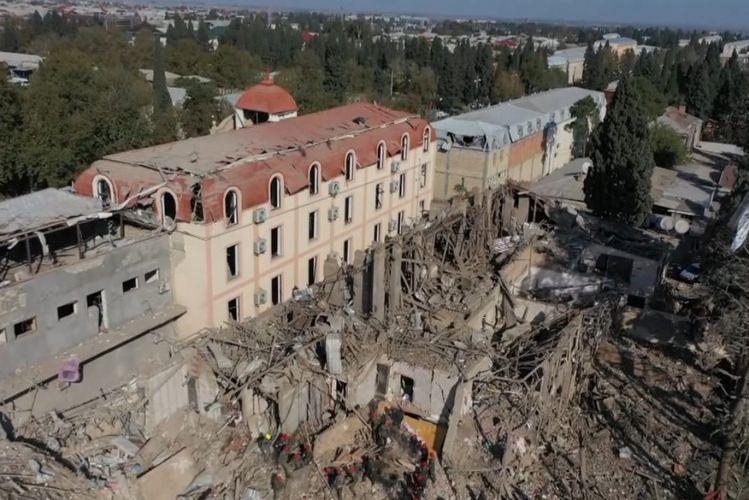
Armenia has even gone as far as sending guided ballistic missiles, in the middle of the night, into Ganja, Azerbaijan’s second largest city, obliterating an entire neighborhood and killing 10 civilians and wounding 33, in their sleep. 

Several Armenian missiles also landed next to the Mingachevir Dam, which is the largest dam in the Caucasus – the one Armenia has repeatedly threatened to blow up. 

Sadly, I know all too well what this new war is really about. Armenia intends to invade more Azerbaijani territories and dictate its own terms to Azerbaijan, despite violating the most basic laws and precepts honored by all democratic nations, and they continue to do so with relative impunity. 

The Armenian media campaign is in full speed, crying out to the Western public as victims, while Armenia has violated every rule in the book while illegally occupying large swathes of its neighbor’s territory and turning hundreds of thousands of civilians into internal refugees.

Reading the news in the morning remains troubling and I tell my daughter not to worry. We are a nation that has always stood up against villainous forces, for centuries, and will continue to champion our national commitment to peace, tolerance and the celebration of diversity. I am absolutely convinced that the day when Armenians and Azerbaijanis of Nagorno-Karabakh will again peacefully live together is not far away. In my hometown of Khojaly in Nagorno-Karabakh and in all parts of the region and beyond, we have lived in peace and harmony for many centuries. We can do it again. The fact that 30,000 Armenians continue to live peacefully in Baku and other major cities of Azerbaijan, despite the conflict, speaks volumes of Azerbaijan’s respect for diversity, tolerance and multiculturalism, – the values that are shared by our incomparably diverse population, that includes Muslims, Jews, Christians, Baha’is, Hare Krishnas and others, who live and practice their faith, culture and traditions in Azerbaijan in peace and dignity.

I also remind my daughter of our allies. We share strong and lasting friendships with the United States, the State of Israel, and all of Europe. We are key partners in the international war against terror. I remind her that Armenia is allies with Syria, Russia and Iran, and although they spin a compelling story to a mostly unknowing Western audience, those in power know what is at stake and will stand up for Azerbaijan. Just as Azerbaijan has stood up for so many throughout history, and into today, we are counting on our allies to stand up against this new aggression targeting our nation, and put an end to an illegal occupation so that we, hundreds of thousands of forcibly displaced Azerbaijanis, can finally return to our homes and lands.

Karabakh: 30 Years of Occupation and Displacement Read More »

The Robust and Zesty Soup You Will Fall In Love With

Recently, when Rachel and I did a Zoom cooking demonstration for the young women of the Jewish Federation’s Emerging Philanthropists group, I was really embarrassed.

Not because of how we performed on the Zoom: that was great and fun.

But because my husband and kids couldn’t stop eating the soup that Rachel had made for the demonstration.

The reviews were unanimous—Rachel’s Harira Soup was beyond delicious and hard to resist! But I made them stop after their second helpings.

Harira is a hearty, robust soup with a tomato base that is traditionally flavored with beef, lamb or chicken and lots of bones, but for our farm to table demonstration, Rachel came up with a very tasty vegetarian version.

Harira is a hearty, robust soup with a tomato base that is traditionally flavored with beef, lamb or chicken and lots of bones, but for our farm to table demonstration, Rachel came up with a very tasty vegetarian version.

Full of bright orange fall harvest vegetables, butternut squash, sweet potatoes and carrots, that provide beta carotene, as well as garbanzos and green lentils, pulses that are rich sources of protein, fiber, folate and minerals like iron and potassium, this soup is nutritionally dense and low in fat. Parsley and cilantro, onions and celery, freshly ground turmeric, cumin and black pepper round out the flavor profile and up the antioxidant factor.

Harira comes from the the Arabic word for silk which refers to the velvety smooth texture lent by a tedouira (thickener) made from flour and water. But in a nod to the trend for gluten-free food, Rachel replaced the flour with an egg whipped with lemon juice. She replaced the green lentils in the recipe with red lentils because they soften quickly and add a pleasing creaminess to the soup.

In Morocco’s cities, Harira is a popular, inexpensive street food, widely available in restaurants and market stalls. At streetside carts, this zesty soup is served in bowls that are then dunked in a bucket of tepid water and reused (environmentally friendly, but eek!). It is also customarily eaten by the Muslims to break the fast during Ramadan. And like so many other culinary influences, this soup has been adopted by the French Moroccan Jews.

As the leaves turn orange, the days grow shorter and the air blows a little cooler, try this amazing soup (just make sure my family isn’t around).

Photo by Alexandra Gomperts

HARIRA MOROCCAN VEGETABLE SOUP (gluten free)

YIELD 8-10 servings

INGREDIENTS

1/4 cup olive oil

2 large onions, thinly sliced

3-4 celery stalks, sliced

2 large carrots, halved and sliced

1 large sweet potato, cubed

4 cups butternut squash, cubed

1 large potato, cubed

1 tablespoon fresh grated turmeric, or 1 teaspoon ground turmeric

1 teaspoon ground cumin

1 teaspoon black pepper

2 teaspoon salt

1 teaspoon harissa (paste) or dried red chile flakes/or harissa powder

1 bunch parsley, chopped

1 bunch cilantro, chopped

1 15 oz can diced tomatoes

2 tablespoons tomato paste

8 cups vegetable, beef, or chicken stock

1 15 oz can chickpeas, drained

1 cup red lentils, rinsed

1 large egg

1/3 cup of lemon juice

PREPARATION

  1. Heat the oil in a large skillet over medium heat and sauté the sliced onions until they start turning golden,
  2. Add the turmeric, cumin, harissa or chile flakes, salt and pepper and sauté with the onions until well coated.
  3. Add the celery, carrots, butternut squash, sweet potato, and potato, stir and coat with spice mixture
  4. Add cup each of the parsley and cilantro, canned tomatoes, and tomato paste
  5. Add vegetable broth, bring to a boil,
  6. Add the lentils and canned garbanzos and simmer for an hour

Whisk the egg and lemon juice. Stir into the soup. Simmer the soup about 5 minutes and serve, top with cilantro and parsley.

Quick tip:

If making this soup as a main course, you can add cut up pieces of thin egg noodle or a cup of rice or a cup of barley.


Rachel Sheff and Sharon Gomperts have been friends since high school. They love cooking and sharing recipes. They have collaborated on Sephardic Educational Center projects and community cooking classes. Follow them on Instagram @sephardicspicegirls and on Facebook at Sephardic Spice SEC Food.

The Robust and Zesty Soup You Will Fall In Love With Read More »

Rosner’s Torah Talk: Bereshit with Matthew Schultz

Matthew Schultz is a writer of fiction and nonfiction and a rabbinic student at Hebrew College.His work has been anthologized in Best American Nonrequired Reading, and has been featured in various magazines.Raised in Massachusetts, Schultz graduated from Sarah Lawrence College in 2010, and lived in Tel Aviv for a number of years. His new book is What Came Before.

Our conversation – the first in a series of Torah Talks with rabbinic students – focuses on the creation of the world. What came before, and what happened after.

https://www.youtube.com/watch?v=p5gXzpwuQH4&feature=youtu.be


Talks with Rabbis on Bereshit

Rabbi Jon Jay Tilsen

Rabbi Yehoyada Amir

Rabbi David Wolpe

Rabbi David Whiman


Rosner’s Torah Talk: Bereshit with Matthew Schultz Read More »