fbpx

October 5, 2020

Windows Broken as Brooklyn Orthodox Synagogue Is Vandalized

An Orthodox synagogue in Brooklyn, N.Y., had its windows broken during an act of vandalism on the evening of Oct. 4.

A spokesperson for the New York Police Department told the Journal that the man used a flagpole to break the windows of the Shore Parkway Jewish Center; he then entered the synagogue and continued to damage the property. The suspect, a 25-year-old man, was subsequently arrested and charged with burglary and criminal mischief hate crimes.

Anti-Defamation League New York / New Jersey tweeted, “We are deeply unsettled to learn that a synagogue’s window in Brooklyn was damaged. This should never happen but it is painful to see one of our spiritual homes vandalized during the festival of Sukkot. [Thank you] @NYPDHateCrimes for swiftly investigating.”

Various local politicians condemned the vandalism.

“Disgusted by the anti-Semitic attack on the Shore Parkway Jewish Center last night,” Rep. Max Rose (D-N.Y.) tweeted. “I’ve spoken to the synagogue’s leadership and a suspect has been arrested. None of us can be quiet in the face of anti-Semitism. We all must stand together to confront this timeless hatred.”


New York Assemblymember and congressional candidate Nicole Malliotakas, a Republican, similarly tweeted, “Shocked to hear that The Synagogue at the Shore Parkway Jewish Center was vandalized late last night leaving broken windows and other significant damage. Thankfully, the NYPD arrested a suspect.”

She added in a subsequent tweet, “There is no place in our city or nation for anti-Semitism & it will take people of every faith to stop it.”


New York Democratic Assemblymember William Colton wrote in a Facebook post, “Another terrible hate crime incident has occurred last night at the Shore Parkway Jewish Center. An individual broke in during the early morning hours and destroyed the sukkah and many furnishings and religious articles in the sanctuary, as well as breaking windows. Fortunately the [individual] was apprehended on the scene and has been charged with a hate crime.”

https://www.facebook.com/william.colton.9/posts/10223867857593978

The Shore Parkway Jewish Center did not respond to the Journal’s request for comment.

Windows Broken as Brooklyn Orthodox Synagogue Is Vandalized Read More »

Artistic Sukkot-Inspired Exhibition: ‘Ushpizin of the Silver Screen’

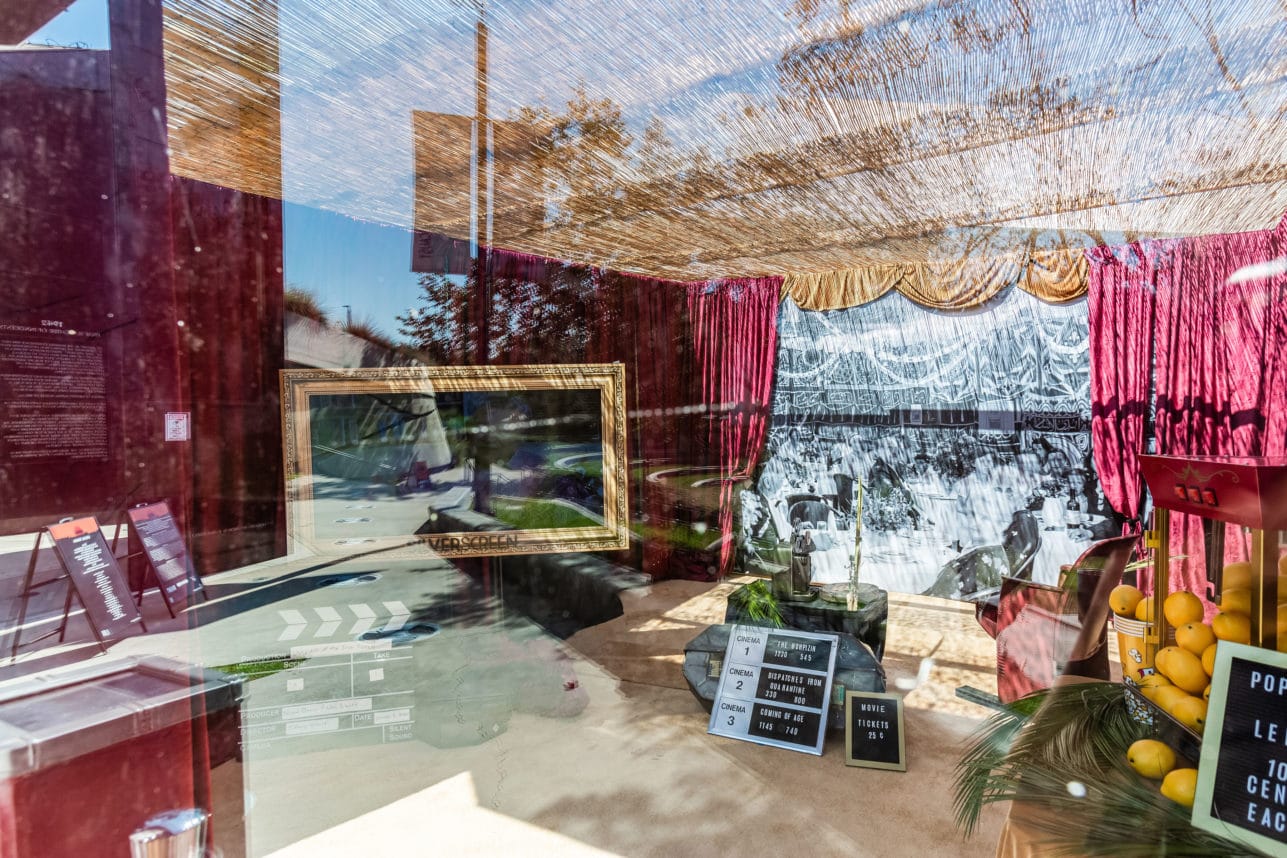
As Jews all over Los Angeles built small huts in their backyards, driveways or front lawns to celebrate Sukkot, artist Tiffany Woolf was setting up a different kind of sukkah structure in Holocaust Museum LA’s memorial garden in Pan Pacific Park. 

“The Ushpizin of the Silver Screen: Honoring the Visions & Voices of the Past,” an artistic interpretation of the traditional holiday hut, is a space for witnessing and learning from the stories of the older generation, “to shine a spotlight on our elders and give them a voice during this time of extreme isolation,” Woolf told the Journal. She also hoped the exhibition, which she called “an ode to a Hollywood-era movie house,” would inspire others to “engage with the older loved ones in their lives and capture their stories.”

The outdoor public art installation — created by Woolf, executive produced by Noam Dromi, and produced and built by Jon Layne of Party Layne Productions — is a collaboration between the arts and culture nonprofit Reboot and Holocaust Museum LA, with support from CANVAS, a Jewish Funders Network-powered arts and culture funding collaborative.

The work also is part of a national CANVAS project, “Dwelling in a Time of Plagues,” which makes new outdoor art possible at museum sites, with organizational support from the Council of American Jewish Museums.  

2020 Party Layne. Shot by Kelly for Beautiful Day Photography.

The Judaic inspiration for the exhibition is the Sukkot tradition of inviting ushpizin — symbolic guests, often including biblical or family ancestors and friends — into the sukkah. The original mystical tradition included prominent male figures from Jewish history (including the patriarchs as well as Joseph and Moses) and more recently has expanded to include prominent women (the matriarchs, Deborah the prophetess, Esther and Ruth) as well as other inspiring figures. 

Artist Tiffany Woolf takes a moment to enjoy the Sukkah. Photo by Joanna Elliott.

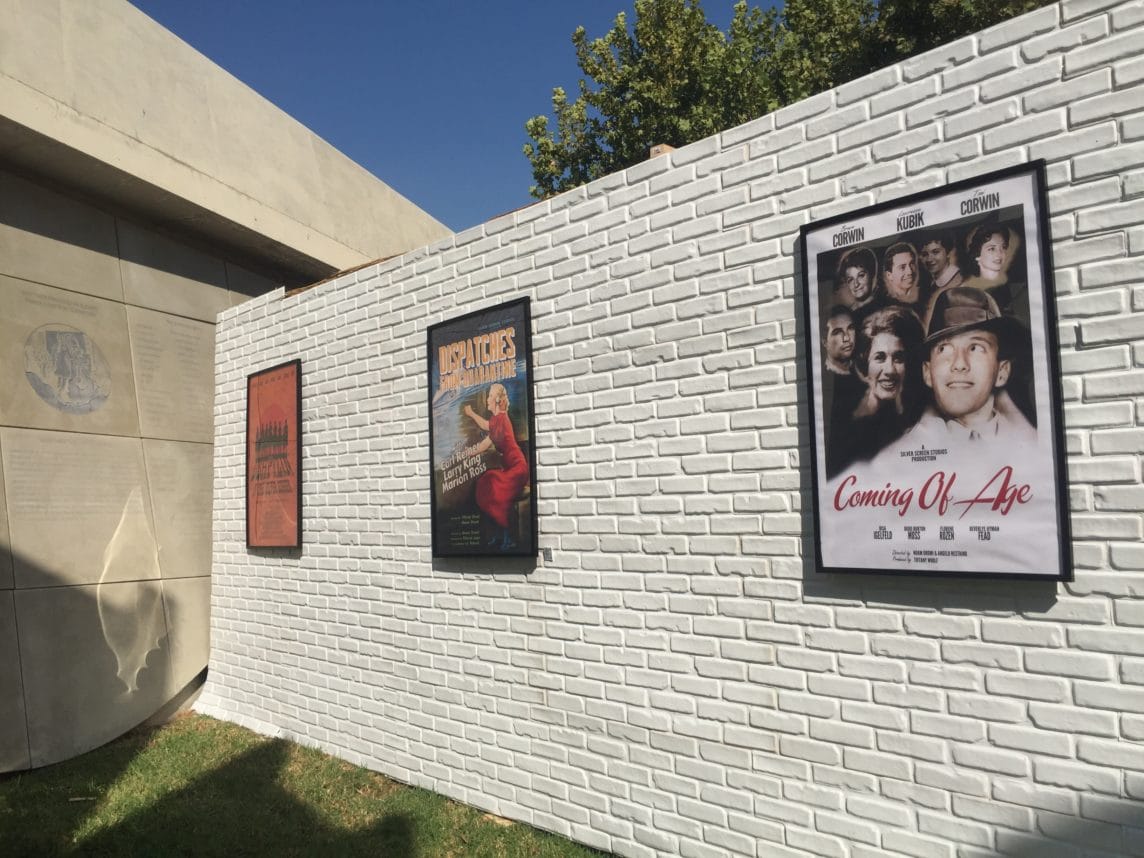
Around the sukkah are posters for the three Silver Screen Studios projects, styled as throwbacks to classic movie posters. Seals on the ground mark proper social distance and invoke a traditional ushpizin guest. Visitors can view the exhibition through a plexiglass window. In one corner is a popcorn machine filled with lemons (a nod to Sukkot’s etrog), and a lulav is sitting in one solitary, classic-style movie seat to indicate the solitude of this time. Next to a cart with an old movie projector and a film reel case, a big-screen TV shows an endless loop of interviews, images and stories, pulled from the Silver Screen Studios catalogue — “Dispatches From Quarantine,” “Coming of Age” and “The Last Act” — as well as testimonies from Holocaust Museum LA’s Voice of History films. Even through the plexiglass, the 70-inch screen is visible and the audio can be heard from 400-500 feet away, “to give voice to the voiceless,” as Woolf put it.

“Our hope is that anyone who walks up learns something from it and leaves with an understanding of what we want to accomplish,” Woolf added. 

“We can’t really go to movie theaters now,” Dromi told the Journal in a Zoom interview, “but we’re excited for people to come to our throwback movie theater in the middle of a park in West Hollywood, and we look forward to the day where these amazing films of amazing seniors can be seen the way we intended them — in a dark room full of strangers with popcorn and Red Vines.”

“Dispatches From Quarantine,” Silver Screen Studios’ pandemic pivot, includes a look inside the coronavirus-dictated quarantine lives of Larry King, Ellen Burstyn, Norman Lear and Tommy Chong. The series featured what turned out to be the last interview with comedy legend Carl Reiner.

2020 Party Layne. Shot by Kelly for Beautiful Day Photography.

Additional Sukkot exhibitions in the “Plagues” series are on display at the Oregon Jewish Museum and Center for Holocaust Education in Portland and the Jewish History Museum in Tucson, Ariz. According to the CANVAS website, the exhibitions will tackle contemporary crises like the global pandemic, institutional racism and ageism, forced isolation, global warming, and the crisis for migrants and refugees, and will commission artist displays for Passover 2021.

“We are deeply moved by this Jewish creative response to real-world plagues of our time,” Lou Cove, CANVAS’ founder told the Journal in an email, noting that CANVAS supports “collaborations that strengthen the Jewish arts and culture ecosystem.” He added, “Together, ‘Dwelling in a Time of Plagues’ gives us all an opportunity to be greater than the sum of our parts. And isn’t that an essential part of what being Jewish is all about?”

Tiffany Woolf, the creator of “The Ushpizin of the Silver Screen,”with the project’s executive producer Noam Dromi, [flanking or inside] the installation in Pan Pacific Park. Photo by Michael Canon.
“It is the responsibility of museum and arts organizations to redesign the Jewish future,” said Reboot CEO David Katznelson in a webinar introducing the exhibition. In considering “how to celebrate in a time when we can’t congregate and how we tell our stories,” he said, “it’s the artists who will help us do that — taking voices from the past and our traditions and figuring out how to bring them forward.”

“We’re still a culture that engages in ageism and puts people out to pasture,” said Dromi, who grew up in L.A. He added that Silver Screen Studios and its programs “are all about finding dynamic ways to give older adults their silver carpet moment.” 

Jordanna Gessler, vice president of education and exhibits at Holocaust Museum LA, said that both the exhibition and the museum’s rebranding deliver their message “in a way that speaks directly to the audience of today and honors Holocaust survivors and their legacy.” She added that stories from Holocaust survivors are woven into the testimonies collected by Silver Screen Studios, “to represent a multipart narrative, famous people and not-famous people whose stories are important and represent the L.A. Jewish community.” 

“The older adult population of L.A. is full of stars and we want to give them their moment in the spotlight,” Dromi said. “Let’s ensure we’re capturing their oral histories so that their stories do not fall victim to apathy or history.”

Woolf called the opportunity to present at the museum “a huge honor. [Whether it’s] survivor stories, or your own personal stories with your loved ones, people are realizing time is of the essence with capturing stories,” she said. “You have to look back to look forward.” 

“The Ushpizin of the Silver Screen: Honoring the Visions & Voices of the Past” will be in the memorial garden in Pan Pacific Park through Oct. 9 from 10 a.m. to 4 p.m. daily. Admission is free. All social distancing protocols will be observed. For more information, visit the Holocaust Museum LA’s website. To see the other works on display, visit the website.

Artistic Sukkot-Inspired Exhibition: ‘Ushpizin of the Silver Screen’ Read More »

Lauren Witzke, Delaware’s GOP Senate Candidate, Appears on Site With Ties to White Supremacists

(JTA) — The Republican nominee in Delaware’s Senate race called for an “immigration moratorium” on a website with ties to white supremacists.

Lauren Witzke, who is running against incumbent Sen. Chris Coons, a Democrat, calls for a drastic reduction in immigration to the United States. In a recent interview, she aired those views on VDARE, an anti-immigrant site that the Anti-Defamation League says is a “xenophobic website” that “regularly publishes articles from white supremacists and anti-Semites.”

Witzke blamed immigrants for drug addiction and job loss in the United States, and said “our country is being dismantled.” Using a term that has been wielded as an anti-Semitic dog whistle, she said most politicians do not share her views because they are beholden to large donors.

“Talking about this matters, and that is worth far more to me than $6 million in the bank from a globalist donor class,” she said. $6 million is the amount of money Coons has raised, according to the campaign finance website OpenSecrets.

“People are so worried about being labeled a white supremacist when we are giving our country away to foreigners,” Witzke added. “They are dismantling our culture. They’re taking down our historical monuments. They’re voting against our interests.”

Witzke, 32, is seen as part of the Republican Party’s far-right fringe and as unlikely to mount a serious challenge to Coons, who has represented Delaware since 2010. She has been photographed wearing a shirt endorsing QAnon, the anti-Semitic conspiracy theory, though more recently she distanced herself from the theory, and one of her advisors has previously worked with openly anti-Semitic candidates.

The VDARE interview, conducted by editor Peter Brimelow, himself a British immigrant who has argued that immigration by nonwhites is hurting America, was published Sunday and first reported by the liberal media watchdog Media Matters for America. The Southern Poverty Law Center, which monitors hate, considers him a white supremacist.

Witzke tweeted out the interview, writing that, “In order to preserve America, we must first preserve American families, our values, and our culture.” In an email response to an inquiry from Media Matters, she wrote, “America is tired of Communist media outlets like CNN and the rest absurdly smearing Americans who want to limit immigration — including African Americans, Cubans, and Jews — as white nationalists or somehow fringe.”

Lauren Witzke, Delaware’s GOP Senate Candidate, Appears on Site With Ties to White Supremacists Read More »

A Simchat Torah Menu Everyone Can Love

If you lived in New York in the ’80s, you experienced a city on steroids.

From the hit Broadway shows “Les Miserables,” “Dreamgirls” and “Phantom of the Opera” to some really cool and quirky off-Broadway productions; from blockbuster art exhibitions featuring the works of Van Gogh, Rembrandt and the Impressionists at the Metropolitan Museum of Art to the downtown art scene featuring avant-garde artists such as Cindy Sherman, Jean-Michel Basquiat and Keith Haring, the city was teeming with attractions.

You could catch Robin Williams doing stand-up at a comedy club and great bands jamming at the Blue Note Jazz Club in Greenwich Village. You might spot Calvin Klein on Seventh Avenue and  Elizabeth Taylor in an elevator at the Helmsley Palace Hotel, and Andy Warhol dining with friends at Mr. Chow. “The Donald” and Ivana Trump dominated the tabloids, high society was flying high, the real estate market was hot and Wall Street was on fire.

If you were Jewish and religious, you experienced all that. But you also ate at kosher establishments: Jerusalem Pizza and Gross Dairy Kosher, Lou G Siegel and Kosher Delight in midtown; Schmulka Bernstein’s Kosher Deli and Ratner’s Dairy on the Lower East Side; and Levana, Benjamin of Tudela and My Favorite Dessert Company uptown. 

If you were Jewish, religious and single and living on the Upper West Side, Shabbat meals could be purchased at Meal Mart or Fischer Bros., and the menu was always the same: rotisserie chicken, potato kugel, noodle kugel and coleslaw. There might be cholent and chopped liver. And if your hosts were truly health conscious, a green salad with peppers and cucumbers, bottled Italian dressing and fake “bacon” bits from a jar. 

For Jewish singles on the Upper West Side, the highlight of the dating calendar was Simchat Torah. To accommodate the large crowds, roadblocks closed off traffic around Lincoln Square Synagogue (jokingly called Wink and Stare Synagogue because it’s round structure afforded congregants a view of the other gender). Young people crowded on the street, greeting one another and looking over one another’s shoulders hoping to find Prince Charming or Ms. Right. Surely, some of them actually made it inside for hakafot, dancing and carrying the Torah scrolls in seven circles around the synagogue. 

Simchat Torah marks the end of the weekly reading of the Torah cycle and the beginning of the new cycle. We rejoice by singing, dancing and drinking. Children wave their flags (and receive lots of candy). The theme of the autumn harvest that pervades Sukkot continues into Simchat Torah. Ashkenazi Jews have a tradition of making stuffed cabbage (when you put two together, they look like a Torah scroll). They also make kreplach, a dough stuffed with ground beef. 

Because of all the vegetarians in our families, we were inspired to remake kreplach into vegan wontons with some Sephardic spices and Harissa and Amba Aioli dipping sauces (amba is a tangy mango pickle condiment that originated in Iraq). They wontons are  really simple to make. Luckily, a few were left for us to photograph. 

CRISPY VEGAN WONTONS

10 ounces medium-firm tofu, drained, patted dry and cut into small cubes
1 8-ounce can water chestnuts, drained and finely chopped
6 medium mushrooms, finely chopped
1 inch ginger root, peeled and finely grated
4 scallions, chopped
2 large cloves garlic, crushed
1/2 teaspoon turmeric
1/4 teaspoon cinnamon
2 tablespoons soy sauce
1 tablespoon sesame oil
1 package wonton wrappers

Oil for frying

In large bowl, combine all ingredients except wrappers and frying oil. Mix well.

Lay out wonton wrappers and stuff each with tablespoon of vegetable mixture. Lightly wet edges of wonton wrapper and close diagonally to form triangle.

Heat oil in frying pan and fry wontons till crispy and golden.

Makes about 36.

DIPS

Harissa

2 tablespoons harissa sauce
2 tablespoons olive oil
Combine ingredients and mix well.

Amba Aioli

3 tablespoons mayonnaise
1 tablespoon amba (pickled mango)
Combine ingredients and mix well.

Honey Soy
1/4 cup soy sauce
1 tablespoon sesame oil
1 tablespoon honey
1/2 tablespoon sesame seeds

Combine ingredients and mix well.

Makes about 12 servings.


Rachel Sheff and Sharon Gomperts will answer cooking questions on Instagram at SephardicSpiceGirls or on Facebook at Sephardic Spice SEC Food. They have collaborated on Sephardic Educational Center projects and community cooking classes.

A Simchat Torah Menu Everyone Can Love Read More »

Home Shalom Monday Message #26

Home Shalom promotes healthy relationships and facilitates the creation of judgement free, safe spaces in the Jewish community. Home Shalom is a program of The Advot Project.

Please contact us if you are interested in a workshop and presentation about healthy relationships, self-worth or communication tools.

“The Divine Presence is not made manifest to human beings through sadness but through joy.”–Talmud Shabbat 30b

Jewish tradition refers to Sukkot as z’man simhataynu – “the time of our joy” — because living life with joy and happiness is a fundamental value of Jewish civilization and we celebrate that as a community each year at Sukkot time. 

One of the most popular practices of Sukkot is to stand in the Sukah and recite the special blessings of the holiday with the unique ritual objects that represent Sukkot – the Lulav and the Etrog. The Lulav is composed of three elements: a palm branch, a myrtle branch, and a willow. There are many different personalities that the sages have claimed these elements represent throughout Jewish history such as those with wealth but no good deeds, those with knowledge but who don’t apply their knowledge to action and those who have neither learning, wealth or good deeds. We are given the opportunity to apply these symbols to the challenges of our own lives in new ways each year. The Lulav, with its mixture of texture and fragrances, is perhaps best understood as representing our own potential to be flexible with what life throws our way, to find the joy in the little pleasures of life, to stand tall when necessary, and stand up for ourselves and our own needs and desires. 

The Etrog is a fruit that smells delicious and tastes bitter – an apt symbol for many relationships that, at first, appear sweet and loving but may turn out to be bitter and painful. Just as we hold them together when we recite the traditional blessings of Sukkot, so we recognize that life itself is messy and the relationships we create are often more complicated than we may first imagine. 

Rabbi Mordecai Kaplan wrote, “The Sukkot festival, with its emphasis on joyous gratitude or happiness, is a protest not against civilization, but against its tendency to be a destroyer of happiness.” Our challenge this year, as in every year, is to create our own joy and happiness, even in the midst of extraordinary challenges and perhaps use the festival of Sukkot to remind us of all we have for which we can still be grateful in our lives.

Rabbi Steven Carr Reuben, Home Shalom and Naomi Ackerman, The Advot Project

Home Shalom Monday Message #26 Read More »

YouTube Removes Nation of Islam Channel

YouTube has taken down the Nation of Islam (NOI) channel from its platform.

According to YouTube, the NOI channel was removed on Oct. 2 for violating YouTube’s policies against hate speech, specifically the notion that members of a protected group are part of an evil conspiracy theory.

“We have strict policies prohibiting hate speech on YouTube, and terminate any channel that repeatedly or egregiously violates those policies,” a YouTube spokesperson said in a statement to the Journal. “After updating our guidelines last year to better address content that spreads hateful conspiracy theories, we saw a 5x spike in video removals and have terminated over 25,000 channels for violating our hate speech policies.”

NOI did not respond to the Journal’s request for comment.

The Anti-Defamation League (ADL) wrote in a July blog post that Nation of Islam leader Louis Farrakhan is the “most popular anti-Semite in America.” The ADL noted in that post that Farrakhan said during a July 4 speech “that Jews are enjoined by their religion to poison prophets and that Jews had ‘broken their covenant relationship with God.’ He referred to Jews collectively as ‘Satan’ and the ‘enemy of God,’ and claimed that white people “are born with lie [sic] and murder in their nature.”

Since August 2019, YouTube also has removed several white nationalist figures from its platform, including David Duke and Richard Spencer in June.

YouTube Removes Nation of Islam Channel Read More »

The Debate That Wasn’t

As President Trump hopefully recovers from the coronavirus, it would be wise if we, too, take a break from the toxic political culture of this election. It would actually be healthy for the body politic. At a minimum, we need to assess the damage.

The rapid descent of civility in politics has accelerated to its lowest levels. Never before have we encountered such a spectacle in political life. You think there was bad blood between John Adams and Thomas Jefferson in the presidential election of 1800? That was a pinprick compared to this bloodbath—a gladiatorial contest involving not only the candidates but also their ardent supporters.

And, apparently, you don’t need to step onto a debate platform to partake. Nowadays, family members are cast against one another at holiday meals. Friends refuse to speak, longstanding bonds irrevocably severed, sides taken, and warring camps created. Each accuses the other of falling from grace, acting obtusely naïve, and being morally beyond the pale. Neighbors draw lines in the sand with dueling political lawn signs—MAGA baseball caps are the new kryptonite.

Even children are not spared, used as vetoes in these political war games. How many parents have said, “I will not allow you to visit that house of Trump supporters?” This is protective parenting at its most partisan.

And partisanship is not confined to our polarizing president. Commercials for or against candidates—even for congressional seats—are dialed-up to the most extreme forms of negative campaigning. The press, almost daily, gives credence to “fake news.” And during the Democratic primaries, perceived frontrunners were treated as foreign enemies. Mike Bloomberg never got off the mat. Kamala Harris blasted Joe Biden, insinuating that he was a racist. That’s a serious charge in today’s racial climate. Now, as his running-mate, she laughs it off by saying, “That’s politics.”

But the first presidential debate was a species of party politics that defied description. Did it qualify as an actual debate? The candidates would have benefitted from having cutmen in their corners. Honestly, we might have had a China Syndrome on our hands. This catastrophe found no bottom. At least it was unrelated to the Wuhan Province.

The debate spectacle was one continuous interruption—all boorishness and berating. But both candidates were not equally to blame. President Trump demonstrated once more how much difficulty he has playing nicely with others—the old Queens schoolyard of his youth must have been hell.

The coarsening of our political culture is so pervasive, it has manifested itself all throughout this campaign season, with the debate providing a particularly vivid demonstration of how sordid is has become. Almost no meaningful information about the candidates could be deciphered. True to form, the president failed to complete a thought, dashing off on tangents and leaving all logical connections in limbo. His tirades relied on his one true talent—turning groups against each other. He will be remembered as one of the world’s great finger pointers.

Biden’s performance was beyond evaluation. He appeared punch drunk and barely entered the fray. Now, with his advancing age, Biden has the gravitas of a grandfather no one listens to anymore. The opening of his mouth is an adventure in damaging sound bites. Not allowing the former vice president to get a word in edgewise was a disastrous mistake; Trump should have left some of the oxygen on the debate stage for his Democratic opponent, just in case a campaign-sinking thought came to him.

Biden was so frustrated by the chaos that Trump lives for, he at least twice referred to the president as a “clown,” and once told him to “shut up.” That was a cringe-producing moment. Imagine if Trump replied, “Need I remind you: I am the President of the United States. You don’t have to like me, but you must respect the office I hold.” That response would have been dramatic and dignified, but also absurd. Not for a single day has this president conducted himself in a manner befitting the office to which he was elected.

Our Founding Fathers would be appalled. Democratic dialogue is nonexistent. Civility and mutual respect have disappeared from the public square and ivy green. Cancellation culture, that cancerous menace that has infected us all, has metastasized to the public sphere. Fear over what is said and what must remain unspoken—and the drumbeat of rage that demands silence—is everywhere around us.

Our Founding Fathers would be appalled. Democratic dialogue is nonexistent.

We have completely lost all understanding of the First Amendment and freedom of speech, our most recognized liberty. At the Constitutional Convention during the summer of 1787, our Founding Fathers debated with great foresight the rights we were to receive. Their manner was straightforward: read books, compare constitutions, and come prepared to deliver your argument. They believed the American public would learn by example from these debates, and that they would become a model for their own civic engagement.

Freedom of speech obviously involves much more than public debates on politics. It doesn’t only apply to candidates—the general public has the right to speak, as well. But more importantly, the exercise of freedom of speech also includes a more contemplative freedom of thought. To think differently and tolerate differences of opinion is part of the same liberty, one that carries a reciprocal obligation.

But that freedom today is under constant assault. Students shout down speakers on campus whose opinion they have decided emphatically not to hear. People are fired for remarks that unintentionally violate intersectional norms. Cancellation culture is the most severe censor. Banishment itself seems to be one of the most lethal calling cards of social media. Thinking independently is somehow seen as audacious, akin to a criminal act. Exercising a constitutional right to speak freely, to some, should have the consequence of a war crime.

Our Founders believed that robust debate improved society, advanced science and culture, and enabled citizens to participate in representative democracy. Where is that happening today? Surely not on campus, in mainstream media, at family meals, or in political campaigns.  Antagonism and annihilation instead define our civic dialogue. At the Women’s March on Washington in 2016, for example, Madonna proclaimed her disapproval of the recently inaugurated Donald Trump by stating that she “wanted to blow up the White House.”

Compare that sentiment to the march on Washington in 1963, when Martin Luther King Jr. delivered his “I Have a Dream” speech. True, a pop star can’t very well be compared to a civil rights legend. But she was chosen for the assignment. And she decided to speak in the language of the degenerate and divisive. The soaring, ennobling words of Dr. King do not supply the lyrics of this age.

It’s not too late to reverse course and reclaim the higher aspirations these liberties were meant to guarantee.

Inspired leadership would help. After he recovers from COVID-19, it would be wonderful if the president resumed his campaign by helping us recapture the respect we once had for freedom of thought, along with the civility that is required in the exercise of this right.

And it would great if he wore a mask, too.


Thane Rosenbaum is a novelist, essayist, law professor and Distinguished University Professor at Touro College, where he directs the Forum on Life, Culture & Society. He is the legal analyst for CBS News Radio. His most recent book is titled “Saving Free Speech … From Itself.”

The Debate That Wasn’t Read More »

An Encounter With Hope in the Grocery Store

I stepped out of the square taped to the supermarket floor, pushed my cart forward and unloaded my groceries. Looking through the plexiglass barrier, I read the name tag of the checker, Emeka, a Black man whom I’d never seen in that store.

Before COVID-19, I used to read the name tags of store clerks and greet them by name. It’s a mitzvah to take the initiative in greeting people, and to do so with a pleasant demeanor. In my experience, doing so infuses predictable interactions with small sparks of connection. Clerks perked up when they heard their names, glad to have their individuality recognized. They’d often smile and offer an appreciative look.

Behind my mask, I should have redoubled my efforts. Instead, I let myself sink into feelings of alienation that followed the lockdown. To my embarrassment, I dropped my practice. But Emeka radiated such optimism that I decided this was the moment I was meant to resume my practice. I said hello, and asked how he pronounced his name.

“My name is pronounced ‘e-MEH-kah.’ It means ‘what God has done is good’ in Nigerian.” He spoke with pride, a dignified man.

“Your name is beautiful,” I said. Encouraged by my compliment, Emeka told me about himself. Scanning the bar codes on my nectarines, asparagus, milk and crackers, he told me about coming here from Nigeria in 1974, returning there to get married, and bringing his wife back to the U.S. “America is the land of opportunity!” he said.

“Do you still feel that way, even now?” I asked.

He said in a tone laced with wonderment at his good fortune, “My wife became a registered nurse here. Now she is studying to become a physician’s assistant. We have three children, two in high school and one in grade school. I bought my own home.”

Blacks and Jews are people whose histories include oppression, enslavement and ongoing prejudice.

As a Black man in the U.S., Emeka may well have encountered suspicious looks, rude gestures, cruel comments, perhaps a white person crossing the street to avoid walking directly past him, and other indignities. But he has not let the painful encounters dampen his appreciation for the life he has built here, and for the country that facilitated it.

As a Jew, I also carry the weight of historical and chronic threats against my people every day. Blacks and Jews are people whose histories include oppression, enslavement and ongoing prejudice in different nations and to varying degrees. We have every reason to feel one another’s pain.

However, the kinship I felt with Emeka wasn’t based on a shared victim status, but on a shared mindset of faith and gratitude. At its best, religion fosters this sense of gratitude, a sense of purpose and the understanding we are crucial players in God’s unfolding plans. A shared sense of faith also creates sustaining bonds of community.

We may not understand why we endure crucibles, but our belief in a God who is our creator and ultimate loving parent, helps us reframe life’s difficulties and forge ahead. We work to uphold God’s laws and pray for a better tomorrow.

Emeka’s pride in telling me the meaning of his name signaled that his faith enables him to see life not as a series of affronts, but a series of challenges to be met through his own positivity, abilities and belief in God. These are advantages no one can take from him.

When my purchase was complete, I told Emeka I looked forward to seeing him again. “I also look forward to seeing you. God bless you,” he said. I returned his blessing in full.

This little encounter in the market should not have been notable. But with racially-charged protests and riots plaguing many cities, everyday encounters between People of Color and whites assume an outsized significance. That made my fleeting onnection with Emeka healing, uplifting, even moving.

In a time of depressing social and political strife, I will long cherish this beautiful moment, one made possible by a shared outlook of faith in God.


Judy Gruen’s is the author of “The Skeptic and the Rabbi: Falling in Love With Faith.” 

An Encounter With Hope in the Grocery Store Read More »

The Anti-Defamation League’s CEO Jonathan Greenblatt Wants to Take Us Back to Our Roots and ‘Remember Why We Are Here Today’

For years, Facebook’s algorithms have been criticized by privacy enthusiasts, regulators, businesses, and of course impacted users–and most recently, musicians who will soon be affected by the new Terms of Service which go into effect Oct. 1, which I recently discussed in a recent Bloomberg Law Insight.

Today, however, the social giant’s mechanisms for combating hate speech, violent rhetoric, and other forms of cancel culture which lead to online bullying and discrimination have been significantly diminished, as it seems online aggressors are winning (perhaps to the platform’s taste).

The Anti-Defamation League (ADL), formerly known throughout the Jewish community as the Anti-Defamation League of B’nai B’rith, is an international Jewish non-governmental organization based in the United States. 

Since 1913, the ADL has envisioned an America where those seemed different were not targets of discrimination and threats but were equals, worthy of shared opportunity. Unfortunately, in today’s political climate, whether we talk BLM, Blue Lives Matter, or our very own White House, the ADL couldn’t be more necessary. And as a Jew and an active member of the B’nai B’rith Youth Organization over the years (Henry Monsky AZA), I hope to push the ADL’s mission onward and upward.

Recently, Jonathan Greenblatt, CEO of the ADL, joined SiriusXM Business Radio host Alan Fleischmann of ‘Leadership Matters’ to talk about his efforts to “revive ADL’s roots,” which takes us back to 1913, when it was first founded by attorney Sigmund Livingston.

“Our fate is intertwined with those of others, and I’ve tried to bring a ‘freshness’ to that fight,” Greenblatt explained to Fleischmann. As the interview went on, Greenblatt emphasized the ADL’s efforts to fight hate speech in a culture centered around redefining the bounds of the First Amendment to the U.S. Constitution, and of course, calling out Facebook, specifically, for its questionable algorithms that promote hate speech and misinformation.

“Facebook’s algorithms are recommending and reinforcing Holocaust denials on the platform. Without selecting it, algorithmically, it’s recommended to users to look at this stuff. And that’s how it circulates and spreads,” he explains.

Greenblatt believes that when it comes to Holocaust denialism, that it should be weighed differently and treated as such for algorithmic purposes. 

“I would suggest that holocaust denialism should be treated differently in the algorithm, than say the knitting club. I would suggest misinformation about COVID-19, should be treated a little differently, than the group who loves Labrador retrievers. I would suggest misinformation about George Floyd, even if one can say that it should be permitted, should be treated a little differently than movie recommendations for god’s sake.”

“I think we need to recognize the difference between hateful speech, harmful speech, and speech designed to hurt, wound, or delegitimize,” Greenblatt proposed, stating that “it should be treated differently. Whether or not one agrees with that or not when you have a speech that sets out to stereotype and scapegoat and slander. Freedom of speech is not freedom to slander. Freedom of expression isn’t the freedom to incite violence. So there are some things we need to tolerate but we can treat in a certain sort of way, and there are other things that there should be no space for in private business. 

I used to be an executive at Starbucks. And if you walked into that Starbucks store in midtown Manhattan, and stood at the counter and started screaming profanities at the customers, or say Jews are controlling the world, or Mexicans need to go back to Mexico, or whatever craziness like that. Do you know what the store manager would do?”

‘Walk you to the door? Fleischmann answered. “‘They would throw you out, exactly,’” Greenblatt acknowledged. 

An Angel On Our Shoulders

And what Greenblatt proposes with respect to regulating speech on social media, also mirrors similar thoughts by ‘13 Reasons Why’ and ‘Supernatural’ actor, Mark Pellegrino, who I recently interviewed and since partnered up with for our ‘Guardian Project’ about what these platforms need to do.

Pellegrino, known for his role as Deputy Bill Standall on Netflix’s 13 Reasons Why and ‘Lucifer’ on the CW’s Supernatural, similarly proposed a system to me in our Thrive Global interview:

“I think the algorithms that [these social media platforms] use to define whatever their parameters are for speech, don’t seem to be very good. They seem to be highly biased in one direction. I think what they need to do if they are a ‘free speech platform’ is understand that free speech still precludes violence and libel.” 

And when it comes to holding users accountable online, Pellegrino believes that “there should be objective criteria for that behavior and a squad of people that are dedicated to just that. Without their political prejudices serving as guidelines–just the guideline of ‘violence’ and a ‘lie’. Is it violent? Is it force or fraud? That’s the only guideline they use, and then deplatform those people.”

Pellegrino and I recently announced the launch of ‘The Guardian Project,’ the physical manifestation of the ‘Guardians’ concept which was first created by Twitter user @ArchLuminous and given to Pellegrino to expand further, in hopes to provide a platform and voice for victims to be heard and their stories to be humanized, so that aggressors are faced with the choice on whether to rehabilitate or face society’s consequences for their poor digital hygiene. 

A Parochial Jewish Notion That Needs to Be Adapted to Universal Rights

When the ADL was founded 100-plus years ago, according to Greenblatt, following the lunching of one Jewish man, Jews faced what we now recognize as “systemic discrimination.”

“They didn’t have political power, economic resources, social standing; and their future in this country was very uncertain. They were weak by every measure. Quotas kept them out of university, laws kept them from buying homes, and social standards kept them out of different professions. I could go on.”

Unfortunately, despite where you fall on the political spectrum, that discrimination still exists from our very own government. Recently, Business Insider reported that U.S. President Donald Trump faces criticism by the Jewish community for allegedly making statements that infer that Jews have a loyalty to their religion above other interests.

Jews, according to President Trump, “are only in it for themselves” and “stick together,” which he said in front of officials in his administration, according to a new report from The Washington Post earlier this week. And let me tell you, the denial is straight-up real by Trump supporters, who refuse to see past anti-semitic behavior, but believe that simply because Trump helped unite Israel with the UAE and Egypt, that he couldn’t possibly make such statements or the fact that his son-in-law and senior advisor, Jared Kushner, is Jewish, he wouldn’t dare make such statements. 

Well, hate to say it, and so bluntly, but the reality is, we have a Nazi in the White House. 

Greenblatt referenced the charter the ADL’s founders first put together, which we call a “manifesto” today. “In it are the words we still use as our mission statement. They wrote that the mission of the ADL would be to ‘stop the defamation of the Jewish people and to secure justice and fair treatment to all.’ Frankly, in 1913, Jewish people probably had more security living in Germany than in the United States. They were better integrated, better situated, more successful. In Germany, their future was more certain, but in America, not so much. And yet these Jewish people said, ‘we will fight for ourselves, but we will also fight for others.’ I mean that was an audacious claim. How could they fight for others, but they themselves were so fragmented and so vulnerable?”

A common Jewish principle is that we could only be free when everyone else was free. “Only when minorities were safe, Jews could be safe,” Greenblatt passionately points out, reminding listeners that this is “a very Jewish idea, which echoes in Hillel.”

And according to the ADL CEO, that’s exactly what propelled this organization, leading to the first Amicus Brief being filed at the U.S. Supreme Court in the 1940s in Shelley v. Kramer, which focused on restrictive housing covenants preventing African Americans and Jews from buying homes in certain areas. 

“Then in 1953, we filed our second amicus brief in Brown v. Board of Education.” While many in the ADL, Greenblatt revealed, believed that this issue wasn’t their fight, “Brown, that’s about young black children being integrated into schools…that’s not a Jewish fight.” But the guy who had my job in 1953 said ‘no, no, no, that’s exactly why it’s a Jewish fight.’ And so, I think in the years before I joined, ADL was more and more parochial, more and more focused on Israel and just Jews, and again, Israel matters, Jews matter, don’t get me wrong. But I think it’s important to center this work in the fight for universal rights and to realize that as Jewish people, the privileges we enjoy today, are not just because we alone achieved, but because we’ve created coalitions and partnered with others. And in that common pursuit, we’ve had a collective success. And forgetting that, letting that go–I think if you disregard that memory and ignore that truth, you do so at your own disadvantage. If we forget how we are here today. Why we’ve enjoyed the success, and if we lack the humility to realize we didn’t do it all on our own, then I think we are doomed to repeat these failures that have accompanied the Jewish people throughout the millennia and throughout other societies.”

For Greenblatt’s full interview with Sirius XM’s Alan Fleischmann, please click here. 

The Anti-Defamation League’s CEO Jonathan Greenblatt Wants to Take Us Back to Our Roots and ‘Remember Why We Are Here Today’ Read More »

Jewish Student Assaulted Outside of German Synagogue

A Jewish student was assaulted outside of a synagogue in Hamburg, Germany, on Oct. 4 in what officials are calling an anti-Semitic attack.

The alleged assailant, reportedly a 29-year-old man, hit the student in the head with a foldable shovel. Police immediately arrested the suspect, who reportedly had a piece of paper with a swastika on it in his pocket during the assault.

The victim, who reportedly was wearing a skullcap at the time of the assault, was taken to a local hospital with serious injuries, although the injuries are not considered to be life-threatening.

Avichai Apel, the chair of the German Orthodox Rabbinical Conference, told the Deutsche Welle broadcast network, “It is unbearable to see hatred and violence against Jews erupt again and again on German streets, and this comes during the holiest Jewish holidays and one year after the terrible attack in Halle.” He called on Germans to “take even more decisive action against hate and incitement on the internet, against right-wing extremist agitators, against the Neo Nazi scene and crude conspiracy theorists, and do more for prevention, education and the promotion of civic courage.”

Other Jewish groups joined in.

“A Jewish student was brutally attacked and severely injured outside a synagogue in #Hamburg, Germany,” Anti-Defamation League CEO Jonathan Greenblatt tweeted. “A full investigation must be done into motivation and organization to better protect Jews who must be able to worship free of fear.”


American Jewish Committee CEO David Harris tweeted, “A year ago, it was an attack at a synagogue in Halle, Germany, during Jewish holiday of Yom Kippur. Now it’s an attack at a synagogue in Hamburg, Germany, during Jewish holiday of Sukkot. Will the age-old & demonic pathology of #antisemitism ever end?”


During Yom Kippur in October 2019, a gunman shot and killed two people outside of a synagogue in Halle. He attempted to enter the synagogue but was unsuccessful due to a lock on the door.

Jewish Student Assaulted Outside of German Synagogue Read More »