fbpx

September 25, 2020

Lisa Edelstein Joins the Cast of ‘ 9-1-1 Lone Star’

Lisa Edelstein (“House,” “The Good Doctor”) has joined the cast of FOX’s “9-1-1 Lone Star” as the ex-wife of the fire captain played by the series’ star Rob Lowe. Plus it’s a reunion: Edelstein also played Lowe’s love interest on the first season of “The West Wing.”

Edelstein fills the leading lady void left by Liv Tyler, who decided not to return for the second season. In the storyline, her character, Gwyneth, will arrive in Austin from New York City to be with her son (Ronen Rubinstein), who is in the hospital after being shot at the end of Season One. 

Edelstein is also continuing her in role on “The Kominsky Method” as  Phoebe, the estranged daughter of Alan Arkin’s character Norman, despite Arkin’s just-announced departure from the show.

Lisa Edelstein Joins the Cast of ‘ 9-1-1 Lone Star’ Read More »

AOC Withdraws From Yitzhak Rabin Memorial Event Following Pro-Palestinian Criticism

Rep. Alexandria Ocasio-Cortez (D-N.Y.) withdrew from an upcoming event honoring the late Israeli Prime Minister Yitzhak Rabin following criticism from pro-Palestinian voices.

Americans for Peace Now (APN), which is hosting the event on Oct. 20, announced in a Sept. 24 tweet that Ocasio-Cortez will be reflecting “on fulfilling the courageous Israeli leader’s mission for peace and justice today in the US and Israel.”

https://twitter.com/PeaceNowUS/status/1309180744745529344?s=20


Alex Kane, a contributing writer for the progressive magazine Jewish Currents, tweeted, “So @AOC is doing a memorial event for Yitzhak Rabin. In the US Rabin is viewed as a liberal peacemaker but Palestinians remember him for his brutal rule suppressing Palestinian protest during the First Intifada, as someone who reportedly ordered the breaking of Palestinian bones.”

He added in a subsequent tweet, “As for his peacemaking — Oslo was an achievement for the Palestinian and Israeli authorities who negotiated it, but in practice gave Israel cover to build more settlements.”

Ocasio-Cortez tweeted in response to Kane, “Hey there — this event and my involvement was presented to my team differently from how it’s now being promoted. Thanks for pointing it out. Taking a look into this now.”


A spokesperson for Ocasio-Cortez told the Times of Israel (TOI) that Ocasio-Cortez won’t be attending the event after all but didn’t state why. A source told TOI that Ocasio-Cortez’s “office did not realize the event would be framed around commemorating Rabin, as opposed to an opportunity to offer Ocasio-Cortez’s policies for the region.”

Pro-Palestinian accounts criticized Ocasio-Cortez for being scheduled to appear at the Rabin memorial.

“Regardless of content, @AOC should not be speaking at an event that rehabilitates the legacy of Rabin and the ‘peace process,’ which was aimed at establishing an autonomy arrangement of permanent subjugation and never the prospects of (even) a truncated Palestinian state,” Rutgers University professor Noura Erakat tweeted.


“Reprehensible for @AOC to honor Yitzhak Rabin, the war criminal who personally oversaw 1948 Lydda Death March, and during the first intifada ordered Israeli soldiers to break bones of Palestinian children,” Ali Abunimah, co-founder of the pro-Palestinian website Electronic Intifada, tweeted. “It shows total contempt for Palestinian lives.

“Seriously, what’s next? Will @AOC be joining @JoeBiden at a commemoration to honor Strom Thurmond?”

CNN’s Jake Tapper, on the other hand, tweeted, “.@AOC is being attacked for participating in a Memorial Event for Yitzhak Rabin who was literally assassinated by a right-wing Israeli zealot for his peace efforts with the Palestinians, especially Oslo.”


Tablet senior writer Yair Rosenberg similarly tweeted, “If @AOC can’t even do an event with *Peace Now* remembering Yitzhak Rabin, the general turned peacemaker killed by a far-right extremist for trying to make peace with the Palestinians, it suggests caring more about Twitter than good real world outcomes. Hope that’s not the case.”

https://twitter.com/Yair_Rosenberg/status/1309514850792599552?s=20


Rosenberg added in a subsequent tweet that he hoped that Ocasio-Cortez’s tweet was “just a misunderstanding about framing or promotion of the event, and not some repudiation of Rabin, because my sense is that contra her critics, AOC is wiser and more strategic than Twitter’s worst instincts on things like this. Guess we’ll see.”

https://twitter.com/Yair_Rosenberg/status/1309521031065894913?s=20


Dan Shapiro, the former U.S. ambassador to Israel during President Barack Obama’s administration, also tweeted, “If @AOC is getting some bad advice, or undue pressure, to rethink her participation in a Yitzhak Rabin memorial, I hope she will not back down. Honoring Rabin, an Israeli patriot killed for trying to make peace, in no way detracts from a commitment to Palestinians’ rights.”


Rabin was elected as Israeli prime minister in June 1992. In November 1995, right-wing extremist Yigal Amir shot Rabin in the chest twice as Rabin was leaving a rally in Tel Aviv. Rabin won the Nobel Peace Prize in 1994 after the signing of the Oslo Accord in 1993; Rabin also signed a peace treaty with Jordan in 1994


AOC Withdraws From Yitzhak Rabin Memorial Event Following Pro-Palestinian Criticism Read More »

Report Highlights Anti-Semitism in Qatari Textbooks

A new report from The Institute for Monitoring Peace and Cultural Tolerance in School Education (IMPACT-se) highlighted anti-Semitism permeating Qatari textbooks.

IMPACT-se CEO Marcus Sheff and Anti-Defamation League (ADL) Washington Director for International Affairs David Andrew Weinberg wrote in a Sept. 25 op-ed for Newsweek that the report shows that Qatari textbooks “propagate nearly all of the anti-Semitic tropes identified by ADL’s guide: power, disloyalty, greed, deicide, blood libel, Holocaust denial and anti-Jewish slanders that are framed as critiques of Zionism or Israeli policy.”

Some of the examples that Sheff and Weinberg highlighted included a fifth-grade textbook accusing Jews of killing Jesus and an 11th-grade textbook calling Zionism “a radical racist political movement, which aims at establishing a state for the Jews in Palestine, in an effort to take over and rule the world.”

Additionally, the 2019 Qatari curriculum calls Israel “Palestine” and urges Muslims to “liberate Palestine.” The report also didn’t find any mentions of the Holocaust in the more than 200 Qatari textbooks that it reviewed.

“It is probably too much to expect that Qatar will embrace the Jewish state in the way that its neighbors the UAE and Bahrain have done,” Weinberg and Sheff wrote. “But Qatar’s government has a duty to ensure that all bigoted materials are removed immediately from its government-published textbooks. And until Qatar proves that it has done so, its international partners, and especially the U.S. government, should explicitly demand the elimination of its educational incitement against Jewish people.”

ADL CEO Jonathan Greenblatt tweeted, “Disturbing new evidence has emerged indicating that Qatar continues to teach anti-Semitic tropes & present hateful depictions of Jews in its government-published textbooks.”


On Sept. 14, the United States and Qatar signed a memorandum of understanding (MOU) focusing on cultural exchange opportunities. Secretary of State Mike Pompeo praised Qatar at the time for “promoting stability in the region.  Tomorrow, as Israel and the UAE [United Arab Emirates] join President Trump at the White House to sign a historic agreement to normalize relations, we anticipate other countries in the Middle East will recognize the benefits of a closer relationship with Israel.  In that effort, also, Qatar plays an invaluable role in helping stabilize Gaza, as well as regional efforts to de-escalate tensions both in Syria and in Lebanon.”

However, Qatari Assistant Foreign Minister Lolwah Alkhater told Bloomberg News that Qatar won’t normalize relations with Israel anytime soon because “the core of this conflict is about the drastic conditions that the Palestinians are living under [as] people without a country, living under occupation.”

Report Highlights Anti-Semitism in Qatari Textbooks Read More »

Netanyahu’s Waning Legacy

Twenty six years ago, I was on the aircraft carrying then-Prime Minister Yitzhak Rabin back from Washington to Israel. The mood in our modest version of Air Force One was euphoric. On the South Lawn of the White House, Rabin had just signed a peace treaty with Jordan, an enemy country whose border with Israel was drenched with blood shed over years of conflict.

I doubt that the plane carrying Prime Minister Benjamin Netanyahu back from the United Arab Emirates (UAE) and Bahrain ceremony had the same festive atmosphere. Presumably, Netanyahu has congratulated himself on this great success — even though Israel had never really been at war with the two Gulf states. How different that ceremony in 1994 was from last week’s event: peace with Jordan was achieved through direct and secret negotiations between the parties, with the Americans arriving at the last moment for the photo opportunity. The Abraham Accords, by contrast, were fully orchestrated by Jared Kushner, which some say he did to help re-elect his father-in-law.

Netanyahu, however, can easily dismiss these differences. For years, he has attempted to carve out his legacy. Netanyahu started out as the guru of anti-terrorism, but as prime minister, he acted precisely against his own teachings. In 2011, for example, he released 1,000 terrorists from Israeli jails, in exchange for the one Israeli soldier held by Hamas, Gilad Shalit — a deal that Ehud Olmert, the preceding prime minister, called “a crime.”

Or consider his campaign against nuclear Iran. Netanyahu staged himself as a cavalier fighting almost single-handedly against the evil regime, boasting that he was the one who had pulled the United States out of the deal. But based on a recent report by the Institute of National Strategic Studies in Tel Aviv, one wonders whether Israel is in a better situation now — when there is no inspection whatsoever on Iran’s nuclear program — than we were in the time of the Iran Deal, imperfect as it was. The jury is still out on his success in this matter.

It’s not too late for Netanyahu to save his legacy.

When the UAE and Bahrain deal emerged, it seemed like a perfect opportunity for Netanyahu to try and make it his legacy. Why, then, does his victory seem so gloomy?

The reason is COVID-19.

The virus has quickly become Netanyahu’s nemesis. At the beginning of the outbreak, Netanyahu dismissed it as just another flu. When he realized it wasn’t, he acted quickly and imposed a full lockdown. Elated by his success, Netanyahu boasted that world leaders were calling him and asking how he had managed to crush the pandemic. But then he called off the lockdown prematurely and sent Israelis to “have fun.” This proved to be a fatal mistake.

In the five months that have passed since that decision, Netanyahu, believing he had once again single-handedly saved Israel, has insisted on being the only Coronavirus Czar. Unwilling to share credit with then-Defense Minister Naftali Bennett and today with Benny Gantz, Netanyahu refused to hand over crisis management to the only organization capable of doing it — the Israeli Defense Forces. Instead, he presided over a chaotic hybrid of fighting politicians and experts, surrendered to pressures of Ultra-Orthodox politicians and mayors, threw money on the left and right, on rich and poor indiscriminately, mortgaging the future of our children, and returned from Washington only to impose another lockdown.

If that wasn’t enough, Netanyahu also is facing an impending corruption trial, which, like in the case of Richard Nixon, might mar his legacy forever.

Just before he passed away in 2018, Netanyahu’s lawyer, Jacob Weinroth, advised the prime minister to ask for a plea bargain. But Netanyahu refused. Many Israelis now believe that everything Netanyahu is doing — related to diplomacy, security, or COVID-19 — is only meant to save him from trial, even at the cost of curbing Israeli democracy. Before COVID-19, Netanyahu had already shattered public trust in Israeli institutions. He denigrated the law enforcement agencies by attacking the police, then the Attorney General, and finally the legal system, blaming them of conspiring together to topple a duly-elected prime minister by sinister measures. With three out of every four Israelis not trusting Netanyahu’s management of the crisis, it’s no wonder that leading commentators have blamed him for imposing the lockdown to stop the ongoing outdoor demonstrations against him.

It’s not too late for Netanyahu to save his legacy. Although a plea bargain is probably off the table, Netanyahu should take this Yom Kippur to have a heshbon nefesh, (accounting of the soul) and perhaps consider stepping down and fighting for his innocence in court —before he tarnishes his name even further. By doing so, he might salvage some of his reputation, and perhaps even leave office with the legacy of a peacemaker.

Uri Dromi is director general of the Mishkenot Sha’ananim conference center in Jerusalem. He was the spokesman of the Rabin and Peres governments (1992-96) and was the chief education officer of the Israeli Air Force and the editor-in-chief of the IAF Magazine and the IDF Publishing House.

Netanyahu’s Waning Legacy Read More »

A Google Search for ‘Jewish Baby Strollers’ Yields Anti-Semitic Images. An Extremist Campaign May Be to Blame

(JTA) — The Google results are shocking: Do an image search for “Jewish baby strollers” and you’ll see row upon row of portable ovens — an offensive allusion to the Holocaust.

Google says it’s looking into the search results and wants to improve them. But according to researchers, the results may not be an accident. It’s possible that they’re the result of a coordinated extremist campaign on a fringe website to yield those specific images.

The Network Contagion Research Institute, which studies the way hate speech spreads online, located a series of posts on the 4chan message board, dating back to 2017, that purposefully pair images of ovens on wheels with the term “Jewish baby stroller.” There were at least a dozen such images turned up in one search, dating from August and September 2017. That means these results may have been in place for years, even though they drew attention Friday.

Posting that specific term next to the image may have manipulated Google’s search algorithm, such that it promoted those images when users search the term, says Joel Finkelstein, the institute’s director.

“What happens is they trick Google into putting that stuff up top,” Finkelstein said. “They paste the image with the words so that when you search those words, the image comes to the top.”

Oven references are relatively common among anti-Semites, who make them to allude to Jews belonging in the crematoria Nazis used to incinerate the bodies of Jews they killed in the Holocaust.

Google told the Jewish Telegraphic Agency in a statement that the images are “disturbing,” and are the result of an algorithm. It did not include clear information on how such search results may be prevented.

“We understand these are disturbing results, and we share the concern about this content,” the statement said. “It does not reflect our opinions. When people search for images on Google, our systems largely rely on matching the words in your query to the words that appear next to images on the webpage. For this query, which is for a product that doesn’t actually exist, the closest matches are web pages that contain offensive and hateful content. We’ve done considerable work in improving instances where we return low quality content, and we’ll look at this situation to see how we can return more helpful results.”

Google rarely removes individual search results or makes adjustments for one specific search term. A spokesperson said the company looks for “broader systematic improvements that can make Search better for other queries like it.” In particular, the spokesperson said, the challenge here is a “data void” where the only content available for a search term is “offensive [or] of low quality.”

Network Contagion Research Institute researchers say there could be another possibility: that an anti-Semitic meme, also from 2017, led Google’s search algorithm to mistake the portable oven for a stroller because they look somewhat similar. Like the 4chan posts, the meme is the picture of a portable oven over the text “Jewish baby stroller” in all caps.

“It’s either a raid from 4chan trolls or it’s a meme that circulated on the web,” said Alex Goldenberg, the institute’s lead intelligence analyst. “The Google search algorithm is driving it to the top for some reason, or the item in the meme is tricking the Google algorithm.”

Goldenberg added, “It’s notable that Google Image search didn’t pick that up.”

If it was a coordinated action by online anti-Semites, called a “raid,” it wouldn’t be the first one. In a 2016 “raid” called Operation Google, extremists tried to undermine a new tool Google had for spotting and filtering out racial and ethnic slurs. They did this by replacing the slurs in their comments with the names of tech companies. So, for example, they used the word “Google” instead of the n-word, and used the word “Skype” to refer to Jews. They hoped that doing that would force Google to censor its own name, which did not happen.

This also isn’t the first time Google has yielded anti-Semitic search results. According to MEMRI, a media research organization, and the World Zionist organization, the search term “oy vey” yielded anti-Semitic results as well. In 2016, Google made changes so that its search function no longer suggested the search term “Jews are evil.”

Goldenberg noted that part of the goal of “raids” is to generate media coverage, such that anti-Semitic terms spread more widely.

“The nature of these raids is to attract attention to the anti-Semitism,” he said.

A Google Search for ‘Jewish Baby Strollers’ Yields Anti-Semitic Images. An Extremist Campaign May Be to Blame Read More »

The Journalist Banned From the U.S. for Alleged Terrorist Ties

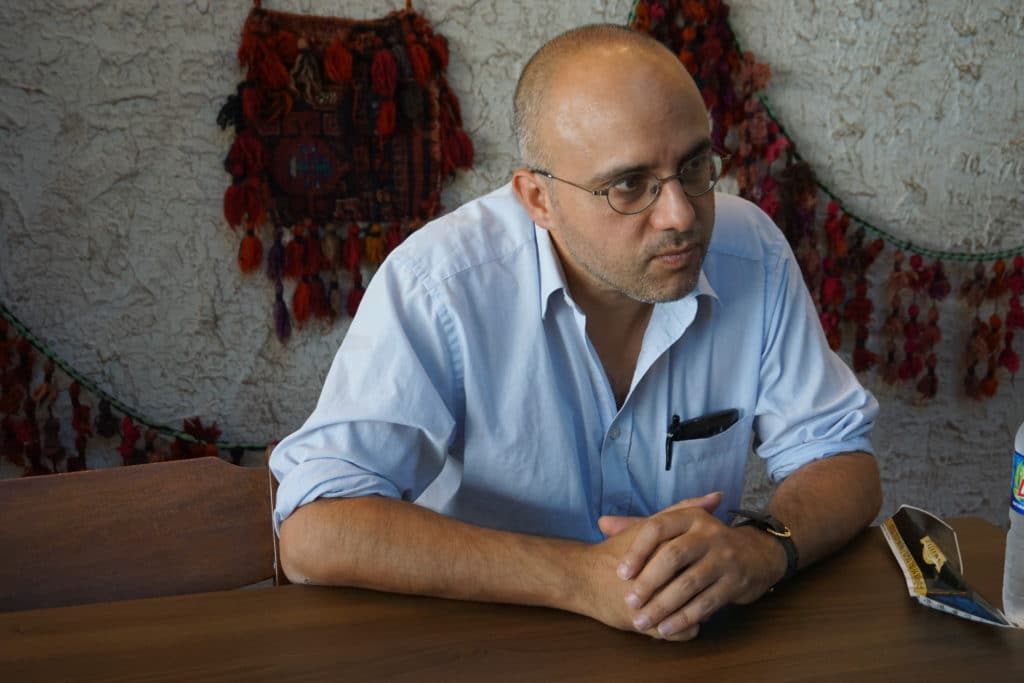
In 2014, British-Israeli journalist Jonathan Spyer was on assignment for Jane’s Intelligence Review. He was on the Kurdish side of Kobane in northern Syria, where he witnessed an exchange of gunfire between the Kurdish YPG and ISIS. A few days later, he crossed back into Turkey, where he managed to coordinate an interview with two ISIS members, and had tea with them in an apartment in Kilis.

Reflecting on these two extremes, Spyer quipped, “That was quite interesting, for example,” adding that it said sums up the practice of covering wars: “The weirdness, the chaotic nature and the fluidity of front lines. If you’re going to be a correspondent there, you have to know how to traverse those lines.”

An expert on Syria, Iraq and radical Islamic groups, Spyer is a fellow at the Jerusalem Institute for Strategic Studies and the founder of the Middle East Center for Reporting and Analysis. Yet despite working in deeply Islamic regions, Spyer’s Israeli and Jewish identity hasn’t posed much of an issue, except when it comes to covering the ongoing Syrian civil war. With President Bashar Assad’s regime paranoid that Zionists are infiltrating, Spyer said, “They’re probably right.” He added that his 2017 tour of Aleppo, Homs and Damascus was the first time he felt a need to create a cover identity with a false online footprint. 

However, it is actually the United States that has banned Spyer. He was slated to speak at several events in March, including the American Israel Public Affairs Committee (AIPAC) policy conference and an Army Special Forces base. After receiving word that his 10-year visa had been abruptly canceled, Spyer assumed it was simply a bureaucratic hiccup. However, when he applied for a new visa, it was denied based on “Section 212 (a) (3) (b), which prohibits issuance of a visa to a person who at any time engaged in terrorist activities or was associated with a terrorist organization.” 

Members of Ktaeb Hizballah, a pro-Iran Shia militia in Iraq. Photo by Jonathan Spyer

“There’s no reason whatsoever that I’m an enemy of the state,” Spyer said. “On the contrary, I’m a great supporter and friend of the U.S.” 

While he has received no official reason behind the U.S. decision to ban him, Spyer said he believes his visa was denied because of his vocal support of the Kurdish cause, specifically, the Kurdish Workers’ Party (PKK), which has been designated a foreign terrorist organization by the United States. He also suspects that the Turkish regime, known for suppressing journalists and Kurdish sympathizers, was somehow involved in having him banned. 

Although Spyer acknowledges that his plight is “not a human tragedy” and that every country has the right to deny entry to foreign nationals, he hopes the ban ultimately will be reversed. 

“The U.S. has become a really important part of what I’ve been doing over the last couple of decades,” he said, “and I am really keen to continue that.” 

The Journalist Banned From the U.S. for Alleged Terrorist Ties Read More »

The Anti-Zionism of Critical Ethnic Studies

As the public comment period on California’s revised draft of an Ethnic Studies Model Curriculum (ESMC) draws to a close, Jewish organizations are mobilizing to address what they perceive as the draft’s failings. Efforts have included calls to add a sample lesson on the Jewish-American experience and a meaningful definition of anti-Semitism—neither of which are currently included. Jewish groups have also demanded that derogatory language about Jews, Israelis, and Israel—explicit in the first draft of the ESMC but removed in the revised draft—not be allowed to creep back into the curriculum. Yet another concern is that a sample lesson on Arab American Studies will be added to the curriculum in November, too late to be scrutinized by the Jewish community.

While these concerns are justified, to understand the real threats posed by the ESMC to Jewish students, it’s essential to look beyond what is included in the curriculum, and instead ask why these acts of omission have been perpetrated in the first place. The answer to that question lies in the very nature of the version of ethnic studies embraced by state education officials.

AB 2016, the bill mandating the development of the ESMC, calls for a non-political, multicultural approach to ethnic studies that will prepare students “to be global citizens with an appreciation for the contributions of multiple cultures.” The vast majority of Californians have embraced that worthy goal. However, the Guiding Principles of both ESMC drafts indicate that the curriculum will be firmly rooted in Critical Ethnic Studies. Make no mistake, Ethnic Studies and Critical Ethnic Studies are two very different beasts.

Critical Ethnic Studies is a movement within ethnic studies that limits its focus to four groups and frames society as oppressed or oppressors. It encourages instructors to use their classrooms to teach and disseminate specific political beliefs. It is a form of academic political activism.

And although the tenets of Critical Ethnic Studies have a divisive impact on all students, they are particularly threatening to Jewish students.

According to this theory, Jews are perceived as “white” and “privileged,” squarely on the oppressor side of the race-class divide. This negative perception of Jews is apparent in a unit in the curriculum’s appendix on “Irish and Jewish Americans: Redefining White and American,” the only lesson to even touch on the Jewish-American experience. The unit requires all students to write a paper “detailing certain events in American history that have led to Jewish and Irish Americans gaining racial privilege” and asks them to “think critically about why and who is allowing this evolution in white identity.” At a time when anti-Jewish sentiment is on the rise, asking students to view Jews as “white” and “racially privileged” while implying that such “privilege” is the result of some conspiracy, reeks of anti-Semitism, and is tantamount to putting an even larger target on the back of Jewish students.

At a time when anti-Jewish sentiment is on the rise, asking students to view Jews as “white” and “racially privileged” while implying that such “privilege” is the result of some conspiracy, reeks of anti-Semitism, and is tantamount to putting an even larger target on the back of Jewish students.

Second, since its inception, Critical Ethnic Studies has falsely and negatively portrayed Zionism as a “racist,” “colonialist,” “system of oppression” that must be vigorously opposed. Anti-Israel Boycott, Divestment, Sanctions (BDS) campaigns have been the weapons of choice for the discipline’s scholars, teachers, and students. For example:

  • The conference launching the Critical Ethnic Studies Association (CESA) and each subsequent conference has included numerous panels and workshops dedicated to the demonization of Israel and the promotion of BDS. All 13 members of CESA’s founding board support BDS, and CESA was among the first professional organizations to endorse an academic boycott of Israel.
  • Critical Ethnic Studies: A Reader, a required textbook in introductory courses on Ethnic Studies, includes several essays that demonize Israel with false accusations of “genocide,” “apartheid,” and “ethnic cleansing.” An essay by the volume’s chief editor, Nada Elia, “calls on academics and others to mobilize support within the academy for the BDS Campaign.”
  • San Francisco State University’s College of Ethnic Studies, a founding institution for the Critical Ethnic Studies movement that trained a large number of the state’s K-12 ethnic studies teachers, has many faculty who support BDS, including the chairs of two of the college’s departments. The college offers numerous classes and hosts many events each year that include anti-Zionist content and promote BDS.

Given the strong anti-Zionist orientation of the discipline, it is hardly surprising that most of the ethnic studies experts hired or appointed by the CDE to develop the first draft curriculum have publicly expressed support for BDS or other anti-Zionist sentiments. Nor is it surprising that the first draft of the ESMC had a clear anti-Zionist bias and openly promoted BDS. And although explicit anti-Zionist language was removed from the draft currently under public review, this does not preclude similar language to be re-inserted into the curriculum once the Arab American Studies sample lesson is added to the revised ESMC.

But even without such a lesson, anti-Zionist sentiments are likely to find their way into Critical Ethnic Studies classrooms, since several of the social movements showcased in the curriculum—Movement for Black Lives, MEChA, and the Brown Berets, among others—have taken anti-Zionist stances and endorsed the BDS movement. These anti-Zionist sentiments, in turn, are likely to incite further hatred of Jews and harm to Jewish students, consistent with the empirical studies showing strong correlations between anti-Zionist expression and anti-Semitic acts targeting Jewish students.

As we fight for the right ESMC, the one laid out in AB 2016, we must look deeper than what’s in and what’s out. Already, many of the Jewish groups aware of the anti-Jewish and anti-Israel biases inherent in Critical Ethnic Studies have urged Governor Newsom to veto AB 331, the bill making an ESMC class a graduation requirement. At a minimum, however, we must demand our governor and our state legislators require that state-approved instructional materials are free from political bias, and that K-12 teachers are prohibited from using their classrooms to advance political causes.

Tammi Rossman-Benjamin is co-founder and director of AMCHA Initiative, a nonpartisan, nonprofit organization dedicated to combating anti-Semitism at colleges and universities in the United States. She was a faculty member at the University of California for 20 years.

The Anti-Zionism of Critical Ethnic Studies Read More »

People Still Won’t Wear Masks and It’s Madness

As an internal medicine specialist, I spend my days treating patients with all sorts of illnesses, including COVID-19. That may be one reason why I was so annoyed a few weeks ago when I walked by a crowded Pilates studio on the Westside and noticed 20 people exercising barely 6 feet apart and without masks. Thinking of my elderly COVID-19 patients, I rapped on the large window and bellowed, “I hope you don’t have grandmothers at home! If you do, you could bring back a virus and kill them!” The instructor flashed a look to her assistant, who headed outside to meet me. I looked across my mask at the assistant as he approached me and mumbled, disapprovingly, “Free speech, you know.”

Why do many Americans still shun the safety measures that produced coronavirus success stories in Korea, Taiwan and elsewhere? The unfortunate answer probably relates to two American cultural trends: contempt for science and extreme libertarianism.

Dr. Anthony Fauci, the government’s leading infectious-disease expert, recently commented that “science is truth.” Unfortunately, Fauci’s view of science meets resistance when it brings unwanted personal or political implications, as in climate science and vaccinations. Last year, State Sen. Dr. Richard Pan’s common-sense bill to improve school vaccine compliance faced surprisingly strong anti-science opposition. At a recent UCLA symposium, Pan expressed extreme frustration with his opponents. They told him that they heard his facts, but had their own opinions. He realized that rational discourse is useless when opinions become independent of the facts.

The “dirty secret” of mask wearing is that it protects others better than it protects the wearer. When everyone masks, we’re all protected. To the extent that others benefit, the motivation depends on an investment in others’ well-being. Unfortunately, the social balance between personal and collective benefit has increasingly shifted over the decades. Sixty years ago, President John F. Kennedy told the nation: “Ask not what your country can do for you — ask what you can do for your country.” Two decades later, the fading of that communal ethic could be seen in presidential candidate Ronald Reagan asking Americans, “Are you better off than you were four years ago?”

Unfortunately, the federal government continues to miss opportunities to alter public behavior and save lives.

This emphasis on individualism rather than the greater good also can be seen in the arguments of anti-maskers. Many deny the government’s authority to restrict their personal freedom by compelling public mask use. These advocates of extreme libertarianism don’t understand that self-determination was never a blank check. The late Supreme Court Justice Oliver Wendell Holmes Jr. noted memorably that the right to free speech “would not protect a man falsely shouting fire in a theater and causing a panic.” Libertarians may wish otherwise but, like freedom of speech, the “right” to avoid a mask is constrained legally and morally by the imperative for public safety.

The experiences with COVID-19 in Taiwan, Korea and elsewhere demonstrate that effective leadership and cultural values can overcome resistance and ensure compliance with mask wearing and the other practices that can stem this pandemic. Unfortunately, the federal government continues to miss opportunities to alter public behavior and save lives. From the beginning of the pandemic, the Trump administration acted as though an appeal for changes in personal behavior would underscore the seriousness of the situation and sabotage the message that we now are “great again.”

In the short six months of this pandemic, less than 10% of the population has been infected, yet we have lost nearly 200,000 American lives, more than three times the death toll of the Vietnam war. The potential for further loss of life remains enormous, particularly because so many states continue to see resurgences of COVID-19 cases and hospitalizations.

Hundreds of thousands of lives still can be spared if we all finally adopt the simple measures proven to work elsewhere. It’s time to stop the mixed messages on masking and social distancing. All public servants should model appropriate behavior by wearing masks in public. They should tell their constituents that to defeat this enemy, we must practice public health measures we know will save lives.

For vulnerable Americans like my senior patients, death is knocking at the door. The time to act is now.


Daniel Stone is a medical doctor practicing in Southern California.

People Still Won’t Wear Masks and It’s Madness Read More »

Friend of Anne Frank Lays First Stone of Amsterdam’s Newest Holocaust Monument

AMSTERDAM (JTA) — For a 91-year-old Holocaust survivor and friend of the renowned teenage diarist Anne Frank, laying the first brick for a new monument to victims of the genocide was a “special moment.”

“I’m satisfied that it’s finally happening,” Jacqueline van Maarsen told the ANP news agency on Wednesday with the launch of the Names Monument.

Van Maarsen was among several dozen people, including other Holocaust survivors, who gathered in Amsterdam to lay the first part of the building, which is designed to have about 102,000 bricks — one bearing the name of each of the Shoah’s identified victims in the Netherlands.

The monument’s construction, the latest phase in a project that began in 2006, is expected to take at least a year and will cost 15 million euros, about $17.4 million. The Dutch government will provide more than half the funding, with the rest supplied by the municipality and private donors, including van Maarsen, who gave 50,000 euros, about $58,000.

Amsterdam has multiple monuments for Holocaust victims.

The brick laid by van Maarsen was named for Dina Frankenhuis, a secretary who was murdered by the Nazis and their collaborators in 1943 in the Sobibor death camp in occupied Poland. She was 20.

“I’m satisfied that it’s finally happening,” said van Maarsen, whose father was Jewish. “It’s a beautiful design with all the names on it.”

Her family survived the war because van Maarsen’s mother was Christian.

Friend of Anne Frank Lays First Stone of Amsterdam’s Newest Holocaust Monument Read More »

Abbas Criticizes Peace Deals, Calls for U.N. to Resolve Israel-Palestinian Conflict

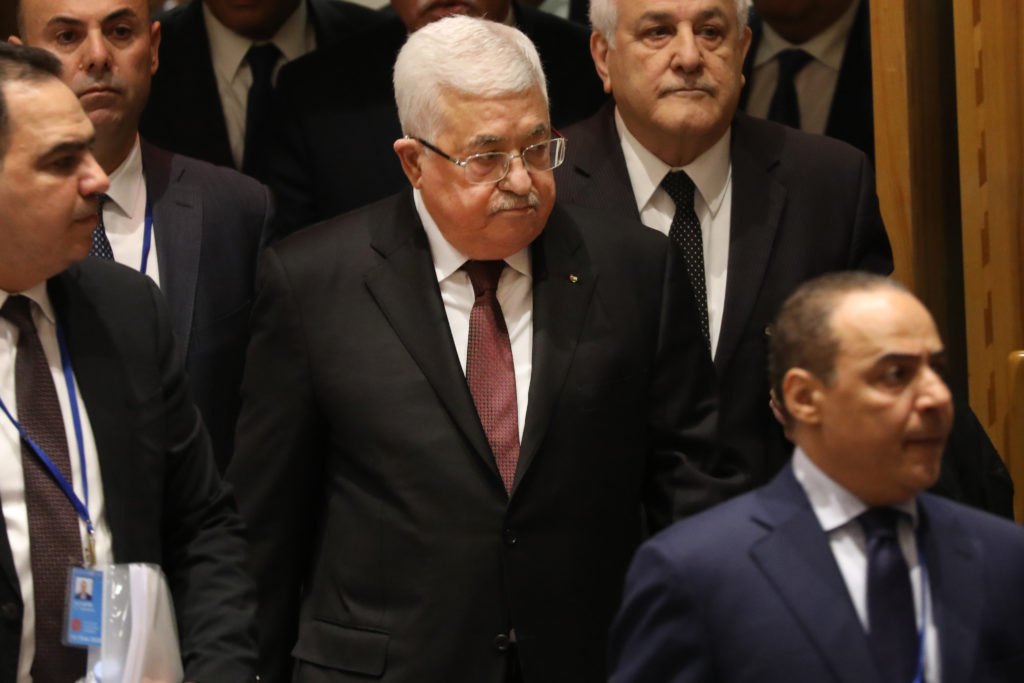
Palestinian Authority President Mahmoud Abbas criticized the recent peace deals between Israel and Arab Nations in a Sept. 25 speech to the United Nations, where he also called for the U.N. to resolve the Israel-Palestinian conflict.

The Times of Israel (TOI) and Jerusalem Post reported that Abbas’ speech, which was pre-recorded, called the peace deals a “violation of the Arab Peace Initiative,” arguing that normalization of ties with Israel won’t lead to the establishment of a Palestinian state.

“The PLO [Palestine Liberation Organization] does not mandate anyone to negotiate or speak in our place,” he said. “The only way to a comprehensive and just peace is the establishment of a Palestinian state on the 1967 borders.”

In 1967 during the Six-Day war against Egypt, Syria and Jordan, Israel captured the West Bank, East Jerusalem, the Gaza Strip, the Golan Heights and the Sinai Peninsula.

Abbas also said that peace in the Middle East can be achieved only by a two-state solution that adheres to international law and U.N. resolutions, including the end of Israeli occupation of the West Bank and with two states based on 1967 borders.

“Until when will the Palestinian people remain under Israeli occupation and will the question of millions of Palestine refugees remain without a just solution in accordance with what the United Nations has determined over 70 years ago?” he said. “We will not kneel or surrender and we will not deviate from our fundamental positions, and we shall overcome.”

TOI noted that Abbas’ comments on the establishment of full diplomatic relations between Israel and the United Arab Emirates, announced August, and Israel and Bahrain, announced September, were far more restrained than his past remarks, which included him calling the agreements a “poisoned dagger.”

Bahraini King Hamad bin Isa Al Khalifa stood by his country’s normalization agreement with Israel during the U.N. session, saying that the agreement serves as “a cornerstone for achieving a just and comprehensive peace leading to the establishment of an independent Palestinian state, with East Jerusalem as its capital, based on the resolutions of international law and the Arab Peace Initiative.”

On Sept. 24, The Jerusalem Post reported that funding to the PA from Arab nations declined 85% from 2019 to 2020. PA Foreign Minister Riyad Al-Maliki said in a press conference that day that the decline was the result of Arab nations failing to adhere to “the decisions of the Arab summits to provide a financial safety net of $100 million for Palestine in the face of US and Israeli sanctions. We do not know if this was the result of the financial repercussions of the coronavirus pandemic, or at the request of the United States, as President (Donald) Trump said.”

Abbas Criticizes Peace Deals, Calls for U.N. to Resolve Israel-Palestinian Conflict Read More »